PANTHER
when you take inspiration from your enemy
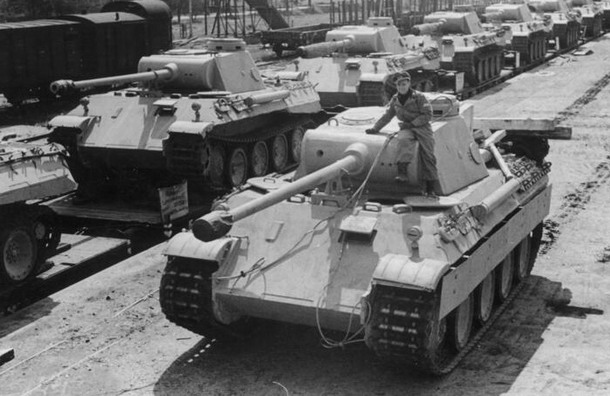
new PzKpfw V Panther Ausf. D tanks heading to the front, source: Bundesarchiv Bild 183-H26258, Wikimedia, Creative Commons, edited
The Challenge Called T-34
When German forces invaded the Soviet Union in June 1941, they soon encountered an unexpected adversary — the highly capable medium tank T-34. In terms of armour and firepower, these vehicles surpassed every German type in the field. The German army command recognised the gravity of the situation very quickly and began to act. Urgently rearming the existing Panzer III and Panzer IV tanks with more powerful guns helped the Germans out of the worst of it, but in the long run the Eastern Front demanded far more drastic measures. An entirely new tank type had to be developed — one capable of turning the balance of forces in the East in favour of the Wehrmacht.
The ongoing development of a new standard tank, on which the firms Krupp, MAN and Daimler-Benz were already working at the time (under the designations VK 2001 and VK 2401), was cancelled on the grounds that the resulting vehicle would be too weak. The three companies were instead to begin work on a new, more heavily armed and better-protected tank in the 30 to 35 tonne weight class. The project received the designation VK 30.02. Alongside this, Rheinmetall-Borsig was contracted to develop a new tank gun capable of penetrating 140 mm of armour at a range of one kilometre. In addition to the gun, Rheinmetall-Borsig was also to design a complete turret that could be fitted to whichever hull emerged from the VK 30.02 project.
At the same time, a special commission was established with the task of identifying and describing the qualities of the Russian T-34 that gave it a qualitative edge over German vehicles. In November 1941 the commission's members travelled to the Eastern Front, where they were given the opportunity to study captured enemy tanks in detail and discuss their qualities directly with the commander of the Second Panzer Army, Colonel General Heinz Guderian. Based on their findings, the Panzerkommission identified four key characteristics of the Soviet vehicle that it considered its main advantages.
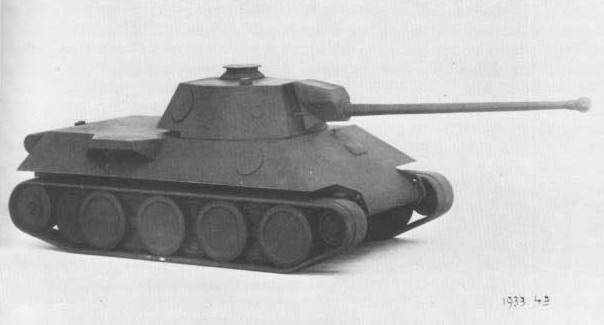
wooden model of the VK 30.02 (DB) by Daimler-Benz; the resemblance to the Russian T-34 hardly needs pointing out, source: Flickr.com with permission of the publishing user, edited
First among these was sloped armour on virtually all parts of the tank, but particularly on the front glacis. The sharp slope increased the effective protection of the armour without any increase in its actual thickness. Incoming rounds were also far more likely to deflect or glance off angled armour. Another key advantage was the use of wide tracks. Wide tracks distributed the tank's weight more evenly and allowed it to handle soft ground far more easily. Soviet designers understood the density and quality of roads in their home country and had prepared their tank accordingly for crossing muddy terrain. The T-34 therefore ran on tracks 550 mm wide, while the main German tanks Panzer III and Panzer IV had tracks only 360, 380 or 400 mm wide (depending on the specific variant).
The third advantage identified was the Soviet tank's 76.2 mm gun. When the Germans had built their new armoured forces before the war, they had decided against a single universal type and instead divided combat roles between two backbone tanks: the PzKpfw III and the PzKpfw IV. The lighter Panzer III was to destroy enemy tanks and armoured vehicles, while the Panzer IV was to clear its path of enemy artillery positions, light fortifications and infantry. Armament reflected this division of roles. The Panzer III carried a 50 mm gun (older versions only 37 mm) which was reasonably effective at penetrating enemy tank armour but whose small calibre limited its destructive power against soft targets. The 75 mm gun on the Panzer IV, on the other hand, had a short barrel and consequently a low muzzle velocity, which severely limited its ability to penetrate armour. The Russian T-34, by contrast, combined both. Its 76.2 mm gun with a barrel 30.5 calibres long was equally capable of destroying infantry and other unarmoured targets as it was of knocking out tanks.
The last key quality of the Soviet vehicle was its powerful diesel engine, which offered several advantages. Diesel fuel was considerably less flammable than petrol, making the risk of the tank catching fire after a fuel tank hit very low. Even more importantly, diesel consumption was lower, giving the tank a greater operational range. The V-2 diesel engine used in the T-34 produced up to 500 horsepower, while the German Panzer III and Panzer IV had engines developing only 300 hp. While it is true that the T-34 was heavier than both German types, its power-to-weight ratio was still by far the best of the three.
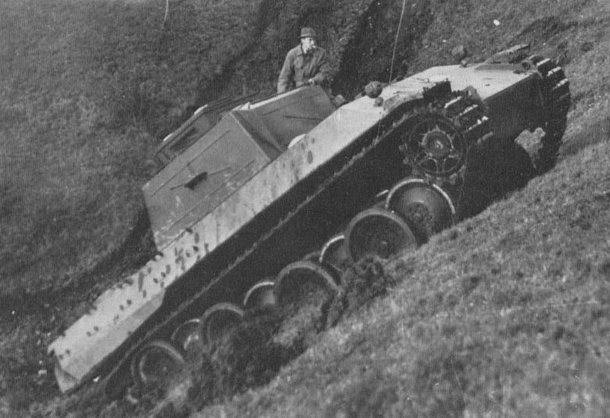
prototype VK 30.02 (M) V1 by MAN during driving trials with a ballast weight in place of the turret, source: Flickr.com with permission of the publishing user, edited
The German Waffenamt incorporated the commission's findings into a development contract for the new tank, designated VK 30.02. The contract was signed on 25 November 1941 with Daimler-Benz and MAN (Maschinenfabrik Augsburg-Nürnberg). Krupp, which had previously worked on the cancelled VK 2001 project, apparently chose not to participate in the successor VK 30.02 project. The army specification called for a tank with an engine producing 650 to 700 horsepower, with sloped armour 60 mm thick on the hull front and 40 mm on the sides. Combat weight was to be around 30 to 35 tonnes and the tank was to reach speeds of up to 55 km/h. The gun and turret for the new vehicle were to be developed by Rheinmetall-Borsig (as noted above).
The VK 30.02 Project
In January 1942 both MAN and Daimler-Benz presented wooden models of their proposals. The Daimler-Benz design made no effort to conceal its inspiration from the Russian T-34. Their vehicle was to have a diesel engine, rear drive sprockets and the transmission and engine both at the rear of the hull — placing the fighting turret toward the front of the hull, just as on the T-34. Road wheels were to be sprung by leaf springs. MAN, by contrast, hewed much more closely to the traditional German design school. Their vehicle had the transmission at the front of the hull, connected to the engine by a driveshaft running beneath the crew compartment floor. Drive sprockets were therefore at the front and the fighting turret was positioned roughly amidships. Road wheels were suspended by torsion bars.
After analysing the first proposals from both firms, the Waffenamt issued a refined technical specification for the new tank on 3 February 1942 and decided that both companies should continue their development work, including the construction of prototypes. The Daimler-Benz project was designated VK 30.02 (DB) and the MAN project VK 30.02 (M). MAN considered using a diesel engine for a time but ultimately decided in favour of the petrol-engined twelve-cylinder Maybach HL 210, which Maybach Motorenwerke had put into production in February 1942.
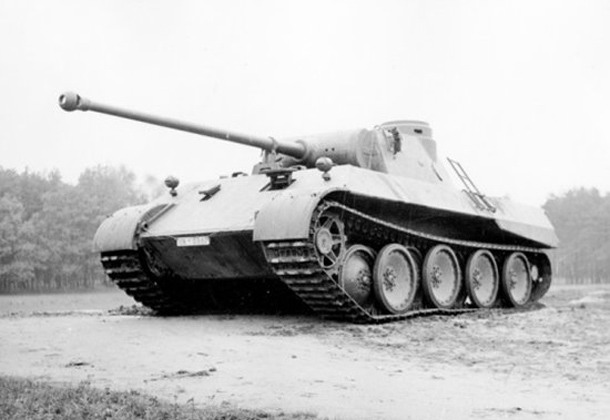
the first complete prototype VK 30.02 (M) V2; note the single-chamber spherical muzzle brake and the commander's cupola intruding into the side wall of the turret, source: Flickr.com with permission of the publishing user, edited
In May 1942 both companies submitted the final technical documentation for their designs. Hitler, who was also following the progress of development closely, for some reason preferred the Daimler-Benz proposal. The Waffenamt, on the other hand, was more impressed by the MAN tank. A selection committee undertook a thorough examination of both designs. We can reveal straight away that the winner was the MAN design. It is sometimes written that the reason for this choice was the Daimler-Benz design's excessive resemblance to the Russian T-34 — but that is an unforgivable oversimplification. The committee members were well aware of how serious the consequences of a wrong decision would be (soldiers at the front were desperately waiting for the new tank) and they therefore subjected both designs to an exhaustive analysis. They even weighed up such nuances as the ease or difficulty of extracting a wounded crew member from the interior — a criterion in which, incidentally, the VK 30.02 (M) won, as both the driver and radio operator had hatches directly above their positions.
Both designs met the basic requirements such as armour thickness and maximum speed. The VK 30.02 (DB) fuel tanks held 550 litres. The VK 30.02 (M) carried 750 litres, but with a petrol engine MAN had higher fuel consumption. Daimler-Benz used leaf springs to suspend the road wheels of their vehicle, positioned outside the hull. This made servicing easier but the springs took up space on the sides of the hull that had to be "saved" elsewhere. The Daimler-Benz hull was therefore 100 mm narrower than the MAN hull and also had tracks 120 mm narrower. As a result of the narrower tracks, the ground pressure of the VK 30.02 (DB) was considerably higher than that of its competitor. The road wheels were smaller in diameter and were supplemented by three return rollers supporting the upper track run. Alongside this version, Daimler-Benz also developed an alternative suspension with large interleaved road wheels (similar to the competing MAN design). This version became widely known through photographs of the VK 30.02 (DB) wooden model, but its prototype was probably never actually built. The prototype with return rollers, on the other hand, is photographically documented — its remains appear in several photographs taken by American soldiers in the captured Daimler-Benz factory in Berlin (photo HERE (Public domain) and HERE (Public domain)).
MAN chose double torsion bars to suspend the wheels of their vehicle. Torsion bars placed no additional demands on hull width, but they did take up space on the floor of the hull tub. The crew compartment floor therefore had to be positioned above the bar assembly, making the VK 30.02 (M) some 195 mm taller overall than the VK 30.02 (DB) (an excellent view of the torsion bar arrangement beneath the floor — and of the driveshaft — can be seen in the photograph HERE (Flickr.com)). The combination of torsion bars and large-diameter road wheels allowed considerably greater wheel travel than leaf springs.
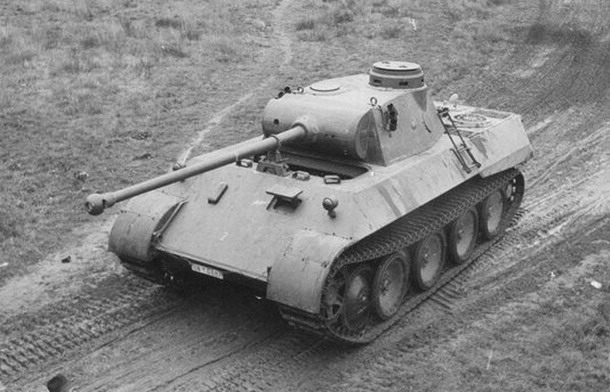
the first complete prototype VK 30.02 (M) V2; note the single-chamber muzzle brake and the commander's cupola tube intruding into the turret side wall, source: Flickr.com with permission of the publishing user, edited
The transmission on the MAN tank was positioned at the front of the hull, between the driver and radio operator, and occupied a considerable portion of the interior. There was also a driveshaft running along the crew compartment floor connecting the transmission to the engine at the rear. In this respect the Daimler-Benz tank had an advantage, as its transmission was at the rear. There was therefore more free space inside the VK 30.02 (DB) crew compartment, particularly at the front where the driver and radio operator sat (even though the overall floor area was slightly smaller than in the MAN). With no transmission in the crew space there was also less noise and less fume. On the other hand, positioning the transmission at the rear meant a fairly complex arrangement of linkage rods connecting it to the driver's gear lever at the front of the vehicle.
Another army requirement was the ability to ford deep water. The Daimler-Benz design envisaged sealing all air vents in the engine section before entering the water. This could only be done from outside, meaning the crew had to stop, dismount and perform the task before fording. The VK 30.02 (DB) diesel engine, however, was air-cooled, which meant that once the vents were sealed the engine lost all cooling. It could therefore be expected that after no more than ten minutes of running with closed vents the engine would overheat. MAN, whose design used a water-cooled engine, solved this problem simply. The engine compartment was divided into a central section housing the engine block and two radiator sections on either side. These sections were hermetically sealed from one another. Before entering the water, only the engine section itself was sealed and the driver also switched off the radiator fans. Once in the water, the radiators became flooded. The fans were stopped, the pump continued to circulate coolant to and from the engine, and cooling was provided by the surrounding water. The fording time was therefore theoretically unlimited.
Another factor that weighed heavily in the committee's deliberations was the speed with which production could begin — the troops needed the new tank as soon as possible. Where the hull and suspension were concerned, both designs were broadly equal in terms of production man-hours. But then there was the turret and armament. MAN had worked from the outset with the turret and gun that Rheinmetall-Borsig had been developing for some time (as described above). The Daimler-Benz design, for some reason, specified a turret of its own construction. Its turret ring diameter was 50 mm smaller, making it impossible to use the Rheinmetall turret. The gun intended for this turret also required a custom mantlet, and Waffenamt representatives feared further delays due to the necessary modifications. The MAN proposal simply promised an earlier production start.
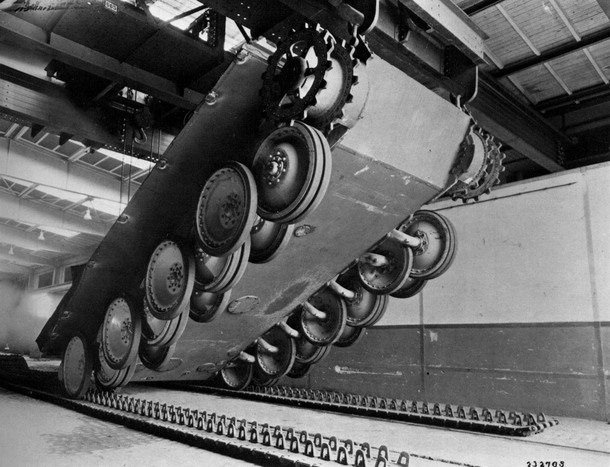
the Panther's road wheels were arranged in four rows and overlapped one another, source: Flickr.com with permission of the publishing user, edited
On 11 May 1942 the selection committee delivered its verdict. Its members unanimously selected the MAN design. Hitler was informed of the result on 13 May — a choice that clearly surprised him, as he had personally favoured the Daimler-Benz proposal. Hitler reportedly studied the committee's conclusions and the following day (14 May 1942) gave his approval. He added one condition, however: he wanted the hull frontal armour strengthened from the existing 60 mm to 80 mm — a demand that must have filled the designers with considerable delight, given that the technical drawings were already complete :-).
Daimler-Benz was ordered to halt further development of its own vehicle but was permitted to complete the two prototypes already under construction. At the same time, Daimler-Benz was to begin urgent preparations for series production of the Panther, based on the winning competitor's design. MAN was to begin production of the new tank first and start deliveries as early as November 1942. Daimler-Benz was to deliver its first series tank in December. From January 1943, Henschel and MNH (Maschinenfabrik Niedersachsen-Hannover) were also to join production. Soldiers on the Eastern Front were desperately waiting for the new tank and the army was therefore pushing production hard.
The First Prototype
The first two actual VK 30.02 (M) prototypes were apparently completed in September 1942. These vehicles received hull numbers V1 and V2 (V = Versuchs = experimental, test). Delivery of fighting turrets from Rheinmetall-Borsig was delayed, however, so these first two prototypes were fitted with ballast weights in place of turrets. The first fighting turret, complete with gun, was not delivered until December 1942 and was immediately installed on prototype V2. This turret did not yet fully correspond to the later production design. The rear of the turret was considerably narrower and as a result the commander's cupola tube projected from the left side wall. The gun installed in the first turret was fitted with a single-chamber spherical muzzle brake.
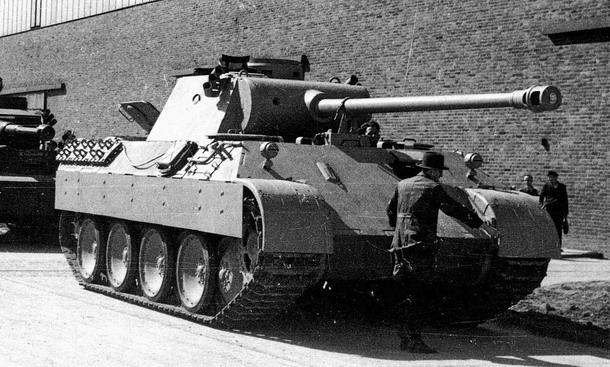
a "fresh" Panther Ausf. D in the Henschel factory yard, source: Flickr.com with permission of the publishing user, edited
After rapid testing of the prototypes, a number of modifications to both the hull and turret were decided upon and series production could finally begin. The first series production Panther rolled out of the MAN factory on 11 January 1943 — two months later than the army had originally requested, but only one month after the first complete prototype had been built. By the end of the month MAN had completed four tanks in total. The first two were immediately handed over to Panzer Abteilung 51 in Grafenwöhr to begin crew training. The remaining two were subjected to thorough testing. Series production and crew training were therefore already under way while testing was still ongoing — a clear demonstration of the immense time pressure the Germans were under. In February 1943 Panthers began rolling out of the Daimler-Benz and MNH factories, and in March the fourth manufacturer, Henschel, joined production.
Ausführung D
The new tank received the official designation Panzerkampfwagen Panther Ausf. D (Ausf. = Ausführung = variant) and the ordnance code Sd.Kfz. 171. Why the letter D was chosen for the variant designation has never been satisfactorily explained. The Panther's running gear consisted of road wheels on eight axles. Each wheel was made up of two discs. Due to the different arrangement of the discs on alternate axles, the wheels partially overlapped one another. The drive sprocket was at the very front and the idler wheel at the rear. Just behind the drive sprocket was one small return roller that helped lift the upper track run before it ran onto the teeth of the drive sprocket. As on the prototype, the road wheels were sprung by double torsion bars. The road wheels had a diameter of 860 mm and were fitted with solid rubber tyres around their circumference for a smoother ride. The tracks were 660 mm wide.
The hull nose was formed by a sharp junction of two front plates. The lower plate was 60 mm thick. The upper plate formed the front of the crew compartment and was 80 mm thick (reinforced from the originally planned 60 mm on Hitler's orders). The front plate of the crew compartment had two openings fitted with heavy covers. The left opening was the driver's vision port, the right one was the machine gun firing port. The driver's vision port was filled with a 90 mm thick block of bulletproof glass. When in a dangerous area the driver closed the front vision port with an armoured cover and looked out of the vehicle using a pair of periscopes in the roof above his station. The radio operator, seated to the right of the driver, also had two observation periscopes.
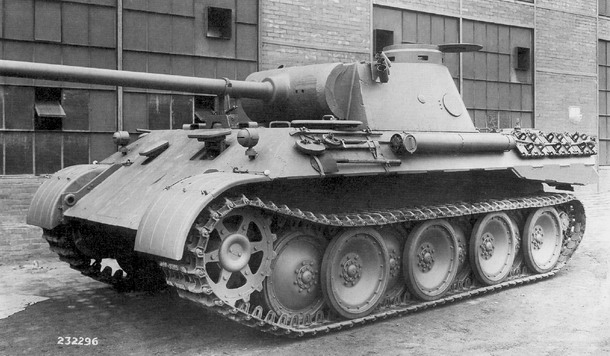
Panther Ausf. D, source: Flickr.com with permission of the publishing user, edited
The series production fighting turret was considerably wider at the rear than the turret fitted to the first prototype. The commander's cupola, located at the left rear of the turret roof, therefore no longer intruded into the side wall. The turret front was formed by a massive cast gun mantlet 100 mm thick. Apart from the commander's cupola, the turret roof held only a ventilation fan to extract propellant gases produced when the gun fired. Small closeable firing ports in the turret side walls allowed the crew to fire their personal weapons in improvised defence against enemy infantry. In the left side wall there was also a communication port through which the tank commander could speak with someone standing alongside the tank (such as the commander of escorting infantry) or exchange documents such as written messages and maps.
The KwK 42 L/70 Gun
The tank's main armament, the 7.5cm KwK 42 L/70 gun, was mounted in the turret. The gun was aimed using a binocular sight TZF 12, for which two small holes were bored in the front mantlet. Horizontal movement of the gun was achieved by rotating the turret, which could traverse through a full 360 degrees. Vertically the gun could be elevated from −8 to +20 degrees. As the gun designation indicates, its barrel was 70 calibres long — that is, 525 cm (553.5 cm including the muzzle brake). The gun and its mounting together weighed 2,650 kg. The maximum range of the weapon was around ten kilometres, though the effective combat range was of course considerably less.
Three types of ammunition were used with the gun: the high-explosive Sprgr. 42 and two types of armour-piercing rounds, the PzGr. 39/42 and the PzGr. 40/42. The Panzergranate 39/42 was a conventional armour-piercing shell with a small bursting charge that exploded after the round had penetrated the enemy tank's armour. The projectile weighed 6.8 kg and its muzzle velocity was around 925–935 m/s. At one kilometre this round could penetrate approximately 111 mm of sloped homogeneous armour. The PzGr. 40/42 was a subcalibre round with a tungsten carbide penetrating core. It weighed 4.75 kg and left the muzzle at around 1,120 m/s. At one kilometre this projectile could defeat sloped armour up to 149 mm thick. A note of caution is warranted here, as the literature contains many widely varying figures for these values. Due to the enormous energy released at the moment of firing, crews were forbidden from using the gun without the muzzle brake, or if the brake was damaged, as the recoil mechanism might not be able to absorb the force. The Panther carried 79 rounds of main gun ammunition.
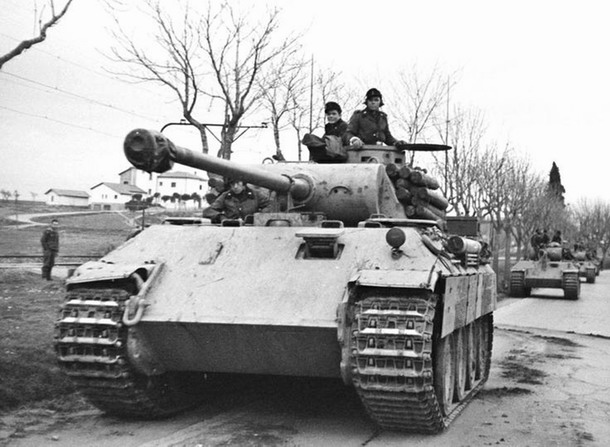
Panther Ausf. D at the front; note the rain guard above the sight apertures and the shorter track mudguards, source: Flickr.com with permission of the publishing user, edited
Secondary armament consisted of two MG 34 machine guns. The first was installed in the turret, to the right of the main gun. Only a small circular opening was cut in the gun mantlet for this machine gun. The second machine gun was operated by the radio operator seated in the right side of the hull, firing through a closeable port in the front armour of the crew compartment. A total of 5,100 rounds were carried for the machine guns. On some tanks, triple smoke grenade launchers were fitted to the edges of the turret front wall.
The Panther's crew consisted of five men. The driver and radio operator (who also operated the hull machine gun) sat side by side in the front of the hull, each with his own roof hatch directly above his station. The remaining three men were stationed in the fighting turret. The gunner sat to the left of the gun. Behind him, on an elevated position, sat the commander, who surveyed the area around the tank through the vision ports around his cupola and searched for targets. The loader sat to the right of the gun. Two hatches were provided for entry and exit: one in the roof of the commander's cupola and one in the rear wall of the turret. The rear opening also served for loading ammunition. The tank's communications equipment consisted of the Fu 5 and Fu 2 radio sets, operated (naturally) by the radio operator seated to the right in the front of the hull.
The engine compartment was at the rear of the hull. The engine itself occupied the central section. According to some authors, Panther Ausf. D tanks were fitted with the Maybach HL 230 engine from the very start of production. Others, however, hold that the first 250 tanks were fitted with the weaker Maybach HL 210, with the HL 230 only introduced from May 1943. Either way, the standard powerplant can be described as the petrol-engined twelve-cylinder HL 230 P30, with a displacement of 23 litres and a maximum output of 700 hp at 3,000 rpm.
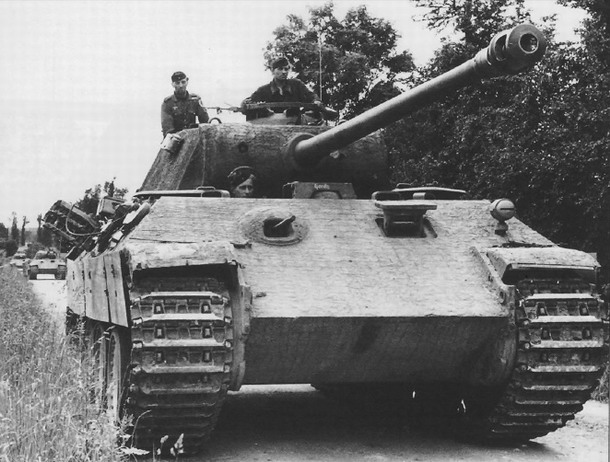
Panther Ausf. A, source: Flickr.com with permission of the publishing user, edited
The radiators and their cooling fans were positioned on either side of the engine. Fuel capacity was 730 litres, stored in a total of five interconnected tanks. A full load was sufficient for approximately 250 to 270 km on roads and around 100 km cross-country. The gearbox, a Zahnradfabrik AK 7-200 with seven forward gears and one reverse, was positioned in the front of the crew compartment between the driver and radio operator, connected to the engine by a driveshaft. The Panther Ausf. D weighed 44.8 tonnes and had a maximum speed of 55 km/h on roads and 30 km/h cross-country.
A very interesting feature was the automatic fire suppression system for the engine compartment — something used in a German tank for the very first time. Two fire extinguishers were stored inside the crew compartment, connected to pipes leading into the engine section. Three extinguisher nozzles were fitted in total, aimed at the starter, fuel pump and carburettor. The system activated automatically when sensors in the engine compartment registered a temperature above 160 degrees Celsius. Another detail worth noting was the stowage for personal equipment. While most German tanks had a single stowage bin hung on the rear turret wall, the Panther had two smaller bins on the rear hull wall.
As already mentioned, the first four series production Panther tanks were built in January 1943 and immediately split between crew training and further testing. Those tests revealed so many deficiencies, however, that formal army acceptance was out of the question. Among other things, it turned out that when the Panther was not on level ground — for example on a slope — the turret traverse mechanism failed to function. Despite these serious problems, series production continued and actually accelerated. Newly built tanks went almost directly to workshops where their "congenital defects" were corrected. This meant that by the end of April 1943, somewhere between 159 and 237 Panthers had been produced (sources differ), yet not a single one had yet been accepted by the army as fully functional. The first tanks were accepted in May, when the most serious problems had been resolved. Heinz Guderian, who naturally took a keen interest in the new tank, was still describing it in June 1943 as insufficiently mature and unfit for combat deployment — but his warnings went unheeded.
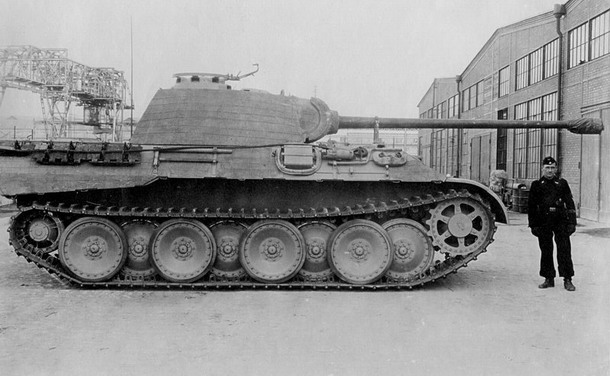
Panther Ausf. A, source: Flickr.com with permission of the publishing user, edited
Production of the Panther Ausf. D ran from January to August 1943 and a total of 850 were built. During production, a number of mostly minor design changes were introduced (setting aside the correction of initial design flaws). According to some historians, the engine was swapped in May 1943 — the HL 210 being replaced by the HL 230. From June 1943, the smoke grenade launchers on the turret sides were no longer fitted, as they had proven too vulnerable: a single rifle hit was enough to set them off, effectively blinding the tank's own crew with smoke.
From April 1943, low spaced armour plates (commonly known as Schürzen — skirts) began to be fitted to the tank's sides. These protected the side hull wall above the tracks, which was vertical and only 40 mm thick. The spaced armour plates were only 5 mm thick and could not of course stop a larger-calibre round, but they did a reasonable job of helping the main armour resist close-range fire from Soviet anti-tank rifles. From June 1943, a strip of metal was welded above the pair of sight apertures in the gun mantlet to deflect rain away from the optics. Similar strips were welded above the pistol firing ports, the communication port in the turret side walls, and also above the loading hatch in the rear turret wall. In July 1943 the communication port on the left side of the turret was discontinued — it was simply no longer present on later tanks. In the summer of 1943, a ring mount for a machine gun was added to the commander's cupola, enabling anti-aircraft fire against attacking enemy aircraft.
From August 1943, tanks began to be coated with Zimmerit anti-magnetic paste, which prevented magnetic mines from adhering to the hull. Apparently toward the very end of Ausf. D production, a new type of commander's cupola was introduced. It was cast and considerably more resistant than the previous version. The commander no longer looked out directly through vision ports protected by bulletproof glass, but through periscopes — a significantly safer arrangement. Seven such periscopes were arranged around the cupola.
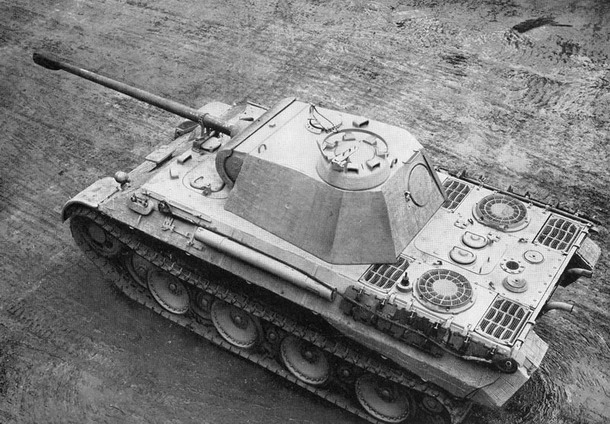
a fine overhead view of the Panther Ausf. A, source: Flickr.com with permission of the publishing user, edited
Ausführung A
In September 1943, a new variant of the Panther entered production, designated Ausf. A (why the Germans went back from D to A in the alphabet I have not been able to determine). There is considerable disagreement in the literature about what changes the new Panther actually brought, and what reliably distinguishes the first Ausf. A tanks from the late Ausf. D vehicles. The most commonly cited new feature, present from the very start of the Ausf. A, was a modified fighting turret. It had a new interlocking design for the joint between the front and side walls, new rubber sealing beneath the gun mantlet and around the ring, and a new multi-speed traverse mechanism allowing the gunner to acquire targets more quickly. The casting for elevation was also simplified, though at the cost of restricting the gun's vertical movement to between −8 and +18 degrees. The cast commander's cupola with seven observation periscopes, already introduced on the last Ausf. D tanks, became standard on the new Ausf. A.
Further new features were introduced on Ausf. A tanks during series production. From November or December 1943, a fixed periscope for the loader appeared on the turret roof. Around the same time the hull machine gun mount was also redesigned. The original closeable opening was replaced by a modern ball-type mount with a built-in optical sight integrated into the front armour. As the radio operator now had a gunsight built into the mount, the original direct-view periscope above his station was no longer needed and was removed. The hull roof above the radio operator's position therefore retained only his second observation periscope, rotated slightly to the right.
Later in production a new gunsight was also introduced for the main gun, specifically the TZF 12a. This sight was monocular (single-eye) and only a single small hole now had to be bored in the gun mantlet for it (the Ausf. D had required two side-by-side holes). The pistol firing ports in the turret side walls were discontinued. During production, a new grenade and smoke canister launcher appeared in the rear portion of the turret roof. The actual launching mechanism was inside the turret, mounted under the roof, with the barrel opening on the roof beside the commander's cupola. The device had the official name Nahverteidigungswaffe — literally "close-defence weapon." In addition to smoke grenades it could also fire anti-personnel shrapnel rounds, and it was even possible to fire a signal pistol through the barrel.
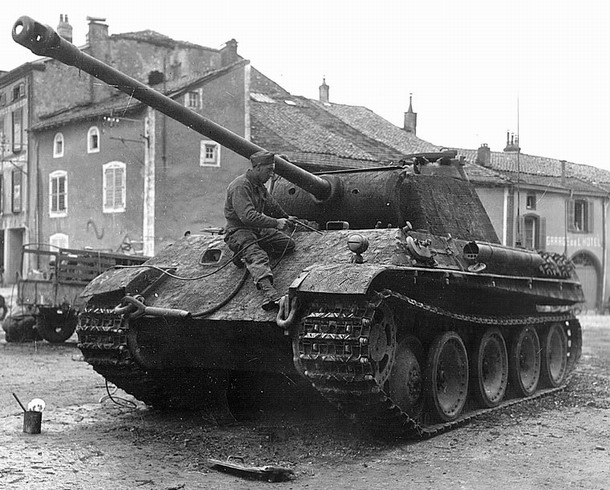
Panther Ausf. G, source: Flickr.com with permission of the publishing user, edited
The last change worth mentioning was the introduction of crew compartment heating in January 1944. The heating worked by drawing hot air from the radiator space to the left of the engine into the crew compartment. However, the change in airflow caused a reduction in radiator efficiency, apparently leading to more frequent overheating of the exhaust manifold on the left side of the engine. As a solution, additional pipes were placed on either side of the left exhaust to help cool it. These pipes did not carry exhaust gases — air flowed through them to cool the exhaust manifold (photo HERE, Flickr.com).
Overall weight, armour thickness, powerplant, gearbox, armament, crew composition, fuel and ammunition loads — all remained the same as on the previous variant. The Panther Ausf. A was in production from September 1943 to March 1944 and a total of 2,200 were built.
Ausführung G
In March 1944, the third production variant of the Panther entered production, this time designated Ausf. G (again ignoring alphabetical order). During 1943, army specialists had already been working on what the successor to the Panther might look like, a vehicle referred to as Panther II. In doing so they compiled a list of various improvements and simplifications the future tank should incorporate. As the war progressed, however, it became clear that the Panther II was unlikely to be realised any time soon, and that maximising production of the existing series tank had to take priority. At least some of the accumulated improvements were to be incorporated into the third production variant, the Panther Ausf. G.
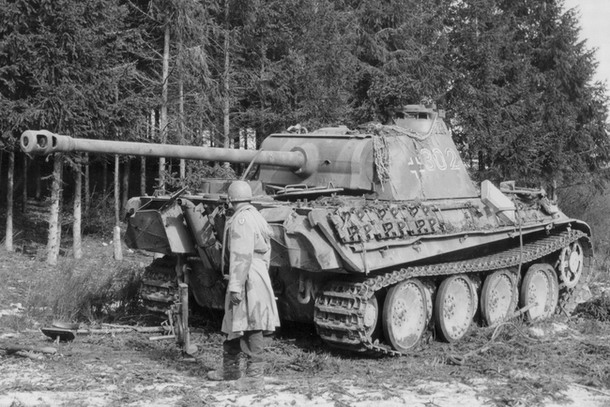
Panther Ausf. G with the new gun mantlet, source: Flickr.com, Public domain, edited
The closeable driver's vision port and both original roof periscopes disappeared from the front of the crew compartment. The driver's view was now provided by a single roof periscope positioned right at the junction of the roof and front wall, which was rotatable and retractable. The roof plate above the driver's and radio operator's positions was also new, including the crew hatches and their covers. The most significant structural change was the reinforcement and reshaping of the hull side walls. Their armour was increased from 40 to 50 mm. At the same time, however, the floor of the hull tub and apparently the lower front hull plate were made thinner. In terms of weight, these armour changes broadly cancelled each other out, resulting in only a minimal increase in overall weight.
The hull side walls also underwent further changes. The angle of their slope was increased from the original 50 to 61 degrees. The lower edge of the side wall no longer had a "step" at the rear as on older variants — it was straight and sloped smoothly from front to rear, better following the upper run of the track. The exposed and more lightly armoured area above the tracks was thus reduced. The difference between the two designs is clearly visible in the comparison photograph HERE. Gun ammunition stowage was increased from 79 to 82 rounds.
Further modifications were introduced during production. Among the smaller changes were new flame dampers on the exhaust pipe ends (photo HERE, flickr.com) and the relocation of the cylindrical gun cleaning equipment container from the left side to the rear edge of the hull. A more visibly significant change was the introduction of a new gun mantlet. Its lower portion was no longer rounded as before, but instead gained a protruding lower edge. The reason was simple. The original rounded mantlet tended, when struck in its lower portion, to deflect incoming rounds downwards against the hull roof beneath — which was only 16 mm thick. In some cases the deflected round punched through the roof and entered the crew compartment from above. The new mantlet with its angular lower portion was specifically designed to prevent this.
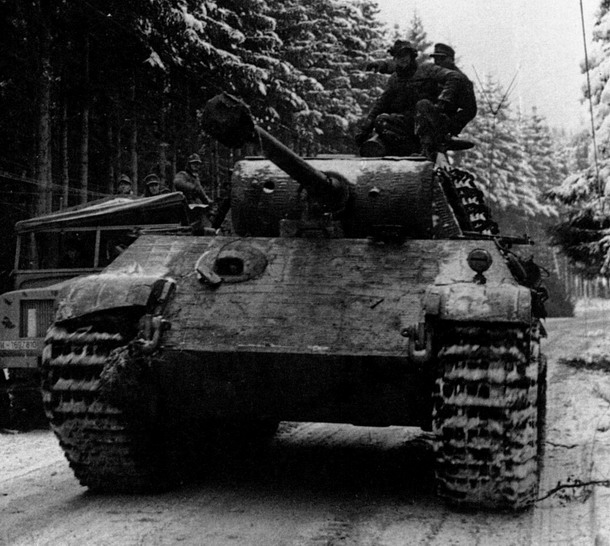
Panther Ausf. G (here in the command version) passing through a snow-covered forest during the Ardennes offensive, source: Flickr.com with permission of the publishing user, edited
Germany's material shortages also affected Panther production. Rubber became one of the scarce materials, and late-production Panther Ausf. G tanks therefore received new road wheels as a cost-saving measure — all-steel construction without rubber tyres around the rim. Without rubber cushioning on the road wheels, the ride was certainly less comfortable for the crew and more noise was generated. Overall driving characteristics did not deteriorate dramatically, however, and maximum speed remained the same. The all-steel wheels were said to put more stress on the tracks and development of new, more durable tracks was considered, though this apparently did not materialise. Judging by the rarity of photographs, only a very small proportion of tanks were equipped with rubber-free road wheels.
Although it was intended to be succeeded by a further variant, the Panther Ausf. G ultimately remained in series production until its involuntary and final cessation in April 1945. With a total production score of 2,953 vehicles, the Ausf. G became the most numerous variant of the Panther.
Night Vision
Since 1936, the company AEG had been experimenting with infrared-based night vision devices at the German army's instigation. By 1942 AEG could demonstrate a fully functional infrared sight for the towed anti-tank gun PaK 40. Army trials of the new development went reasonably well and attention shifted toward night sights for tanks — specifically for the latest German tank, the Panther. Integrating night vision directly into the gun sight proved impractical, however. Instead, a night vision device was produced for the tank commander, mounted on the traversing ring around the commander's cupola. To use it, the commander had to expose his head outside the tank, which of course left him vulnerable — a risk he unfortunately had to accept.
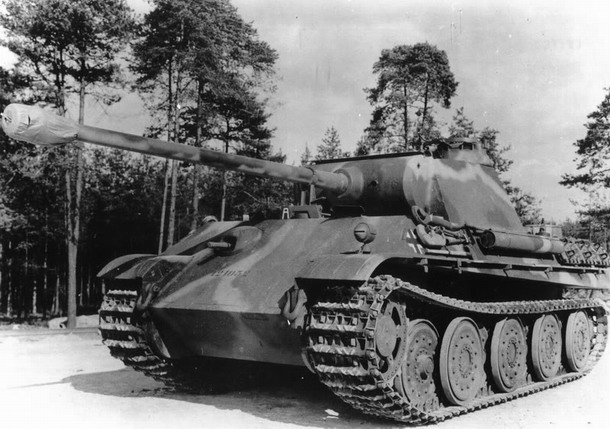
Panther Ausf. G with all-steel road wheels, source: Flickr.com with permission of the publishing user, edited
The device was named FG 1250 Sperber (Sparrowhawk). It was an active system, meaning it required the target to be actively illuminated with invisible infrared light. The complete system therefore consisted of an illuminator projecting the light and a sight that converted the reflected infrared light back into a visible image. Neither the driver nor the gunner had any infrared equipment of their own. The driver effectively drove completely blind, guided solely by verbal instructions from the commander. For the gunner, the commander's sight was mechanically linked to an elevation and traverse indicator for the gun. When the commander placed a target in his viewfinder, the gunner could set the gun using the indicator and then fire into the darkness, essentially without seeing anything himself.
Only a small illuminating lamp 20 cm in diameter and 200 watts in power could be fitted to the commander's cupola, and this naturally had a limited range. For guiding the driver, reliable visibility extended to roughly 100 metres, meaning the tank had to move relatively slowly so the commander could monitor the terrain, issue instructions and the driver could react in time. For combat use, it was apparently possible to detect and engage targets at up to 400 metres with some difficulty.
The Germans recognised, however, that to make full use of the advantages of night vision they needed much broader and longer-range battlefield illumination. Each platoon of night-capable Panthers was therefore to be accompanied by a half-track Sd.Kfz. 251/20 (also known as the Uhu — Eagle Owl) equipped with a 60 cm infrared searchlight producing 2,000 watts. The range of this lamp was an impressive 1.5 kilometres. With Sd.Kfz. 251/20 support, the Panther could reportedly engage targets at around 700 metres with reasonable reliability. The improved battlefield illumination also allowed the driver to travel at higher speeds — reportedly up to 40 km/h.
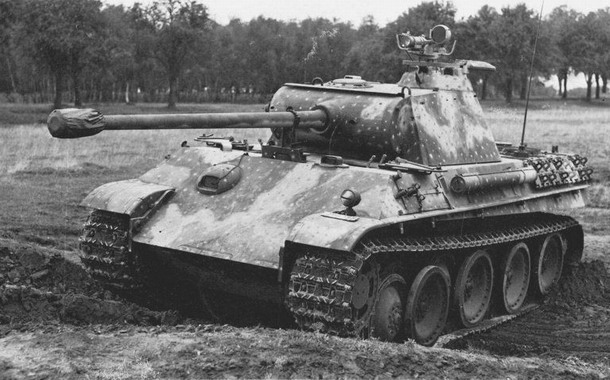
Panther Ausf. G equipped with the FG 1250 Sperber night vision device, source: Flickr.com with permission of the publishing user, edited
The night combat team also included a sub-variant of the Sd.Kfz. 251 half-track known as the Falke (Falcon). This was a standard infantry carrier half-track adapted for night operations. The roof machine gun was fitted with its own infrared sight, and the soldiers aboard were to be armed with Sturmgewehr 44 assault rifles with the Vampir attachment — a portable infrared illuminator and sight mounted directly on the rifle. The Germans thus possessed a sophisticated night-fighting doctrine combining tanks, infantry and illumination support.
Towards the end of the war series production of the Sperber device was indeed launched (resulting in perhaps as many as 1,000 units), but only a very limited number of Panthers equipped with this technology actually reached frontline units in the final months of fighting. Although it represented a genuinely advanced capability, it could have virtually no practical effect on the course of events by 1945.
Ausführung F
In the spring of 1944, work began on a fourth production variant of the Panther, to be designated Ausf. F. The hull and suspension were not to change significantly. The main improvement was to be a completely redesigned fighting turret and a new version of the gun. Development of the new turret was assigned to Daimler-Benz, while the gun modifications were given to the Škoda works in Pilsen (Skodawerke Pilzen). The new turret armour was to be more resistant without any weight increase. The turret was to have the smallest possible frontal area (so as to present the smallest possible target to enemy fire). The mantlet shape was to be such that it would not deflect an incoming round downward against the hull roof. The coaxial machine gun was to be the MG 42 type. Simplification and reduction of manufacturing costs compared to the existing series turret was also expected.
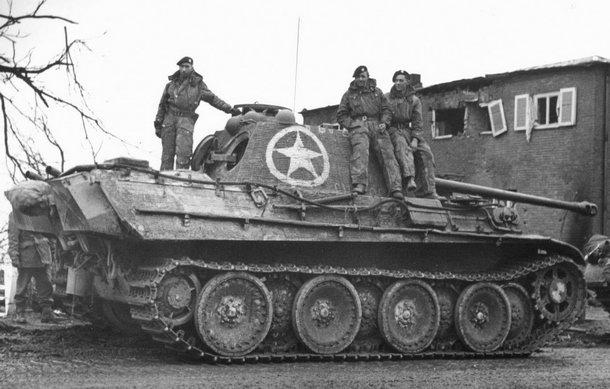
Panther Ausf. G tank captured and pressed into service by the Allies, source: Flickr.com, Public domain, edited
Where the gun was concerned, the army demanded the ability to destroy enemy tanks at 3,000 metres. The Škoda designers working on the weapon for the new tank recognised they had no time to develop anything fundamentally new — such as an entirely new gun — and decided instead to solve the problem simply by removing the muzzle brake from the existing gun. This made the propellant gases in the barrel more efficient, allowing rounds to achieve higher muzzle velocities. It also meant, however, a significant increase in the recoil force pushing the barrel back. The engineers therefore had to strengthen the recoil mechanism to handle the greater travel and at the same time redesign it to be as narrow as possible so it would fit with the gun in the new turret. The modified weapon received the designation 7.5cm KwK 44/1. Calibre remained at 75 mm, as did barrel length at 70 calibres. The weapon weighed 1,920 kg. Vertical elevation was from −8 to +20 degrees. The gun also received a new conical mantlet and a new gunsight. The first example of the new turret was fitted with the monocular TZF 13 sight, for which a small hole was bored in the front wall. The production turret was to use a periscopic SZF 1 sight projecting from the turret roof, protected by a small armoured housing.
There was also a practical problem. At ranges of over 2 kilometres, accurate estimation of target distance and correct elevation setting became critically important. The army therefore also required the new turret to be equipped with a stereoscopic rangefinder. This optical instrument was supplied by the firm Karl Zeiss, which had been working on tank rangefinders since 1942. In simplified terms, the stereoscopic rangefinder consisted of two adjustable optical prisms at the ends of a long tube with an eyepiece for the operator. The observer looked into the eyepiece, where the images from both prisms were brought together. Initially two separate images were seen, and the operator had to adjust the prisms until the two images merged into one continuous picture of the target. Once the image was aligned, the operator read the measured distance from a scale on the instrument and fed it into the gun sight.
The Germans considered developing a device that would serve simultaneously as both rangefinder and gunsight. The stereoscopic rangefinder required considerable magnification, however (the instrument for the new Panther had 15× magnification), which gave it a very narrow field of view — unsuitable for use as a gun sight. Two separate instruments were therefore used: one purely for determining target distance and another for actually aiming the gun at the target.
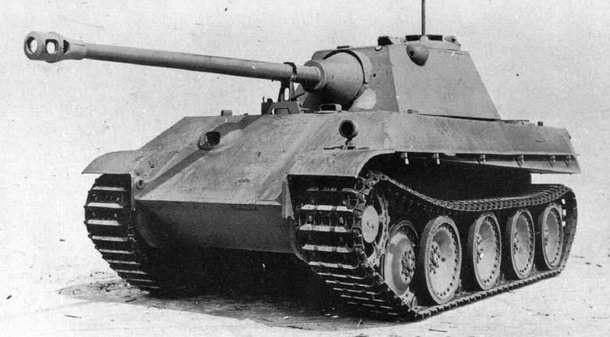
prototype of the turret for the Panther Ausf. F (the so-called Schmalturm) experimentally installed on a Panther Ausf. G chassis, August 1944, source: Flickr.com with permission of the publishing user, edited
The rangefinder tube planned for the Panther Ausf. F was 132 cm long. The rangefinder objectives were housed in two spherical blisters on the sides of the turret. The rangefinder was operated by the gunner. Its mounting was also a separate engineering challenge. The Panther was capable of moving cross-country at considerable speed, producing violent vibrations. The enormous shock of the gun firing also shook the entire vehicle, and the rangefinder was of course a sensitive optical instrument. Vibrations could damage its internal components or simply knock it out of alignment, rendering it useless. The rangefinder therefore had to be mounted not rigidly but on springs to absorb the shocks. The Zeiss instrument showed reasonable accuracy: the theoretical error at a range of 2 kilometres was only 10 metres, and the practical error was still an impressive 30 metres. Series production of the rangefinder for the Panther was never actually begun before the end of the war.
The front face of the new turret was considerably narrower than the existing production Panther turret. It therefore received the designation Schmalturm — literally "narrow turret." All walls of the new turret were thicker than those of the standard Panther turret: the front was a full 120 mm, the sides 60 mm and the rear 60 mm. Despite this, the Schmalturm was actually slightly lighter than the older production turrets, primarily thanks to the substantial reduction in the frontal area and the size of the gun mantlet.
The first example of the new turret was built apparently in August 1944. For some reason, however, this first turret was fitted with a gun with a muzzle brake (possibly because the new KwK 44/1 was not yet ready and the original KwK 42 was temporarily used instead). The front wall of the first Schmalturm still had two openings, one on each side of the mantlet: the right one was a firing port for the MG 42 machine gun and the left one housed the TZF 13 gunsight (later replaced by a periscope). The turret roof carried a new commander's cupola. Like the cupola used on production Ausf. G Panthers, it was cast and fitted with observation periscopes, but it was lower, making it a smaller target. The new cupola had a ring around its top to which a machine gun, a binocular artillery periscope or the night vision device (described above) could be attached. The Schmalturm's turret ventilator was discreetly positioned at the turret ring. On 20 August 1944, the first Schmalturm was installed on a standard Panther Ausf. G chassis and handed over for testing.
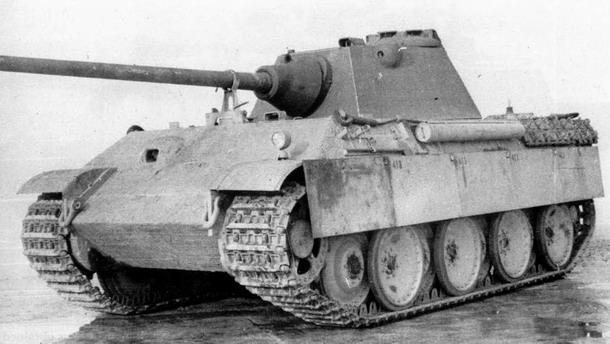
the second Schmalturm prototype installed again on a Panther Ausf. G chassis; this turret no longer has an aperture for the gunsight optics in the front wall, source: Flickr.com with permission of the publishing user, edited
The second prototype of the new narrow turret was completed in January 1945 and again installed on an Ausf. G chassis for testing. This second turret already had the periscopic SZF 1 gunsight, and its front wall therefore had only a single opening — the firing port for the MG 42 to the right of the gun.
For interest, it is worth mentioning that Škoda later proposed a further modernisation of the gun for the Panther Ausf. F. The weapon was to be fitted with a semi-automatic loading system. The device required no separate power source, relying entirely on the energy of the gun's own recoil, transmitted through a system of springs and linkages. After firing, the barrel slid rearward, the breech automatically opened and the empty case was ejected, the loading mechanism pushed a fresh round from a small magazine into the open chamber, the breech closed, and the recoil mechanism returned the barrel to the firing position.
The magazine for the auto-loader held only four rounds, so this was not a system that would entirely replace a human loader. The human loader still refilled the magazine, and the auto-loader then handled the actual chambering. It did this considerably faster than human hands, however. The theoretical rate of fire rose to an astonishing 40 rounds per minute — one shot every one and a half seconds. It must be emphasised that this was purely a theoretical figure. In practice, the recoil mechanism would most likely not have survived a sustained rate of 40 rounds per minute. Nevertheless, it was without question a further element that would have made the new Panther a truly fearsome opponent. Imagine: the gunner uses the rangefinder to determine the enemy tank's range with great precision, then aligns the reliable gunsight almost certain to hit on the first shot, and within just six seconds delivers four rapid shots at the target.
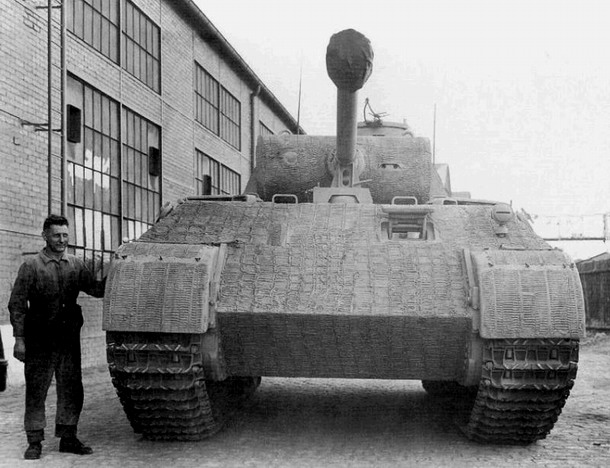
Panther Ausf. D command tank; note the blanked-off turret machine gun port, source: Flickr.com with permission of the publishing user, edited
Setting aside the new turret, the hull of the Ausf. F was to differ from the older Ausf. G in only a few minor details: a more heavily armoured roof, redesigned crew hatches for the driver and radio operator, and the replacement of the MG 34 hull machine gun mount with a port for the Sturmgewehr 44 assault rifle. The engine, gearbox and other internal components were to remain unchanged.
Series production of the Panther Ausf. F was to begin in March 1945 and gradually increase until it fully replaced the older Ausf. G from June 1945 onwards. Events, as we know, developed differently. Series production of the new tank was never begun. How many Schmalturm turrets the Germans managed to produce before their surrender is unknown. In the shattered Daimler-Benz factory in Berlin, Allied forces found four nearly completed Panther Ausf. F hulls and chassis after the fighting ended. In theory it is therefore possible that a handful of vehicles were actually assembled — not necessarily completely, but to some kind of battleworthy state — in the very last days of the war and sent to fight in the streets of Berlin. In all likelihood, however, this did not happen. Even if they had been immediately destroyed in the fierce fighting, some evidence of their existence would surely have been found — and none has been.
Command Tanks
Between May 1943 and February 1945, a proportion of Panther tanks were adapted during production for the role of command vehicle, the so-called Panzerbefehlswagen. Command tanks were built on the basis of all three series production variants — Ausf. D, Ausf. A and Ausf. G — and a total of 329 were produced. Panther command tanks existed in two configurations, differing in the combination of radio sets carried. The more common was the Sd.Kfz. 267, fitted with Fu 5 and Fu 8 sets. The second, the Sd.Kfz. 268, carried Fu 5 and Fu 7.
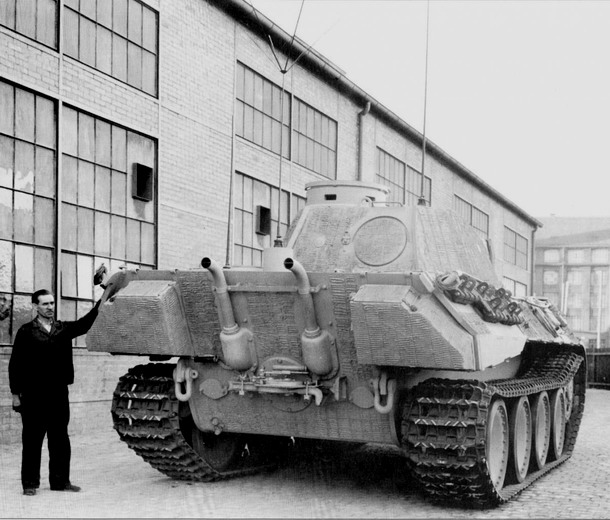
Panther Ausf. D command tank, source: Flickr.com with permission of the publishing user, edited
The Sd.Kfz. 267 served commanders from tank company to regimental level. The Fu 8 radio allowed the vehicle to communicate by voice at ranges of up to around 20 kilometres, and up to 40 km in Morse code. The less common Sd.Kfz. 268 provided liaison and coordination with air support. Its primary radio was the Fu 7, which was also standard equipment in the Luftwaffe. The Fu 7 had a voice range of around 50 km and up to 70 km in Morse.
The powerful radio sets and their associated equipment (such as a generator) occupied a considerable amount of interior space and certain modifications were therefore necessary. The turret machine gun was removed and its port to the right of the gun barrel was blanked off with an armoured cover. Gun ammunition stowage also had to be reduced to 64 rounds. A standard Panther carried only a single 1.4-metre rod antenna just behind the turret on the left side of the engine deck. The command tank, by contrast, carried three antennas. The original one was retained (though in many photographs it appears to have been removed). One new rod antenna appeared on the right rear corner of the turret roof, and a second new antenna was at the rear of the engine deck. The latter antenna also distinguished the two sub-variants from one another: the Sd.Kfz. 268 had a plain rod antenna at the rear, while the Sd.Kfz. 267 used a star-shaped Sternantenne D.
The Panther command tank crew numbered five: the commander, a communications officer (who also served as gunner), the driver and two radio operators (one of whom also served as loader).
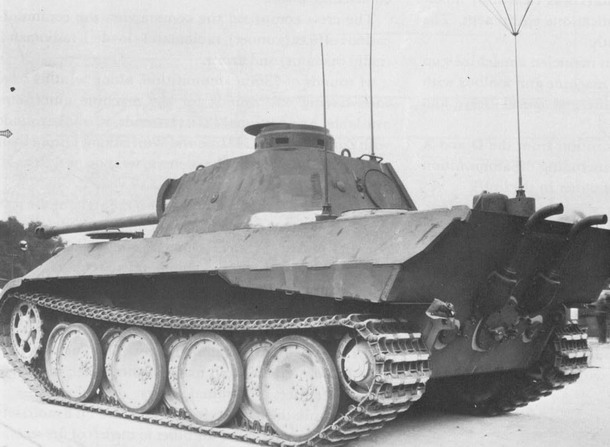
Panther Ausf. D command tank, source: Flickr.com with permission of the publishing user, edited
Panzerbeobachtungswagen
As early as 1942, Rheinmetall-Borsig had begun working on a proposal to convert the Panther into an observation and forward artillery direction vehicle. The purpose of such a vehicle was to locate and determine the position of a potential target, transmit the co-ordinates to friendly artillery, and then correct the fire based on direct observation of shell impacts.
The project received the designation Panzerbeobachtungswagen (beobachten = to observe). It was only in July 1943 that the work was ready in the form of finalised technical drawings. The observation tank was fitted with a range of optical instruments for locating and precisely targeting enemy positions. These included a fully rotatable TBF 2 periscope (Turmbeobachtungsfernrohr) that extended from the turret roof. A rod periscope (TSR 1) or a scissor periscope (SF14Z/Scherenfernrohr) could also be extended directly from the commander's cupola.
Perhaps the most interesting piece of equipment was the stereoscopic rangefinder mounted inside the turret. Its tube was installed on the inside of the turret front wall, and two apertures were bored through the front wall for the rangefinder optics. Because the rangefinder occupied the front wall, there was of course no room for a gun. The Panzerbeobachtungswagen Panther therefore carried no main gun. A dummy gun barrel was fitted to the front wall to deceive the enemy — though it must be said that the dummy was noticeably shorter than the barrel of the real KwK 42. To the right of the dummy barrel was a machine gun MG 34 mount, intended to give the observation tank at least some defence against enemy infantry.
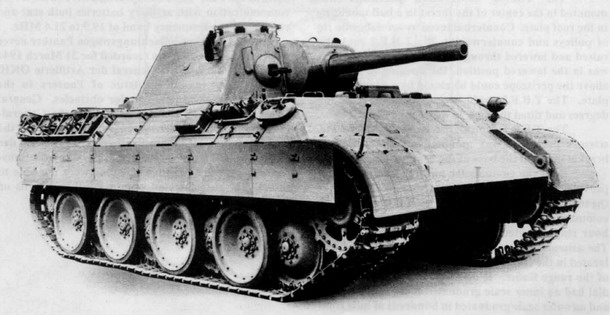
a heavily retouched but apparently the only existing photograph of the Panther observation and direction tank, source: Flickr.com with permission of the publishing user, edited
The crew consisted of what was apparently five men (though four is sometimes given): commander, driver, radio operator and two observers. Radio equipment comprised three sets — Fu 4, Fu 8 and Funksprechgerät f. Sometime between July and September 1943, a prototype of the special observation turret was built and experimentally installed on a standard Panther Ausf. D chassis. The entire project was, however, soon cancelled. Given how the fighting on the Eastern Front was developing, the Germans simply could not afford to convert their best medium tanks into mere artillery support vehicles — especially when half-tracks could perform the observation and direction role almost as effectively.
Bergepanther
At nearly 45 tonnes, the Panther posed a major problem for existing recovery equipment. Standard half-tracked prime movers simply could not handle the new tank; recovering one typically required two or three prime movers working simultaneously, which was organisationally demanding and often impossible in the field. Particularly the early production Panthers suffered from a whole range of technical problems and frequently broke down. Without the ability to tow a disabled tank away, the crew had only two choices: blow up the immobilised vehicle before abandoning it, or risk it falling into enemy hands. Either way, it meant the essentially unnecessary loss of a valuable vehicle that could often have been repaired and returned to service relatively easily.
In May 1943, the Waffenamt therefore tasked MAN with converting 12 (some sources say only 10) Panther tanks into armoured recovery and service vehicles, the so-called Bergepanther. The conversion was very simple and all ordered vehicles could be delivered as early as the following month (June 1943). Essentially these were standard Panther Ausf. D tanks with the fighting turret removed and the opening covered by a slightly raised roof of wooden planks.
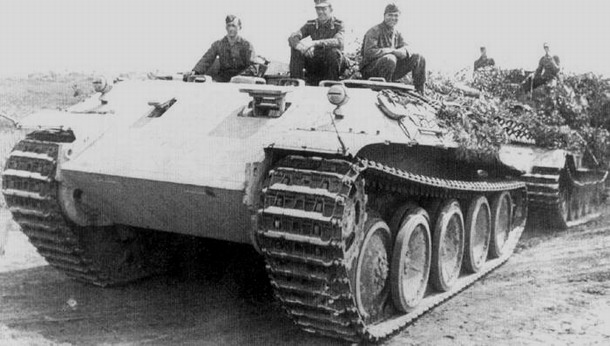
the first Bergepanther recovery vehicles were essentially just standard Ausf. D tanks with their turrets removed, source: Worldwarphotos.info with permission of the site owner, edited
Probably still in May 1943, the Waffenamt commissioned a fully developed Bergepanther recovery vehicle, this time from Henschel. This was to be a much more thoroughly designed vehicle, properly adapted and equipped for its new purpose. Henschel was to design the new vehicle and produce 70 of them. The new Bergepanther was again turreted. The hull roof no longer retained the circular opening from the fighting turret; instead, a much larger rectangular opening was cut. This opening was surrounded by partially folding sides made of wooden planks. The interior of the hull was adapted as a cargo space. The armoured roof above the driver's and radio operator's seats was also removed and replaced by a fold-down canvas cover.
A beam was welded to the front hull armour for mounting a 20 mm KwK 38 gun (so the vehicle would not be entirely unarmed). The gunner would have been almost completely unprotected while operating the weapon, and it was therefore to be fitted with at least a small shield. In practice, however, the KwK 38 was not fitted to the production vehicles. Mounting points for machine guns were welded to the hull roof in front of the driver's and radio operator's stations on both sides. Two vertical square brackets appeared on the hull front nose. A large wooden beam — functioning as a bumper — was attached to these. The Bergepanther would drive up nose-first to another stuck vehicle and push or nudge it using this wooden buffer. When not in use, the wooden beam was hung on the left side of the plank cargo surround above the hull.
The cargo space inside the hull held a wide range of equipment needed for recovery operations and field repairs. Some Bergepanther vehicles were also fitted with an enormous 40-tonne winch supplied by MAN. Unfortunately, not enough of these powerful winches were available for all Bergepanthers produced. The winch was powered by the tank's engine through a series of gearing. The steel cable ran over a pulley at the rear of the engine deck. At the rear of the tank was a massive folding spade with a sharp point, which functioned as a ground anchor.
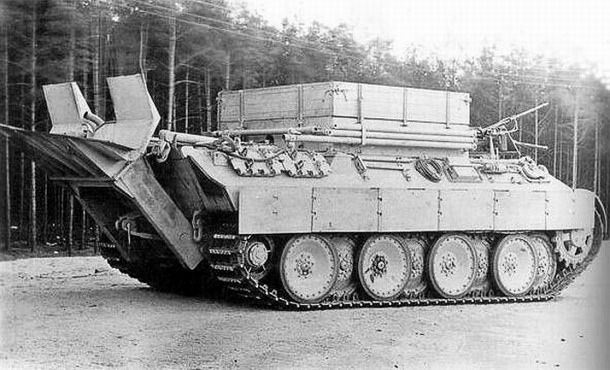
prototype of the fully developed Bergepanther recovery tank complete with armament; note the enormous ground anchor spade at the rear, source: Flickr.com with permission of the publishing user, edited
A typical recovery operation went roughly as follows. The Bergepanther reversed to within about 10 metres of the stuck vehicle and lowered the rear spade so that it rested loosely on the ground. The crew then paid out the steel cable from the winch and securely attached it to the stuck vehicle. The Bergepanther then drove slowly forward. The cable unreeled from the winch behind the tank as it went, with the lowered anchor spade simply dragging along the ground. When the tank had reached a suitable position (the cable was probably about 150 metres long), it stopped, braked both tracks and started the winch. If the load was heavy enough to cause the braked recovery vehicle to creep backward, the sharp point of the rear anchor dug into the ground until the vehicle stopped moving. When the stuck vehicle had been hauled up to the Bergepanther, the winch was stopped and the whole procedure repeated as many times as necessary until the stuck vehicle was recovered to a road or firm ground. There it was hitched behind the recovery vehicle — usually using rigid tow bars — and the Bergepanther towed it under its own power to the nearest field workshop.
As mentioned, the winch had a 40-tonne pull. The tow cable could, however, be rigged through a pulley with one end attached to the anchor spade, and the load attached to a second cable passed through the pulley. In this configuration the effective pull of the winch doubled to a full 80 tonnes, allowing the Bergepanther to recover even the heaviest equipment such as Tiger II tanks or Ferdinand tank destroyers. If even this force was insufficient — for example, with a very heavy vehicle stuck deeply in mud — the only remaining option was to combine the efforts of two recovery vehicles. To prevent overloading and cable failure, the Bergepanther was equipped with a tension load meter.
Another useful piece of equipment was a collapsible tubular crane with a two-tonne lifting capacity, which could be assembled on either side of the hull and used, for example, to handle spare parts during field repairs.
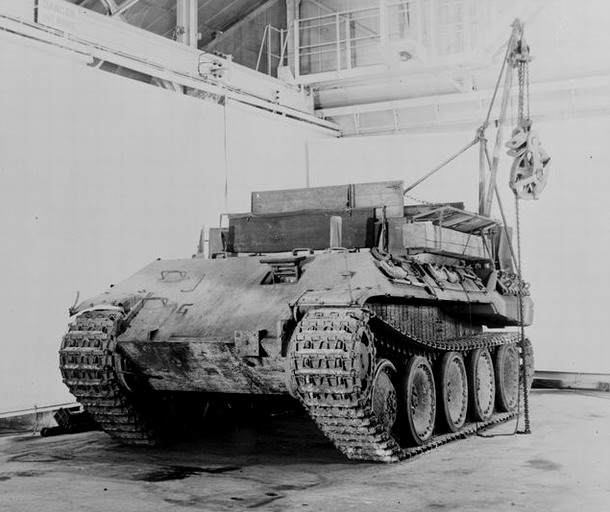
series production Bergepanther recovery tank, source: Wikimedia, Public domain, edited
Henschel delivered the first prototype of the Bergepanther described above in September 1943. This prototype was apparently the first and last to be genuinely fitted with the KwK 38 gun complete with shield. Henschel then delivered the remaining 69 ordered vehicles. Bergepanther production continued in 1944 and 1945 at the Daimler-Benz and Demag plants. The recovery tank was built on all three Panther variants (Ausf. D, A and G) and was assigned its own ordnance code Sd.Kfz. 179. Total production figures of 278, 297 or even 319 vehicles can be found depending on the source. A further 61 Bergepanthers were reportedly built in the workshops of Seibert Stahlbau, which converted older combat-damaged tanks for this purpose.
Ostwallturm
A very interesting use was found for Panther tank turrets in the construction of static fortifications. Three different variants of such turret emplacements were designed, but only two were ever realised. In all cases the turret was to be placed above an underground crew bunker. The difference lay in the design of this bunker. The first variant, known as Pantherturm I (Stahluntersatz), used a bunker with metal walls. The second variant, intended to be the cheapest of all, was to have a bunker with wooden log walls. This version was never built, probably because such a structure would have struggled to withstand the considerable forces generated when the gun fired. The third variant, designated Pantherturm III (Betonsockel), used a reinforced concrete crew bunker.
The bunker with its turret was intended to function as a small, permanently manned strongpoint. Directly beneath the turret was the fighting space with ammunition storage. The turret was installed complete with its basket and floor. Below the fighting space was the living area, containing three folding bunks, a small stove and sometimes reportedly even a petrol generator (a toilet is never mentioned, suggesting there was none inside). All of this was buried underground, hidden from the enemy. Only the turret itself was visible above ground. The crew was apparently three men and could enter the strongpoint either through the turret hatches or through an entrance passage dug beside the bunker.
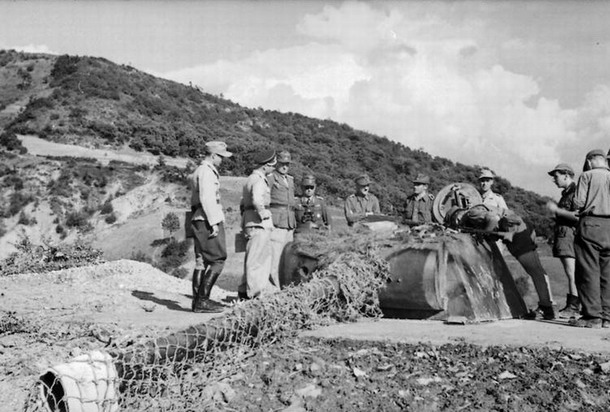
Panther Ostwallturm — a strongpoint with a Panther tank turret; this photograph clearly shows how small a target the turret alone presented, source: Bundesarchiv Bild 101I-587-2267-24, Wikimedia, Creative Commons, edited
For the construction of such strongpoints, standard fighting turrets from production tanks whose other components had been irreparably damaged in combat were partially used. However, turrets specially adapted for this purpose also existed, supplied by the firm Demag. The adapted turrets received new roof armour 40 mm thick, to better withstand indirect fire from heavier artillery. Another change was the replacement of the standard tank commander's cupola with a flat hatch with a rotating periscope.
A total of 143 strongpoints with steel bunkers and 125 with concrete bases were built and installed — 268 in total. The vast majority were installed either as part of the Atlantic Wall along the French coast or along the so-called Siegfried Line around Germany's western border. A number of strongpoints were also built in Italy as part of the Gothic Line. These turret emplacements were generally called Panther Ostwallturm (even though very few were actually installed on the Eastern Front). For completeness it should also be noted that Panther turrets were placed in smaller numbers on city streets within Germany itself — though these were often not standard strongpoints but simply complete tanks that had been rendered immobile for some reason (e.g. an irreparably damaged suspension) and buried in position (see photo HERE).
A strongpoint with a Panther turret was a decidedly dangerous adversary. Since only the turret protruded above ground, it was an extremely inconspicuous object that was virtually impossible to detect before it had fired its first shot. Even after the strongpoint had revealed itself, it presented such a small target that it was very difficult to hit. And even when a hit was scored, the frontal armour of the turret was beyond the capabilities of most Allied tanks to penetrate. Attackers therefore tried to approach from the side, where the armour was significantly weaker. A hit to the side wall reportedly often caused the ammunition inside the bunker to explode, blowing the turret completely off and to one side. A well-executed infantry or engineer assault was the other option.
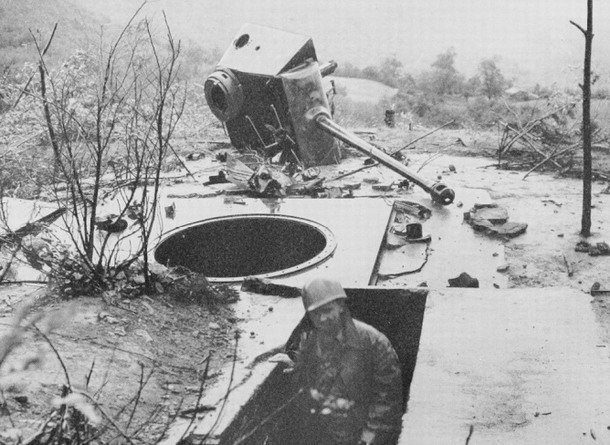
destroyed Panther turret fortification, the so-called Panther Ostwallturm, source: Flickr.com, Public domain, edited
Ersatz M10
Five Panther Ausf. G tanks received a very curious modification when they were deployed in December 1944 as part of an operation codenamed Greif — a component of the larger Ardennes offensive against the Allies (Operation Wacht am Rhein). Specially selected, English-speaking soldiers were to be dressed in American uniforms, equipped with captured American weapons and vehicles, and sent behind enemy lines to carry out various acts of sabotage and disruption.
Command of Operation Greif was entrusted to SS-Obersturmbannführer Otto Skorzeny. Skorzeny had only five or six weeks to prepare the operation. A special unit called Panzer Brigade 150 was created for its execution. Skorzeny had requested 3,300 men, 15 American tanks, 20 armoured vehicles and a wide range of other equipment including a hundred Jeeps. His requests were far from fully met. The Germans had only two serviceable American Sherman tanks available for the operation. It was therefore decided to deploy at least their own Panther tanks, roughly disguised as American M10 Wolverine tank destroyers.
Sheet metal was welded onto the Panthers to alter the shape of both the turret and the hull. The tanks were given American olive-green camouflage and markings. In the literature these modified tanks are often referred to as Ersatz M10 — literally "substitute M10" — though whether this was their actual designation is uncertain. The resemblance of a modified Panther to a genuine M10 was convincing only from a great distance. The German vehicle was considerably larger than the American original and resembled it only in basic outline. Operation Greif was compromised very shortly after it began. The modified Panthers took part in the attack on the town of Malmedy on 21 December 1944. During several attempts to seize one of the local bridges and in the subsequent American air counterattack, all five tanks were lost.
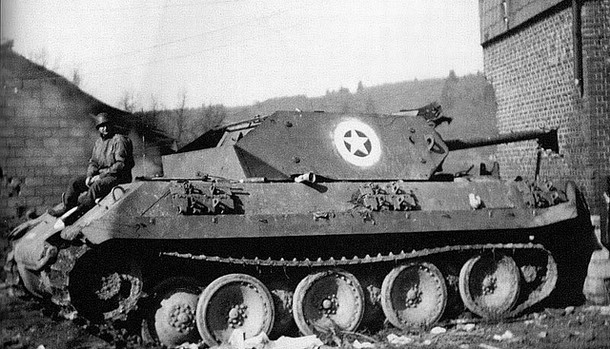
destroyed Panther Ersatz M10, disguised as an American tank destroyer for the sabotage operation, source: Flickr.com, Public domain, edited
Panther II
When Adolf Hitler approved the start of Panther production on 14 May 1942, he ordered the hull frontal armour to be increased from the original 60 to 80 mm (which duly happened). Very soon, however, he began to doubt that this would be sufficient and requested a further increase to 100 mm. The designers had to reject this, as it would have required excessively far-reaching changes to the vehicle's structure with major implications for weight distribution, suspension loading and so on. Hitler insisted, however, that 100 mm of armour would be absolutely necessary in the near future, and if the existing Panther could not have it, at least its successor must. Thus was born the project for the second-generation tank, known simply as Panther II.
Development of the second-generation tank was again entrusted to MAN. The first proposals emerged in January 1943. The only difference from the existing Panther was to be heavier armour — on the front and side walls of both hull and turret. Powerplant, gearbox and gun were all to remain the same. Designers expected a weight increase of roughly 7 tonnes.
In February 1943, however, a decision came to fundamentally redesign the Panther II project. The new tank was no longer to be merely a more heavily armoured version of the first Panther; it was to be built with as many components as possible shared with the Tiger II (the Königstiger), which was then under development. The aim was to simplify and reduce the cost of manufacturing and subsequent servicing of both tanks.
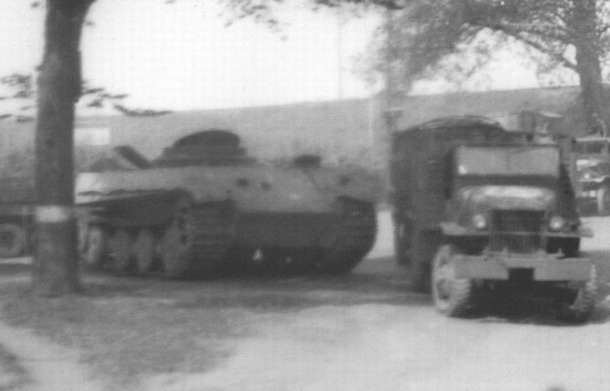
a very poor quality but quite possibly the only photograph showing the Panther II prototype as it was found by Allied forces — with only a ballast weight instead of a turret, source: Flickr.com, Public domain, edited
The Panther II was therefore to have a suspension with all-steel road wheels arranged in the same manner as on the Königstiger. The torsion bar suspension system was also to be identical to that of the Königstiger. The designers concentrated their efforts mainly on the hull and suspension. As for the fighting turret, several variants were considered but only as drawings. The expected weight of the new tank was around 53 tonnes.
Series production was to transition from the old to the new Panther starting in September 1943. This deadline was later pushed back to early 1944. In January 1944, further postponement was decided upon. The Germans realised they simply could not afford the production gap that would inevitably come with halting the old Panther and ramping up the new one. Maximising production of the existing type had to take priority. Some of the design improvements planned for the Panther II were at least incorporated into series production of the older Panther — specifically its Ausf. G variant. The second-generation Panther project was definitively cancelled sometime around April–May 1944. MAN was, however, permitted to complete one partially built chassis and hull prototype for the new tank.
The sole completed Panther II prototype had no fighting turret. For testing purposes it carried only a ballast weight simulating the weight of the turret. It was in this state that the prototype fell into American hands at the end of the war. They secured it and shipped it to the United States along with other captured equipment. There it was first subjected to tests and then sent to Aberdeen, where it was fitted with a turret from another captured tank — a standard series production Panther Ausf. G. In this assembled form it then moved to the military museum at Fort Knox, where it became part of the collection.
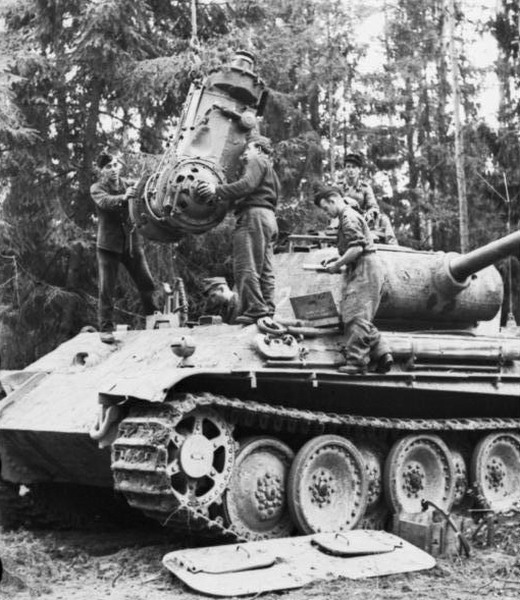
early Panthers suffered from numerous mechanical failures; here an Ausf. G during a gearbox replacement, source: Bundesarchiv Bild 101I-280-1096-33, Wikimedia, Creative Commons, edited
In connection with the Panther II project, one mysterious photograph is worth mentioning (viewable HERE, Flickr.com), which can be found on the internet. It shows a vehicle whose hull and ballast weight in place of the turret correspond exactly to the first prototype tank from September 1942 (designated V1), but the vehicle has a running gear virtually identical to that of the Panther II project. According to some authors, the photograph dates from 1942 and shows the original prototype V1, which during the course of various trials was fitted with an experimental running gear. This is not impossible. However, the photograph also exists in a version with a frame containing accompanying data indicating the year 1944 (viewable HERE, Flickr.com). It is therefore theoretically possible that the original prototype V1 remained in MAN's storage after series production began, and was used sometime in 1944 for the first experiments with the new running gear for the Panther II. I leave the conclusions to the reader.
First Units
The first two battalions to receive the new Panther tanks were specifically created for this purpose. Panzer Abteilung 51 was formed on 13 January 1943 at the training centre in Grafenwöhr (Truppenübungsplatz Grafenwöhr). The core of the battalion consisted of experienced tankers transferred from the 33rd Panzer Regiment, the rest being new recruits. Panzer Abteilung 52 was established on 6 February 1943, also at Grafenwöhr, drawing on veterans transferred from the 15th Panzer Regiment as well as new men.
Panzer Abteilung 51 received its first Panthers as early as January 1943, but most of January and February was spent not on training but on testing the new vehicles, reporting the faults found and cooperating with MAN's technicians in resolving them. In April 1943 both battalions handed over all their tanks for repairs. With nothing left to train on, someone in the command had the idea of sending the men to the Wehrmacht training centre in northern France near the village of Mailly le Camp. Barely had the men arrived there at the end of April when at the beginning of May they received orders to return to Grafenwöhr and take delivery of their "repaired" tanks. By around mid-May the tankmen were back in Germany, but their Panthers were not actually returned to them until the end of June — just in time to begin packing for the journey to the Eastern Front and Operation Zitadelle.
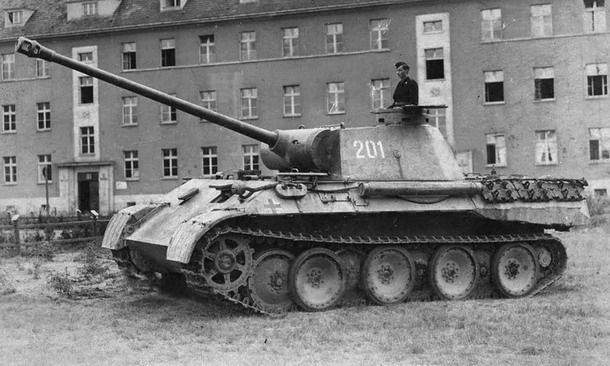
Panther Ausf. D apparently in a barracks yard, source: Flickr.com with permission of the publishing user, edited
Although both battalions (Panzer Abteilung 51 and 52) had been formed nearly half a year before their first deployment, they had in practice had virtually no opportunity for proper training throughout that entire period. The gunners were probably the best prepared among the crews, since most of the tank failures concerned the engines and drivetrain generally — gun practice was still possible. What was entirely absent was any combined training at battalion level. It can therefore be fairly said that crew preparation was wholly inadequate for men who were about to receive an entirely new type of tank and take it straight into combat. This undoubtedly contributed to the disappointing outcome of the Panthers' combat debut — but more on that later.
Organisational Structure
Deploying the first Panthers in what were essentially independent battalions was only a temporary organisational arrangement. As a rule, Panthers were integrated into standard Panzer divisions according to existing organisational tables. In 1943, a standard Panzer division had one Panzer Regiment consisting of two Panzer Abteilungen (battalions). After the introduction of the Panther, one battalion of the regiment was to be equipped with these tanks while the other retained the older Panzer IV. Each battalion was further divided into four Panzer Kompanien (companies), each company consisting of four Panzer Züge (platoons).
According to the 1943 organisational table, each platoon had 5 tanks. A company had 22 tanks in total (four platoons of five plus two tanks at company headquarters). The entire battalion therefore had 88 tanks in four companies plus a further 5 in an independent reconnaissance platoon. Battalion headquarters also had three command tanks with enhanced communications. In total, a tank battalion at full strength disposed of 96 Panthers (including command tanks). This of course describes units at their full paper strength, which in practice was rather the exception.
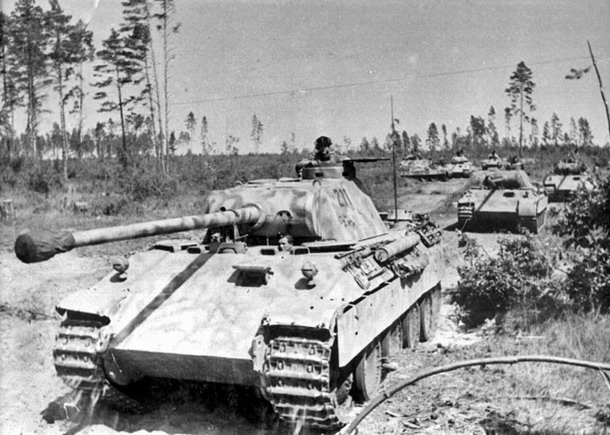
Panther tanks were first committed to combat at the Battle of Kursk in July 1943, source: Flickr.com with permission of the publishing user, edited
In 1944 the organisational model was revised. The number of platoons per company was reduced from four to three. Company strength therefore fell from 22 to 17 tanks (three platoons of five plus two at company headquarters). A tank battalion now had only 76 Panthers. In addition to the tanks themselves, a battalion of course contained a wide range of other combat and support vehicles.
Panther production began in January 1943 and continued until April 1945 (in April 1945 MAN delivered the last 20 tanks). Total production was around six thousand vehicles (figures ranging from 5,995 to 6,042 are cited). The manufacturers involved were MAN, Daimler-Benz, MNH and Henschel. MAN delivered the greatest number of tanks, closely followed by Daimler-Benz.
Combat Deployment
The Panther made its combat debut in July 1943 at Kursk during Operation Zitadelle. Waiting for sufficient Panthers had in fact been one of the reasons for the repeated postponements of the operation. The Germans had enormous hopes riding on the new tanks and therefore watched and evaluated their first combat appearance very carefully.
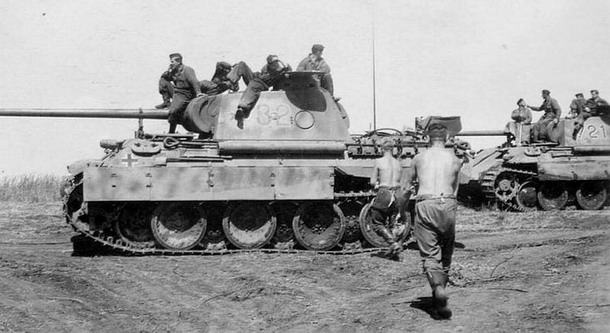
200 Panthers were committed to Operation Zitadelle (though for most of the operation only a fraction were operational at any given time), source: Flickr.com with permission of the publishing user, edited
Two battalions equipped with Panthers were deployed at Kursk: Panzer Abteilung 51 (under the command of Captain Heinrich Meyer) and Panzer Abteilung 52 (under Major Gerhard Tebbe). Both battalions were assigned the headquarters staff Stab Panzer Regiment 39, and from these three components Panzer Regiment von Lauchert was formed, named after its commander Major Meinrad von Lauchert. Each of the two battalions had 96 Panthers, and a further 8 were at Stab Panzer Regiment 39 — making 200 Panthers committed at Kursk in total. Panzer Regiment von Lauchert was then grouped together with Panzer Regiment Grossdeutschland under the command of Stab Panzer Brigade 10, and the whole formation was attached to the Grossdeutschland Panzergrenadier Division. The formation's commander was Colonel Karl Decker. For completeness, all units under Colonel Decker's command were, for Operation Zitadelle, assigned to XLVIII Panzer Korps (General Otto von Knobelsdorff), which in turn came under the 4th Panzer Army (Colonel General Hermann Hoth), itself part of Army Group South (Field Marshal Erich von Manstein).
The first of many troop trains carrying the men and equipment of Panzer Abteilungen 51 and 52 arrived at the last railhead before the front on 1 July 1943. The last elements arrived as late as 3 July — just two days before the operation was due to begin. From the railhead the Panthers set off under their own power on 4 July (one day before the attack) first to the town of Borisovka and then to their assembly area west of the village of Tomarovka (about 30 km north-west of Belgorod). During this movement, not only did 20 tanks suffer various mechanical failures, but two Panthers completely burned out due to engine fires.
On the opening day of the offensive, 5 July 1943, the troops had 184 operational Panthers available (2 of the original 200 had, as we know, burned out on the road, and a further 14 were still under repair). Before describing what followed, we can note straight away that the Panthers' combat debut proved a clear disappointment for the Germans. Historians generally attribute the Panthers' failure at Kursk primarily to their technical immaturity, stemming from rushed development and insufficient testing. The truth is, however, that faulty combat tactics and errors in the overall organisation of the operation bore a considerable share of the blame as well.
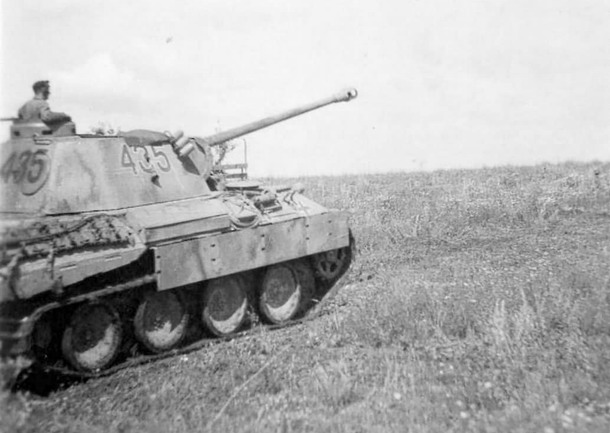
the open terrain of the Kursk region was ideally suited to the long-range gun of the Panther, source: worldwarphotos.info with permission of the site owner, edited
Panzer Regiment von Lauchert with its two battalions (Panzer Abteilungen 51 and 52) launched its attack at around 8:15 in the morning of 5 July. Setting out from Tomarovka at the southern tip of the Kursk salient, the regiment advanced almost directly northward toward the town of Cherkasskoye. Panzer Abteilung 51 led the way, with Panzer Abteilung 52 behind it. When fully deployed, the formation covered a frontage of roughly 500 metres and a depth of roughly 3 kilometres. After about an hour of advancing, the Panthers reached the flooded Berezovy ravine, where the Soviets had constructed a wide anti-tank ditch and minefields. Tanks in the lead bogged down in the soft ground before the ravine and could move neither forward nor back. Some Panthers set off to the west to find a better crossing point but drove into a Soviet minefield. At that moment Soviet artillery also opened fire on the Germans. The men quickly sheltered inside their tanks to wait out the fire. Soviet artillery scored a lucky hit and destroyed one Panther; several others were lightly damaged. Six German soldiers were killed.
Grossdeutschland division scouts meanwhile found a suitable crossing point roughly 1.5 km to the west. By around 4 o'clock in the afternoon, the first 40 Panthers (and other vehicles) had managed to cross the Berezovy ravine and continued their advance. At 7 pm the Panthers were finally able to join the attack on Cherkasskoye. Most of the town was in German hands by around 9 pm. Recovery of the Panthers bogged in the mud near the ravine continued through the night and into the following morning.
On 6 July, around 10:40, the Germans set out from captured Cherkasskoye toward Luchanino. Panzer Regiment von Lauchert was delayed, however, waiting for further Panthers to be recovered from the mud at the Berezovy ravine overnight. The Panthers therefore left the town on their own and well behind their fellow soldiers. Von Lauchert was apparently uncertain of the correct direction and after about 2 km his tanks drove into a Soviet ambush — a minefield and dug-in T-34 tanks. Several Panthers were immobilised by mines, and the others came under fire from the T-34s of General Krivoshein's 3rd Mechanised Corps. The Soviets attacked from the flank and succeeded in destroying several Panthers by hitting their weaker side armour. The Germans returned fire. The Soviet T-34s were in hull-down positions with only their turrets visible. The Panthers' guns, however, were accurate enough that the gunners were able to hit several Soviet vehicles in their turrets — which surprised the Soviets considerably, made them feel unsafe in their dug-in positions, and caused them to withdraw.
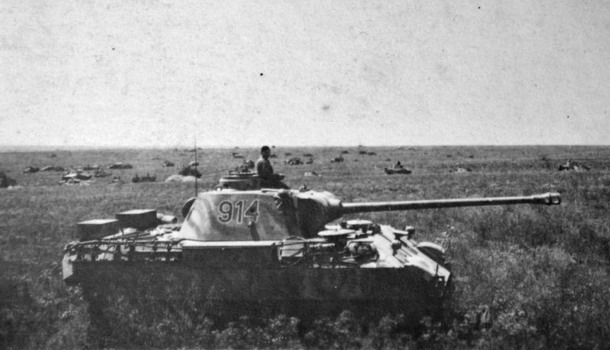
the open terrain of the Kursk region was ideally suited to the long-range gun of the Panther, source: worldwarphotos.info with permission of the site owner, edited
Von Lauchert continued his advance and later managed to link up with the rest of the Grossdeutschland division. Following these initial coordination failures, several commanders were replaced. Among other changes, Colonel Decker (commander of Stab Panzer Brigade 10) was recalled to General von Knobelsdorff, and command of both tank regiments (Panzer Regiment von Lauchert and Panzer Regiment Grossdeutschland) was taken over by Colonel Count Hyazinth Strachwitz. The number of operational Panthers fell to 166 during 6 July. Luchanino was not taken that day. The attack resumed at around 6:00 am on 7 July. Luchanino fell and the Panthers pressed on toward the village of Dubrova, which was also taken around 10 o'clock in the morning. From there they advanced toward the town of Syrtsewo. Shortly after noon, however, their advance was completely halted by Soviet mines, anti-tank guns and tanks. The number of operational Panthers plummeted to just 40 vehicles — after two and a half days of fighting they were down to roughly 20% of their starting strength.
On 8 July the attack on Syrtsewo continued, the town still holding out. It was being defended by the already mentioned 3rd Mechanised Corps of General Krivoshein. Strachwitz and his Panthers drove Krivoshein's men into retreat and set off in pursuit, chasing them roughly 4 kilometres northward to the town of Verkhopenyye, where he halted his advance at around 3 pm. He had around twenty operational Panthers left (plus other tank types). The following day (9 July) Strachwitz continued pressing the retreating Soviets northward. His Panthers took the village of Novoselowka and stood on the road to the town of Oboyan. At this point Strachwitz had only 16 operational Panthers, 3 Tigers and 17 other tanks (apparently Panzer IIIs and IVs). Meanwhile, the Germans were still fighting to take both Syrtsewo and Verkhopenyye behind him.
General Knobelsdorff judged further northward advance by Colonel Strachwitz toward Oboyan too risky and wanted first to finish off the Soviets in both towns. He therefore ordered the remnants of Panzer Regiment von Lauchert and Panzer Regiment Grossdeutschland to turn south, envelop Syrtsewo and Verkhopenyye from the west and help finally take them. Strachwitz obeyed and set out early on the morning of 10 July to encircle both towns. He ran into the Soviet 6th Tank Corps and his advance stalled. Verkhopenyye was taken, however. The number of operational Panthers fell to just 10 vehicles. Strachwitz himself was wounded that day, and Colonel Decker again assumed command of both regiments. General Guderian also arrived at the unit that day, deeply concerned by the loss of so many Panthers and wanting to assess the situation personally.
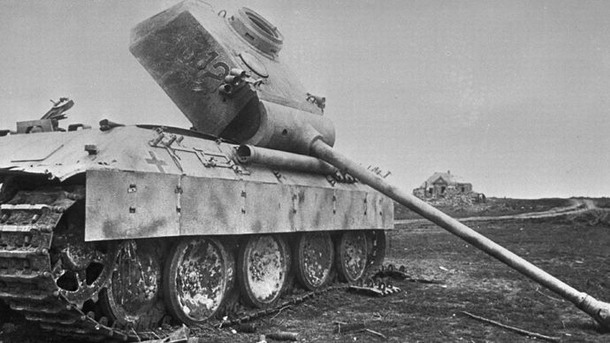
the Panthers' first deployment at Kursk did not go quite as expected; the vehicle in this photograph was apparently blown up by its own crew, source: Flickr.com with permission of the publishing user, edited
The repair workshops were working at full capacity and managed to raise the number of operational Panthers back to 30 by 11 July. That day the tanks took part in the successful capture of Syrtsewo and Berezovka. But that was as far as the Germans — or the Panthers — got on this sector. For the next three days (12–15 July) they fought off Soviet counterattacks in the forests north-west of Berezovka. Meanwhile, Operation Zitadelle as a whole was called off, the Germans began withdrawing from the ground they had gained and went on the defensive against Soviet counter-offensives. The number of operational Panthers fluctuated between 20 and 40 during these days. Even at these low numbers, however, the Panthers repeatedly demonstrated that when given the opportunity to face Soviet tanks head-on, the enemy had little chance. Between 5 and 17 July 1943, Panthers at Kursk destroyed a total of 263 Soviet tanks! Their own losses, according to the report of 20 July, amounted to only 58 Panthers completely destroyed. In fairness it should be noted that the figure of 263 Soviet tanks destroyed was taken from Colonel Decker's own report — and some historians argue this report was not entirely objective, as Decker had reason to present himself in a favourable light, and that in reality the Panthers destroyed closer to 120 Soviet tanks during this period. Whether the first or the second figure is more accurate, the fact remains that the Germans had expected far more from their new tanks.
Fighting continued unabated after 17 July as the Soviets progressively shifted to counter-offensive. Between 17 and 19 July both Panther battalions withdrew back to Tomarovka (from where they had launched their attack on 5 July). Panzer Abteilung 51 handed over its remaining tanks to Panzer Abteilung 52 and departed by rail for Bryansk, where 96 brand-new Panthers from Germany were waiting for it. Panzer Abteilung 52 remained at Tomarovka working on repairing its damaged and broken-down tanks. When the Soviets launched their counter-offensive in this sector on 3 August 1943 (Operation Rumyantsev), Panzer Abteilung 52 had only 27 operational Panthers, with a further 109 under repair. If the Germans at Tomarovka were not to be encircled, they had to pack up quickly. The withdrawal was carried out on 5 August. A full 72 Panthers that could not move under their own power had to be blown up before the unit left.
Panzer Abteilung 52 retreated toward Borisovka, fighting off Soviet attacks along the way. On 6 August alone, the Panthers destroyed 17 T-34s during the fighting retreat without suffering any losses of their own. On 8 August the Germans passed through the town of Grayvoron and by 9 August were at Akhtyrka, where they linked up with the Grossdeutschland division. During this march of over 100 km, most Panthers suffered some kind of mechanical failure, so that by the time the unit reached Akhtyrka it had only 9 operational tanks remaining. Total Panther losses from 5 July to 11 August amounted to 156 vehicles completely destroyed.
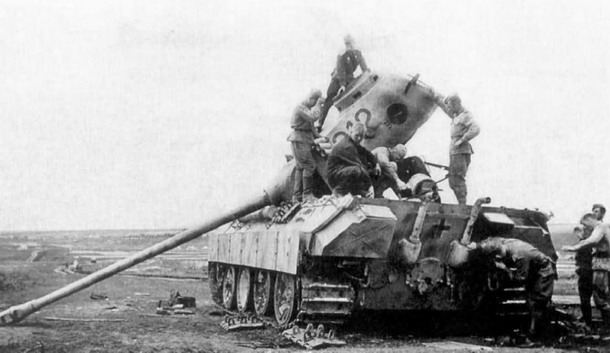
the wreck of the new German tank draws well-deserved attention from Soviet soldiers, source: worldwarphotos.info with permission of the site owner, edited
The Panthers' poor combat performance during Operation Zitadelle is traditionally attributed primarily to their technical immaturity. However, both Colonel Decker and General Guderian in their after-action reports emphasised also the major contribution of poor combat tactics, insufficient training on the new tanks, and command failures. The very late arrival of the Panthers at the front was itself a highly unfortunate affair. As already noted, the Panthers only set out from the railhead to their assembly area on 4 July — one day before the operation began. As a result, commanders had no time for any thorough briefing and went into the attack without clear orders regarding the direction of advance, operational objectives, terrain characteristics and so on. Reportedly they did not even receive maps or information about which radio frequencies to use during the attack.
A significant number of Panthers were destroyed or disabled by mines because the ground had not been properly cleared by engineers. The Germans were generally caught off guard at Kursk by the number and density of the minefields; there were too few engineers and virtually no mechanical mine-clearance equipment available. Tanks therefore either had to stop and wait for the available engineers to clear the fields by hand, or press on and take the risk. And higher command was of course pushing for the timetable to be met. Another important factor was insufficient support for the Panthers from other arms. While their frontal armour was very well protected, the Panthers were relatively vulnerable from the sides and were nonetheless committed without flank protection. Air reconnaissance also failed, not even warning, for example, of the flooded Berezovy ravine, which halted the Panthers' advance for several hours on the very first day.
Let us look more closely at the Panther strength figures on 10 July, when they reached their lowest point. At the end of that day the situation was as follows: 2 tanks had, as we know, burned out before the operation even began; 23 had been completely destroyed in combat to that date; 25 had broken down and were awaiting towing to a repair facility; 40 were on their way back from service workshops to the units; and a full 100 were in workshops being repaired. A more detailed look at the vehicles under repair is even more revealing: of that hundred, 56 were battle-damaged and 44 had suffered mechanical failures. This shows that a far from negligible proportion of the tanks had been knocked out by the enemy, not merely by their own unreliability.
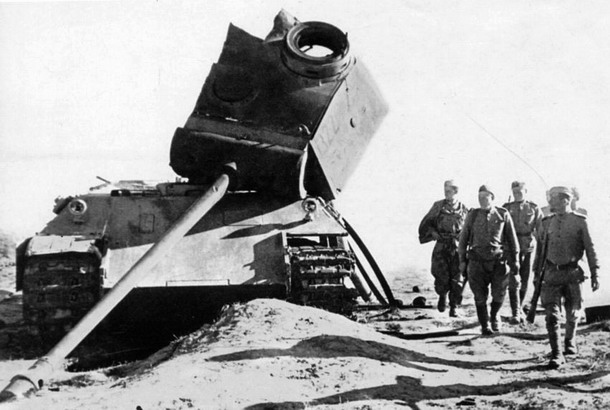
Soviet soldiers marching past the shattered wreck of a Panther, source: worldwarphotos.info with permission of the site owner, edited
According to the conclusions of Guderian's report, several basic rules were to be observed in future Panther deployments. Panthers, like other tanks, need adequate support from all other arms — especially artillery and infantry. In the attack, these tanks should ideally advance in a broad formation with wide spacing, flanks protected by other tanks and infantry. Thorough terrain reconnaissance and mine-clearing are also essential. Guderian mentioned the high rate of engine failures in his report, but added that the frequency of breakdowns was declining, which he attributed to two things: insufficient running-in of new engines and insufficient training of drivers. The most failure-prone components proved to be the fuel pump and the final drives of the drive sprockets, which were evidently inherently flawed by design.
The repair workshops functioned very well according to Guderian, managing to return an average of 25 Panthers per day to service. Spare parts supply also worked reasonably well, greatly aided by air resupply (though according to other sources spare parts were in desperately short supply and mechanics had to cannibalise other Panthers). Although Guderian had warned in advance about the immaturity of the new tanks, he ultimately judged their performance at Kursk not as a success, but not as a catastrophe either. He even highlighted their strengths. He praised in particular the KwK 42 gun, thanks to which the average distance at which an enemy tank was destroyed ranged between 1,500 and 2,000 metres, with successful hits even recorded at over three kilometres. (Here too, in fairness, it should be added that Soviet records indicate that most of their tanks were hit by Panthers at ranges of 800 to 1,200 metres.)
Later Panther combat operations were rarely documented in as much detail as their debut at Kursk. This was partly because, unlike Tigers for example, Panthers were not formed into dedicated independent units but were primarily assigned to standard Panzer divisions, where they fought alongside the older Panzer IV — and combat results were then usually reported for the division as a whole. Panthers fought on both fronts until the very end of the war. At the time of the Allied landings in Normandy in June 1944, around 650 were deployed in the West. During the first month of fighting on the so-called invasion front, 112 were destroyed. In mid-December 1944, when the German attack in the Ardennes began, 471 Panthers were available in the West, of which 336 were operational.
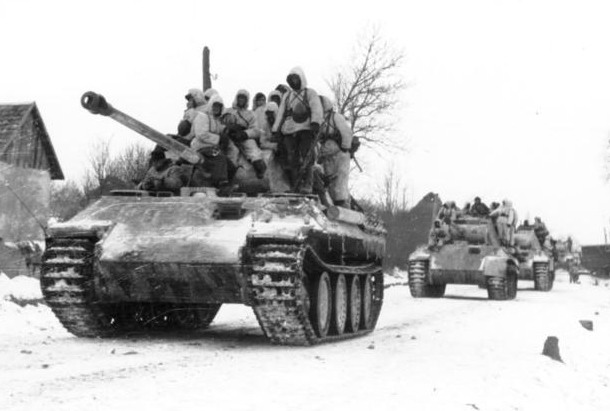
Panther Ausf. D tanks on the Eastern Front, late 1943, source: Bundesarchiv Bild 101I-664-6759-30, Wikimedia, Creative Commons, edited
Overall Assessment
From its combat debut in July to the end of 1943, a total of 493 Panthers were completely destroyed (for comparison, T-34 losses for the whole of 1943 amounted to an astonishing 14,000 vehicles). Around half of the lost Panthers were blown up by the Germans themselves when they could not tow a damaged vehicle away and capture by the enemy seemed imminent. Average monthly Panther losses in 1943 thus exceeded 80 vehicles. Production of new Panthers in the same period averaged over 200 per month, however, so the total number of these tanks in German service grew, and by 1 January 1944 the Germans had 1,177 Panthers available.
As the absolute number of tanks grew, so did the intensity of their use and consequently the absolute losses. During 1944 the Germans were losing an average of 233 Panthers every month — almost 8 per day. The production factories again more than compensated for losses that year, delivering an average of 314 new Panthers per month. By 1 January 1945 the army therefore had 2,151 Panthers available (regardless of their current operational status). The worst single month in Panther combat history was September 1944, when an astonishing 692 tanks were completely written off — roughly 23 per day. The last overall Panther strength report dates from February 1945 and gives a figure of 2,133. A considerable number of these vehicles must therefore have survived to the end of the war.
The reasons for the Panthers' initially mixed performance were therefore both flawed combat tactics and the enormous rush that accompanied the tank's development and introduction to production. Many design imperfections that would normally have been identified and resolved before production began were instead built into the series vehicles and had to be dealt with daily by soldiers in the field. Over time, a significant proportion of the defects were eliminated or mitigated, and the crews and mechanics learned what the vehicle demanded in order to show its true qualities. Even though things looked grim at Kursk, the Panther ultimately proved to be a very capable tank and did not disappoint its creators.
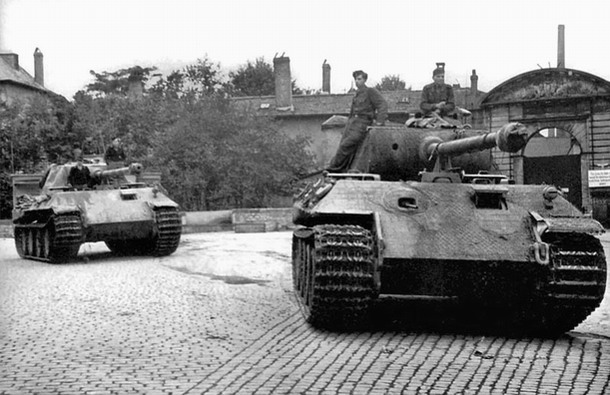
a pair of Panther tanks, source: Flickr.com with permission of the publishing user, edited
The Panther represented a balanced combination of protection, mobility and firepower. Its greatest strengths were undoubtedly its main gun and its running gear. The 75 mm KwK 42 L/70 gun had an extremely flat trajectory, making it very accurate and effective. In terms of armour penetration capability, this gun actually outperformed even the legendary 88 mm gun of the Tiger. Compared to the Tiger, the Panther was also a relatively inexpensive vehicle. The price of a single Panther without armament and radio equipment was 117,100 Reichsmarks — less than half the cost of a Tiger.
The suspension with road wheels sprung by double torsion bars allowed smooth cross-country travel even at higher speeds. It was of course more demanding to manufacture (requiring, for example, many holes to be drilled in the hull side plates) and more demanding to service (extracting and replacing densely packed torsion bars twisted by a mine blast was no easy job), but the suspension proved its worth. The only reason the same system was not to be used on the Panther II was to simplify production.
The Panther's greatest weaknesses, conversely, were its unreliable engine and — above all — its weak final drives (the components that transmit power from the gearbox to the drive sprockets and also contribute to steering). Particularly in the early Panthers, losses due to mechanical failure were substantially higher than losses due to enemy action, and failing final drives played the leading role. The designers had originally planned to use more advanced planetary-type final drives for the tank. These were, however, considerably more complex to manufacture, and under the general pressure to accelerate and cheapen production a different, cheaper but less robust type was used instead.
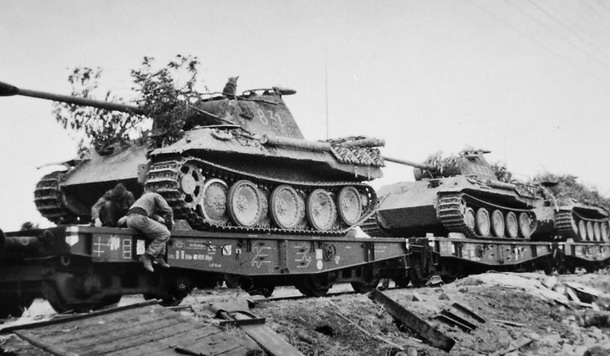
whenever at all possible, Panthers were transported by rail to reduce wear and tear, source: Flickr.com with permission of the publishing user, edited
The service life of most mechanical components was reportedly around 5,000 km. For the running gear and tracks it was only 2,000 to 3,000 km, and the engine lasted just 1,000 to 1,500 km (on early vehicles as little as 700 km). The final drives, however, could give out after as little as 150 kilometres — effectively the range of a single fuel load. The drive to maximise production of new tanks also meant that insufficient spare parts were manufactured for the very frequent repairs required.
The Germans were well aware of these weaknesses. Whenever at all possible, tanks travelled even short distances by rail rather than under their own power, to avoid unnecessary wear. They also knew the tank's strengths and tried to exploit them fully. Tank crews were instructed to avoid close-range engagements with the enemy. They were to seek combat at longer ranges in order to make the most of the gun's outstanding performance. This required good battlefield reconnaissance. Some tanks would advance about a kilometre ahead of the main Panther formation to draw out any concealed enemy. As soon as the enemy revealed himself, the Panthers were to destroy him with accurate fire at longer ranges. The flanks of an advancing Panther force were to be protected by lighter Panzer IV tanks or assault guns.
When handled correctly and used with the right tactics, the Panther became a genuinely fearsome fighting machine. Until the very end of the war, Panther crews could engage virtually any enemy tank with a high expectation of victory. The kill-to-loss ratio for this tank was strongly positive. The Panther is often described as the best tank of the entire Second World War — which is certainly an oversimplification. But among the best it most definitely belonged.
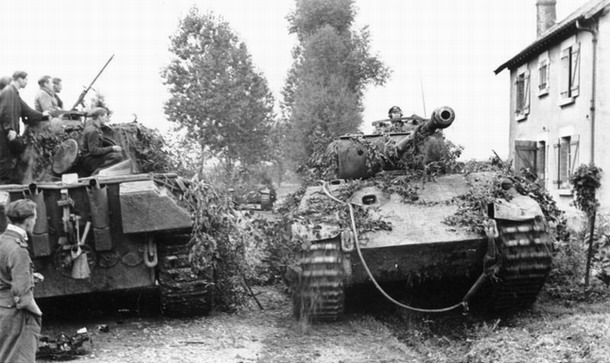
during the fighting in France, camouflage with branches was an absolute necessity due to overwhelming Allied air superiority, source: Bundesarchiv Bild 101I-301-1954-06, Wikimedia, Creative Commons, edited
The Panther chassis was used to build the equally famous tank destroyer Jagdpanther, armed with an 88 mm gun. The Germans also worked on developing an anti-aircraft variant of the Panther, designated Coelian, though its development was not completed. The drawing boards at Krupp and Rheinmetall-Borsig also saw several proposals for 128 mm self-propelled guns on the Panther chassis. The latter firm also prepared a proposal for another anti-aircraft variant armed with an 88 mm gun. None of these projects progressed beyond drawings or at most a reduced-scale mock-up.
Technical Data
|
weight: |
44.8 t |
|
length: |
8.66 m |
|
width: |
3.27 m |
|
height: |
2.99 m |
|
engine: |
Maybach HL 230 P30 |
|
engine power: |
700 hp |
|
max. road speed: |
55 km/h |
|
max. cross-country speed: |
30 km/h |
|
fuel capacity: |
730 l |
|
road range: |
250 – 270 km |
|
cross-country range: |
100 km |
|
hull armour: |
|
|
- front: |
80 mm |
|
- sides: |
40 mm |
|
- rear: |
40 mm |
|
turret armour: |
|
|
- front: |
110 mm |
|
- sides: |
45 mm |
|
- rear: |
45 mm |
|
crew: |
5 men |
|
armament: |
KwK 42 L/70 gun, 75 mm 2 × MG 34, 7.92 mm |

ARTICLE
CONTENTS:
Reproducing text from the Panzernet website without the written consent of the operator is prohibited.