Sd.Kfz. 251
the legendary half-track armoured personnel carrier
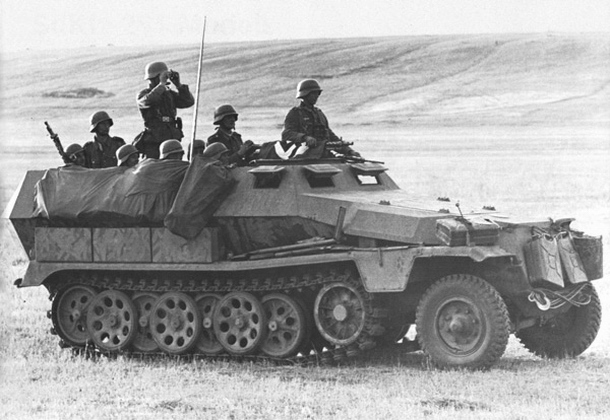
Sd.Kfz. 251 Ausf. C with the front machine gun on a fixed mount, source: Bundesarchiv_Bild_101I-217-0493-31, Wikimedia, Creative commons, edited
A great deal has naturally been written about so widely used a vehicle as the Sd.Kfz. 251, and one might assume that its history must by now be thoroughly documented. Unfortunately, in this case the opposite tends to be true — the more publications and authors one consults, the more versions and contradictions emerge between them. I must therefore apologise in advance for my frequent use of words such as "apparently," "probably," and "seemingly." Given these contradictions in the sources, I have chosen to base this article primarily on a thorough study of period photographs, since what one can see in a contemporary image is somewhat more reliable than conflicting written accounts. For this reason the article is literally peppered with references to specific photographs on which parts of the text are based. To give the reader some sense of the scale of this research: in writing this article I examined, with varying degrees of thoroughness, around four hundred photographs of the Sd.Kfz. 251 in all its variants.
Origins of the Vehicle
In the 1930s, the proponents of German armoured warfare pulled off something of a coup. They managed to establish the tank as the army's primary offensive weapon — a role that had previously belonged to the infantry. The tank was not to support the other arms; rather, everything else was to support the tanks, including the infantry. Conventional foot soldiers, advancing at walking pace at best, could not keep up with armoured formations and would in practice have slowed them down. Transporting them by truck solved the speed problem, but wheeled vehicles could not match tanks across country, and they offered the men aboard no protection from enemy fire. Blitzkrieg needed a new kind of carrier — one fast enough to keep pace with the tanks, able to go wherever the tracks could go, capable of protecting its occupants from small-arms fire, and ideally able to provide the infantry with direct fire support.
It clearly had to be an armoured vehicle. A wheeled chassis was out of the question, and building such a vehicle as a fully tracked machine would have been too expensive. The cost had to be kept reasonably low to allow mass production. The most practical approach was to use an existing chassis. By a process of elimination, the designers narrowed the field to several types of half-track artillery tractors, from which the leichter Zugkraftwagen 3t — better known as the Sd.Kfz. 11 — was selected as best meeting the requirements.
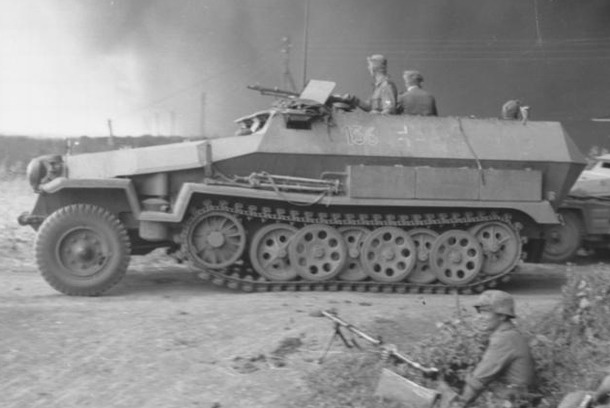
Sd.Kfz. 251 Ausf. C, source: Bundesarchiv_Bild_101I-792-0138-21A, Wikimedia, Creative commons, edited
This was a half-track vehicle developed from 1933 by Borgward (or more precisely its subsidiary Hansa-Lloyd). In 1938, the army project was handed over to Hanomag, which brought it to its final form designated Hkl 6 (sometimes written Hl Kl 6) — from which designation the half-track apparently acquired its nickname "Hakl." It was on this version of the tractor that the new armoured infantry carrier was to be built. Development began in 1937: Hanomag was to adapt the existing chassis for its new purpose, Büssing-NAG was to design the armoured hull, and final assembly of the vehicle was apparently entrusted to Deutsche Werke.
The vehicle was designated mittlerer Gepanzerter Mannschaftstransportwagen (MTW) — literally "medium armoured personnel carrier." Its ordnance designation was Sd.Kfz. 251 Ausf. A (Sd.Kfz. = Sonderkraftfahrzeug = special purpose vehicle, Ausf. = Ausführung = variant or mark). The first prototypes were built and tested in 1938.
Design Description
The running gear consisted of a front wheeled section and a rear tracked section. The front steerable axle was sprung by a single large transverse leaf spring. According to some sources, the front wheels had no brakes at all. The tracked section on each side comprised seven pressed-steel road wheels with circular lightening holes. Each wheel consisted of two discs. The odd-numbered wheels had their discs mounted close together on the axle, while the discs of the second, fourth, and sixth wheels were spaced apart — and it was into this space that the odd-numbered wheels fitted. The even-numbered wheels thus partially obscured the odd ones when viewed from the side. The last road wheel was raised slightly above the level of the others and served simultaneously as the idler. At the front was the drive sprocket, which was of a different design.
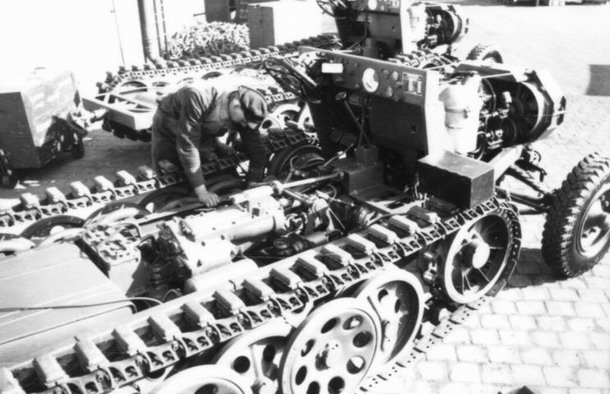
running gear for the Sd.Kfz. 251 (according to the original caption this is supposedly the standard Sd.Kfz. 11 running gear, i.e. Hkl 6, but the angled steering wheel and twin radiator fans indicate the Hkl 6p — the version specifically modified for the Sd.Kfz. 251), source: Bundesarchiv_Bild_101I-750-0001A-10A, Wikimedia, Creative commons, edited
The road wheels were sprung by torsion bars, which meant they could not be positioned exactly opposite one another on each side of the vehicle. The wheels on the left side were set further back, so the gap between the first road wheel and the drive sprocket was on that side about 14 cm larger than on the right. As a result, the left track was one link longer than the right (the left track had 56 links, the right 55). The tracks, 280 mm wide, were fitted with rubber pads for more comfortable travel on hard roads. According to some sources, the rubber pads were replaced by metal ones on the last production batches — a change that would certainly make sense in historical context, as rubber was becoming increasingly scarce for Germany toward the end of the war, and many tanks also lost their rubber-cushioned road wheel rims.
The chassis modified for the new purpose received the designation Hkl 6p. The modifications included, for example, the installation of a second radiator fan (the Sd.Kfz. 11 had a single large fan; the Sd.Kfz. 251 had two smaller ones), since the designers anticipated that the engine, enclosed in an armoured bonnet, would need more effective cooling. The steering wheel had to be tilted downward to fit beneath the planned frontal armour of the cab. The silencer and exhaust outlet were moved from the rear of the chassis to the left front side, into the space between the front wheel and the tracked section. The fuel tank may also have been modified.
Other components of the original tractor were naturally carried over. Chief among these was the powerplant — the Maybach HL42 TUKRM, a six-cylinder petrol engine of 4.2 litres displacement producing a maximum output of 100 horsepower at 2,800 rpm. The Hanomag 021 32785 U50 gearbox was also retained, offering four forward and one reverse gear ratio. The engine was located at the front of the chassis, with the gearbox beneath the cab floor. Behind the gearbox, also beneath the floor, sat a 160-litre fuel tank, whose filler neck opened directly into the cab floor. At first glance this might seem impractical, but it did offer certain advantages — fuel could be topped up from jerricans without leaving the vehicle, theoretically even while moving.
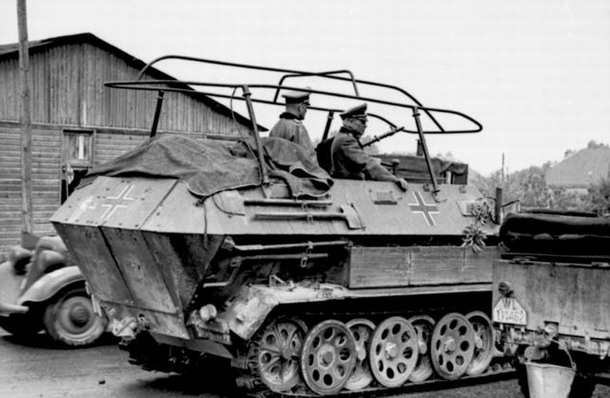
Sd.Kfz. 251 Ausf. A. Ausf. A vehicles are easy to identify by the vision ports in the sides of the troop compartment, source: Bundesarchiv_Bild_101I-769-0235-31, Wikimedia, Creative commons, edited
In addition to the main gearbox, the Sd.Kfz. 251 (and by extension the Sd.Kfz. 11) was fitted with a two-speed auxiliary transfer gearbox, giving the driver a total of eight forward and two reverse ratios. It is noteworthy that a significant proportion of sources make no mention of the auxiliary gearbox at all.
An modern armoured hull was fitted to the adapted chassis. Its detailed configuration changed with each production variant of the half-track (of which there were four in total, Ausf. A through D), but its basic concept remained unchanged and was consistent with that used on contemporary German armoured cars. The hull had an upper and lower portion with walls angled in opposite directions — widening from the hull bottom upward, then narrowing again. This design ensured that there was virtually no surface on the sides of the vehicle against which an enemy projectile could strike at a perpendicular angle. On the first three variants (Ausf. A through C), the rear wall of the vehicle was designed in the same manner.
At the front (speaking of the Ausf. A), the hull began with a narrow nose that was reminiscent in shape of a coffin lid. The frontal plate consisted of two separate panels, upper and lower. The lower panel had a rectangular cutout, closable by a single-piece cover. When this cover was opened, air could flow through the opening to the radiator mounted directly behind the front plate, improving its efficiency. Below the nose of the hull a simple tubular bumper was fitted, with conventional round headlights on either side of the frontal nose (later a third light of the Notek blackout type was added to the left front wheel mudguard).
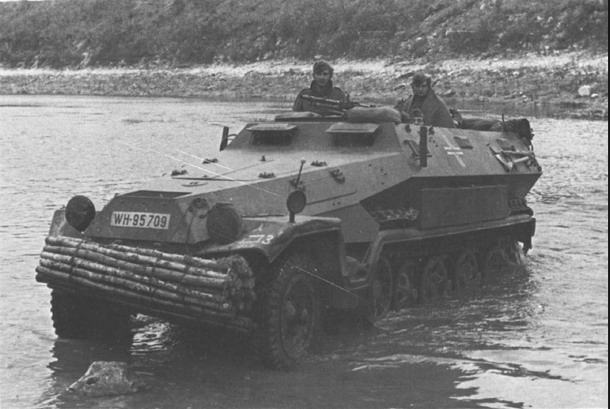
Sd.Kfz. 251 Ausf. A with the front machine gun on a fixed mount; note the vision ports in the sides of the troop compartment, source: Flickr.com, courtesy of the publishing user, edited
Behind the frontal nose came the engine bonnet, whose sides flared outward and whose top plate rose gradually upward. Just behind the edge of the front nose was a further ventilation opening in the top of the bonnet for additional air supply to the radiator, protected not by a solid cover but by a close-mesh grille. Behind this grilled opening was a small circular cover concealing the radiator filler cap. Further back, the main service access panel was cut into the upper bonnet plate with a two-piece lid whose halves hinged outward to the sides. Additional openings in the engine compartment armour were located on the sides of the bonnet — one oblong opening on each side with a single-piece cover that opened upward. These cutouts could of course also be used for servicing the engine, but their primary purpose was to allow improved ventilation of the engine compartment when needed. For this reason they could probably be opened remotely from the driver's position, allowing the driver to operate them while on the move.
The engine compartment sides were followed at the front by angular sheet-metal mudguards over the front wheels, fitted with small indicator posts to show the driver the vehicle's width. A rear-view mirror for reversing was attached to the left indicator post. The term "front wheel mudguard" is not entirely accurate, since the mudguard was in fact shared by both the front wheel and the tracked section — it ran along each side from the nose all the way to the stern, with a sort of lowered saddle in the space between the front wheel and the start of the tracks. On the left side, the silencer was housed in this saddle section.
The engine bonnet extended quite far rearward, only giving way to the front wall of the cab at the level of the gap between the first road wheel and the drive sprocket of the track assembly. At this point the sides also stopped flaring outward, and from here back the hull width was constant. In the forward part of the cab sat the only two permanent crew members — the driver and the commander, who also operated the radio. The cab's front wall contained two observation ports: the left one for the driver, the right for the commander. These ports were fitted with covers that hinged upward. When in a dangerous area the ports were closed, and both men could only observe through narrow vision slits in the covers. From inside, the ports were additionally protected by a frame of bulletproof glass. A further identically designed vision port was located in each side wall — the left for the driver, the right for the commander.
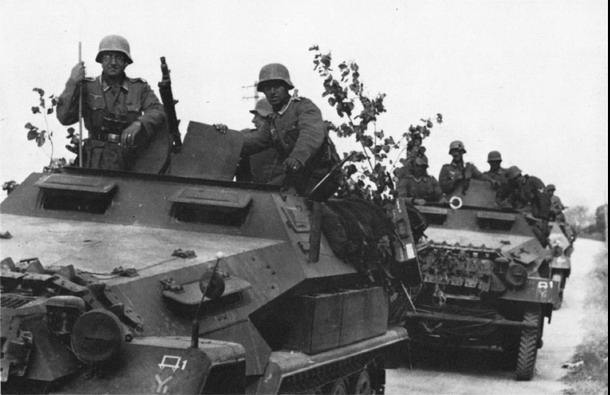
Sd.Kfz. 251 Ausf. B; note the emblem of the 8th Panzer Division on the front wheel mudguard, source: Flickr.com, courtesy of the publishing user
The forward section of the cab, unlike the rest of it, had a fixed roof. The driver and commander were thus the best-protected men aboard — surrounded by armour on all sides except behind them, where the troop compartment began. Soft padding was attached to the roof above both men's heads for safety and comfort. Neither the driver nor the commander had dedicated entry and exit hatches; to leave the cab they had to pass rearward through the troop compartment. To ease this, their seats had folding backrests. A particularly interesting feature was an arc-shaped pipe fitted in the centre of the cab beneath the instrument panel. Running from the engine compartment into the cab, it delivered warm air heated by the engine — a very welcome feature in the conditions of a Russian winter. According to some sources, this heating system was not introduced until the Ausf. C variant.
The driver controlled the vehicle with a steering wheel, a standard set of three pedals, and two gear levers — the second belonging to the two-speed auxiliary transfer gearbox. The handbrake lever was to the driver's right. Given the considerable length of the track contact area, the Sd.Kfz. 251 (like the Sd.Kfz. 11) had to use a steering method typical of fully tracked vehicles. Only for gentle turns could conventional automotive steering via the front wheels alone be used. Once the driver turned the steering wheel more than 15 degrees, braking of the inner track was automatically engaged. The relative complexity of this steering system was more than compensated for by the excellent cross-country performance that the large track surface provided. For safe operation on ordinary roads and in urban streets, the half-track was fitted with mechanical turn indicators, mounted externally on the side cab armour, folding outward to indicate a turn.
As already mentioned, the vehicle commander doubled as the radio operator. The standard radio fit of the Sd.Kfz. 251 was the Fu Spr f set (Funksprechgerät f). On the Ausf. A (and according to some sources also the Ausf. B), the radio was mounted on the right side wall above the commander's shoulder. This location proved impractical, however, and from the Ausf. B (or Ausf. C, depending on which source one believes) the set was moved forward to below the commander's front vision port. The radio's whip antenna was relocated from the right mudguard to the rim of the cab's side wall. The set's range was approximately 5 km when stationary and around 3 km while on the move.
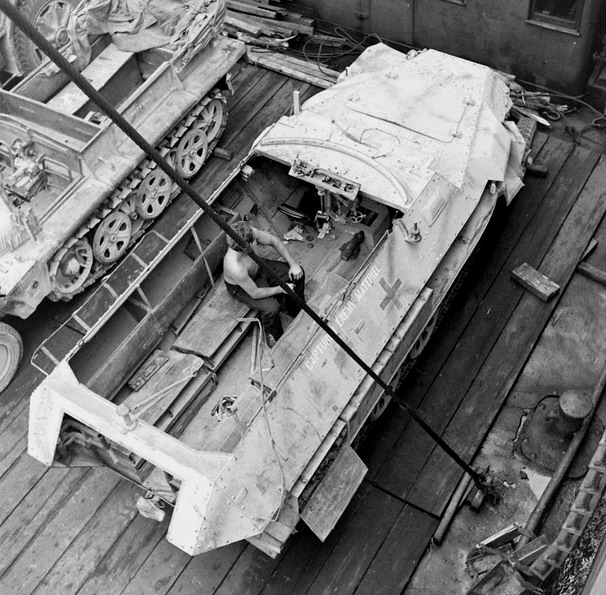
a wonderful view into the troop compartment of an Sd.Kfz. 251 Ausf. C; the front machine gun was mounted on a fixed bracket; this vehicle was captured by the Americans and is being loaded aboard a freighter for transport to the United States, source: internet, Public domain, edited
The troop compartment for the infantry began behind the driver's and commander's seats. Bench seats ran along both sides. Early vehicles apparently had a single long bench on each side. On most vehicles, however, the benches were divided into two separate sections — the forward section being longer, seating three soldiers, and the shorter rear section seating two more. Five soldiers therefore sat on each side, side by side, perpendicular to the direction of travel and facing the soldiers on the opposite benches. Behind the bench backrests was a space for storing rifles. The area directly beneath the bench seats was left unused; only in the floor of the vehicle was there provision for stowing machine gun ammunition (still referring to the Ausf. A). The roof of this section of the cab remained open, which made movement inside more comfortable and gave the soldiers a good all-round view. On longer moves they could also sit on the edge of the hull rather than being confined to the benches. When soldiers sat on the benches, their heads partly protruded above the side walls, which presumably made it obligatory to wear steel helmets inside the vehicle at all times. In the side walls of the troop compartment there were two vision ports on each side, protected from inside by bulletproof glass (still referring to the Ausf. A). These side ports were non-openable and could only be looked through via a slit.
The upper edges of the side walls were rimmed with a rail from which various items of equipment could be hung — rucksacks, canteens, gas mask cases, and jerricans. In bad weather, the open roof could be covered with a waterproof canvas tarpaulin. Over the open space the tarpaulin would have sagged without support, however, so it had to be held up. For this purpose, metal strips were laid across the open roof, anchored to the side walls, and arched upward to create hoops — a canvas-covered vehicle can be seen clearly in the photograph HERE (source: worldwarphotos.info).
Infantry boarded and disembarked through large double doors in the rear wall of the cab, hung on heavy tubular hinges. A lever on the left door leaf unlocked the doors when lifted. The locks took the form of rods that engaged into the floor below and into a header above. A fire extinguisher was attached to the inside of the right door leaf. On the outside of the doors, jerricans of petrol or water were sometimes hung. Below the doors, on the rear face, was a towing device and an electrical socket for supplying a towed trailer or equipment. Thanks to the open roof, soldiers could also bail out over the sides in an emergency.
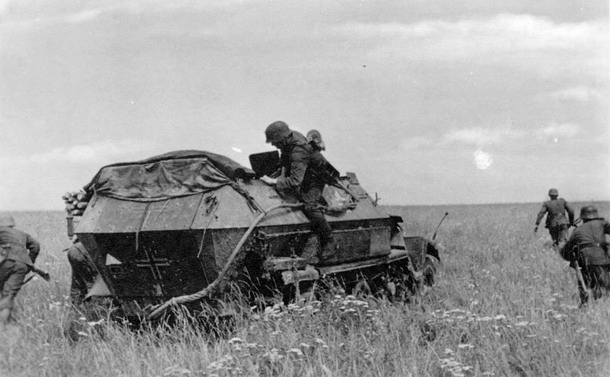
Sd.Kfz. 251 during a dismount; note that the rear doors remain closed and the soldiers have chosen to jump over the sides instead, source: Flickr.com, courtesy of the publishing user, edited
The inward slope of the side walls created a free space above the track mudguards which the designers used to fit toolboxes for small tools and various supplies. Large working tools such as spades and crowbars were carried hanging in leather straps on the upper sections of the cab side walls.
The front and rear halves of the hull were manufactured as separate assemblies — each welded (or in some cases riveted) from steel plates — and then bolted together on the chassis. The front section ended at the level of the rear edge of the driver's and commander's cab roof. This arrangement was chosen for servicing reasons: if a more involved repair of the powerplant was needed that the service access panels in the engine bonnet could not accommodate, it was not necessary to remove the entire hull from the chassis — only the front section. Field workshops with their standard equipment could therefore handle the job.
Armour thickness was greatest at the nose of the hull, at 14.5 mm. The engine bonnet had 8 or 10 mm of armour (sources differ), while the front of the cab, its sides, the rear, and the floor all had 8 mm, with the floor being a mere 6 mm thick. In its basic infantry carrier configuration, the Sd.Kfz. 251 carried two MG34 machine guns, mounted on swivel arms at the front and rear edges of the open cab. The guns could be loaded either from a drum magazine or from a standard belt. On some vehicles the front gun was fitted in the "heavy" configuration — a low cradle with a periscope and remote trigger — allowing the operator to fire while remaining concealed inside the cab. Since Ausf. A vehicles had no standard gun shield on the front machine gun, crews sometimes improved their protection by piling sandbags on the front cab roof. Photographs confirm that on some Ausf. A vehicles the original front gun mount was later replaced with the more modern type with a shield. In non-combat conditions the guns could be removed from their mounts and stowed behind the benches in the space between the seat cushions and the backrests. The on-board ammunition supply was probably around 2,010 rounds.
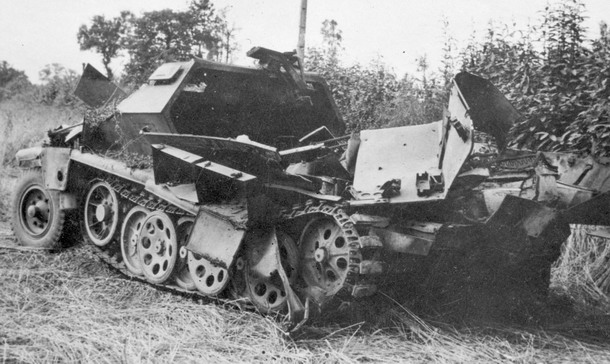
this photograph of an Sd.Kfz. 251 torn apart by an explosion clearly shows the join between the front and rear hull sections (do not be misled into thinking the Sd.Kfz. 251 had such thick armour as the profile visible at the end of the front hull section might suggest — what you are looking at is the bent section connecting the two hull halves, not a cross-section of armour plate), source: Flickr.com, Public domain, edited
As for the weight of the half-track, combat weight is most commonly cited in the sources. This figure (at least by current Czech Army definitions) includes 100% fuel and all operational fluids, armament and ammunition, all personnel carried with their full personal kit and weapons, plus any additional special equipment and stores not normally supplied with the vehicle but required to fulfil a specific combat mission. Combat weight of the Sd.Kfz. 251/1 Ausf. A is variously given as 8.5 to 8.9 tonnes (different sources give different figures). Some publications also cite a maximum permissible weight (the highest weight specified by the manufacturer based on the vehicle's construction) of 9 tonnes. The last figure I have seen is the weight of the half-track without armament, fuel, or crew, reportedly 7.4 tonnes — though other figures without identification of weight type also appear (for example, both the Czech and English Wikipedia give 7.81 tonnes without further explanation). On roads the Sd.Kfz. 251 was capable of a maximum speed of 52.5 km/h. A full tank of petrol was sufficient for around 300 km on roads and approximately 150 km cross-country.
Series Production
As noted above, prototypes of the new armoured personnel carrier were tested in 1938. The vehicle met the army's expectations and series production was soon initiated. The exact date is unclear, however, and sources disagree. The same is true of the date on which the army took delivery of the first series-produced vehicles. Some accounts state that production began in June 1939; others claim that the first series-built vehicles were delivered to the army as early as spring of that year; and some authors maintain that not a single Sd.Kfz. 251 was accepted by the army before the end of 1939. I will follow the first version, according to which series production of the carrier began in June 1939. By the time war broke out on 1 September 1939, only a negligible number of vehicles had been delivered. Even so, the type managed to see service in the Polish campaign, apparently with the 1st Schützen Regiment of the 1st Panzer Division.
The Unarmoured Version
In the first months, production did not ramp up as quickly as the army wished, with deliveries of armour plate being a particular bottleneck. The Germans therefore resorted to a stopgap and began producing vehicles from untempered steel alongside the fully armoured half-tracks. More than three hundred of these were probably built during 1939. The official designation of this sub-variant was mittlerer ungepanzerter Mannschaftstransportwagen (ungepanzerter = unarmoured).
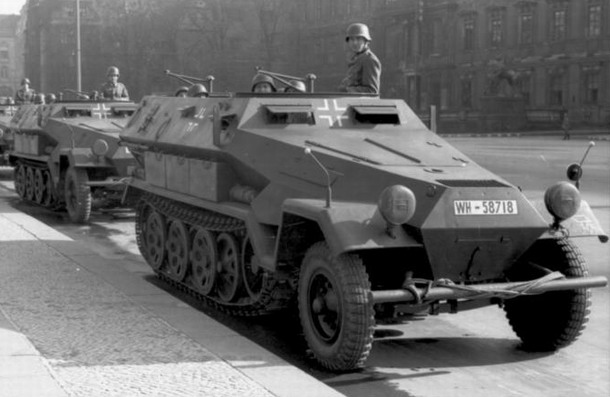
the unarmoured Sd.Kfz. 251, or ungepanzerter Mannschaftstransportwagen; unarmoured vehicles can be identified by several details — notably here the openable vision port in the side of the troop compartment, source: Bundesarchiv_Bild_101I-801-0664-36, Wikimedia, Creative commons, edited
In practically all respects the unarmoured vehicle matched the performance of the standard Sd.Kfz. 251 — it was simply less resistant to enemy fire. Visually, the unarmoured half-track differed from the armoured version in several details. The hull nose was formed from a single plate: the fold present on the standard vehicle where two plates were welded together was here simply a bend in the single front plate. Another key identifier is the vision port covers in the front and side cab walls — on the unarmoured version these were flat, with the observation slit positioned at mid-height (the standard vehicle's covers were convex, with the slit at the bottom). The troop compartment side vision port covers were openable on the unarmoured version, unlike on the armoured one. A final difference was the two-piece main service access hatch in the engine bonnet, which stood proud of the upper bonnet surface rather than flush with it.
Despite its reduced protection, the ungepanzerter Mannschaftstransportwagen was assigned to units as a normal combat vehicle. Once the army had sufficient fully armoured half-tracks in hardened steel, however, the unarmoured vehicles were transferred to non-combat duties such as driver training.
Ausführung B
Production of the Ausf. A probably ended at the turn of 1939–40, with a total of 232 vehicles built (plus the approximately three hundred unarmoured ones). From January 1940 production switched to the Ausf. B. The changes from the first variant were minor. The radio set, located on the Ausf. A on the right side wall above the commander's shoulder, was on the Ausf. B moved forward to below the commander's front vision port. The radio antenna was relocated from the right mudguard to the rim of the cab's side wall. Some authors place this radio relocation at the Ausf. C instead, but the antenna move on the Ausf. B — clearly demonstrated by photographs — suggests the radio itself was indeed already moved on this variant.
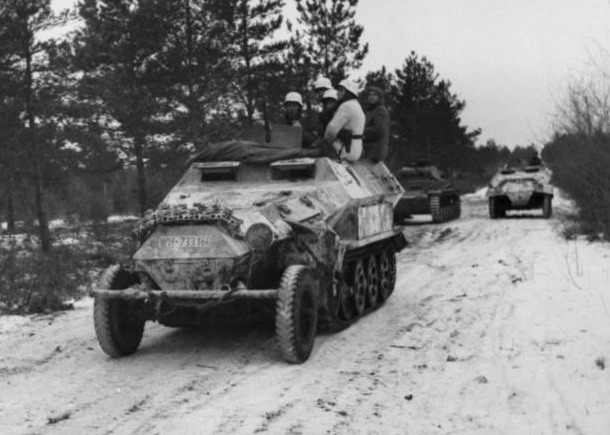
Ausf. B vehicles no longer had vision ports in the sides of the troop compartment; Russia, winter 1941, source: Bundesarchiv_Bild_101I-268-0178-06, Wikimedia, Creative commons, edited
The vision ports in the sides of the troop compartment were eliminated on the Ausf. B. There may also have been minor changes to the instrument panel layout and internal storage within the cab. Another new feature was the replacement of the original rotating front machine gun arm with a mount fitted with an arrow-shaped shield. This change was not introduced immediately from the start of production, however — the first Ausf. B vehicles still had the original rotating arm at both front and rear. Only during the production run was the new mount with its characteristic shield introduced, and it subsequently began to be retrofitted to earlier vehicles as well (and occasionally even to Ausf. A vehicles, as mentioned above). Production of the Ausf. B continued until the end of 1940, with approximately 340 examples built according to some sources.
Ausführung C
Apparently in early 1941, the Ausf. C entered production. Vehicles of this variant received a new engine compartment nose. Instead of the original complex multi-panel nose, there was now a single sloped hexagonal plate with a bend at the bottom. Immediately above this lower bend was a centrally positioned hole for inserting the starting handle. The ventilation openings in the sides of the engine bonnet were completely redesigned: instead of the closable cutouts in the armour, fixed box-shaped covers were used. These were open at the bottom, allowing permanent airflow while keeping the armour continuous. This new solution was effective enough that the original grilled ventilation opening in the front section of the top bonnet plate could be eliminated entirely.
The track mudguard on the Ausf. C was not horizontal. At the front it was raised, sloping very gently rearward; just above the second road wheel there was a barely perceptible kink, and from there back the mudguard was again level. The designers wanted to gain more clearance above the drive sprocket, since on earlier variants the space beneath the mudguard had apparently often become packed with mud, causing it to impede the track. The forward slope of the track mudguard is very clearly visible in the photograph HERE (Bundesarchiv_Bild_101I-258-1320-10, Wikimedia, Creative commons, edited). In connection with this change, the equipment boxes on the mudguards were shifted considerably further rearward, freeing up space at the front of the mudguards for larger tools such as spades and crowbars, which on Ausf. A and B vehicles had been hung on the sides of the cab.
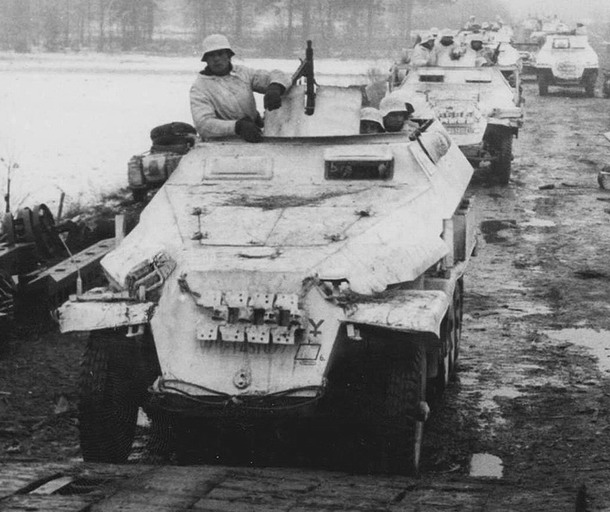
Ausf. C vehicles had (among other changes) the new front nose and the box-shaped air intake covers on the sides of the engine bonnet, source: Flickr.com, courtesy of the publishing user, edited
Another mudguard modification is also visible in photographs. On some Ausf. C vehicles, the saddle of the right mudguard in the space between the front wheel and the tracked section was plated over, making it solid. The mechanical turn indicators, positioned on Ausf. A and B vehicles near the driver's and commander's side vision ports, were moved on the Ausf. C to the side of the engine bonnet at approximately the level of the start of the tracks. Further changes were made inside the cab, including the creation of new storage space directly beneath the bench seats.
With the Ausf. C, production of the vehicle shifted into a higher gear. Many additional firms were brought in — Wesserhütte, Wumag, Schichau, Adler, Auto-Union, Škoda, Schöller & Beckmann, and others. Worth mentioning in this context is a firm from Česká Lípa that supplied armoured hulls. Its exact name I was unable to verify — Bohemia and EPA are both mentioned in sources, though I found no information about firms of either name operating in Česká Lípa during the war. Regardless, this Czech firm entered the history of the Sd.Kfz. 251 on account of its different hull manufacturing technique. Apparently due to a lack of equipment and experience with welding armour plate, the firm used riveting instead. How many Ausf. C half-tracks with riveted hulls were produced I was also unable to determine, but photographs confirm that this applied to many different variants — the basic Sd.Kfz. 251/1, the mortar-carrier Sd.Kfz. 251/2, the engineer version Sd.Kfz. 251/7, the ambulance Sd.Kfz. 251/8, the gun-armed Sd.Kfz. 251/10, and the flamethrower Sd.Kfz. 251/16.
Ausführung D
Production of the Ausf. C continued until August 1943, when it was superseded by the fourth and final variant, the Ausf. D. This variant arose from the German drive to simplify and cheapen production of the half-track sufficiently to deliver it in greater numbers. The Eastern Front was literally consuming soldiers and equipment, and the existing production rate could not meet the army's demands. Maximum simplification of the design was therefore necessary.
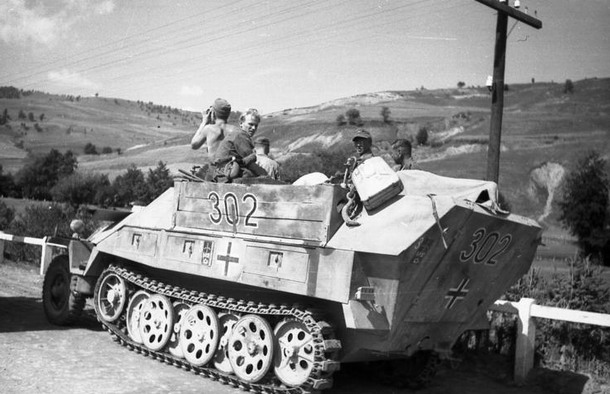
the Ausf. D was characterised by the built-in stowage boxes above the tracks and the sloped rear wall, source: Bundesarchiv_Bild_101I-715-0212A-27A, Wikimedia, Creative commons, edited
The designers focused first on the hull shapes. By redesigning them, the number of armour plates on the Ausf. D was reportedly reduced by half — meaning less cutting, less welding, and significant savings in time and money. Among the most prominent simplifications was the elimination of the box-shaped ventilation covers on the sides of the engine bonnet. Instead, the upper bonnet panels were extended further down and outward to merge with the front wheel mudguards. Behind the front wheel, where the mudguard dipped, a gap remained below the extended bonnet armour, and this was now where the necessary air entered the engine compartment — simple, elegant, and effective. The entire tracked-section mudguard could be done away with entirely, as the space above the tracks was now filled by vertical armour with integrated stowage boxes, three on each side.
Perhaps the most striking change, however, was the treatment of the rear hull wall. It was no longer kinked at mid-height as on earlier models, but instead was flat and steeply sloped throughout its full height, with the upper hull extending further rearward as a result. The entry doors no longer needed complex tubular hinges — ordinary hinges sufficed, since the door leaves were now made of flat plates. The one slight disadvantage was that the doors had to be locked at all times, otherwise gravity would cause them to swing open continuously. Other changes included the replacement of the padded benches with wooden ones resembling park benches, and the replacement of the openable vision ports beside the driver and commander with simple vision slits cut directly into the side armour. Of the three headlights on earlier variants, only one remained on the Ausf. D, mounted on the left front wheel mudguard. Finally, the original MG34 machine guns were replaced by the more modern MG42.
During the production run of the Sd.Kfz. 251 Ausf. D, further minor detail simplifications were introduced. The original hinged covers of the driver's and commander's front vision ports were replaced on later examples by simpler flat covers (clearly visible in the photographs HERE (Public domain) and HERE (Public domain)). The engine bonnet service access arrangements also changed: the front section above the radiator became openable, hinging to the right (photo HERE (Public domain)), and the two-piece main service hatch was replaced by a single large lid that opened toward the front wall of the cab (photo HERE (Public domain)).
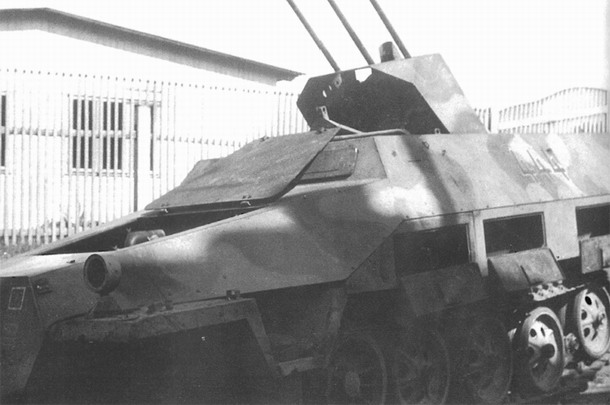
late Ausf. D half-track (single-piece engine bonnet service hatch and flat vision port covers in the front cab wall), source: Flickr.com, Public domain, edited
The Ausf. D delivered what was expected of it, enabling production of the half-track to reach previously unseen levels. More Ausf. D vehicles were produced than all three preceding variants combined. In 1944, when production reached its peak, approximately 7,800 half-tracks left the factories. Total production of the Sd.Kfz. 251 in all variants over the years 1939 to 1945 reached somewhere between 15,000 and 16,000 examples, depending on which source one trusts.
As noted above, the half-track's original official designation was mittlerer Gepanzerter Mannschaftstransportwagen. In early 1941 this was changed to mittlerer Schützenpanzerwagen (SPW). The ordnance designation Sd.Kfz. 251 remained unchanged, followed by the variant designation (Ausführung), e.g. Sd.Kfz. 251 Ausf. B. The half-track had proven itself a highly effective machine from the very start of its career, and it is no surprise that the army quickly sought to use it in roles other than infantry transport. Specialised variants for various purposes began to emerge, distinguished by an additional number after a slash in the ordnance designation. A full vehicle designation might therefore look like this: Sd.Kfz. 251/6 Ausf. A. Each specialised variant also received its own full official name, such as mittlerer Krankenpanzerwagen. A total of 23 such special-purpose variants were produced, and these are described below.
Sd.Kfz. 251/1
The Sd.Kfz. 251/1 was the basic variant of the half-track — the armoured infantry carrier described in detail above.
Sd.Kfz. 251/2
The first specialised variant was the self-propelled mortar Sd.Kfz. 251/2, with the full designation mittlerer Schützenpanzerwagen (Granatwerfer) (Sd.Kfz. 251/2). An 8 cm Granatwerfer 34 (GrW 34) mortar of 81.4 mm calibre was mounted in the forward half of the fighting compartment. The weapon fired 3.5 kg mortar bombs to a range of up to 2.4 km. The GrW 34 was noted for its accuracy and high rate of fire — 15 to 25 rounds per minute. The mortar's baseplate was probably bolted to the cab floor to prevent it shifting during firing; lateral traverse was therefore only possible within the range permitted by the weapon's traversing mechanism, beyond which the whole vehicle had to be repositioned. A second standard baseplate was also carried aboard, so that if necessary the mortar could be dismounted from the vehicle and used as a conventional infantry weapon with the second baseplate.
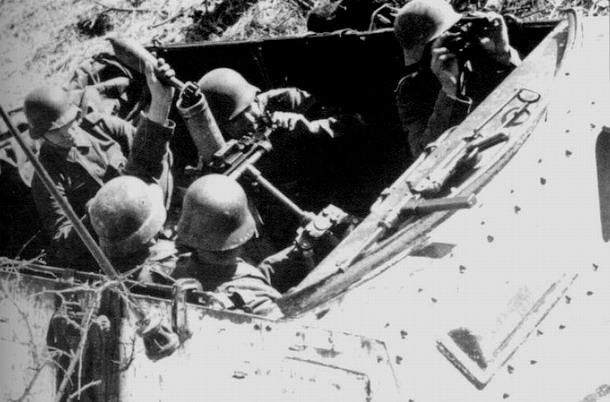
a fine view into the fighting compartment of the Sd.Kfz. 251/2, source: Flickr.com, courtesy of the publishing user, edited
In addition to the driver and commander, the crew numbered six further men. The rear seat on the right side of the vehicle was removed and the space used for stowing mortar ammunition. Further bombs were apparently stored under the remaining seats as well. A total of 66 rounds were carried aboard. The front machine gun was removed to avoid interfering with mortar fire. The rear machine gun was retained, with 2,010 rounds carried for it. The weight of this variant was 8.64 tonnes. The Sd.Kfz. 251/2 apparently entered production in spring 1941.
Sd.Kfz. 251/3
Next in sequence was the Sd.Kfz. 251/3. There is one significant conflict in the sources regarding the use of this designation. According to some credible online sources, the index was used twice: first in 1940 for an artillery tractor, and then again in 1943 for a radio vehicle (after production of the tractor ended), with the Sd.Kfz. 251/4 designation being assigned to the ammunition carrier that accompanied the artillery tractor. However, none of the three printed publications on the Sd.Kfz. 251 I was able to consult supports this version. According to these books, the index 251/3 was used from the outset for the radio vehicle, the artillery tractor of the infantry gun carried the designation Sd.Kfz. 251/4, and a separate ammunition carrier designation is not mentioned at all. I will follow the version described in these books.
The armoured radio vehicle Sd.Kfz. 251/3 appeared in 1940. Its full designation was Mittlerer Funkpanzerwagen (Sd.Kfz. 251/3). This vehicle existed in multiple sub-variants differing in their role and corresponding radio fit. Some sources list five sub-variants, others nine or even ten. Radio sets of types FuG 4, FuG 5, FuG 7, FuG 8, FuG 11, FuG 12, Fu Spr f, Fu Tr 30 Mw, Fu Tr 80 Mw, Fu Tr 100 Mw, and apparently others, were fitted in various combinations. The radios were installed in a tubular frame in the right rear half of the cab, with the operators seated on the opposite bench. The radio frame substantially narrowed the passage for entering and exiting the vehicle through the rear, so photographs sometimes show a metal ladder hung on the side armour to allow boarding and alighting over the side through the open cab roof.
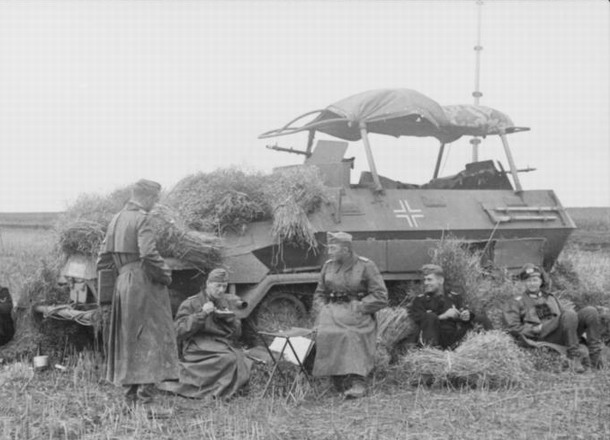
Sd.Kfz. 251/3 Ausf. A in a camouflaged position with the telescopic antenna fully extended, source: Bundesarchiv_Bild_101I-187-0208-27, Wikimedia, Creative commons, edited
Different radio configurations corresponded to different antenna combinations. The most common was a large frame antenna combined with one or two whip antennas. The frame antenna was supported on four brackets and extended over the entire cab. It existed in at least two versions — with and without an internal cross (the former being more common). Sub-variants with more powerful sets such as the FuG 11 also carried an extendable whip antenna 8 or 9 metres long with a branched tip (known as the Kurbelmast).
Photographs reveal at least three different mounting positions for the telescopic antenna, apparently depending on the specific sub-variant. Most commonly it was mounted externally on the right rear corner of the hull. Some vehicles, however, have the antenna inside the cab or on the rear wall. In the latter case, the antenna apparently prevented the right rear door from opening, though this was no real handicap since this side was already blocked from inside by the radio frame. The telescopic antenna was extended using a hand crank, and could only be fully deployed when the vehicle was stationary, at which point the half-track effectively became a fixed communications station.
The purpose of the Sd.Kfz. 251/3 radio vehicles was to coordinate the activities of different units and arms. Some sub-variants were focused on communication between ground units and air support, others on linking command with artillery or armoured formations, and some apparently also served as command vehicles. Specific sub-variants can sometimes be identified by the men aboard — if, for example, the soldiers are wearing Luftwaffe insignia and flying helmets, it is clear that this is the sub-variant intended for communication with the air force.
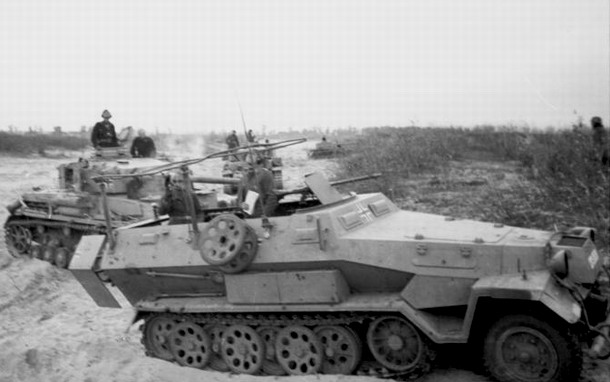
Sd.Kfz. 251/3 Ausf. A in the sub-variant for communication between ground units and the air force (the crew members are wearing aviator headphones; note also how practically all the men in the photograph are looking skyward); the frame antenna brackets are original, but the antenna itself is improvised, source: Bundesarchiv_Bild_101I-088-3710-13, Wikimedia, Creative commons, edited
Some sub-variants of the Sd.Kfz. 251/3 are virtually impossible to distinguish from the command vehicle Sd.Kfz. 251/6 in photographs, since they carried a frame antenna of identical design. As a result, one frequently encounters the same photograph described in some books or online sources as an Sd.Kfz. 251/3 and in others as an Sd.Kfz. 251/6 — and this article may not be immune to the same error. To complicate correct identification further, there is also a considerable number of photographs showing various improvised radio or command vehicles.
A reader may for instance come across a photograph of an originally engineer-variant Sd.Kfz. 251/7 fitted with a frame antenna apparently taken from some type of armoured car, or photographs of vehicles with bent frame antennas clearly fabricated in the field (as in the photo HERE (Bundesarchiv_Bild_101I-088-3710-09, Creative commons, edited)), or even one with an antenna welded from straight sections and strung with wire so that it looks more like a bed frame than a radio accessory. There is also a photograph of a vehicle on which the crew used the branched tip cut from a telescopic antenna as an ordinary side-mounted whip. Who could then say whether one is looking at an Sd.Kfz. 251/3, an Sd.Kfz. 251/6, or something entirely outside the standard numbering system?
And if that were not enough, there were also Sd.Kfz. 251/3 vehicles without the frame antenna at all. The highly conspicuous frame antenna advertised from a distance that this was an important vehicle, and on some later-production radio vehicles it was therefore replaced by a far less obvious star-tipped whip antenna, usually mounted on the left side or at one of the rear corners of the cab. This was supplemented by two additional simple whip antennas which were not permanently fixed to the armour but attached to removable brackets that could be taken off the armour and stowed inside the cab along with the antennas (these removable whip antenna brackets are clearly visible in the photograph HERE (Flickr.com, courtesy of the publishing user, edited)). With the antennas removed, the vehicle was even less conspicuous and gave no impression at first glance of being any kind of special communications vehicle. This configuration of the Sd.Kfz. 251/3 is depicted in an illustration from the operating manual HERE, and an actual vehicle of this type is shown in the photograph HERE (Bundesarchiv_Bild_101I-088-3711-10A, Creative commons, edited).
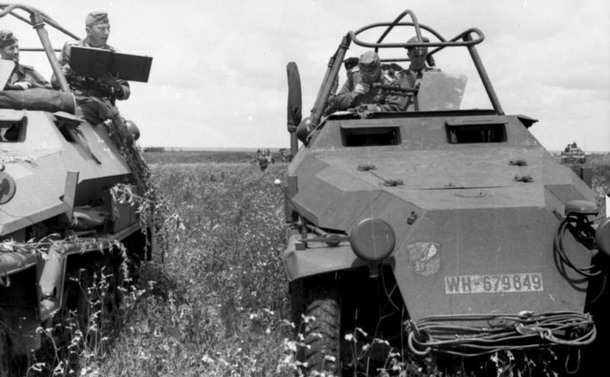
Sd.Kfz. 251/3 Ausf. C; note the folded telescopic antenna on the right rear corner of the hull (covered by a cloth sleeve), source: Bundesarchiv_Bild_101I-216-0404-22, Wikimedia, Creative commons, edited
The weight of the Sd.Kfz. 251/3 is usually given as around 8.5 tonnes. Although it was not intended for direct engagement with the enemy, this radio vehicle carried the standard armament of front and rear machine guns with a supply of 2,010 rounds. Photographs exist showing two different examples of this radio vehicle with an interesting field modification: the front machine gun has been replaced by an anti-tank rifle Panzerbüchse 41 of 28 mm calibre with a tapered bore (28 mm at the chamber, only 20 mm at the muzzle). The crew evidently wanted to improve their chances of survival in an unplanned encounter with enemy armour.
Sd.Kfz. 251/4
The Sd.Kfz. 251/4 was a tractor for towing artillery pieces. Its full designation was mittlerer Schützenpanzerwagen (IG) (Sd.Kfz. 251/4), where the letters IG apparently abbreviated Infanterie Geschütz — infantry gun. The carrier was fitted with a stronger towing hook capable of holding heavier loads without difficulty. Otherwise the vehicle was mechanically identical to the basic Sd.Kfz. 251/1, and if it does not currently have a gun in tow, it cannot be identified in photographs.
The vehicle was originally intended to tow the light infantry gun 7.5cm le IG 18, but in practice it was routinely used to tow other weapons as well, such as the howitzer 10.5cm le FH 18 or the anti-tank guns 3.7cm PaK 36, 5cm PaK 38, and 7.5cm PaK 40. The Sd.Kfz. 251/4 also carried the gun crew and apparently a supply of ammunition alongside the gun itself. It was not intended for direct combat. The 7.5cm le IG 18 that it towed was designed to provide conventional artillery support at relatively long ranges (up to 3.5 km) from firing positions well behind the front line. This is why most photographs show the machine guns removed — they simply were not needed and only got in the way.
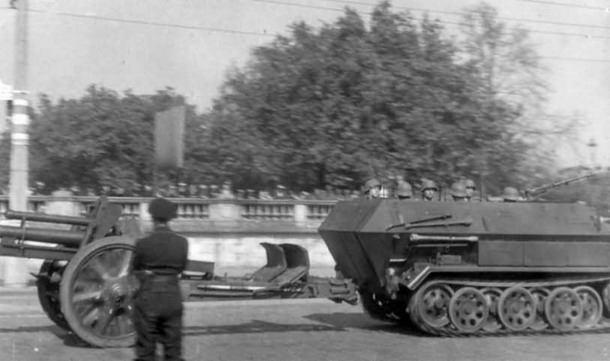
Sd.Kfz. 251/4 Ausf. A towing a light howitzer 10.5cm le FH 18, source: worldwarphotos.info, courtesy of the site operator, edited
This was not the case, of course, when the tractor was towing one of the anti-tank guns mentioned, which fired at direct-fire ranges. In such situations the Sd.Kfz. 251/4 inevitably found itself in the combat zone, where it risked direct contact with the enemy, and the machine guns became potentially useful. Photographs exist of an Sd.Kfz. 251/4 (photo HERE (Flickr.com, courtesy of the publishing user, edited)) towing a PaK 40 anti-tank gun, in which the crew had further enhanced the vehicle's armament by fitting a Panzerbüchse 41 anti-tank rifle of 28/20 mm calibre in place of the front machine gun. So equipped, the tractor could defend itself against an enemy armoured vehicle even in the moments when the towed gun was not ready to fire.
As already noted, the Sd.Kfz. 251/4 can only be identified in photographs if it currently has a gun in tow. Even this identification is not foolproof, however. Given the enormous proliferation of the Sd.Kfz. 251, other variants were certainly sometimes pressed into towing artillery when they happened to be available.
Sd.Kfz. 251/5
The Sd.Kfz. 251/5 was a variant designed for use by engineer troops. Its full designation was mittlerer Schützenpanzerwagen (Pi) (Sd.Kfz. 251/5), where the letters Pi apparently abbreviated some form of the word Pioniere (pioneers). The most significant changes compared to the basic Sd.Kfz. 251/1 were made to the cab interior, rearranged to accommodate various engineer equipment. Again, several sub-variants existed differing in the specific equipment carried aboard and therefore also in the cab layout and crew size (views inside the interiors of various sub-variants with different equipment arrangements can be found HERE, HERE, HERE, HERE and HERE (all images source: colleurs-de-plastique.com)).
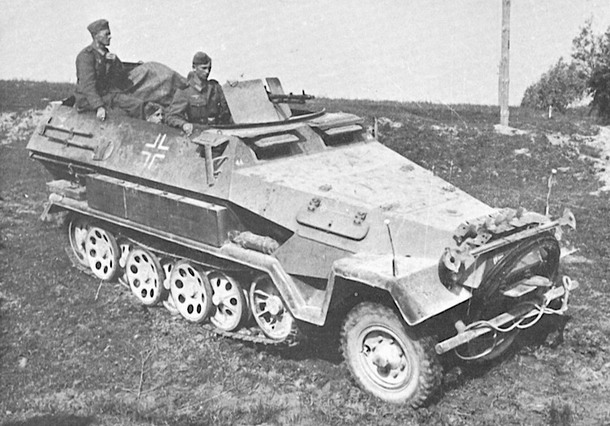
engineer Sd.Kfz. 251/5 Ausf. B; the carried equipment occupied a substantial portion of the cab, with additional items stowed on the front of the vehicle, source: Flickr.com, courtesy of the publishing user, edited
The cab typically contained explosives, ammunition, ropes, rope ladders, barbed wire, binding wire, and similar materials. One sub-variant even carried an inflatable dinghy and a compressor to inflate it (photo HERE (source: colleurs-de-plastique.com)). This variant was also not intended for direct combat but only for support activities. Both machine guns were nonetheless retained. On some sub-variants the rear weapon was practically impossible to use due to the equipment aboard, however, and was simply removed, leaving only the empty mounting at the stern.
Sd.Kfz. 251/6
Next was the command variant already mentioned, designated mittlerer Kommandopanzerwagen (Sd.Kfz. 251/6). This was a command vehicle for higher levels of command and was equipped among other things with an Enigma cipher device for encoding outgoing messages. Again, several sub-variants apparently existed differing in the radio combination installed. The sets most commonly associated with this vehicle are the FuG 11, FuG 12, FuG 19, and Fu Tr 100 Mw. As on the Sd.Kfz. 251/3, the radio sets were fitted in a tubular cage in the right rear section of the cab.
Antenna combinations apparently varied as well. A large frame antenna of the same design as on the Sd.Kfz. 251/3 is typical, sometimes supplemented by one or two whip antennas in various photographs. But photographs also exist showing vehicles fitted with a telescopic Kurbelmast antenna, and even images of vehicles with only whip antennas. It is therefore possible that, as with the Sd.Kfz. 251/3, some later-production Sd.Kfz. 251/6 command vehicles were built without the conspicuous frame antenna.
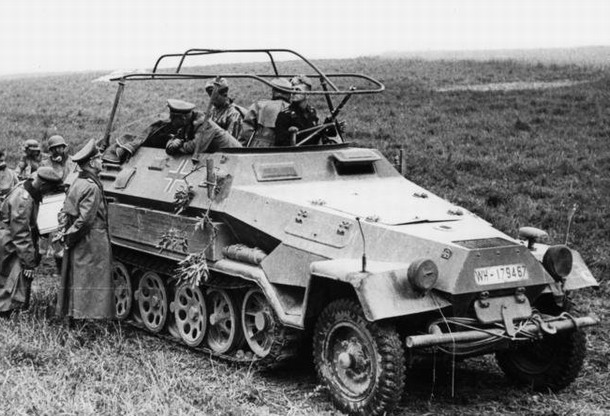
Heinz Guderian aboard his command Sd.Kfz. 251/6 Ausf. A during the campaign in France in 1940, source: Bundesarchiv_Bild_101I-769-0229-02A, Wikimedia, Creative commons, edited
The front machine gun was retained on the command vehicle; the rear was eliminated. Photographs confirm, however, that at least the rear machine gun mounting was preserved on some vehicles (for example in interior photographs of Guderian's Sd.Kfz. 251/6 Ausf. A taken during the fighting in France, a reading lamp can be seen attached to this mounting — photo HERE (Bundesarchiv_Bild_101I-769-0229-10A, Creative commons, edited)). True to form, photographs also exist of command vehicles with both front and rear machine guns — which may however be a field modification requested personally by the vehicle's user for a greater sense of personal security.
In connection with the Sd.Kfz. 251/6, I must again mention how easily it can be confused with the radio vehicle Sd.Kfz. 251/3. Given their very similar range of antennas and practically non-existent constructional differences on the vehicle itself, one must look for other distinguishing features. The simplest is to look in photographs for command pennants identifying staff vehicles (as in the example HERE (Flickr.com, courtesy of the publishing user, edited)). A further distinguishing aid may be the map table, though this was carried only by some command vehicles and was more of a rarity than the norm. It was a very simple shelf welded above the front cab wall, extending the roof area above the driver and commander. Officers aboard the command vehicle could then conveniently spread maps and documents on this surface (a vehicle with this shelf is shown HERE (Bundesarchiv_Bild_101I-209-0056-06, Creative commons, edited)).
Sd.Kfz. 251/7
The Sd.Kfz. 251/7 was again an engineer vehicle, officially designated mittlerer Pionierpanzerwagen (Sd.Kfz. 251/7). Unlike the earlier engineer version 251/5, only minor changes were made to the internal layout. The most significant new feature was the addition of beams along the upper sections of the side walls. These beams served to carry two sections of a light assault bridge. The space between the beams was often closed off with planking or wire to create additional cargo space (as seen for example in the photograph HERE (Bundesarchiv_Bild_101I-715-0212A-27A, Creative commons, edited)). The Sd.Kfz. 251/7 also reportedly existed in several sub-variants differing in the engineer equipment carried.
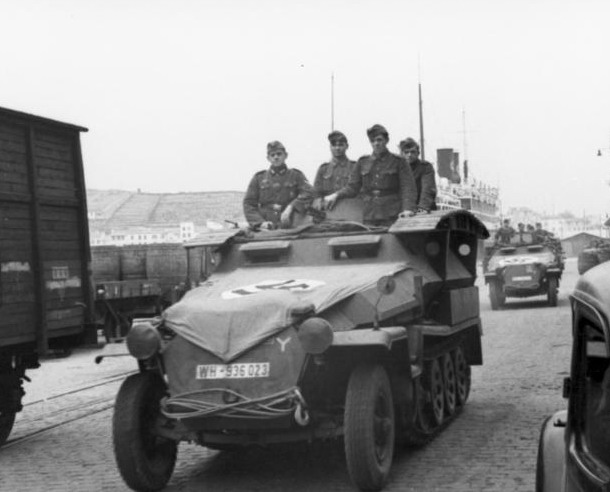
engineer Sd.Kfz. 251/7 Ausf. C; note the emblem of the 7th Panzer Division on the front nose, source: Bundesarchiv_Bild_101I-258-1320-09, Wikimedia, Creative commons, edited
The crew apparently numbered seven soldiers. The armament was the standard pair of machine guns at front and rear. However, crews also carried an anti-tank rifle PzB 39 of 7.92 mm calibre inside the cab. Some vehicles are additionally known to have towed a second anti-tank rifle, the PzB 41. Photographs also exist showing some vehicles with a PaK 36 anti-tank gun of 37 mm calibre installed in place of the front machine gun.
Sd.Kfz. 251/8
Next was the Sd.Kfz. 251/8, which served as an armoured ambulance. The half-track ambulance was capable of crossing more difficult terrain than conventional ambulance cars. Its armour also made it more resistant to inadvertent and deliberate fire, allowing it to evacuate casualties directly from the front line. The main modifications were made to the cab interior. The original benches were removed. On the left side they were replaced by a shorter bench and one folding seat at the rear. On the right side, two pairs of stretchers were fitted — the lower pair simply resting on the floor of the vehicle, the upper pair suspended above them. A small folding seat was again present at the rear on this side. The stretcher suspension system was very simple: two metal bars were fixed across the open cab roof, from which fabric-wrapped chains hung, and the inner edges of the stretchers were hooked onto these chains. When no stretchers were in use, the free end of the chain was hooked back to the carrying bar to prevent it swinging and causing injury. The ambulance could therefore carry up to four seated (on the left) and two recumbent (on the right) casualties, plus two medical orderlies on the folding seats at the rear.
Basic medical equipment for first aid was stored inside the vehicle. A barrel of drinking water was housed in the space between the driver and commander. A larger additional barrel was sometimes hung outside on the side cab armour. A small step was welded below the main rear doors to make it easier to board (loading a stretcher with a wounded soldier was apparently no easy task). On some vehicles another new feature is visible: the tarpaulin support hoops were noticeably taller than on the standard half-track, creating more headroom inside for moving around and attending to casualties when the tarpaulin was fitted (a vehicle with this raised tarpaulin frame is shown in the photograph HERE (Bundesarchiv_Bild_101I-585-2194-17A, Creative commons, edited)).
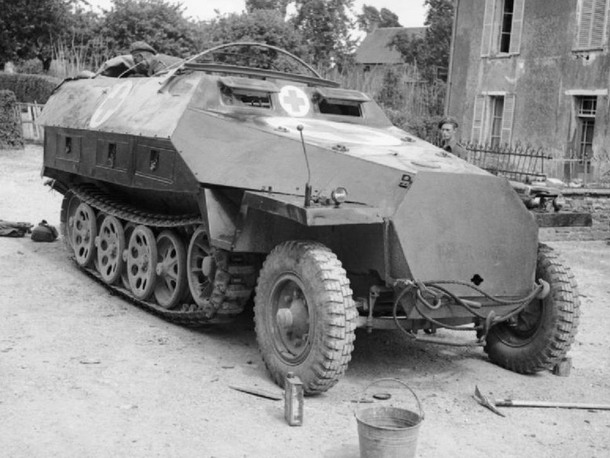
ambulance Sd.Kfz. 251/8 Ausf. D captured by the Allies, source: Wikimedia, Public domain, edited
The above describes the standard cab arrangement on which practically all sources agree. Photographs confirm, however, that the interior was flexible in this regard, and the stretchers could be positioned or suspended on the left side as well when circumstances required.
The full name of the ambulance was mittlerer Krankenpanzerwagen (Sd.Kfz. 251/8). In addition to the driver and commander, the crew probably included two medical orderlies. The Sd.Kfz. 251/8 carried no armament and was marked with prominent red crosses on a white background so that the enemy could immediately recognise it as a medical rather than a combat vehicle. Soviet soldiers frequently ignored this marking and fired on ambulances regardless. For this reason the Germans sometimes avoided any special markings on ambulances on this front (to avoid drawing unnecessary attention) and even left the armament in place so the vehicle could defend itself if attacked.
Sd.Kfz. 251/9
The Sd.Kfz. 251/9 was designed to provide direct fire support to infantry. Its full designation was mittlerer Schützenpanzerwagen (7,5 cm) (Sd.Kfz. 251/9). The order for development of this vehicle was issued in March 1942, and not by coincidence. At that moment, production of the Panzer IV Ausf. F2 and the assault gun StuG III Ausf. F had just successfully begun — both representing pivotal variants equipped with new gun types. The transition to these variants left the Germans with large numbers of the now-surplus short 75 mm guns KwK 37 L/24 (from the Panzer IV) and StuK 37 L/24 (from the StuG III). It was natural to put these reliable weapons to use on other types of combat vehicle, including the Sd.Kfz. 251 half-track (and for example also the Sd.Kfz. 233).
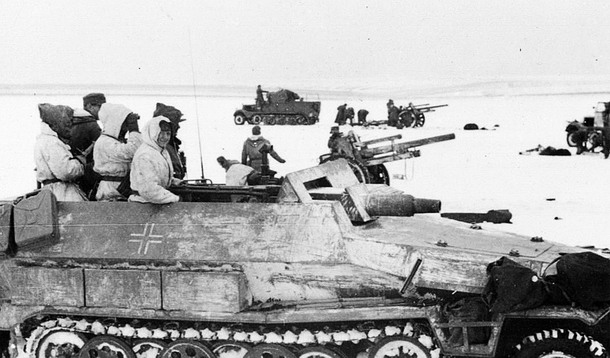
Sd.Kfz. 251/9 with the original right-side gun installation, source: Flickr.com, courtesy of the publishing user, edited
The first two evaluation examples of the new vehicle armed with the KwK 37 L/24 were delivered to the Eastern Front for testing in actual combat conditions in June 1942. The vehicles passed this test, and series production was soon initiated. The Sd.Kfz. 251/9 was built on the Ausf. C and Ausf. D half-tracks and produced until 1944. Toward the end of the production run a modified variant was introduced with a different gun installation and higher armour.
In the original configuration, the gun was mounted in the right section of the front wall. The commander's position was eliminated and an opening for the gun was cut into the front wall in front of it. The front armour of the cab was raised by welding an additional plate. The front machine gun naturally disappeared. The gunner sat on a chair to the left of the gun breech, directly behind the driver. The gun occupied practically the entire forward half of the cab interior. The rear section contained a seat on the right for the remaining crew and an ammunition box on the left. The rear machine gun was retained.
The gun could traverse 12 degrees to each side (sometimes given as 12 degrees right but only 10 degrees left). Vertical elevation ranged from -5° to +20° (though -10° to +12° is also cited). Ammunition stowage comprised 52 rounds. The crew probably numbered four men: driver, gunner, loader, and commander doubling as radio operator.
At the turn of 1943–44 the already-mentioned modernised version entered production. On this variant, the front cab armour was retained and the gun was moved above it. The commander's position was again eliminated. The opening left by the commander's vision port in the front wall was permanently welded over with a piece of armour. The gun was now mounted centrally above the front cab wall, surrounded by additional armour that also extended along the sides — necessary because the gun's repositioning above the standard cab armour level would otherwise have left the gun crew unprotected.
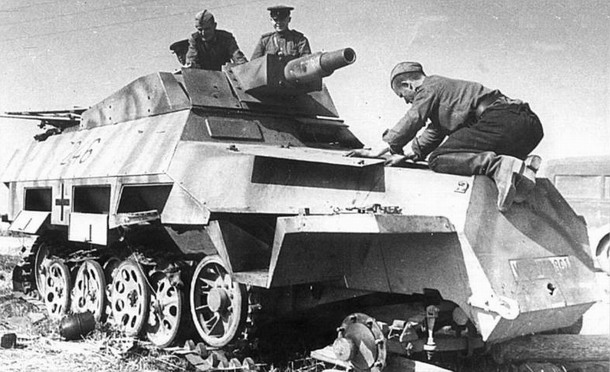
Sd.Kfz. 251/9 Ausf. D with the centrally mounted gun, source: Flickr.com, courtesy of the publishing user, edited
This late variant of the Sd.Kfz. 251/9 used a new gun type — the KwK 51 L/24 (also written K51 L/24). The weapon and its installation were practically identical to that used on the armoured car Sd.Kfz. 234/3. The gun was rigidly connected to the front plate of the additional armour, so when aiming this armour section moved together with the barrel. The gun's traverse reportedly increased to 20 degrees each side thanks to the new installation. The new mount also had a special cradle to the right of the gun for a machine gun, which when fitted moved with the gun and could provide protection against pressing enemy infantry.
This late variant with raised armour was produced only on the Ausf. D half-track. Crew size and cab layout probably remained unchanged from the earlier low-gun version of the 251/9. It is worth noting that soldiers often nicknamed the vehicles armed with this gun Stummel (stump or stub) — a nickname acquired by the short-barrelled gun itself and the vehicles it was fitted to, alluding to the short barrel which, alongside the more modern long guns, genuinely looked like a cigarette butt.
Sd.Kfz. 251/10
Next was the Sd.Kfz. 251/10, adapted for destroying lightly armoured enemy vehicles. To this end it was fitted with the light anti-tank gun PaK 36 of 37 mm calibre. The official designation was mittlerer Schützenpanzerwagen (3,7 cm PaK) (Sd.Kfz. 251/10). Although this variant carried the index /10, it was developed considerably earlier than many variants with lower numbers — specifically in 1940 — which is why it was built on all four production variants of the half-track, Ausf. A through D.
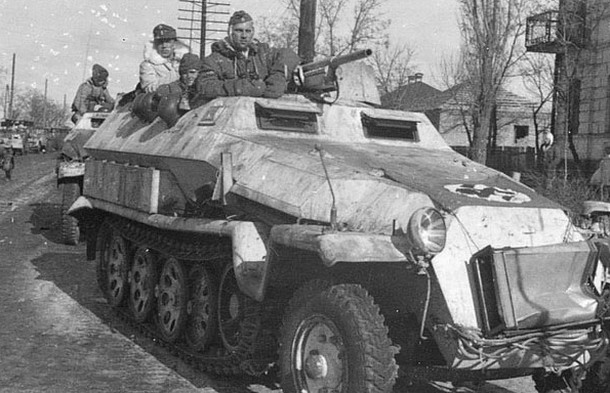
Sd.Kfz. 251/10 Ausf. C with the standard gun shield, source: Flickr.com, courtesy of the publishing user, edited
The gun was installed at the front edge of the cab, in place of the front machine gun. On early vehicles, particularly those based on the Sd.Kfz. 251 Ausf. A and B, the gun was mounted with its standard shield, which inconveniently raised the silhouette of the vehicle and made it more conspicuous. The tall shield was not actually needed in this installation, since the soldiers operating the gun stood inside the cab whose floor was considerably lower than the gun itself. Designers therefore quickly came up with smaller shield versions. The first and fairly rare new shield was lower and wider than the original, covering the full width of the front cab wall (a vehicle with this shield is shown in the photograph HERE (Flickr.com, courtesy of the publishing user, edited)). Far more common became the minimalist shield protecting only the left side of the gun, where the gunner sat (nicely shown in the photograph HERE (Bundesarchiv_Bild_101I-217-0493-27, Creative commons, edited)). This shield was double-layered with a fairly prominent gap between the layers (the purpose of this design I do not know). An aiming optics aperture was cut into the armour. Photographs also exist of vehicles with the gun fitted without any shield at all, or conversely with the tall shield from the towed version of the PaK 36 (as in the photograph HERE (Public domain)).
The Sd.Kfz. 251/10 was intended for platoon commanders of regular infantry half-tracks, providing fire support when the platoon encountered an enemy armoured vehicle. The light PaK 36 was admittedly of very limited penetration, but it was still capable of dealing with a standard armoured car or a light tank. The rear machine gun was retained as a secondary weapon with 1,100 rounds. 168 rounds were carried for the gun. Crews sometimes also carried an anti-tank rifle PzB 39 of 7.92 mm calibre. Crew strength was five or six men.
Both the Sd.Kfz. 251 half-track and the PaK 36 anti-tank gun were very widely used. It is therefore no surprise that alongside the officially manufactured Sd.Kfz. 251/10 vehicles, field installations of the gun on other half-track variants also appeared.
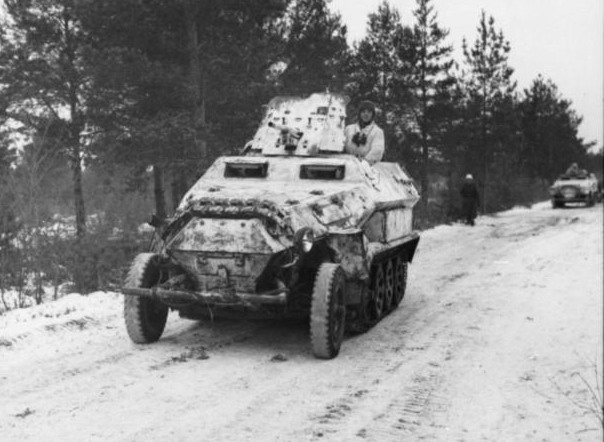
Sd.Kfz. 251/10 Ausf. B with the gun fitted with the original full shield, source: Bundesarchiv_Bild_101I-268-0178-07, Wikimedia, Creative commons, edited
Sd.Kfz. 251/11
The next variant was the Sd.Kfz. 251/11 — a rare vehicle with a very specific purpose. Its role was to lay and maintain telephone and telegraph cables in areas close to the front line. The official designation was mittlerer Fernsprechpanzerwagen (Sd.Kfz. 251/11). The army ordered its development in January 1942, and production began in August of the same year.
The benches on the right side of the cab were removed on this variant, replaced by an open-fronted cabinet for cables, field telephones, and associated equipment. On the right side were also closable tool boxes and storage for other necessary signals equipment. The vehicle also carried three cable drum holders. A drum in its holder could rotate freely, allowing cable to unwind smoothly by itself as the vehicle moved forward, trailing the cable behind it. Two of these holders were mounted on top of the cabinet on the right side of the cab. If circumstances required, at least one of them could be unbolted from the cabinet, fitted to a crew member's back using straps, and used by that soldier to lay cable on foot.
The third cable drum holder was mounted on the right front mudguard and was used for suspending cables above the ground. In this method of laying cable, one of the soldiers would stand in the rear of the cab and use a long pole with a fork at the end to lift the cable and drape it over tree branches, bushes, existing telegraph poles, and similar structures. Clearly this required the vehicle to travel very slowly to allow the man with the pole to keep up. The Sd.Kfz. 251/11 apparently existed in two sub-variants designated Feldkabelträger 6 and Feldkabelträger 10. Crew strength was apparently five men.
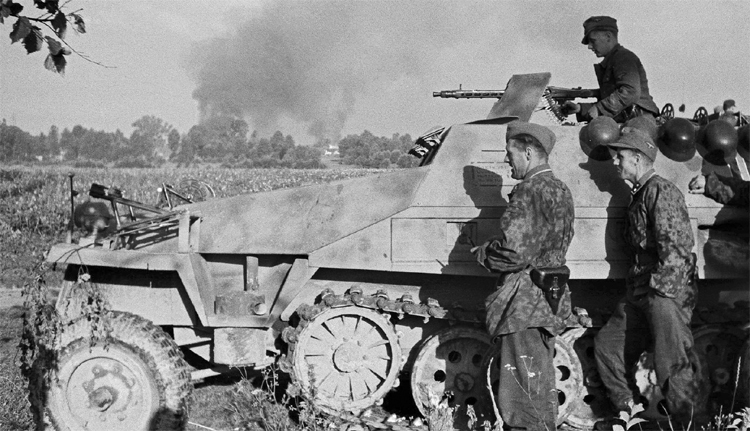
Sd.Kfz. 251/11 in the Ausf. D variant; the holder on the left front wheel mudguard is empty, but the second one has a cable drum loaded, and another drum can be seen inside the cab, source: Flickr.com, courtesy of the publishing user, edited
None of the sources I consulted cite a production figure. It is probable, however, that only a very small number were built.
Sd.Kfz. 251/12
Following number eleven came four similarly rare vehicles for special purposes. The Sd.Kfz. 251/12, 13, 14, and 15 were all intended for artillery support roles. The first of these — the 251/12 — was an observation and ranging vehicle. Its full designation was mittlerer Messtrupp und Gerätpanzerwagen. The little that is known about it includes the fact that it was produced between 1942 and 1943. It carried equipment for observing and locating enemy positions, including the well-known scissor periscope binoculars. It also had an extended radio fit to ensure reliable communication with friendly artillery. Some examples were therefore fitted with a frame antenna, though of a noticeably lower design than those on the Sd.Kfz. 251/3 or 251/6 described above — presumably to reduce conspicuousness, since the Sd.Kfz. 251/12 was intended to operate within sight of the enemy.
Sd.Kfz. 251/13
The next of the artillery quartet — the Sd.Kfz. 251/13 — was adapted for making and analysing sound recordings for artillery use. Exactly how these recordings were then used by German artillery remains a mystery to me. The vehicle's full official designation was mittlerer Schallaufnahmepanzerwagen. This variant was again apparently built only in very limited numbers.
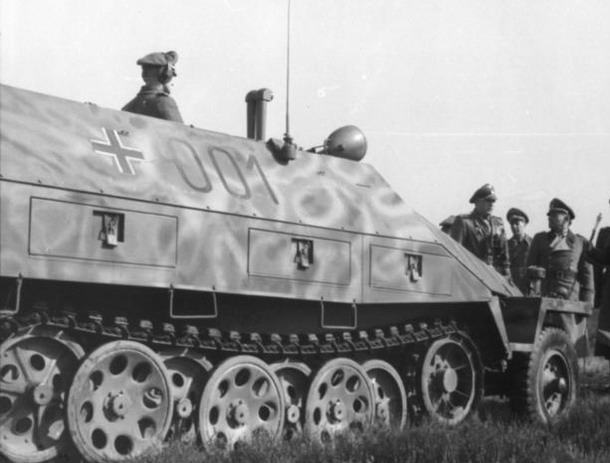
Sd.Kfz. 251/15 Ausf. D, source: Bundesarchiv_Bild_101I-297-1740-10A, Wikimedia, Creative commons, edited
Sd.Kfz. 251/14
Next was the mittlerer Schallauswertepanzerwagen — Sd.Kfz. 251/14 — intended for intercepting and analysing enemy artillery fire by sound, apparently for the purpose of locating and identifying enemy gun types. Again apparently a very rare type.
Sd.Kfz. 251/15
Following was the Sd.Kfz. 251/15, full name mittlerer Lichtauswertepanzerwagen. According to some sources this variant had the same purpose as its predecessor, but used the observation of muzzle flashes rather than sound to locate and identify enemy artillery batteries (which might make sense at night, but in daylight?). According to other sources this vehicle was equipped with a powerful searchlight and illuminating flares and was intended to assist in directing friendly artillery fire.
As already noted, the 251/12 through 251/15 half-tracks were comparatively rare, produced only in small numbers. Some fairly credible sources go so far as to suggest that only evaluation prototypes were built and that none of the four variants ever actually entered production. The reader will have to make up their own mind.
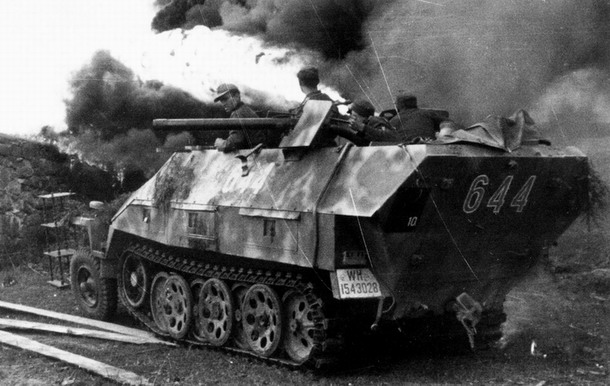
flamethrower Sd.Kfz. 251/16 Ausf. D, source: Bundesarchiv_Bild_101I-281-1110-18, Wikimedia, Creative commons, edited
As for photographic documentation of these vehicles: two very nice photographs taken during an inspection by Field Marshal von Rundstedt at a Waffen SS unit show an Sd.Kfz. 251 with some hard-to-identify device fitted at the front edge of the cab. These photographs are sometimes captioned as Sd.Kfz. 251/13, with the mysterious apparatus described as a recording device. Elsewhere the same photographs appear with the caption Sd.Kfz. 251/15 and the claim that the device is a searchlight — which personally strikes me as the more plausible interpretation.
Sd.Kfz. 251/16
The purpose of the next variant was clear beyond any doubt. The Sd.Kfz. 251/16 served as a self-propelled flamethrower, with the full designation mittlerer Flammpanzerwagen (Sd.Kfz. 251/16). It was produced from January 1943, on the Ausf. C and Ausf. D half-tracks. Two 14 mm flamethrower projectors were positioned along the side edges of the cab. In the rear of the cab, fuel tanks on both sides held a total of 700 litres of the incendiary mixture Flammöl (some sources give 700 litres per tank, i.e. 1,400 litres combined). In the centre between the tanks was a pump driven by its own separate petrol engine, which had its own independent fuel supply, making the pump's operation completely independent of the vehicle's main powerplant and fuel tanks.
Hoses from both fuel tanks joined into a single line feeding the pump, which then drove the mixture through two separate hoses to the projector nozzles. Because of the pump and its engine, the rear doors could not be used for boarding and alighting. Crew members had to climb over the side walls of the cab, which was certainly no easy matter given the projector nozzles themselves. The rear doors were not permanently welded shut, however — they could still be opened for servicing the pump.
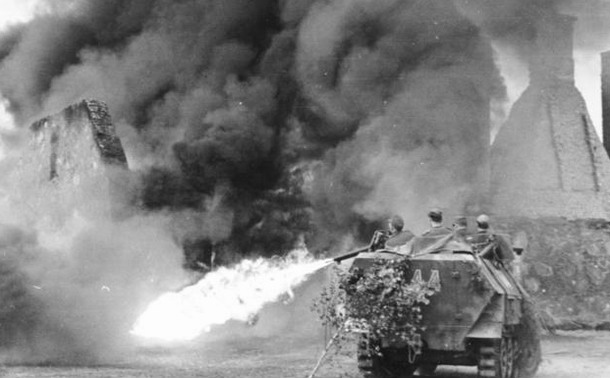
flamethrower Sd.Kfz. 251/16 Ausf. D, source: Bundesarchiv_Bild_101I-281-1110-03, Wikimedia, Creative commons, edited
Each projector nozzle was fitted with a shield to protect its operator. Crew members also had protective suits and face masks available. Photographs confirm that the nozzle shields existed in several designs — some fitted with a glazed observation window. The standard design was similar to the front machine gun shield, with arrow-shaped angled side panels and a cutout for aiming at the upper edge. The two projector nozzles were not positioned symmetrically — the one on the right side was set further forward.
The fuel supply was sufficient for approximately eighty two-second bursts. The range of the flamethrowers was apparently around 35 metres. The front machine gun was retained as secondary armament. Some vehicles were also equipped with a hand-held flamethrower of 7 mm calibre, drawing fuel from the same tanks as the two main projectors aboard. A ten-metre hose connected it to the pump, allowing the soldier carrying it to move relatively freely around the vehicle. In normal use the hand-held flamethrower was stowed externally on the upper section of the rear cab wall, with the ten-metre hose coiled and hung in the same location — which further underlined the impossibility of using the rear doors for normal entry and exit.
Vehicles based on the Ausf. D half-track were apparently not equipped with the hand-held flamethrower at all — the design of the rear wall of this variant left nowhere to mount the weapon and hose.
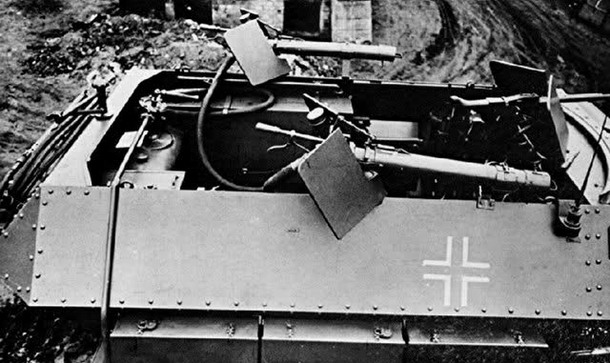
view inside the cab of the Sd.Kfz. 251/16, source: Flickr.com, courtesy of the publishing user, edited
The crew consisted of five men: driver, commander/radio operator, machine gunner, and two flamethrower operators. The Sd.Kfz. 251/16 was produced in 1944 and 1945, with a total of 347 vehicles built — the overwhelming majority in 1944.
Each platoon of flamethrower half-tracks was to be accompanied by three tanker lorries from which the half-tracks could replenish their fuel supply.
An interesting feature of the Sd.Kfz. 251/16 were the pipes that ran from the rear of the cab over the sides and down to the level of the tracks. I found a reference to these pipes in only one of my sources. According to that source, they served as air inlets for the fuel tanks — as with any tank, for the contents to flow smoothly, air had to be allowed in, otherwise a vacuum would form and the fuel would eventually stop pumping. One might have expected this to be handled by a vent in the tank lid, but the use of long vent pipes does make a certain sense. Such a lid vent would inevitably allow vapour from the volatile fuel inside to escape. If the vent opened inside the cab or near its edges, these vapours would enter the crew space where they would be unpleasant for the crew and could also be ignited by the flamethrowers, potentially causing the entire vehicle to explode. Hence the routing of the vent pipes over the sides and down to track level, where neither risk applied.
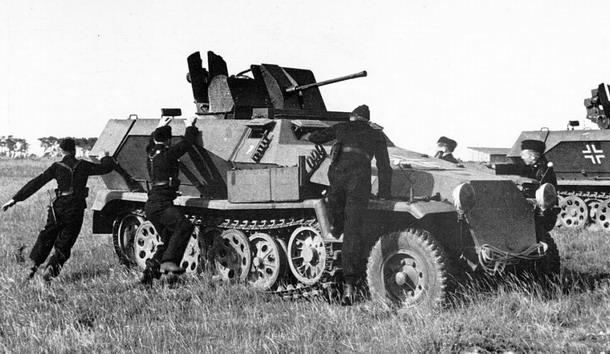
Sd.Kfz. 251/17, source: Flickr.com, courtesy of the publishing user, edited
Sd.Kfz. 251/17
The next variant, mittlerer Schützenpanzerwagen (2cm) (Sd.Kfz. 251/17), was a self-propelled anti-aircraft vehicle. The first official vehicle of this type was apparently not built until 1942, though various field installations of light anti-aircraft weapons on Sd.Kfz. 251 half-tracks of other variants had already appeared before then. The most suitable weapons for such installations proved to be the Flak 30 and Flak 38 in 20 mm calibre — widely used, reliable weapons with a decent rate of fire, and most importantly of relatively compact dimensions and weight (450 and 420 kg respectively). An effective altitude ceiling of 2,200 metres was nothing spectacular, but it was entirely adequate for what the soldiers needed — defence against low-level air attacks on moving columns.
A whole array of such unofficial anti-aircraft vehicles is documented in photographs. Sometimes the gun was simply installed in the vehicle without further modification (which obviously allowed very limited traverse), while in other cases the builders took more trouble and modified the cab sides to give the gun greater freedom of movement when aiming. At least one example also exists of an Sd.Kfz. 251 Ausf. D fitted with a KwK 38 (a weapon derived from the Flak 38) in a Hängelafette 38 mount, probably taken from an armoured car Sd.Kfz. 222.
Official attempts were also made to mount the Flak 30 or 38 (to judge at least by the quality of the work and the existence of demonstration photographs). In this case the weapon was fixed on a minimal rotating bracket on the roof of the forward cab section, where the front machine gun was normally located.
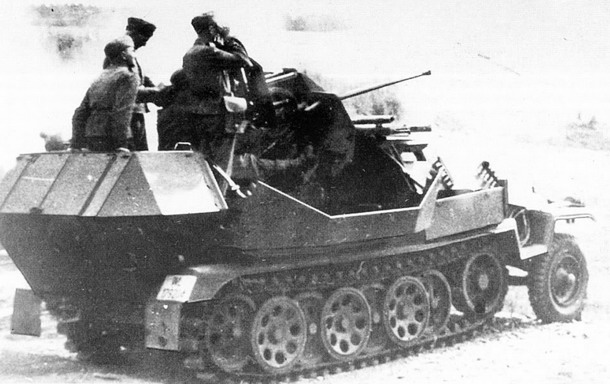
Sd.Kfz. 251/17 with the sides folded down, ready to fire, source: Flickr.com, courtesy of the publishing user, edited
But now to the official Sd.Kfz. 251/17. The Flak 38 was again chosen as the main weapon for this variant. Unlike the field modifications and the official prototype, however, the Sd.Kfz. 251/17 involved far more extensive structural changes. The fighting cab was substantially widened at the point of the gun installation, which in itself apparently allowed 360-degree traverse. For even greater comfort when aiming, the widened side sections could additionally be folded down to the sides. This opened up the fighting space fully, giving the crew genuinely adequate room to traverse the gun freely in any direction — and also making the loader's work considerably easier.
When folded down, the side panels did not rest on the track mudguards — they actually hung by hooks from the fixed part of the side armour. According to some authors, the folding and raising of the panels was hydraulic, which is not accurate. Opening the sides was apparently not particularly difficult, as gravity helped. Raising them required more hands, and one crew member presumably had to step outside the vehicle and push from the outside.
The gun was installed in the interior complete with its full mount and shield. The gunner sat on an elevated seat to the right of the weapon. The gun was loaded from the left using 20-round magazines. A total of 600 rounds were carried aboard, apparently at several locations. One elongated ammunition box was for example fixed on the front roof above the driver's and commander's heads.
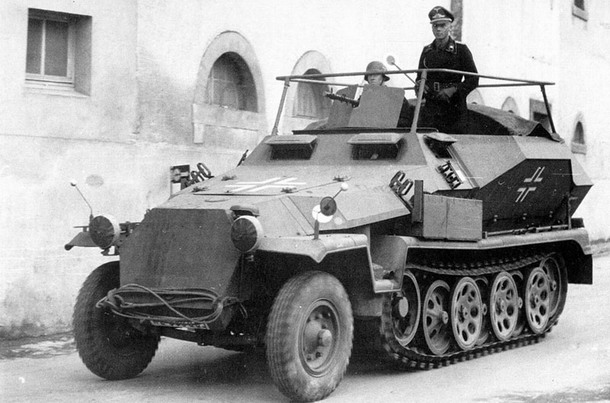
command variant of the Sd.Kfz. 251/17, source: Flickr.com, courtesy of the publishing user, edited
The Sd.Kfz. 251/17 was built only on the Ausf. C half-track. Crew strength was apparently five men: besides the obligatory driver and commander, there was the gun's layer, and probably two loaders. Both front and rear machine guns had to be removed, though it is possible that the crew carried at least one such weapon stored loose inside the vehicle.
According to some sources, the Sd.Kfz. 251/17 was never accepted into full series production, owing to the high production costs associated with the extensive structural modifications. Under this theory only a small pre-production evaluation batch was built. These may have been particularly attractive to photographers, which would explain why the large number of surviving images has given the impression that this variant was fairly widespread.
In any case, several of these vehicles were converted into command vehicles, with expanded radio equipment including a frame antenna fitted in place of the gun. Standard machine guns were restored to both the front and rear mounts on these command vehicles, which then apparently operated together with regular armed Sd.Kfz. 251/17 vehicles.
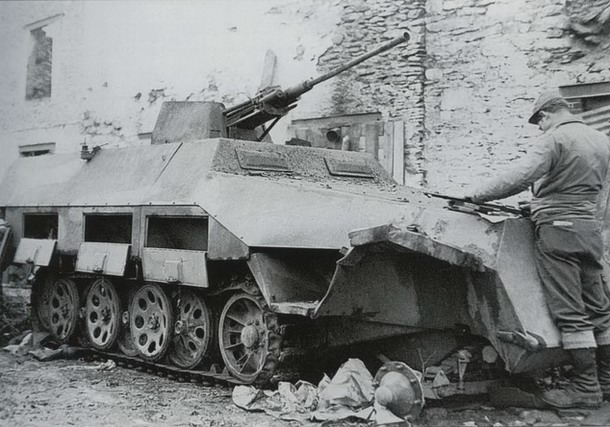
Sd.Kfz. 251/17 Ausf. D with the Schwebelafette 38 suspended mount, source: internet, Public domain, edited
The complexity of manufacturing the Sd.Kfz. 251/17 led designers to look for a better solution. Once all production was transferred to the Ausf. D in 1943, the design with folding side panels could no longer be used at all, since the construction of the Sd.Kfz. 251 Ausf. D simply did not permit it. So in 1944 a new variant of the Sd.Kfz. 251/17 appeared.
The armament was again the Flak 38, but this time it was not installed on a rotating pedestal on the cab floor — instead it was suspended in a Schwebelafette 38 mount. The gun was stripped of all unnecessary accessories and surrounded by an open-topped shield forming a small fighting cupola of sorts. This shield protected the head of the gunner, who sat on a small seat directly behind the gun. The loader inserted magazines from the left side of the weapon, in the area in front of the front wall of the shield, and was therefore not protected by armour while working.
A photograph exists of this version of the Sd.Kfz. 251/17 fitted with a frame radio antenna (photo HERE (Public domain)), apparently a command vehicle. Fitting the antenna did prevent firing upward and thus negated the vehicle's primary purpose — though it could still engage ground targets. In connection with this vehicle it should be added that some authors regard it not as a second-generation Sd.Kfz. 251/17 but as the type Sd.Kfz. 251/23.
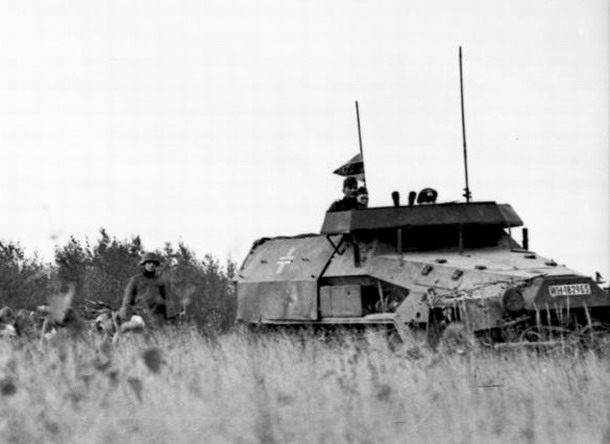
Sd.Kfz. 251/18, apparently Ausf. B, with the atypical supplementary armour on the side, source: Bundesarchiv_Bild_101I-268-0167-27A, Wikimedia, Creative commons, edited
Sd.Kfz. 251/18
Next was the Sd.Kfz. 251/18, or mittlerer Beobachtungspanzerwagen. This is again a type about which little is known and around which much confusion exists. Sources agree on practically nothing except that it was a reconnaissance and observation vehicle for artillery use. From there, disagreement is almost universal.
According to some sources the clear identifier of this type is the large map table extending over the roof above the driver and commander. According to others, not all Sd.Kfz. 251/18 vehicles had this table. Some authors state it had a frame antenna, others deny this. Some say the type was produced in 1944 and 1945, others date it from 1943. Some sources state it was built only on Ausf. C and D half-tracks, and that all Ausf. A and B vehicles with the characteristic map table are merely field conversions of standard half-tracks. Other publications maintain the Sd.Kfz. 251/18 was deliberately built by converting older early-variant half-tracks. In short, the confusion surrounding this type is extreme. I will therefore again rely on photographs and use the map table as my identifier.
This table extended across the full width of the front cab wall and overhanging to both sides. It was not merely a flat board but had front and side walls and even a small roof, so that items placed on it would not fall off the edges as the vehicle moved, and so that the wind would not blow away maps and documents. The front machine gun naturally disappeared with the installation of the table, and approximately where its original mount had been there was now a mount for a scissor periscope binocular rangefinder. The rear machine gun was retained. Some vehicles, however, also have a front machine gun — on these the map table has a lowered central section to allow machine gun fire. None of the vehicles I have seen photographed were fitted with a frame antenna — most had one or two whip antennas. Some sources cite FuG 5 and FuG 12 radio sets with two whip antennas as standard. I should also note that all photographs of this vehicle I have been able to identify (using the map table as the identifier) show Ausf. A and B half-tracks.
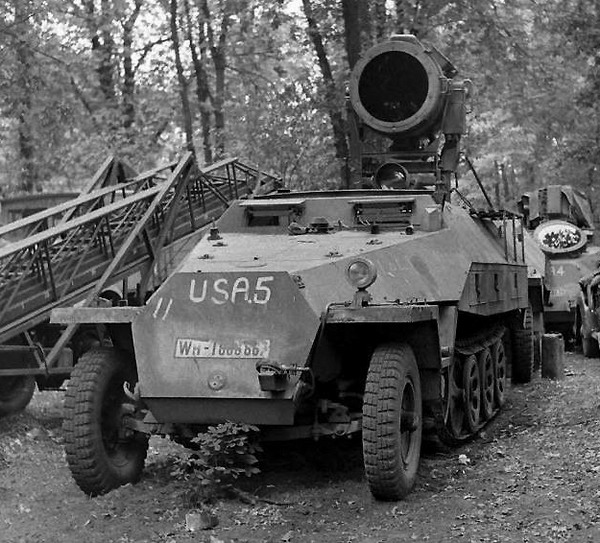
Sd.Kfz. 251/20 Uhu captured by the Americans, source: internet, Public domain, edited
Sd.Kfz. 251/19
Not much is known about the following vehicle either. The Sd.Kfz. 251/19, or mittlerer Fernsprechbetriebspanzerwagen, was intended as a mobile telephone exchange, apparently intended to cooperate with the Sd.Kfz. 251/11 in routing telephone calls. It carried the necessary switching equipment plus additional telephone cable and laying tools. According to some sources, only prototypes were built and this vehicle never entered series production.
Sd.Kfz. 251/20
Next came the Sd.Kfz. 251/20, a vehicle with a very interesting purpose. Its full official designation was probably mittlerer Schützenpanzerwagen (Infrarotscheinwerfer), though the designation mittlerer Schützenpanzerwagen zur Gefechtsfeld-beleuchtung (literally "for battlefield illumination") is also cited. The vehicle is best known, however, by its combat name Uhu — Eagle Owl. Whatever the official name, the vehicle's purpose was clear: to illuminate targets for Panther tanks engaging at night, using infrared light.
Panther tanks were experimentally equipped from 1944 onwards with an infrared night-fighting system called Sperber (Sparrowhawk). This was an active system requiring active illumination of the target. The system therefore consisted of an illuminator and a sight that converted the reflected infrared light back into visible light. The tanks could carry only a limited-size illuminator, however, giving the Sperber system a range of around 400 metres and a coverage angle of 30 degrees. The Germans recognised that to fully exploit the advantages of night vision they needed far wider and longer battlefield illumination — which was the job of the Sd.Kfz. 251/20 accompanying each platoon of infrared-equipped Panthers.
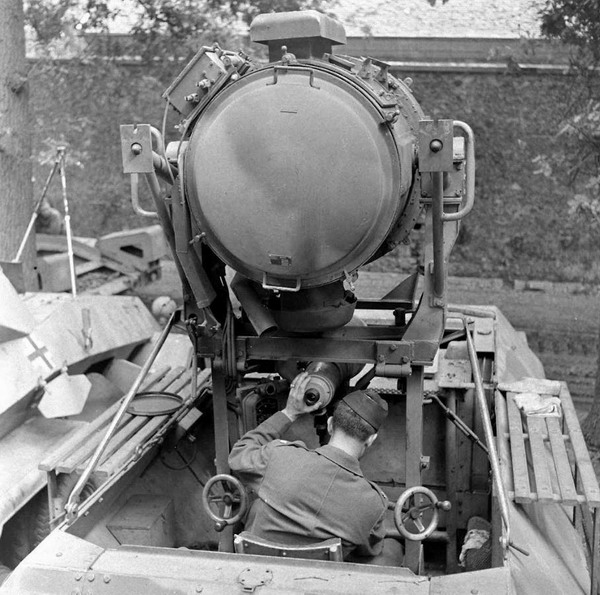
an American soldier trying the controls of the infrared illuminator on a captured Sd.Kfz. 251/20 Uhu, source: internet, Public domain, edited
The fighting cab of the Sd.Kfz. 251/20 was partitioned roughly at mid-length by a large generator supplying power to the infrared searchlight. The standard short roof above the driver's and commander's heads was apparently extended rearward to cover the first half of the cab, protecting the electrical installation from rain and also providing easier access to the searchlight for servicing.
In the rear section of the fighting cab stood a massive mounting, from which a 60 cm diameter, 2 kW infrared searchlight projected through the open roof. The range of this infrared lamp was an impressive 1,500 metres. The searchlight mounting was of course rotatable, and the lamp itself could be elevated up and down. A seat for the operating crew member was attached to the mounting. This man aimed the searchlight using horizontal and vertical control handles; to see where he was pointing it, he had his own sight in front of him that converted reflected infrared radiation back into visible light (the operator's workstation is clearly visible in the photographs HERE, HERE and HERE (all: Public domain)). For easier servicing access to the searchlight, small platforms were created on the side walls on each side of it, on which a technician could stand. Some vehicles had these platforms running the full length of the side walls and also on the front wall.
The half-track driver could not rely on the main searchlight, so he had his own illuminator mounted in front of the front cab wall — the same type used on Panther tanks in the Sperber system. Directly in front of his vision port, the driver also had his own infrared detector through which he observed the illuminated ground ahead and could drive safely. The Uhu had no room for either the front or rear machine gun and was therefore completely unarmed (apart from the crew's personal weapons).
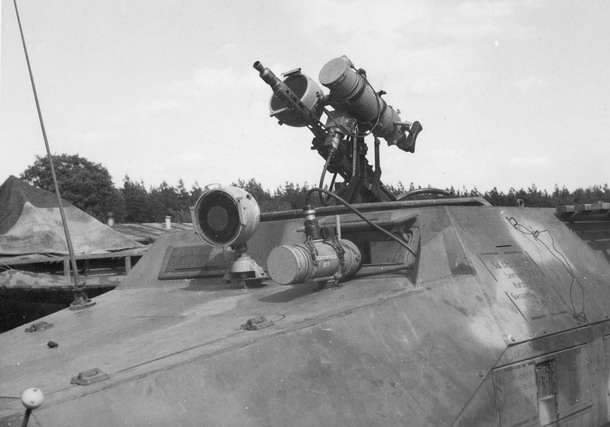
Sd.Kfz. 251/20 Falke, source: Flickr.com, Public domain, edited
Alongside the standard large-searchlight Uhu carriers, one further sub-variant of the Sd.Kfz. 251/20 existed, with the combat name Falke (Falcon). This was a conventional infantry transport half-track adapted for night fighting. The driver again had his own infrared illuminator and detector for safe driving through the night landscape. A further infrared illuminator and sight was built into the MG42 in the front mount. The soldiers aboard were to be armed with the Sturmgewehr 44 assault rifle equipped with the Vampir system — a personal infrared illuminator and sight mounted directly on the weapon. The Germans could thus boast a sophisticated infrared night-fighting doctrine involving tanks, infantry, and illumination support. How many soldiers could fit aboard the Falke is not known, but it is quite possible that it was fewer than the standard ten, since each soldier carried a fairly bulky battery pack to power his infrared system.
Both the Uhu and the Falke were built only on the Ausf. D half-track, and probably only several dozen examples of each were produced.
Sd.Kfz. 251/21
The next variant, the Sd.Kfz. 251/21, arose from the desire to obtain a higher rate of fire in the anti-aircraft role than the existing Sd.Kfz. 251/17 could provide. A rotating mount — the Flakdrilling Sockellafette, originally developed by the navy for ship defence — was installed on the cab floor. As the name of the mount suggests, it carried three autocannons: either MG 151/15 in 15 mm calibre or MG 151/20 in 20 mm calibre. Both weapons had originally been developed for German Luftwaffe fighter aircraft, but as more modern and more powerful aircraft guns replaced them, large numbers of MG 151s became available for other arms.
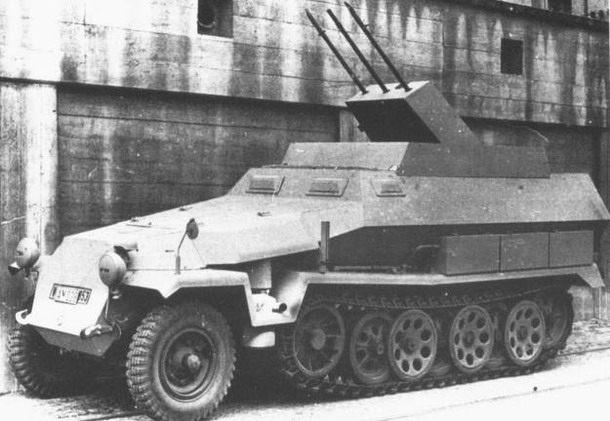
Sd.Kfz. 251/21 Ausf. C prototype, source: Flickr.com, courtesy of the publishing user, edited
The guns were arranged side by side in the mount, the central one upright and the two outer ones tilted to the sides. The complete mount stood on a rotating conical pedestal, to three sides of which were attached large ammunition belt boxes. The side boxes each held 250 rounds and fed the outer guns. The front box held 400 rounds and fed the central gun — it was larger because reloading the central gun was the most complex. I could find no information as to whether it was possible to fire the guns individually. Empty cartridge cases and belt link pieces fell into the hollow pedestal foot.
The gunner sat on a small seat attached directly to the pedestal foot behind the guns. Two sights were available for aiming. For engaging ground targets, the primary instrument was apparently a monocular optical sight with three times magnification, positioned between the left and central gun. For engaging aerial targets, where the gunner needed a wider field of view, the primary aiming device was apparently a simple reticle cross positioned above the central gun.
The designers' main objective — a higher rate of fire than the Sd.Kfz. 251/17 — was fully achieved. The rate of fire of each of the three autocannons was around 700 rounds per minute, meaning the triple-barrelled assembly could theoretically deliver up to 2,100 rounds per minute, literally showering the enemy with fire. This made the weapon highly effective not only against low-flying aircraft but also against ground targets. Total on-board ammunition stowage was 3,000 rounds.
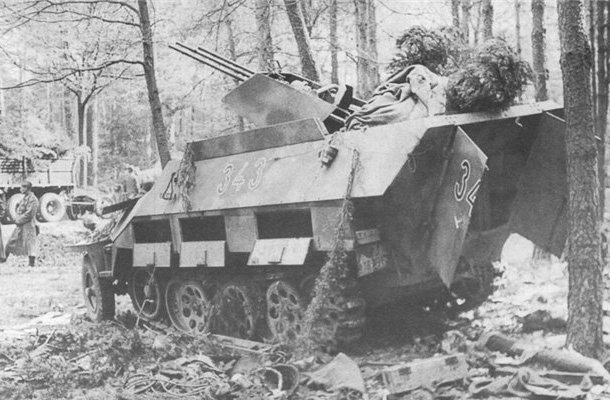
wreck of a series-production Sd.Kfz. 251/21 Ausf. D, source: Flickr.com, courtesy of the publishing user, edited
Sd.Kfz. 251/21 prototypes were built on Ausf. C half-tracks; later series-production vehicles exclusively on the Ausf. D (incidentally, I came across an excellent photograph confirming that Hitler himself took a personal interest in the Sd.Kfz. 251/21 prototype and came to inspect it). On prototypes, the area around the guns was enclosed by raised armour on all sides including the rear. The gun shield on prototypes was low, strictly rectangular, and extended well out to the sides, with an aperture cut in the front plate for the optical sight. On series vehicles the gun shield was considerably taller, with a more steeply angled front wall and trimmed lower corners. The cab armour was also raised on production vehicles, but only at the front and sides, not behind the guns.
The mount allowed vertical elevation of the weapons from -10° to +60°. Horizontal traverse was apparently possible through the full 360 degrees. The gunner moved the weapons by direct arm force, without servo controls. On some vehicles in photographs, pointed extensions can be seen on the muzzles of the two outer guns — these were apparently compensators intended to help the gunner keep the guns level during firing. Both standard machine guns were apparently eliminated on this half-track. The crew consisted of four men: driver, commander/radio operator, gunner, and loader. The full official designation of the vehicle just described was mittlerer Schützenpanzerwagen (MG 151 Drilling) (Sd.Kfz. 251/21).
While studying this type I came across an interesting photograph showing a damaged Sd.Kfz. 251/21 built on an Ausf. C half-track, apparently a combat-deployed vehicle. However, prototypes were supposed to be the only vehicles built on Ausf. C chassis. The vehicle in the photograph (which can be viewed HERE (Public domain)) has another peculiarity: the guns have no shield whatsoever. It would therefore seem that this is not an official Sd.Kfz. 251/21 but a field installation of the Flakdrilling Sockellafette into an Sd.Kfz. 251 of a different variant.
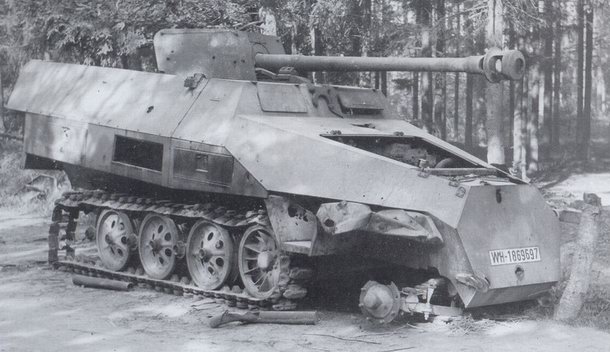
wreck of a destroyed Sd.Kfz. 251/22 Ausf. D, source: Flickr.com, Public domain, edited
Sd.Kfz. 251/22
The last variant of the Sd.Kfz. 251 to enter production was the vehicle with the full designation mittlerer Schützenpanzerwagen (7,5cm PaK) (Sd.Kfz. 251/22). This was the result of the Germans' desperate drive — and Hitler's personal order — to mount anti-tank guns on as many self-propelled chassis as possible. In this case the anti-tank gun was the PaK 40 L/46 in 75 mm calibre.
To leave enough room inside the cab for the crew of such a large weapon, the gun had to be installed as far forward as possible. To get it where it needed to be, the designers had to cut away part of the roof above the driver's cab. The commander's position in the forward section was eliminated entirely. The driver was effectively trapped in his seat and had to squeeze through the narrow space in front of the gun when getting in or out. On some vehicles the vision port in front of the eliminated commander's position was retained; on others it was blanked off with a solid non-openable piece of armour.
The gun had to be mounted fairly high to fire over the front of the cab, which meant the crew operating it were partially outside the protection of the standard armour. For this reason the gun was installed retaining the upper portion of its original shield, so that the crew inside the cab had at least frontal protection from the forward arc. The lower portion of the shield had to be cut off — it would not have fitted inside and was of no use there. A simple support bracket was installed on the front cab wall edge into which the gun barrel was rested during longer moves to prevent unnecessary movement and vibration.
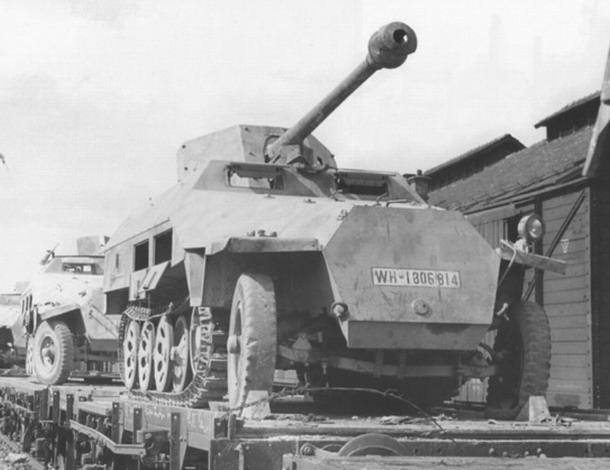
wreck of an Sd.Kfz. 251/22 Ausf. D, source: Flickr.com, Public domain, edited
All seats except one on the left at the rear had to be removed from the cab. This single remaining seat served both loaders. The gunner sat on a folding wooden seat to the left of the weapon. The rear machine gun was eliminated without replacement. Every remaining inch of space in the cab was used for ammunition stowage — and yet only 22 rounds of 75 mm ammunition could be fitted in two stowage boxes. Crews often carried additional loose rounds piled wherever space could be found inside the vehicle.
The PaK 40 was a highly effective anti-tank gun. At 1,000 metres it could penetrate armour inclined at 30 degrees with a thickness of 85 mm (PzGr. 39) or 97 mm (PzGr. 40). The Sd.Kfz. 251 was not an ideal platform for such a heavy weapon, however. The chassis and hull inevitably suffered greatly from the severe shocks of firing. The relatively narrow cab also permitted only limited gun traverse: 18 degrees to the right and 20 degrees to the left. Vertical elevation ranged from -3° to +22°.
As already largely stated, the crew of this variant consisted of four men: driver, gunner, and two loaders. The Sd.Kfz. 251/22 apparently entered production in December 1944. By the end of the war only a few dozen examples had been built at most, all on the Ausf. D half-track.
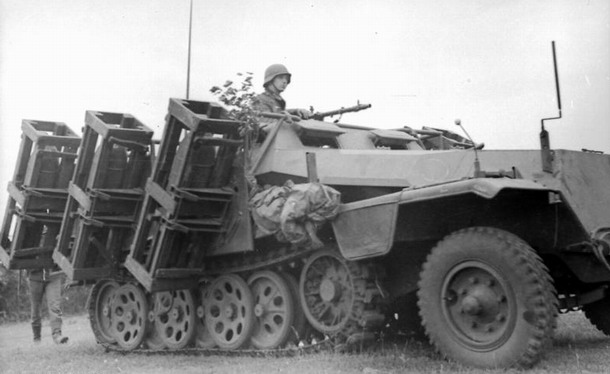
Sd.Kfz. 251 Ausf. B with wooden rocket launch cages, source: Bundesarchiv_Bild_101I-216-0417-09, Wikimedia, Creative commons, edited
Sd.Kfz. 251/23
The last variant of the Sd.Kfz. 251 to receive an official serial number was the Sd.Kfz. 251/23. This was to be a reconnaissance vehicle with an enclosed cab and a fighting turret taken from the armoured car Sd.Kfz. 234/1, armed with the KwK 38 of 20 mm calibre and a co-axial machine gun. The sole frequently published photograph of this vehicle is a poorly executed photomontage, and many authors consequently believe that this vehicle never actually saw the light of day — or at most reached only prototype stage.
In addition to the official variants described above, various test and evaluation vehicles were of course also produced. A vehicle as widespread and versatile as the Sd.Kfz. 251 was moreover an irresistible candidate for all manner of field modifications according to whatever a given unit needed at any given moment. Some of these field variants have already been mentioned above. What follows is a description of further non-standard versions documented in photographs I have had access to — though this is certainly not a complete catalogue of all modifications made to the Sd.Kfz. 251.
Wurfrahmen
Let us start with one entirely official and very widespread modification — the installation of a framework for launching rocket projectiles. The tubular framework lay over the cab of the half-track, roughly following its contour. On the sides, adjustable brackets were mounted on tubular frames, to which the rocket launching cages themselves were hung. The standard arrangement was three cages on each side of the vehicle. Photographs do confirm the existence of one or more vehicles with only two cages per side, but this was probably a field modification — simply cutting off the front section of the framework.
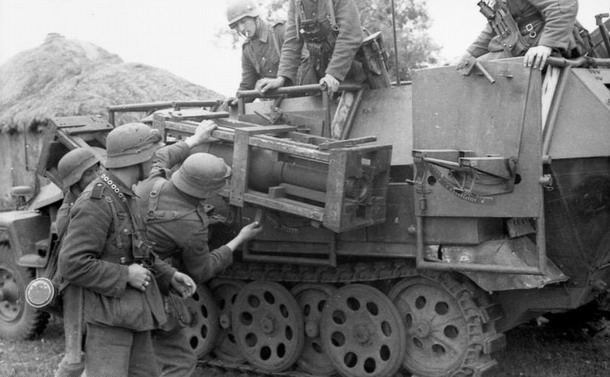
Sd.Kfz. 251 Ausf. C during loading of rocket cages; note the scale for adjusting cage angle visible on the rear empty bracket, source: Bundesarchiv_Bild_101I-216-0417-06, Wikimedia, Creative commons, edited
The plates with the cage brackets were not all at the same height — they rose progressively toward the rear, so the front plate and its cage were lowest and the rear plate highest. The bracket for each rocket cage was adjustable, allowing the cage to be set at angles from +5° to +40°. A scale painted on the plate below the bracket allowed finer adjustment. The cages were positioned manually. Horizontal aiming was accomplished by steering the whole vehicle in the required direction. Two short "antennae" were fitted at the very nose of the vehicle to help the driver align it correctly.
The cages were either steel or (most commonly) wooden. Steel ones were intended for reuse; wooden ones were discarded after the rocket was fired. Two rocket types were used: 320 mm incendiary rockets filled with thickened petrol, with a range of 2,200 metres, and 280 mm high-explosive rockets filled with explosives, with a range of around 1,900 metres. According to some sources, 300 mm rockets with a range of up to 4.5 km were also available from 1943 onwards. The rockets had impact fuzes, which were safety-locked during transport and only armed immediately before firing. Firing a full salvo of six rockets took no more than 10 seconds. Reloading with fresh rockets took around 5 minutes and required three to four men. Regulations stipulated that the crew was to leave the vehicle before firing to avoid injury from the backblast.
For reloading, it was apparently planned for an accompanying ammunition vehicle to carry fresh rockets. Photographs confirm, however, that some half-tracks carried additional rockets inside the cab — which meant they could no longer function as normal infantry carriers, as there was simply no room for the soldiers. The rocket-armed half-tracks were used as a substitute for artillery support and proved particularly effective in urban fighting, where they could reduce buildings to rubble with great efficiency. The sheer destructive power of this variant earned the Sd.Kfz. 251 the nickname Stuka zu Fuss — roughly "the infantry's Stuka."
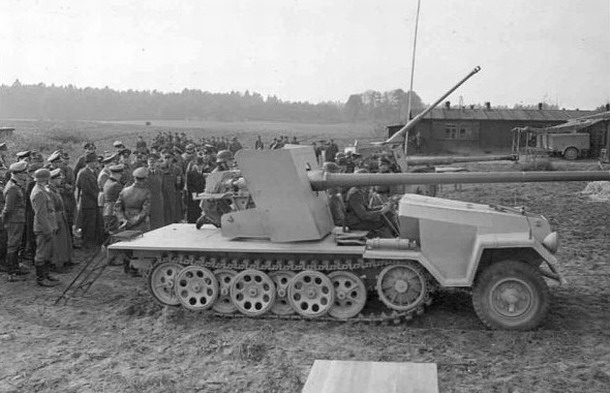
prototype of the Sd.Kfz. 251 armed with the PaK 42 gun of 75 mm calibre, source: Flickr.com, courtesy of the publishing user, edited
Both front and rear machine guns were retained on the rocket half-track. The crew was to number seven men (which obviously did not apply in the case described above, where the cab was loaded with spare rockets). The first vehicles with the launch framework were apparently built as early as 1941. The official designation of this modified half-track was mittlerer Schützenpanzerwagen (Sd.Kfz. 251) mit Wurfrahmen — "with launch frames." Another version of the suffix, mit schwerem Wurfgerät 40, is also sometimes cited. Most sources assume this modification was applied only to the basic variant, the Sd.Kfz. 251/1.
7.5 cm PaK 42 Gun
An entirely official prototype was also built in 1943 of an Sd.Kfz. 251 fitted with the anti-tank gun PaK 42 in 75 mm calibre — a modified version of the Panther tank's gun, which without its muzzle brake was also used by the Jagdpanzer IV tank destroyers. Official German documents apparently referred to the prototype as 7,5 cm Pak 42 auf 3t Zugkraftwagen, which strictly speaking made it a variant of the artillery tractor Sd.Kfz. 11 (Zugkraftwagen 3t) rather than the armoured carrier Sd.Kfz. 251 — though this may not be worth being too pedantic about. The vehicle did unquestionably borrow the armoured engine bonnet from an Sd.Kfz. 251 — either Ausf. A or Ausf. B, in any case from an early variant no longer in series production at the time. Only the front armour section was taken from the Sd.Kfz. 251, however. From the front wheel mudguards rearward, the armour was clearly purpose-built for the new prototype. The armour ended immediately behind the engine section — the driver and commander therefore sat in an open cab with no protection from enemy fire, and the gun crew behind them was not much better off.
The rear half of the vehicle was an open fighting compartment with the enormous gun on a central pedestal. The barrel was 70 calibres long — approximately 5.25 metres from breech to muzzle — and when the muzzle brake is added, the gun was almost as long as the entire vehicle beneath it. The army specification called for the pedestal to allow full 360-degree rotation, enabling fire in any direction. Given the weapon's enormous power, it is no surprise that there were concerns among soldiers about the chassis stability when firing broadside. The travel position for the barrel was 12 o'clock — pointing directly forward. In this position it could be rested in a folding support cradle mounted on the engine bonnet armour, passing directly between the driver's and commander's heads. Development was apparently begun sometime in the second half of 1943, and on 1 October of that year the prototype was demonstrated to army command representatives including Hitler himself. Thorough firing trials of the prototype followed this presentation — and apparently they did not go well, as the project was terminated on 26 January 1944.
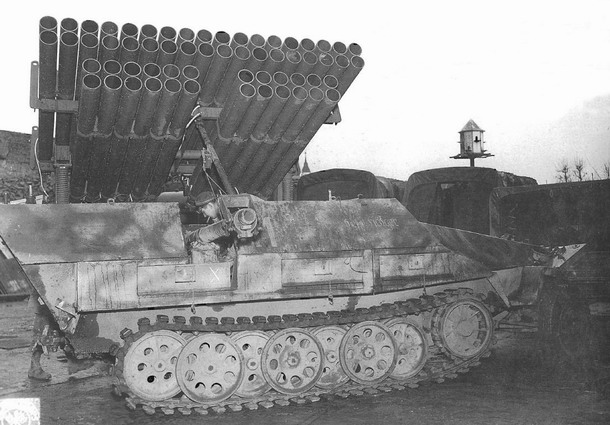
an American experiment — Sd.Kfz. 251 Ausf. D fitted with a Calliope rocket launcher, source: internet, Public domain, edited
Photographs confirm that Adolf Hitler himself took an interest in this prototype and came to inspect it personally. The PaK 42 was a genuinely powerful weapon, and any armoured vehicle equipped with it would theoretically have been a fearsome opponent for enemy tanks. The practical usefulness of this particular vehicle, however, was negligible. Setting aside the complete absence of crew protection, the Sd.Kfz. 251 half-track was simply not designed to carry a weapon of this type. The exact weight of the gun in its modified installation for this vehicle is unknown, but one can safely assume it was more than half the weight of the rest of the vehicle combined. Driving and firing would inevitably have caused enormous wear to the chassis, powerplant, gearbox, and virtually every other component. It is no wonder this type remained a prototype only.
Unofficial Modifications
As a field modification, a half-track was produced armed with the anti-tank gun PaK 38 of 50 mm calibre. The gun was fixed on the cab roof above the driver and commander, complete with its original shield, which substantially increased the vehicle's silhouette. Whether the weapon could be traversed, and if so by how much, is not known. The vehicle was evidently produced in a field workshop somewhere in North Africa (photo HERE (source: panzer35.ru)). Also apparently produced in a field workshop was the installation of a rapid-fire MG 151/15 cannon, visible in the photograph HERE (Flickr.com, courtesy of the publishing user).
Entirely routine were minor modifications such as adding various roofs and shelters over the open cab for crew comfort. Apparently for infantry anti-tank training, several vehicles were built carrying dummy tank turrets (as seen in the photograph HERE (Flickr.com, courtesy of the publishing user)). And there are further mysterious photographs of modified half-tracks without any detailed caption — such as the vehicle in the photograph HERE (Public domain) with a large shield inside the cab and a cage on the side of the hull.
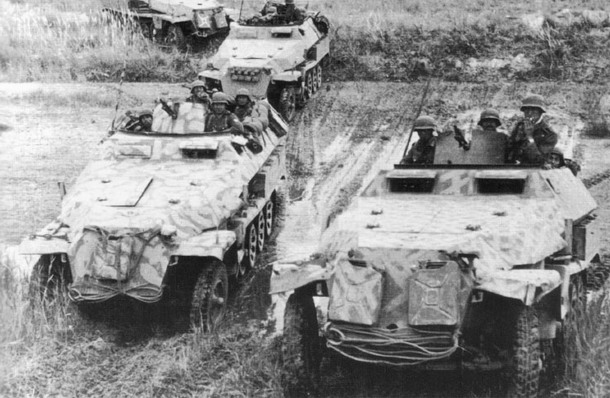
four Sd.Kfz. 251 Ausf. C on the march, source: Flickr.com, courtesy of the publishing user, edited
One of the most remarkable conversions of the half-track was produced not in a German but in an American workshop. Several captured Sd.Kfz. 251 vehicles of various variants were in December 1944 converted to carry the T34 "Calliope" rocket launcher. Fitting the sixty-barrel weapon required considerable modifications to the vehicle's armour. The launcher was mounted transversely in the vehicle, aiming out to the side. Photographs confirm that the Americans used a gun barrel as part of the elevation mechanism — possibly a captured German PaK 40. It is probable that these vehicles were never actually deployed in combat and served only as evaluation prototypes.
The Sd.Kfz. 251 did not escape the drive to conserve every drop of fuel, and conversions to alternative propulsion also appeared. Available photographs show several different installations on vehicles of various variants including the latest Ausf. D. Details differed between individual conversions, but generally the vehicles carried a tall wood-gas generator boiler hung at the rear, with pipes running along the sides connecting the boiler to condensation and filtration tanks and then onward to the engine. Vehicles modified in this way probably did not serve as combat vehicles but rather as training vehicles or support lorries (though a photograph of an ambulance Sd.Kfz. 251/8 with this propulsion system also exists).
During the war, captured vehicles were used not only by the Western Allies but also by the Red Army, and after the war the newly reconstituted Czechoslovak Army became a major operator. Its inventory included not only examples acquired after the German surrender, but around the turn of the 1950s and 1960s production of the half-track was even restarted. This was already a new type that only derived from the German Sd.Kfz. 251, however — the new vehicles received a domestic Tatra engine and the hull underwent a series of changes. The designation of this half-track was OT-810, and approximately 1,500 were built. The last of them were reportedly retired from Czech Army stocks as late as 1995.
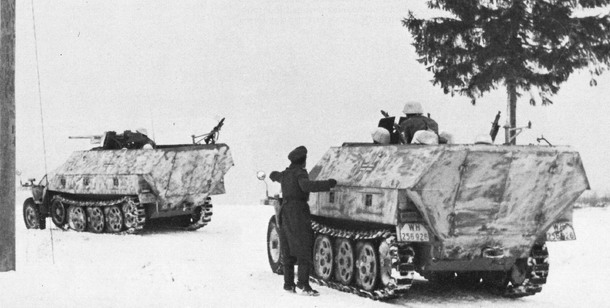
two Sd.Kfz. 251 Ausf. D in the Russian winter; the vehicle in front is the 251/10 variant, source: Bundesarchiv_Bild_101I-701-0371-17, Wikimedia, Creative commons, edited
As early as the turn of 1940–41, Demag and Hanomag were working on the development of a generational successor to the Sd.Kfz. 251. This was part of a broader initiative aimed at consolidating the types within the half-track vehicle category. The theoretical successor to the Sd.Kfz. 251 was designated HKp 603 (HK = HalbKette = half-track, p = probably gepanzert = armoured). The eight-tonne vehicle had a new chassis and hull but was overall very similar in concept and shape to the existing Sd.Kfz. 251. The gearbox and powerplant were also new — the latter being a six-cylinder Maybach HL45Z producing 120 horsepower at 3,800 rpm. The HKp 603 was never accepted for production and remained only a prototype. It apparently influenced the designers working on the simplified hull of the Sd.Kfz. 251 Ausf. D — though in exactly what way I do not know.
Organisation and Deployment
The diversity of the Sd.Kfz. 251's variants was matched by the diversity of the units to which it was assigned. Half-tracks of various types served with the artillery, with reconnaissance units, with Luftwaffe anti-aircraft units, and so on. In its original role as an armoured infantry carrier, however, the Sd.Kfz. 251 was assigned primarily to rifle (Schützen) units within panzer divisions. At the start of the war, each Panzerdivision had two Schützen Regiments; later this was reduced to one. A Schützen Regiment consisted of two battalions (Bataillone), each with four companies (Kompanien) — two rifle companies, one heavy company, and one motorcycle company. Each rifle company broke down into three platoons (Züge), and each platoon had three sections (Gruppen) of ten men. Each such ten-man section was to have one Sd.Kfz. 251 carrier.
Each platoon was to have a total of four carriers — one per section plus one for the platoon commander. From the moment they became available, platoon commanders received the Sd.Kfz. 251/10 variant armed with the 37 mm anti-tank gun. This was the theory; in practice, production of the half-track fell far short of army requirements, and typically only one of the two battalions of a Schützen Regiment was equipped with carriers. This battalion was sometimes designated as mechanised, while the second battalion, equipped only with lorries, was described as motorised.
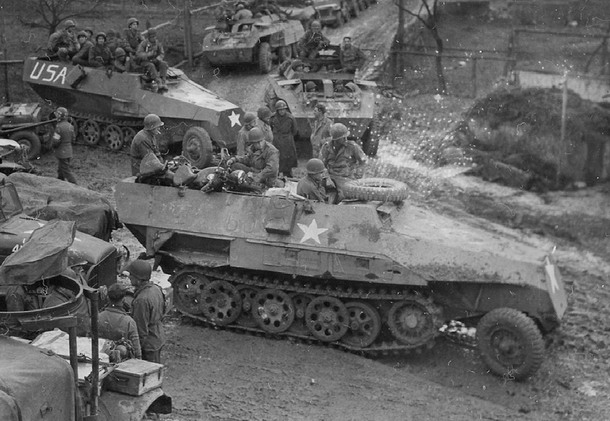
for the Americans the Sd.Kfz. 251 was a welcome prize — its cross-country performance surpassed their own half-tracks, source: internet, Public domain, edited
In 1942 the rifle units were reorganised and redesignated as Panzergrenadier (armoured infantry) units. Literature often emphasises that the motivation was to boost morale by giving the men a new designation evoking an association with tanks and with the historical military elite. But it was not merely a name change. The subordination of these units was also altered, and their training and tactics were updated. Until that point the rifle units had been under infantry command rather than armoured command, which complicated their direction. With the transition to Panzergrenadiere, this changed, and the soldiers were now formally subordinated to tank division command. The update to training and tactics was directly connected to the growing proportion of half-track carriers. As Sd.Kfz. 251 production grew, the Panzergrenadiere could shed their conventional lorries and cooperate even more closely with the tanks on the battlefield. Beyond the panzer divisions, half-track carriers were also assigned to independent Panzergrenadier Divisions.
Perhaps no other vehicle has come to symbolise the Wehrmacht as much as this half-track carrier. It accompanied German soldiers in the African desert and the Russian frost, from the first to the last days of the Second World War. The Sd.Kfz. 251 was one of the workhorses of the Blitzkrieg. Its fate seemed to mirror that of the German army itself — as economies were sought and production optimised, ever greater demands were placed on it, with ever heavier weapons mounted upon it.
Technical Data
|
weight: |
8.5 t |
|
length: |
5.8 m |
|
width: |
2.1 m |
|
height: |
1.75 m |
|
engine: |
Maybach HL42 TUKRM |
|
engine output: |
100 hp |
|
max. speed: |
52.5 km/h |
|
range – road: |
300 km |
|
range – cross-country: |
150 km |
|
front armour: |
14.5 mm |
|
side armour: |
8 mm |
|
rear armour: |
8 mm |
|
crew: |
2 men + dismount |
|
armament: |
2 x MG 34 machine gun, 7.92 mm calibre |
*The technical specifications above apply to the basic variant Sd.Kfz. 251/1

ARTICLE
CONTENTS:
Reproducing text from the Panzernet website without the written consent of the operator is prohibited.