FLAKPANZER 341 "COELIAN"
anti-aircraft tank project on the Panther chassis
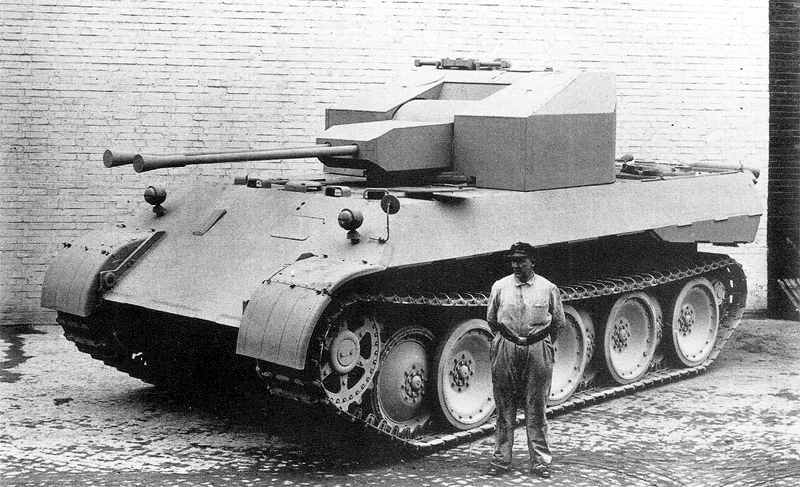
the Rheinmetall-Borsig Flakpanzer 341 demonstrator with a wooden mockup of the fighting turret, source: Flickr.com with the permission of the publishing user, edited
The Need for Flakpanzers
By mid-1943 the German Army had a range of vehicles for close-range air defence in its inventory, but virtually without exception these were half-tracked vehicles with an open fighting compartment (or, at best, a lightly armoured driver's cab). These were adequate for protecting columns of vehicles on the move or supply convoys, but were not suited for deployment in the thick of ground fighting, where they were highly vulnerable to enemy guns, tanks and infantry. The intensity of Soviet ground-attack aircraft strikes directly against fighting German tanks was, however, growing continuously, and the Germans were beginning to recognise the lack of any sufficiently effective defensive means.
The situation was serious enough that in May 1943 it reached the agenda of the so-called Panzerkommission — the military-technical committee overseeing armoured vehicle development. At this meeting a decision was taken that every German tank regiment would receive 18 anti-aircraft tanks (Flakpanzers), which, thanks to the armoured protection of their fighting compartment, would be able to operate on the battlefield far more safely than the existing half-tracked vehicles. This was easy enough to say but harder to do, since at that time German armaments manufacturers were not producing any series Flakpanzers. New combat vehicles therefore had to be developed, tested and then rapidly brought into production.
A working group was appointed to define the required characteristics of the new vehicle so that it would meet the army's needs as closely as possible. By the end of June 1943 an analysis and a basic set of requirements had been produced. Front-line experience indicated that enemy ground-attack aircraft most commonly attacked from altitudes of 150 to 300 metres, firing from a distance of approximately 1,000 metres from the target. The analysis further noted that a fully deployed tank battalion of 96 tanks would be spread across an area of approximately 1,200 by 2,000 metres — from which it was possible to calculate the area the new Flakpanzers would need to be able to cover with their fire.
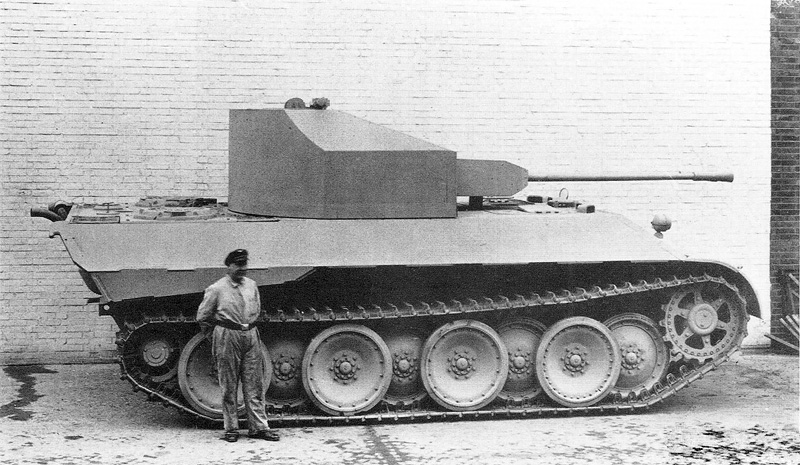
the Flakpanzer 341 demonstrator; for some reason the wooden turret mockup had vertical front walls, whereas the drawings envisaged sloped walls, source: Flickr.com with the permission of the publishing user, edited
Existing tank chassis were to be used as the basis for the vehicle. Light Panzer I and Panzer II were naturally out of the question. Panzer III chassis were needed for the production of StuG III assault guns, leaving the Panzer IV and the brand-new Panther, just then entering service. As for armament, the analysis proceeded from the assumption that enemy aircraft could reach speeds of up to 500 km/h during an attack run (an allowance was clearly being made for faster aircraft yet to come). On this basis it was estimated that between 60 and 70 rounds would be needed to bring down a single aircraft. There was therefore no doubt that the new Flakpanzers would have to carry rapid-fire weapons.
The Panther as the Basis
From this point, Flakpanzer development essentially went in two directions. The first prioritised speed of development and entry into production, and therefore relied on the series Panzer IV chassis with a relatively simple side-only armoured fighting compartment. Leaving the top of the fighting space open greatly simplified development, since there was no need to resolve the complex issues of aiming and fume extraction. The second direction aimed at more advanced vehicles with a fully enclosed fighting turret, based on Panzer IV and — primarily — Panther chassis.
Three armament options were recommended for consideration for a Flakpanzer on the Panther chassis: a battery of four 20 mm cannon, a battery of two or three 37 mm cannon, and a battery of two 55 mm cannon. Rheinmetall-Borsig came forward with a proposal for a fighting turret mounting two pairs of MG151/20 aircraft cannon in 20 mm calibre, with an incredible theoretical combined rate of fire of 2,400 to 3,000 rounds per minute. In December 1943, however, the Panzerkommission ruled that 20 mm calibre was insufficient and that the new Flakpanzer should be armed with a pair of twin-mounted 37 mm cannon, with provision for re-arming with 55 mm cannon in the future once such a weapon became available.
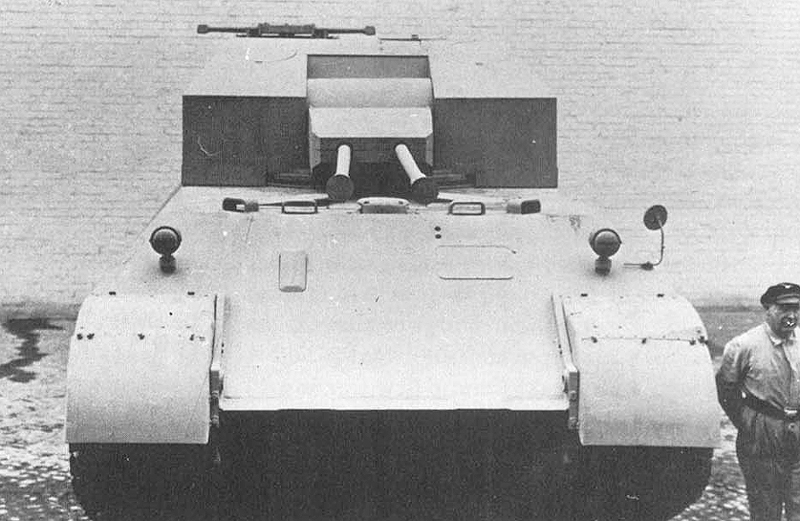
the Flakpanzer 341 demonstrator; note the dummy sight/rangefinder on the roof of the fighting turret, source: Flickr.com with the permission of the publishing user, edited
The Daimler-Benz Proposal
The task of designing the new fighting turret was assigned to Daimler-Benz, but few details of their work are known. In March 1944 drawings were produced for a new turret with 60 mm armour and a pair of cannon designated Flak 44. No information about a weapon by that name can be found anywhere, however. It is therefore possible that the actual weapon intended was the Flak LM 44 — a twin 37 mm installation with side-by-side barrels being developed for the German Navy. Power for the turret's traverse mechanism was to come from the tank's main engine via a special gearbox. The designers apparently struggled greatly with the problems of tracking a fast-moving target and, in particular, of ventilating the turret during sustained fire. In any case, the Daimler-Benz turret proposal ultimately remained only on paper.
The Rheinmetall-Borsig Proposal
In January 1944, Rheinmetall-Borsig also became involved in the development of the fighting turret for the new Flakpanzer, and in March of the same year submitted its own vehicle proposal to the ordnance office under the designation Flakpanzer 341. According to some generally credible sources, Rheinmetall entered the project through its subsidiary Vereinigte Apparatebau AG — though virtually no information about such a company can be found on the internet.
Rheinmetall planned to install a pair of 37 mm cannon that it was itself developing at the time under the designation Gerät 341. This was essentially an enhanced version of the series Flak 43, featuring a longer barrel (L/77 instead of L/57) and, crucially, more powerful ammunition. The result was a muzzle velocity of 1,040 m/s (compared to only 820 m/s for the standard Flak 43). For the Flakpanzer, belt-fed loading of the cannon was envisaged. A total of 1,500 rounds of 37 mm ammunition were to be carried on board. The range of vertical elevation is usually given as −5° to +90°. Aiming was apparently to be handled by a periscope mounted on the turret roof — from its design, most likely a combination of gunsight and coincidence rangefinder.
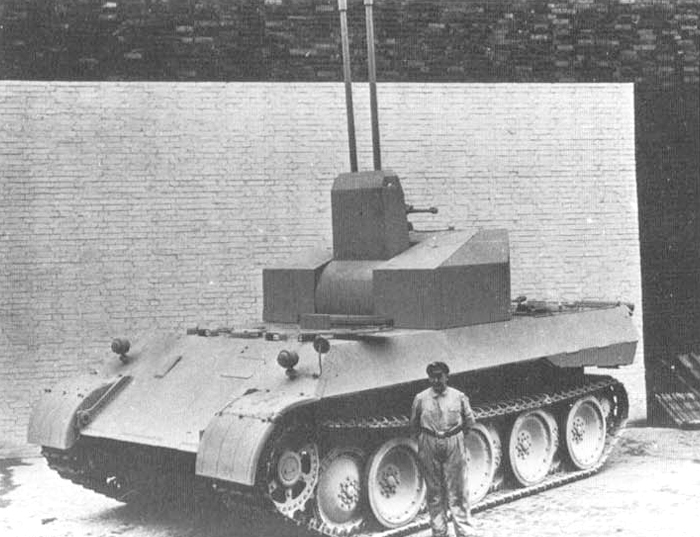
the Flakpanzer 341 demonstrator at maximum weapon elevation; note how the sight has rotated skyward together with the barrels, source: Flickr.com with the permission of the publishing user, edited
Rheinmetall took its Flakpanzer 341 design somewhat further than its rival Daimler-Benz — specifically to the point of building a demonstrator with a wooden turret mockup on an actual Panther Ausf. D chassis. Most sources state that this demonstrator was completed and shown to the army as late as January 1945.
In that same month — January 1945 — a fatal verdict was pronounced on the new Flakpanzer. This was delivered by the Inspector General of Panzer Troops, Heinz Guderian, who cancelled the project on the grounds that Panther chassis were too precious to the army to be used for building such lightly armed vehicles.
The Name "Coelian"
As already noted, Rheinmetall used the designation Flakpanzer 341 for its proposal. Alongside this, however, the vehicle under development also acquired an unofficial name: "Coelian" (written "Cölian" in some sources). Where did this name come from? According to most sources, it was one of the given names of Lieutenant Josef von Glatter-Götz, an officer at the German Armored Troops Inspectorate who was responsible for overseeing the new Flakpanzer project. As is our custom at Panzernet, we did a little research and found one intriguing connection — we hope it will not bore you.
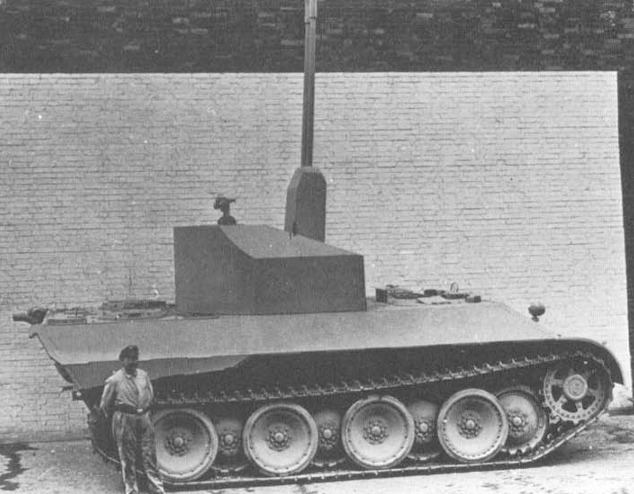
the Flakpanzer 341 demonstrator at maximum weapon elevation; note how the sight has rotated skyward together with the barrels, source: Flickr.com with the permission of the publishing user, edited
The company Gebrüder Rieger was founded in 1879 by brothers Otto-Anton and Gustav Rieger. In 1903, Otto Rieger junior — son of Otto-Anton, born in 1880 — took over the running of the company. This Otto Rieger had gone to school with one Josef von Glatter-Götz (also born in 1880), who became a very close friend of his — so close, in fact, that Otto later employed Josef at a senior management position in the family firm. When Otto Rieger died in 1920 at the age of just 40, Josef von Glatter-Götz took over the management of the entire company and four years later bought it from the Rieger family.
The Gebrüder Rieger firm thus now belonged to the von Glatter-Götz family, and Josef (senior) employed both of his sons there: Egon and Josef junior (born 1914). And it was precisely this Josef von Glatter-Götz junior — a qualified engineer who had studied at technical institutions in Wrocław, Chrudim and Berlin — who served in the rank of lieutenant in the German Wehrmacht at the Armored Troops Inspectorate (Inspektion der Panzertruppen). His full name was Josef Carl Raimund Maria Celyan von Glatter-Götz. "Celyan" is apparently one of the historical forms of the name Kilian, just as Coelian or Coelianus are old Latin variants of the same name.
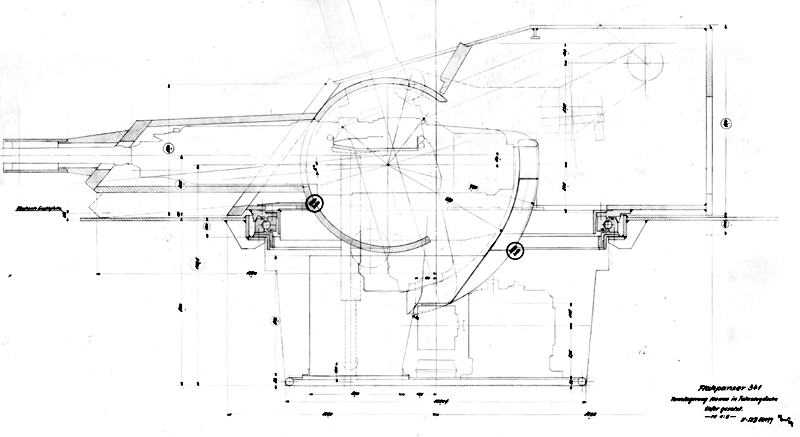
the drawing of the fighting turret for the Flakpanzer 341 shows the sloped front walls that were absent from the demonstrator, source: Flickr.com with the permission of the publishing user, edited
It would seem that the Rheinmetall representatives were very keen indeed to stay in the good graces of Lieutenant von Glatter-Götz — naming their creation after him and then contracting the work to his father's factory. In the end, however, it did them little good (in this particular case, at least). We will not even mention the obvious conflict of interest on the lieutenant's part.
Technical Specifications
|
weight: |
approx. 40 t |
|
length: |
6.87 m |
|
width: |
3.27 m |
|
height: |
2.80 m |
|
engine: |
Maybach HL 230 P30 |
|
engine output: |
700 hp |
|
max. speed: |
55 km/h |
|
fuel capacity: |
730 l |
|
range - road: |
250–270 km |
|
range - off-road: |
100 km |
|
crew: |
4 or 5 men |
|
armament: |
2× Flak 341, 37 mm |
ARTICLE
CONTENTS:
Reproducing text from the Panzernet website without the written consent of the operator is prohibited.