FERDINAND/ELEFANT
the unwanted child that became a legend
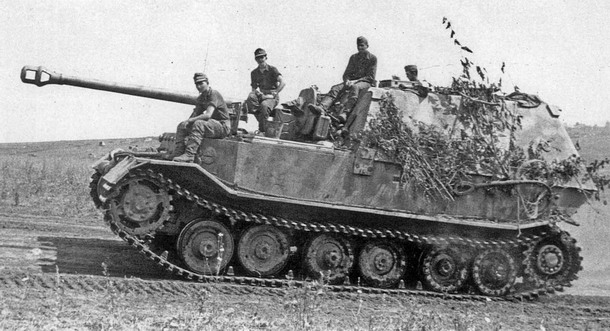
the Ferdinand heavy tank destroyer; source: Flickr.com, published with the permission of the original contributor, edited
Origins of the tank destroyer
The Ferdinand heavy tank destroyer came about essentially as an unplanned by-product of the development of the famous heavy tank Tiger. Let us therefore first take a brief look at the history of that tank. Its development began in May 1941 under the designation VK 45.01, with two firms competing for the contract: Henschel (project VK 45.01 (H)) and Porsche (project VK 45.01 (P)). Hitler, who took a very personal interest in the new heavy tank — and had in fact himself defined some of its required parameters — was on very good terms with Dr. Porsche and was convinced that Porsche's design would prove the better and therefore the winning one. Hitler was pressing hard for the development to be completed and series production of the Tiger to begin as soon as possible. In the interest of speeding up the whole process, the ordnance office placed orders as early as July 1941 for the construction of the first 100 series tanks to Dr. Ferdinand Porsche's design (orders directed to Krupp and Nibelungenwerke, with whom Porsche was collaborating on the project).
The first comparative demonstration of the competing Porsche (VK 45.01 (P)) and Henschel (VK 45.01 (H)) prototypes, held in April 1942, came down in favour of the Henschel vehicle — contrary to Hitler's expectations. It is true that this was only a first demonstration, arranged essentially to mark the Führer's birthday, and the result was not therefore considered conclusive. Thorough army trials followed in July, but again confirmed the superior performance of the Henschel prototype. Accordingly, in August 1942 Henschel was declared the competition winner and its Tiger (VK 45.01 (H)) was accepted for series production. Representatives of the ordnance office and Armaments Minister Speer now had to work out what to do with Porsche's VK 45.01 (P) project. Thanks to the earlier ordnance office orders, by this point the Nibelungenwerke factory in St. Valentin, Austria, already had completed components for one hundred Porsche-version tanks sitting on the floor. Simply scrapping them would have been scandalous waste that Germany in the middle of a war could not afford.
The obvious option was simply to complete these tanks and introduce them into service alongside the series Henschel Tigers. In the end, however, events took a different course. The Germans were at that time looking for a suitable fully tracked armoured carrier for the new 88 mm anti-tank gun Pak 43, and the chassis of the Porsche VK 45.01 (P) appeared usable for this purpose. In September 1942 it was therefore decided that the hundred part-built chassis and hulls for the Porsche Tigers would be completed — not as tanks, however, but as self-propelled anti-tank guns armed with the aforementioned Pak 43. The original VK 45.01 (P) project was formally terminated in October 1942, and work began on defining the requirements for a new vehicle provisionally designated Panzerjäger Tiger (P).
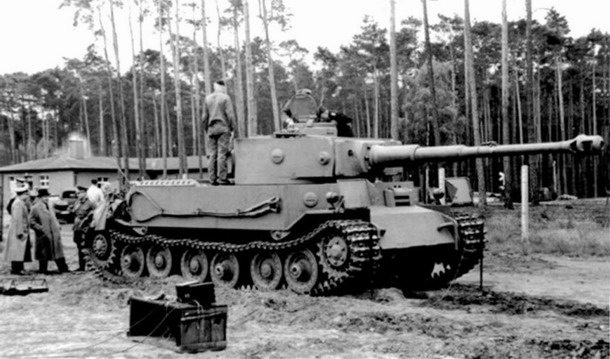
the Ferdinand heavy tank destroyer was based on the VK 45.01 (P) chassis — Porsche's unsuccessful heavy tank design; source: Flickr.com, published with the permission of the original contributor, edited
With the Porsche chassis came one absolutely fundamental characteristic. Dr. Porsche was convinced that a vehicle weighing 50 tonnes or more could not reliably function with a conventional mechanical gearbox, as it would be overloaded. He therefore experimented with alternative methods of transmitting drive from the engine to his tank's drive sprockets. His VK 45.01 (P) prototype was accordingly fitted with a petrol-electric drivetrain: two conventional internal combustion engines drove a pair of electric generators, which produced current for two electric motors, and it was these electric motors that actually drove the tank's wheels. We will say more about the details of this drivetrain later; in any case, the new Panzerjäger Tiger (P) had no choice but to inherit this type of propulsion.
Development of the new tank destroyer on the Porsche chassis was entrusted to the Berlin firm Alkett (Altmärkische Kettenwerke GmbH), which had extensive experience producing the successful StuG III assault guns. Final assembly of the resulting vehicles was to take place at the Austrian Nibelungenwerke factory rather than at Alkett — presumably to avoid the need to ship all the already-completed parts from Austria to Germany. Alkett therefore sent 120 of its workers to Nibelungenwerke to handle both the development work and the subsequent assembly (though some publications give exactly the opposite account, stating that all components were shipped to Berlin and the Ferdinands were assembled at the Alkett works there). The design of the new vehicle was finalised in December 1942. The order for converting the original tank into a self-propelled anti-tank gun covered only 90 vehicles. The remaining 10 part-built Porsche vehicles were to be put to other uses — further testing, as command tanks, and later also for the construction of recovery vehicles.
Description of construction
The running gear was taken over from the tank prototype without modification. It consisted of six large road wheels on each side. The wheels were of double-disc design, with the track guide teeth passing through the gap between the two discs. The road wheels were suspended in pairs: the first and second wheels shared a common suspension, as did the third and fourth, and the fifth and sixth. This shared suspension consisted of two arms. The main swing arm was connected to a pivot on the side of the hull. At the outer end of this relatively short arm was the axle of one of the wheels on the outside, while on the inner side a longer secondary swing arm was pivotally connected. At the end of this secondary arm was mounted the second wheel of the pair. The secondary swing arm was in fact a hollow tube, inside which a torsion bar was fitted. This torsion bar provided springing for the entire suspension assembly with both wheels. At the far end the torsion bar was fixed rigidly. At the end near the pivot joint between the main and secondary arms, the bar was conversely free to move, and the sliding motion generated there by the arms moving up and down over uneven ground was transmitted in some manner (the details of which the author unfortunately could not establish, though it was presumably some form of cam mechanism) into a rotational movement that twisted the torsion bar.
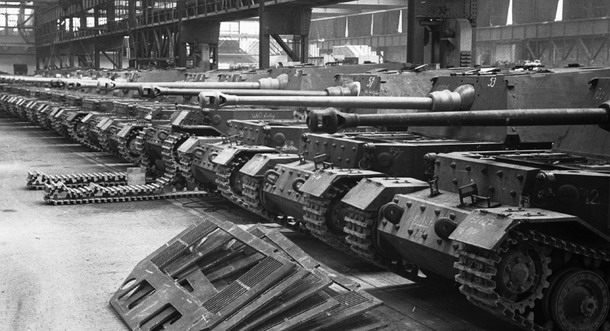
conversion of the original tank chassis into tank destroyers took place at the Nibelungenwerke factory; source: Aviarmor.net, published with the permission of the site operator, edited
In addition to the six road wheels, the running gear also included a toothed rear drive sprocket and a likewise toothed front idler wheel. The front wheel also had to be toothed because, in addition to tensioning the track, it was used for steering by means of braking. The tracks were 640 mm wide and each consisted of 109 links.
The Ferdinand tank destroyer was intended to be able to punch through enemy defences while withstanding even the heaviest anti-tank fire. To improve its survivability, the new vehicle was to have thicker armour at its most exposed points than the original tank design had specified. These points were the upper nose of the hull and the front plate of the driver and radio operator's compartment. The original VK 45.01 (P) tank prototype had 100 mm armour there. On the new tank destroyer, however, additional plates of a further 100 mm were riveted onto the original armour. The Ferdinand could therefore boast 200 mm of frontal armour — truly unprecedented for the time, and virtually guaranteeing immunity to frontal penetration.
Behind the reinforced front wall were the positions of the driver and radio operator: the driver on the left, the radio operator on the right. On the original VK 45.01 (P) prototype, the driver observed ahead through a vision port set directly in front of him in the front wall of the compartment. As part of the conversion to a tank destroyer, however, this vision port was eliminated and the driver was instead given three fixed periscopes in the cover of his entry hatch (positioned in the roof plate directly above the driver's head) (the three periscopes are clearly visible on the open hatch cover HERE (source: Flickr.com). The original tank prototype was also equipped with a hull machine gun, with its ball mount located in the front wall of the compartment on the right-hand side — operated by the radio operator seated in that part of the compartment. The Ferdinand tank destroyer did not retain the hull machine gun, and its ball mount was therefore eliminated. The front wall of the driver and radio operator's compartment could as a result be straightforwardly reinforced with the aforementioned additional armour plate, in which no cut-outs were required — neither for a vision port nor for a machine gun.
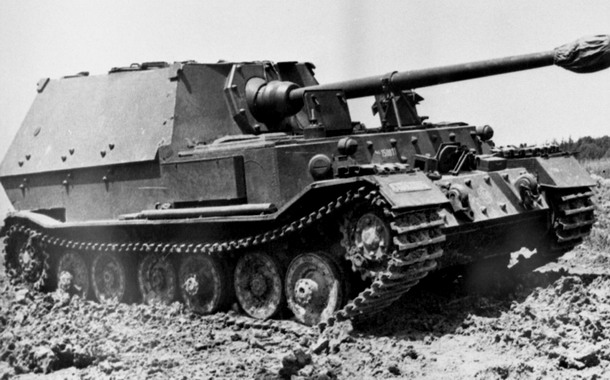
the first completed Ferdinand, with chassis number 150011, during trials; this vehicle still differed from the other production vehicles in several details; source: Flickr.com, published with the permission of the original contributor, edited
Significant changes compared with the original Porsche VK 45.01 (P) tank prototype also took place inside the hull. Its internal layout had to be fundamentally reorganised for the new purpose. Whereas the original tank was to have had its fighting turret at the front, with all drivetrain components therefore placed in the rear half of the hull, the Ferdinand arrangement was almost exactly the opposite. The conversion designed by the Alkett engineers placed the fighting superstructure at the rear of the hull. The front of the hull therefore housed the already-mentioned driver and radio operator positions, immediately behind which came the engine section. This contained the two combustion engines, two electric generators, fuel tanks, and cooling system. Only the pair of Siemens-Schuckert electric motors remained at the very rear of the hull, connected directly to the rear drive sprockets.
The original VK 45.01 (P) tank prototype was fitted with Porsche's own Typ 101 combustion engines — air-cooled petrol engines whose design was quite immature, making them highly unreliable. Alkett therefore had to find more suitable powerplants for the Ferdinands. The Berlin firm's engineers turned to the proven and reliable Maybach HL 120 engines — twelve-cylinder petrol units of 11.9 litres displacement producing 300 horsepower each. These engines were cooled not by air but by liquid, however, meaning the cooling system (radiators, coolant tanks, pumps, and plumbing) also had to be squeezed into the hull. The result was an enormously crowded engine section, with individual components packed together to an almost incredible degree — a situation that would prove a source of problems in both operation and servicing.
The relocation of the engines and generators freed up space in the rear of the hull for the main fighting superstructure. Alkett designed for it a fixed armoured enclosure built from flat armour plates. Its front plate was 200 mm thick; the sides and rear were 80 mm. The original VK 45.01 (P) hull narrowed towards the very rear (as can be seen in the photograph HERE (source: Flickr.com). If the fighting superstructure had to taper here as well, it would have considerably complicated and increased the cost of its manufacture. The designers therefore chose the opposite approach, simply widening the narrowed rear section of the hull so that its sides were straight along their full length. Both the superstructure and the hull thus ended up with straight side walls that matched each other neatly.
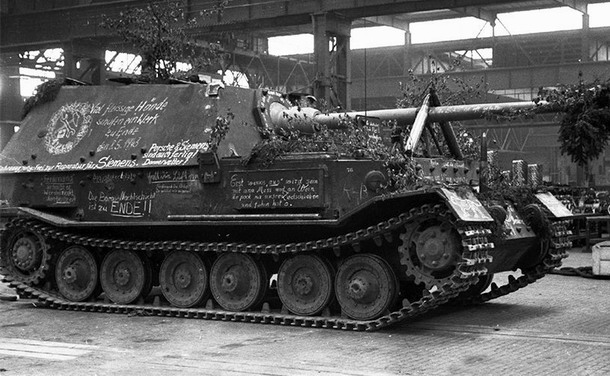
May 1943: the last of the 90 Ferdinands is complete... and decorated for the occasion. Note that the vehicle does not yet have the gun barrel shield fitted; source: Flickr.com, published with the permission of the original contributor, edited
The 8.8 cm Pak 43 gun
Installed inside the fighting superstructure was the main weapon: the anti-tank gun 8.8 cm Pak 43/2 L/71. As the name indicates, this was a weapon of 88 mm calibre with a barrel approximately 71 calibres long (precisely 6,298 mm). The "2" after the slash signified that this was a modified version of the Pak 43, adapted specifically for installation in the Ferdinand tank destroyer. This adaptation concerned only the mounting arrangement, however, not the weapon itself. In terms of ballistic performance, the Pak 43/2 was identical to the standard towed Pak 43.
The Pak 43 had been developed from the outset as a highly effective anti-tank weapon suitable for straightforward installation in armoured fighting vehicles. The designers at Krupp (which developed the weapon) therefore paid particular attention to the size of the cartridges and the gun's chamber. The rounds had to be large enough to guarantee power (a large propellant charge), yet not so long as to make handling them inside a fighting compartment impractical. By using shorter but wider cartridge cases, it proved possible to create a gun with a reasonably sized chamber and outstanding armour-piercing performance.
The Ferdinand was thus fitted with the modified Pak 43/2 version of the gun. The barrel was mounted in a spherical mantlet in the centre of the front wall of the fighting superstructure. The mounting allowed only limited traverse for aiming: 15 degrees to each side (sometimes given as only 14 degrees), beyond which the entire vehicle had to be moved. This restricted horizontal movement might at first glance appear to be a critical handicap, but given the gun's enormous effective range, this field of traverse was generally sufficient for engaging targets. Vertical elevation ranged from -8 to +18 degrees (sometimes quoted as -6 to +14 degrees).
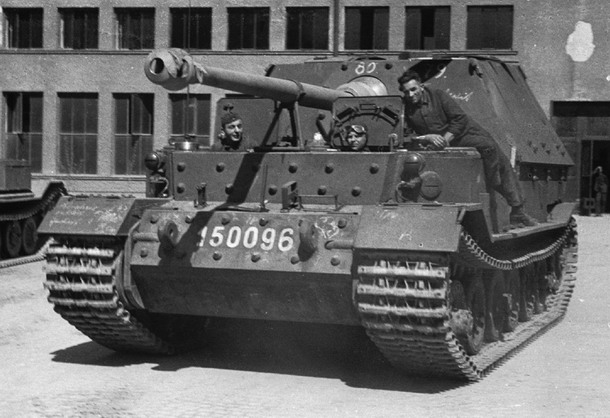
a freshly completed Ferdinand with chassis number 150096 outside the factory; source: Flickr.com, published with the permission of the original contributor, edited
The gun was aimed using a Sfl ZF 1a (Selbstfahrlafetten-Zielfernrohr) periscopic sight, which extended through an aperture in the roof of the fighting superstructure. The on-board ammunition supply was 50 rounds (55 according to some sources). Because the gun barrel was extremely long, it had to be secured during longer road moves — otherwise it had a tendency to vibrate, which was naturally undesirable. A barrel travel lock was therefore fitted at the front of the hull, into which the barrel was placed before any lengthy journey.
Four types of ammunition were used with the Pak 43. The primary round for destroying enemy armour was the Pzgr. 39/43 (Pzgr. = Panzergranate). This was an armour-piercing shell weighing 10.2 kg with a small bursting charge. The projectile left the muzzle at approximately 1,000 m/s. At a range of one kilometre it could penetrate 165 mm of sloped homogeneous armour, and at two kilometres still an incredible 132 mm. Beyond sheer penetration power, the Pak 43 was also renowned for its accuracy. Gun accuracy is typically expressed as the probability of hitting a target 2.5 metres wide and 2 metres tall (roughly the frontal dimensions of a tank), distinguished between range conditions and combat conditions — with the understanding that real-world results were generally somewhat poorer than those on the range, due to the greater stress and time pressure of actual combat. For the Pak 43 using the Pzgr. 39/43, the probability of a hit at 1,000 metres was 100% on the range and 85% in combat. At 2,000 metres this fell to 85% on the range and 43% in combat.
The second anti-tank round available was the tungsten-cored Pzgr. 40/43. This projectile weighed only 7.3 kg and left the muzzle at 1,130 m/s. At 1,000 metres it could defeat 193 mm of sloped armour, and at 2,000 metres 153 mm — slightly more accurate than the Pzgr. 39/43 as well. However, this round was quite scarce, as tungsten was a strategic material in short supply for Germany. Crews therefore carried only a handful of these rounds at most — if any — and saved them for engagements with the heaviest Soviet armour. Unlike the Pzgr. 39/43, the Pzgr. 40/43 carried no explosive charge, meaning its destructive effect after penetrating the interior of an enemy vehicle was more limited. That said, it only had to strike the stored ammunition — of which every tank carried plenty — for catastrophic destruction to follow regardless.
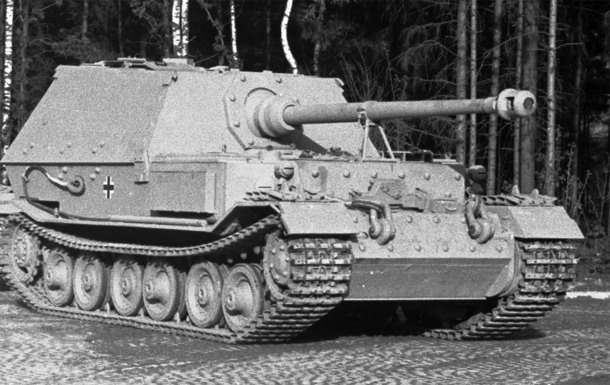
the Ferdinand heavy tank destroyer shortly after completion — again without the gun barrel shield; source: Flickr.com, published with the permission of the original contributor, edited
The third available round was the Gr. 39/3 HL, a shaped-charge anti-tank projectile. This round weighed 7.65 kg and had a muzzle velocity of only around 600 m/s. For a shaped-charge round, however, impact velocity is irrelevant — penetration is achieved not through kinetic energy but through a chemical effect, meaning its armour-piercing capability does not diminish with increasing range. The Gr. 39/3 HL could penetrate 90 mm of armour — substantially less than the armour-piercing rounds described above. Shaped-charge ammunition was also less accurate than conventional rounds, and crews generally did not bother carrying it at all. The fourth and final ammunition type for the Pak 43 was the high-explosive Sprgr. 43 (Sprgr. = Sprenggranate), used against unarmoured — so-called soft — targets, including enemy infantry.
Inside the fighting superstructure, four crew members had their positions. The vehicle commander sat to the right of the gun; the gunner sat to the left. Two loaders each occupied one of the rear corners of the superstructure. Together with the driver and radio operator already mentioned, the Ferdinand's full crew therefore numbered six men. The driver and radio operator each had their own individual entry hatches positioned directly above their seats. The crew members in the fighting superstructure had access to only two hatches in its roof.
As for visibility from the vehicle, the crew's options were quite limited. Best served was the driver, who had three fixed observation periscopes in his entry hatch cover and one additional vision slit in the angled transition between the front and left side walls of the hull. The radio operator had only a single vision slit in the angled transition between the front and right side walls. The gunner could only see out through the gun's periscopic sight. In the rear corners of the fighting superstructure roof were smaller circular covers concealing two retractable periscopes — one for each loader, to give them situational awareness of what was happening behind the vehicle. The vehicle commander was, paradoxically, probably the worst served of all the crew members: his only way to look outside was to open his hatch cover and extend a scissors-type artillery periscope through it.
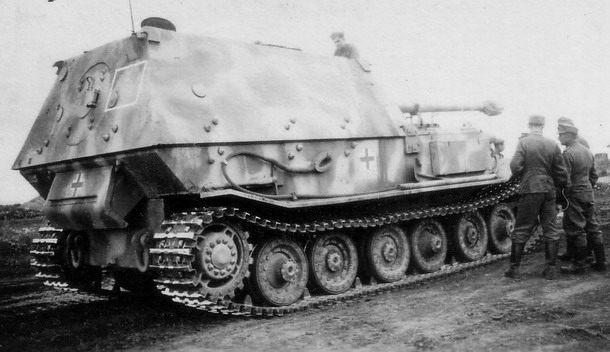
the Ferdinands received their baptism of fire at the Battle of Kursk in July 1943; source: Worldwarphotos.info, published with the permission of the site operator, edited
Roughly in the centre of the fighting superstructure roof was another opening, covered by a raised housing — the superstructure ventilation fan. In the left front section of the roof was a covered crescent-shaped aperture through which the gun sight extended. The crescent shape allowed the sight to move as the weapon was traversed. In the rear sections of the fighting superstructure side walls were small circular openings that could be sealed with armoured plugs, serving as pistol ports for the crew's personal weapons. In the centre of the rear wall was a large circular opening sealed with a massive cover. This large opening was used to withdraw the gun if it needed to be repaired or replaced. The cover was normally bolted permanently in place and could not simply be opened. In the centre of this circular cover was a smaller circular cut-out, however, fitted with a hinge so that it could be opened in normal use. This smaller aperture was used for loading fresh ammunition and ejecting spent cartridge cases (clearly visible in the photograph HERE (source: Flickr.com), and for discarding spent cases. On either side of the large service opening were two further small circular pistol ports in the rear wall.
The official designation of the new fighting vehicle was probably Panzerjäger Tiger (P) Ferdinand für 8,8cm Pak 43/2, and its ordnance code was Sd.Kfz. 184. The vehicle's weight ultimately came to a full 65 tonnes. On roads the Ferdinand could achieve a maximum speed of 30 km/h, though cross-country it generally moved at only around 10 km/h. The fuel capacity was an impressive 950 litres, though this was sufficient for only around 150 km on roads and 90 km cross-country. The vehicle was equipped with Fu 2 and Fu 5 radio sets and an intercom for internal crew communication.
Production
The first batch of Ferdinand tank destroyers was completed either in January or February 1943, and conversion of the original tank chassis continued through to May 1943. The first vehicle built carried chassis serial number 150011 and was apparently tested by the army in February 1943. Surviving photographs confirm that this example still differed from later production vehicles in several details.
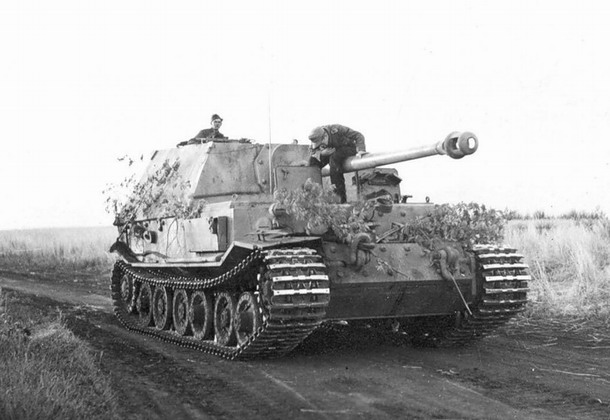
the vast open Russian landscape was the ideal battlefield for the Ferdinand, allowing full use of the enormous effective range of its gun; source: Aviarmor.net, published with the permission of the site operator, edited
Let us mention at least two of the more readily visible differences. Ferdinand No. 150011 had a hull welded from armour plates that had been manufactured during the earlier phase when the design details of the original Porsche VK 45.01 (P) tank were still being finalised. At that stage, circular entry hatches for the driver and radio operator had been planned, intended for placement in the side walls of the hull. This idea was quickly rejected, however, as cutting such large openings in the side armour would have drastically reduced its protective value. By that time, though, the order for the armour plates for the Porsche tank had already been placed and Krupp had begun working on them, and before word reached everyone who needed to know, workers had already cut the circular openings in the plates. The cut-out sections of steel had to be welded back into their positions. The first hulls produced for the VK 45.01 (P) tank thus retained clearly visible circular weld seams in the front sections of their side walls — and one such "marked" hull was used for the verification Ferdinand No. 150011. The second difference between this vehicle and the standard production examples was the absence of the steel clamps that helped secure the fighting superstructure to the hull. Both differences are clearly visible in the photograph HERE (source: Flickr.com).
The final test report on the first Ferdinand tank destroyer was not exactly full of praise. It described a range of failures that had manifested during the trials, and also catalogued numerous design shortcomings. At that point, however, there was no alternative but to commit the new vehicle to service and attempt to address the deficiencies — or at least mitigate them — progressively while in operation. One improvement measure that was adopted was additional armour for the gun mantlet. A square cover with rounded corners was mounted on the gun barrel in front of the spherical mantlet itself, which had been identified as too vulnerable. All Ferdinands reportedly received this armour plate before their first deployment.
Organisation
In March 1943, the organisational structure for deploying Ferdinands was formally established: they were to be formed into heavy tank destroyer battalions (schwere Panzerjäger Abteilung, or sPzJgAbt). A battalion consisted of three companies (Kompanie), each further divided into 3 platoons (Zug), each armed with four Ferdinand tank destroyers (plus supporting vehicles). Each company also had its own command section with two additional Ferdinands. A company at full strength therefore fielded 14 tank destroyers (3 x 4 plus 2). The full battalion had 45 Ferdinands (three companies of 14 plus the battalion command with three more).
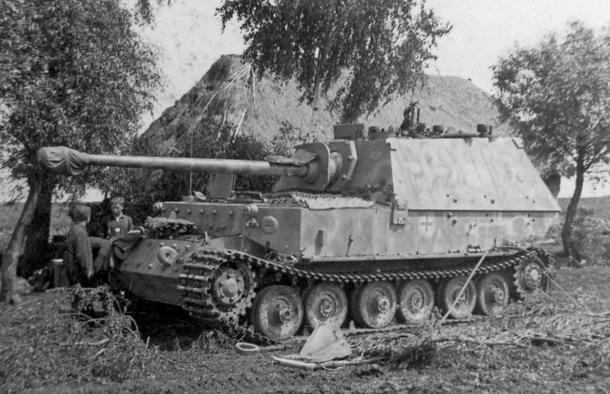
the Ferdinands proved extremely demanding to repair and maintain; source: Aviarmor.net, published with the permission of the site operator, edited
The ninety vehicles produced were therefore sufficient to form only two such battalions: sPzJgAbt 653 and sPzJgAbt 654. Both battalions were subsequently incorporated into the heavy tank destroyer regiment sPzJgRgt 656 (schwere Panzerjäger Regiment). Also included in the regiment was the assault gun battalion StuPzAbt 216, equipped with Brummbär self-propelled guns.
The new tank destroyers were to make their combat debut at the Battle of Kursk (Operation Zitadelle). The entire 656th Regiment with its ninety Ferdinands was assigned for this operation to the XXXXI Panzerkorps (41st Armoured Corps), which was part of the 9th Army of Field Marshal Walther Model, which in turn came under Army Group Centre (Field Marshal Günther von Kluge). The Ferdinands were therefore committed to the northern sector of the attempted Kursk encirclement.
The war diary of the 9th Army records that on 30 April 1943 an unnamed Panzerwaffe officer visited their sector of the front to reconnoitre the terrain and assess whether Ferdinands could be deployed there at all. He also briefed the 9th Army officers to the effect that the new weapon they were about to receive was not yet fully mature in terms of design, and was therefore not suitable for operations requiring long road marches. Instead, it should be used in short but intensive breakthroughs of enemy defensive positions.
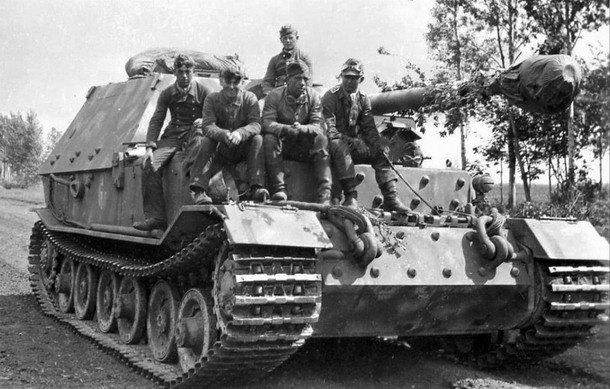
a Ferdinand and its crew; source: Worldwarphotos.info, published with the permission of the site operator, edited
First action at Kursk
The 656th Regiment (sPzJgRgt 656) with its 90 Ferdinands moved up to the Kursk area in stages during June 1943. On 5 July, when the German attack began, the regiment was at full combat strength. As we know, Operation Zitadelle ended in failure for the Germans. The Ferdinands themselves left behind a mixed impression from this battle. They were capable of destroying enormous numbers of enemy tanks (we will return to specific figures later), yet they proved highly unreliable and breakdown-prone, and under certain circumstances surprisingly easy to put out of action. On 8 July 1943 — the fourth day of Operation Zitadelle — the 656th Regiment (sPzJgRgt 656) reported the following Ferdinand status: 7 completely destroyed, 46 under repair, 37 combat-ready. As is clear, more than half of all vehicles were in the workshops, with mechanical failures outnumbering combat damage among the causes.
Lessons from the first action
After the conclusion of the entire operation, the Inspector General of Armoured Forces, Heinz Guderian, compiled a report for his superiors on the combat experience gained with the new vehicle. All 90 Ferdinands had been committed during the Battle of Kursk. In its course, 19 had been permanently lost and a further 40 had been damaged in combat but recovered and subsequently repaired. Of those 40 damaged, the largest proportion had been knocked out by mines. Of the 19 permanently lost, 15 had been destroyed by the enemy and 4 had burned out completely due to electrical system failures.
Not a single case of frontal armour penetration was recorded. On a few vehicles, enemy shells had penetrated through the side or rear armour. A particularly vulnerable point proved to be the engine compartment roof. To allow air flow to the internal components, the roof was not fully plated but was grated, and the gaps between the grille bars were fairly large. In several cases an enemy shell had struck the front wall of the fighting superstructure, failed to penetrate it, but the fragments from the explosion had passed through the grated roof into the engine compartment and caused damage there. In the extremely crowded engine section it was not difficult for fragments to hit something vital — a coolant pipe, for instance, could be pierced, and within minutes the engine would overheat and an otherwise fully combat-ready vehicle would be knocked out. Guderian's report proposed fitting the engine compartment roof with raised armoured covers that would permit air flow but would not be so easily penetrated by shell fragments.
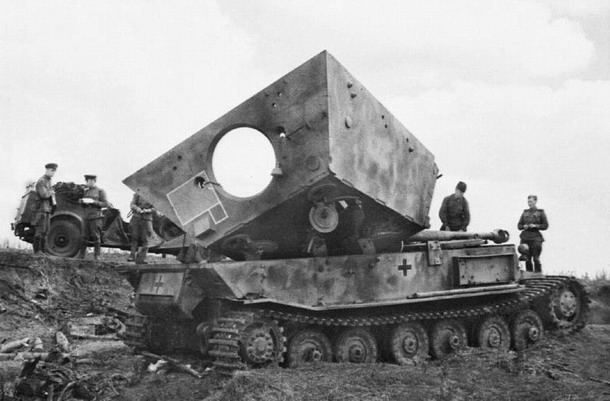
if a broken-down vehicle could not be towed away for repair and there was a risk of it being captured by the enemy, crews were ordered to blow it up rather than allow it to fall into enemy hands — as in this case. The force of the ammunition explosion was sufficient to lift the entire armoured superstructure and flip it upside down; source: Flickr.com, published with the permission of the original contributor, edited
The second major weakness exposed by the Ferdinands was their lack of machine gun armament. The soldiers had been aware of this shortcoming from the beginning and always tried to deploy accompanying infantry or Panzer III tanks alongside the Ferdinands to protect them from Soviet infantry. This was not always possible, however, and as a result some Ferdinands fell victim quite unnecessarily to Soviet infantry armed with Molotov cocktails. Ferdinand crews could defend themselves by firing small arms through the pistol ports, but the effect was not comparable to a built-in machine gun. The vehicle's enormous weight was also problematic: on soft ground it was prone to becoming stuck, and a motionless vehicle was then very difficult to recover.
Regarding the gun armament, however, the report was unsparing in its praise. The Pak 43/2 could destroy Soviet tanks at ranges of over 2,000 metres without difficulty, and destroying one enemy vehicle generally required no more than two rounds at most. This was reflected in the large number of enemy vehicles claimed. The figures cited are almost unbelievably high — though perhaps not entirely fabricated. Between 5 and 16 July 1943, the Ferdinands are said to have destroyed 320 Soviet tanks and an unspecified quantity of other equipment. If accurate, that works out to nearly 17 enemy tanks destroyed for every Ferdinand lost.
The cancellation of Operation Zitadelle did not end the fighting in the Kursk area — quite the opposite. On 17 July the Soviets launched a general counteroffensive and the Germans went over to the defensive. Most of the combat-ready Ferdinands were moved to the town of Kromy, about 30 km south of Orel, where they fought defensive actions until the end of July. At the end of July the Germans were forced to withdraw from the Orel salient further westward. On 1 August 1943, the 653rd Battalion (sPzJgAbt 653) reported only 12 combat-ready Ferdinands, with a further 17 under repair and 16 completely lost. Schwere Panzerjäger Abteilung 654 was in an even worse state: while it still had 13 combat-ready vehicles, its losses amounted to 26 complete write-offs, with the remaining 6 Ferdinands under repair. Of the original total of 90 built and deployed, 42 had been permanently lost in less than a month of fighting. Moreover, all surviving Ferdinands were reported as urgently requiring a full overhaul.
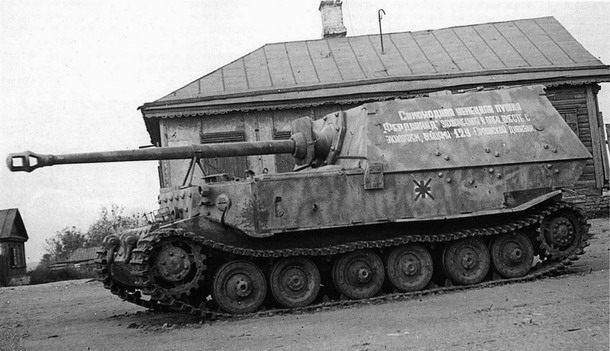
this Ferdinand fell into Soviet hands in relatively undamaged condition; source: Aviarmor.net, published with the permission of the site operator, edited
Around mid-August it was decided to withdraw sPzJgAbt 654 to France to rest and re-equip with the new Jagdpanther tank destroyers. The 19 Ferdinands the battalion then had on hand were transferred to sPzJgAbt 653 before its departure. Only a single unit equipped with Ferdinand tank destroyers therefore remained at the front.
Bryansk – Nikopol
On 18 August the 653rd Battalion received orders to concentrate at Bryansk, from where it was to move by rail to Dnipropetrovsk. Dnipropetrovsk had facilities suitable for the badly needed full overhauls.
Withdrawing all the Ferdinands to a single location was far from simple. Every operational vehicle was desperately needed at the front, so the transfer from Bryansk to Dnipropetrovsk had to proceed piecemeal as vehicles could be released from action and delivered to the railhead. The first Ferdinands left Bryansk on 21 August 1943. Further delays occurred en route, as the railway was running at capacity. The overhauls apparently did not begin until the very end of August. Alongside straightforward repairs and maintenance, the front-line units were also calling for numerous improvements — but they would have to wait. For now, the priority was simply to repair the Ferdinands, replace heavily worn components, and return them to the front as quickly as the supply of spare parts from Germany and Austria allowed. New engines were fitted, new tracks installed, and so on.
In mid-September all the combat-ready vehicles from the Dnipropetrovsk workshops — all eight of them — were formed into Kampfgruppe Baumunk (a mixed unit named after its commander) and sent eastward towards Pavlohrad, about 60 km away. Over the following days these eight Ferdinands were committed to fighting in the area between Pavlohrad and Synelnykove. It very quickly became clear that German forces would once again have to withdraw further west. The repair personnel at Dnipropetrovsk were therefore tasked with getting all remaining Ferdinands into a state where they could at least drive under their own power to the nearest railhead. At the same time they were to load all spare parts and other equipment and prepare to move south to Zaporizhzhia in Ukraine.
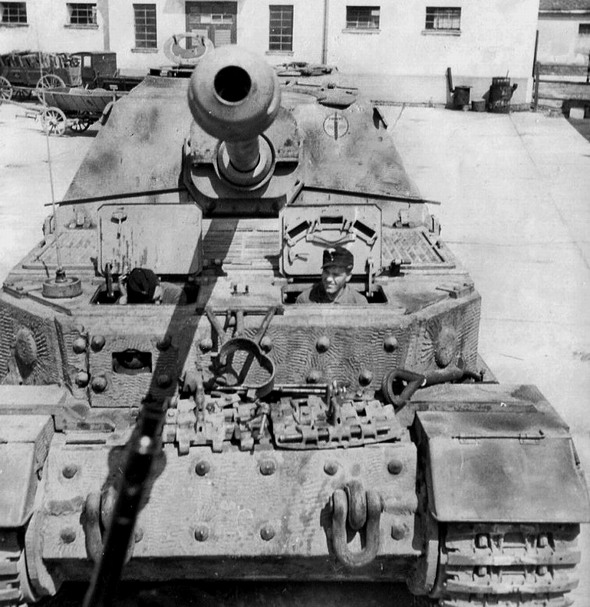
in early 1944 all surviving Ferdinands underwent modernisation. The modernised tank destroyer was subsequently renamed Elefant. Note the machine gun ball mount in the hull front and the new commander's cupola on the fighting superstructure roof; source: Flickr.com, published with the permission of the original contributor, edited
Here the entire 656th Regiment — which by this time consisted only of sPzJgAbt 653 and StuPzAbt 216, as sPzJgAbt 654 had, as noted, been withdrawn to France — was placed under Army Group South's command, with all combat-ready vehicles to prepare for the fight for the so-called Zaporizhzhia bridgehead on the Dnieper. Thirteen Ferdinands were declared combat-ready; the rest, which were not, were transported further west to Nikopol for their overhauls to continue.
October and November were spent by the Ferdinand crews in defensive fighting along various sections of the front in the Zaporizhzhia, Nikopol, and Myrhorod areas. The repair workshops at Nikopol ran at full capacity: repaired vehicles went straight back into action and returned damaged again by combat or mechanical failure. Track and running gear damage was very frequent: Soviet tank crews had discovered that the Ferdinand's frontal armour was simply impenetrable for them, and had increasingly begun targeting the tracks and wheels instead. The cumulative score from individual combat reports shows that by 5 November 1943, sPzJgRgt 656 had destroyed a total of 582 enemy tanks and 344 anti-tank guns. Since this figure covers the entire regiment, not all of these victories can of course be attributed to the Ferdinands alone — the regiment's other equipment, such as the Brummbärs of StuPzAbt 216, contributed as well.
Modernisation
On 2 December 1943, the 656th Regiment (sPzJgRgt 656) received the long-awaited order to prepare for the journey back to the Reich for rest and modernisation. The first train departed for Vienna on 16 December. At that time the 653rd Battalion (sPzJgAbt 653) still had 48 Ferdinands on its books — exceeding its table of organisation strength, thanks to the 19 Ferdinands received from the 654th Battalion in August. Fewer than a third of them appear to have been in operational condition, however.
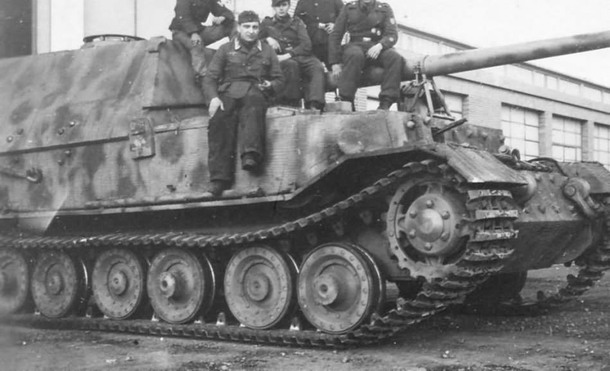
the modernised Elefant — this photograph clearly shows both the hull machine gun barrel and the commander's cupola; source: Worldwarphotos.info, published with the permission of the site operator, edited
By late December all surviving Ferdinands were at the Nibelungenwerke factory in St. Valentin, Austria. The factory lacked sufficient storage space, so the vehicles had to park literally wherever space could be found. In January 1944 the workers got down to business. Now, far from the front, there was finally time not only for repairs but also for the modernisation that front-line soldiers had been calling for so long. An aperture was cut in the right side of the front armour of the driver and radio operator's compartment, and an MG 34 machine gun ball mount was installed. Its operation was assigned to the radio operator seated there. The engine compartment received a new-pattern roof plate that was significantly less susceptible to penetration by shell fragments. In place of the original simple entry hatch for the commander, a raised commander's cupola fitted with seven observation ports around its circumference was installed on the fighting superstructure roof. All vehicles also received a coating of Zimmerit anti-magnetic paste and an updated gun barrel shield.
Had these been ordinary German tanks, the vehicles after modernisation would probably have been designated as a new variant — e.g. Ausf. B (Ausf. = Ausführung = variant, version). In the case of the modernised Ferdinands, however, they were given an entirely new name: Elefant (elephant).
Deployment in Italy
It will surprise no one that repairs and modernisation did not proceed as quickly as planned, mainly due to delayed deliveries of key components. On 22 January 1944, however, Allied forces landed at Nettuno and Anzio in Italy, and an urgent order soon reached the Nibelungenwerke factory for one company of Elefants (14 vehicles) to be readied for deployment on the Italian front without delay. In the end, command had to settle for only 11 vehicles, which were available by 15 February 1944. The very next day these vehicles were loaded onto a train and dispatched to Italy.
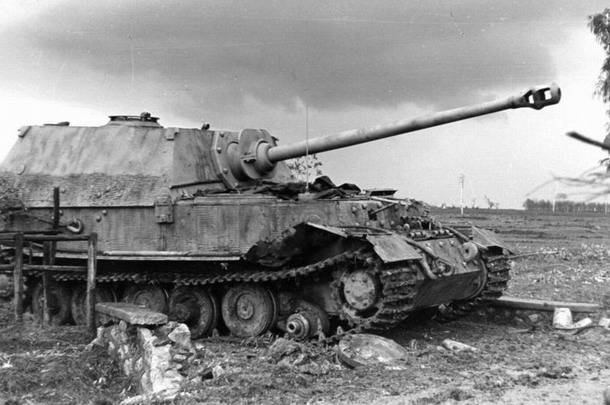
a modernised Elefant destroyed during the fighting in Italy; source: Bundesarchiv_Bild_101I-313-1004-25, Wikimedia, Creative Commons, edited
The Elefants entered combat at the end of February. By 7 March, however, only six of them were still operational. The terrain in the deployment area was entirely unsuitable for Elefants. The narrow, hilly roads full of bends placed enormous strain on the already sensitive drivetrain. The broken, obstructed terrain also prevented proper use of the vehicle's main advantage — the enormous effective range of its gun. Despite this, the Elefants managed over the following months to effectively slow the Allied advance. Slowly but surely, however, they were forced to withdraw northward with the rest of the German forces, and their losses steadily mounted. It was not until early August that the remnants of the company withdrew to San Marino, from where they were to be evacuated back to Germany. By that point the company was down to its last two tank destroyers.
Back to the east
While the fighting described above was taking place on the Italian front, the remaining vehicles of the 653rd Battalion (sPzJgAbt 653) underwent repairs and modernisation at St. Valentin. In early April 1944, 30 modernised Elefants were dispatched by rail to the Eastern Front. On 8 April they arrived at the Ukrainian town of Berezhany, about 40 km west of Ternopil. The vehicles were immediately committed to combat against the Red Army. Despite some local successes, it was a futile struggle from the outset against overwhelming numerical superiority. The Elefants relentlessly destroyed Soviet tanks in tens, but new ones always appeared. The battalion was also desperately short of service equipment — cranes, supply vehicles, and the like — and spare parts, so the number of combat-ready tank destroyers steadily declined.
From May to July the 653rd Battalion fought along various sections of the front west of Ternopil, gradually withdrawing westward. Large numbers of Elefants were lost during this fighting, though in most cases not through direct combat. Recovery equipment shortages took a heavy toll: an Elefant immobilised by a breakdown or minor damage too close to the front line simply could not be safely towed to the rear for repair, and the crew therefore had to blow it up themselves to prevent it falling into enemy hands. Equipment was thus being lost, but not the men. The battalion's reports therefore repeatedly contained requests for re-equipment with other available vehicles, as soldiers with invaluable experience on heavy tank destroyers were being forced to fight as ordinary infantrymen for lack of vehicles — a genuine waste.
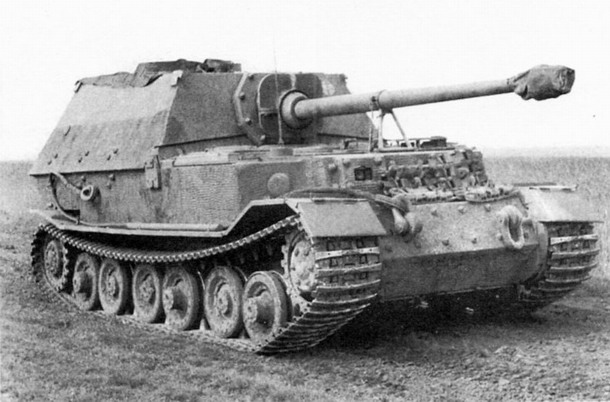
an Elefant; source: Flickr.com, published with the permission of the original contributor, edited
The last company
At the end of July the remnants of the unit received orders to withdraw. Only 12 Elefants returned to Germany during August 1944. These 12 vehicles were reunited in Germany with the 2 Elefants that had just returned from Italy. These last 14 surviving vehicles were just enough to equip one company. Of the entire 653rd Battalion, only the 3rd Company remained — equipped, moreover, with vehicles that were already very heavily worn. After the most essential repairs had been carried out, the 3rd Company was sent to fight south of Kraków in Poland. Reports on the unit's subsequent fate become fragmentary. In December 1944 only 10 Elefants remained with the 3rd Company, which by that time had been detached from sPzJgAbt 653 and redesignated Panzerjägerkompanie 614 (PzJgKp 614). sPzJgAbt 653 itself had by that point already been preparing for several months to re-equip with the newest type of tank destroyer, the Jagdtiger.
The last reports in which Elefant tank destroyers appear date from February 1945, noting that the final two available Elefants took part in the fighting at Zossen and Wünsdorf, only about 25 km south of Berlin itself. In all likelihood, not a single operational example survived to the end of the war.
Bergetiger (P)
When the last of the ninety Ferdinands was completed in May 1943, the question of how to recover and tow them in the event of breakdown had still not been resolved. The German army had no vehicle powerful enough to handle the new heavy tank destroyer. The only solution was to hitch three or four Sd.Kfz. 9 half-tracked prime movers together. Getting three or four such tractors to the same spot and connecting them all was time-consuming, and a better solution was clearly needed. In June 1943, Nibelungenwerke was therefore tasked with converting three more of the original VK 45.01 (P) tank chassis into recovery vehicles. It will be recalled that only 90 of the total 100 prepared chassis had been converted into Ferdinands, so there were still chassis available (note: according to some authors, only 86 Ferdinands were built, with the remaining four of the 90 VK 45.01 (P) chassis earmarked for recovery vehicle construction).
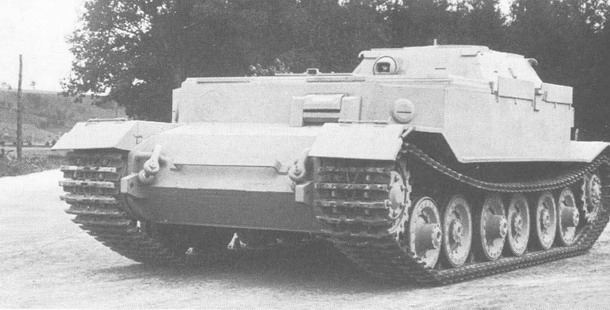
the Bergetiger (P) recovery vehicle; source: Flickr.com, published with the permission of the original contributor, edited
The internal hull layout was changed in the same manner as on the Ferdinands themselves: Porsche's combustion engines were replaced with Maybach units and the engine section relocated forward. At the rear, however, instead of a tall fighting superstructure, a low superstructure housing the crew compartment was fitted. The thickness of this superstructure's armour unfortunately could not be established. In its front wall was a hemispherical ball mount for an MG 34 machine gun. The roof featured a circular entry hatch, and the rear wall had double-leaf access doors apparently borrowed from the side walls of the fighting turret of the Panzer III tank.
The hull front was not fitted with the additional riveted armour plate, leaving it at the original "mere" 100 mm thickness. The hull machine gun aperture of the original VK 45.01 (P), located in the front wall ahead of the radio operator's position, was evidently welded shut. The crew of the recovery vehicle — which received the name Bergetiger (P) — consisted of three or four men. The vehicle unfortunately had no winch or other specialised equipment, and had to rely on its own tractive power alone when towing damaged Ferdinands. Only three Bergetigers were built, apparently delivered in August 1943.
Overall assessment
What can be said in conclusion? The Ferdinand heavy tank destroyer could, with some exaggeration, be described as something like the unwanted child of German wartime industry — born essentially unplanned and purely out of necessity. The primary "parents" of this unwanted child would arguably be Dr. Porsche and Hitler himself. On paper the Ferdinand was a superbly armoured vehicle armed with the best anti-tank gun of its era. The numbers of enemy tanks it destroyed far exceeded its own losses. And yet, despite all of this, the vehicle is generally considered an unsuccessful project.
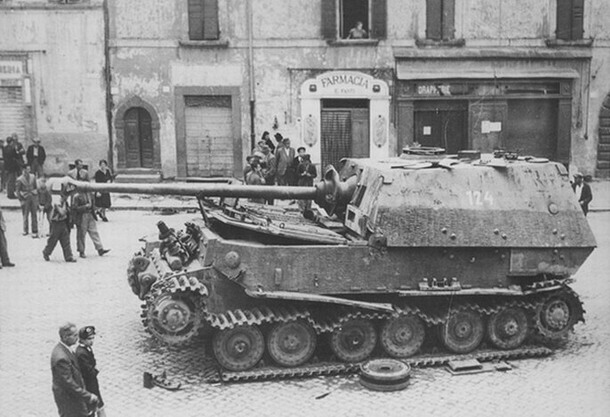
an Elefant destroyed on the Italian front — the crew apparently attempted to replace a damaged road wheel suspension unit (the replacement unit lies ready on the hull nose) but were forced to flee before the advancing Allies and blew the vehicle up rather than leave it (as suggested by the lifted engine compartment roof plate); source: Aviarmor.net, published with the permission of the site operator, edited
Its clearly stated qualities on paper were often overshadowed by enormous practical operational problems. As mentioned several times in the text above, the Ferdinand was among other things quite prone to engine overheating and failures of the electrical components. The problem was not so much with the engines or the generators themselves — the Maybach HL 120 combustion engines used served perfectly well in the medium Panzer III and Panzer IV tanks. The problem lay in how extremely tightly all the components were packed together in the hull. As a result, there was insufficient space for free air circulation, and elements such as coolant pipes and hot exhaust pipes were placed right next to each other, reducing cooling efficiency and raising the risk of overheating. The grated engine compartment roof, intended to aid cooling, in turn left the internal electrical installations exposed to rain and snow, increasing the risk of short circuits. A large proportion of the vehicles fell victim to mechanical failures rather than enemy action.
Another major problem was the weight of the vehicle. The running gear had originally been designed by Dr. Porsche for a lighter vehicle — the VK 45.01 project envisaged a weight of around 45 tonnes, whereas the Ferdinand came in at 65 tonnes — and it suffered accordingly. Despite the use of relatively wide tracks, Ferdinands frequently became bogged down on soft ground and recovery was sometimes simply impossible; in such cases the vehicle then sometimes simply had to be blown up. The enormous fuel consumption, which placed significant demands on logistics, is also worth noting.
Many students of historical statistics might object that the Ferdinand's breakdown rate was not actually all that scandalously high if compared with that of other heavy vehicles such as the Tiger tank. It must be borne in mind, however, that only 90 Ferdinands were ever built, meaning that a huge proportion of spare parts had to be manufactured in very small batch runs — which was of course extremely expensive. It is therefore no surprise that as time passed and the number of surviving Ferdinands dwindled, soldiers complained ever more frequently of spare part shortages. Can one really justify the cost of manufacturing and shipping expensive spare parts to the front for the sake of perhaps the last roughly 30 or so operational vehicles?
In short, the prevailing view among historians is that had the time, energy, and money expended on producing and operating the Ferdinands been instead purposefully invested in producing and operating a more standardised vehicle — such as the Tiger or Panther tanks — the number of enemies destroyed could have been even higher.
Technical data
|
weight: |
65 t |
|
length: |
8.14 m |
|
width: |
3.38 m |
|
height: |
2.97 m |
|
engine: |
2 x Maybach HL 120 TRM |
|
engine output: |
2 x 300 hp |
|
max. speed: |
30 km/h |
|
fuel capacity: |
950 l |
|
range - road: |
150 km |
|
range - cross-country: |
90 km |
|
hull armour: |
|
|
- front: |
200 mm |
|
- sides: |
80 mm |
|
- rear: |
80 mm |
|
superstructure armour: |
|
|
- front: |
200 mm |
|
- sides: |
80 mm |
|
- rear: |
80 mm |
|
crew: |
6 men |
|
armament: |
Pak 43/2 L/71 gun, 88 mm calibre 1 x MG 34 machine gun, 7.92 mm calibre (Elefant) |
ARTICLE
CONTENTS:
Reproducing text from the Panzernet website without the written consent of the operator is prohibited.