BRUMMBÄR
the grumbler that was built to destroy cities
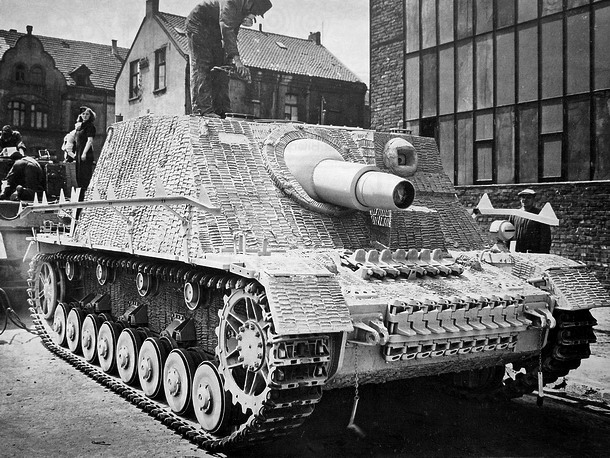
Sturmpanzer IV from the fourth (final) production series — workers in the factory yard finishing the paintwork, source: worldwarphotos.info, with permission of the operator, edited
Origins of the Vehicle
During the fighting in Stalingrad, German units faced many problems specific to urban warfare. One of them was the need to dislodge defenders who had fortified themselves inside large multi-storey buildings. Driving them out in room-to-room fighting was a slow process that came at a tremendous cost in casualties. The most effective way to overcome this kind of resistance was simply to destroy the entire building. But how to achieve this in practice? Sending combat engineers to the building with demolition charges was tantamount to sacrificing them. German tanks could reach a building with relative safety, but even at their best their guns were simply not capable of bringing down a large residential block or a factory hall with thick walls. Heavy artillery, which would certainly have been sufficient for the task, operated from great distances and was not accurate enough to take out a specific building without destroying everything around it. Air power was of course also an option — a dive bomber could strike a designated house with reasonable precision, but this was a costly and time-consuming solution, and attacking at low altitude over a city carried a considerable risk of being shot down by ground-based anti-aircraft defences.
What the German soldiers fighting in Stalingrad simply lacked was a self-propelled weapon capable of bringing down a large building with just a few shots, while at the same time withstanding close-range fire from enemy infantry weapons. Their requirement was conveyed to the Army High Command at Hitler's conference on 20 September 1942. The German High Command reacted with remarkable speed. The Berlin firm Alkett (Altmärkische Kettenwerk) was immediately tasked with designing and developing not one but two new armoured vehicles suitable for this role.
The first of these was to be essentially a stopgap solution, with speed as the overriding priority. The heavy infantry gun sIG 33 — or rather its modified variant sIG 33/1 (developed by Škoda Plzeň specifically for installation in armoured vehicles) — was selected as its main weapon. The chassis was taken from the assault gun StuG III, which was already being mass-produced at Alkett. The vehicle was to have a fully enclosed fighting compartment and was to use as many existing components as possible to speed up production. The resulting fighting vehicle received the designation Sturminfanteriegeschütz 33. The engineers and workers at Alkett pulled off a genuinely impressive feat, delivering the first twelve Sturminfanteriegeschütz 33 vehicles in October 1942 — which meant they actually did make it in time to see action in the streets of Stalingrad.
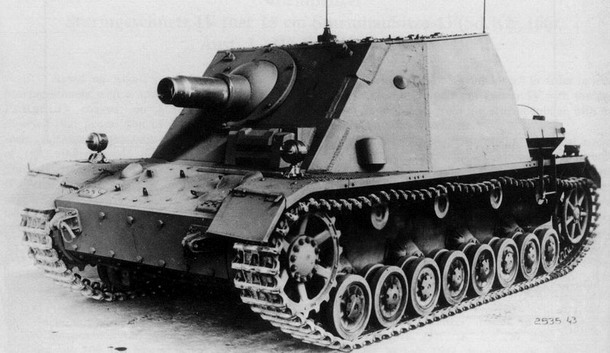
Prototype of the Sturmpanzer IV — the bolted-on additional armour plate on the hull front is clearly visible, source: Flickr.com, with permission of the publishing user, edited
At the same time, however, Alkett was to prepare a second design — one that could afford to take longer and require a greater investment, but would be a fully developed advanced vehicle that would become the standard means of fulfilling this combat role in the future. A conceptual design for this second vehicle was ready as early as 2 October 1942. The chassis of the medium tank PzKpfw IV was selected as its basis, and the main armament was again to be the sIG 33 — this time, however, in a much more extensively modified form. Hitler approved the design immediately and ordered an initial production run of 60 vehicles.
Development of the gun for the new vehicle was entrusted to Škoda Plzeň, which had already proved its worth in the aforementioned modifications of the sIG 33/1. The conceptual design of the complete vehicle was further refined, and in February 1943 a full-scale wooden model was built. Construction of a verification prototype followed.
First Production Series
At least 40 of the first series production vehicles were to be delivered by May 1943 at the latest, in order to be available for the summer offensive on the Eastern Front. Since every new PzKpfw IV tank was desperately needed at the front, it was decided that the chassis for the first production series would be sourced from existing older tanks returning from the front for major overhaul. In line with this decision, production of the new vehicle was entrusted to the army vehicle repair depot in Vienna (Heeres-Kraftfahrzeug-Werkstatt Wien, or HKW Wien).
For conversion at HKW Wien, older Panzer IV chassis were set aside — specifically the Ausf. E, F and G variants. The conversion involved considerably more than simply removing the fighting turret and crew compartment. On the oldest Ausf. E chassis, for example, the road wheels, idler wheels and drive sprockets were all replaced, and new 400 mm wide tracks were fitted (standard Ausf. E tanks had 360 mm tracks). The hull's frontal armour also had to be substantially reinforced, since the new self-propelled gun was intended to operate in the cluttered confines of built-up areas where unexpected short-range fire was a constant threat. Additional armour plates of the same thickness were bolted to the front of the hull, which on the PzKpfw IV Ausf. E, F and G had a uniform thickness of 50 mm. The front of the new vehicle's hull could thus boast a formidable 100 mm of armour protection!
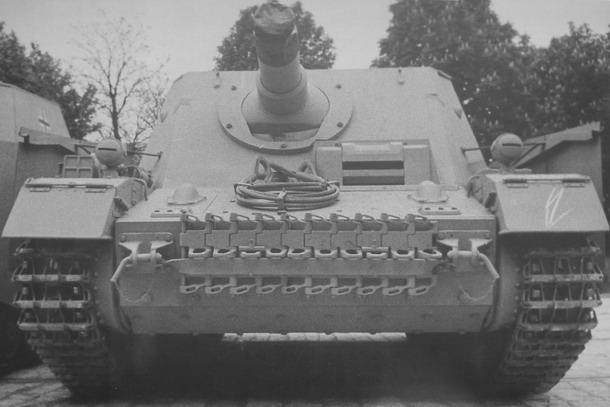
Sturmpanzer IV from the first production series, source: Flickr.com, with permission of the publishing user, edited
Meanwhile, Škoda Plzeň was working intensively on developing the gun with its distinctive ball mount. While the development work drew on the sIG 33 as its starting point, precious little of the original weapon remained apart from the breech itself. The gun received a new barrel, a new recoil mechanism and above all a new semi-spherical ball mount. This heavily modified weapon received the designation 15cm Sturmhaubitze 43 L/12. By retaining the original breech, the weapon used the same ammunition as the sIG 33. The precise calibre of the Sturmhaubitze 43 (and indeed of the original sIG 33) was 149.1 mm, though 150 mm is the commonly cited figure. The barrel length was 1,810 mm and the weapon's weight is generally given as 1,850 kg. The first six Sturmhaubitze 43 guns were ready in March 1943, a further twenty were delivered in April and the last fourteen in May 1943. The Škoda guns were immediately fitted into the prepared vehicles, so the first 20 complete machines rolled out of the Vienna depot in April 1943, followed by a further forty in May — completing the first production series.
The name of the new vehicle is a chapter in itself. At least ten different designations for it can be found in various official German documents — to give just a flavour: 15cm Sturmhaubitze 43 (L/12) Sturmgeschütz IV, 15cm Sturmhaubitze auf Panzerfahrgestell IV, Sturmgeschütz IV für 15cm Stu.Haub.43, and so on. On 4 May 1943, Hitler himself apparently ruled that the new vehicle would henceforth be designated Sturmpanzer — literally "assault tank." The Roman numeral IV was not strictly necessary since no other Sturmpanzer existed, but most historians include it for clarity. As for the combat name Brummbär, it does not appear in any contemporary German documents at all. It first surfaced in an American intelligence report from September 1944 describing a Sturmpanzer IV captured in France. Who coined the name and why will probably never be known — it may simply have been a nickname painted on the armour by the particular vehicle's crew, which would not have been unusual. The American intelligence officers would have known perfectly well that an inscription on the armour was not an official designation, but since they had nothing better to go on, they simply used it. Whatever the origin, the name stuck among historians and enthusiasts alike. Incidentally, the German word Brummbär is often incorrectly translated as "grizzly bear," which is wrong — Brummbär is a colloquial word for a grumbler or curmudgeon.
As already noted, the Sturmpanzer IV was built on older used PzKpfw IV chassis of various variants. Like the standard PzKpfw IV, it therefore had eight 470 mm diameter rubber-tyred road wheels on each side for a smoother ride. The wheels were double, with the track guide teeth running between the two discs. Road wheels were suspended in pairs, with four mounts on each side of the hull tub, each mount connecting two swing arms, each arm carrying one road wheel. Both arms were connected by a quarter-elliptic leaf spring. The upper run of the track was supported by four 250 mm diameter rubber-tyred return rollers. At the very front was the toothed drive sprocket and at the rear a spoke-type idler wheel. The vehicle ran on 400 mm wide tracks, each consisting of 99 links.
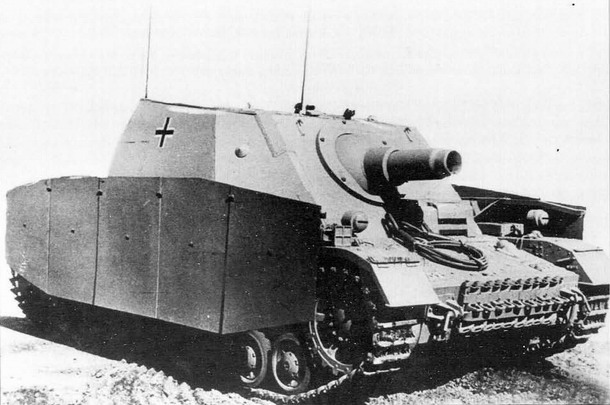
Sturmpanzer IV from the first production series — the vehicle has two antennas and is therefore evidently fitted out as a command vehicle, source: Flickr.com, with permission of the publishing user, edited
The original tank's low crew compartment and fighting turret were removed and replaced by a tall, angular, fixed superstructure. Its front wall was 100 mm thick and angled at 40 degrees. In the lower left of the front plate was the driver's vision port. For production efficiency, vision ports taken from the heavy Tiger tank were used here. More precisely, the first series of Sturmpanzers used vision ports originally manufactured for the Porsche prototype of the Tiger (VK4501 (P)). The ninety VK4501 (P) vehicles built had been converted into Ferdinand tank destroyers at the turn of 1942–43, a conversion that involved among other things completely eliminating the driver's vision port from the front plate of the cab. The removed vision ports were otherwise unused, and the Sturmpanzer IV designers were glad to make use of them. The one slight imperfection was that the vision port was rather oversized for its new application — its upper right corner encroached on the outer rim of the gun mount, requiring a small notch to be cut in it (photo HERE, source: flickr.com).
Slightly to the right of the vehicle's centreline, the main armament — the already-mentioned 15cm Sturmhaubitze 43 — was installed in the front wall. A large circular opening was cut in the front plate for the gun, its edges framed by a collar bolted on from outside with six heavy bolts. Into this collar fitted the semi-spherical ball mount of the weapon, which was connected to the gun barrel and traversed with it during aiming. Inside the compartment, a heavy tubular frame attached to the massive breech defined the space into which the gun recoiled when fired. To the left of the gun, the gunner's seat was fixed to the gun mounting. In front of him was the traverse handwheel for setting vertical elevation, and the Sfl ZF 1a periscopic sight, which extended through the roof. Horizontal traverse of the gun was possible to 15 degrees on each side (other figures are sometimes given). Vertical elevation ranged from -8° to +30°.
The Sturmhaubitze 43 (like the sIG 33) used separate-loading ammunition, meaning the shell was rammed first followed by the propellant charge. The standard round was the Jgr. 38 shell weighing 38 kg, of which 8.3 kg was the amatol explosive filling. A hollow-charge Gr. 39 Hl/A round weighing 25 kg was also available for use against enemy armour. The maximum effective range of the Sturmhaubitze 43 is generally quoted at between 4,300 and 4,500 metres. The first production series Sturmpanzer IV had no integral machine gun armament. The crew did, however, carry an MG 34 machine gun in the fighting compartment, from which fire could be directed from the roof — more on that below.
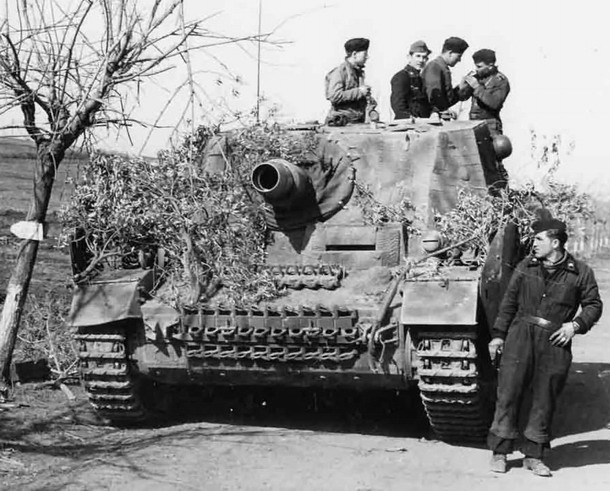
Sturmpanzer IV from the second production series in Italy — second-series vehicles were based on the PzKpfw IV Ausf. H chassis and no longer had the bolted-on additional front hull armour, but received a new armour plate below the driver's vision port, source: worldwarphotos.info, with permission of the operator, edited
The side walls of the fighting compartment initially flared outward from the front plate until they reached the outer edges of the track guards, then continued straight rearwards alongside them. The side walls were slightly angled inward, so the compartment narrowed toward the roof. In the forward flaring sections of the side walls were small circular ports for firing the crew's personal weapons, closed by armoured plugs (photo HERE, source: worldwarphotos.info). In the left side wall beside the driver's position was a small ventilation opening, protected on the outside by a cylindrical cover (photo HERE, source: flickr.com). The left and right halves of the fighting compartment roof were formed by separate armour plates that could be unbolted and lifted — either one or both — allowing the compartment to be fully opened for mechanics to extract the large main weapon.
The fighting compartment roof had three hatches in total. Most of the right half of the roof was occupied by a large hatch that also appears to have served for loading ammunition, closed by a two-leaf cover with a machine gun port cut into its forward leaf. When needed, one of the loaders would open the hatch, prop the forward leaf open in the raised position, push the MG 34 with its drum magazine through the opening, and open fire on attacking infantry — the raised leaf serving as a shield, though only from the front, leaving the gunner exposed on the sides and rear. The machine gun could also be hung on the edge of the raised leaf for firing at low-flying enemy aircraft.
In the forward left section of the roof was a further hatch serving primarily the driver and gunner, with a two-leaf cover opening sideways. This hatch also contained a smaller closable opening through which the gun's periscopic sight extended. The last hatch was in the right rear corner of the roof — circular in shape and serving primarily the vehicle commander, also with a two-leaf cover. The entire roof sloped gently toward the front. An additional hatch for crew access or ammunition loading was located in the rear wall of the fighting compartment. On either side of the rear wall were openings for forced extraction of propellant fumes from the compartment, protected on the outside by box-shaped covers (photo HERE, source: flickr.com). Radio antenna mounts were fitted above these covers.
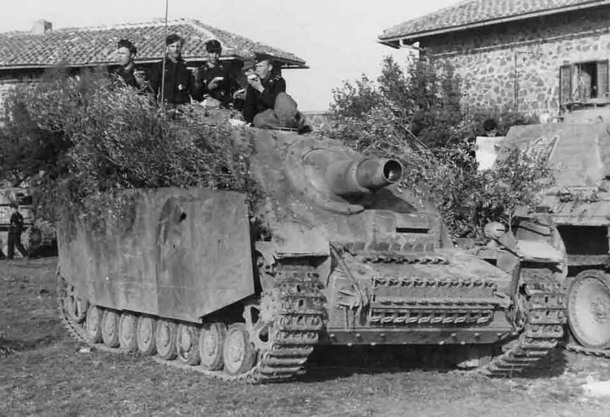
Sturmpanzer IV from the second production series in Italy, source: worldwarphotos.info, with permission of the operator, edited
Behind the fighting compartment came the engine compartment, which differed only minimally from that of the standard Panzer IV tank. The rear wall gained frames for stowing two spare road wheels, and sheet metal stowage boxes for various equipment were added to the sides. The Brummbär inherited its powerplant along with the tank chassis — the Maybach HL 120 TRM twelve-cylinder petrol engine producing a maximum of 300 horsepower at 3,000 rpm. Fuel capacity was 470 litres. A driveshaft ran from the engine under the fighting compartment floor to the gearbox in the front of the hull — also inherited with the chassis — of the Zahnradfabrik SSG 76 type with six forward gears and one reverse.
The Sturmpanzer IV's crew consisted of five men. These were the already-mentioned driver, seated furthest forward on the left, who looked out through the already-mentioned vision port salvaged from the VK4501 (P) prototype. Directly behind him sat the gun layer, and further behind him the vehicle commander. The remaining two men served as gun loaders — two being necessary because handling 38 kg shells was physically demanding work. The loaders had additional duties as well: one also acted as radio operator and the other as machine gunner when required.
The fighting compartment stowed 38 rounds of 150 mm ammunition and 600 machine gun cartridges. The shells stood in racks on both sides of the compartment, while the propellant cartridges were stored in bins along the rear wall. The literature is rather sparse on details regarding communications equipment. Standard Sturmpanzers were probably fitted with a Fu 5 radio and an intercom. Command Sturmpanzers appear to have carried either a combination of Fu 5 and Fu 2 sets, or a combination of Fu 8 and Fu 2 (suggested by the star-shaped antenna visible in a handful of rare photographs). Brummbärs were standardly equipped with side skirt armour plates known as Schürzen. Some vehicles also received a coating of Zimmerit anti-magnetic paste.
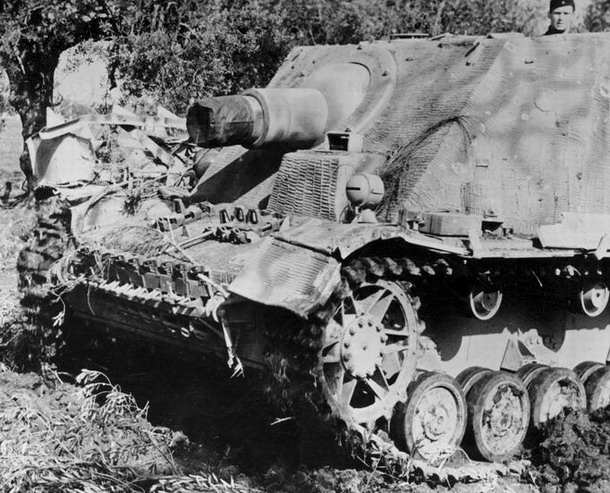
In the third production series Sturmpanzer IV, the driver received a new armoured hood with an observation periscope, source: Flickr.com, with permission of the publishing user, edited
The combat debut of the first Sturmpanzers showed the type to be a valuable vehicle that would certainly find a useful role at the front — but it also revealed some significant shortcomings. The overall weight of the Brummbär is generally quoted at between 28.2 and 28.4 tonnes. Standard Panzer IV tanks of the Ausf. E and Ausf. F variants — which, as we know, also served as the basis for the Brummbär — weighed only around 22 tonnes. The new vehicle therefore added roughly 6 tonnes, representing an increase in chassis loading of approximately 27%! The vast majority of this extra weight was concentrated at the front of the vehicle — the additional hull front armour and the thick front plate of the new superstructure. It is hardly surprising, therefore, that the front of the chassis suffered considerably, and the Sturmpanzer IV was prone to drivetrain failures. Excessive wear on the road wheels at the front of the chassis was also a problem. The enormous shocks generated by firing placed additional strain on the running gear. The designers therefore set about finding ways to reduce the vehicle's weight while at the same time improving the chassis's ability to cope with the extra load — a task in which Škoda Plzeň was also involved, receiving a commission to develop a lighter variant of the Sturmhaubitze 43.
Second Production Series
In November 1943, while engineers were still working on lightening the vehicle, production of the second Sturmpanzer series began. This time, instead of older used chassis of various variants, only new chassis from the PzKpfw IV Ausf. H were used. These chassis already had an 80 mm thick hull front plate as standard, so the bolted-on additional armour plate was dispensed with. Production continued at the Vienna repair depot, which received new tank chassis from the Nibelungenwerke plant in St. Valentin.
Brummbärs from the second production series still used the driver's vision ports from the converted VK4501 (P) prototypes, but a new 50 mm armour plate was added to better protect the vulnerable lower section of the vision port (photo HERE). The crew entry hatch for the loader and driver in the left half of the roof was eliminated and replaced by a new sliding cover for the gun's periscopic sight. A new fan for extracting propellant fumes generated during firing was installed directly above the gun breech. Given the severe wear on the rubber-tyred road wheels, second-series Sturmpanzers carried racks for four spare road wheels at the rear (the first series had only two).
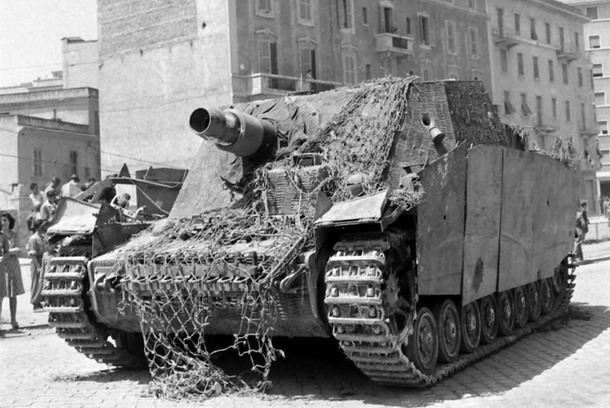
Third-production-series Sturmpanzer IV abandoned by its crew in the streets of Rome, source: worldwarphotos.info, with permission of the operator, edited
The easiest way for the crew to get in and out of the Brummbär was through the rear wall hatch, then backwards across the engine compartment cover and down to the ground over the very stern of the hull. The drop to the ground was still rather too far for comfort, however, and crews had taken to using the exhaust silencer as a step — which it was never designed for, resulting in frequent denting. Beginning with the second production series, a steel plate was therefore fitted above the exhaust to serve as a proper step (photo HERE). Incidentally, first-series Sturmpanzers that survived the fighting of 1943 were retroactively modernised to incorporate several of the second-series improvements described above.
In December 1943 Škoda Plzeň completed development of the lightened variant of the Sturmhaubitze 43. The new weapon received the designation Sturmhaubitze 43/1 and can be identified in photographs by its longer armoured barrel collar (a visual comparison of both weapon variants can be found HERE). The new howitzers began to be fitted to Brummbärs probably from January 1944. By exactly how much the new weapon was lighter I have not been able to find recorded anywhere, but it was evidently not much, as the change had virtually no effect on the vehicle's overall weight.
Different publications divide Brummbärs into production series differently — not only in terms of numbers, but also in terms of which features characterised each series. Unfortunately, it is therefore impossible to state precisely how many vehicles were produced in the second series. They were evidently built only until the remaining driver's vision ports from the converted VK4501 (P) vehicles were exhausted, which means there could not have been more than thirty — and in all likelihood somewhat fewer.
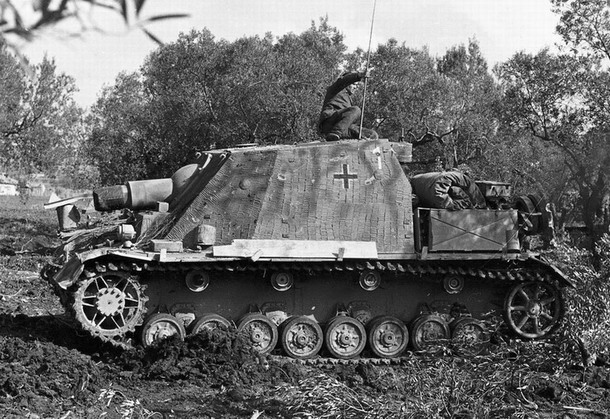
Third-production-series Sturmpanzer IV, here in command vehicle configuration, source: Flickr.com, with permission of the publishing user, edited
Third Production Series
Production of the third series followed on seamlessly from the second. New PzKpfw IV Ausf. H chassis continued to be used as the basis. Instead of the VK4501 (P) vision port, the driver of the new Sturmpanzer received a small armoured hood on top of which was a partially rotatable observation periscope. This meant the outer gun mount rim no longer needed to be notched — a small but certainly welcome simplification of production. Another innovation introduced during third-series production was the fitting of steel-rimmed road wheels in place of rubber-tyred ones. These were more durable (which the overloaded chassis badly needed) and saved increasingly scarce rubber in the process. Steel wheels were typically fitted to the first two or first four positions on the chassis. Third-series production ran until June 1944. Again, the exact number of vehicles built cannot be stated, though it is known that the second and third series combined totalled 80 vehicles.
Since Sturmpanzers were now being built on new chassis, it no longer made much sense to have them assembled by workers at a repair depot.
Fourth Production Series
Production of the fourth Brummbär series was therefore entrusted to Deutsche Eisenwerke (DEW) of Duisburg. In May 1944, while Vienna was still completing the last vehicles of the third series, the first 12 Sturmpanzers of production series four rolled out of the DEW gates.
New PzKpfw IV Ausf. J chassis were now used as the basis. The fighting compartment of the fourth-series Brummbär underwent a substantial redesign aimed at reducing weight and shifting the chassis loading further toward the rear. The rear section of the compartment was lowered by some 85 mm. The front section of the roof remained sloped, while the rear section was now horizontal. At the same time, the front of the compartment was shortened by 42 mm — moving the front plate further rearward to relieve the overloaded front wheels — while the rear wall gained a partial rearward extension. The crew's main entry hatch passed through this rearward projection. On the horizontal section of the roof, a commander's cupola was newly installed, taken from the assault gun StuG III Ausf. G. The cupola was fitted around its circumference with eight observation periscopes giving the commander all-round visibility. A mount for suspending a machine gun was fitted to the cupola for engaging low-flying enemy aircraft. The roof also had two ventilators and two small crew hatches.
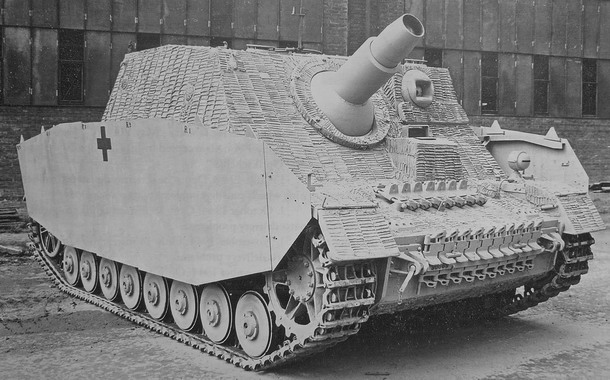
The fourth-production-series Sturmpanzer IV had a machine gun integrated into the front wall of the fighting compartment — shown here as a brand-new example in the courtyard of the DEW factory in Duisburg, source: Flickr.com, with permission of the publishing user, edited
The most significant innovation, however, was on the front wall of the fighting compartment. In its upper left corner a forward-projecting "bay" appeared, housing a ball-mounted MG 34 machine gun. The Brummbär thus finally received an anti-infantry weapon built in under armour protection. Operation of the machine gun was the gun layer's responsibility. The front wall on the fourth series was the same width as the sides of the fighting compartment — eliminating the earlier flared sections — which simplified production but increased the area of the front plate and thus added weight. Some authors note that as a countermeasure the thickness of the front plate was reduced from 100 to 80 mm (bringing it to the same thickness as the hull front). Fourth-series Brummbärs received steel-rimmed road wheels on the front half, or in some cases across the entire chassis.
Production of the fourth series continued at DEW until March 1945 and reached 162 vehicles (some sources give 166). The total number of all Brummbärs built was therefore 302 units (sometimes stated as 306).
Organisation
In April and May 1943, several orders were issued defining the organisation of Sturmpanzers into dedicated units — the Sturmpanzer-Abteilung, or assault tank battalion. The battalion consisted of three companies (Kompanie), each company of three platoons (Zug), each platoon of four Sturmpanzers — giving a company of three platoons 12 Sturmpanzers. Two further command Brummbärs in the company headquarters brought the paper strength of one assault tank company to 14 Brummbärs in total. Three companies therefore gave the battalion 42 vehicles (3×14), plus three further command vehicles in the battalion headquarters. The total number of Brummbärs in a Sturmpanzer-Abteilung was thus 45. The battalion also had a full range of supporting equipment, in particular half-tracked prime movers, staff cars and lorries, Munitionspanzer IV ammunition carriers converted from older PzKpfw IV combat tanks, and in some cases Bergepanzer III recovery vehicles converted from Panzer III tanks.
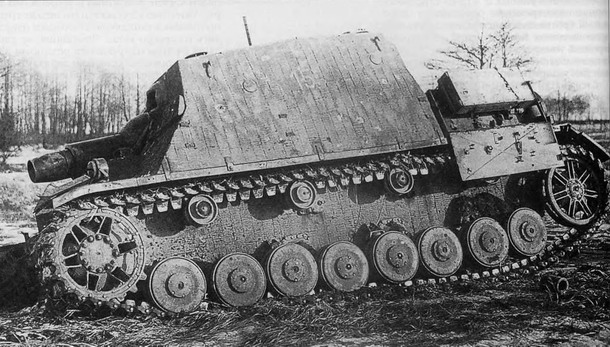
Knocked-out fourth-production-series Sturmpanzer IV — this vehicle has steel-rimmed road wheels throughout, source: waralbum.ru, with permission of the operator, edited
The first unit of its kind was Sturmpanzer-Abteilung 216 (StuPzAbt 216), formed in April 1943. In May the battalion was sent to Amiens in France, where the crews trained on their brand-new vehicles. The training period had to be cut to the bare minimum, however, to ensure the battalion was ready for the planned summer offensive on the Eastern Front. On 10 June 1943 the unit departed by rail eastward, destination: the area of the Kursk–Orel railway line. From there the battalion was to join the attack as part of the German Operation Zitadelle. For this operation, StuPzAbt 216 was attached to two heavy tank destroyer battalions equipped with Ferdinands — schwere Panzerjäger Abteilung 653 and 654 (sPzJgAbt 653 and 654). All three battalions were then combined into a single regiment designated schwere Panzerjäger Regiment 656 (sPzJgRgt 656).
Combat Deployment
The Brummbär's combat debut took place on 5 July 1943 on the northern face of the Kursk salient. The entire 656th Regiment was placed under XXXXI Panzerkorps (41st Panzer Corps) for the forthcoming operation. This corps formed part of the 9th Army under Field Marshal Walther Model, which in turn came under Army Group Centre (Field Marshal Günther von Kluge). StuPzAbt 216 entered the attack at full strength with 45 combat-ready vehicles. After just two days of fighting it reported the following losses: 5 Sturmpanzers completely destroyed and 17 damaged — the damage caused in most cases by Soviet mines. Operation Zitadelle ultimately ended in failure for the Germans. StuPzAbt 216 lost nearly half its Brummbärs during the operation, but was partially replenished, remained combat capable and continued to operate in the Orel area. Around mid-August it was withdrawn to Bryansk, and from there to Dnepropetrovsk for necessary repairs. During September and October the unit fought in the Zaporozhye, Nikopol and Myrhorod areas. At the turn of November and December 1943 the battalion was pulled out of the line, and the surviving Sturmpanzers were sent to the Vienna depot for major overhaul and modernisation.
The respite did not last long. On 22 January 1944, Allied forces landed in Italy and the combat-ready part of the battalion had to pack up and move. The first and second companies at full strength — 14 Brummbärs each — set off for Italy on 4 and 5 February 1944, entering combat around the middle of the month. By 22 February both companies together had just two operational Sturmpanzers! Most vehicles, however, had only been put out of action temporarily — by mechanical failures resulting from the long overland march through hilly terrain — and were subsequently repaired. The third company arrived in Italy later, and all three companies remained on the Italian front until the end of the war, slowly but steadily retreating northward until they crossed the River Po. On 15 April 1945 the battalion reported an astonishing 42 operational Brummbärs! Some were lost in the final fighting retreat, and the remaining vehicles were destroyed by the German crews themselves before they surrendered — some blown up, others reportedly driven into Lake Garda.
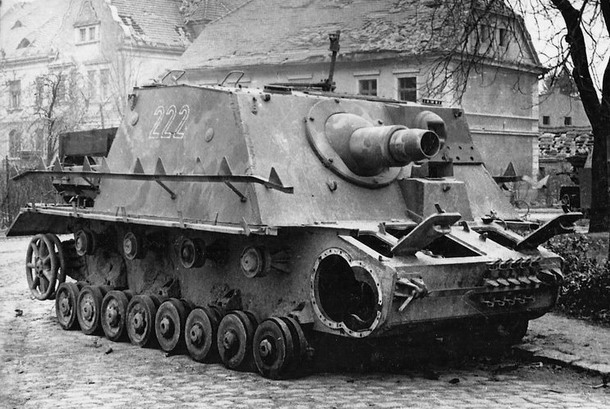
Abandoned wreck of a fourth-production-series Sturmpanzer IV — the vehicle appears to have been knocked out by final drive failure, source: waralbum.ru, with permission of the operator, edited
The second assault tank battalion was formed in April 1944 and numbered 217 (StuPzAbt 217). The unit did not receive its first Brummbärs until late May and subsequently underwent only a brief training period at the Grafenwöhr training centre. On 1 and 2 July it travelled by rail to Normandy, on the newly opened so-called invasion front. Due to the dismal state of the railway network, the battalion had to detrain 170 km from its target area and continue under its own power. The unit then became engaged in fighting near Caen, Cintheaux and Ouilly-le-Tesson. A report dated 19 August 1944 lists 17 operational Sturmpanzers and a further 14 under repair. In the second half of August, part of the battalion was encircled and subsequently destroyed or captured in the Falaise Pocket, but the remainder managed to escape and retreat northeastward. At the city of Rouen the crews had to abandon some of their Brummbärs due to fuel shortages — which they duly blew up before leaving.
On 7 September the battalion was in the Liège area of Belgium, where in the following days it engaged American forces. The unit then fought and retreated through the Eupen area and onto German soil, where it continued to resist in the Aachen sector. By October 1944 the total number of Brummbärs in the unit (regardless of current serviceability) had fallen to just 22 vehicles. With all three companies this depleted, maintaining three separate companies made little sense, and the 3rd Company was formally dissolved, its Sturmpanzers absorbed into the 1st and 2nd. Surplus personnel were transferred to other units. In December 1944 Sturmpanzer-Abteilung 217 took part in the German offensive in the Ardennes, advancing as far as St. Vith. From January 1945 the battalion was in continuous retreat eastward. The unit crossed the Rhine between Bonn and Remagen. In March 1945 it was still fighting the Americans near Siegen, though the critical fuel shortage limited its activities severely. The last remnants of Sturmpanzer-Abteilung 217 surrendered to the Allies in April 1945 in the Ruhr Pocket.
In August 1944 the formation of another battalion — number 218 — was begun. The process was interrupted by the Warsaw Uprising, which the Germans intended to suppress with the utmost ruthlessness. The incomplete first company of the new battalion was therefore immediately reorganised as an independent unit designated Sturmpanzer Kompanie z.b.V. 218 (z.b.V. = zur besonderen Verwendung = for special use) and, with only ten Brummbärs available to it at that moment, was dispatched to Warsaw on 13 August 1944. After the suppression of the Warsaw Uprising the unit remained in the East Prussian area. In January 1945, formation of Sturmpanzer-Abteilung 218 was resumed (having been interrupted in August), with Sturmpanzer Kompanie z.b.V. 218 expected to form part of it. The company was, however, desperately needed in the east and so remained there in the end, fighting as an independent unit against the Red Army until its final destruction.
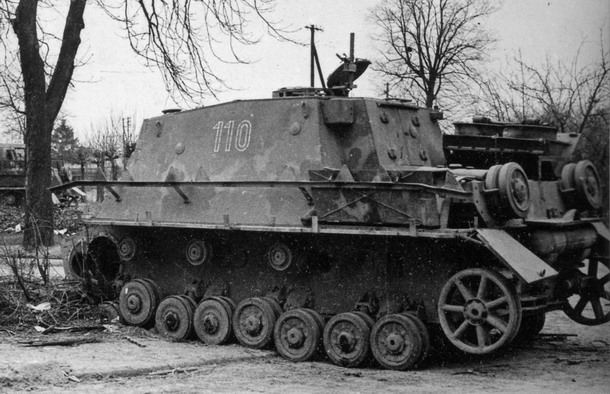
Rear view of a wrecked fourth-production-series Sturmpanzer IV, source: waralbum.ru, with permission of the operator, edited
The second partially-formed company for the 218th battalion was similarly reorganised as an independent unit, Sturmpanzer Kompanie z.b.V. 2/218, and on 20 August 1944 departed for the Paris area. Virtually no records of its activities there have survived. Some of its personnel were, however, incorporated in January 1945 into the reformed Sturmpanzer-Abteilung 218, which was thus finally officially constituted — but according to most sources never actually equipped with Brummbärs (a report from March 1945 lists the battalion as armed solely with 43 assault guns of the StuG III type).
The final assault tank battalion was numbered 219 and was formed in September 1944, built around the remnants of Sturmgeschütz Brigade 237. The unit trained at the Döllersheim training centre. In December 1944 the battalion was sent to Hungary, where it was committed against the Red Army in the fighting between Lake Balaton and Budapest. The battalion lost the majority of its equipment in the intense fighting, was withdrawn, and its remnants continued to fight for the rest of the war as part of various improvised Kampfgruppen.
As we know, the Sturmpanzer IV had its origins in the soldiers' need to rapidly demolish entire buildings in towns being stormed. By the time the vehicle actually reached combat units, however, the era of taking large cities by assault was long past. Even so, the Brummbär found a role at the front as an artillery support weapon, with its crews tasked with destroying enemy anti-tank guns, machine gun nests and infantry. At least ten Brummbärs of Sturmpanzer Kompanie z.b.V. 218 did, however, eventually see use in precisely the role for which the vehicle had been designed — during the fighting in Warsaw, where Brummbärs demolished buildings sheltering insurgents. The Sturmpanzer IV had no rotating turret, so it required flank protection from either its own tanks or accompanying infantry. Except in exceptional circumstances, crews were forbidden to engage enemy tanks; whenever these appeared, the Sturmpanzers were to withdraw immediately.
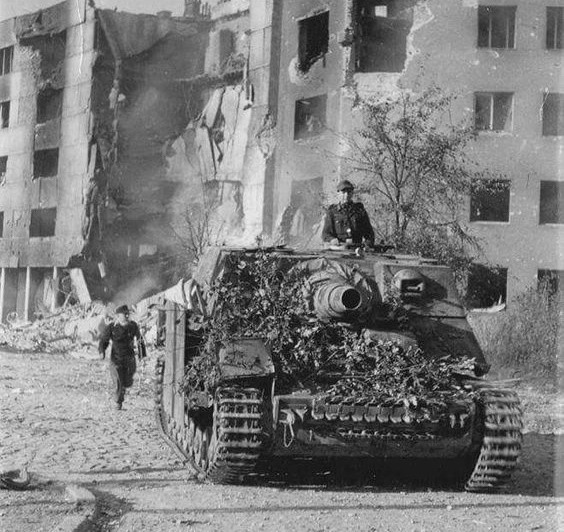
Fourth-production-series Sturmpanzer IV in the role it was created for — street fighting in an urban environment, source: Flickr.com, with permission of the publishing user, edited
The Brummbär was undoubtedly an interesting fighting vehicle, possessing enormous destructive power and very robust frontal armour. Its weaknesses were the overloaded chassis and drivetrain. There are many photographs of disabled or abandoned vehicles with the final drive covers removed, evidence of crews attempting repairs in the field. Another shortcoming was the limited ammunition supply. It is true that at a rate of fire of just one to two rounds per minute those 38 shells lasted a reasonable amount of time, but even so the Brummbär was heavily dependent on a steady flow of ammunition resupply. For this purpose, Munitionspanzer IV ammunition carriers — converted from older PzKpfw IV combat tanks — were assigned to the units.
Technical Data
|
weight: |
28.2 t |
|
length: |
5.93 m |
|
width: |
2.88 m |
|
height: |
2.52 m |
|
engine: |
Maybach HL 120 TRM |
|
engine power: |
300 hp |
|
max. speed: |
35 km/h |
|
fuel capacity: |
470 l |
|
range – road: |
210 km |
|
range – cross-country: |
130 km |
|
hull armour: |
|
|
- front: |
100 / 80 mm |
|
- sides: |
30 mm |
|
- rear: |
20 mm |
|
fighting compartment armour: |
|
|
- front: |
100 mm |
|
- sides: |
50 mm |
|
- rear: |
30 mm |
|
crew: |
5 men |
|
armament: |
StuH 43 (or 43/1), 150 mm (MG 34 machine gun, 7.92 mm) |
ARTICLE
CONTENTS:
Reproducing text from the Panzernet website without the written consent of the operator is prohibited.