Sd.Kfz. 9
self-propelled gun on the half-track tractor chassis
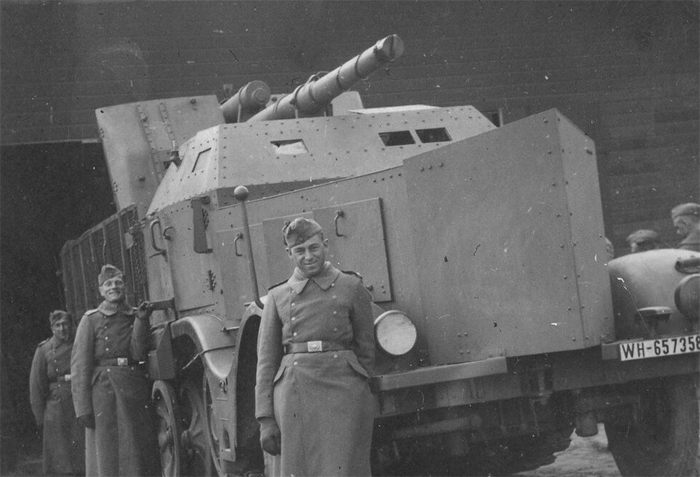
8,8cm Flak 37 Selbstfahrlafette auf schwerer Zugkraftwagen 18t; source: Flickr.com, used with permission of the publishing user, edited
Origins of the Half-track
During the first half of the 1930s, Germany undertook an extensive programme for the development of half-track artillery tractors spanning six different weight categories. The heaviest and most powerful type in this family was the vehicle carrying the ordnance designation Sd.Kfz. 9 (Sd.Kfz. = Sonderkraftfahrzeug = special purpose vehicle).
Development was carried out by FAMO (Fahrzeug und Motorenbau GmbH) in Breslau (today Wrocław, Poland). The first version of the tractor appeared in 1936 under the factory designation FM gr 1, of which only a small number of pre-production evaluation vehicles were likely built. An improved version, designated F2, followed in 1938 and entered full series production. Both types were powered by the Maybach HL 98 TUK engine developing 220 hp, and externally they differed little from the later production Sd.Kfz. 9.
Vehicle Description
The definitive variant, designated F3, appeared in 1939 and was subsequently produced — with minor refinements — until 1944. The F3 received a more powerful Maybach HL 108 TUKRM engine with a displacement of 10.838 litres and a maximum output of 270 hp. The gearbox offered four forward speeds and one reverse, supplemented by a two-speed reduction gearbox, giving the driver a total of eight forward gears and two in reverse. Fuel was carried in two tanks with a combined capacity of 290 litres of petrol. The half-track could reach a top speed of 50 km/h on roads, with a range of approximately 260 km on roads and 100 km cross-country.
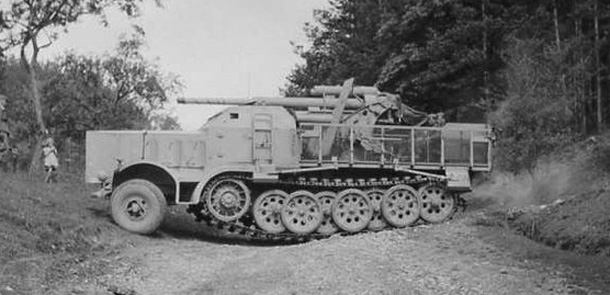
8,8cm Flak 37 Selbstfahrlafette auf schwerer Zugkraftwagen 18t; source: worldwarphotos.info, used with permission of the operator, edited
The driver steered using a conventional steering wheel: gentle turns moved only the front wheels, while larger steering inputs additionally applied braking to the track on the inside of the turn. The chassis consisted of a front steered axle and a rear track unit. The track assembly comprised a front drive sprocket, a rear idler, and six road wheels. The road wheels were sprung by torsion bars and fitted with rubber tyres to improve ride characteristics. Each wheel was a double unit, made up of two steel discs — so the half-track effectively had twelve road wheel discs arranged on six axles. The wheels were arranged in interleaved rows overlapping one another, a configuration typical of German half-tracks and, later, tanks as well. The discs of the even-numbered wheels were mounted further apart on their axles, with the odd-numbered wheels — whose discs sat close together — fitting into the gap between them. Viewed from the side, only the even-numbered wheels were fully visible, specifically their outer discs.
The engine compartment occupied the front of the vehicle, followed by the driver and commander's cab, with the main payload area at the rear. The full designation of the half-track was schwerer Zugkraftwagen 18t. In German half-track nomenclature, the number preceding the letter "t" conventionally indicated towing capacity in tonnes, and this was apparently the original intent for the Sd.Kfz. 9 as well. In practice, however, its actual towing capacity was considerably higher, with figures of between 22 and 28 tonnes cited in various sources.
The Sd.Kfz. 9 itself weighed 15.2 tonnes, and could carry a payload of up to 2.8 tonnes in the cargo area, bringing the total laden weight to approximately 18 tonnes. The tractor's dimensions matched its weight and power: it was over eight metres long, 2.6 metres wide, and 2.85 metres tall — the sheer scale of the vehicle is well illustrated, for example, in THIS photograph of a soldier lying on the engine bonnet.
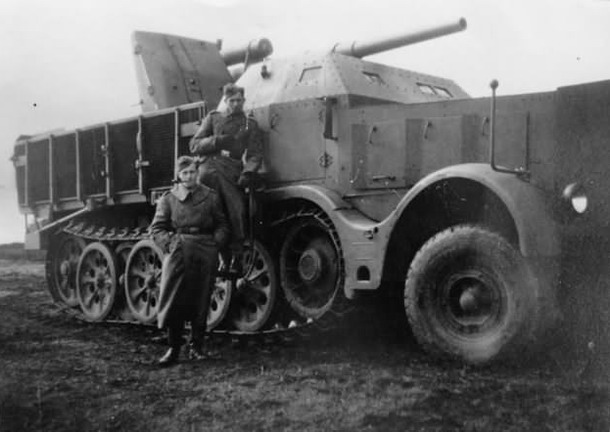
8,8cm Flak 37 Selbstfahrlafette auf schwerer Zugkraftwagen 18t; source: worldwarphotos.info, used with permission of the operator, edited
The Sd.Kfz. 9 served both as a conventional artillery tractor for the heaviest guns in service — such as the 24 cm K3 or the 12.8 cm Flak 40 — and as a recovery and towing vehicle for medium tanks such as the Panzer III and Panzer IV. Given the chronic shortage of heavy recovery equipment, it was also pressed into service towing Panthers and Tigers, though in such cases multiple half-tracks had to work in concert — recovering a Tiger required the combined effort of no fewer than three of these tractors. Two crane-equipped recovery and maintenance variants also existed: the Sd.Kfz. 9/1, fitted with a 6-tonne crane, and the Sd.Kfz. 9/2, which carried a 10-tonne crane.
The Armed Version
Like other German half-tracks, the Sd.Kfz. 9 also served as the basis for a self-propelled gun — and a particularly formidable one. The official designation of this vehicle was 8,8cm Flak 37 Selbstfahrlafette auf schwerer Zugkraftwagen 18t, making clear that the weapon installed was the 88 mm Flak 37 anti-aircraft cannon. The engine bonnet and driver's cab received armour protection consisting of riveted plates 14.5 mm thick on the front and sides, and 8 mm on the roof. The engine grille was protected by a prominent armoured shield formed from two angled plates meeting in a V-shape, the point of which projected well forward of the original grille and allowed air to flow to the engine. Additional closeable ventilation louvres were cut into the side panels, three on each side.
The driver and commander observed the surroundings through vision ports in the front armour plate, and entered and exited via doors in the side panels — also fitted with observation ports. In the roof of the cab were two rectangular hatches with single-piece covers, which apparently served as emergency exits. The cab roof also featured a folding support cradle for the gun barrel, used during longer road moves to limit the vibration transmitted to the long barrel. The side armour extended slightly rearward to protect a bench seat positioned behind the driver's compartment, used by part of the nine-man gun crew.
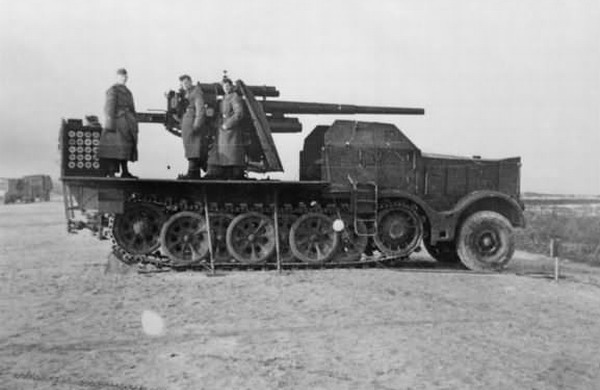
8,8cm Flak 37 Selbstfahrlafette auf schwerer Zugkraftwagen 18t; source: worldwarphotos.info, used with permission of the operator, edited
The rear payload section was converted into a flat fighting platform, in the centre of which the Flak 37 cannon was mounted on a fully rotating pedestal. The weapon was installed complete with its standard shield, though at least two photographs show a vehicle or vehicles without the gun shield (HERE and HERE). The sides of the platform were enclosed by a low railing of heavy-gauge wire mesh, sections of which were folded down to the sides before firing to clear the arc of traverse and allow the crew to move freely. Once folded, the railing sections remained horizontal, suspended on chains.
At the rear of the fighting platform stood a large storage chest divided into three compartments. The two larger compartments on either side were accessible from the outside and held ammunition; the smaller central compartment was accessed from above through a hinged lid, and whether it also stored ammunition or held tools is not entirely clear. The entire storage chest was protected at the rear and sides by armour plates; the side panels of this armour swung open to allow access to the ammunition in the side compartments, each of which apparently held twenty rounds. The half-track therefore carried a minimum of forty 88 mm rounds on board. On the inner face of the ammunition chest, a fold-down bench seat was fitted for the remainder of the gun crew.
The cannon could be elevated from -3 to +85 degrees, and traversed a full 360 degrees in the horizontal plane. To improve stability when firing to the sides, the vehicle was equipped with foldable outriggers, two on each side. The vehicle's weight rose to a full 25 tonnes with the armour and heavy gun installed — exceeding even the heaviest German tank of the early war years, the Panzer IV.
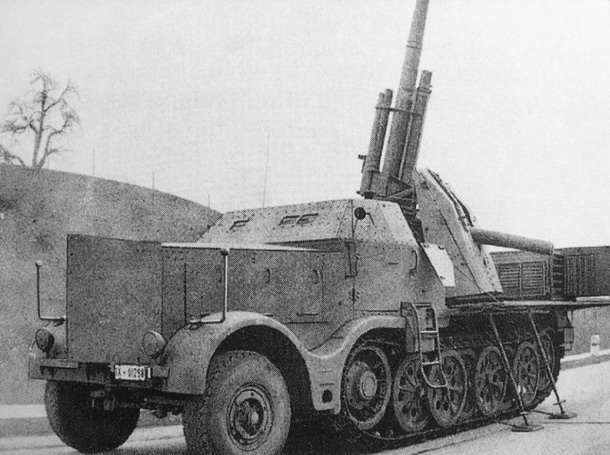
8,8cm Flak 37 Selbstfahrlafette auf schwerer Zugkraftwagen 18t; source: Flickr.com, used with permission of the publishing user, edited
Combat Deployment
The history of how the 8,8cm Flak 37 Selbstfahrlafette auf schwerer Zugkraftwagen 18t came to be built and deployed is not entirely clear, and contradictory accounts appear in the literature. The impetus for the vehicle most likely came from German units fighting in North Africa, where the Afrikakorps apparently lacked sufficiently powerful weapons — not only for dealing with enemy aircraft, but above all for engaging heavily armoured Allied tanks such as the British Matilda. Work on the armed variant of the half-track probably began in 1941, though the first evaluation prototype did not appear until October 1942. The Army subsequently placed an order for 112 vehicles, but in the end only 12 were built, completed between July and September 1943, at which point production ceased. Assembly of these self-propelled guns reportedly took place at the Weserhütte factory.
All vehicles built were assigned to the 1st and 2nd Heavy Batteries of Flak Detachment No. 304 (1. and 2. schwere Batterie, Heeres Flakartillerie Abteilung (Sf.) 304). Some sources claim that within this unit they saw brief action in Africa, though this is almost certainly incorrect, as the Germans evacuated North Africa in May 1943. In all likelihood, the half-tracks were actually deployed in Italy, where the entire 304th Detachment was attached to the 26th Panzer Division.
In terms of overall assessment, the conclusions for this self-propelled gun on the Sd.Kfz. 9 chassis are similar to those for the identically armed vehicle based on the lighter Sd.Kfz. 8. The main drawback was the low level of protection afforded to the crew, particularly the soldiers manning the gun on the open platform. The vehicle's greatest asset, on the other hand, was unquestionably the Flak 37 cannon itself: with such a powerful weapon at its disposal, the half-track could engage high-flying enemy aircraft and simultaneously destroy virtually any armoured opponent on the ground, even at considerable range.
ARTICLE
CONTENTS:
Reproducing text from the Panzernet website without the written consent of the operator is prohibited.