PANZER III
the backbone type designed to destroy armoured vehicles
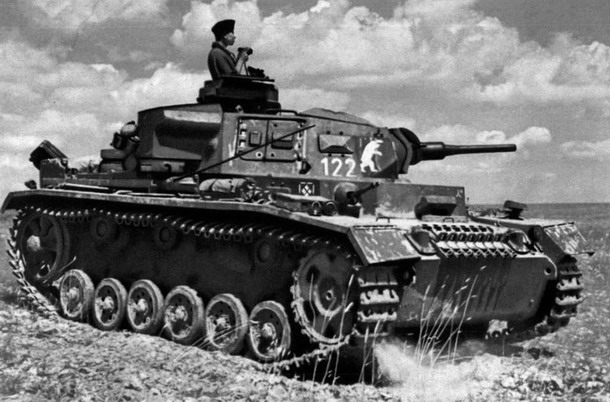
Panzerkampfwagen III in a propaganda photograph, specifically an Ausf. J, source: Flickr.com with permission of the publishing user, edited
Origins of the Tank
The tank Panzerkampfwagen III (abbreviated PzKpfw III) was designed and built to serve as one of two backbone types of the German armoured forces, alongside the heavier and more powerful PzKpfw IV. The Panzer III was intended to destroy enemy armoured vehicles on the battlefield, while the Panzer IV would deal with artillery positions, light fortifications and other obstacles that the lighter "three" could not handle due to the range or destructive power of its gun. This concept of armoured warfare was the brainchild of the Chief of Staff of the Inspectorate of Motorised Troops, Lieutenant Colonel Heinz Guderian.
The requirements for the new tank, based on this concept, were translated by the Waffenamt (Army Weapons Office) into a specific design brief, which was then submitted in January or February 1934 to four industrial firms — MAN, Daimler-Benz, Krupp and Rheinmetall-Borsig. The specification called for a design and blueprints for a tank in the 10 to 15 tonne weight class, armed with a 37 mm gun, powered by an engine producing 300 horsepower and capable of reaching a speed of up to 40 km/h. The vehicle was assigned the cover designation Zugführerwagen (literally "platoon commander's vehicle"), abbreviated Z.W. Since multiple production variants were developed, this designation was supplemented with a version number — the first was accordingly designated 1/Z.W.
The individual firms apparently submitted their proposals in June 1934. After reviewing them, it was decided to redistribute the further development work. Daimler-Benz was to concentrate solely on the new tank's chassis, while Krupp and Rheinmetall-Borsig were tasked with producing the turret. In the next phase, a full-scale wooden mock-up of the new tank was built and used to refine the overall design. Krupp and Rheinmetall had both completed their experimental turrets (Versuchs-Turm) by the end of 1934 at the latest, allowing them to be tested independently, including firing trials. The last piece to arrive was the prototype chassis (Versuchs-Fahrgestell) from Daimler-Benz, completed in August 1935. By the end of 1935, two complete prototypes of the new tank could be assembled — both on Daimler-Benz chassis, but one with a Krupp turret and the other with a Rheinmetall turret.
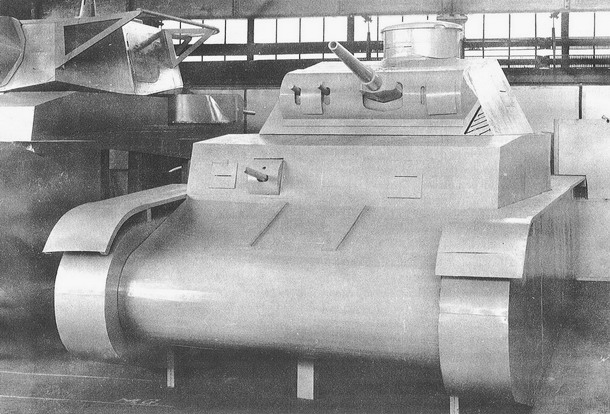
as part of the development work on the new tank, a full-scale wooden model was also built, source: Flickr.com with permission of the publishing user, edited
As with much other military hardware, there is an alternative — and quite different — version of the Panzer III's early history, one that actually prevails in the literature. According to this account, Krupp also built its own complete prototype, designated MKA, which however was not selected for further production and remained a one-off. In this text I personally follow the version described by Thomas L. Jentz in the Panzer Tracts series, according to which the MKA was an independent Krupp project that had essentially nothing to do with the genesis of the Panzer III.
First Prototypes
Both Daimler-Benz prototypes with their two different turrets survive in rare photographs, which reveal minor differences compared to the later production Ausf. A. The overall layout of the vehicle, however, changed little between the prototypes and the production version. The Zugführerwagen had a suspension with five large road wheels on each side. The wheels featured lightening holes and rubber tyres for a smoother ride. Each wheel was independently suspended and sprung by its own coil spring. At the front was a toothed drive sprocket and at the rear an idler wheel, both with circular lightening holes. The upper run of the track was supported by a pair of small return rollers.
It is not entirely clear from the photographs, but the prototypes appear to have had a rounded front glacis plate on the hull (as did the original wooden mock-up), in contrast to the angled plates of the production tanks. Very clearly visible, however, are the rounded front ends of the track mudguards — again matching the wooden mock-up but different from the later production vehicles. At roughly the level of the first road wheel, the front wall of the crew compartment projected from the hull. On its left side was a rectangular driver's vision port, and on the right a circular opening for the hull machine gun mount. The prototypes captured in surviving photographs had not yet been fitted with either the machine gun mount or the vision port covers. The driver had an additional vision port in the left side wall of the crew compartment as well.
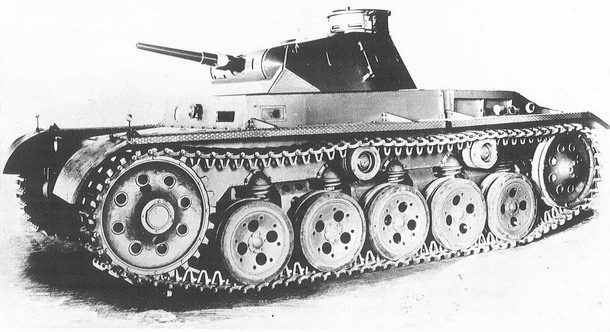
prototype tank with Daimler-Benz chassis and Krupp turret, source: Flickr.com with permission of the publishing user, edited
Behind the crew compartment came the engine section. The photographs of the prototypes tell us little about its design. It is clear, however, that the air intakes for engine cooling were located on the sides, as on the later production vehicles (although the design of the covers was different at this stage). As for the engine itself, two contradictory pieces of information can be found. Some sources state the prototypes were powered by a Maybach HL 100 TR, others by the Maybach HL 108 TR (which was later fitted in production tanks). On top of the crew compartment sat the turret. As already noted, each prototype carried a turret from a different manufacturer, though both looked very similar at first glance. The Rheinmetall turret had noticeably more rounded contours, and other details also differed — the gun mantlet, the commander's cupola and the layout of the side hatches. In the end, the army selected the Krupp turret for series production.
Ausführung A
The prototypes apparently underwent both factory and troop trials, and following some minor modification proposals, an order was placed for a first production batch of 10 vehicles. In April 1936, the tank was renamed from Zugführerwagen to Panzerkampfwagen III (3,7 cm) Ausf. A (the abbreviation Ausf. stands for Ausführung, meaning "variant" or "model") and was also assigned the ordnance designation Sd.Kfz. 141 (Sd.Kfz. = Sonderkraftfahrzeug = special purpose vehicle). Some of the ten ordered tanks were delivered to the army as early as the end of 1936, with the remainder following in 1937. These vehicles carried hull numbers 60101 to 60110.
The production Panzerkampfwagen III Ausf. A was very similar to the prototype at first glance. The suspension again consisted of five large road wheels. The front drive sprocket, however, was of a new design with oval lightening holes. The rear idler wheel was also new, with a spoked design. The tracks were 360 mm wide. The front of the hull was angular on the production tank, formed by an upper and a lower plate. The lower plate had two square openings for service access to the steering clutches and brakes, covered by bolted armour plates.
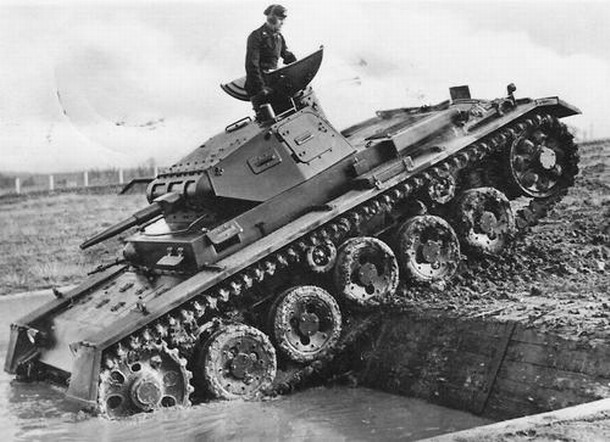
Panzerkampfwagen III Ausf. A on the test range, source: Flickr.com with permission of the publishing user, edited
Behind the front glacis came a nearly flat hull roof, which featured two hatches — the left one for the driver and the right one for the radio operator. Behind this was the raised crew compartment. The driver's vision ports in its front and side walls were now of course fitted with covers (unlike on the prototype). The cover of the side vision port had a slit through which the driver could look even when the cover was closed. The front vision port cover had no slit, so when closed the driver could only see through a binocular periscope mounted above the port itself. Two small holes were drilled in the front armour plate just above the vision port cover to accommodate the periscope. In the right part of the front wall of the crew compartment was a ball-mount for the MG 34 machine gun.
Behind the crew compartment came the engine compartment. Its roof was flat at the front and sloped downwards toward the rear. The flat section of the engine deck, as well as its sides, featured louvred air intake openings. Heated air was expelled through further louvred openings in the rear sloped section of the engine deck. The rear wall of the hull carried the mufflers of the two exhaust pipes, with a rack above them for five smoke grenades that could be discharged from inside the crew compartment.
The PzKpfw III Ausf. A was powered by a twelve-cylinder petrol engine, the Maybach HL 108 TR, with a displacement of 10.8 litres. Figures for the engine output vary between sources, but the most commonly cited maximum power is 250 hp at 2,800 rpm. The engine compartment also housed two fuel tanks, each holding 150 litres. The SFG 75 gearbox was located in the front of the hull and connected to the engine by a driveshaft. It provided five forward gears and one reverse.
The fully rotating turret sat on top of the crew compartment roof. Its front wall consisted of an outer mantlet with three large cutouts, into which fitted the internal gun and weapon mounts. The right cutout accommodated a cylindrical mount containing two MG 34 machine guns chambered in 7.92 mm. This mount was independently movable, allowing the machine guns to be elevated or depressed independently of the main gun. The remaining two cutouts in the turret front were filled by the gun mantlet. The main gun barrel itself passed through the central cutout, while the left cutout housed the optical gunsight and a closeable vision port beside it.
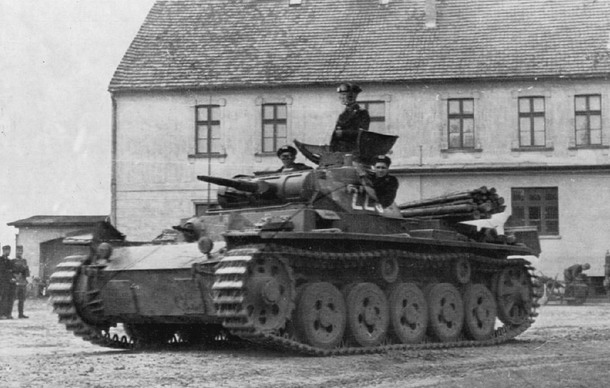
Panzerkampfwagen III Ausf. A deployed in Poland, source: Flickr.com with permission of the publishing user, edited
The main armament was the 3.7cm KwK 36 L/46.5 gun in 37 mm calibre. The letters KwK stood for Kampfwagen Kanone, the standard German designation for tank guns. The L/46.5 code indicates that the barrel was 46.5 calibres long, i.e. 46.5 × 37 mm ≈ 1.72 metres. The gun was paired with a TZF5 sight (TZF = Turm-Zielfernrohr) offering 2.5× magnification. Ammunition stowage for the gun consisted of 121 rounds. For all three machine guns the tank carried 4,500 rounds. The standard armour-piercing round for the 37 mm gun weighed 685 grams and left the muzzle at 745 m/s (sometimes quoted as 800 m/s). At 500 metres it could penetrate 29 mm of armour angled at 30 degrees.
In the front part of each turret side wall was a vision slit, followed further back by a crew entry/exit hatch. These hatches were closed by single-piece doors, which also incorporated additional observation slits. Handholds were welded to the turret roof above the hatches for easier boarding and dismounting. During longer non-combat road marches, the crew were very fond of throwing open these doors and sitting in them with their upper bodies outside the turret.
The rounded rear wall of the turret contained two smaller cutouts fitted with square covers, serving as firing ports for the crew's personal weapons. The turret roof was angled at the front and flat at the rear, dominated by a relatively tall commander's cupola positioned at its rear. The cupola's tube extended significantly into the rear turret wall as well. The commander's cupola (German: Kommandantenkuppel), the highest point on the tank, gave the vehicle commander the best possible view of the battlefield. Around its circumference were eight vision ports protected from inside by 12 mm thick safety glass, providing the commander with all-round observation. The commander's entry hatch was in the roof of the cupola, closed by a two-part cover.
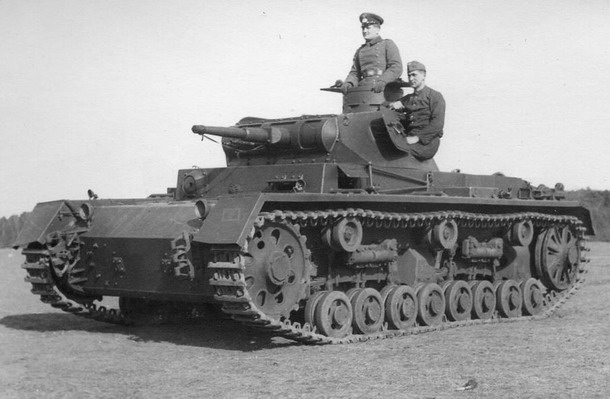
a fine view of the Panzerkampfwagen III Ausf. B, source: Flickr.com with permission of the publishing user, edited
The armour of the PzKpfw III Ausf. A was designed solely to resist rifle or machine gun armour-piercing rounds in 7.92 mm calibre. The designers had no ambition to protect the vehicle against any form of artillery fire. The thickest armour on the tank was therefore only 16 mm, found on the turret front. The front, rear and sides of the hull were 14.5 mm thick, as were the sides and rear of the turret. The roof plates were 10 mm and the hull floor was only 5 mm. The tank weighed 15.4 tonnes and could reach a maximum speed of around 35 km/h, with a range of approximately 165 km on roads and about 95 km cross-country.
The crew consisted of five men. The driver sat on the left in the front of the crew compartment, with the radio operator to his right, who also operated the hull machine gun. The remaining three men were stationed in the turret. The loader, who also operated both turret machine guns, sat to the right of the gun. The gunner sat to the left of it, and the commander occupied the rear of the turret. The seats of all three turret crew members were attached to the turret ring and thus rotated with the turret.
Most sources agree that the PzKpfw III was equipped with the Fu 5 radio set from the very first generation — a combination of the 10 W.S.c transmitter and the Ukw.E.e receiver. Confusingly, however, the Panzer Tracts series (which we often use as our primary source) explicitly states that combat PzKpfw III Ausf. A vehicles were fitted with the Fu 2 set, which was a receiver only. According to this source, standard tanks could therefore only receive messages, and if they needed to communicate with each other they were reliant on signal flags. Only vehicles assigned to platoon commanders were said to have had a transmitter. For internal communication between crew members, an intercom system was used. A rod antenna connected to the radio was mounted on the right side of the crew compartment. The antenna could be folded back toward the rear of the tank and when fully lowered it rested in a wooden protective channel on the track mudguard.
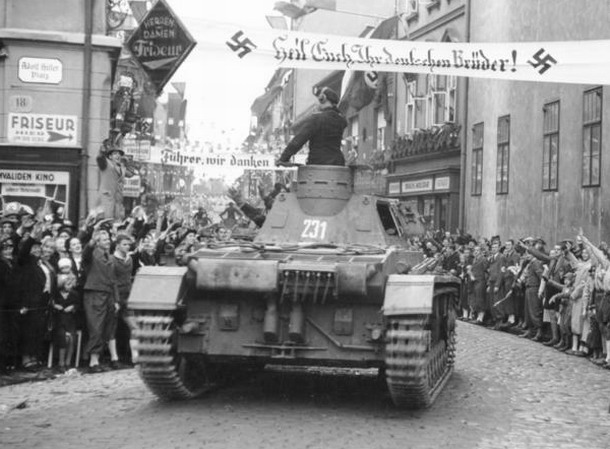
Panzerkampfwagen III Ausf. B driving through the streets of an Austrian town during the Anschluss, source: Bundesarchiv_Bild_146-1969-065-26, Wikimedia, Creative Commons, edited
Production of the Panzer III Ausf. A ended with this first batch, so only 10 were built in total. No larger-scale production was ever planned. The Germans treated this first version (along with the three that followed) as essentially a development and evaluation vehicle, and had no intention of launching mass production until the new tank had its teething problems sorted out — and that was precisely the purpose the Ausf. A was meant to serve.
Nevertheless, most of them saw combat in Poland in September 1939. At the turn of 1939–40, however, a rapid programme of replacement with newer versions was launched at frontline units. The remaining PzKpfw III Ausf. A tanks were then apparently transferred to training units, where they served out their days as instructional aids. There is an interesting photograph (viewable HERE (source: flickr.com)) which shows that at least one Ausf. A was modified for training purposes in a manner similar to what was common with, for instance, training versions of the PzKpfw I. The turret and crew compartment roof were removed, and a low railing was fitted around the open superstructure. Students could sit in the open compartment and observe the instructor demonstrating the vehicle's controls.
Ausführung B
Probably as early as 1935, while Daimler-Benz was still working on the chassis prototypes for the first Zugführerwagen variant, the company was asked by the Waffenamt to begin parallel work on alternative suspension layouts. The goal was to test different running gear configurations and find the best possible arrangement for the future mass-produced tanks.
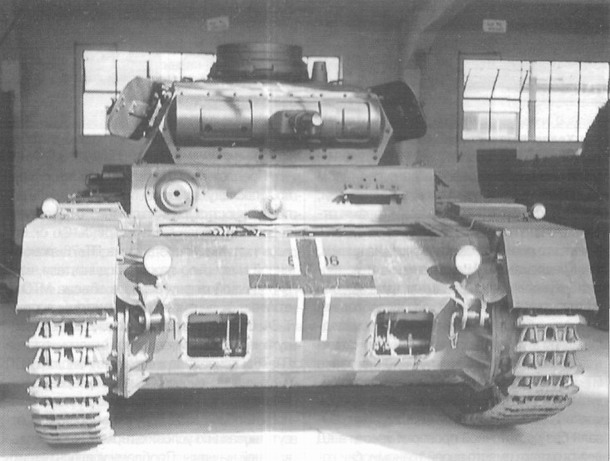
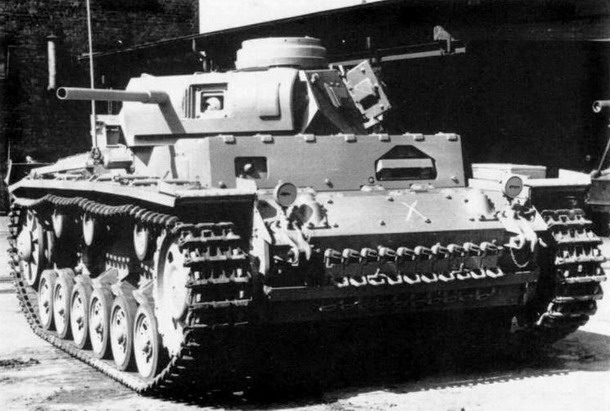
Panzerkampfwagen III Ausf. C or D, note the open service hatches in the hull front, source: Flickr.com with permission of the publishing user, edited
This gave rise to the second production series of the tank, given the project designation 2/Z.W. (though it entered history under the designation Panzerkampfwagen III Ausf. B, assigned to it in 1936). The PzKpfw III Ausf. B received an entirely redesigned running gear. On each side it consisted of eight road wheels 40 cm in diameter. The wheels were paired (so that the track guide horn could pass between them) and fitted with rubber cushioning tyres for a smoother ride. Pairs of wheels were mounted on swing arms, with two arms sharing a single leaf spring (one arm at each end). The eight wheels thus had four swing arms, which in turn shared two leaf springs. At the front was the drive sprocket, at the rear the idler wheel, and the upper track run rested on three return rollers.
More than just the suspension changed compared to the Ausf. A. The original square service access holes in the hull front were replaced by circular cutouts with hinged bolted covers. The arrangement for air intake to the powerplant was also changed — the intake openings were no longer on the sides of the engine deck but on its roof. The driver received a new vision port taken from the Panzer II Ausf. A. A new commander's cupola was also installed.
Armour thickness, the powertrain, gearbox, armament and crew composition all remained unchanged from the Ausf. A. Weight increased slightly to 15.9 tonnes. Because work on the Ausf. B proceeded almost in parallel with the Ausf. A, the first Panzer III Ausf. B tanks could be delivered to the army as early as the end of 1937. A total of 15 were ordered (hull numbers 60201 to 60215), but only ten were accepted as complete tanks. The remaining five hulls were ultimately used as the basis for prototypes of the Sturmgeschütz III assault gun. Five already completed superstructures and turrets for the Ausf. B tanks were left in storage, to be put to use later.
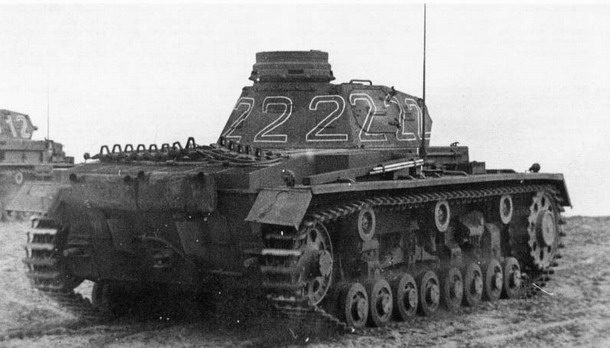
rear view of the Panzerkampfwagen III Ausf. C, source: Flickr.com with permission of the publishing user, edited
The Panzer III Ausf. B also saw combat in Poland in September 1939. They then began making way for newer versions at frontline units and most likely served out their remaining time at tank training schools. Photographs confirm that here too some tanks were stripped of their turrets and roof covers for training purposes, allowing more students to sit in the open compartment and observe the instructor at work.
Ausführung C
The next generation was logically designated Panzerkampfwagen III Ausf. C. Daimler-Benz tracked it internally as 3a/Z.W. The suspension used on the Ausf. C was similar to the previous variant, again consisting of eight small road wheels on each side with leaf spring suspension. The wheel arrangement, however, was different from the preceding generation. Three leaf springs were used in total. The front spring handled the first two road wheels, the rear spring the last two. The middle spring — the largest of the three — was connected to the four central wheels.
The service access holes in the hull front returned to the angular design with bolted covers, as on the Ausf. A. A new commander's cupola with five observation openings around its circumference was introduced. Several other details also changed — the rear hull design, the idler wheel and certain vision ports — but overall the Ausf. C was very similar to its predecessor. Fifteen PzKpfw III Ausf. C tanks were built (hull numbers 60301 to 60315) and since work on them proceeded essentially simultaneously with the two preceding types, the first Ausf. C tanks were delivered to the army in December 1937 with the remainder following through 1938.
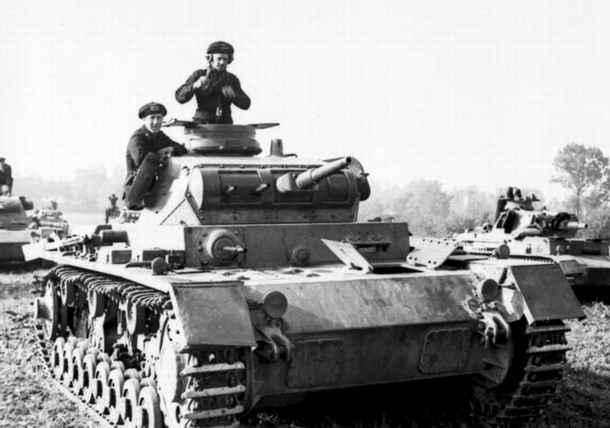
Panzerkampfwagen III Ausf. D in Poland, 1939, source: Bundesarchiv_Bild_101I-318-0083-30, Wikimedia, Creative Commons, edited
Ausführung D
After the Ausf. C came the next still-developmental variant, designated PzKpfw III Ausf. D, internally tracked by Daimler-Benz as 3b/Z.W. Most of the changes compared to the Ausf. C took place under the skin. The Ausf. D received a new SSG 76 gearbox with six forward gears and one reverse. The fuel tanks (now four of 75 litres each), coolant pumps and cooling fans were also redesigned. But there were also externally visible changes. The road wheel suspension was revised again. Three leaf springs were retained as on the previous Ausf. C, but with a different mounting arrangement. The engine air intake openings moved back from the roof of the engine deck to its sides, as on the Ausf. A. The rear hull was extended and projected noticeably further back beyond the track assembly, making the Ausf. D the longest of all the variants described so far.
According to some sources, the armour of the Panzer III Ausf. D was increased from 14.5 mm to 30 mm, with a corresponding weight increase to up to 19.8 tonnes. This is most likely an error, however. The armour upgrade was only applied to the command vehicle variant designated Ausf. D1 (described below); the standard combat Ausf. D had armour of the same thickness as its predecessors and weighed around 16 tonnes.
A total of 25 Ausf. D tanks were originally built (hull numbers 60316 to 60340) and delivered to the army approximately in mid-1938. Subsequently, an additional five hulls were ordered (numbers 60221 to 60225). These were to be fitted with the superstructures and turrets from the Ausf. B tanks that had been left in Daimler-Benz storage after five Ausf. B hulls were used for the Sturmgeschütz III prototypes. This resulted in five hybrid vehicles combining elements from different Panzer III variants — their armoured superstructures and turrets came from the older Ausf. B, the hulls from the newer Ausf. D, and certain specific details such as the rear idler wheels were actually taken from the Ausf. D1 command tank.

Panzerkampfwagen III Ausf. D in Poland, 1939, note its long rear hull, source: Bundesarchiv_Bild_101I-318-0083-32, Wikimedia, Creative Commons, edited
The Panzerkampfwagen III Ausf. D, like the three preceding generations, was built primarily as an evaluation vehicle (which is why only a negligible number of each of these variants was produced). In 1939, however, it too saw real combat during the invasion of Poland. Afterwards, together with its older siblings, it was included in the programme of replacement with newer types and likewise finished its days as a training tank.
Ausführung E
As already mentioned several times, the Panzer III variants Ausf. A through D were built in small batches as evaluation vehicles. Only the next variant, the Ausf. E, was considered a fully capable combat tank and was intended for series production. Development of this variant took place in 1938 and series production began the following year. The Ausf. E suspension was completely redesigned. On each side it now consisted of six road wheels sprung by torsion bars. The wheels had a diameter of 520 mm and were fitted with rubber tyres for a smoother ride. They were paired, with the track guide horns running between each pair. Due to the use of torsion bars, the road wheels on opposite sides of the hull could not be directly opposite each other, so the right-side wheels were offset slightly forward relative to those on the left. The first and last road wheels also had additional dampers, as these wheels experienced the greatest stress during cross-country travel. At the front was a toothed drive sprocket with circular lightening holes, and at the rear an idler wheel. The upper track run was supported by three return rollers 310 mm in diameter. The tracks were 360 mm wide.
According to some sources, the designer of this variant's suspension was an engineer at the Waffenamt, Ernst Kniepkamp, who was also responsible — among other things — for the suspension concept used in German half-tracked prime movers and armoured personnel carriers. His stated goal was to design a tank capable of reaching up to 70 km/h.
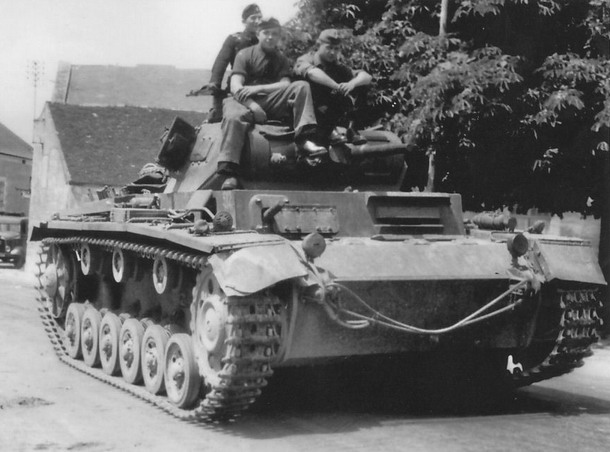
Panzerkampfwagen III Ausf. E with its entirely new running gear, source: Flickr.com with permission of the publishing user, edited
The frontal hull armour on the Ausf. E was 30 mm thick and no longer had any service access holes. The front wall of the crew compartment was also reinforced to 30 mm. On its right side was the ball-type machine gun mount for the MG 34 (Kugelblende 30), which allowed the gun to be traversed 15 degrees to either side, elevated 20 degrees and depressed 10 degrees. The machine gun was aimed using the Kugelzielfernrohr 2 sight. The driver's vision port (Fahrersehklappe 30) was in the left part of the front wall and could be closed with a heavy armoured flap. When shut, the driver looked through a binocular periscope above the main port. Both the driver and the radio operator had small emergency escape hatches in the sides of the hull directly above the road wheels — though these were quite small and getting through them was probably no easy feat.
The turret sat on the crew compartment roof. Its basic layout was unchanged from the Ausf. D, though it differed in various details. As before, the front wall featured two independently movable inner weapon mounts — the pair of MG 34s on the right, the KwK 36 L/46.5 gun in 37 mm calibre in the centre, and on the left the sight aperture and a closeable vision port. Gun ammunition stowage was 121 rounds, and 4,500 rounds were carried for all three machine guns. The commander's cupola, whose tube extended into the rear turret wall, was at the rear of the turret roof as usual. The vision ports in the turret side walls and the firing ports in the rear turret wall were redesigned, as were the side turret hatch doors. Instead of the large single-piece doors of older versions, the Ausf. E used two-part doors: the front part had an observation slit, and the rear part a firing port for crew personal weapons.
The engine compartment was at the rear of the tank. Four service hatches for access to the engine and cooling system were cut into its roof. Air intakes were on the sides of the engine deck. The Panzer III Ausf. E received a new powerplant, the Maybach HL 120TR — a liquid-cooled, twelve-cylinder petrol engine of 11.9 litres displacement, producing a maximum of 300 hp at 3,000 rpm. A new semi-automatic gearbox, the Variorex SRG 328 145, provided ten forward gears and one reverse. The more powerful engine combined with the wide range of gears gave the tank a theoretical top speed on roads of up to 67 km/h. At high speeds, however, significant damage occurred to the rubber tyres of the road wheels, and drivers were therefore instructed not to exceed 40 km/h.
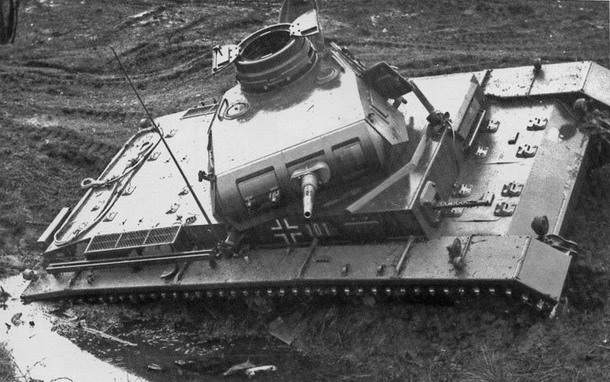
a fine overhead view of a Panzerkampfwagen III Ausf. E stuck in the mud, source: Flickr.com with permission of the publishing user, edited
The armour protection of the Ausf. E was substantially greater than that of the earlier variants. The front of the hull and the front of the crew compartment were both 30 mm thick (compared to only 14.5 mm on older variants), the hull sides were also 30 mm, the rear 20 mm, and the roofs and floor 16 mm. All walls of the turret, except the roof, were 30 mm. The turret roof was only 10 mm. The heavier armour naturally brought a weight increase to approximately 19.5 tonnes. Unlike the earlier variants, the "E" had a single large fuel tank positioned to the right of the engine, holding 310 litres of petrol (sometimes quoted as 320 litres), which gave the vehicle a range of roughly 165 km on roads and about 95 km cross-country. The number of crew members remained unchanged from older versions.
Development of the Ausf. E took place in 1938 and the tank was also referred to as the 4/Z.W. and even Z.W.38. Production began in 1938 and according to some sources the first examples were actually delivered to the army just before the end of that year. As for the total production figure for this variant, combined totals covering this and the next version are often the only figures available. The PzKpfw III Ausf. E alone, however, was probably built to 96 examples, with hull numbers 60401 to 60496.
After production ended, the Ausf. E tanks underwent a whole series of retroactive modifications. The most significant came in December 1940 as part of the so-called Umbewaffnung Programme. The aim of this programme was to bring older Panzer III tanks closer to the standard of the newer Ausf. H. It included above all the installation of the new 5cm KwK 38 L/42 gun in 50 mm calibre (to which we will return in more detail later), the bolting-on of 30 mm additional armour to the front and rear hull and the front of the crew compartment, the fitting of wider tracks and the corresponding widening of the road wheels and other running gear components. This modernisation certainly increased the tank's weight — by exactly how much I was unable to determine, but probably up to around 21 tonnes.
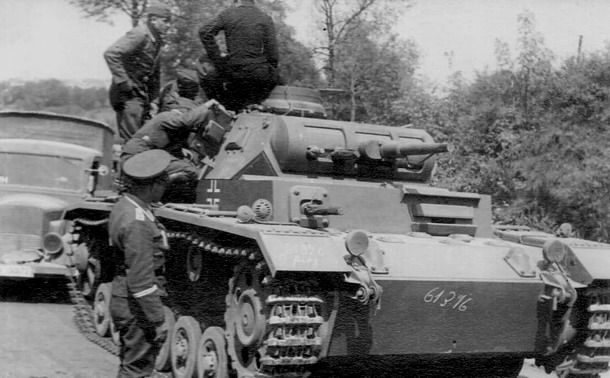
Panzerkampfwagen III Ausf. F, hull number 61316 indicates a vehicle built by Henschel, source: Worldwarphotos.info with permission of the site owner, edited
Ausführung F
True mass production of the PzKpfw III began only with the Ausf. F (or 5/Z.W.), which entered production in August 1939. The Waffenamt order this time called for 435 tanks and was shared between MAN, Daimler-Benz, FAMO, Henschel, Alkett and MIAG (with a large number of sub-suppliers also involved). Apart from receiving an updated Maybach HL 120TRM engine, the Ausf. F was virtually identical to the preceding Ausf. E (at least before various retrofits were applied). Basic characteristics such as overall dimensions, weight (19.5 tonnes), fuel capacity, speed (recommended maximum 40 km/h), gearbox (Variorex) and radio equipment remained unchanged from the Ausf. E. Even telling the E and F apart in photographs is not always easy.
As noted, production of the Ausf. F started in August 1939 and continued apparently until April 1941. For part of 1939, production of the E and F ran concurrently until the Ausf. E line was fully phased out. During production, and retrospectively after it ended, various design changes were introduced to the Ausf. F. A few of the more easily noticeable ones in photographs are worth mentioning.
From around late 1939, tanks began to be fitted with ventilation openings for the steering brake exhaust. These holes were drilled in the upper front hull plate and covered by raised armoured caps. From January 1941 at least some of this variant were modified for tropical service. Additional airflow openings were drilled into the engine deck and covered by raised armoured caps (photo HERE (source: flickr.com)). As part of this change, the radiator cooling fan was also uprated. From April 1941, tanks began to be fitted with storage boxes hung on the rear turret wall (using the lifting hooks originally intended for turret removal in field workshops). These boxes were used to store crew personal effects and provisions.
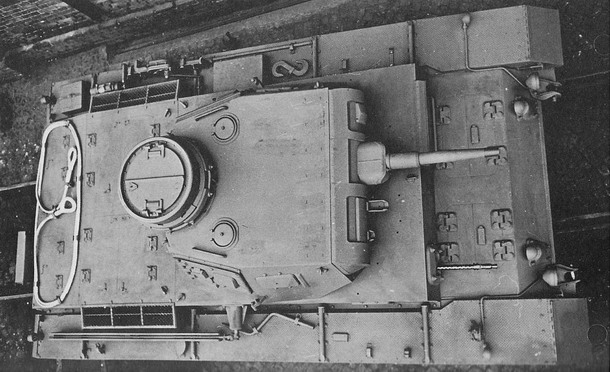
a fine overhead view of the Panzerkampfwagen III Ausf. F, source: Flickr.com with permission of the publishing user, edited
The Panzer III Ausf. F was the first variant to receive an upgunning during original production. In June 1940 a decision was made to urgently switch Panzer III production from the 3.7cm KwK 36 L/46.5 gun to the more powerful 5cm KwK 38 L/42 in 50 mm calibre with a barrel 42 calibres long. This change was given the highest possible priority and was consequently introduced into production as early as July! The designers faced no small challenge: the new gun had to be fitted in a way that would also allow retrofitting to older Ausf. E, F and G tanks already built with the original, weaker weapon. Modifications to the turret structure therefore had to be minimal or, ideally, non-existent.
The new gun required a new mantlet. This was now an external type, consisting of a cylindrical armoured plate 35 mm thick (known as the Walzenblende). The gun itself was mounted centrally in the mantlet. A small opening for the optical gunsight was to the left of the barrel, while an MG 34 machine gun in 7.92 mm (now just one) was to the right of the gun. Observation vision ports with armoured covers were fitted on either side of the mantlet. The tank thus lost one of its original three machine guns. The new gun more than compensated for this loss, however, and could also be used effectively against infantry with high-explosive rounds. The more powerful gun produced more propellant gases when fired, so an additional opening was cut in the turret roof and a small extractor fan installed beneath it, covered externally by an armoured cap. Ammunition for the new gun consisted of 87 rounds (some sources cite 99). The two machine guns were provided with 3,750 rounds.
From July 1940, newly produced Ausf. F tanks were therefore fitted with the 5cm KwK 38 L/42 gun. Of the total 435 tanks built in this variant, the last approximately 100 received the 50 mm gun in original production. Older tanks built with the original 37 mm gun were later also rearmed as part of the already mentioned Umbewaffnung Programme launched in December 1940. Alongside the retrofitting of the 5cm KwK 38 L/42 gun, this programme included the bolting-on of 30 mm additional armour plates to the front and rear hull and the front of the crew compartment, as well as the fitting of wider tracks and the corresponding widening of the road wheels and other running gear components (a Ausf. F modernised in this way can be seen in the photograph HERE (source: flickr.com)). This modernisation certainly added to the tank's weight — by exactly how much I was unable to find out, but probably up to around 21 tonnes.
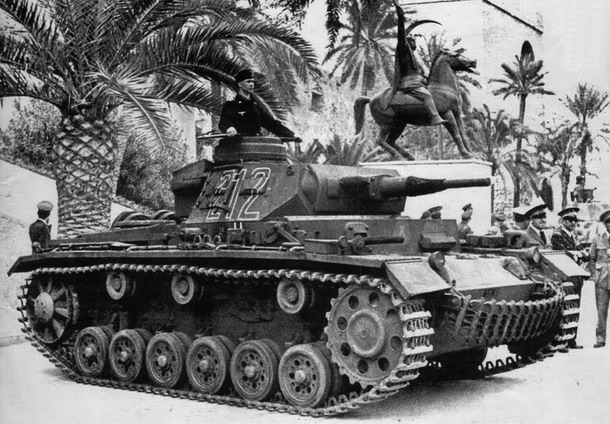
Panzerkampfwagen III Ausf. G with 50 mm gun, source: Flickr.com with permission of the publishing user, edited
Ausführung G
As early as March 1940, the next variant of the Panzer III entered production, designated Ausf. G (or 6/Z.W.). Production of this variant continued until early 1941, running concurrently with the older Ausf. F the entire time. Both versions were also very similar to each other, differing only in certain details. Among the differences visible in photographs was, for instance, a redesigned driver's vision port cover, and a new commander's cupola introduced partway through production (which therefore not all Ausf. G tanks had). Basic characteristics such as overall dimensions, weight (19.5 tonnes), fuel capacity, powerplant (Maybach HL 120 TRM), speed (recommended maximum 40 km/h), gearbox (Variorex) and radio equipment remained unchanged from the Ausf. F (and largely from the Ausf. E as well).
The Panzer III Ausf. G was also initially produced (from March 1940) with the 37 mm gun. In June 1940, however, the already-mentioned decision came to urgently switch to the more powerful 50 mm gun, which was reflected in production from the very next month. A total of 600 Ausf. G tanks were built, of which the first 140 to 160 examples had the older 37 mm gun. The remainder, produced from July 1940 onwards, left the factory fitted with the 5cm KwK 38 L/42 gun in 50 mm calibre.
The Ausf. G received essentially the same range of retroactive modifications as the E and F. To recap some of them: from January 1941, some Ausf. G tanks were modified for service in tropical climates, with additional airflow openings drilled into the engine deck and covered by the characteristic raised armoured caps (photo HERE (source: flickr.com)). Another worth mentioning was the storage boxes hung from April 1941 on the rear turret wall for crew personal effects.
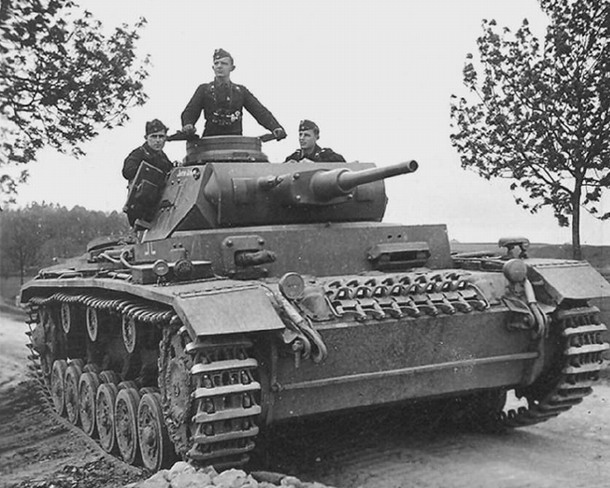
Panzerkampfwagen III Ausf. G with 50 mm gun, source: Flickr.com with permission of the publishing user, edited
The most significant changes, however, came from December 1940 onwards as part of the already frequently mentioned Umbewaffnung Programme. The aim of this programme was to bring older Panzer III tanks up to the standard of the newer Ausf. H. It included above all the retrofitting of the new 5cm KwK 38 L/42 gun into those 140 to 160 earliest tanks still fitted with the weaker weapon. It also included the bolting-on of 30 mm additional armour to the front and rear hull and the front of the crew compartment, plus the fitting of wider tracks and the corresponding widening of the road wheels and other running gear components. This modernisation certainly increased the tank's weight — by exactly how much I was unable to determine, but probably up to around 21 tonnes.
Rearming the Panzer III with the 5cm KwK 38 L/42 brought a significantly improved ability to destroy enemy armour. Two types of armour-piercing ammunition were used for this weapon. The standard armour-piercing round PzGr. 39 weighed 2.06 kg and left the muzzle at 685 m/s. At 500 metres this projectile could penetrate 46 mm of angled armour. The subcalibre PzGr. 40 weighed only 850 grams (sometimes cited as 925 g) and achieved a muzzle velocity of 1,060 m/s, capable of penetrating 58 mm of angled armour at the same range. The combat use of the Ausf. E, F and G variants soon revealed one significant weakness they shared: a complex and unreliable gearbox. During 1940 and 1941 the manufacturer managed to resolve most of the problems, but this transmission was not to be used in the next version of the Panzer III regardless.
Ausführung H
The next variant of the PzKpfw III was designated Ausf. H in alphabetical order, also known by the production codes 7/Z.W. and Z.W.39. It was the first variant of the tank intended to be produced from the outset solely with a 50 mm gun — specifically the KwK 38 L/42. The new gun required a new mantlet. In contrast to the mantlet for the older 37 mm gun, this was an external type consisting of a cylindrical armoured plate 35 mm thick (the Walzenblende). The gun was mounted centrally in the mantlet, with a small opening for the optical gunsight TZF 5d to its left and an MG 34 machine gun in 7.92 mm to its right. Observation vision ports with armoured covers flanked the mantlet on either side. The mantlet allowed the weapons to be elevated from −10 to +20 degrees. The more powerful gun produced more gases on firing, so an additional opening was cut in the turret roof and a small extractor fan installed beneath it. Gun stowage was 99 rounds, and 3,750 rounds were carried for the two machine guns.
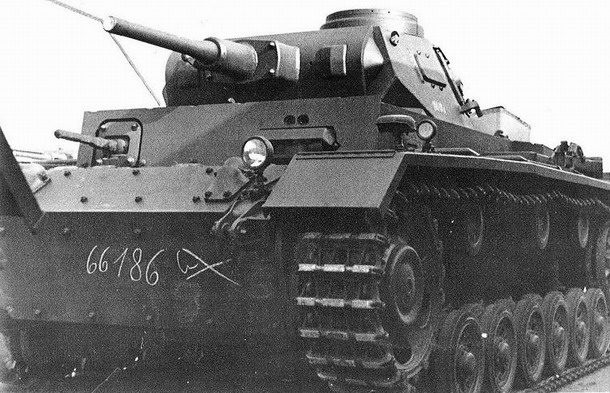
Panzerkampfwagen III Ausf. H, hull number 66186 indicates a vehicle built by MAN in March 1941, source: Flickr.com with permission of the publishing user, edited
Another new feature of the Ausf. H was a change of gearbox. The semi-automatic Variorex transmission by Maybach, fitted in the Ausf. E, F and G, was replaced by the more reliable six-speed manual Zahnradfabrik SSG 77. The PzKpfw III Ausf. H also had substantially heavier armour protection, achieved by bolting on additional 30 mm plates (Zusatzpanzerung) to the front and rear of the hull and to the front of the crew compartment. On all of these surfaces, the armour thickness was therefore doubled from 30 to 60 mm (30 + 30).
The heavier armour naturally pushed the vehicle's weight up to 21.5 tonnes (compared to 19.5 tonnes on the three preceding variants). The designers therefore also widened the running gear and tracks in order to maintain the same ground pressure. The Ausf. H thus had tracks 380 mm wide — 20 mm more than on older variants. In addition to wider tracks, the Ausf. H received entirely new drive and idler sprockets. Deliveries of these new sprockets were delayed, however, so some Ausf. H tanks had to be fitted with the previous generation's drive and idler wheels, suitably widened using spacer inserts.
The Ausf. H used from the outset the new commander's cupola that had been introduced during production of the Ausf. G. On the Ausf. H, a further change was made: the upper sides of the turret were extended further toward the rear, meaning the commander's cupola no longer intruded into the rear turret wall.
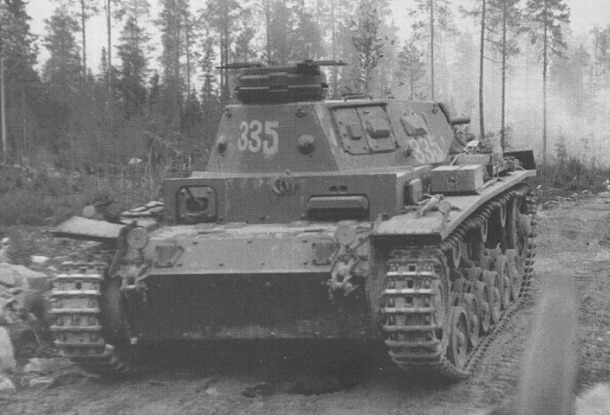
a knocked-out Panzerkampfwagen III Ausf. H; this photograph nicely shows two new features of the Ausf. H — the additional frontal armour (the bolt heads securing it are clearly visible) and the commander's cupola whose tube no longer extends into the rear turret wall, source: Flickr.com with permission of the publishing user, edited
The first PzKpfw III Ausf. H tanks rolled off the production lines in October 1940. From January 1941, some began to be modified for tropical service, including uprated cooling fans and additional airflow openings in the engine deck with the characteristic raised covers. From April 1941, tanks were fitted with the already mentioned storage boxes hung on the rear turret wall (using the turret-lifting hooks for this purpose). These were used to store crew personal effects and provisions. A total of 286 Panzer III Ausf. H tanks were produced by Daimler-Benz, MAN, MIAG and Henschel.
Ausführung J
Next in line was the Ausf. J, factory-designated 8/Z.W. Compared to the preceding Ausf. H, very little changed. The main new feature was the use of 50 mm homogeneous armour plate on the front and rear of the hull and on the front of the crew compartment — no longer a bolted-on additional plate as on the Ausf. H, but an integral armour plate. The new thicker front of the crew compartment brought with it a new driver's vision port (Fahrersehklappe 50) and a new hull machine gun mount (Kugelblende 50). Another detail that helps identify this variant in photographs was the redesigned tow cable attachment eyes on the sides of the front hull plate.
The powerplant remained the petrol-engined Maybach HL 120TRM of 11.9 litres displacement and 300 hp. The gearbox was also the same as in the preceding generation, the SSG 77 with six forward gears and one reverse. The main armament was likewise unchanged — the 5cm KwK 38 L/42 gun in 50 mm calibre with the external cylindrical mantlet (Walzenblende). Gun stowage was 99 rounds and 3,750 rounds were carried for the machine guns. The weight of the Ausf. J was 21.6 tonnes.
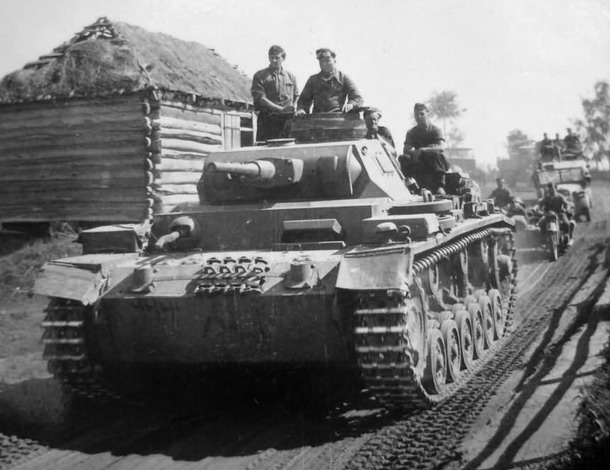
Panzerkampfwagen III Ausf. J on the Eastern Front, source: Worldwarphotos.info with permission of the site owner, edited
Production was originally planned for "only" 440 tanks in the Ausf. J variant. This figure was soon revised upwards to 779 vehicles, with hull numbers allocated from 68001 to 68979. The order was distributed between Daimler-Benz, MAN, MIAG, MNH and Henschel. In 1940, a further 1,800 tanks were ordered and Alkett was to join the production effort. Finally, in 1941 the order was expanded again by another 1,400 vehicles. It should be noted immediately, however, that due to subsequent developments, the vehicles delivered against these orders included not only the Ausf. J but also the later Ausf. L, M and even N.
The first Ausf. J tanks left the production lines in March 1941, and production continued until May 1942. Due to the overlapping of Ausf. J and L production, arriving at an exact figure for the Ausf. J alone is not straightforward. The total was probably somewhere between 1,521 and 1,602. As with previous variants, some Ausf. J tanks were also modified for tropical service, with uprated fans and additional airflow openings in the engine deck covered by the characteristic armoured caps. As the effectiveness of anti-tank ammunition grew, the Germans began working on further armour improvements for the Panzer III toward the end of 1941. From March 1942, an additional armour plate appeared on the front of the crew compartment and turret: 20 mm plates spaced 10 cm in front of the main armour on the crew compartment and 14 cm in front of it on the turret.
Ausführung L
Let us return briefly to the already frequently mentioned Umbewaffnung Programme, launched at the end of 1940. Among other things, this programme included rearming older PzKpfw III variants from the 37 mm gun to 50 mm guns with a barrel 42 calibres long (L/42). Even at that time, a proposal was apparently made to rearm the tanks directly with the yet more powerful 5cm PaK 38 with a barrel 60 calibres long (L/60). The proposal was dismissed at that point as technically impractical. Hitler, however, was clearly taken with the idea and raised it again at a meeting with armaments representatives in February 1941. Most of those present continued to reject the proposal, but a representative of the firm Alkett offered to attempt to build a test example of such an armed tank. The prototype was completed on 19 March 1941.
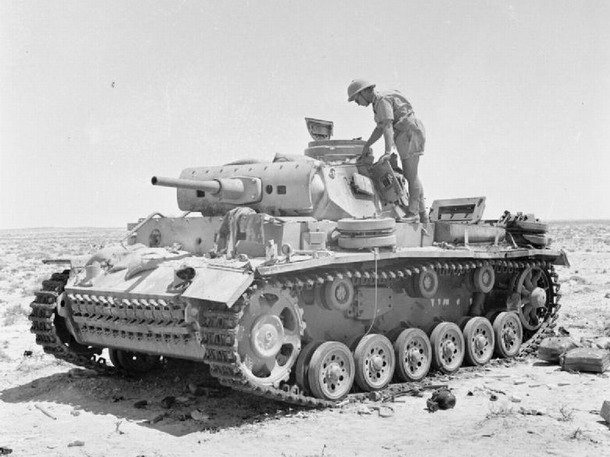
Panzerkampfwagen III Ausf. J with spaced armour on turret and hull, knocked out in North Africa, source: Wikimedia, Public domain, edited
Factory and troop trials followed, during which the vehicle proved fully capable of combat use. It was then decided to urgently standardise this more powerful, longer-barrelled gun for series production Panzer III tanks. By December 1941 the Ausf. J was in series production, and all production plants gradually transitioned to fitting the new guns between December 1941 and March 1942. Tanks newly equipped this way were initially still designated PzKpfw III Ausf. J. It was only at the turn of March and April 1942 that it was decided this was a significant enough design change to warrant a new variant designation, and tanks with the longer gun became PzKpfw III Ausf. L. Already produced Ausf. J tanks with the longer gun were also retroactively redesignated as Ausf. L.
The new gun was designated 5cm KwK 39 L/60 and, as noted, was derived from the anti-tank gun PaK 38. Two types of armour-piercing ammunition were used with it. The standard PzGr. 39 armour-piercing round weighed 2.06 kg and had a muzzle velocity of 823 m/s (sometimes given as 835 m/s), capable of penetrating 57 mm of homogeneous armour angled at 30 degrees at 500 metres. The subcalibre PzGr. 40 weighed 0.85 kg (sometimes cited as 0.925 kg) and achieved 1,198 m/s (sometimes given as 1,180 m/s), capable of penetrating up to 78 mm of angled armour at the same range.
A total of 1,470 Ausf. L tanks were produced. The only difference from the older Ausf. J was the new gun and the related changes — an increase in overall length (including the longer overhanging barrel) and a weight increase to 22.5 tonnes. The new gun was also paired with a new sight, the TZF 5e, and the gun ammunition stowage had to be reduced from 99 to 84 rounds.
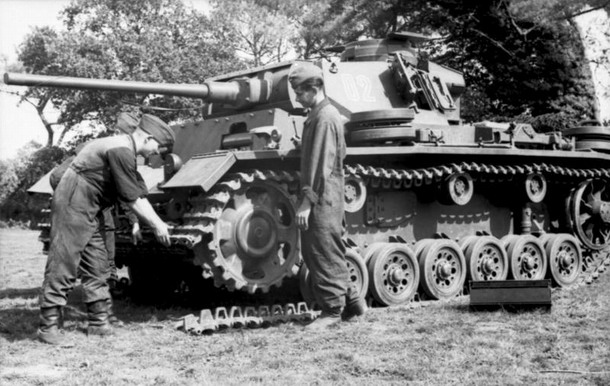
Panzerkampfwagen III Ausf. L; note that the tank no longer has a vision port on the turret side, but still retains the emergency hatch in the hull side above the road wheels, source: Bundesarchiv_Bild_101I-639-4262-04, Wikimedia, Creative Commons, edited
During production, further minor design changes were made to the Ausf. L, mostly aimed at simplifying and reducing the cost of manufacture. In December 1941, a new arrangement of ventilation openings in the engine deck was introduced, which from then on became standard for all tanks regardless of whether they were intended for tropical service or not. From January 1942, the vision ports in the front of the turret side walls were eliminated, as was the vision port on the right side of the gun mantlet. This change only fully worked its way through production after several months, once stocks of already prepared turrets were used up. From June 1942, the emergency escape hatches in the hull sides above the road wheels were also discontinued.
From March 1942, tanks began to be fitted with smoke grenade dischargers mounted on the turret sides — three barrels on each side. In May 1943, however, these were discontinued again as they had proven insufficiently effective. From March 1942, the spaced armour plates on the front of the crew compartment and turret (the same as introduced on the older Ausf. J) also appeared on the Ausf. L — 20 mm plates spaced 10 cm in front of the main crew compartment armour and 14 cm in front of the turret. Apparently from May 1943, some tanks were also retroactively fitted with spaced side armour plates on the hull and turret sides. These plates were nicknamed Schürzen (skirts) and provided additional protection against Soviet anti-tank rifles (though the prevailing theory is generally that they were intended as protection against shaped-charge projectiles).
Ausführung M
In February 1942, an army requirement was raised to improve the Panzer III's ability to ford water obstacles. The result was the Ausf. M, which entered production in September 1942. Personally, I find it difficult to understand what distinguished this vehicle sufficiently to warrant its own variant designation, since the deep wading modifications were the only thing that set it apart from the preceding Ausf. L.
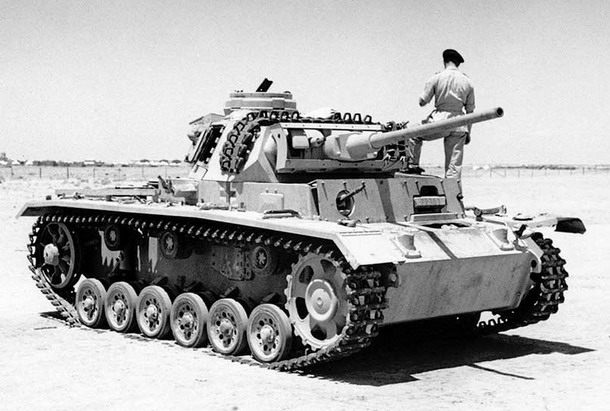
Panzerkampfwagen III Ausf. L knocked out by the Allies in Africa, source: Flickr.com, Public domain, edited
The most easily noticeable new feature was an upswept exhaust pipe terminated by a one-way flap that prevented flooding. The vents in the engine deck were fitted with seals that could be opened and closed from inside the crew compartment. In addition, all hull vision ports, steering brake vents and even the turret ring were sealed — the latter with an inflatable rubber gasket. These measures raised the fording depth from the roughly 80 cm typical of older versions to 160 cm. Weight (22.5 t), powertrain (Maybach HL 120 TRM) and armament (5cm KwK 39 L/60) all remained the same as on the Ausf. L. Apparently from May 1943, some tanks were also retroactively fitted with spaced side armour plates on the hull and turret sides, the so-called Schürzen (skirts), providing additional protection against Soviet anti-tank rifles (though the prevailing theory is that they were primarily intended against shaped-charge projectiles).
Production of the Ausf. M ran from September 1942 to May 1943 and a total of 517 were built. The attentive reader will notice that production of this variant was far less massive than the two preceding ones — and this was no coincidence. As early as the beginning of 1942, a decision had been made to gradually wind down Panzer III production and redirect the manufacturing capacity toward the StuG III assault gun, which in the view of the army leadership and Hitler himself had greater combat value.
Ausführung N
At the beginning of 1942, a decision was made to rearm PzKpfw IV tanks with newer, more powerful guns. As a result, hundreds of older short-barrelled 7.5cm KwK 37 L/24 guns in 75 mm calibre were left in storage, and the army sought a sensible use for them. Probably as early as February 1942, design work was ordered with the aim of fitting this gun into a Panzer III turret. Both the turret mantlet and the gun itself required minor modifications. The result was positive, and in June 1942 a decision was made to build 450 Panzer III tanks armed with the 7.5cm KwK 37 L/24 gun. These tanks were henceforth to be designated PzKpfw III Ausf. N. A new TZF 5b sight was paired with the gun. Beyond the new gun and the modifications required to install it, nothing changed compared to the Ausf. M. Weight did increase, however, to 23 tonnes.
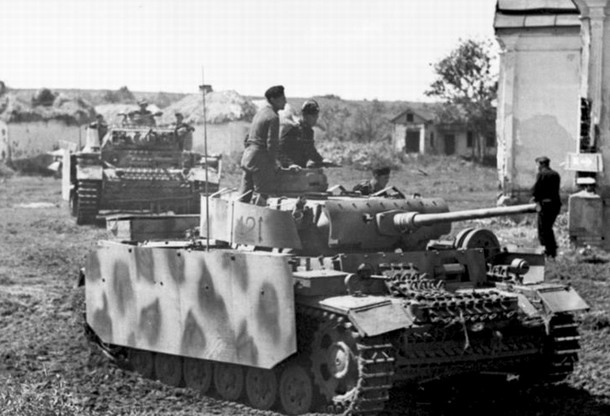
Panzerkampfwagen III Ausf. M on the Eastern Front, source: Bundesarchiv_Bild_101I-219-0595-23, Wikimedia, Creative Commons, edited
The first Ausf. N tanks were completed in July 1942 and production continued until October of that year. Of the 450 ordered, 447 were accepted by the army. Given the very positive response from frontline units, production of the Ausf. N was resumed in February 1943. Between February and August of that year a further 167 PzKpfw III Ausf. N were built, bringing the total for both production runs to 614 vehicles.
Thanks to its armament, the PzKpfw III Ausf. N was particularly well suited to combat against enemy infantry and the destruction of smaller fortified positions. In practice, cooperation with the heavy Tiger tanks proved effective. The Tigers' guns excelled at destroying enemy tanks and armoured vehicles at long range, while the Panzer III Ausf. N helped "clear the path" and protected them from close infantry attacks. This was partly why the Ausf. N was sometimes nicknamed the "Tiger guardian." Apparently from May 1943, some tanks were retroactively fitted with spaced side armour on the hull and turret, the so-called Schürzen (skirts), providing additional protection against Soviet anti-tank rifles (though the prevailing theory is that they were primarily intended as protection against shaped-charge projectiles).
In August 1943 production of the Ausf. N came to an end, along with Panzer III production as a whole. The hulls, however, continued to be produced as the basis for StuG III assault guns. The Panzerkampfwagen III was built in twelve variants in total (counting only the combat variants Ausf. A, B, C, D, E, F, G, H, J, L, M and N). Production ran for roughly six and a half years (from late 1936 to August 1943), and between 5,599 and 5,680 vehicles left the factories during that time. Comparing the first variant (Ausf. A) and the last (Ausf. N), the tank's weight grew from 15.4 to 23 tonnes, the thickness of armour at the strongest points increased from 16 to 70 mm (50 + 20), and the gun calibre rose from 37 mm to 75 mm. Beyond the combat variants described, a whole range of specialised vehicles was developed on the Panzer III chassis, and these are described in the following sections.
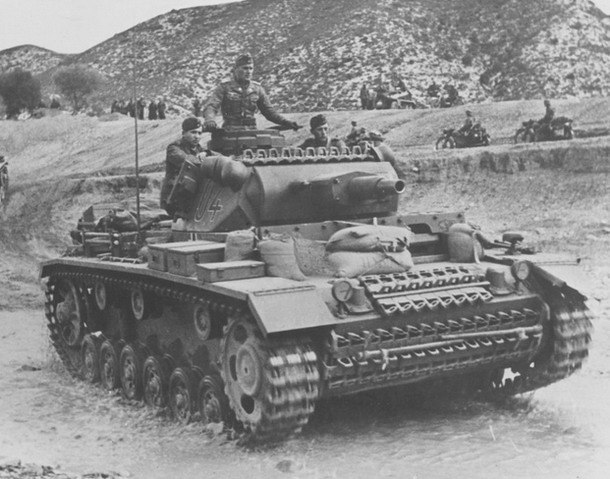
Panzerkampfwagen III Ausf. N, source: Flickr.com with permission of the publishing user, edited
Schachtellaufwerk
As already mentioned, the first four variants of the PzKpfw III were produced in small batches and served as evaluation vehicles in the search for the ideal running gear configuration. Only with the Ausf. E were the Germans satisfied and its suspension layout became the standard for the Panzer III. Nevertheless, in the first half of 1940 the Waffenamt decided to test one further alternative suspension arrangement.
This was to be the so-called Schachtellaufwerk — the interleaved wheel suspension. This type of arrangement was standard on German half-tracked vehicles and later on tanks as well (Panther, Tiger and Tiger II). The firm FAMO (Fahrzeug und Motorenbau GmbH) was tasked with building a prototype Panzerkampfwagen III mit Schachtellaufwerk. The new suspension consisted of six road wheels 850 mm in diameter on each side, fitted with rubber tyres around their circumference. The wheels were arranged in two rows. The outer row wheels had lightening holes; the inner wheels were solid with spoke-like pressed indentations. The wheels were sprung by torsion bars. Return rollers were not needed, as the upper track run rested directly on the road wheels. The drive sprocket remained at the front and the idler at the rear, both also of new design. The hull and turret (with a 50 mm gun) were taken from an Ausf. G tank.
After tests of the first prototype, a small series of 20 vehicles was ordered. These were delivered, apparently in 1941. Again, Ausf. G hulls were used, but the turrets were taken from Ausf. H tanks (recognisable by the commander's cupola that no longer intrudes into the rear turret wall). Photographs show that on some of the 20 tanks the original emergency hatch in the hull side was retained — though it was blocked by the upper track run and thus unusable. On some vehicles the hatch was modified and relocated upward above the track run to remain accessible. And finally, photographs suggest that on some vehicles the hatch was eliminated entirely.
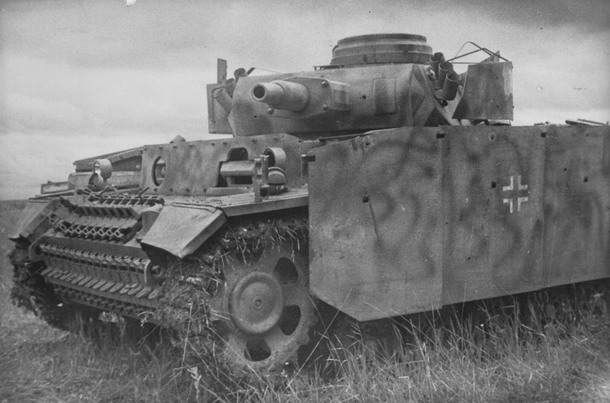
Panzerkampfwagen III Ausf. N with side skirt armour, source: Flickr.com with permission of the publishing user, edited
Series production was not pursued, as the new suspension brought no meaningful improvement in cross-country performance. The large-wheel arrangement was better suited for high-speed travel, but this was not considered a significant enough advantage.
Panzerbefehlswagen III Ausf. D1
Among the special conversions of the Panzer III were the command vehicles Panzerbefehlswagen III, produced in five different variants (Ausf. D1, E, H, J and K), each based on a different combat tank version. Command tanks were intended to allow unit commanders to move safely close to the front line, maintain situational awareness and react quickly by issuing orders. The first Panzerbefehlswagen III was based on the standard Ausf. D tank and its full designation was Panzerbefehlswagen III Ausf. D1. Daimler-Benz tracked this variant internally under the code 3c/Z.W.
At first glance the command Ausf. D1 was very similar to the standard Ausf. D, but in reality it differed in many ways. Most significantly, its armour was substantially increased. Wherever the standard Ausf. D had 14.5 mm armour, the Ausf. D1 used 30 mm plate. Its weight accordingly rose to approximately 18.2 tonnes. The thicker armour also meant the elimination of the cutouts in the lower front hull plate that the Ausf. D had for service access to the steering clutches and brakes. The heavier armour also brought a newly designed driver's vision port and a new hull machine gun mount. The rear idler wheels were also of a new design.
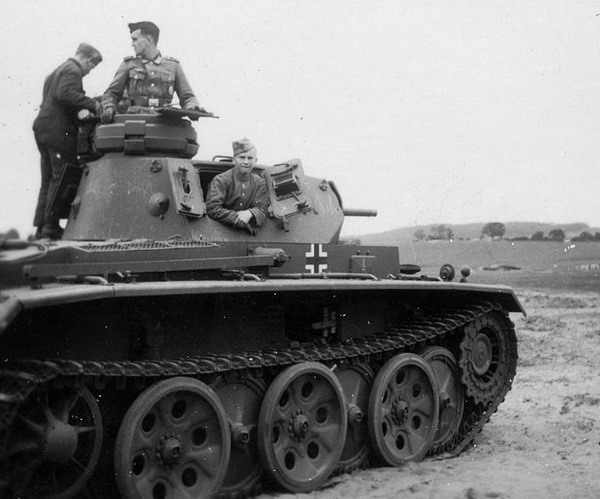
prototype of the Panzer III tank on FAMO chassis, source: Flickr.com with permission of the publishing user, edited
The fundamental difference from a standard tank was the fixed turret with no gun. On the command Ausf. D1, the turret was simply bolted rigidly to the superstructure and could not be rotated. The traverse mechanism and the gun were removed to make room for communications equipment. The entire cylindrical weapon mounting assembly was replaced by a fixed, immovable front plate on which only a wooden dummy gun barrel was fitted. The false barrel was meant to give the vehicle the appearance of a standard combat tank and thus deceive the enemy. The left turret machine gun was also eliminated and replaced by another wooden barrel dummy. The right turret machine gun was retained, but to allow it to be traversed within the fixed front plate, it had to be mounted in a new ball-type mount.
The hull machine gun was also removed and its original mount replaced by a closeable port through which a submachine gun stowed inside the crew compartment could be fired. Two further similar firing ports were provided in the sides of the crew compartment. The command tank's only integral weapon was thus the single turret machine gun. Given its role, however, it was never supposed to engage in combat, and the lack of armament was therefore not seen as a fatal shortcoming. Beyond the changes described, a whole series of further minor modifications were made (photographs reveal, for example, a new observation port in the rear of the right side wall of the crew compartment). The powerplant (Maybach HL 108 TR) and gearbox (SSG 76) remained the same as in the standard Ausf. D.
The crew remained at five men, but its composition changed. The principal figure aboard was of course the commander, accompanied by his adjutant, two radio operators and a driver. One of the radio operators presumably also operated the machine gun. The command tank lost its main gun but was instead "armed" with several radio sets. Three sub-variants existed, each carrying a different combination of radios. The first, carrying the ordnance designation Sd.Kfz. 266, was fitted with Fu 6 and Fu 2 sets. The second, Sd.Kfz. 267, carried Fu 6 and Fu 8, and the third, Sd.Kfz. 268, carried Fu 6 and Fu 7. Each of the three sub-variants was intended for use at a different level of command.
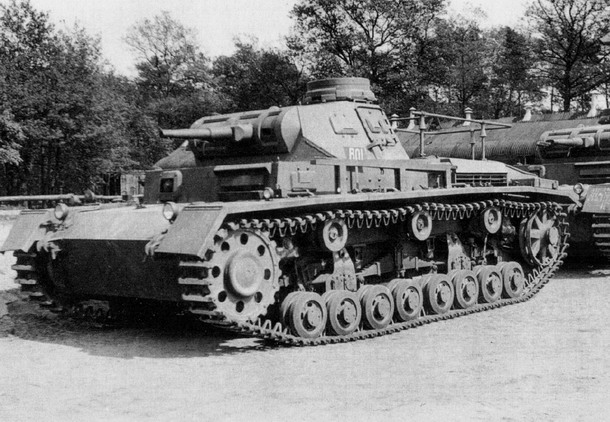
command Panzerbefehlswagen III Ausf. D1, source: Flickr.com with permission of the publishing user, edited
Antennas were of course needed for the radios, and the PzKpfw III Ausf. D1 had four. One rod antenna was fitted on each side of the crew compartment, a frame antenna above the engine compartment, and — at least on some of the three sub-variants — a further telescopic star-shaped antenna inside the crew compartment. This was extended through a circular cutout in the turret roof. Fully extended, this antenna reached a height of 9 metres, which meant it could only be raised when the tank was stationary — effectively turning the vehicle into a mobile radio station. A total of 30 command tanks of the Ausf. D1 variant (in all three sub-variants) were built, with hull numbers 60341 to 60370.
Panzerbefehlswagen III Ausf. E
The second command vehicle was based on the combat tank Ausf. E and was accordingly named Panzerbefehlswagen III Ausf. E. Daimler-Benz tracked this vehicle internally as 4a/Z.W. Again, the command vehicle looked almost identical to the standard tank, but once more had a fixed, non-rotating turret without a gun. Its front wall was again a fixed plate with a wooden gun barrel dummy intended to give the vehicle the appearance of a standard combat tank and deceive the enemy. The left turret machine gun was also eliminated and replaced by another dummy barrel. The right turret machine gun was retained, but to allow it to move within the fixed front plate, it had to be mounted in a new ball-type mount.
The hull machine gun was removed and its mount replaced by a closeable port for firing a submachine gun stowed inside. Two further similar firing ports were in the sides of the crew compartment. The vehicle's only integral armament was therefore the single turret machine gun. Given its role, however, the command vehicle was not supposed to engage in combat, and the minimal armament was not considered a fatal shortcoming. One curiosity of the command Ausf. E was its driver's vision port. For some reason, the standard Ausf. E vision port was not used but rather the more modern type normally found on the Ausf. G. For an even less obvious reason, some Befehlspanzers of the E variant were fitted with an entirely non-standard flat rectangular vision port cover with an observation slit.
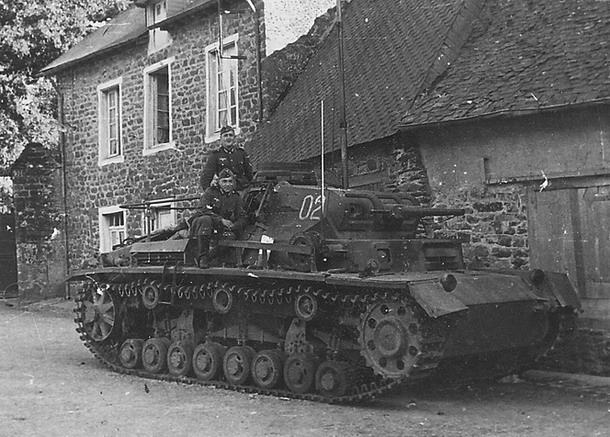
Panzerbefehlswagen III Ausf. D1 in France, 1940; note the telescopic antenna extended from the turret, source: Wikimedia, Creative Commons, edited
The crew remained at five men, but its composition changed. The commander was of course the principal figure aboard, accompanied by his adjutant, two radio operators and a driver. One of the radio operators presumably also operated the turret machine gun. The command tank lost its main gun but was instead "armed" with several radio sets. Three sub-variants existed, each carrying a different combination of radios. The first, Sd.Kfz. 266, was fitted with Fu 6 and Fu 2. The second, Sd.Kfz. 267, carried Fu 6 and Fu 8, and the third, Sd.Kfz. 268, carried Fu 6 and Fu 7. Each sub-variant was intended for use at a different level of command.
Four antennas were fitted. One rod antenna on each side of the crew compartment, a frame antenna above the engine compartment, and — at least on some of the three sub-variants — a further telescopic star-shaped antenna inside the crew compartment. This extended through a circular cutout in the turret roof and reached a height of 9 metres when fully raised, meaning it could only be deployed when the vehicle was stationary, effectively turning it into a static radio station. A total of 45 command tanks of the Ausf. E variant (in all three sub-variants) were built, with hull numbers 60501 to 60545.
Panzerbefehlswagen III Ausf. H
The next command tank was built on the PzKpfw III Ausf. H chassis and was (predictably) designated Panzerbefehlswagen III Ausf. H. Again it had a non-rotating turret without a gun, with only a dummy barrel to deceive the enemy. While the standard Ausf. H tanks were armed with 50 mm guns, most Ausf. H command tanks received dummy barrels representing the older 37 mm gun.

Panzerbefehlswagen III Ausf. E; the machine gun in the turret mount has been removed on this vehicle, apparently for maintenance, source: Worldwarphotos.info with permission of the site owner, edited
The hull machine gun was also removed, replaced by a closeable port for firing a submachine gun stowed inside. Two further similar ports were in the sides of the crew compartment. The sole armament of the Panzerbefehlswagen III Ausf. H was the turret machine gun. To allow it to traverse within the fixed front plate, it was mounted in a new ball-type mount. Given its role, the command vehicle was not expected to engage in combat, and its minimal armament was therefore not seen as a fatal shortcoming.
The Panzerbefehlswagen III Ausf. H had (like the combat Ausf. H) armour reinforced by additional 30 mm plates (Zusatzpanzerung) bolted to the front and rear hull and to the front of the crew compartment, giving a total armour thickness of 60 mm (30 + 30) on all of these surfaces. As with the standard combat Ausf. H, some command tanks had the older drive and idler wheels while others already had the new design.
The crew totalled five soldiers. The commander was of course the principal figure aboard, accompanied by his adjutant, two radio operators and a driver. One of the radio operators presumably also operated the turret machine gun. The command tank lost its main gun but was instead "armed" with several radio sets. Three sub-variants existed with different radio combinations aboard. The first, Sd.Kfz. 266, was fitted with Fu 6 and Fu 2. The second, Sd.Kfz. 267, carried Fu 6 and Fu 8, and the third, Sd.Kfz. 268, carried Fu 6 and Fu 7. Each sub-variant was intended for use at a different level of command.
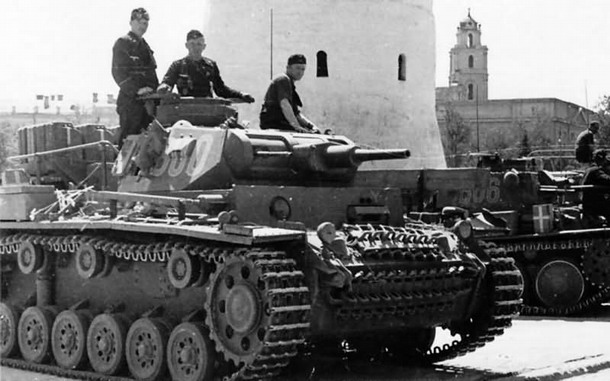
Panzerbefehlswagen III Ausf. H, source: Worldwarphotos.info with permission of the site owner, edited
Four antennas were fitted. One rod antenna on each side of the crew compartment, a frame antenna above the engine compartment, and — at least on some of the three sub-variants — a further telescopic star-shaped antenna inside the crew compartment, extended through a circular cutout in the turret roof. Fully raised, this antenna reached a height of 9 metres and could therefore only be deployed when the vehicle was stationary, effectively converting it into a mobile radio station. A total of 145 command tanks of the Ausf. H variant (in all three sub-variants) were built, with hull numbers 70001 to 70145 (a further 30 may have been subsequently reordered).
Panzerbefehlswagen III Ausf. J
The fourth command tank was the Panzerbefehlswagen III Ausf. J, based (as expected) on the combat Ausf. J. Having learned from experience with the unarmed command variants D1, E and H, the troops this time demanded a vehicle that would retain fighting capability. The army specification issued to Daimler-Benz in early 1942 therefore called for a rotating turret and a 50 mm gun.
Between February and April 1942, the Henschel firm dispatched a total of 81 standard Ausf. J tanks to the Daimler-Benz factory for conversion into command vehicles. The designers succeeded in fitting all necessary radio equipment into the vehicle's interior while genuinely retaining the original KwK 38 L/42 gun in 50 mm calibre and the turret traverse mechanism. The hull machine gun had to be eliminated, however, and its former mount was replaced by a simple closeable port through which a submachine gun could be fired. Ammunition stowage for the gun also had to be reduced.
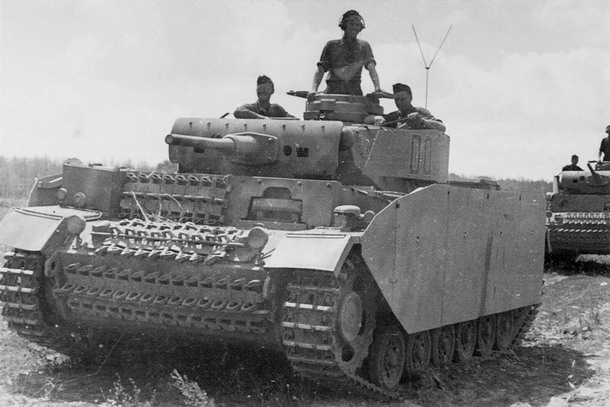
Panzerbefehlswagen III Ausf. J; note the star-shaped antenna, source: Worldwarphotos.info with permission of the site owner, edited
The Panzerbefehlswagen III Ausf. J had (like the combat Ausf. J) spaced armour plates on the front of the crew compartment and turret — 20 mm plates set in front of the main armour. In May 1943, the tanks were also retroactively fitted with spaced side armour (Schürzen) on the hull and turret sides. The weight of the command tank was practically identical to the standard Ausf. J combat tank (21.6 t).
Three sub-variants of this vehicle existed, each with a different radio combination. The first, Sd.Kfz. 266, carried Fu 6 and Fu 2. The second, Sd.Kfz. 267, carried Fu 6 and Fu 8, and the third, Sd.Kfz. 268, carried Fu 6 and Fu 7. Each sub-variant was intended for use at a different command level. Three antennas were fitted: one rod (Stabantenne) on each side of the crew compartment and a star-shaped antenna (Sternantenne) on the rear hull. The Panzerbefehlswagen III Ausf. J therefore no longer had the frame antenna that was standard on older command vehicles.
Panzerbefehlswagen III Ausf. K
The last Panzerbefehlswagen III was based on the combat Ausf. M tank, yet for some reason received its own separate variant designation with the letter K. Its official name was therefore Panzerbefehlswagen III Ausf. K. This command tank received a specially modified turret whose front section design was inspired by the PzKpfw IV.
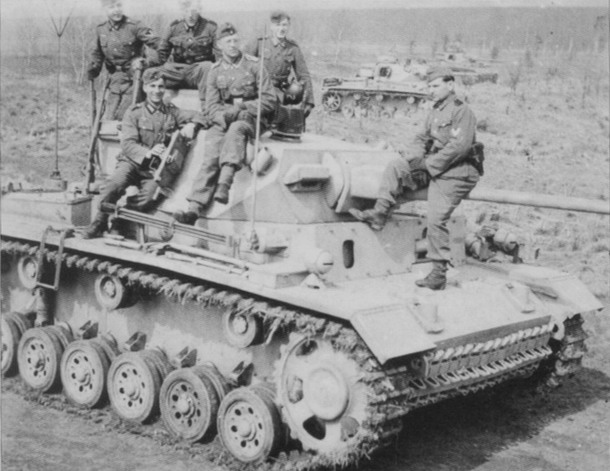
Panzerbefehlswagen III Ausf. K; note the vision port in the turret, source: Flickr.com with permission of the publishing user, edited
The original KwK 39 L/60 gun, which armed the standard Ausf. M, was retained on the command Ausf. K, but was mounted in an entirely new, significantly narrowed mantlet. To the right of this mantlet, a new observation port was created in the fixed turret front wall, virtually identical in design to the driver's vision port in the crew compartment front. To accommodate this new port, the turret machine gun had to be removed. The hull machine gun was also eliminated, its place taken by a closeable port serving as a firing position for the crew's submachine gun. The only integral armament of the Ausf. K command tank was paradoxically the gun itself.
Inherited from the Ausf. M, the Panzerbefehlswagen III Ausf. K also had the deep wading modifications and 20 mm spaced armour on the front of the crew compartment (but not the turret). In May 1943, these tanks were also retroactively fitted with spaced side armour (Schürzen) on the hull and turret sides. The weight of the command tank was 23 tonnes.
Again three sub-variants existed, each with a different radio combination. The first, Sd.Kfz. 266, carried Fu 6 and Fu 2. The second, Sd.Kfz. 267, carried Fu 6 and Fu 8, and the third, Sd.Kfz. 268, carried Fu 6 and Fu 7. Each sub-variant was intended for use at a different command level. Three antennas were fitted: one rod (Stabantenne) on each side of the crew compartment and a star-shaped (Sternantenne) antenna on the rear hull. The Panzerbefehlswagen III Ausf. K thus also lacked the frame antenna typical of older command vehicles. Between December 1942 and February 1943, a total of 50 Ausf. K command tanks were built.
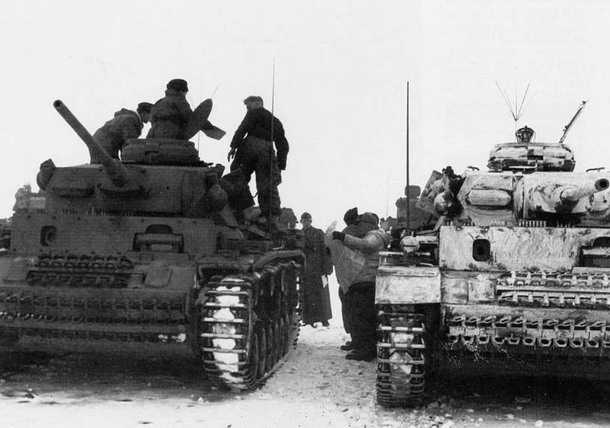
two Panzerbefehlswagen III Ausf. K; note the vision ports in the turrets, source: Flickr.com with permission of the publishing user, edited
Tauchpanzer III
In 1940 the Germans began seriously preparing for a naval invasion of Great Britain. As part of this operation, code-named Seelöwe (Sea Lion), specialised submersible versions of the Panzer III were among the vehicles to be developed. These were intended to be capable of moving along the seabed at depths of up to 15 metres. The first conversion trials took place in June 1940, using combat Ausf. F tanks. Every opening in the hull and turret had to be carefully sealed with rubber gaskets — vision ports, crew hatches, engine service access covers, engine air intakes and so on. The turret ring was sealed with an inflatable rubber gasket.
The driver's vision port received a special cover that still allowed forward visibility. The front wall of the turret was fitted with a large rubber "mask" protecting both the gun and the two turret machine guns, with transparent panels at the appropriate points to allow aiming. A similar rubber mask with a transparent panel was fitted over the hull machine gun mount and the commander's cupola. Some authors suggest that the weapon masks were to be blown off by small explosive charges after the tank emerged from the water, allowing it to go immediately into action. The photographs, however, show no sign of any such demolition charge arrangement. On the contrary, the transparent panels in the rubber masks suggest the tank was capable of movement and combat even with them in place. The Tauchpanzer was apparently designed simply to drive ashore and transition smoothly into combat with all its special equipment in situ. The first shot from the gun or machine gun would simply tear the mask at the appropriate point, after which the gunner could fire at will.
Air supply for both the crew and the engine was provided by a hose 110 mm in diameter and 15 metres long. The end of the hose was attached to a floating buoy to prevent flooding. A radio antenna was also routed through the hose for communication with the surface. Although the tank was fitted with a compass, it was also planned to guide it by radio from a command vessel. One-way check valves were also installed on the exhausts to prevent flooding. The engine cooling system was also modified — the normal air intakes were sealed off and a small tube fitted with a cylindrical strainer appeared on the left side. Water was to flow through this into tanks containing the coolant, helping to dissipate the heat.
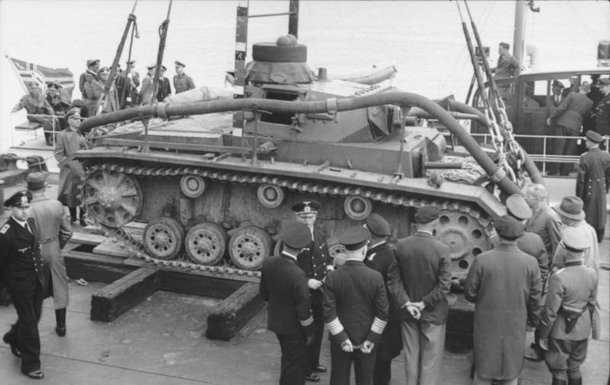
Tauchpanzer III during trials, source: Bundesarchiv_Bild_101II-MW-5674-33, Wikimedia, Creative Commons, edited
In July 1940 two series of trials were conducted. In the first, the submersible tank (Tauchpanzer) drove approximately 100 metres through water about 3 metres deep — essentially just below the surface — as a basic watertightness check. In the second test, the tank was gradually lowered by crane to a depth of 10 metres while the engine ran and the crew reported the vehicle's behaviour. At approximately 7.5 metres, the first leaks began to appear. In order to expel exhaust gases, the exhaust valves had to overcome a considerable water pressure, resulting in some exhaust gas escaping into the engine compartment and crew space. Concentrations of toxic gases inside the crew space were measured after the vehicle surfaced and remained at a fairly low level, posing no danger to the crew.
On the basis of these trials, it was decided that the air supply and exhaust extraction system would need to be redesigned. The submersible tank was to be fitted with a rigid tube 12 metres long through which fresh air would flow in and exhaust gases would be expelled. Sealing was also to be improved to prevent the water ingress described at greater depths. After reviewing the trial results, Hitler ordered the urgent construction of 200 submersible tanks in total (148 Panzer III tanks of the Ausf. F and G, 48 Panzer IV tanks, and 4 Panzerbefehlswagen III Ausf. E command vehicles). The work was contracted to Alkett. One of the improvements intended to enhance watertightness was an extension of the hull roof plate around the turret ring, visible in photographs of later Tauchpanzers. The conversion of all 200 tanks was completed in August 1940.
Operation Seelöwe was ultimately cancelled and in November 1940 orders came for the Tauchpanzers to be returned to standard land configuration. All special features that did not interfere with normal "dry" operation were to be retained. In March 1941, however, new orders arrived: all 200 existing Tauchpanzers were to be made ready for amphibious operation again. This time, instead of the original 12-metre tube, they were to be fitted with a narrow tube only 350 cm long, attached to an opening in the turret roof. Engine air was apparently drawn from the crew compartment. The 3.5-metre tube was sufficient because by this time the tanks were no longer envisaged for use at sea, but only for crossing rivers in the Soviet Union. In addition to reconditioning the existing 200 Tauchpanzers, construction of a further 105 new ones was ordered (a mix of Panzer III Ausf. G and H, Panzerbefehlswagen III Ausf. H and Panzer IV). At least some of the submersible Panzer IIIs eventually put their unique capability to the test under actual combat conditions on 22 June 1941 — the first day of Operation Barbarossa — when they crossed the border river Bug on the riverbed. According to some sources, the Tauchpanzer IIIs used their underwater capability again later when crossing the Dnieper River.
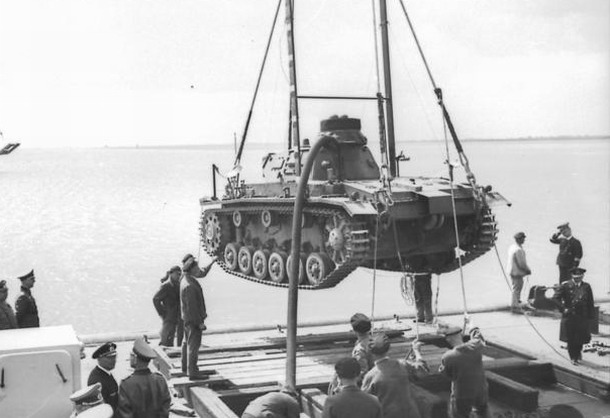
Tauchpanzer III during trials; the metal frame carries a scale to show how deep the tank is submerged, source: Bundesarchiv_Bild_101II-MW-5674-43, Wikimedia, Creative Commons, edited
Beobachtungspanzer III
At the beginning of 1943, series production began on the Wespe and Hummel self-propelled guns, which were intended to provide artillery support primarily to motorised and armoured units. The pace at which tanks advanced placed ever greater demands on the artillery. Tanks changed position rapidly, and the artillery therefore needed constant awareness of the situation at the front line. Artillerists needed forward observers who could operate on the front line alongside combat tanks and direct gun fire in real time. Ideally, these would be converted tanks whose special role would not be immediately apparent to the enemy.
Ultimately, a special variant of the Panther was intended to fill this role. But that was a future prospect, and the army needed a quick interim solution — and the Panzer III was chosen. The conversion of this tank into an artillery observation vehicle was entrusted to Alkett. The Panzerbeobachtungswagen III, as the vehicle was designated, lost its gun and the turret front wall received an entirely new mantlet. On either side of it were closeable vision ports, and in the centre a ball-type mount for an MG 34 machine gun. To the right of the mount, a very simple dummy gun barrel projected from the mantlet to disguise the vehicle's true purpose. The hull machine gun was removed to make room for radio equipment, replaced by a closeable firing port. The vehicle's only integral weapon was the turret machine gun.
Panzerbeobachtungswagen III, source: Flickr.com with permission of the publishing user, edited
A new opening appeared in the turret roof for the extension of the TBF2 observation periscope. A binocular periscope SF 14 Z could be extended directly from the commander's cupola. The Panzerbeobachtungswagen III was equipped with Fu 8, Fu 4 and Funksprechgerät f radio sets. A portable Tornisterfunkgerät g radio was also carried aboard, allowing one of the crew to take it along as a backpack for dismounted reconnaissance. The primary means of communication was the Funksprechgerät f, which allowed voice contact at a range of 4 to 5 km — more than adequate for the vast majority of situations, as self-propelled gun batteries were usually within this range behind the front line. Receivers aboard the Wespe and Hummel self-propelled guns were connected to loudspeakers, so all crew members could hear orders clearly without wearing headsets (which would have restricted their movement). When the range of the Funksprechgerät f was insufficient, the Fu 8 set was used for voice communication at ranges up to 20 km. The observation tank carried two antennas — a simple rod antenna on the right side of the crew compartment and a star-shaped antenna (Sternantenne) at the rear of the engine deck.
Conversion of standard tanks into the Panzerbeobachtungswagen III began in February 1943, peaked in April of that year, but continued at a slow pace until April 1944. A total of 262 of these vehicles were built, most on hulls of the Ausf. G and Ausf. F variants. A small number were reportedly also built on Ausf. E, H, J, L and M hulls (possibly retroactive conversions of tanks whose turrets had been damaged). As of 15 March 1945, 31 operational Panzerbeobachtungswagen III were still reported on strength with frontline units.
Schienenkettenfahrzeug 1
A very interesting Panzer III variant emerged in 1943, with development apparently ordered as early as the end of 1942. The project was designated Schienenkettenfahrzeug 1, literally "rail-and-track vehicle," which gives rise to the commonly used abbreviation SK1. As the name suggests, this was a tank converted for travel on railway tracks. Its intended role was apparently the escort of trains and patrolling of lines threatened by saboteurs and partisans. An Ausf. N tank armed with the 75 mm gun was selected as the basis for the prototype, with the conversion work carried out by the firm Steyr.
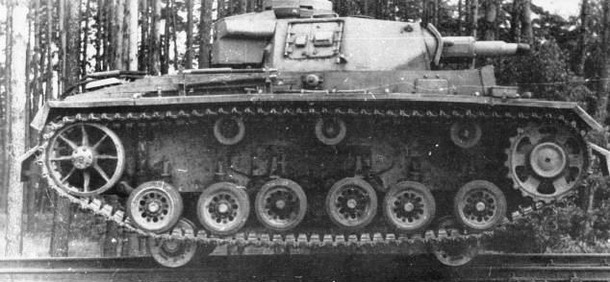
prototype of the railway tank SK 1, source: henk.fox3000.com with permission of the site owner, edited
Two beams were fitted at the front and rear of the tank's hull, each carrying one axle with metal railway wheels. When travelling normally on tracks, these beams folded under the hull and the railway wheels retracted into specially created recesses between the normal road wheels and the hull sides. This would not have been possible on a standard Panzer III, as the hull floor was crossed by closely spaced torsion bars that would have left no room for railway wheels. The designers therefore had to relocate some of the torsion bars, change the orientation of some of the swing arms, and thereby shift the road wheels themselves. An observant eye can spot in photographs of the SK1 larger gaps between the first and second wheels, between the third and fourth (i.e. in the centre), and between the fifth and sixth wheels. According to some authors, the entire track assembly was also extended by 20 cm.
In any case, folding the beams with the railway wheels under the hull and switching to track travel took only 30 seconds and could be done without leaving the tank. Raising the tank onto its railway wheels was somewhat more involved, as it first had to drive to the exact position and align itself above the rails. Mounting the railway wheels was accomplished using the tank's own power, without a crane or any external lifting equipment. When running on rails, the SK1 could reach speeds of up to 80 km/h, with a typical cruising speed of around 50 km/h. Fuel consumption was approximately one quarter of what was needed for cross-country travel on tracks.
The railway tank retained the full armament of the standard Panzer III Ausf. N — the 75 mm gun and two machine guns — making it a fully capable combat vehicle in this respect. Steyr completed the prototype in September 1943. By then, however, production of the Panzer III had ended in August 1943, which apparently contributed to the SK1 project being halted at the prototype stage.
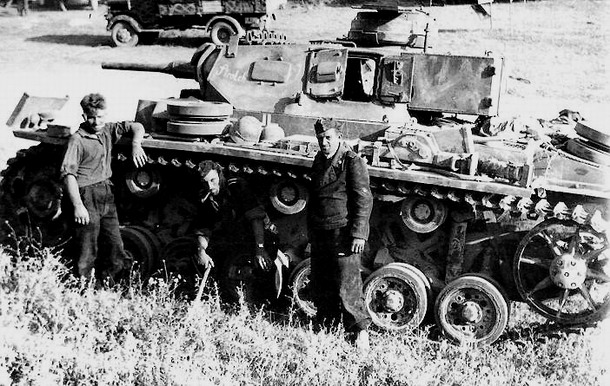
PzKpfw III (Funk) Ausf. J, source: Flickr.com with permission of the publishing user, edited
Panzer III (Funk)
In 1942 the German army began receiving the remotely controlled demolition carriers Sprengladungsträger B-IV. These vehicles were used to clear minefields, destroy bunkers and demolish buildings occupied by enemy infantry. The Sprengladungsträger B-IV was controlled remotely by radio from a command vehicle, and Panzer III tanks were among the vehicles used for this role.
Tanks assigned to this role had to be slightly modified. The standard storage box normally hung on the rear turret wall was replaced by a new, more angular box housing the Fu KS 8 transmitter used to send control commands. A simple rod antenna was mounted directly on this box. The transmitter was connected by cable to the Kommandogeber KoG 2 control console, allowing the commander to direct the Sprengladungsträger B-IV from the safety of the tank interior. The command tanks, designated PzKpfw III (Funk), were based on standard combat variants Ausf. J, L and N and retained their original armament. The command tank could therefore also protect its remotely guided demolition carrier with its own fire if necessary.
The exact number of PzKpfw III (Funk) built is not known to me, but it was apparently several dozen. These tanks were assigned to specialised units, the best known of which was probably Panzer-Abteilung 300 (Funklenk). This unit saw action, for example, during the fighting in Crimea at the siege of Sevastopol, later near Rostov and Leningrad. With other units, the command tanks also served in North Africa and took part in Operation Zitadelle.
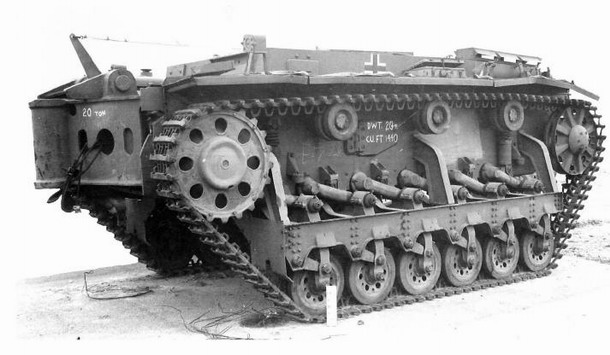
Minenräumpanzer III, source: Flickr.com, Public domain, edited
Minenräumpanzer III
Very little is known about the mine-clearing tank Minenräumpanzer III. It was a highly interesting and technically demanding conversion of the Panzer III — apparently based on the Ausf. E or Ausf. F (judging from the rear hull configuration). As can be inferred from photographs, the fighting turret was removed and the opening sealed with a roof in which at least one hatch was fitted. The road wheels, idler wheel and drive sprocket were retained from the original tank, but their suspension and mounting were completely reworked to raise the hull as high as possible above the ground. The aim was to minimise the danger to the crew in the event of a mine detonating beneath the vehicle. The floor armour of the hull was very likely also reinforced.
According to the designers' concept, the vehicle was to push ahead of it a mine-clearing device in the form of two large rollers to trigger mines, while a further roller may also have been towed behind. The hull machine gun was removed from the Minenräumpanzer III, leaving the vehicle with no organic armament whatsoever — the crew's only means of self-defence were their personal weapons. The crew appears to have consisted of only two men. Sources do not make clear when or how many prototypes were built, but it is generally assumed that only one example was completed. The project was then discontinued. The finished prototype was not scrapped, however, and by all accounts fell into Allied hands at the end of the war.
Bergepanzer III
As early as the beginning of 1942, it was clear to army planners that the Panzer III was becoming obsolete and would soon have little to offer on the battlefield. Production was ended the following year for the same reason. Yet thousands of these vehicles remained on strength at frontline units, and the Germans faced the question of what to do with the Panzer IIIs returning from the battlefield either worn out or only lightly damaged. Scrapping them would have been a luxury they could not afford by the middle of the war. It is therefore no surprise that in early 1944 a decision was made to convert worn-out PzKpfw IIIs into armoured recovery vehicles known as Bergepanzer III.
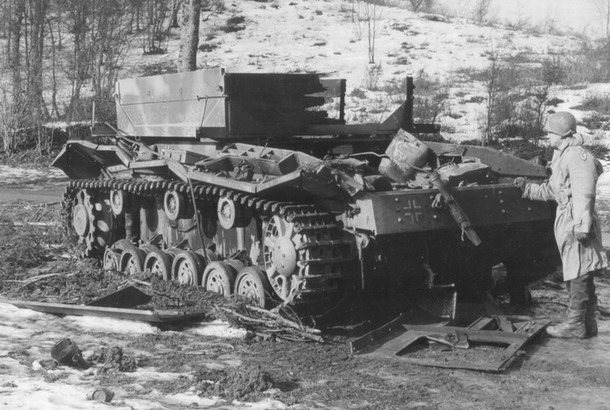
Bergepanzer III knocked out on the Western Front, source: Flickr.com, Public domain, edited
On the Bergepanzer III, the turret was removed and a wooden plank cargo bed built in its place. This carried various items of equipment — tools, a welding set, spare parts, fuel cans and so on. A small hatch into the crew compartment below apparently also existed. A simple block-and-tackle crane was fitted on the left side of the engine deck, capable of lifting loads of up to two tonnes. The Bergepanzer III had no winch and was therefore reliant solely on its own motive force for recovery. There was a plan to equip these vehicles with a large ground anchor that could dig into the earth, allowing the recovery tank to pull a stuck vehicle not directly but through a pulley attached to this anchor. This apparently did not progress beyond prototype testing, however.
Between March 1944 and March 1945, a total of 176 retired Panzer III combat tanks were converted in this way, representing a mix of variants from older types up to and including the last Ausf. M and N. Beyond these officially converted Bergepanzers, many similar conversions of unneeded tanks were also carried out directly in field workshops.
Brückenmaterialträger
A particular Panzer III conversion is also documented photographically, one that was produced in probably only five examples as an unofficial field conversion — apparently in mid-1943 in preparation for the Kursk operation. This was an adaptation for the needs of engineer units. The fighting turrets were removed from standard tanks (at least some of which were Ausf. N) and the hull roof was used to carry engineer bridging components and heavy wooden planks. These modified tanks appeared in army reports under the designation Brückenmaterialträger — literally "bridge material carrier." At least three of them are photographically documented in actual use, crossing wetlands in the Kursk region during Operation Zitadelle.
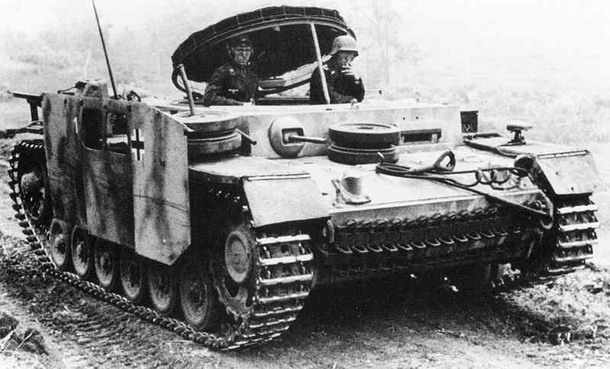
Munitionspanzer III, source: Flickr.com with permission of the publishing user, edited
Munitionspanzer III
Some of the retired Panzer III tanks also found a use as ammunition carriers for other combat vehicles. No complex conversion was involved. Worn-out combat tanks of various versions were simply stripped of their turrets and the interior of the crew compartment was used to carry as much ammunition as possible. The turret opening was covered by a large hatch made apparently from wire mesh and sheet metal. These ammunition carriers received the designation Munitionspanzer auf PzKpfw III Fahrgestell and served, for example, with schwere Panzer Abteilung 505, supplying Tiger heavy tanks with ammunition. Exactly how many Panzer IIIs were adapted for this purpose is not entirely clear from sources, but according to some estimates it was more than a hundred.
SU-76i
Perhaps the most curious conversion of the Panzer III was carried out not in German but in Soviet workshops. The Red Army captured a considerable number of these tanks during the fighting on the Eastern Front, in more or less battleworthy condition. Despite their overwhelming numerical superiority in armoured vehicles, the Soviets found the German tanks very useful and decided to put them to work. Some were pressed into service in their original form, but for a portion of them the Soviets decided to enhance their combat value with significantly more powerful armament, effectively rebuilding them into self-propelled guns.
The turrets were removed from these Panzer IIIs and a new boxy superstructure welded from flat armour plates was built in their place. The main armament became the S-1 gun in 76.2 mm calibre, a modified version of the F-34 tank gun used in the famous T-34 tanks. The original hull machine gun was removed. The new self-propelled gun received the designation SU-76i. The prototype was built by Factory No. 37 in Sverdlovsk, apparently in March 1943. Series production then began and continued until November of that year, producing a total of 181 standard vehicles and a further 20 in a command version. The command version differed from the standard SU-76i primarily in the installation of a more powerful radio set and the use of a commander's cupola.
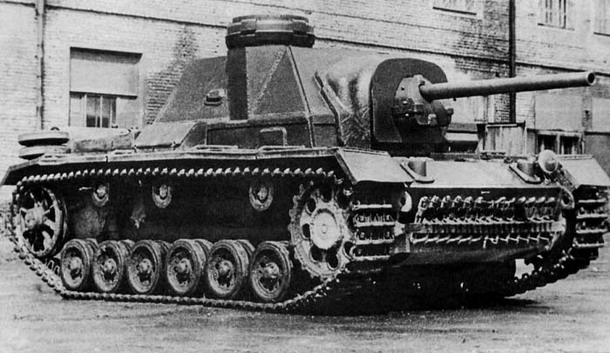
Panzer III converted by the Soviets into the SU-76i self-propelled gun, here the command version, Flickr.com with permission of the publishing user, edited
The commander's cupola was also taken from the German Panzer III and positioned on the right side of the superstructure roof, though its installation required modification of the superstructure's side wall. Production of the SU-76i was discontinued primarily for two reasons. First, the number of Panzer IIIs in the front line had fallen sharply by late 1943, making it increasingly difficult to obtain new captured hulls. By that time, the Soviets had also solved most of the design problems with their own SU-76 self-propelled guns, clearing the way for their mass production and deployment.
The SU-76i self-propelled guns saw action, for example, during the Battle of Kursk in the summer of 1943. In the autumn of that year a curious incident occurred when one of the Soviet self-propelled guns was captured by troops of the German 23rd Panzer Division. The Germans did not hesitate, marked the captured vehicle with their own insignia, and deployed it in combat against the Soviets through the winter of 1943 with the 128th Tank Destroyer Detachment.
Organisation
As stated in the introduction, the Panzer III was intended to operate alongside the heavier Panzer IV, and this was reflected in the structure of the Panzer divisions. According to the organisational model of September 1939, the core of a Panzer Division was one Panzer Brigade. This comprised two Panzer Regiments, each of which had two Panzer Abteilungen (battalions). A Panzer Abteilung consisted of four Panzer Kompanien (companies), three of which were designated as light (leichte Panzer Kompanie) and one as medium (mittlere Panzer Kompanie).
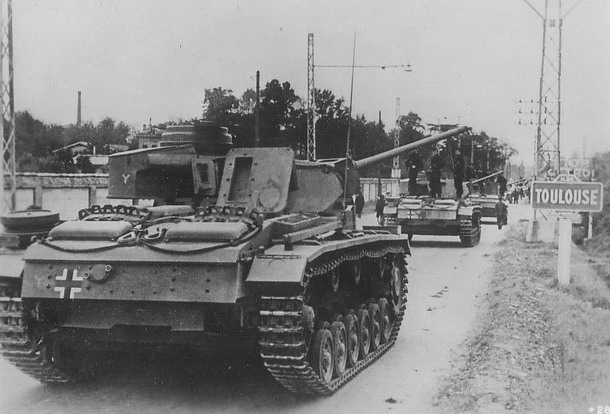
Panzerkampfwagen III tanks in France, source: Worldwarphotos.info with permission of the site owner, edited
According to the tables of organisation, each light company was to have four Panzer Züge (platoons) of five tanks each. To make things more complex, not all platoons were the same. The first was a so-called light platoon (leichte Zug) equipped with five Panzer II tanks. The remaining three platoons in the light company were equipped with Panzer IIIs. The light company headquarters also had two additional Panzer IIIs. The medium company was structured exactly like the light company, but instead of Panzer IIIs it had the heavier Panzer IVs (at four per platoon). Adding this up, a complete Panzer Abteilung at full strength totalled 55 Panzer III tanks (five each in nine platoons of three light companies, plus two each in the headquarters sections of the three light companies, plus one at battalion headquarters, plus three in the battalion reserve). Alongside these combat Panzer IIIs, two Panzerbefehlswagen III command tanks also served at battalion headquarters.
Since each regiment had two battalions, the regiment had 2 × 55 Panzer IIIs plus one more at regimental headquarters — 111 in total. The entire Panzer Division with its two regiments was therefore theoretically to have had 222 combat Panzer IIIs. This was wishful thinking with no connection to reality in September 1939. On the day the Second World War broke out, the German army had a total of 98 Panzer IIIs available. Of these, 87 were sent into the attack on Poland. Of these 87, some 78 were assigned to Panzer divisions (1st through 5th Panzer Division). That meant an average of fewer than 16 Panzer IIIs per division deployed in Poland — less than one tenth of the table strength! In Poland, the German Panzer divisions simply had to rely on light tanks of the Panzer I and Panzer II types.
During the war, the organisational structure of the Panzer divisions was revised several times. The first major change came in 1940, following the French campaign. Experience in Poland and France had shown that a two-regiment Panzer division was simply too large for effective command. Divisions were henceforth to have only one regiment, though its internal structure remained the same. The proportion of Panzer IIIs and Panzer IVs grew while the lighter Panzer I and Panzer II types diminished (bringing actual strengths closer to the theoretical tables). The 1940 reorganisation effectively halved the number of tanks per division, though on the other hand it allowed more divisions to be formed.
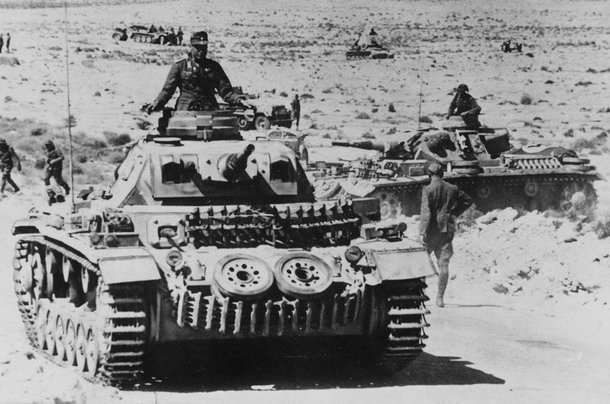
Panzerkampfwagen III tanks in North Africa, source: Flickr.com with permission of the publishing user, edited
The 1943 Panzer division organisational scheme no longer included the Panzer III as a combat tank (only as a command vehicle). By then it was clear that the main combat tanks of the German army would henceforth be the Panzer IV and the Panther (the Tigers are deliberately left aside here, as they fell outside the Panzer divisions). Reality lagged behind the charts once again, however, and Panzer IIIs remained in Panzer division inventories in considerable numbers even in 1943.
In 1942, Panzer IIIs also appeared in the organisational structure of heavy tank battalions (schwere Panzer Abteilungen) equipped with Tigers. There were not yet enough Tigers to go around, so the Germans began combining them with Panzer IIIs — primarily the Ausf. N variant. These vehicles were to provide cover for the Tigers, especially against enemy infantry. A schwere Panzer Abteilung formed according to the August 1942 scheme was to have 5 Panzer IIIs in its headquarters company (Stabkompanie), with each combat company having a further 10 of this type. As the number of available Tigers steadily grew, however, the 1943 heavy tank battalion scheme no longer included Panzer IIIs at all.
Combat Deployment
When the Second World War broke out in September 1939, the Panzer III was essentially a newborn. The Germans had only around 150 vehicles available — versions A, B, C, D and E (the Ausf. F was just entering production). The attack on Poland was its trial by fire. The Germans sent 87 into combat, plus an approximately unknown number of Panzerbefehlswagen III Ausf. D1 command vehicles. The Panzer IIIs thus represented just over 3% of all German tanks deployed in Poland. Losses of this type, tallied to 10 October 1939, amounted to 26 totally destroyed and 14 damaged — nearly a third of those deployed.
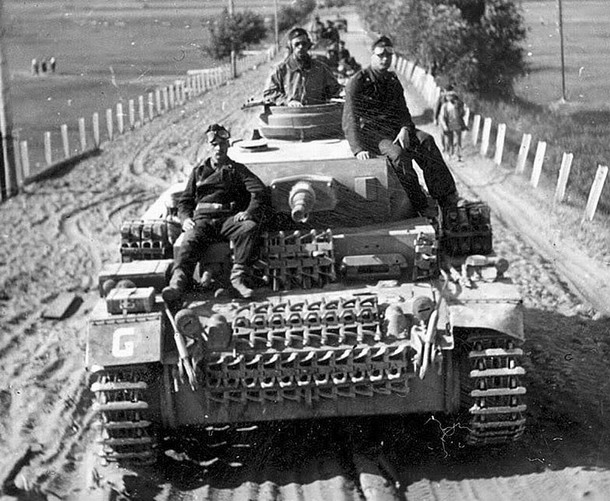
Panzerkampfwagen III on a Russian "road", source: Flickr.com with permission of the publishing user, edited
For the attack on France in May of the following year, the Germans deployed between 349 and 381 Panzer IIIs, including the latest Ausf. F and G variants, which however were still armed only with the 37 mm gun. In France, the Panzerwaffe had to contend not only with a more numerous enemy but also with qualitative superiority represented by tanks such as the Renault R35, Hotchkiss H35, Somua S35 and Char B1. The frontal armour of these vehicles was too hard a nut for the 37 mm German gun, and Panzer III crews had to work hard to hit a vulnerable spot — the gun, the turret ring, the tracks or wheels — or quickly manoeuvre around the enemy to engage the weaker side or rear armour. There is a documented case of a single French Char B1, whose crew refused to be deterred by superior numbers and engaged the tanks of the 10th Panzer Division, destroying 13 German Panzer IIIs and Panzer IVs before driving off the battlefield under its own power. The Germans' overall success in France owed less to the technical superiority of their tanks than to their advanced tactics — deploying armour in close cooperation with other arms. Total Panzer III losses in the western campaign reached 135 vehicles (more than a third of those committed), which underlines just how hard the fighting in France was.
In March 1941, when they entered the war in North Africa, the Germans already had significant numbers of Panzer IIIs with the more powerful 50 mm gun. Rommel initially brought 71 of them along as part of the newly formed 5th Light Division. A further 71 Panzer IIIs arrived on the African continent during April and May of the same year with the 15th Panzer Division. Even with the stronger guns, however, the Panzer III was no match for, say, the British Mk II Matilda.
In April 1941, Panzer IIIs took part in the parallel attacks on Greece and Yugoslavia. Combining both operations, the Germans deployed a total of 275 Panzer "threes" — 109 still with the original 37 mm gun and 166 with the more powerful 50 mm weapon. At the end of the campaign, frontline units counted a total of 21 destroyed Panzer IIIs, most of which fell victim to either mines or anti-tank artillery.
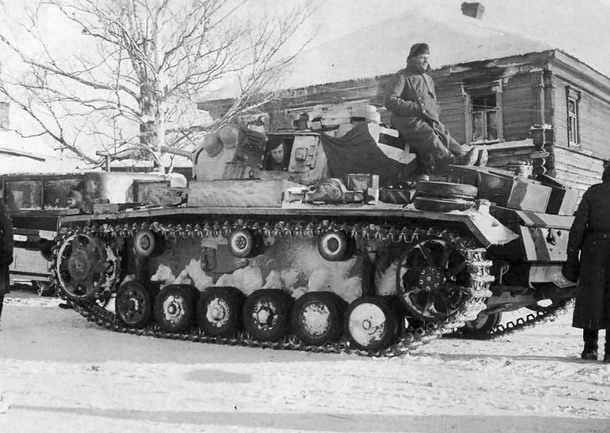
Panzerkampfwagen III fighting the Russian winter, source: Worldwarphotos.info with permission of the site owner, edited
On 22 June 1941, German forces invaded the Soviet Union. The enormous offensive force assembled for this operation included 966 Panzer IIIs — 259 still with the 37 mm gun and 707 with the more powerful 50 mm weapon. The Soviet army at that time had somewhere between 22,000 and 23,000 tanks. Of these, around 18,000 to 19,000 were battleworthy, with the remainder in various stages of repair. Of this number, "only" around 10,000 to 11,000 were deployed in the western military districts where they could actually engage the Germans. And of these, up to three quarters were light T-26 and BT tanks.
The Red Army lacked a developed doctrine for armoured operations and the combined arms cooperation that the Germans had mastered. Most Soviet tanks carried no radio, and their crews were by no means as well trained and battle-hardened as their German counterparts. The overall condition of the Red Army in June 1941 had a huge influence on how the opening months of Operation Barbarossa played out. Its officer corps had just been through severe political purges, the entire army was in a state of reorganisation amid widespread confusion, and all-powerful political commissars had their say in purely military matters. The entire military was governed by a rigid command system in which every junior commander was genuinely afraid to issue any order without confirmation from above. The Germans, in contrast, gave junior commanders in the field a great deal of autonomy in operational and tactical decision-making — what mattered was the result.
Panzer IIIs could handle the light Soviet T-26 and BT tanks without difficulty. The medium T-34 and the heavy KV-1 were a different matter entirely. A Panzer III with the 37 mm gun had virtually no chance against either. With the newer 50 mm gun with a barrel 42 calibres long, it could take on the T-34 at around 500 metres, but against the heavy KV-1 it had a chance only at under 100 metres and only using subcalibre tungsten-core ammunition. Fortunately for the Germans, the Soviets deployed their most valuable tanks in small numbers and without proper coordination with infantry or artillery, so the Germans mostly found a way to deal with them — though that too was beginning to change.
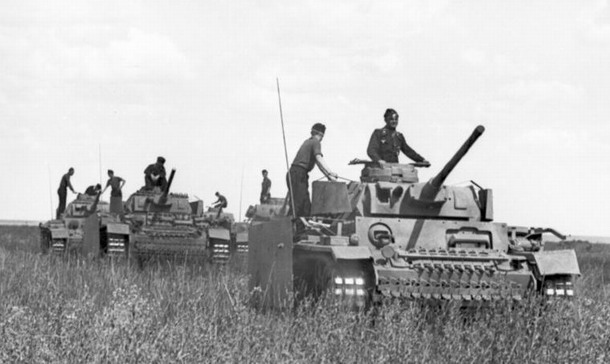
Panzerkampfwagen III tanks during Operation Zitadelle, source: Bundesarchiv_Bild_101I-219-0595-03, Wikimedia, Creative Commons, edited
From the start of Operation Barbarossa to the end of 1941, the Germans lost 776 Panzer IIIs on the Eastern Front. Over the same period, factories produced 1,158 new vehicles, so the German balance was still positive at this stage. The troops were nonetheless desperately calling for more firepower, which — as we know — came in early 1942 with the new long-barrelled 60-calibre gun. Even then, it was already clear that the development potential of the Panzer III was very limited and that the future would belong to the stronger Panzer IV and the newly developed Panther and Tiger. For the time being, however, the Wehrmacht could not do without the Panzer III, and so its production not only continued but actually increased.
When Army Group South launched its drive toward the Caucasus and Stalingrad in June 1942 as part of Operation Fall Blau, it had a total of 1,286 tanks available. Of these, 678 were Panzer IIIs — 303 with the L/42 gun and 375 with the longer L/60. The balance for 1942 was again positive for the Panzer III: 1,571 were lost in combat, but the factories delivered 2,605 new ones, so the total number of Panzer IIIs in Wehrmacht service actually grew during that year.
The defining event of 1943 on the Eastern Front was without doubt the Battle of Kursk, which began with the German offensive on 5 July. Figures for the total German armoured strength committed to this operation vary considerably by source, but it was probably around 2,800 vehicles. Of these, somewhere between 862 and 1,013 were Panzer IIIs (sources diverge considerably here). A clear figure for Panzer IIIs lost during Operation Zitadelle is also unavailable. For all of July 1943, however, the German army lost a total of 189 Panzer IIIs — suggesting that the Battle of Kursk accounted for an estimated 150 to 160 of them. Nor was the situation much better in the following months (average monthly Panzer III losses between August and December 1943 reached 102 tanks!).
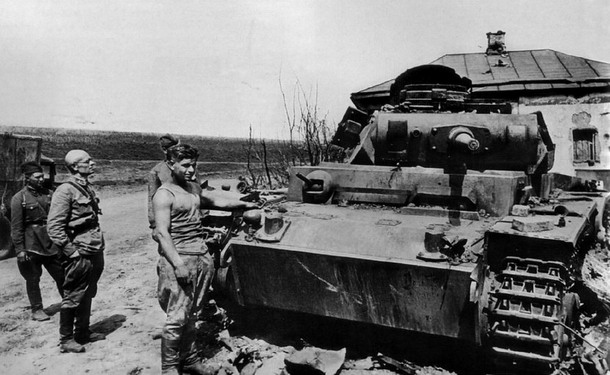
Soviet soldiers beside a knocked-out Panzerkampfwagen III, source: Flickr.com with permission of the publishing user, edited
In August 1943, as we know, production of the tank was halted and numbers began to decline from that point on. Their combat involvement also diminished, as they were simply no longer adequate against the newer opponents. The reduced commitment was reflected in combat losses, which for the entire year of 1944 reached only 220 destroyed tanks. The last available Panzer III strength figures come from a February 1945 report, citing 534 tanks — suggesting that around five hundred vehicles may have survived to the end of the war.
Technical Data
|
|
Ausf. A |
Ausf. B,C |
Ausf. D |
Ausf. E-G |
Ausf. H |
Ausf. J |
Ausf. L |
Ausf. M |
Ausf. N |
|
weight: |
15.4 t |
15.9 t |
19.8 t |
19.5 t |
21.5 t |
21.6 t |
22.5 t |
22.5 t |
23 t |
|
length: |
5.69 m |
6.00 m |
6.00 m |
5.38 m |
5.52 m |
5.56 m |
6.41 m |
6.41 |
5.65 m |
|
width: |
2.81 m |
2.81 m |
2.81 m |
2.91 m |
2.95 m |
2.95 m |
2.95 m |
2.97 |
2.97 m |
|
height: |
2.33 m |
2.45 m |
2.45 m |
2.43 m |
2.50 m |
2.50 m |
2.50 m |
2.50 |
2.50 m |
|
engine: |
HL 108 TR |
HL 108 TR |
HL 108 TR |
HL 120 TR/TRM |
HL 120 TRM |
HL 120 TRM |
HL 120 TRM |
HL 120 TRM |
HL 120 TRM |
|
engine power: |
250 hp |
250 hp |
250 hp |
300 hp |
300 hp |
300 hp |
300 hp |
300 hp |
300 hp |
|
max. speed: |
32 km/h |
35 km/h |
35 km/h |
40 km/h |
40 km/h |
40 km/h |
40 km/h |
40 km/h |
40 km/h |
|
road range: |
165 km |
165 km |
165 km |
165 km |
165 km |
145 km |
155 km |
155 km |
155 km |
|
cross-country range: |
95 km |
95 km |
95 km |
95 km |
95 km |
85 km |
95 km |
95 km |
95 km |
|
hull armour: |
|||||||||
|
- front: |
14.5 mm |
14.5 mm |
30 mm |
30 mm |
30 mm |
50 mm |
50+20 mm |
50+20 mm |
50+20 mm |
|
- sides: |
14.5 mm |
14.5 mm |
30 mm |
30 mm |
30 mm |
30 mm |
30 mm |
30 mm |
30 mm |
|
- rear: |
14.5 mm |
14.5 mm |
30 mm |
30 mm |
30 mm |
50 mm |
50 mm |
50 mm |
50 mm |
|
turret armour: |
|||||||||
|
- front: |
14.5 mm |
14.5 mm |
30 mm |
30 mm |
30 mm |
50 mm |
50+20 mm |
50+20 mm |
50 mm |
|
- sides: |
14.5 mm |
14.5 mm |
30 mm |
30 mm |
30 mm |
30 mm |
30 mm |
30 mm |
30 mm |
|
- rear: |
14.5 mm |
14.5 mm |
30 mm |
30 mm |
30 mm |
30 mm |
30 mm |
30 mm |
30 mm |
|
crew: |
5 men |
5 men |
5 men |
5 men |
5 men |
5 men |
5 men |
5 men |
5 men |
|
armament: |
KwK 36 L/45 gun, 37 mm 3 × MG 34, 7.92 mm |
KwK 36 L/45 gun, 37 mm 3 × MG 34, 7.92 mm |
KwK 36 L/45 gun, 37 mm 3 × MG 34, 7.92 mm |
KwK 36 L/45 gun, 37 mm 3 × MG 34, 7.92 mm |
KwK 38 L/42 gun, 50 mm 2 × MG 34, 7.92 mm |
KwK 38 L/42 gun, 50 mm 2 × MG 34, 7.92 mm |
KwK 39 L/60 gun, 50 mm 2 × MG 34, 7.92 mm |
KwK 39 L/60 gun, 50 mm 2 × MG 34, 7.92 mm |
KwK 37 L/24 gun, 75 mm 2 × MG 34, 7.92 mm |
Related Vehicles
|
Tank destroyers: |
Stug III (75 mm gun) |
|
Self-propelled guns: |
SIG 33 (15 cm sIG 33 infantry gun) SIG 33 (improvised conversion) StuH 42 (10.5 cm howitzer) |
|
Flame-thrower tanks: |
Flammpanzer III (on Ausf. M chassis) |
ARTICLE
CONTENTS:
Reproducing text from the Panzernet website without the written consent of the operator is prohibited.