STURMGESCHÜTZ III
legendary assault gun on the Panzer III chassis
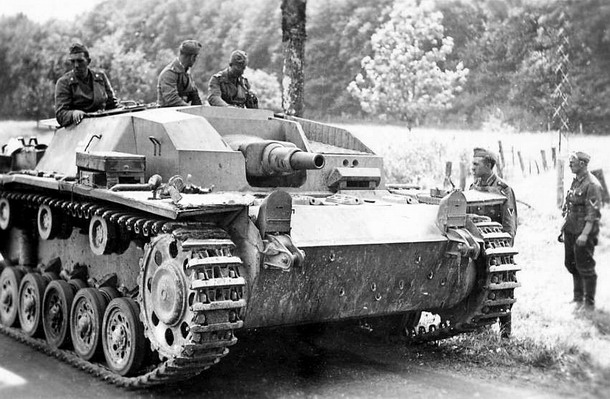
the Sturmgeschütz III assault gun, also known as the StuG III, here apparently the Ausf. A variant, source: Flickr.com with permission of the publishing user, edited
Origins of the Assault Gun
The German word Sturmgeschütz translates into English as "assault gun" and designates a specific category of fighting vehicle, to which the legendary Sturmgeschütz III belongs. To fully understand why assault guns emerged as a category of armoured vehicle at all, we need to take a brief look back at the First World War. The character of that conflict was shaped by one seemingly minor new element — the machine gun in combination with barbed wire entanglements. Simple and relatively cheap as these things were, a few rows of wire obstacles and a handful of well-protected machine gun nests were enough to drown the grand assaults of thousands of infantrymen in blood. Artillery support proved equally incapable of solving the problem. Conventional guns had to be positioned at a safe distance from the front line, which meant they were firing at long range and could not accurately engage point targets such as a machine gun nest. Moreover, the artillery was not in direct communication with the fighting infantry and therefore had no way of learning precisely where a burst of machine gun fire had suddenly erupted and concentrating on that spot immediately. It is no wonder that the war quickly became one of fixed positions, with neither side able to achieve any significant breakthrough.
The Germans themselves responded to this situation by introducing so-called Infanterie Begleitbatterien — literally "infantry escort batteries". These units used lighter guns that could be moved more quickly and kept close to the advancing infantry at all times. It was not a perfect solution, but it was better than nothing. By 1918, however, the war was over before this concept could be developed further. Germany was defeated, and its army and arms industry were effectively barred from progress by the Treaty of Versailles.
Some fifteen years passed, Adolf Hitler came to power, and the German Army began to raise its long-bowed head once more. When something is being built from scratch, there is room for new ideas, and it was in this climate that a modern, independent armoured force — the Panzerwaffe — was established within the German Army. Tanks may have become something of a symbol of Germany's military revival, but even the new Wehrmacht could not do without the "queen of the battlefield", the infantry. And so, after years of stagnation, the question of how to protect infantry on a battlefield full of wire and machine gun nests had to be answered all over again.

one of the five StuG III prototypes, built on a Panzer III Ausf. B chassis, source: worldwarphotos.info with permission of the site operator, edited
The concept of modern artillery support for infantry was set out as early as 1935 by the then-Colonel Erich von Manstein. In his memorandum to the Chief of the General Staff, Manstein described a self-propelled armoured vehicle that would move across the battlefield immediately behind the advancing infantry and deliver rapid, accurate fire against specific targets as soon as they were identified. For these fighting vehicles, Manstein used the term Sturmartillerie — assault artillery. The idea attracted attention, and von Manstein was asked to develop his proposal further.
The idea was certainly compelling, but where was the right vehicle to be found? Other nations — the British, for example — were building specialised infantry tanks designed precisely for supporting foot soldiers. The leadership of the German Panzertruppen, however, would not hear of it. Their concept for the deployment of tanks was simple and clear: the backbone of the panzer divisions was to consist of just two types — the lighter Panzer III for destroying enemy armour, and the heavier Panzer IV for engaging softer targets. There was no room for any additional type. Developing a tank specifically for the infantry was, in the view of the Panzertruppen leadership, a step backwards. The Panzer IV with its 75 mm gun could theoretically have been used for infantry support, but the tank commanders would not discuss that either. In 1935 the Panzer IV was still in development, and even then it was obvious that sufficient numbers would not be available in the near future even for the Panzerwaffe itself, let alone to be shared with the infantry. It was therefore clear that an entirely new type of fighting vehicle would have to be developed for infantry support — not another tank, but a self-propelled gun designed from the outset for a specific purpose. And since this gun was to support infantry attacks, it was given the designation assault — Sturmgeschütz.
The task of drawing up the requirements for the new vehicle was entrusted to Captain Hans Röttiger of the technical department of the General Staff. The specification was completed in June 1936 and subsequently passed to the ordnance office for implementation. Unlike conventional tanks, the new vehicle was to have no rotating turret. The gun was to be housed in an armoured fighting compartment mounted directly on the hull. Early thinking even suggested this compartment might have an open roof. The reasoning was straightforward enough. The assault gun was to destroy targets identified by the infantry — in other words, it would fire on known positions (imagine a machine gun nest: the moment it opens fire, everyone in the vicinity knows exactly where it is). If the target's position is known, you can simply point the whole vehicle at it and have no need of a rotating turret that allows you to rapidly engage targets appearing unexpectedly from all directions. In short, the Sturmgeschütz was always expected to fire only forwards. Its gun could therefore be fixed in a rigid superstructure and required only limited lateral traverse. A vehicle without a rotating turret could also be considerably lower than a tank — a definite advantage — and was significantly cheaper to produce. The open roof was proposed to ease the work of aiming.
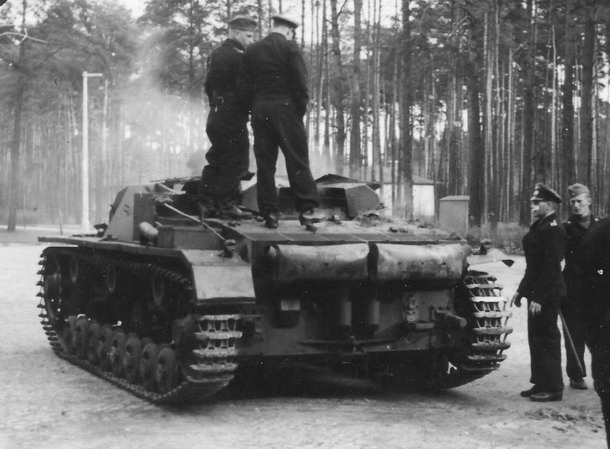
one of the five StuG III prototypes, built on a Panzer III Ausf. B chassis, source: worldwarphotos.info with permission of the site operator, edited
The requirements called for armament with a gun of at least 75 mm calibre, capable of traversing at least 30 degrees to each side. The gun's maximum range was not to be less than 6,000 metres. Although the assault gun's primary role was to destroy soft targets, its gun was also required to penetrate the armour of most enemy tanks (which at the time meant a maximum of around 40 mm) at a range of 500 metres. The vehicle's frontal armour had to withstand 20 mm armour-piercing fire, while the sides and rear needed only to resist armour-piercing rounds from infantry rifles of 7.92 mm calibre. The overall height of the vehicle was not to exceed the average height of a standing man.
The infantry representatives took care to explain to the Army's senior leadership that an assault gun was not a tank, and a tank was not an assault gun. The differences between the two types of fighting vehicle were very clearly set out in a memorandum sent by the infantry command to the General Staff in August 1936. Tank units combined multiple arms so as to form formations capable of conducting autonomous combat operations on a fairly large scale. Tanks were breakthrough weapons, leading the attack and pulling behind them supporting elements such as self-propelled artillery, mechanised infantry, and anti-tank defence. Tanks operated typically in large numbers, using concentrated attacks to break through the enemy line. Assault artillery, by contrast, was a complement to the infantry. It did not fight independently or conduct breakthroughs, but pushed infantry attacks forward. It did not need to be committed in large numbers — even a single platoon, or even a single vehicle, could have a significant effect on the course of an assault.
It was thus clear to everyone involved that the infantry command was not asking for another tank. At the same time, developing a completely new tracked armoured vehicle from scratch would have required a great deal of time and money. The compromise solution was that a new vehicle would indeed be built — one that was not a tank — but that it would be based on the chassis of the existing Panzer III. Daimler-Benz was at the time working on the second generation of that tank, known by the internal designation 2/Z.W. (better known as the Ausf. B). The ordnance office therefore ordered that of the total of 15 Panzer III Ausf. B tanks on order, five chassis were to be delivered without superstructures or turrets and used as the basis for building prototypes of the new assault gun. Daimler-Benz was simultaneously tasked with designing and building a fighting superstructure, armoured on all sides except the roof. The development of a suitable gun was entrusted to Krupp.
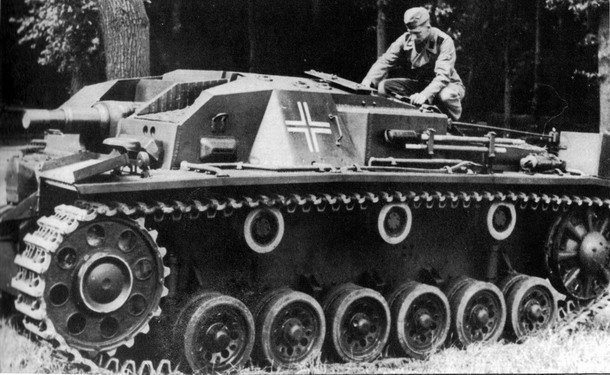
StuG III Ausf. A — note all the features of this variant: the drive sprocket with circular cut-outs, the evenly spaced return rollers, and the material box on the rear mudguard, source: Flickr.com with permission of the publishing user, edited
The First Prototypes
The five evaluation prototypes were completed at some point during 1938 and subsequently handed over to the 10th Artillery Training Regiment (Artillerie-Lehr Regiment) at Jüterbog. The superstructures of these vehicles were fabricated from soft, non-armoured steel, and no actual combat deployment was intended for them. These machines were to serve only for testing, crew training, and evaluating the proposed tactical doctrine. According to some sources, the superstructures of the first five prototypes had open roofs, exactly as called for in the 1936 specification, with the roof plates being added retrospectively in 1939. However, no surviving photograph of the early StuGs shows a vehicle with an open superstructure. If the prototypes were indeed originally built without roofs, the decision to add them — and the work itself — must have been carried out before handover to the 10th Artillery Training Regiment. It is also possible that the vehicles were not delivered in 1938 but in 1939, as some authors suggest.
As noted above, the prototypes were built on Panzer III Ausf. B chassis. The running gear on each side comprised eight road wheels of 40 cm diameter. The wheels were doubled (so that the track's guide teeth could pass through the gap between them) and fitted with rubber cushioning tyres for a smoother ride. The wheels were paired and mounted together on a swing arm; the swing arms were sprung by leaf springs, two arms to one spring — one at each end. Eight wheels thus corresponded to four swing arms and two leaf springs. At the front was the drive sprocket, at the rear the idler wheel, and the upper run of the track was supported by three return rollers. The tracks were 360 mm wide.
In the front plate of the hull, two circular holes were cut for service access to the steering clutches and brakes, each covered by a bolted lid mounted on hinges. The tank chassis was adopted together with a substantial portion of its original hull armour and internal components — most notably the engine and gearbox. The engine was located at the rear of the hull and was a Maybach HL 108 TR twelve-cylinder petrol unit with a displacement of 10.8 litres. Various figures are cited for its output, but 250 horsepower at 2,800 rpm is the most commonly quoted maximum. The Aphon SFG 75 gearbox was located in the front of the hull and connected to the engine by a driveshaft. It had five forward gears and one reverse. The weight of the prototypes was apparently around 16 tonnes.
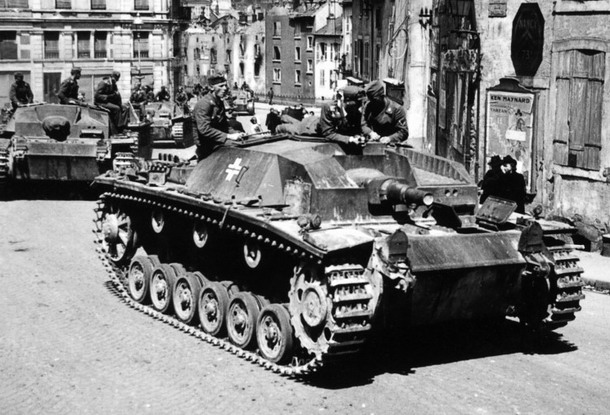
StuG III, probably Ausf. A (judging by the even spacing of the return rollers), source: Flickr.com with permission of the publishing user, edited
In the centre of the vehicle sat the fixed, non-rotating fighting superstructure. On the left side of its front plate was the driver's vision port. On the same side, slightly higher and further back, the front armour had an opening for the main weapon's sight. The gun itself was the 7.5 cm StuK L/24, whose design was derived from the tank gun 7.5 cm KwK 37 L/24 (as used on early versions of the Panzer IV). The five prototypes, given their use of non-armoured steel, were never deployed in actual combat. These vehicles served only as development, training, and instructional tools — probably well into 1941.
Ausführung A
Encouraged by the favourable impression made by the prototypes, the ordnance office placed an order with Daimler-Benz for a production series of 30 assault guns with full combat armour. Production was to begin in December 1939 and the vehicles were to be ready by 1 April 1940, assigned chassis numbers 90001 to 90030. The series-production assault guns were to be based on the latest version of the Panzer III chassis — the Ausf. E, also known as 5/Z.W. or sometimes Z.W.38. Production got off to a slight delay from the outset, with the first complete vehicle not leaving the Berlin factory until January 1940 — apparently because of late delivery of the first guns from Krupp. The last of the 30 ordered vehicles was completed in May 1940. During production, on 28 March 1940, the new vehicle was given its official designation: Sturmgeschütz III (literally "assault gun III"), or StuG III for short. Its ordnance code was Sd.Kfz. 142 (Sd.Kfz. = Sonderkraftfahrzeug = special-purpose vehicle). The vehicles from the first production batch were designated, in keeping with standard German practice, Ausführung A, abbreviated Ausf. A (Ausführung = version or variant).
As already noted, the StuG III Ausf. A was built on a more modern chassis than the first prototypes. Each side now had six road wheels sprung by torsion bars. The road wheels were 520 mm in diameter and fitted with rubber tyres for a smoother ride. The wheels were doubled, with the track guide teeth passing through the gap between them. The first and last road wheels had additional shock absorbers (as these experienced the greatest stress during travel). At the front was a toothed drive sprocket with circular lightening holes, and at the rear an idler wheel. The upper run of the track was supported by three return rollers of 310 mm diameter. The tracks were 360 mm wide.
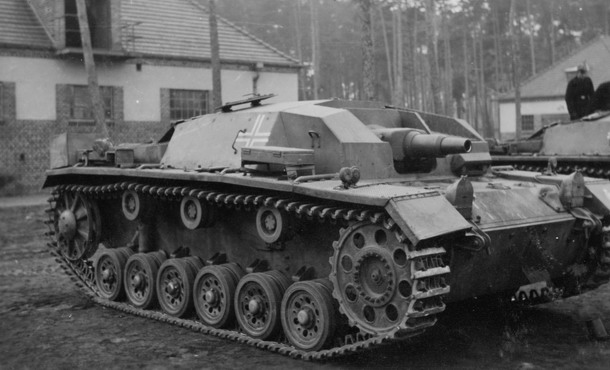
the last 20 examples of the StuG III Ausf. A were built on standard tank chassis and therefore retained features such as the hull side escape hatches and the steering brake ventilation covers — here is one of these unique machines, source: Flickr.com with permission of the publishing user, edited
Along with the newer tank chassis came the more powerful Maybach HL 120 TR engine, with a displacement of 11.9 litres and a maximum output of 300 horsepower at 3,000 rpm. Also new was the semi-automatic Maybach Variorex SRG 328145 gearbox, with ten forward speeds and one reverse. While the original Panzer III Ausf. E from which the chassis was derived had a front hull plate only 30 mm thick, the StuG III received 50 mm frontal armour. The emergency escape hatches cut into the sides of the original Panzer III hull were not incorporated into the StuG III.
The armoured superstructure mounted on the hull was very similar in design to the first prototypes. Rising from the flat roof plate of the hull was the front wall of the fighting compartment. On its left side was the driver's vision port, fitted with a heavy armoured flap (the Fahrersehklappe 50). In relatively safe areas, the driver left the flap open and looked through the port, which was filled with bullet-resistant glass. In combat areas, the driver could close the flap and instead use a binocular periscope (KFF — Kraftfahrfernrohre), for which two small holes were drilled in the front plate just above the main vision flap. Above the driver's station was a lowered section of the roof, which stepped upward and narrowed as it extended rearward, ending in the opening for the gun's sight.
The 7.5 cm StuK L/24 Gun
The gun itself was positioned to the right of the driver's station. It was not mounted on the vehicle's longitudinal centreline but slightly to the right of centre. The same gun as on the prototypes was used for the StuG III Ausf. A — the 7.5 cm StuK L/24, with a barrel 176.65 cm long (approximately 24 calibres). Its mount allowed 12 degrees of traverse in each direction, and elevation could be adjusted from -10° to +20°. The gun weighed around 490 kg and had a maximum range of approximately 6 kilometres.
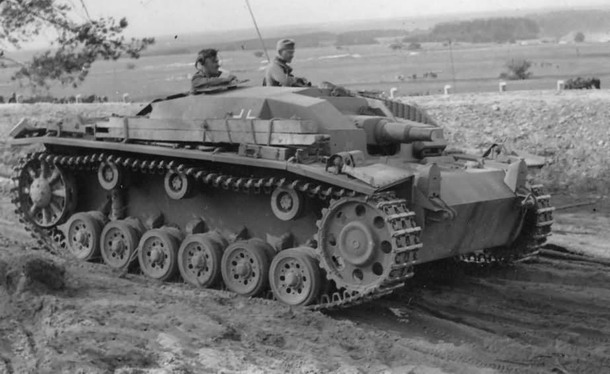
StuG III Ausf. B — the vehicle still has the original drive sprocket design, but the first return roller has already been moved forward, source: worldwarphotos.info with permission of the site operator, edited
Several types of ammunition were available for the gun. First among them was the high-explosive fragmentation shell Gr.34, intended for use against infantry and soft targets, with a muzzle velocity of 420 m/s. Next was the armour-piercing round K.Gr.rot Pz, with a projectile weight of 6.8 kg and a muzzle velocity of 385 m/s; at 500 metres this round could penetrate angled homogeneous armour up to 39 mm thick. Three types of shaped-charge anti-tank ammunition were also available: Gr.38 Hl/A, Gr.38 Hl/B, and Gr.38 Hl/C (Hl = Hohlladung = hollow charge). These rounds left the barrel at around 450 m/s. The Gr.38 Hl/A, weighing 4.4 kg, penetrated 70 mm of angled armour; the Gr.38 Hl/B weighed 4.75 kg and could defeat 75 mm; and the most powerful, the Gr.38 Hl/C, weighed 4.8 kg and could handle up to 90 mm. Crucially, the penetration of shaped-charge ammunition did not diminish with range, since this type of ammunition relies not on kinetic energy but on the Monroe effect. The vehicle's onboard ammunition supply comprised 44 rounds.
The gun was served by a Rundblickfernrohr 32 (Rbl.F. 32) panoramic sight, which looked out through an opening in the upper left section of the front armour. Unlike conventional tanks, the StuG had no built-in machine gun for engaging enemy infantry. The StuG III was intended to operate in direct cooperation with friendly infantry, who were expected to provide protection against approaching enemy foot soldiers — making a machine gun unnecessary. The crew did, however, carry two MP 38 submachine guns, each with 192 rounds.
The side walls of the superstructure were partly vertical and partly angled. The left side wall featured a box-like protrusion at the rear, inside which was a compartment housing the radio receiver, operated by the vehicle commander. The StuG III Ausf. A was equipped only with a radio receiver — the Ukw. E. h (Ultrakurzwellen Empfänger h), also known as the Fu 15. Being a receiver only, with no transmitter, the crew could only receive orders from the battery commander, who rode in an armoured half-track Sd.Kfz. 253. A loudspeaker may have been connected to the set so that incoming transmissions could be heard by all crew members. The first generation of StuGs had no internal intercom, so the crew had to communicate directly by shouting (though a voice tube between the commander and driver may have been fitted).
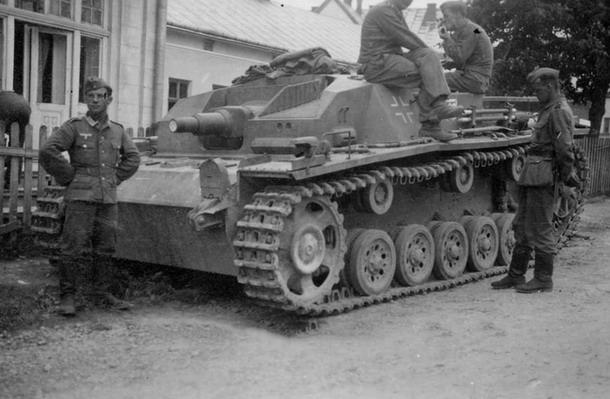
this StuG III Ausf. B has already received the new-pattern drive sprocket, source: worldwarphotos.info with permission of the site operator, edited
The StuG III's crew consisted of four men. The driver sat in the left front of the hull. Behind and slightly above him was the gunner's station; his seat was connected to the gun mount and moved with the gun during aiming. Behind the gunner sat the vehicle commander, who also operated the radio. His seat was height-adjustable, so the commander could sit high enough for his head to protrude through the open roof hatch. To the right of the gun sat the loader, whose seat was mounted perpendicular to the direction of travel — he sat facing directly at the gun, with his back to the right side wall.
The superstructure roof had four openings. At the rear were two large crew hatches for entry and exit. In the left forward section was a smaller opening for the gunner, though it appears to have been too small for use as a hatch. Further forward still was a tiny opening through which the gun sight could be extended if needed. For normal entry and exit, all crew members apparently used the two main hatches at the rear of the roof. The driver, farthest from these hatches, could in an emergency exit through an opening in the hull roof plate just in front of his vision port, which normally served as a service access for the steering brakes.
At the rear of the hull was the engine compartment, housing the already-mentioned Maybach HL 120 TR twelve-cylinder petrol engine. Air intakes for the powerplant were located on the sides of the engine compartment, with the heated air expelled through an opening in the rear of the hull. The engine compartment roof had openings for service access to the engine and cooling system. Five smoke candles were mounted on the rear hull wall and could be ignited from inside the fighting compartment. The vehicle carried 310 litres of fuel, sufficient for approximately 160 km on roads and around 100 km cross-country. The StuG III Ausf. A weighed 19.6 tonnes (sometimes quoted as 20.7 tonnes) and had a maximum speed of 30 km/h.
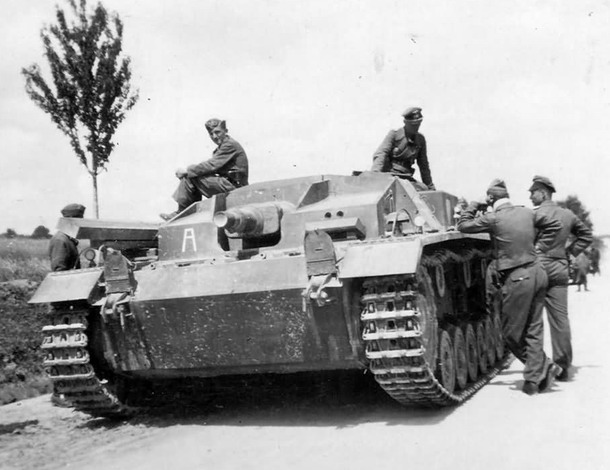
StuG III Ausf. C or D — the ribbing above the driver's vision port and the sight opening are already absent, source: Flickr.com with permission of the publishing user, edited
Production of the Ausf. A officially ended in May 1940 after 30 vehicles had been completed. Between June and September 1940, however, a further 20 StuGs were built which were also designated Ausf. A but differed from the first batch in several respects. For reasons that remain unclear, these vehicles were based on Panzer III Ausf. G (i.e., 6/Z.W.) chassis, and these chassis were adopted without the usual modifications — just as they were. As a result, these 20 StuGs retained, for example, the emergency hatches in the hull sides above the road wheels (standard on the original Panzer III tanks but removed on all other StuG variants). The front hull armour also remained at the same thickness as on the original tank — a mere 30 mm — rather than the 50 mm fitted to the first-batch Ausf. A vehicles. Since 30 mm was insufficient, these 20 hybrid vehicles had additional 20 mm armour plates bolted to the hull front. Another feature carried over from the unmodified tank chassis was the steering brake ventilation covers in the upper front hull plate. The newer chassis also brought a newer engine variant, the Maybach HL 120 TRM, again rated at 300 horsepower. One of these 30 vehicles built on standard tank chassis can be seen in the photograph HERE (source: worldwarphotos.info).
Ausführung B
In June (or July, according to some sources) 1940, production of the new StuG III variant, designated Ausf. B, began. The Army ordered 250 outright, and subsequently expanded the order by a further 50 vehicles. The transition to the Ausf. B also brought a change of primary manufacturer. Instead of Daimler-Benz, the new assault guns were to be supplied by Alkett (Altmärkische Kettenwerk) from the Borsigwalde district of Berlin. The reason was that Daimler-Benz was heavily overloaded — producing Panzer III battle tanks, half-track prime movers, and other equipment — and could devote only a fraction of its capacity to StuG production, which was nowhere near sufficient for the intended output.
The StuG III Ausf. B was built on the Panzer III Ausf. H chassis (i.e., 7/Z.W.). With the new chassis came the Maybach HL 120 TRM engine developing 300 horsepower, along with a new gearbox. The previous Variorex gearbox had unfortunately suffered from numerous shortcomings and was replaced by a more reliable six-speed manual Zahnradfabrik SSG 77 unit. The new chassis also brought wider 380 mm tracks and correspondingly wider road wheels. The size and design of the opening in the roof for extending the periscopic sight were also changed.
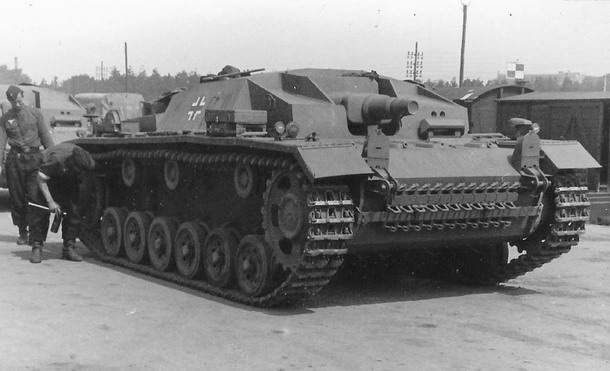
StuG III Ausf. C or D — the ribbing above the driver's vision port and the sight opening are already absent, source: Flickr.com with permission of the publishing user, edited
The combat weight of the Ausf. B rose to a full 22 tonnes. Thanks to the new engine and gearbox, however, the vehicle's maximum speed increased to 40 km/h. Further minor design changes were introduced during the course of Ausf. B production. The drive sprockets were redesigned and the front return roller was moved further forward. The storage boxes that had been fitted to the rear of the track mudguards on the Ausf. A were eliminated during Ausf. B production. Production of the StuG III Ausf. B ran through to March 1941.
Ausführung C
In April 1941, the third production variant of the assault gun entered production under the designation StuG III Ausf. C. Only 50 vehicles were ordered, assigned chassis numbers 90551 to 90600. On this version, the designers focused among other things on the sight opening in the front wall of the fighting compartment, which had been considered the weakest point in the frontal armour — something of an Achilles' heel. The StuG III Ausf. C therefore received a new sight of the type Selbstfahrlafette Zielfernrohr 1 (Sfl.Z.F.1), which extended through an opening in the roof and no longer required a cut-out in the front armour plate. The roof of the superstructure at the point where the sight was extended had naturally to be modified accordingly. The lowered section of the roof above the driver's station was also redesigned: instead of the stepped, narrowing profile of previous versions, it now closely matched the profile on the opposite side of the gun. New star-pattern idler wheels were also fitted. Armour thickness, powerplant, armament, overall weight, speed, crew composition, fuel capacity — none of these changed compared to the previous version.
Ausführung D
The very next month — May 1941 — saw the introduction of another variant, the StuG III Ausf. D. One hundred and fifty vehicles were ordered, with chassis numbers running from 90601 to 90750. The changes from the previous Ausf. C were few, and the two versions are virtually indistinguishable in photographs. A few novelties were nonetheless introduced. According to some authors, the Ausf. D was the first StuG variant to be fitted with an internal crew intercom. Others suggest it received only an electric buzzer mounted on the right wall beside the driver, by which the commander could signal to him. The Ausf. D was also apparently the first StuG variant on which modifications for hot-climate operation were carried out — specifically, strengthening the engine cooling fans and creating additional ventilation openings in the engine compartment roof, covered by distinctive raised armoured covers. All basic parameters remained unchanged from the previous version: weight 22 tonnes, maximum speed 40 km/h, Maybach HL 120 TRM engine, and SSG 77 gearbox.
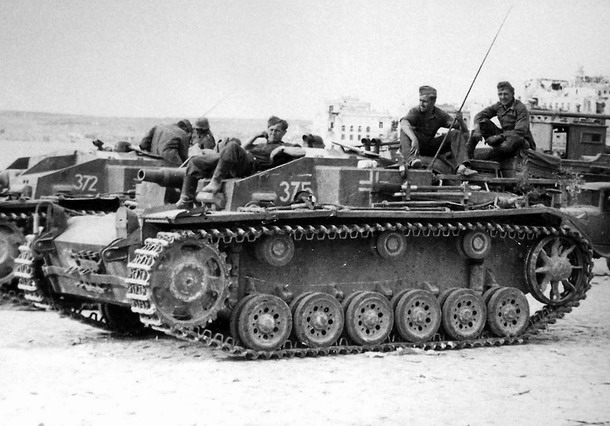
the StuG III Ausf. E had a new design for the superstructure side walls, with rectangular box-like protrusions, source: Flickr.com with permission of the publishing user, edited
Ausführung E
The fifth variant of the StuG, designated E, entered production in September 1941. A total of 284 vehicles were ordered and built, with chassis numbers from 90751 to 91034. The main design changes were to the side walls of the fighting superstructure. The rectangular box-like protrusion on the left side, which created internal space for the radio set, was extended, and an identical protrusion was added entirely new on the right side as well. The reason was simple: assault gun battery commanders had until then been using armoured half-track vehicles Sd.Kfz. 253 at the front. The Army now wanted to equip them with their own StuGs, which were safer than the lightly armoured half-tracks and also had their own gun. A commander's StuG allowed commanders to keep pace far more effectively with the batteries they led. A command vehicle, however, needed additional internal space for extra radio equipment — hence the new protrusions on the sides, enlarging the interior of the Ausf. E's fighting compartment.
Vehicles designated as command vehicles were fitted with radio stations Fu 15 (receiver) and Fu 16 (receiver and transmitter). The Fu 15 was housed in the left-side space and operated by the commander; the Fu 16 was in the right-side space and was the loader's responsibility. On vehicles not designated as command vehicles, the additional internal space was used to stow six extra rounds of gun ammunition. Standard StuGs thus retained only a radio receiver and could not transmit. Command StuGs can be identified in photographs by their two rod antennas (for example HERE, or HERE, source: Flickr.com with permission of the publishing user). The antennas could be folded rearward into wooden protective channels along the sides of the engine compartment. Ausf. E vehicles were certainly also fitted with an intercom for internal crew communication (headsets and throat microphones). In terms of basic parameters, the StuG III Ausf. E was virtually identical to the preceding three variants (Ausf. B, C, and D) — weighing 22 tonnes, powered by the Maybach HL 120 TRM engine developing 300 horsepower, with a four-man crew and the StuK L/24 gun.
The StuG III Ausf. E also received a number of further updates introduced during the course of production. From December 1941, brackets were added to the front hull plate for carrying a spare section of track (11 links in length). At the same time, spare road wheels began to appear, mounted one per side on the rear mudguards of the tracks. Incidentally, both of these additions were simultaneously retrofitted to all older StuGs of variants A through D.
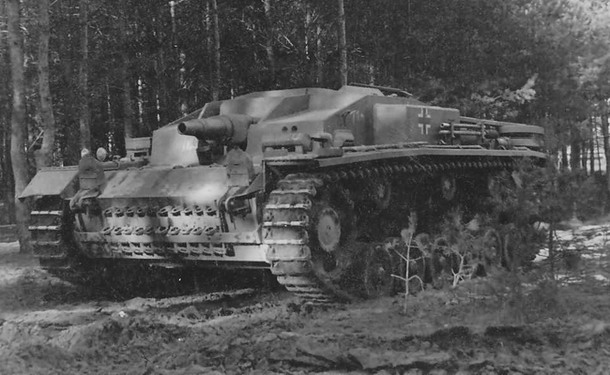
StuG III Ausf. E, source: worldwarphotos.info with permission of the site operator, edited
Following the invasion of the Soviet Union, StuGs found themselves engaging enemy tanks with increasing frequency, and it soon became apparent that the short-barrelled StuK L/24, with its low muzzle velocity, left much to be desired in this role. In September 1941, Hitler ordered the urgent improvement of armour protection on all newly produced StuGs and their rearming with more capable long-barrelled guns better able to deal with Soviet armoured vehicles. The increase in weight and the associated deterioration in mobility were to be accepted as the price of greater firepower and protection.
The 7.5 cm StuK 40 Gun
The development of a new gun for future StuGs was entrusted to Rheinmetall-Borsig. The new weapon was designated the 7.5 cm Sturmkanone 40 L/43 (abbreviated StuK 40 L/43). As the designation indicates, the calibre remained 75 mm, but the barrel length grew to 43 calibres. The 7.5 cm StuK 40 L/43 was derived from the tank gun 7.5 cm KwK 40 L/43 used on the Panzer IV Ausf. F2 and Ausf. G. The weapon featured automatic ejection of spent cartridge cases: just before the end of the gun's recoil after firing, the breech opened automatically, the empty case was expelled by its own momentum, and fell into a fabric bag beneath the gun.
Ausführung F
The first examples of the new gun were completed in January 1942. In March, the first three complete StuGs fitted with these weapons were built, and full series production got underway in April. The Sturmgeschütz III with the new long gun was designated Ausf. F. The vehicle was essentially the previous Ausf. E rearmed. Apart from the gun itself, several additional modifications were made, all of them related to the installation of the new weapon. The gun opening in the front wall of the fighting compartment was widened. A raised ventilator housing appeared at the rear of the roof to draw propellant fumes from the compartment after firing the more powerful gun. New ammunition stowage racks were of course also needed to accommodate the considerably longer ammunition.

StuG III Ausf. F — the first variant with the long gun, source: Flickr.com with permission of the publishing user, edited
With its new gun, the Sturmgeschütz III Ausf. F could take on even heavily armoured enemy tanks without hesitation. The armour-piercing round Pzgr. 39, weighing 6.8 kg, left the barrel of the StuK 40 L/43 at 740 m/s — almost double the muzzle velocity of the older short-barrelled gun. At 500 metres, this round could penetrate 91 mm of angled homogeneous armour. At one kilometre, it could still pierce an impressive 82 mm.
The mount provided 10 degrees of horizontal traverse in each direction. The vertical range was -6° to +20°. The gun was served by a Sfl.Z.F.1a sight, whose periscope extended through an opening in the superstructure roof. The weight of the StuG grew from 22 tonnes on the Ausf. E to 23.2 tonnes on the Ausf. F. Some of the new StuK 40 L/43 guns were fitted with a spherical single-chamber muzzle brake. The standard fitting, however, was a two-chamber brake of the type also common on other German guns.
The re-arming with the long gun was such a significant change that the vehicle's ordnance code was also revised. Whereas all earlier StuGs with the short gun (Ausf. A through E) had shared the code Sd.Kfz. 142, vehicles with the long gun (from Ausf. F onwards) were assigned the code Sd.Kfz. 142/1. StuGs with long guns are also sometimes collectively referred to as Sturmgeschütz 40, after the name of their armament — the Sturmkanone 40.
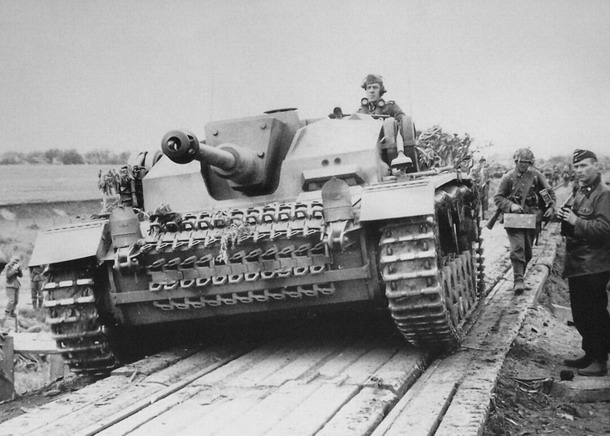
StuG III Ausf. F, source: waralbum.ru with permission of the site operator, edited
Production of the StuG III Ausf. F ran from March 1942 (when the first three evaluation vehicles were built) to September 1942, with a total of 366 examples completed, carrying chassis numbers 91035 to 91400. However, only the first 120 Ausf. F vehicles were armed with the StuK 40 L/43 gun mentioned above. From June 1942, an even more powerful gun was introduced — the StuK 40 L/48, with a barrel extended to 48 calibres. This weapon too was derived from a tank gun, the 7.5 cm KwK 40 L/48, as fitted to the Panzer IV Ausf. H and Ausf. J. With this gun, the StuG III became a true tank killer. Using the Pzgr. 39 armour-piercing round at a muzzle velocity of 750 m/s, it could penetrate 96 mm of angled homogeneous armour at 500 metres. The Pzgr. 40 round with a tungsten core could at the same distance penetrate armour up to 120 mm thick.
As usual, various minor and more substantial modifications were introduced during the production run of the Ausf. F. From May 1942, the smoke candle holders on the rear hull were discontinued. In addition to the more powerful gun, Hitler also demanded that the StuG's frontal armour be increased from 50 to 80 mm. From June 1942, new vehicles were therefore fitted with additional frontal armour — 30 mm plates welded to the front of both the hull and the fighting superstructure. These plates had to be cut away to avoid covering the two small periscope openings in the driver's front plate just above the main vision flap.
In August 1942, the armour of the upper front section of the superstructure was modified. The angled section of the roof above the front wall was given a new slope that blended more smoothly into the superstructure roof, eliminating a face that enemy projectiles could strike at nearly 90 degrees (as was the case on earlier StuGs). To achieve a similar effect on older vehicles, their crews sometimes had this section of armour filled with a layer of concrete at field workshops. Changes were also made during production to the ammunition stowage layout, increasing the onboard gun ammunition supply to 54 rounds. Hitler was evidently satisfied with the new Sturmgeschütz and ordered production to be gradually increased at the expense of Panzer III tank output. The target production rate for the StuG III was set at 100 vehicles per month, to be reached by December 1942.

the StuG III Ausf. F/8 can be distinguished from the previous variant, for example, by the design of the tow rope attachment rings, source: Flickr.com with permission of the publishing user, edited
Ausführung F/8
In September 1942, the StuG III Ausf. F/8 entered production. This variant received its somewhat unusual designation because it was essentially identical to the preceding Ausf. F but was built on a new chassis with the factory designation 8/Z.W. (the chassis used for the last four variants of the Panzer III tank — the Ausf. J, L, M, and N). Alongside the new chassis, several minor additional design changes were made. The sight opening in the superstructure roof was reduced in size and on some vehicles additionally fitted with a mesh guard. The radio antenna on the Ausf. F/8 could no longer be folded rearward, so the wooden antenna rest channel along the side of the engine compartment was also eliminated. One of the reliable visual features that helps distinguish photographs of the StuG III Ausf. F/8 from the older Ausf. F is the redesigned tow rope attachment rings on the sides of the front hull plate (a comparison photograph can be seen HERE (source: flickr.com)).
Otherwise, little really changed. The powerplant remained the same as on previous variants — the Maybach HL 120 TRM twelve-cylinder petrol engine. The gearbox and other major components were likewise unchanged. The vehicle's weight increased slightly to 23.4 tonnes, though its maximum speed remained 40 km/h. Production of the StuG III Ausf. F/8 ran from September to December 1942, with a total of 250 vehicles built, carrying chassis numbers 91401 to 91650.
Additional 30 mm armour plates were welded to the front hull and superstructure plates of Ausf. F/8 vehicles too. From October 1942, however, the method of attachment was changed and the additional armour was bolted rather than welded. The Ausf. F/8 was the first StuG on which a roof-mounted machine gun was experimentally installed in December 1942. This weapon was operated by the loader, who had to stick his head and upper body out through the roof hatch to do so. To give the loader at least some protection, the machine gun was fitted with a small shield with a narrow aiming aperture. From May 1943, some Ausf. F/8 vehicles were retroactively fitted with side armour skirts known as Schürzen, intended to improve resistance against anti-tank rifle fire and shaped-charge projectiles.
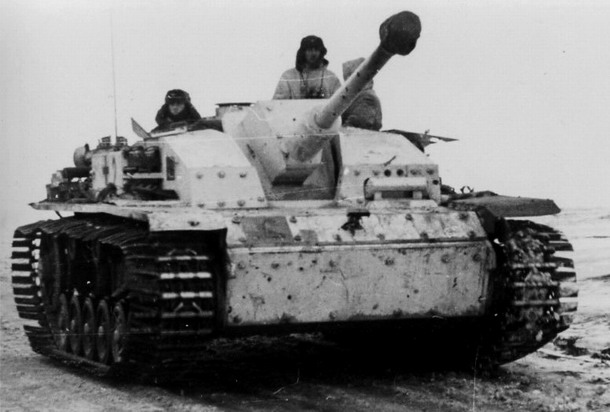
StuG III Ausf. F/8 fitted with wide winter tracks, source: Flickr.com with permission of the publishing user, edited
Ausführung G
In December 1942, production began of the final variant of the StuG III assault gun, designated Ausf. G. With minor ongoing design changes, this version remained in production until the very end of the war and became by far the most numerous of all variants. The running gear of the StuG III Ausf. G was virtually unchanged from the previous version — the same modified 8/Z.W. chassis originally used on the late-production Panzer III tanks. The new Sturmgeschütz did, however, receive a redesigned superstructure. The rectangular box-like protrusions on the side walls were eliminated; instead, the entire superstructure was widened and its sides given a slight inward slope. The wider superstructure fulfilled the same purpose as the old rectangular protrusions — providing additional interior space for radio equipment or ammunition stowage.
In the left rear section of the superstructure roof, where all earlier StuG variants had always had a commander's roof hatch, the Ausf. G introduced a new circular commander's cupola, similar to those on regular tanks. The cupola became the vehicle's new highest point and was ringed with vision ports all round, giving the commander an all-round field of view. It also served as the commander's entry hatch and was naturally fitted with an openable lid. The lid itself contained a smaller closeable aperture through which the commander could extend his observation periscope for a closer look at, for example, a more distant target ahead of the vehicle. The superstructure ventilator fan remained in the same position as on the Ausf. F/8, though it was lower-profile and no longer protruded as far above the roof.
From virtually the start of production, Ausf. G vehicles were fitted with folding shields for the roof-mounted machine gun. When not in use, the gun was stowed inside the vehicle and the folded shield lay flat on the superstructure roof. When needed, the shield was raised and the gun passed through an opening in it. The loader operated the weapon but had to push his head and upper body out through the roof hatch to do so, exposing himself to danger. The shield reportedly offered two mounting positions for the machine gun — one for engaging ground targets and another for firing against attacking enemy aircraft.
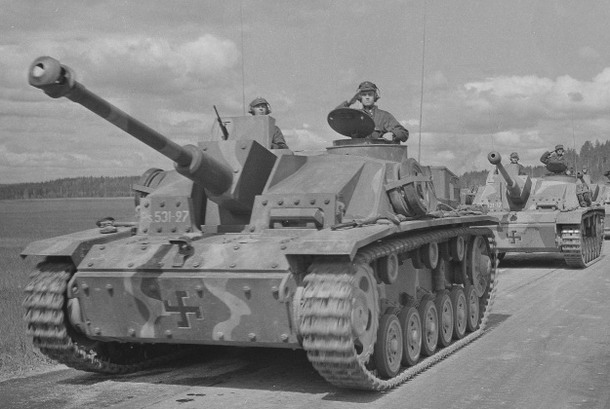
StuG III Ausf. G here in Finnish Army service, source: Flickr.com with permission of the publishing user, edited
Series production of the StuG III Ausf. G ran for almost two and a half years, during which many larger and smaller design modifications were introduced. As early as January 1943, the vision port in the left side wall of the driver's station was eliminated, replaced by only a small closeable pistol port. Simultaneously, the front faces of the widened superstructure sides were given a sharper angle (see comparison HERE (source: flickr.com)). Vehicles with the side driver's vision port were thus produced for only a single month, making photographs of them quite rare (one can be seen HERE (source: worldwarphotos.com)). Also in January 1943, the superstructure ventilator fan was relocated from the roof to the rear wall of the fighting compartment, where it was less obstructive to the crew.
From March 1943, the KFF periscopes serving as an alternative viewing device for drivers were no longer fitted. This meant that the two small periscope optic holes previously drilled into the front armour plate were no longer needed. This section of the front plate could at last be covered entirely by the additional 30 mm armour plate without creating a more vulnerable spot. With the KFF periscope gone, drivers retained only the main Fahrersehklappe 50 vision port.
In March 1943, it was decided that all new StuGs were to be fitted with Schürzen side armour skirts. This armour was intended primarily as protection against Soviet anti-tank rifles. The first StuGs equipped with it began appearing at the front from June 1943.
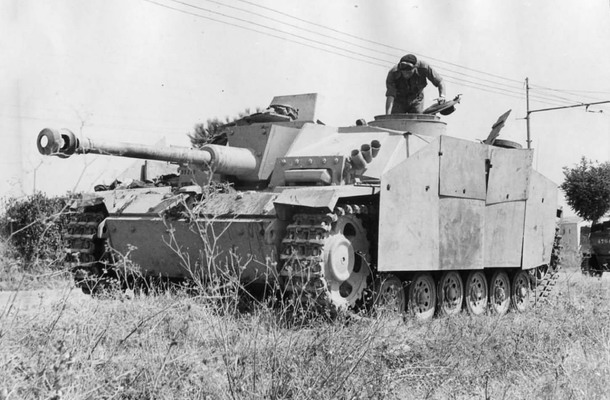
StuG III Ausf. G with side Schürzen armour skirts and smoke dischargers, source: Flickr.com with permission of the publishing user, edited
In February 1943, an order was issued requiring the StuG to be fitted with a homogeneous 80 mm front armour plate. Rather than the 50 mm base plate with 30 mm bolted-on additional plates, a single full-thickness 80 mm plate was to be used. The factories continued working through their existing stocks of already-manufactured components for several months, so the first StuGs with 80 mm front armour did not appear until May 1943. Conversely, the last StuGs with the 50 + 30 mm arrangement left the factories as late as October of that year.
The upper part of the StuG III Ausf. G commander's cupola was originally rotatable. From September 1943, however, cupolas had to be installed in a fixed, non-rotating position. The reason was simple: in August 1943, Allied bombers struck factories in Schweinfurt that produced ball bearings, which subsequently became scarce for several months. The commander's cupolas on StuGs therefore had to temporarily do without bearings — and thus without the ability to rotate. In August 1944, once the worst of the bearing shortage had been overcome, StuG production returned to the rotating cupola.
From September 1943, newly produced assault guns began to be coated with Zimmerit anti-magnetic paste, intended to prevent magnetic anti-tank charges from adhering to the armour. Approximately 70 kg of the substance was needed per StuG III. In October 1943, additional armour protection for the front section of the commander's cupola was introduced. Field workshops were simultaneously authorised to retroactively reinforce the cupola armour on older vehicles using a concrete casting.
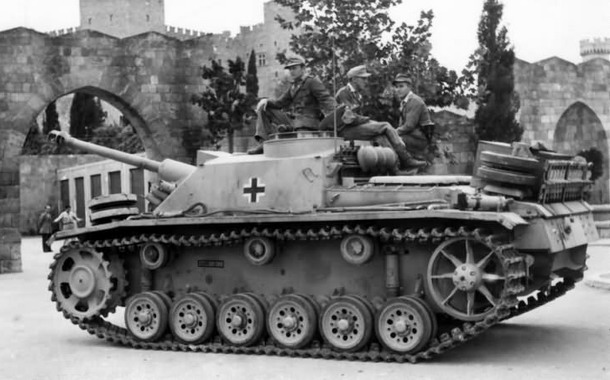
StuG III Ausf. G fitted with smoke dischargers, source: Flickr.com with permission of the publishing user, edited
In November 1943, a new gun mantlet was introduced into production. It was cast rather than fabricated, and in both shape and armour thickness was considerably more resistant to hits than the earlier design. Its distinctive shape earned it the soldiers' nickname Saukopf (or Saukopfblende) — literally "pig's head". Production of the new mantlet could not, however, keep pace with overall StuG production, so new vehicles were fitted with both types of mantlet in parallel until the end of the war.
From February 1943, StuGs began to be fitted with smoke discharger launchers. Triple-barrelled dischargers were mounted at the front on both sides of the superstructure and could be fired remotely from inside the vehicle. By May 1943, however, fitting of the smoke dischargers had already been discontinued. Crews complained that when the device was struck by a shell fragment or even small-arms fire, the smoke candle was set off while still in the barrel. The resulting smoke then penetrated the fighting compartment and made it impossible for the crew to function.
One of the persistent weaknesses of the StuG III assault gun was its ability to defend itself against close-in infantry attack. The Sturmgeschütz simply had no built-in machine gun. Originally this was not such a serious problem, since StuGs were expected to operate side by side with friendly infantry who would provide close protection. As the war progressed, the Germans were increasingly forced to use StuGs not only in the infantry support role but in others too — sometimes even as substitutes for tanks. Experience showed that an onboard machine gun could simply come in useful. There was a roof-mounted machine gun with a foldable shield, but operating it in combat was quite dangerous (it was the loader's responsibility and required him to push part of his body out of the superstructure). In April 1944, a new mounting arrangement was therefore tested: the MG 34 machine gun was fitted in a low, fully rotatable mount that could be operated from the safety of the interior. Its operation was again the loader's responsibility, and he used a periscope to aim it. The gun was fitted with a low arrow-shaped shield. Only after expending the ammunition in the drum magazine did the loader need to open his hatch and reload the weapon — and only his hands needed to be exposed, not half of his body.
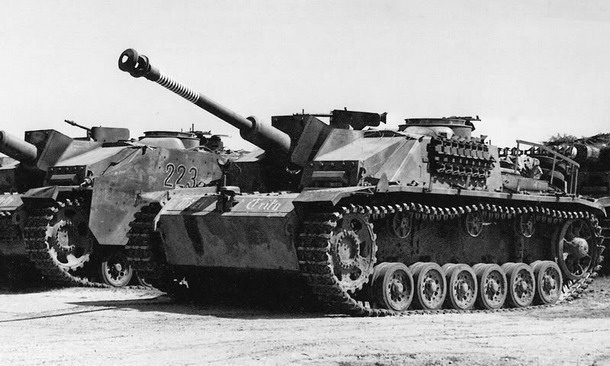
late-production StuG III Ausf. G with all-steel return rollers, additional cupola armour, and the remotely operated low machine gun shield on the roof, source: Flickr.com, Public domain, edited
In June 1944, the designers came up with yet another solution — fitting the machine gun directly alongside the main gun inside the mantlet. The machine gun fired through an opening created for it in the upper left section of the gun shield. This was the safest solution of all, similar in principle to how machine guns were mounted in tank turrets. The gun could, however, only fire straight ahead and had a very limited field of aim. This mounting arrangement existed for both the older square-profiled mantlet and the newer Saukopfblende.
As part of efforts to save scarce rubber, all-steel return rollers (replacing the original rubber-tyred ones) began to be used on StuGs towards the end of 1944. While noise levels increased and rolling resistance rose, both remained within acceptable limits. Experiments were also conducted with all-steel road wheels, but these never entered series production.
From May 1944, a new close-defence weapon port was fitted in StuGs. The original smoke discharger launchers mounted on the exterior of the superstructure sides had proven too vulnerable. The new device was therefore housed not outside but inside the vehicle, protected by the armour. It was mounted under the superstructure roof, with its barrel exiting through the left front section of the roof plate. The device was officially designated the Nahverteidigungswaffe — literally "close-defence weapon". In addition to smoke grenades, it could also fire anti-personnel fragmentation rounds, and it was even possible to fire a signal pistol through its barrel. Due to limited production capacity, only a small proportion of StuGs received this device.
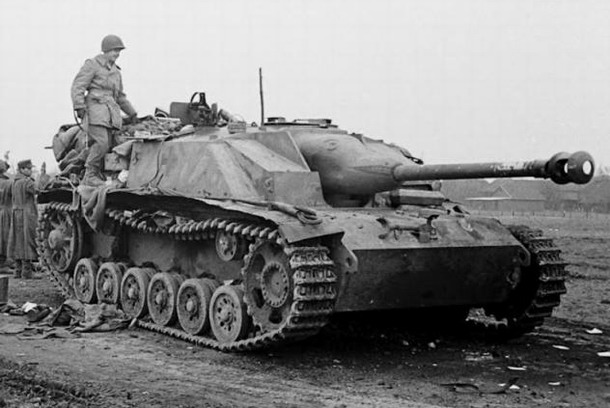
late-production StuG III Ausf. G with the cast gun mantlet nicknamed Saukopf, source: Flickr.com, Public domain, edited
The last design novelty worth mentioning was the attachment points for a folding mini-crane. These took the form of small metal cylinders welded to the superstructure roof — five in total, one at each corner and one in the centre. The sections of the crane were assembled from tubes inserted into the hollow cylinders. The crane had a maximum lifting capacity of 2 tonnes and was used primarily during field engine repairs, when it could easily lift the armoured engine compartment cover. A fine photograph of a StuG III Ausf. G — the final production variant — showing all the progressive innovations described above can be found HERE (source: flickr.com, Public domain).
The Sturmgeschütz III with the long guns proved extraordinarily effective in combat, and both the Army's leadership and Hitler himself insisted on maximising production. Output of the Ausf. G was to be ramped up to unprecedented levels. According to plans drawn up at the end of 1942, at least 220 new StuGs were to be produced every month from June 1943 at the latest. Such demands could not be placed on Alkett alone. It was therefore decided that MIAG (Mühlenbau und Industrie AG) of Braunschweig would also join StuG production on a large scale. MIAG was tasked with gradually winding down its Panzer III tank production while increasing its StuG output. The first ten StuGs left the MIAG factory in February 1943. In May of that year, Panzer III production at Braunschweig was definitively terminated, allowing MIAG to concentrate far more fully on assault gun production — that month, 120 vehicles were completed.
Beyond regular production StuG III Ausf. G vehicles, a series of 142 non-standard vehicles was also built in 1943. The chassis of these vehicles did not originate as purpose-built StuG chassis in the usual sense, but were taken from stocks of hulls originally manufactured for the Panzer III tank — specifically the Ausf. M variant. These 142 chassis had been produced by MAN, but under a directive reducing Panzer III production it was decided they would not be built up into tanks but used instead for StuG III assault guns. MAN therefore transferred the chassis to Alkett and MIAG, who completed the assault guns. The front armour of these hulls was only 50 mm thick — the standard for regular Panzer III tanks — and was therefore reinforced for assault gun use by welding on 30 mm plates. Also carried over with the chassis was non-standard exhaust pipework adapted for deep wading. Photographs of StuGs with these distinctive features are relatively rare, but their existence is clearly established photographically.
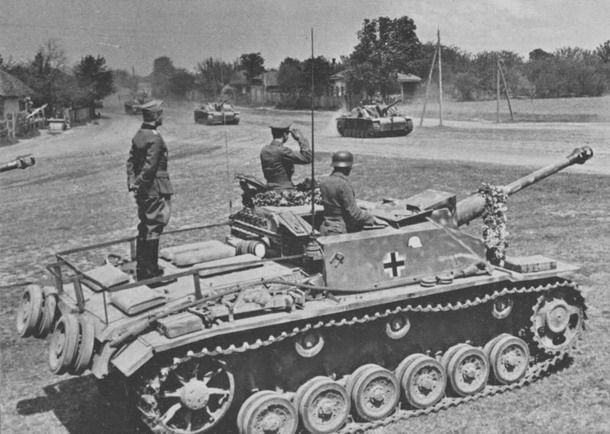
StuG III Ausf. G from the Grossdeutschland regiment, source: Bundesarchiv_Bild_101I-732-0110-23, Wikimedia, Creative commons, edited
Conversions of Panzer III tank chassis into assault guns most likely also took place in reverse — tanks being converted back into assault guns. These would have been vehicles returning for repair with, for example, severely damaged turrets, or tanks taken from Army reserves for this purpose. Germany also supplied StuGs to its allies: officially, these vehicles entered service with the armies of Finland, Bulgaria, Hungary, Romania, and Italy. Approximately 290 vehicles were "exported" in this way during 1943 and 1944.
Organisation
The basic organisational unit of the StuG III was the so-called assault battery — Sturmbatterie. The first unit of this type was Sturmbatterie 640, formed on 1 November 1939 within the Artillery Training Regiment (Artillerie-Lehr Regiment) at Jüterbog. The attentive reader will note that this unit was actually formed before the first series-production Ausf. A StuGs had even left the factory. In April 1940, this battery was incorporated into the Grossdeutschland infantry regiment, from which point it was designated the 16th Sturmbatterie. During April and May 1940, Sturmbatterie 659, 660, and 665 were also formed. From the last six Ausf. A StuGs to be built, an SS Sturmbatterie belonging to the Leibstandarte SS Adolf Hitler division was formed at the end of May.
The structure of these units was defined by the standard K.St.N. 445 of 1 November 1939. Each Sturmbatterie had six StuG III assault guns, divided into three platoons (Zug) of two each. The battery also had five command and observation half-tracks of the type Sd.Kfz. 253 and six ammunition half-tracks of the type Sd.Kfz. 252, plus various lorries, staff cars, and motorcycles. The first Sturmbatterien — numbers 16, 659, 660, and 665 — were the only ones ready in time to take part in the attack on France in June 1940. The SS Sturmbatterie of the Leibstandarte SS Adolf Hitler reportedly did not have such "luck" and was not ready in time to join the French campaign.
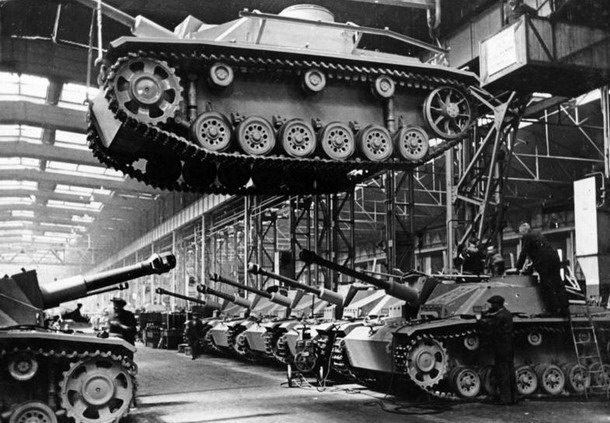
StuG III Ausf. G production was truly on a massive scale, source: Bundesarchiv_Bild_146-1985-100-33, Wikimedia, Creative commons, edited
In July 1940, two further Sturmbatterien were formed, numbered 666 and 667. That same month, the directive K.St.N. 446 was issued, under which batteries began to be grouped into assault gun battalions — Sturmartillerie-Abteilung. Each battalion was to consist of three batteries, each retaining its six assault guns, though the supporting vehicle numbers were reduced. A full-strength battalion thus had 18 StuGs in total. To make the organisational picture slightly more complex, in 1941 it was decided to rename the units: the Sturmbatterie became the Sturmgeschütz-Batterie, and the Sturmartillerie-Abteilung was redesignated the Sturmgeschütz-Abteilung.
In April 1941, the K.St.N. 446 directive was updated and the number of assault guns in each battery was raised from six to seven. The seventh vehicle served as the battery commander's vehicle (replacing the original Sd.Kfz. 253 half-track). The battalion commander also received his own StuG, bringing the total number of assault guns in a complete battalion from 18 to 22 (three batteries of seven, plus the battalion commander's vehicle). The StuG assigned to the battalion commander was fitted with special radio equipment — instead of the Fu 15 and Fu 16 combination used by battery commanders, it carried the Fu 16 and Fu 8. The powerful Fu 8 enabled voice communication up to approximately 20 km and Morse transmission up to 40 km. It was served by a special star-shaped rod antenna called the Sternantenne. Photographs of such a vehicle can be seen HERE or HERE (source: Flickr.com with permission of the publishing user).
The accelerating pace of StuG production made it possible not only to form new units but also to expand existing ones. In November 1942, the number of assault guns in a single battery was raised again — this time from seven to ten. The battery still divided into three platoons, each now with three StuGs. The full battalion now had 31 StuGs (three batteries of ten, plus the battalion commander's vehicle). In 1943, it was decided that one platoon within a battery could be equipped with assault howitzers of the type StuH 42, thereby formally authorising the formation of mixed StuG III and StuH 42 units.
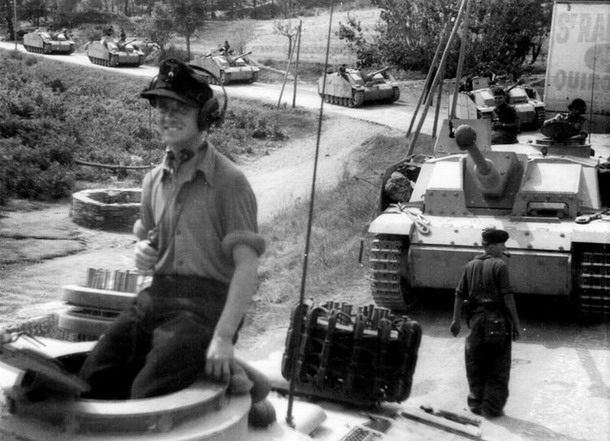
a battery of StuG III Ausf. G assault guns on the move, source: Flickr.com with permission of the publishing user, edited
Another organisational change came in February 1944. The Sturmgeschütz-Batterie gained a fourth platoon in addition to its existing three, each platoon still with three vehicles, giving a total of twelve assault guns. The battery headquarters also received one additional vehicle. The battery thus had 14 assault guns in total (four platoons of three, plus two command vehicles). One platoon could again be equipped with StuH 42 howitzers, and likewise one of the two command vehicles could be of this type. A complete assault gun battalion (Sturmgeschütz-Abteilung) now consisted of three batteries of 14 vehicles each, plus three assault guns for its own headquarters — 45 fighting vehicles in total. The older organisational structure remained officially valid, however, so batteries of ten and batteries of fourteen assault guns continued to exist in parallel in practice.
In 1944, assault gun battalions were officially redesignated as brigades — in German, from Sturmgeschütz-Abteilung to Sturmgeschütz-Brigade. Their internal structure did not change with the name. It should also be noted for completeness that assault gun units organic to panzer divisions and to Waffen-SS units had their own organisational standards, which are not described here.
Series Production
Production of the StuG III assault gun ran from January 1940 to April 1945. The first production batch of 30 vehicles was delivered by Daimler-Benz, specifically from its Werk 40 plant in the Marienfelde district of Berlin. That was, however, Daimler-Benz's only involvement in StuG production. The primary manufacturer from June 1940 onwards was the Berlin firm Alkett. Between June 1940 and April 1945, Alkett's workshops produced a total of 6,577 StuG III assault guns, from Ausf. B through Ausf. G. From February 1943, a second manufacturer joined the programme — MIAG (Mühlenbau und Industrie AG) of Braunschweig, which produced StuGs until March 1945, completing a total of 2,643 vehicles.
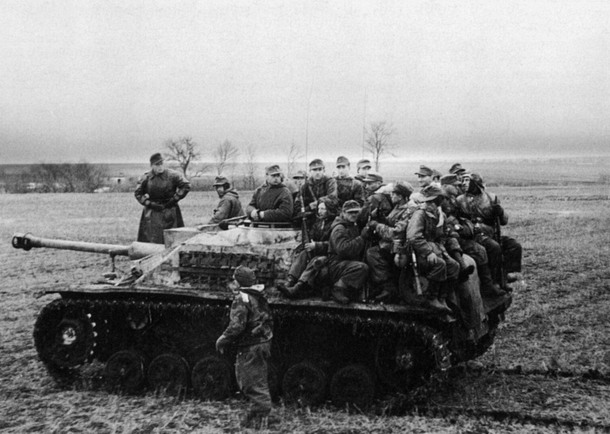
the StuG III operated most typically in close cooperation with infantry, source: Flickr.com with permission of the publishing user, edited
From the transition to the StuG III Ausf. G in December 1942, the production rate rose almost continuously. In October 1943 alone, 395 new StuGs left the factory halls. The first setback came in November 1943, when the Alkett plant was hit by Allied bombing. The peak production year was 1944, when 3,840 StuGs were produced — even though both the MIAG and Alkett factories were bombed on several occasions that year. The single most productive month in the entire production run was December 1944, when the factories turned out an extraordinary 452 new assault guns.
Total production of the StuG III in all variants reached the impressive total of 9,250 vehicles. This figure made the Sturmgeschütz III the single most numerous type of German armoured fighting vehicle of the entire Second World War. Moreover, this figure represents only first-production vehicles and very likely does not include vehicles produced by converting original tanks — which may have numbered up to 200. Some authors put the total even above ten thousand.
Production figures were high, but so were losses. W. Spielberger, in one of his publications, cites a report by the Artillery Inspectorate from September 1944 giving the number of combat-ready StuG IIIs on the Eastern Front month by month from January to August 1944. Although this was a record year for production, the number of combat-ready StuG IIIs in the field never exceeded one thousand in any single month. According to this report, 713 StuGs were permanently lost over those eight months — approximately 90 vehicles destroyed per month. An even larger number was evidently temporarily unserviceable each month due to combat damage or mechanical failure.

Stug III Ausf. G during field maintenance, zdroj: Flickr.com with permission of the publishing user, edited
The Alkett and MIAG factories served primarily as assembly plants where finished vehicles were completed from delivered components and sub-assemblies. More than fifty major suppliers and a large number of smaller contractors and sub-contractors were involved in production. The engines, for example, were manufactured and supplied — under licence — by three firms in addition to the original producer, Maybach. The gun sights were made by the still-famous Carl Zeiss company, though two additional licensed manufacturers also supplied them. Of particular interest to Czech readers may be the fact that approximately 40% of all long-barrelled Sturmkanone 40 guns were supplied by the Škoda works in Plzeň.
Combat Deployment
The Sturmgeschütz III assault gun had many opponents from the very beginning. They argued that resources should be concentrated on tanks, which were far more versatile than a turretless gun, and that StuGs would merely drain away production capacity that was needed for tank manufacture. History, however, clearly demonstrated that the StuG III more than justified its existence. Its combat record was unequivocally positive. Returning once more to the Artillery Inspectorate report of September 1944, covering assault gun operations on the Eastern Front from January to August 1944: during this period, StuGs were credited with the destruction of 4,667 enemy tanks, at the cost of 713 of their own vehicles lost. The report then estimates the overall score of StuG III assault guns on the Eastern Front for the period from 22 June 1941 to August 1944 at an extraordinary 18,261 Soviet tanks of all types. By the end of the war this figure must certainly have grown further still, and the StuGs operating on the Western Front and in Africa had undoubtedly added countless more tallies to their gun barrels. Given the general shortage of fighting vehicles in the later stages of the war, StuG IIIs were also allocated to armoured units in place of Panzer IV tanks, as well as to tank destroyer units.
Technical Specifications
|
|
Ausf. A |
Ausf. B |
Ausf. C |
Ausf. D |
Ausf. E |
Ausf. F |
Ausf. F/8 |
Ausf. G |
|
|
weight: |
19.6 t |
22.0 t |
22.0 t |
22.0 t |
22.0 t |
23.2 t |
23.4 t |
23.9 t |
|
|
length: |
5.38 m |
5.40 m |
5.40 m |
5.40 m |
5.40 m |
6.31 m |
6.77 m |
6.77 m |
|
|
width: |
2.92 m |
2.95 m |
2.95 m |
2.95 m |
2.95 m |
2.95 m |
2.95 m |
2.95 m |
|
|
height: |
1.95 m |
1.96 m |
1.96 m |
1.96 m |
1.96 m |
2.15 m |
1.85 m |
2.16 m |
|
|
engine: |
HL 120 TR |
HL 120 TRM |
HL 120 TRM |
HL 120 TRM |
HL 120 TRM |
HL 120 TRM |
HL 120 TRM |
HL 120 TRM |
|
|
engine output: |
300 hp |
300 hp |
300 hp |
300 hp |
300 hp |
300 hp |
300 hp |
300 hp |
|
|
max. speed: |
30 km/h |
40 km/h |
40 km/h |
40 km/h |
40 km/h |
40 km/h |
40 km/h |
40 km/h |
|
|
frontal armour: |
50 mm |
50 mm |
50 mm |
50 mm |
50 mm |
50 mm |
50+30 mm |
50+30 mm |
50+30 / 80 mm |
|
crew: |
4 men |
4 men |
4 men |
4 men |
4 men |
4 men |
4 men |
4 men |
|
|
armament: |
75 mm StuK L/24 gun |
75 mm StuK 40 L/43 gun |
75 mm StuK 40 L/48 gun |
||||||
Related Vehicles
|
Flame-thrower tanks: |
Stug III (Flamm) - only 10 evaluation vehicles |

ARTICLE
CONTENTS:
Reproducing text from the Panzernet website without the written consent of the operator is prohibited.