TIGER
the beast that spread fear
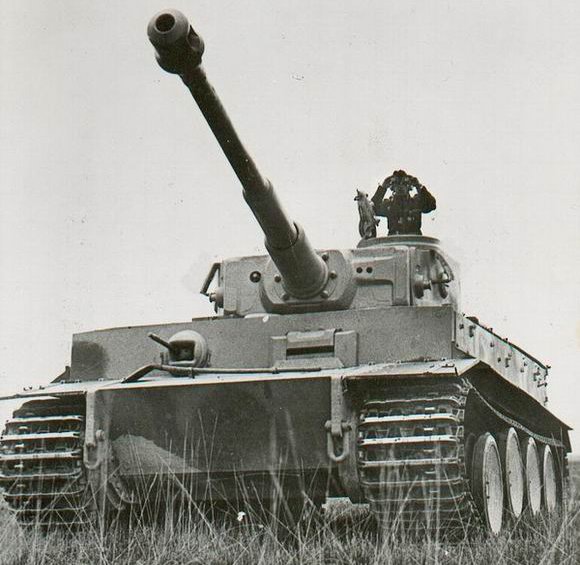
Panzerkampfwagen VI – Tiger, early production variant, source: Bundesarchiv_Bild_183-J05741, Wikimedia, Creative commons
The Tiger is beyond any doubt the most famous German tank of the Second World War, and one of the most iconic tanks in the entire history of armoured warfare. Its name has featured in virtually every war film ever made and has become a symbol of German tank technology — and all this despite the fact that, compared to other vehicles, relatively few were actually produced.
A Difficult Road to Production
If we trace the development of this vehicle back to its roots in the broader effort to create a standardised German heavy tank, the story begins as early as 1937. That was when the ordnance office (Waffenamt) first formally set out its requirements for a new heavy tank for the Wehrmacht — one that would represent a qualitative step forward over the older and not entirely successful designs of the Grosstraktor and the Neubafahrzeug.
Efforts to meet the Waffenamt's requirements produced, in the years that followed, a series of heavy tank prototypes designated DW 1 and DW 2 (DW = Durchbruchwagen = breakthrough vehicle). Both prototypes were the work of Henschel. After testing, the DW programme was cancelled (more about the Durchbruchwagen prototypes can be found in the dedicated article HERE). The Waffenamt's requirements were subsequently revised and a new programme was launched, designated VK3001 (VK = Vollkettenkraftfahrzeug = fully tracked vehicle).
VK 30.01
The new ordnance office specifications called for a vehicle in the 30-tonne weight class, armed with the short-barrelled KwK 37 L/24 gun in 75 mm calibre — the same weapon already in use on the PzKpfw IV.
Two rivals of the German tank design world joined the VK3001 project: the firm of Henschel and the design bureau of Professor Porsche. Both companies submitted their prototypes during 1939, designated VK3001 (H) and VK3001 (P) respectively. These were not complete tanks, however, but only hull and running gear assemblies without turrets. Both manufacturers envisaged fitting standard or modified turrets from the existing PzKpfw IV in due course. During driving trials, the weight of the turrets was simulated using ballast weights.
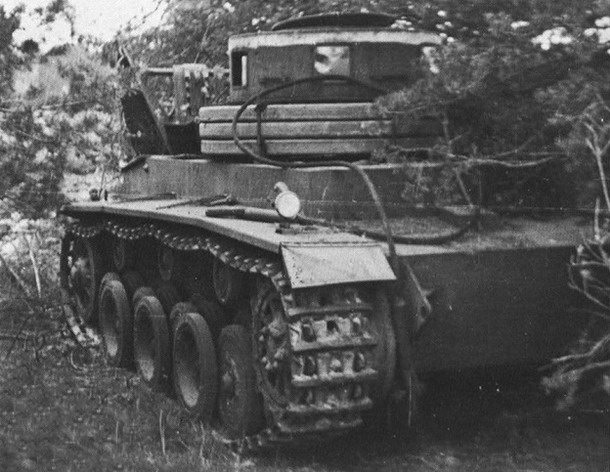
VK3001(H) prototype during trials, with concrete rings fitted in place of a turret, source: Flickr.com, courtesy of the publishing user
The Henschel running gear consisted of seven road wheels on each side. The wheels were doubled and interleaved — the inner and outer halves of alternating wheels meshed into the gaps between one another, so that when viewed from the side the wheels partially overlapped. The outer row contained three wheels, the inner row four. At the front sat a spoked drive sprocket and at the rear a spoked idler. Three return rollers, symmetrically spaced above the road wheels, completed the arrangement. The track rested on them from above.
Hull and running gear armour ranged from 35 to 50 mm. The powerplant was a six-cylinder petrol engine, the Maybach HL 116, with a displacement of 11 litres producing a maximum output of 300 horsepower at 3,000 rpm. The vehicle's maximum road speed was 35 km/h. Four prototypes were built in total and subjected to thorough testing over the following months. After the programme was cancelled, two of these hulls were used as the basis for a heavy tank destroyer designated 12,8cm Kanone 40 auf VK 3001 (H). For this new purpose they had to be lengthened and received an eighth pair of road wheels. The remaining two prototypes apparently served out their days as training vehicles.
Professor Porsche's prototype, VK3001 (P), known during development as the Leopard, was produced as a single example. Its running gear consisted of six doubled road wheels which, unlike the Henschel design, were arranged in a single row without interleaving. At the front was a solid drive sprocket and at the rear a spoked idler. Two return rollers supported the track from above. Hull and running gear armour ranged from 30 to 50 mm.
A distinctive feature of this prototype was the combined petrol-electric drive system that was characteristic of Professor Porsche's designs. In this arrangement, the internal combustion engine did not drive the running gear directly but powered only an electric generator, which in turn supplied current to an electric motor that actually drove the tracks. The advantage of this complex solution was considerably smoother driving behaviour. Steering a heavy tracked vehicle — particularly in demanding terrain — was no easy task, and this drive system was intended to make it easier. In practice, however, the benefits were outweighed by the drawbacks of the combined drive, chiefly increased unreliability and significant energy losses.
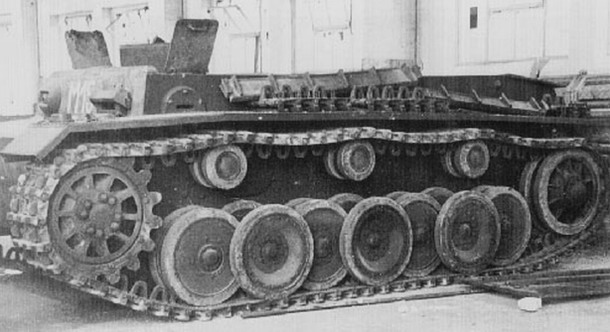
VK3001(H) prototype, source: Flickr.com, courtesy of the publishing user
In the case of VK3001 (P), the drive system consisted of two ten-cylinder Porsche 100 engines each producing 210 horsepower, two generators, and two Siemens electric motors. After the project was cancelled, the sole Porsche prototype presumably served out its remaining life as a training vehicle.
VK 36.01
As is now clear, the VK3001 project also failed to deliver the standardised heavy tank the German army was looking for, and in 1941 it was cancelled in favour of a new project. This was approved at a meeting on new weapons development held on 26 May 1941, under the designation VK3601.
According to the specifications, the new tank was to weigh around 36 tonnes. Frontal armour was to be a full 100 mm thick, with side armour of 60 mm. The vehicle was to be capable of reaching 40 km/h on roads. Henschel was tasked with developing the hull and running gear, while Krupp was to design the turret. An order was placed for seven test vehicles, to be delivered no later than April 1942.
The plan called for each tank division to have twenty of the new tanks on strength, serving as breakthrough vehicles to punch gaps in enemy lines for the medium tanks PzKpfw III and PzKpfw IV to exploit. For this role they were to be armed with a powerful, long-range gun. A tapered-bore weapon using high-velocity tungsten-cored armour-piercing ammunition was planned, but development dragged on, and by that time the German economy was already beginning to feel a critical shortage of tungsten — the essential raw material for this type of ammunition. As a result, a conventional 75 mm or 88 mm gun with a standard uniform bore began to seem the more realistic option.
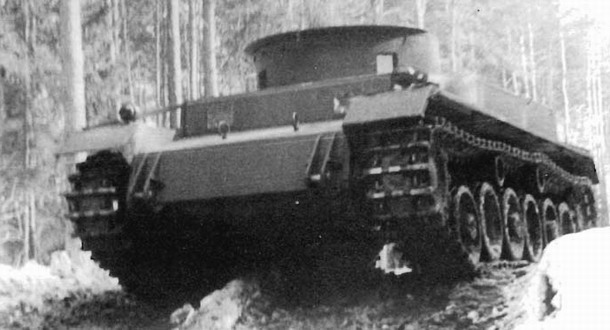
VK3001(P) prototype during trials, source: Flickr.com, courtesy of the publishing user
In early 1942, Henschel delivered its VK3601 (H) prototype for testing. It was again a hull and running gear assembly only, without a turret. The running gear on each side consisted of eight large-diameter road wheels. Each wheel comprised two discs. The discs of the odd-numbered wheels were mounted close together on the axle, while those of the even-numbered wheels had a gap between them — into which the odd-numbered wheels fitted. Viewed from the side, the wheels overlapped, and only the outer discs of the even-numbered wheels were visible as a continuous row. The road wheels were solid and fitted with rubber tyres around their circumference.
The system was completed by a simple idler at the rear and a massive drive sprocket at the front. No return rollers were needed, as the tracks rested directly on the road wheels from above. For the complete tank fitted with turret and armament, a weight of between 36 and 40 tonnes was anticipated. The intended powerplant was the twelve-cylinder Maybach HL 174, with a displacement of 19 litres and a maximum output of 550 horsepower.
A total of six VK3601 (H) vehicles were produced. After the decision against series production and the cancellation of the programme, they were converted into recovery vehicles. One of them was even fitted with a crane and apparently served in field repair workshops.
VK 45.01
The VK3601 (H) project was ultimately killed off by German experience on the Eastern Front. Even as work on VK3601 was continuing through 1941, however, a parallel project had already been launched — designated VK4501 — aimed at developing an even heavier and more heavily armoured tank. The brutal fighting against the ever-growing masses of Soviet armour eventually led, during 1942, to the decision to abandon work on the lighter vehicle and concentrate all available resources on developing a tank in the 45-tonne weight class.

VK3601(H) during a test drive, source: Flickr.com, courtesy of the publishing user, edited
With the VK4501 project we can already speak of a direct line of development leading to the Tiger. Unlike with VK3601, Henschel again had its traditional rival in this project — Professor Porsche and his team. Both manufacturers worked, per the specification, only on hulls and running gear, while the turret for the new tank was being developed by Krupp. Both Henschel and Porsche were required to present their prototypes by 20 April 1942 — Hitler's birthday.
The Henschel designers, who were working on both VK3601 and VK4501 simultaneously, decided to share as many design elements as possible between the two vehicles. As a result, the VK3601 (H) and VK4501 (H) prototypes were very similar to one another. Dr. Porsche's team, which was focused solely on the heavier tank, made faster initial progress on its VK4501 (P) prototype than Henschel — at least at the outset.
Krupp, which was developing the turret for the future tank, tailored it to fit the Porsche prototype precisely because of this early lead. Henschel therefore had to adapt its hull design to match the turret. As a result, the hulls of both manufacturers' prototypes were broadly similar in the region where the turret sat.
Both prototypes were ultimately completed on time, fitted with their turrets, and demonstrated to Hitler on his birthday. In addition to the Führer, many other senior figures of the Third Reich attended the driving trials — among them Göring and Speer. The failure of the Porsche prototype during these tests was therefore all the more embarrassing.
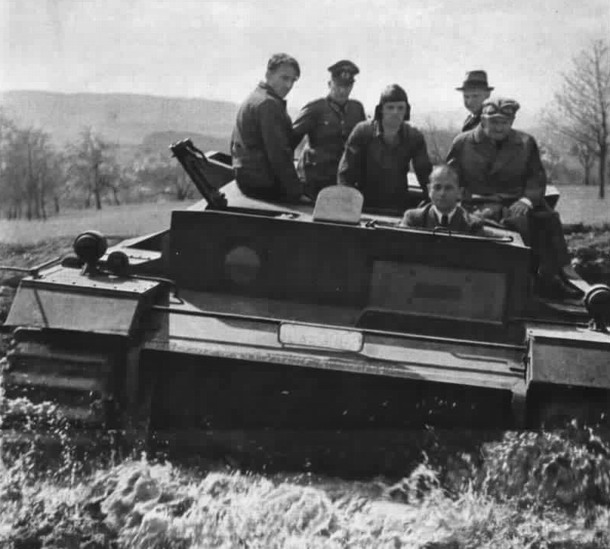
VK3601 (H) during a test drive — at the wheel is none other than Albert Speer, with Prof. Porsche seated behind him, source: Flickr.com, courtesy of the publishing user, edited
Porsche's Design Has Problems
The VK4501 (P), sometimes also known as the Porsche Tiger, had a running gear consisting of six large all-steel road wheels on each side, suspended in pairs. The drive sprocket was at the front and the idler at the rear. The tracks rested directly on the road wheels from above. The tank's hull was assembled from welded flat armour plates. The frontal plate was 100 mm thick, the sides and rear 80 mm.
Porsche, as before, applied his characteristic petrol-electric drive system to this vehicle as well. The combustion element consisted of two ten-cylinder Porsche 101/4 engines each producing 320 horsepower, connected to two electric generators that supplied current to two electric motors. So equipped, the VK4501 (P) prototype was capable of reaching a maximum road speed of 35 km/h.
In addition to the turret armament, the vehicle carried a hull machine gun mounted in a hemispherical ball mount in the right side of the frontal plate. The crew consisted of five men: driver, radio operator/machine gunner, gunner, loader, and commander. The first two had their positions inside the hull; the remainder were in the rotating turret. The ammunition stowage for the main gun was 70 rounds. Fuel capacity was 520 litres, giving the tank a range of approximately 80 km.
For the Porsche team, the driving trials turned into a nightmare from the very start. No sooner had their tank rolled off the unloading ramp than it became stuck in soft ground and had to be ignominiously recovered by the rival vehicle. The VK4501 (P) continued to perform poorly for the remainder of the trials — the only area in which it exceeded the Henschel machine was cross-country top speed, and even on roads it could not match the Henschel in that regard. It is no surprise that the Porsche entry failed the trials.
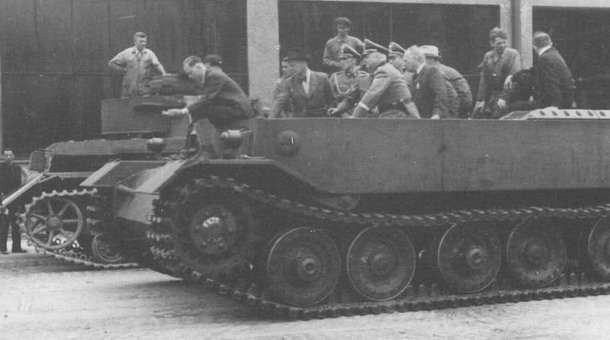
VK4501 (P) prototype without turret during a test drive, source: Flickr.com, courtesy of the publishing user, edited
Two VK4501 (P) tanks, by then fully completed, were used as training vehicles for future tank crews after series production was rejected. One of them later found a somewhat more distinguished role, being assigned as a command vehicle to the headquarters of the heavy tank destroyer battalion sPzJgAbt 653.
The self-confident Professor Porsche had ordered series production of chassis for his tank to begin at his factories well before the competitive trials had concluded. When the rejection came, ninety-five nearly complete chassis were already standing in the production halls. Leaving them unused or scrapping them outright would of course have been a needless waste of resources. At the same time, it was not possible to introduce a second standard tank alongside the winning design, as this would inevitably have led to higher maintenance costs, confusion in spare parts ordering, and so on. Ninety of these chassis were therefore used as the basis for the new heavy tank destroyer Ferdinand, while the remaining five served as the foundation for a heavy recovery tank known as the Bergetiger. Both of these vehicles belong to a different chapter, however.
Henschel Is the Winner
As is now clear, the winner of the competition was the VK4501 (H) from Henschel. The running gear of the Henschel design was very similar to the already-described arrangement used on the VK3601 (H) prototype by the same manufacturer, but somewhat more complex. Each axle carried two road wheels — one double-disc wheel and one single-disc wheel. Alternate axles were of different lengths and carried the wheels in different configurations. The wheels interleaved with one another, and when viewed from the side only the outer row of single-disc wheels was fully visible. All road wheels were solid and fitted with rubber tyres around their circumference.
The complex arrangement of a large number of road wheels allowed the tank's enormous weight to be distributed acceptably while keeping the overall running gear length relatively short — a short wheelbase having a favourable effect on the vehicle's manoeuvrability.
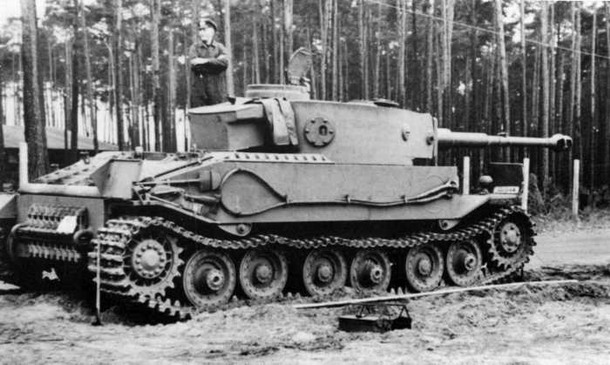
VK4501 (P) prototype, here already fitted with the Krupp turret, source: Flickr.com, courtesy of the publishing user, edited
The road wheels were complemented by an idler at the rear and a drive sprocket at the front. The vehicle had no return rollers, as the tracks rested directly on the large road wheels from above. The full wheel arrangement is clearly visible in the photograph below.
The tank's hull was built from flat steel plates joined by welding. The frontal plate was 100 mm thick, the sides and rear 80 mm. The VK4501 (H) prototype was fitted with an additional folding armour plate. During transit and when outside the combat area, this plate rested on top of the nose plate of the hull (as visible in the photograph two images below). In combat it was to be folded down to provide additional protection to the lower hull and especially the tracks. This feature was not carried over into series production, however.
Series production was ordered immediately following the successful trials of the prototype, and the first new tank rolled off the production line as early as June 1942. The tank received the official designation Panzerkampfwagen VI Tiger Ausf. H1, where the letter H abbreviated the manufacturer's name, Henschel. The designation was later changed to Ausf. E (Ausf. = Ausführung = variant). What led the army authorities to choose the letter E is not known. On earlier tanks, the variant letters had generally been assigned in alphabetical order, but this was not the case with the Tiger.
With a few exceptions — such as the folding frontal armour plate already mentioned — the first series production tanks were essentially identical to the VK4501 (H) prototype. The description that follows therefore applies broadly to both the prototype and the Tiger tank itself.
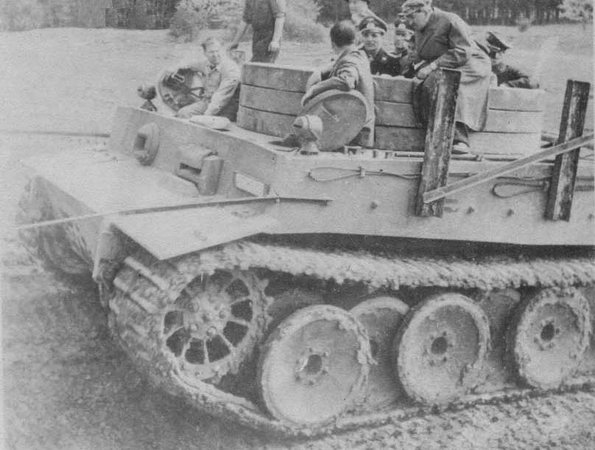
VK4501 (H) with concrete rings in place of a turret during driving trials, source: Flickr.com, courtesy of the publishing user, edited
The frontal hull plate contained the driver's vision port, with a hemispherical ball mount for the hull machine gun to its right. The powerplant was located at the rear of the hull — a twelve-cylinder petrol engine, the Maybach HL 210 P45, with a displacement of 21.3 litres and a maximum output of 642 horsepower at 3,000 rpm. This unit was capable of propelling the vehicle to a top road speed of 45 km/h — a truly impressive figure given the vehicle's weight of 56.9 tonnes.
The fuel consumption was equally impressive, though in a less flattering sense. On roads, the twelve-cylinder engine consumed roughly 535 litres of petrol per 100 km; cross-country, this rose to as much as 935 litres. Four fuel tanks with a combined capacity of 534 litres gave the tank a road range of approximately 100 km, and a mere 60 km across country. The Maybach OLVAR OG 401216 A gearbox, located at the very front of the hull and connected to the engine by a driveshaft running beneath the floor, offered eight forward and four reverse gear ratios.
The crew again numbered five, in the standard configuration. The radio operator and driver sat in the forward hull section. Both entered the vehicle through their own circular hatches above their respective stations, each fitted with a periscope. In addition, the driver had a large closable vision port directly in front of him. He steered the vehicle using a steering wheel — somewhat unconventionally — with conventional brake levers available as a backup in the event of failure.
The remaining crew members — commander, gunner, and loader — had their positions inside the turret. Two hatches in the turret roof served for entry and exit: the first, with a single rectangular lid, was located in the right forward area of the turret; the second, circular, was in the commander's cupola. The cupola provided the commander with all-round observation through five symmetrically spaced vision ports around its circumference, glazed with bulletproof glass. In addition to the hatches, an electric ventilation fan also opened through the turret roof.
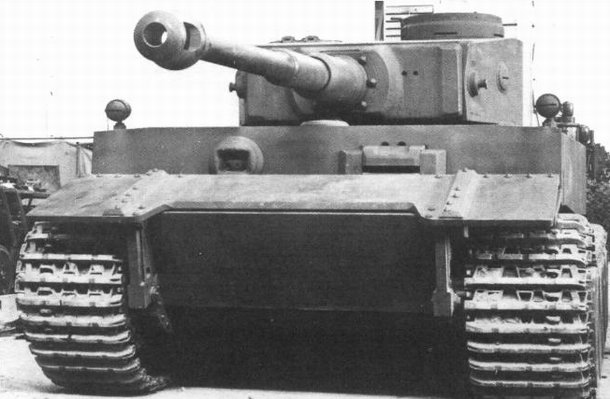
VK4501 (H) prototype in full glory — note the folding armour plate, source: Flickr.com, courtesy of the publishing user, edited
Krupp's Fighting Turret
The turret, a Krupp design, was conceived from the outset to be as low as possible in order to minimise the target area presented to enemy projectiles. This did impose some restriction on the gun's vertical arc of movement. The first eight turrets produced had lower side walls and a horizontal roof with a raised section — this bulge allowed the gun to be depressed more steeply, as it provided clearance for the breech end of the barrel to rise towards the turret roof. Later standard turrets were taller, with a flat roof plate that sloped forward, without the raised section.
The turret was rotated by an electric motor, controlled by the gunner via foot pedals. Manual traverse wheels were available to both the gunner and the commander in the event of an electrical failure.
The frontal turret plate was flat and 100 mm thick. The remainder of the turret was formed from a single steel plate 80 mm thick, bent into a horseshoe shape. The weapon carried in the turret was the highly capable KwK 36 L/56 gun in 88 mm calibre, derived from an anti-aircraft gun. The gun was fixed in the front vertical mantlet plate, which allowed it to be elevated and depressed within a range of -6.5° to +17°.
The on-board ammunition supply comprised 92 rounds. Four types of ammunition were available for the gun: the armour-piercing Panzergranate 39, the sub-calibre Panzergranate 40, the hollow-charge Hohlladungsgranate, and the high-explosive Sprenggranate. At the time of its introduction, this gun was an outstanding weapon — effective, accurate, and with a long reach. Thanks to it, the Tiger was capable of knocking out virtually any contemporary opponent at ranges far exceeding those at which they could return effective fire.
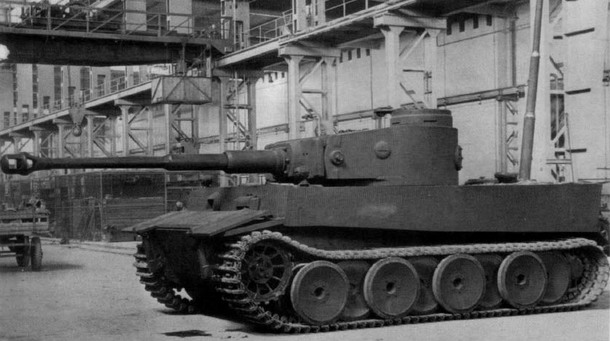
VK4501 (H) prototype in the Henschel factory hall, source: Flickr.com, courtesy of the publishing user, edited
Secondary armament consisted of two MG34 machine guns in 7.92 mm calibre. The first, already mentioned, was mounted in a ball mount in the right side of the hull's frontal armour and operated by the radio operator. The second was co-axially mounted in the turret to the right of the main gun. A total of 3,920 rounds were carried for both machine guns. The tank's armament also included six smoke grenade launchers — three on each side of the turret — and five close-defence antipersonnel mine throwers, one in each corner of the hull and one to the left of the turret. These antipersonnel mortars were discontinued very early in the production run, however.
Crew members also carried their personal sidearms and sometimes had a submachine gun on board. Two pistol ports in the rear turret wall, surrounded on the outside by a circular raised cover, served for firing personal weapons. During the production run, tanks began to be fitted with a large stowage box for miscellaneous equipment, hung on the rear turret wall.
The first series-production tanks were standardly prepared for deep wading. The hull, turret, and turret ring were all fully sealed, and a metal tube was fitted before submersion to supply air and vent the engine exhaust (a Tiger prepared for underwater travel is visible in the photograph below). The Tiger was thus capable of driving through water up to four metres deep. No documented instance of this capability being used in actual combat is known, however, and the deep wading preparation was eventually discontinued in production vehicles.
Progressive Modifications
Throughout the production run, a number of further minor and major design changes were introduced. From December 1942, for example, the pistol port in the right side of the turret was removed. In its place, next to the rear stowage box, a circular emergency escape hatch appeared, for use in bailing out of the turret in an emergency.
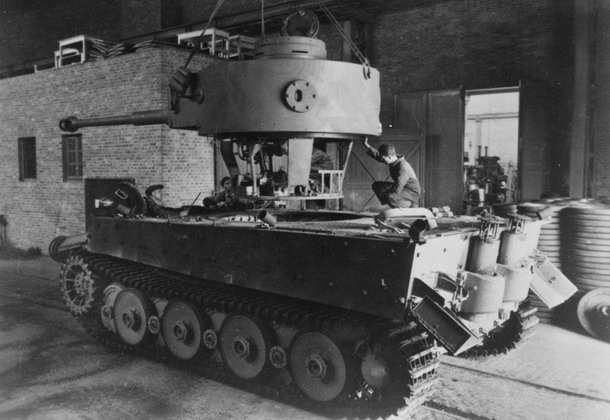
Tiger tanks being assembled in the factory hall. The close-defence mine throwers in the hull corners indicate an early-production vehicle. The tank is fitted with narrow transport tracks, as it will be loaded directly onto a railway flatcar upon completion. Source: Flickr.com, courtesy of the publishing user, edited.
Early-production Tigers were standardly equipped with Feifel air filters. Two thick rubber tubes ran from these filters across the engine deck, forming a "V" shape. The filters were essential for vehicles intended for service in African conditions, where there was a risk of sand and dust clogging the engine. For European conditions they were unnecessary, however, and they disappeared accordingly. Tanks produced after 1943 no longer carried them.
The side mudguards, as visible in the photograph above, were also not standard equipment on Tigers from the very beginning — they appeared partway through the production run. They consisted of four simple steel panels mounted along the side of the hull one behind another, covering the full length of the hull, with angled front and rear mudguards connecting at either end.
The design of the front mudguards themselves also changed during production. The original rounded mudguards, which followed the contour of the track, were replaced by flat mudguards that were simpler to manufacture and more robust.
From April 1944, the gunner's binocular sight Turmzielfernrohr 9b was replaced by the more modern monocular Turmzielfernrohr 9c. With this change, one of the two original apertures in the frontal turret plate to the left of the gun disappeared.
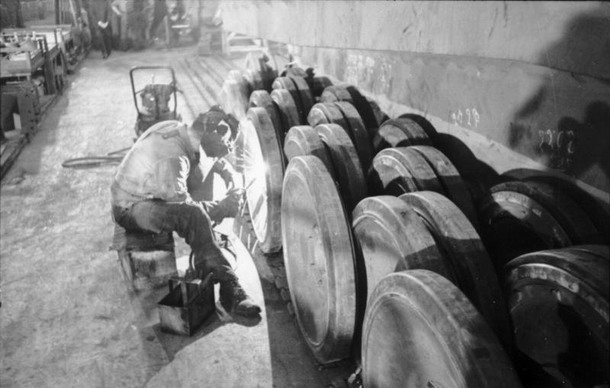
This photograph clearly shows the complex road wheel arrangement of the Tiger. The large number of wheels was necessary to distribute the vehicle's considerable weight. Source: Bundesarchiv_Bild_101I-635-3965-28, Wikimedia, Creative commons, edited.
From the summer of 1943, the smoke grenade launchers on the sides of the turret were no longer fitted. Earlier Tigers had three launcher tubes on each side of the turret. On later vehicles these were replaced by a single-barrel launcher for both smoke and antipersonnel grenades, installed directly in the turret roof. Its advantage was that it could be reloaded from inside the turret without the crew having to leave the safety of the armoured interior.
The most visually significant changes — and the ones by which the production period of individual tanks can most readily be identified — were the redesign of the road wheel arrangement and the redesign of the commander's cupola.
A Complex Running Gear
The intricate interleaved wheel arrangement used on original Tigers — 48 wheels in total — allowed the vehicle's enormous weight to be distributed more evenly and gave it a smoother ride and easier handling, but it brought with it one serious practical problem. When driving cross-country, stones were relatively easily drawn into the road wheels and became jammed in the narrow gaps between them, often resulting in deformed wheels or damaged axles requiring laborious replacement.
On the Eastern Front, the wheels were also frequently clogged with mud which froze overnight while the tank stood still, making it impossible to move the tank in the morning. The large number of overlapping wheels made this problem worse. Complaints about these issues led designers to simplify the wheel arrangement. Whereas the earlier solution had placed one double-disc wheel and one single-disc wheel on each axle — giving three disc units per axle in total — the new running gear had only two disc units per axle. On even-numbered axles there was a gap between the two discs; on odd-numbered axles the two discs were close together, effectively forming a single doubled wheel.
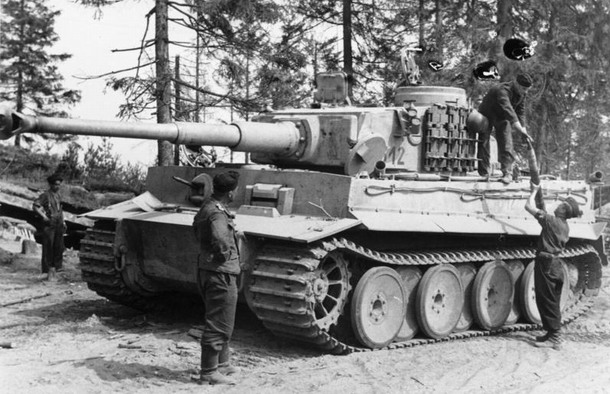
An early-variant Tiger being rearmed, source: Bundesarchiv_Bild_101I-461-0213-34, Wikimedia, Creative commons, edited.
In practice, this amounted to removing the two outer layers of wheel discs, as illustrated in the diagram below — the hatched wheels were eliminated. The same weight now had to be supported by 36 wheels instead of 48, which would not have been possible without a further innovation. Along with the new arrangement, the Tiger received new all-steel road wheels. The impetus for developing the new wheel design was not only the need for greater load-bearing capacity but also the desire to conserve scarce raw materials — the original road wheels had been fitted with rubber tyres around their circumference, and rubber was becoming an increasingly scarce commodity for Germany in the second half of the war.
The designers thus killed two birds with one stone: they reduced rubber consumption while simultaneously simplifying the tank's running gear. The new arrangement reduced the number of gaps between wheels and thus the likelihood of stones jamming or mud freezing in them. This change was applied from the 826th tank produced onwards.
The removal of the two outer rows of wheels narrowed the overall running gear assembly. While in the earlier design the road wheels had extended to the outer edge of the tracks, the new arrangement left a large portion of the track overhanging to the side.
From July 1943, Tigers began to receive a new commander's cupola. The old cupola with glazed vision slits was replaced by one fitted with seven observation periscopes arranged symmetrically around its circumference, giving the tank commander a vastly improved field of view.
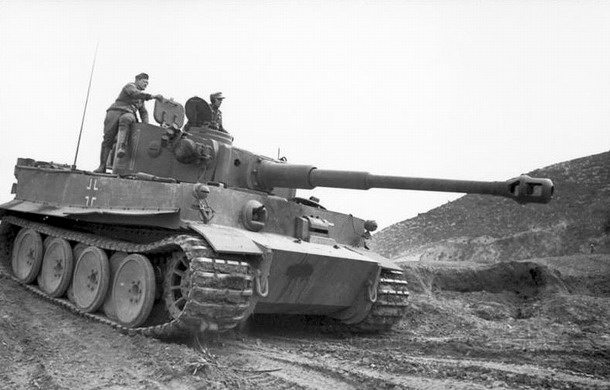
Tiger tank in Africa, source: Bundesarchiv_Bild_101I-554-0872-35, Wikimedia, Creative commons, edited
Around the rim of the new cupola, a rotating ring mount was added for an MG34 machine gun, serving as a means of improvised anti-aircraft defence. When outside areas with a threat of air attack, the machine gun was removed and stowed inside the turret. The hatch opening mechanism was also changed — the original hatch, which opened upward on a hinge, was replaced by one that could be partially raised and then swung to the side.
The most significant internal change made during the production run was the replacement of the powerplant. The first 250 series-production tanks were powered by the Maybach HL210 P45 already mentioned. From May 1943, the improved Maybach HL230 P45 began to be used instead, with a displacement of 23 litres and a maximum output of 694 horsepower at 3,000 rpm.
Beyond the changes described, the tank naturally underwent numerous smaller detail modifications during its production life. The design of the exhaust covers on the rear hull plate changed, as did the rear mudguards. From August 1943, tanks were coated with Zimmerit anti-magnetic mine paste.
Two Types of Tracks
The designers of the Tiger had to pay very close attention to the ground pressure the vehicle exerted on the soil. The terrain conditions of the Eastern Front were unforgiving, and the ability to cross vast expanses of mud without becoming stuck was critical. Thanks to the use of tracks 725 mm wide, ground pressure was kept to 1.04 kg/cm², which — while not entirely optimal (by comparison, the T-34/76 achieved a ground pressure of just 0.64 kg/cm²) — was at least acceptable.
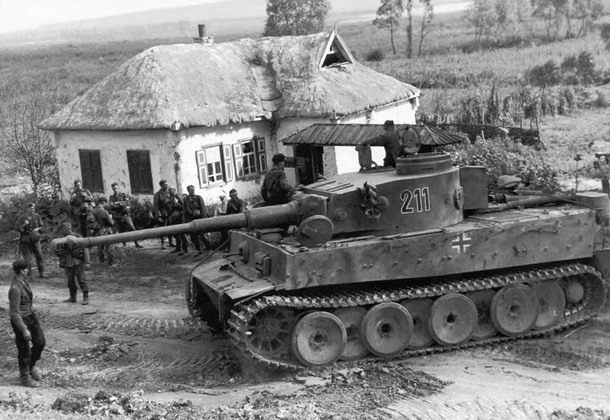
When it entered service, the Tiger was a true king of the battlefield and commanded well-deserved respect, source: Flickr.com, courtesy of the publishing user, edited.
The wide tracks, necessary for distributing the weight and keeping ground pressure within acceptable limits, created a serious complication for rail transport. With the operational tracks (Marschketten) fitted, the Tiger's total width was 3.72 m — wider than could be loaded onto standard railway flatcars. Before loading, tanks therefore had to be fitted with narrower transport tracks (Verladeketten) measuring 520 mm in width.
On older Tigers with the original interleaved wheel arrangement, changing to transport tracks also required removing the two outer rows of road wheels. This significantly complicated and extended the whole track-changing process. Later-production tanks, with their simpler all-steel wheel arrangement, were free of this problem — their running gear was already narrower by exactly those two outer rows of wheels.
Even on these later tanks, however, changing tracks was far from a trivial task. Each link of the operational tracks weighed 30 kg, and each track consisted of 96 links. The total weight of one complete wide track was therefore 2,880 kg — a figure that makes clear just how demanding the handling of the tracks was.
In addition to the tracks and wheels, the side mudguards also had to be removed — though this was by far the least of the problems involved. During transit the operational tracks were stowed beneath the tank itself and travelled with it. The transport tracks were the property of the railway flatcar assigned to carry these tanks, so after being changed back to operational tracks at the destination station, they were simply loaded back onto the flatcar.
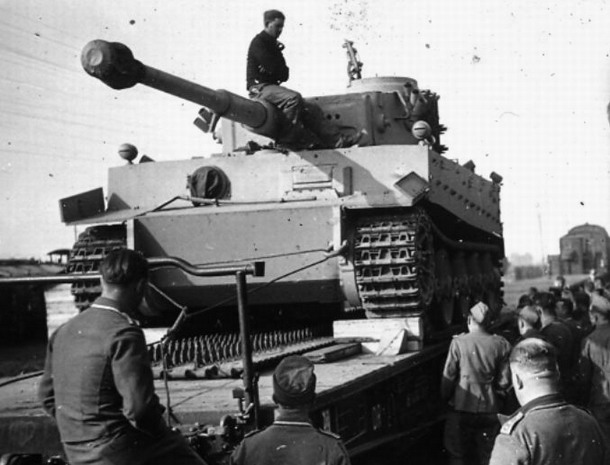
Tiger on a railway flatcar fitted with narrow transport tracks. Note the operational tracks stowed beneath the tank. Source: Flickr.com, courtesy of the publishing user, edited.
The narrow tracks were officially intended solely for rail transport and were not to be used for any other purpose. When fitted, ground pressure increased by 40%, and prolonged use risked damage to both the ground surface and the tracks themselves. Despite this, as countless photographs demonstrate, the narrower tracks were sometimes used for ordinary driving.
Unit Organisation
Tiger tanks were not assigned to individual tank divisions as was the norm for other German tanks of the period. Instead, they were formed into wholly independent units — heavy tank battalions, designated by the abbreviation sPzAbt (sPzAbt = schwere Panzerabteilung). The organisational structure of these units changed over the years.
According to the original tables of organisation from August 1942, each battalion (Abteilung) was to consist of two companies (Kompanie), each with four platoons (Zug). Each platoon contained two Tigers and two support tanks — PzKpfw III Ausf. N. In addition, each company headquarters had one Tiger and two PzKpfw III Ausf. N on strength. Each company thus totalled nine Tigers and ten Panzer IIIs. The battalion also had a signals platoon of two Tiger command variants and one Panzer III Ausf. L. The total number of Tigers in an establishment-strength battalion, including command variants, was therefore twenty.
From March 1943, however, the official structure changed. A battalion now comprised three companies, each with three platoons. Each platoon still consisted of two Tigers and two PzKpfw III Ausf. N. Each company headquarters now had two Tigers instead of the previous one Tiger and two Panzer IIIs. The battalion signals platoon was also restructured — its Panzer III Ausf. L was replaced by a standard Tiger. A heavy tank battalion at full establishment strength now numbered 27 Tigers in total, including command variants.
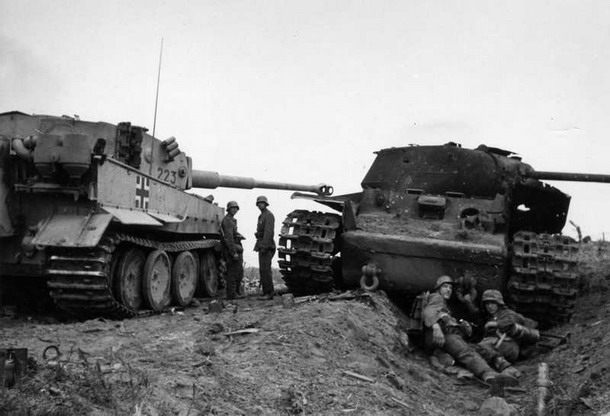
A Tiger and its victim — a Soviet KV-1S, source: Flickr.com, courtesy of the publishing user, edited.
As Tiger production gradually increased, the support Panzer III Ausf. N tanks in the platoons began to be replaced by additional Tigers. Under the tables of organisation for 1944 and 1945, each platoon was to have all four of its tanks as Tigers. The total number of Tigers per company thus rose to 14, and per battalion to 45 vehicles. These were, of course, paper figures — in practice, battalions were generally below establishment strength due to combat losses, mechanical problems, and so on.
In addition to the tank companies, each battalion had a number of supporting elements essential to its operation. These were a services company and a maintenance company. The services company included a motorcycle reconnaissance platoon, an anti-aircraft platoon, a pioneer platoon, a transport platoon, a medical unit, and an escort tank platoon. The escort tank platoon earlier had ten Panzer IIIs or Panzer IVs, or a mix of both. In later years this became ten Panzer IV Ausf. H or Ausf. J. The maintenance company consisted of a recovery vehicle platoon and repair facilities.
A total of 11 Wehrmacht heavy tank battalions and 3 Waffen SS heavy tank battalions were formed. The Wehrmacht battalions were numbered sPzAbt 501 through 510. The eleventh was the 3rd battalion of the tank regiment of the Grossdeutschland division. The first to be established was sPzAbt 502, formed in April 1942. The last to be formed was sPzAbt 510, on 6 June 1944. In addition, Tigers were also equipped to smaller independent units such as Tigergruppe Meyer, Panzerkompanie Hummel, and others.
In November 1942, the Waffen SS was also authorised to form one heavy tank company each within the 1st, 2nd, and 3rd SS tank regiments belonging to the Waffen SS divisions Leibstandarte, Das Reich, and Totenkopf. These companies gradually grew until, in the summer of 1943, they were expanded into the 101st, 102nd, and 103rd SS Heavy Tank Battalions.
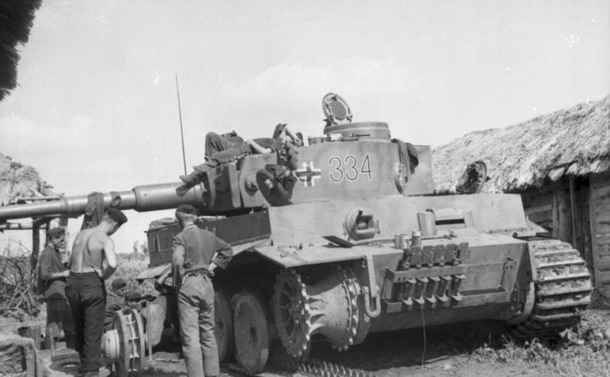
the Tiger was a highly capable fighting machine, but demanded constant maintenance and servicing, source: Bundesarchiv_Bild_101I-022-2948-05, Wikimedia, Creative commons, edited
Combat Deployment
The Tiger's first combat deployment had been planned for North Africa, within the 501st and 503rd sPzAbt. These battalions were originally to be equipped with Porsche Tigers, which were already waiting in the factories awaiting completion. After Porsche's defeat in the competitive trials, however, their equipping was delayed, and the first series-produced Henschel tanks ultimately went to the 502nd battalion — which, despite its number, thus became the first battalion to be physically established and equipped.
The Eastern Front became the Tiger's first actual battlefield. On 29 August 1942, four brand-new Tiger tanks belonging to the 1st company of the 502nd Heavy Tank Battalion arrived at the town of Mga, near Leningrad. There, four support tanks — PzKpfw III Ausf. N — were attached to the Tigers, giving Army Group North two complete establishment-strength platoons by September.
On 16 September the Tigers went into action for the first time, supporting an infantry attack on strategically important heights in the surrounding area. The choice of ground for the first deployment of the new tanks proved very unfortunate, however. Three of the four Tigers became stuck in soft ground and had to be towed back by recovery vehicles.
The follow-up action on 22 September went even worse. The commanders, apparently having learned nothing from the first debacle, once again sent the Tigers into boggy terrain. This time all four vehicles became stuck. Three were eventually towed to safety, but the fourth was buried so deeply in the mud that it could not be freed despite repeated attempts. German engineers ultimately had to destroy the immobilised monster using several dozen kilograms of explosives to prevent it falling into enemy hands.

early-variant Tiger captured by the Allies in Africa, source: Flickr.com, Public domain, edited.
The general rule requiring the unconditional destruction of any Tiger that could not be recovered behind friendly lines applied throughout the war. The enemy was not to be given the opportunity to thoroughly examine the capabilities of the latest German tank on a captured example. Every effort was to be made to save the vehicles in the first instance, of course. When a tank was severely stuck, for instance, the recommended procedure was to blow the tracks off with explosive charges and tow it out on its road wheels alone. Sometimes even this was not possible.
The Tiger did eventually fall into enemy hands regardless. On 16 January 1943, retreating German forces in northern Russia were forced to abandon one immobilised tank. Soviet engineers subsequently recovered it, and the vehicle was transported to Moscow for thorough examination. In May of the same year, the Tiger was put on public display in Moscow as part of an exhibition of captured German equipment.
By that point the Soviets had gathered sufficient information on the strengths and weaknesses of the new German weapon. Much as the Germans had been forced to acknowledge, nearly two years earlier when they first encountered the Soviet T-34, the Soviets now had to admit that they had nothing in their arsenal that was a match for the Tiger.
All the early setbacks shared a common cause: mechanical failures. Actual combat losses of Tiger tanks at this stage were minimal. The Tiger's armour made it virtually invulnerable to the most common Soviet tank — the T-34/76 — in a direct engagement, not least because the Tiger's highly effective gun allowed it to open fire at ranges at which Soviet shells simply could not harm the German vehicles.
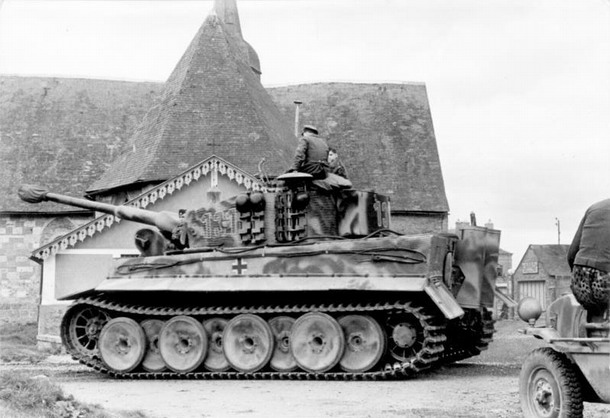
a mid-production Tiger — the vehicle already has the new commander's cupola, but still carries the original rubber-tyred road wheels, source: Bundesarchiv_Bild_101I-299-1804-04, Wikimedia, Creative commons, edited.
On 18 June 1943, for example, the Tiger of Hauptmann Waker from the 3rd company of the 506th Heavy Tank Battalion destroyed a Soviet T-34 at the extraordinary range of 3,900 metres! The Tiger's armour protection was illustrated by a documented case of a Tiger returning from combat under its own power after absorbing twenty hits from Soviet 76.2 mm anti-tank guns, with not a single crew member wounded.
The Tiger's combat record was sometimes almost unbelievable. On 4 November 1943, for instance, a single Tiger on patrol on the road between Nevel and Vitebsk destroyed ten T-34s. This was the tank commanded by Otto Carius, one of the greatest tank aces of the war. Carius spotted twelve Soviet tanks at long range but allowed them to approach to within just sixty metres before giving the order to fire, while remaining concealed himself in a camouflaged position. The surprised Soviets had almost no chance to respond, and only two of their tanks managed to escape the battlefield.
Even more remarkable is the fact that Carius's Tiger was on patrol at the same spot two days later. A group of five T-34s arrived to inspect what remained of their comrades' tanks — and this time not a single Soviet tank escaped Carius.
The celebrated tank ace Michael Wittmann also earned a great part of his fame in the Tiger. His combat performance in the French village of Villers-Bocage on 13 June 1944 became legendary — on that day alone, his Tiger destroyed 27 enemy vehicles. Another remarkable feat was achieved by Feldwebel Kramer from the 2nd company of the 502nd Heavy Tank Battalion, whose Tiger managed on 16 December 1943 to shoot down an Ilyushin Il-2 aircraft with a high-explosive shell.
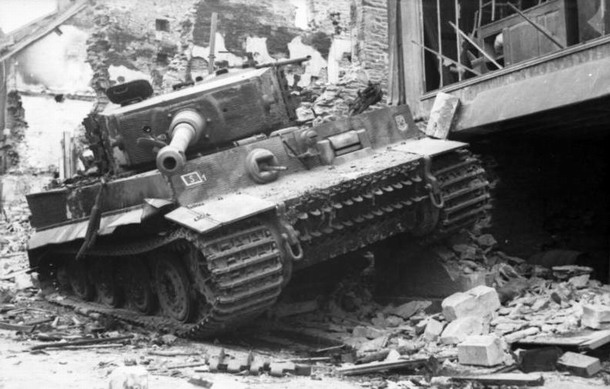
late-variant Tiger (with all-steel road wheels and monocular gunner's sight) destroyed at Villers-Bocage, source: Flickr.com, courtesy of the publishing user, edited.
The Soviet answer to the new German tank was to up-gun their most widely used tank, the T-34, producing the T-34/85 variant with an 85 mm gun. The development and deployment of the heavy IS-2 tank with its 122 mm gun was the other Soviet response. On the Allied side, the only vehicles capable of taking on the Tiger on something approaching equal terms were the Sherman Firefly and the later heavy tank M26 Pershing. All of these, however, appeared on the battlefield only later, and so when the Tiger first entered service it was a true master of the battlefield.
An indestructible master, however, it was not. Tigers could be destroyed — or at least knocked out — by concentrated artillery fire, aerial bombs, or anti-tank mines. A significant percentage of Tiger losses was also attributable to mechanical breakdowns.
Throughout the Tiger's operational life, both the Soviets and the Western Allies relied primarily on their overwhelming numerical superiority when facing it. By British estimates, destroying one Tiger required committing five Sherman tanks — with an expected loss of four of them.
It is no wonder, then, that Tigers inspired genuine terror in Allied tank crews. The phenomenon sometimes described as "Tiger phobia" led Allied tank men to see Tigers everywhere, mistaking even late-model PzKpfw IVs for them. All of this naturally had a considerable effect on morale on both sides. German tank crews regained the confidence that had been ground down by endless brutal fighting on the Eastern Front, while it became increasingly clear to the Allies that the road to Berlin would be no easy journey.
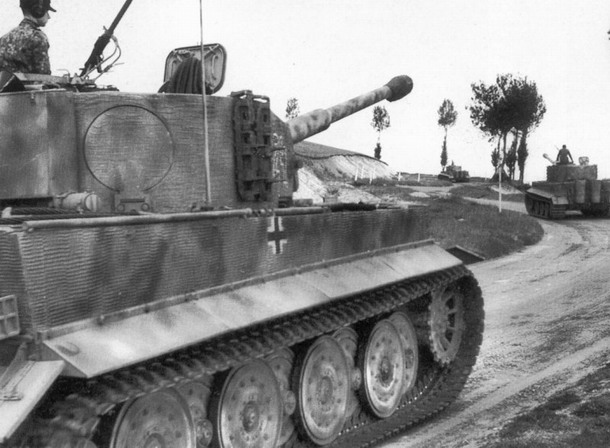
late-variant Tiger with all-steel road wheels, source: Flickr.com, courtesy of the publishing user, edited.
Because of their great combat effectiveness, Tigers were always deployed on the most threatened sections of the front, and almost always against superior enemy forces. Four combat and movement formations were officially approved for Tiger platoons. For movement and deployment, the formation known as Reihe (column) was used, with tanks following one behind another at an interval of 10 metres when deploying and 25 metres when on the move. The platoon commander's tank (marked with a cross in the diagrams below) led, with the section commander's tank (marked with a half-cross) in third position.
The Linie (line abreast) formation was also used for combat deployment. The platoon commander's tank was at the far right, with the section commander second from the left. When approaching the front line in open terrain or during an attack, the Doppelreihe (double column) formation was used. The platoon commander's tank led the right column, with the section commander to his left. The interval between the two columns was 150 metres, and the distance between tanks following one behind another in each column was 100 metres.
The most commonly used attack formation was the Keil (wedge). In the lead row of the wedge, the platoon commander's tank and the section commander's tank drove abreast with an interval of 100 metres. The second row followed 100 metres behind the first, with the tanks offset outward so that the interval between them was 300 metres.
In practice, combat formations never lasted long. The platoon commander had to manoeuvre his tank during battle to maintain the best possible overview of the overall situation, which frequently required him to leave the prescribed formation. Moreover, when tactically appropriate, the platoon would split during the engagement into two sections of two tanks each, one commanded by the platoon leader and one by the section leader. Both sections then operated independently, but remained under the platoon commander's orders throughout.

Allied troops testing the fording capabilities of a captured Tiger, source: Flickr.com, Public domain, edited.
Assessment
From the start of series production in July 1942 through to August 1944, a total of 1,355 Tigers were built. The relatively modest number produced was due — in addition to the increasing resource constraints facing German industry — primarily to the vehicle's exceptional cost and complexity to manufacture. The price of a complete Tiger was 800,000 Reichsmarks. The number of man-hours required to build one was 300,000 — enough to produce two Panther tanks, or even three Messerschmitt Bf 109 fighters.
The German public — and the world at large — first learned of the Tiger's existence on 11 December 1942, when a photograph of the tank was published in the magazine Nazional Zeitung.
The Tiger was a highly effective weapon. It was well armoured and superbly armed with what many experts consider the finest gun of the entire Second World War. It had significant weaknesses, however. The engine was underpowered for the vehicle's weight and frequently had to run at high revs, leading to considerable stress and relatively frequent breakdowns.
Even more prone to failure was the gearbox. It was technically a brilliant piece of engineering, but its construction was extremely complex and demanding in terms of both correct operation and maintenance. In the field, the required level of maintenance could not always be provided, and the gearboxes suffered accordingly, breaking down with considerable frequency. The already-mentioned enormous fuel consumption was another major weakness. According to veterans, a full tank of fuel was sufficient for approximately two and a half hours of combat operations.
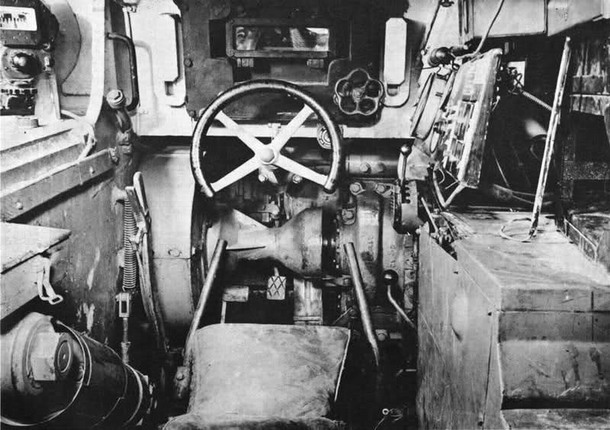
The Tiger's primary control was the unconventional steering wheel; the classic brake levers were present only as a backup in the event of its failure. Source: Flickr.com, courtesy of the publishing user, edited.
Derived Vehicles
Not many Tigers were built, and the same was true of their variants and vehicles derived from them. A specialised command tank was developed for unit commanders, carrying an expanded radio suite to ensure reliable communication with higher headquarters and supporting units. These vehicles existed in two versions designated Sd.Kfz. 267 and Sd.Kfz. 268, differing in the radio sets fitted. The Sd.Kfz. 267 was equipped with the standard Fu 5 set plus an additional Fu 8; the Sd.Kfz. 268 carried a supplementary Fu 7 instead. Installing the additional radio equipment required the removal of the co-axial turret machine gun. All other armament was retained. Command tanks also carried additional antennas.
A small number of Tigers were converted into recovery and field maintenance vehicles known as the Bergepanzer VI or Bergetiger. The gun was removed from the turret and the opening plated over. A 15-tonne crane powered by the tank's engine was fitted to the turret roof. In addition to recovering bogged-down heavy vehicles, the Bergetiger was also used in field repair workshops to handle engines, gearboxes, and other components of vehicles under repair.
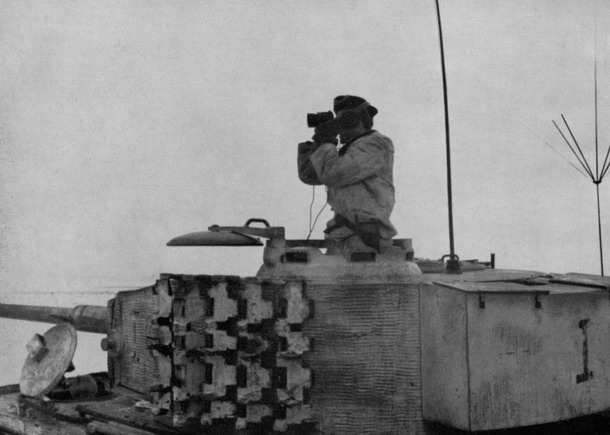
The Tiger command variant carried an expanded radio suite. The whip antenna was relocated to the turret roof, and a second antenna with a star-shaped aerial was added to the side of the hull. Source: Flickr.com, courtesy of the publishing user, edited.
A small number of Tigers were adapted for gas propulsion for crew training purposes. Four pressure tanks — two on each side at the rear — substantially altered the vehicle's silhouette. By the end of the war Germany was facing an acute shortage of petrol, and conversions of non-combat vehicles to alternative fuels were fairly common.
It is also worth noting that alongside the later standard turret, Krupp was also developing a second turret armed with a 75 mm gun. This was intended for an alternative version of the Tiger built on the standard Henschel chassis, which Henschel designated Tiger H2. The turret featured one element very unusual for German tanks — a machine gun in a ball mount on the rear turret wall. Since development of the turret with the heavier armament was proceeding without problems, however, the Tiger H2 project was abandoned before a prototype was ever built.
The Tiger's chassis also served as the basis for the self-propelled rocket launcher Sturmtiger (described in a dedicated chapter in the Self-Propelled Guns section).
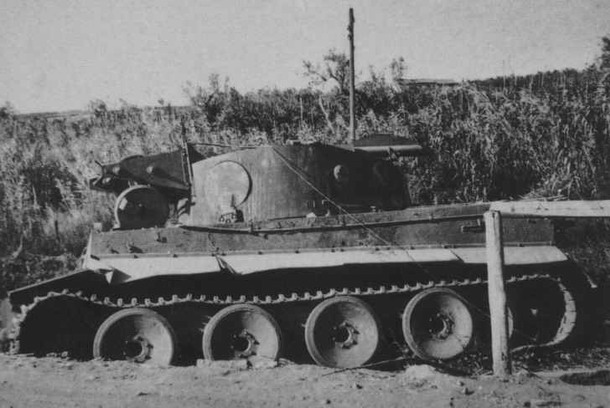
the Bergetiger recovery and maintenance vehicle, source: Flickr.com, courtesy of the publishing user, edited.
The Porsche chassis that had remained in the factory halls after losing the competitive trials also found a use. In addition to the Ferdinand tank destroyers built on them, five recovery vehicles designated Bergetiger (P) were also produced (this vehicle is described on the page dedicated to the already-mentioned Ferdinand tank destroyer).
Conclusion
Tigers fought on every front — in the East, in the West, and in Africa. The appearance of new heavy tanks on the enemy side and the development of ever more effective anti-tank weapons eventually forced the Germans to develop the new, even more massive and powerfully armed Tiger II — also known as the Königstiger — which replaced the original Tiger in production during 1944. Königstigers were never produced in sufficient numbers to completely supplant the original tanks in frontline units, however, and Tiger I tanks — as the original Tigers came to be called to distinguish them from their successor — fought on until the very last days of the war, remaining dangerous opponents to the end.
Many individual crews compiled remarkable records in tank-versus-tank combat, and the total number of enemy tanks and self-propelled guns destroyed by Tigers was a multiple of the number of Tigers ever built.
Technical Data
|
weight: |
56.9 t |
|
length: |
8.45 m |
|
width: |
3.70 m |
|
height: |
3.00 m |
|
engine: |
Maybach HL210 P45 (HL230 P45) |
|
engine output: |
650 hp (700 hp) |
|
max. speed: |
45.5 km/h |
|
fuel capacity: |
534 l |
|
fuel consumption – road: |
535 l / 100 km |
|
fuel consumption – cross-country: |
935 l / 100 km |
|
hull armour: |
|
|
- front: |
100 mm |
|
- sides: |
80 mm |
|
- rear: |
80 mm |
|
turret armour: |
|
|
- front: |
100 mm |
|
- sides: |
80 mm |
|
- rear: |
80 mm |
|
crew: |
5 men |
|
armament: |
KwK 36 gun, 88 mm calibre 2 x MG 34 machine gun, 7.92 mm calibre |
ARTICLE
CONTENTS:
Reproducing text from the Panzernet website without the written consent of the operator is prohibited.