TIGER II
Germany's most powerful mass-produced tank
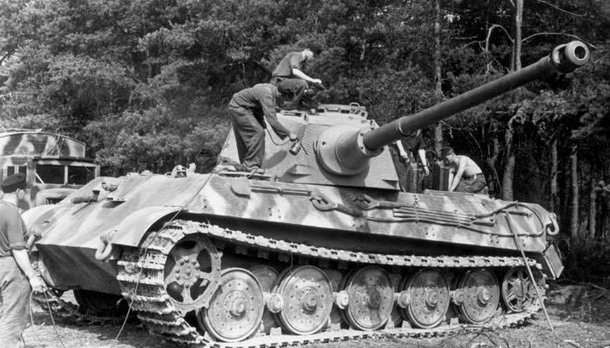
PzKpfw VI Tiger Ausf. B, also known as Tiger II or Königstiger. Source: Bundesarchiv Bild 101I-721-0398-21A, Wikimedia, Creative Commons, edited
Strictly speaking, Königstiger is the German term for the Bengal tiger, but in the context of this tank the word is more often translated literally as "King Tiger" (which also corresponds to the commonly used English variant Kingtiger). In any case, Königstiger was never the official name of the famous German heavy tank. It is therefore more accurate to refer to it as the Tiger II, or Tiger Ausf. B (Ausf. = Ausführung = variant, version). Throughout this article and on this site in general, however, we also use the popular nickname Königstiger for simplicity.
Hitler Wants More
The Tiger II was the last German tank to enter series production during the Second World War. It was also the heaviest and most powerfully armed German production tank. The first step towards its creation was taken on 26 May 1941, at a meeting between Hitler, Armaments Minister Todt, representatives of the Army Weapons Office, and the chairman of the so-called Panzerkommission, the renowned Czech-born Dr. Ferdinand Porsche. The Panzerkommission — the tank commission — was an advisory body whose members represented leading industrial firms involved in tank development and production, with Porsche serving as its chairman.
Among the topics discussed at that meeting was the current state of development of the new heavy tank Tiger (referred to as Tiger I in this article for clarity). This project carried the codename VK 45.01, and two competing firms were preparing their respective prototypes: Henschel (prototype VK 45.01 (H)) and Porsche (prototype VK 45.01 (P)). Porsche worked very closely with Krupp, who was designing the turret and gun. Both Porsche and Henschel planned to equip their Tiger I designs with the 8.8 cm KwK 36 L/56 gun, manufactured by Krupp. As the designation suggests, this was an 88 mm calibre weapon with a barrel 56 calibres long. During the meeting on 26 May 1941, Hitler expressed his doubts about whether this gun would be a sufficiently powerful weapon. He demanded that the new tank's gun be capable of penetrating armour up to 100 mm thick at a range of 1,500 metres — something the Krupp weapon could not achieve.
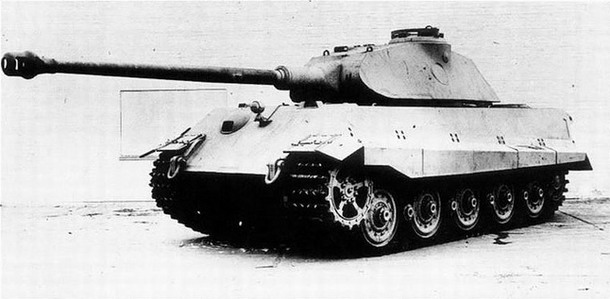
The first Tiger II prototype was handed over to the army in November 1943. Note the flat front mudguard sections. Source: Flickr.com, with permission of the publishing user, edited
The only suitable weapon meeting Hitler's requirements was the new 88 mm anti-aircraft gun, the 8.8 cm Flak 41 L/74, made by Rheinmetall. However, this gun had a barrel almost a third longer than the originally planned KwK 36 L/56 (4,930 mm vs. 6,548 mm). The Flak 41 L/74 also had a larger breech chamber, a more powerful recoil mechanism, and its ammunition was considerably longer than that of the KwK 36 L/56. It became clear that the turret Krupp had developed for the Tiger I — designed to accommodate the KwK 36 L/56 — simply could not accept the more powerful Flak 41 L/74. An entirely new and more spacious turret would be needed for the longer gun. Moreover, it was far from certain whether the existing turret ring diameter would even be sufficient for such a larger turret, and if not, further changes to the hull itself would be required.
What seemed like a straightforward gun swap thus threatened significant delays to the entire project. To make matters worse, the Flak 41 L/74 was still in the testing phase and not yet in series production. It was therefore decided that the VK 45.01 project (the Tiger I) would be completed and put into production as originally designed, with the existing turret and KwK 36 L/56 gun. In parallel, development of an entirely new turret capable of housing the more powerful Flak 41 L/74 would begin immediately, and as soon as it was ready, it would replace the original turret in production. The Weapons Office expected the first 100 series Tigers to carry the original turret and gun, with the switch to the new turret and more powerful gun happening from the 101st vehicle onwards.
Both Krupp (who had designed the original Tiger I turret) and Rheinmetall (the maker of the more powerful Flak 41 L/74) were tasked with preparing new turret designs for the heavier gun. During the development process it apparently became clear that the Flak 41 L/74 was simply not suitable for installation in an armoured fighting vehicle. Both competing firms therefore decided to develop entirely new weapons for their turrets that would still meet Hitler's penetration requirements. Krupp began work on a new generation of 88 mm gun with a barrel 71 calibres long (L/71), while Rheinmetall started on a new 75 mm gun with a 70-calibre barrel (L/70). Krupp once again worked closely with Porsche, so Rheinmetall logically found its partner in Henschel.
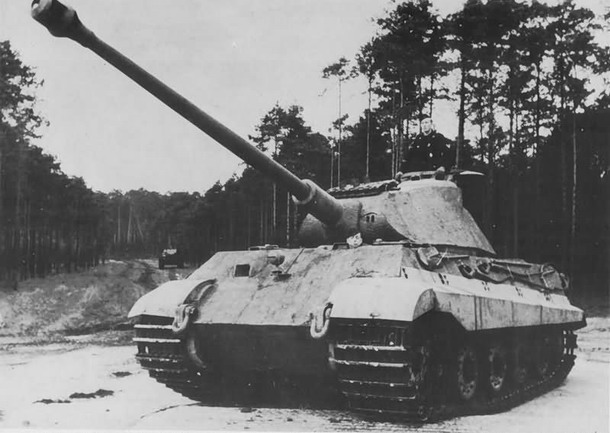
Tiger II with hull number 280006 (the sixth production vehicle) was completed in February 1944 and is seen here during trials at the Kummersdorf proving ground. Source: Worldwarphotos.info, with permission of the site operator, edited
VK 45.02 and VK 45.03
The original plan was to leave the hull and running gear of the Tiger I unchanged and simply fit a new turret and gun from the 101st vehicle. As time passed, however, the army kept adding new requirements, and it soon became clear that what the military actually wanted was an entirely new tank. Among the main new requirements was the use of sloped frontal armour. Around April 1942, development work was therefore also being pursued as a completely new project, designated VK 45.02 (P) for Porsche and VK 45.03 (H) for Henschel. The designations Tiger P2 (for Porsche) and Tiger H3 (for Henschel) were also commonly used. The project later also received the simpler designation Tiger II. (Note: the designation VK 45.02 (H) and Tiger H2 had already been used for a different project, hence VK 45.03 (H) / Tiger H3.)
Now that an entirely new tank was being developed rather than just a new turret, the inevitable consequence was a longer development timeline. In July 1942 the order for series production of the original Tiger I with the KwK 36 L/56 gun was therefore extended. Recall that under the earlier plan only one hundred such vehicles were to be built, with the 101st already receiving the new turret and gun. Now the order for the original tank was expanded to an even three hundred vehicles, after which production of the old Tiger I would cease and production of the new Tiger II would begin.
In July 1942 the Weapons Office rejected Rheinmetall's conceptual proposal for a new turret with a 75 mm, 70-calibre gun. This effectively settled the matter: the future Tiger II would carry a Krupp turret with an 88 mm gun. Porsche himself, who worked closely with Krupp, apparently took this as proof of his favoured position in the project and gave free rein to his creativity, preparing no fewer than five different new tank designs combining various types of combustion, electric, and hydraulic drivetrains (some with the turret at the front, others at the rear). These variants were designated internally as Types 180A, 180B, 181A, 181B, and 181C. Henschel, by contrast, approached the development work with considerably more caution. Especially after the rejection of the Rheinmetall 75 mm turret, Henschel feared their chances of beating Porsche were rather limited.
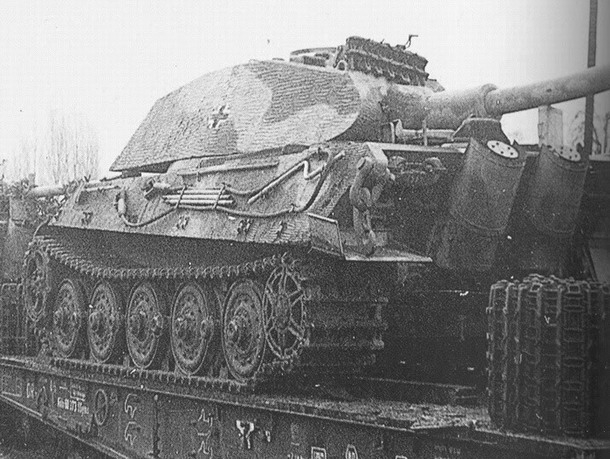
This Tiger II loaded on a flatcar is fitted with the narrower transport tracks; the wider combat tracks are rolled up behind the tank. Based on the exhaust configuration, this vehicle is one of the very first production examples built in January 1944. Source: Flickr.com, with permission of the publishing user, edited
Everything changed in August 1942, when the selection committee chose the Henschel prototype VK 45.01 (H) for series production of the Tiger I. Porsche lost primarily due to his complex diesel-electric drivetrain — the same system he intended to use in the new Tiger II. It came as no surprise, therefore, that in November 1942 Porsche's VK 45.02 (P) design was rejected without even waiting for a prototype to be built. The diesel-electric drivetrain worked as follows: the tank was fitted with one or two conventional combustion engines, either diesel or petrol. These drove an electric generator, which in turn produced current for a pair of electric motors. The electric motors then finally drove the track sprockets. Porsche favoured this arrangement because he believed a tank of such weight could not be equipped with a conventional mechanical gearbox, fearing it would simply not withstand the enormous load. Steering a tank powered by electric motors was theoretically very easy and acceleration perfectly smooth. In practice, however, it was an overly complex solution with significant energy losses and additional maintenance demands.
At the same time as Porsche's VK 45.02 (P) was cancelled, Henschel was tasked with completing its VK 45.03 (H) as quickly as possible and commencing series production. Krupp was simultaneously instructed to adapt its turret — originally designed for Porsche — so that it could be installed on the Henschel hull. Fortunately, the only modification required in this regard was a change to the turret traverse drive mechanism.
In January 1943, Hitler intervened with an additional requirement: the new tank's frontal armour was to be increased to 150 mm. Another requirement that surely delighted the designers arrived in February 1943 — the new Tiger II was to be standardised with the then-developing Panther II. This meant sharing specific engine types, gearboxes, cooling systems, and even tracks. Such additional requirements naturally prolonged Tiger II development further, which meant production of the original Tiger I had to continue longer than planned — the Germans simply could not afford a production gap. (Note: the Panther II project was ultimately cancelled, so this standardisation effort came to nothing.)
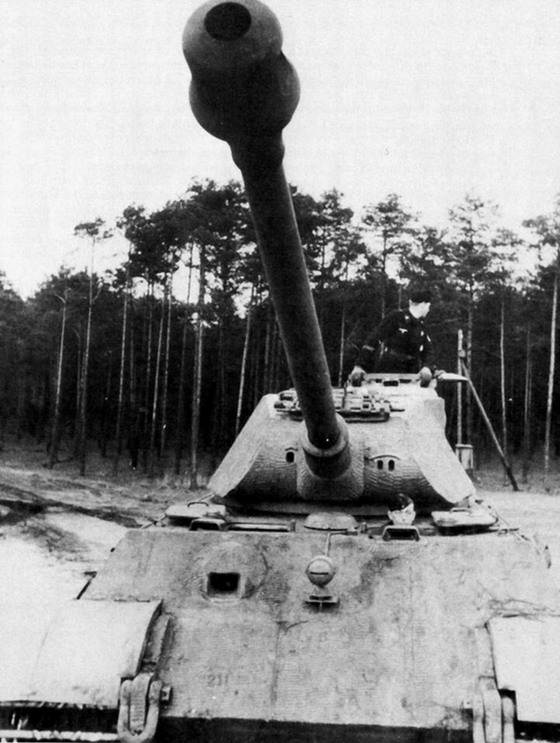
Tiger II hull number 280006 again during trials at Kummersdorf. This image clearly shows the original one-piece barrel without the wider first section. Source: Flickr.com, with permission of the publishing user, edited
As already noted, both Krupp and Rheinmetall prepared new turret designs for the more powerful gun. Rheinmetall's proposal, featuring a 75 mm gun, had been rejected in July 1942, leaving only Krupp's design in the running. Krupp had developed this turret in collaboration with Dr. Porsche, and as it turned out, it was far from an ideal solution. The front face of the proposed turret consisted of a heavily curved armour plate up to 100 mm thick. Bending such a thick steel plate was no simple task, and it sometimes resulted in minor cracks. Another inefficient feature was the complex shape of the left side wall of the turret, which required a bulge to accommodate the commander's cupola. This made the turret more laborious and costly to produce than the Weapons Office would have liked. The curved front plate also created a risk of deflecting an incoming enemy round downward — directly into the relatively thin roof of the crew compartment below.
As early as August 1942, Krupp was therefore tasked with revising its design to eliminate the risk of downward deflection and to make the turret faster and cheaper to produce, while maintaining the same level of protection. There was, however, a problem. In February 1942, in order to accelerate the start of series production, Krupp had already received a contract from the Weapons Office for the first one hundred turrets. By August 1942 this batch was in the middle of production. To avoid wasting already-completed components, it was decided that Krupp would finish 50 turrets to the original design, with the 51st Tiger II receiving a turret of the new, improved pattern.
According to the October 1942 plan, the first Tiger II prototype was to be completed by September 1943, with series production commencing immediately thereafter. Output was to increase gradually, reaching the target rate of 50 tanks per month by May 1944. Due to the delays described above, however, the first complete prototype did not emerge until November 1943. This vehicle carried the serial number V1 (V = Versuchs = test). The prototype consisted of the running gear and hull developed by Henschel as the VK 45.03 (H), fitted with the Krupp turret featuring the curved front plate.
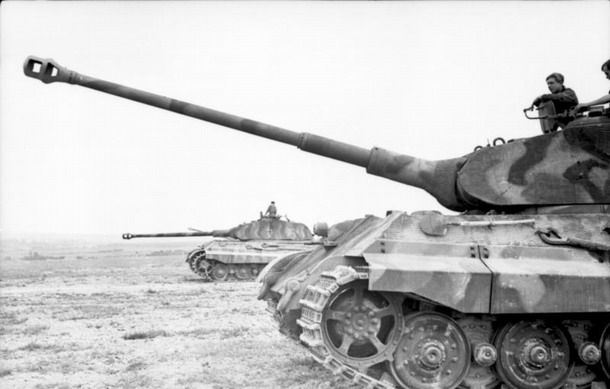
Tiger IIs with the Porsche turret. This turret variant was later replaced, partly due to the unfortunate curvature of its front face which risked deflecting incoming rounds downward into the thin hull roof. The vehicle in the foreground already has the two-piece gun barrel. Source: Bundesarchiv Bild 101I-721-0397-29, Wikimedia, Creative Commons, edited
Running Gear
The new Tiger II had nine road wheel axles on each side. To distribute the tank's enormous weight effectively, the maximum possible number of road wheels was required. The solution was an overlapping arrangement: the axles were placed very close together and each carried two road wheels. On odd-numbered axles the wheels were positioned at the outer end of the axle, while on even-numbered axles they were mounted closer to the hull. Viewed from the side, the wheels overlapped each other considerably. Compared to the older Tiger I, this was a significantly simpler arrangement with less risk of stones becoming jammed between the wheels (the wheel arrangement is clearly visible in the image HERE (Public domain)). The road wheels of the new tank were all-steel with a diameter of 800 mm, sprung by torsion bars. The first two and last pair of road wheels were additionally fitted with shock absorbers mounted inside the hull, as these wheels had to absorb the most vibration during travel. Besides the road wheels, the running gear included rear idler wheels and front drive sprockets.
The Tiger II used two types of tracks: narrower transport tracks and wider combat tracks. The combat tracks were 800 mm wide, giving a ground pressure of approximately 0.76 kg per square centimetre. The transport tracks were 660 mm wide, producing a ground pressure of 1.23 kg per cm². Transport tracks were necessary for rail travel, as with the combat tracks installed the tank was simply too wide for standard rail loading gauges. Before loading onto a flatcar it was therefore necessary to swap the tracks, and then again after unloading at the destination. Crews were prohibited from using the transport tracks for normal overland travel. The tracks consisted of 46 double-link sections, each comprising a main link and a connector link. A single double-link section of the transport track weighed 42.9 kg; for the combat track, 62.7 kg. It is easy to calculate that a complete combat track for the Tiger II weighed no less than 2,884 kg — track swapping was clearly a demanding job that exceeded the limits of manpower alone.
The Hull
The hull of the Tiger II strongly resembled that of the medium Panther tank, though it was considerably more robust. The most exposed part of the hull — the upper front plate — was an extraordinary 150 mm thick. Moreover, it was angled at 50 degrees, further increasing its protective value. The front of the tank was as a result practically immune to any type of fire. The lower front plate was "only" 100 mm thick, also angled at 50 degrees but in the opposite direction. The thinner armour here was not a serious drawback, since the probability of being hit by an enemy round in this location was negligible — any projectile striking there would have to be on a descending trajectory and would almost certainly glance off the armour into the ground.
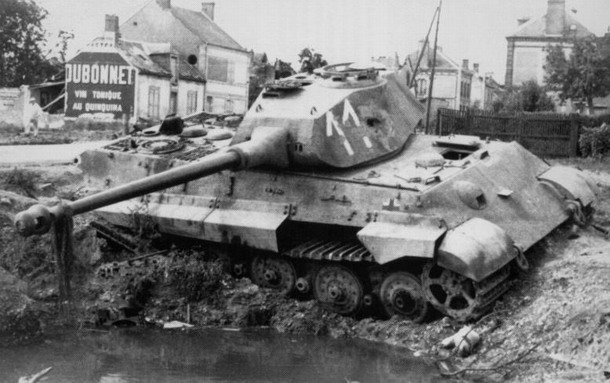
A knocked-out Tiger II with the Porsche turret. The vehicle has the original one-piece gun barrel without the wider first section. Source: Worldwarphotos.info, Public domain, edited
The driver sat on the left side of the hull front. He observed through a rotating periscope mounted in the hull roof, just at the edge of the front plate. The designers chose a roof-mounted periscope for two reasons: drilling a vision port through a 150 mm steel plate would have been enormously difficult, and it would have created an unnecessary weak spot in an otherwise near-impenetrable front. To the driver's right sat the radio operator, who also manned the hull machine gun — an MG 34. The ball mount for this weapon was built into the right half of the front plate, along with a Kugelzielfernrohr 2 sight. The radio operator also had his own observation periscope built into the hull roof above his position. Unlike the driver's periscope, this one was fixed rather than rotating, angled 16.5 degrees to the right.
The hull side walls were 80 mm thick, as was the rear wall. The hull roof was 40 mm thick. The hull floor was 40 mm thick at the front and 25 mm at the rear under the engine compartment. The roof panel above the driver and radio operator's positions was a large rectangular plate that could be unbolted, providing access for lifting out the entire gearbox.
The Porsche Turret
Behind the driver and radio operator's positions lay the turret space. As already noted, the first 50 tanks received turrets designed by Krupp for Porsche's VK 45.02 (P) prototype, featuring a curved front face 100 mm thick. The side walls of this turret were 80 mm thick and angled at 30 degrees. While the angle increased their protective value, it also meant the turret narrowed significantly towards the top, leaving insufficient room on the roof for the commander's cupola. An outward bulge therefore had to be formed in the left side wall to accommodate it.
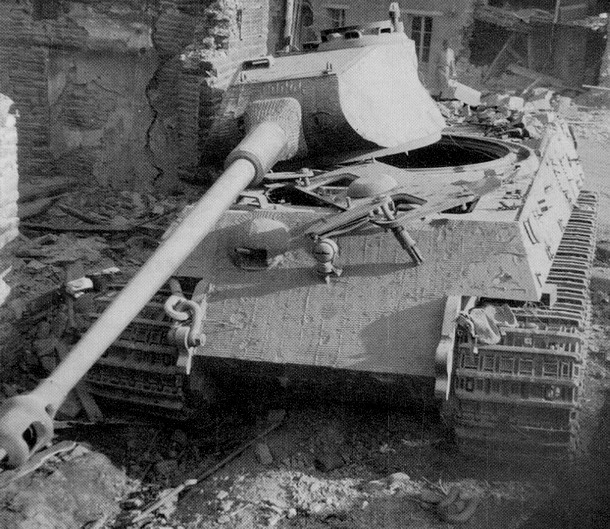
A destroyed Tiger II with the Porsche turret, apparently blown off by an ammunition explosion inside. The gun has the original one-piece barrel, but the newer monocular TZF 9d sight (one of the original two sight apertures is blanked off). Source: Flickr.com, Public domain, edited
As the above implies, the commander's cupola was positioned on the left side of the turret roof. It was the highest point on the entire tank and its purpose was to give the vehicle commander the best possible all-round observation. To this end, seven observation periscopes were arranged around its circumference. The cupola also served as the entry and exit hatch. A ring mount for a freely positioned MG 34 machine gun was fitted around the outside of the cupola.
A second entry hatch was located in the right side of the turret roof. The roof also housed a ventilation fan, a loader's periscope, a circular ejection port for spent 88 mm cartridge cases, and the barrel of the Nahverteidigungswaffe — literally "close-defence weapon" — a grenade and smoke launcher (the turret roof layout is clearly visible in the image HERE (Public domain)). The firing mechanism of this weapon was mounted inside the turret beneath the roof; only the barrel protruded through the roof. In addition to smoke grenades, the Nahverteidigungswaffe could also fire anti-personnel fragmentation rounds, and it was even possible to fire a signal pistol through the barrel. For reference, the Sprenggranatpatrone 326 Lp round fired from this weapon travelled 7 to 10 metres before detonating approximately 0.5 to 2 metres above the ground. The resulting fragments had a lethal radius of up to one hundred metres — clearly a rather effective weapon against infantry pressing close to the tank.
In the right side wall of the turret there was a small circular port, sealed with an armour plug, intended as a pistol port for the crew's personal weapons. An identical port was planned for the left side wall, and on this side there was also a larger circular opening intended to allow direct communication between the tank commander and someone standing outside — for instance, a conversation with an accompanying infantry commander or a despatch rider. However, already on the first prototype it was decided that these openings in the turret sides were more of a liability than an asset, and all three (two pistol ports and one communication port) were permanently welded shut. On later series vehicles with this turret type, the openings were either welded closed or not created in the armour plate at all.
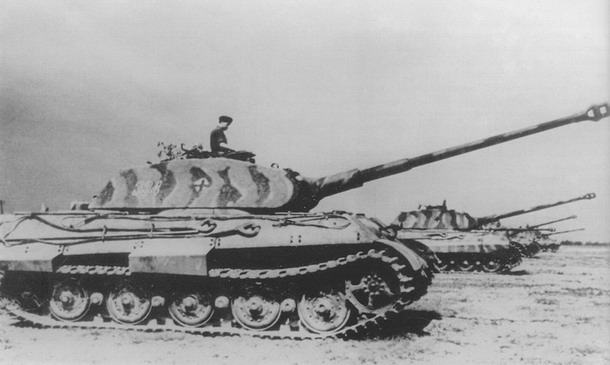
The Tiger II's combat debut took place on the Western Front with the 503rd battalion in July 1944. The vehicle in the foreground already has the two-piece gun barrel and the newer tracks (the drive sprocket has only nine teeth). Source: Flickr.com, with permission of the publishing user, edited
In the rear wall of the turret there was another large opening, used primarily for loading ammunition but which could also serve as an emergency escape hatch. Its cover incorporated a small circular pistol port sealed with an armour plug. A large portion of the rear turret wall could be unbolted, and through the resulting opening the gun could be removed from the turret without having to lift off the entire turret assembly. For deep fording operations, the entire turret could be hermetically sealed — including its ring, which was sealed using an inflatable rubber gasket.
The KwK 43 L/71 Gun
The turret of course housed the tank's main armament. As already mentioned, neither the Rheinmetall Flak 41 L/74 nor any direct derivative was ultimately used. Instead, Krupp developed its own purpose-built weapon, designated the 8.8 cm KwK 43 L/71. This gun was designed from the outset for installation in the new tank. Its barrel was 6,298 mm long — approximately 71 calibres — roughly 25 cm shorter than the Flak 41 L/74. New ammunition was developed for it with a shorter but wider cartridge case, allowing easier handling in the confined interior of the turret. The breech chamber and recoil mechanism were also shorter, making the KwK 43 L/71 considerably more suitable for tank installation than the originally proposed Flak 41 L/74 in every respect, while achieving very similar armour penetration performance. The KwK 43 L/71 was fitted with a muzzle brake to reduce recoil and shorten the barrel's recoil travel. The gun was not mounted exactly on the turret centreline but offset 30 mm to the right.
The longer a gun barrel, the more propellant gases remain in it after firing. The moment the projectile leaves the muzzle, pressure inside the barrel equalises almost instantly with ambient air pressure, and any smoke remaining in the rear of the barrel has no force behind it to push it towards the muzzle and out. When the breech is then opened and the spent cartridge ejected, the smoke flows back into the turret interior — which is clearly undesirable. The solution is straightforward: immediately after firing, before opening the breech, the barrel must be purged to drive the remaining gases out through the muzzle. The KwK 43 L/71 with its barrel over six metres long suffered from exactly this problem. A small compressor driven by the tank's engine was therefore installed on the turret floor. The compressor pumped compressed air into a small pressure cylinder connected by hoses to the breech. After each shot, air from the cylinder automatically purged the barrel and expelled the remaining smoke through the muzzle.
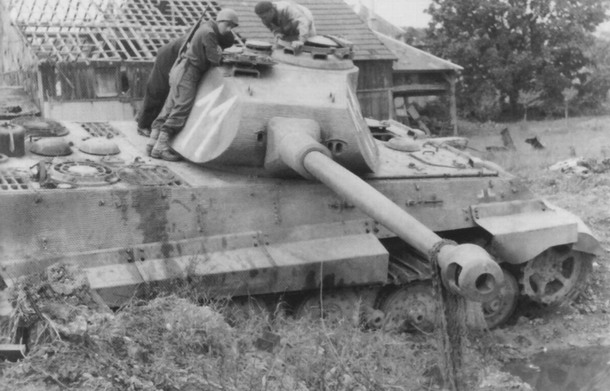
A destroyed Tiger II with the Porsche turret, again showing the original one-piece gun barrel without the wider first section. Source: Flickr.com, Public domain, edited
Horizontal traverse of the gun was provided by rotating the entire turret and was therefore unlimited. Vertical elevation ranged from –8 to +15 degrees. To the left of the gun sat the gunner, who aimed using a binocular TZF 9b/1 sight (TZF = Turmzielfernrohr) with 2.5× magnification and a 25-degree field of view. Two small apertures were drilled in the front turret face to the left of the gun for the sight optics, with a small rain deflector welded above them. To the right of the gun, a coaxially mounted MG 34 machine gun in 7.92 mm calibre fired through a small port in the turret front plate. Turret traverse was powered hydraulically from the main engine; manual traverse was also available in case of mechanical failure.
The extended rear bustle of the turret served both as a counterweight for the long gun barrel and as storage space for ammunition. A total of 16 rounds of 88 mm ammunition were stacked horizontally in the rear of the turret. As for the total ammunition stowage, sources differ considerably — even different publications by the same authors give conflicting figures. Inside the hull, approximately 48 rounds (sometimes cited as 42) were stored along the sides of the fighting compartment. Together with the 16 in the turret this gives 64 rounds. These were held in designated racks secured by straps or springs. In addition, up to 16 more rounds could be placed loose on the fighting compartment floor, bringing the total to 80 rounds.
Four types of ammunition were used with the KwK 43 L/71. The primary anti-armour round was the Pzgr. 39/43 (Pzgr. = Panzergranate), an armour-piercing shell weighing 10.2 kg with a small bursting charge. The projectile left the muzzle at approximately 1,000 m/s. At a range of one kilometre, this round could penetrate 165 mm of sloped homogeneous armour, and at two kilometres a still-remarkable 132 mm. Nor were these unrealistic ranges — the gun's maximum range was between 13 and 16 kilometres, while its effective range is generally cited as up to four kilometres for direct anti-tank fire and around ten kilometres for indirect fire with high-explosive rounds.
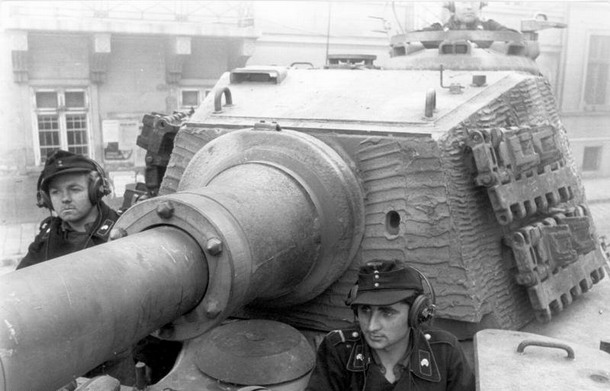
In June 1944 the new turret variant entered production, sometimes referred to as the Serienturm or Henschelturm. Its front face was flat and 180 mm thick. Source: Bundesarchiv Bild 101I-680-8282A-09, Wikimedia, Creative Commons, edited
German 88 mm guns were renowned, among other things, for their accuracy — and the KwK 43 L/71 was no exception. Accuracy is typically expressed as the probability of hitting a target 2.5 metres wide and 2 metres tall (approximately the frontal profile of a tank), distinguished between range conditions and combat conditions, with real-world results generally somewhat lower than those achieved on the range. The difference was due to the greater stress and time pressure of actual combat. For the Tiger II using the standard Pzgr. 39/43 round, the probability of hitting the described target at one kilometre was 100% on the range and 85% in combat. At two kilometres, the figures dropped to 85% on the range and 43% in combat.
The second type of anti-armour ammunition was the tungsten-cored Pzgr. 40/43. This projectile weighed just 7.3 kg and left the muzzle at 1,130 m/s. At 1,000 metres it could defeat 193 mm of sloped armour, and at 2,000 metres still 153 mm. This round was also slightly more accurate than the Pzgr. 39/43. However, it was scarce, as tungsten was a material in short supply for Germany. Crews typically carried only a handful of these rounds — if any at all — holding them in reserve for engagements with the heaviest Soviet armour. Unlike the Pzgr. 39/43, the Pzgr. 40/43 carried no explosive charge, so its destructive effect after penetrating an enemy vehicle was lower. However, if the round struck stored ammunition — of which every tank carried a considerable supply — the result was equally catastrophic.
A third type of available ammunition was the Gr. 39/3 HL, a shaped-charge anti-tank round. This projectile weighed 7.65 kg and had a muzzle velocity of around 600 m/s. For a shaped-charge round, however, impact velocity is irrelevant, as it defeats armour not through kinetic energy but through chemical energy. Its penetration therefore does not diminish with range. The Gr. 39/3 HL could penetrate 90 mm of armour — considerably less than the kinetic penetrators above — and was also less accurate, so crews generally did not carry it at all.
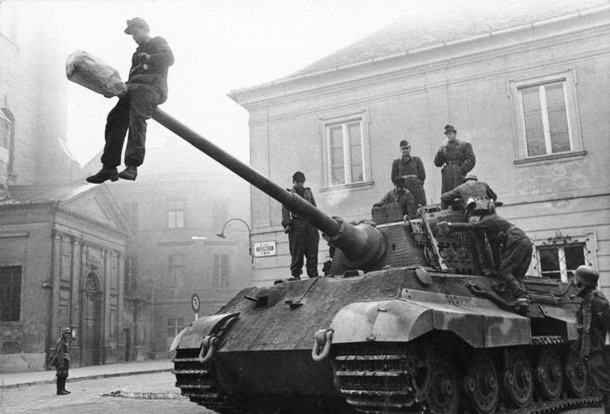
October 1944: Tiger IIs of the 503rd battalion deployed in the streets of Budapest during Operation Panzerfaust. The extraordinary length of the gun is clearly apparent. Source: Bundesarchiv Bild 101I-680-8282A-16A, Wikimedia, Creative Commons, edited
The fourth and final type of ammunition for the Tiger II's gun was the high-explosive round, Sprgr. 43 (Sprgr. = Sprenggranate). This was used against unarmoured — so-called soft — targets, including enemy infantry. Ammunition carried on board typically consisted of roughly equal quantities of Pzgr. 39/43 and Sprgr. 43. Beyond the built-in armament (one gun, one hull MG 34, and one coaxial MG 34 in the turret), the vehicle also carried a third MG 34 which could be mounted on the ring around the commander's cupola as needed, as well as an MP 40 submachine gun and one signal pistol (Leuchtpistole).
The Maybach Engine
Behind the fighting compartment lay the engine section at the rear of the hull. A tank as heavy as the Tiger II could not rely on standard bridges, whose load capacity was usually insufficient, and had to be capable of crossing water obstacles under its own power — in other words, the tank had to be capable of deep fording. For this reason the engine compartment was divided into three longitudinal sections. The central section housing the engine itself could be sealed watertight. On either side of the engine, separated by a watertight bulkhead, were the radiators and their cooling fans. For deep fording it was envisioned that the engine itself would remain dry while the radiator spaces on either side would flood, providing cooling. The fans would of course remain stationary during such an operation. Air supply for engine combustion would be provided by a hollow snorkel tube raised above the roof of the engine compartment.
The Tiger II used the same powerplant as the older Tiger I: the petrol-fuelled Maybach HL 230 P30 twelve-cylinder engine. With a displacement of 23 litres, it produced a maximum output of 700 horsepower at 3,000 rpm. An automatic fire suppression system was installed in the engine compartment: if temperature in the engine bay rose above 120 degrees Celsius, fire suppressant was automatically discharged onto the carburettors and fuel pumps as the highest-risk points. The gearbox was the Olvar OG 40 12 16 B type, a modified version of the same gearbox used in the Tiger I. It was located in the front of the hull between the driver and radio operator, connected to the rear-mounted engine by a driveshaft. The gearbox provided eight forward gears and four reverse gears.
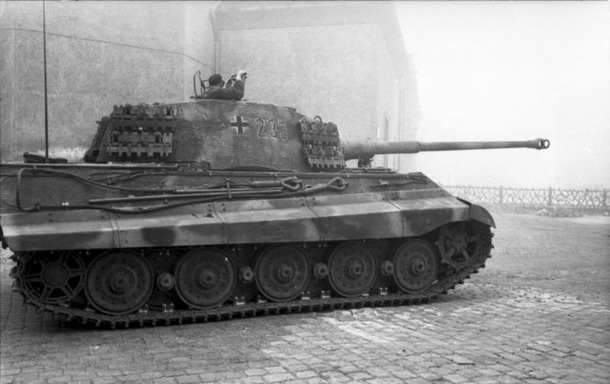
Another Tiger II with the series turret deployed in Budapest in October 1944. The number 233 identifies it as a vehicle from the third platoon of the second company of the battalion. Source: Bundesarchiv Bild 101I-680-8282A-06, Wikimedia, Creative Commons, edited
The engine compartment roof was literally covered with openings. There were four grilled intakes for cooling air and two large circular outlets for expelling heated air from the radiators, plus filler caps for fuel and coolant and an opening for the fording snorkel. A rod aerial for the radio was mounted on the right side.
The total fuel capacity of the Tiger II was 860 litres, distributed across seven separate but interconnected tanks. The largest volume was held in two tanks located on the fighting compartment floor beneath the ammunition racks, together holding 340 litres. Further large tanks were placed in the sides of the engine compartment, each holding 145 litres. One smaller tank was located on each side in the space beneath the radiators, and the final tank — holding 85 litres — was positioned at the top centre of the hull rear, where the filler cap was also located. All seven tanks were interconnected by a fuel line system.
Two exhaust pipes were mounted on the rear hull wall, directed upward and rearward, and protected by heavy armoured covers where they exited the hull. Near each idler wheel, an opening in the rear hull wall allowed adjustment of the idler wheel position using a spanner, ensuring the tracks remained correctly tensioned. Further openings in the lower rear wall accepted a hand-starting crank and a starting shaft, which could be connected either to a portable starter motor or to the engine of a car driven up behind the tank. A final opening in the rear hull wall allowed insertion of a lit torch to preheat the coolant, helping start the engine in extreme cold. Mounted on the rear hull wall were also a jack, a wooden block to use as a jack base, and gun cleaning rods.
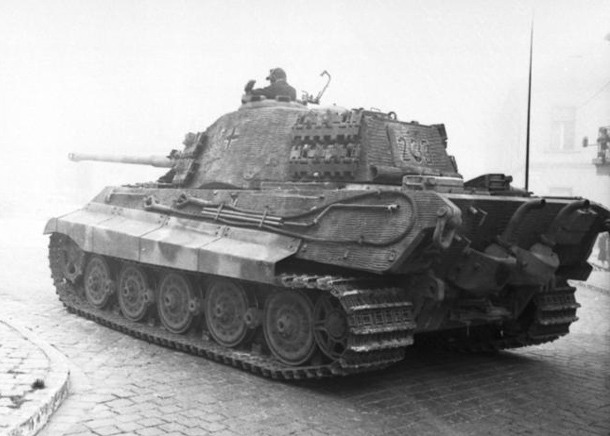
Tank number 233 again in the streets of Budapest. Source: Bundesarchiv Bild 101I-680-8282A-03A, Wikimedia, Creative Commons, edited
The Tiger II had a crew of five. The driver and radio operator — who also served as the hull gunner — sat side by side in the front of the hull, separated by the gearbox. The remaining three crew members were stationed in the turret: the loader to the right of the gun, the gunner to the left, and the commander slightly behind and above the gunner on his own seat. The driver steered the tank using a steering wheel (as in the older Tiger I), with conventional steering levers as a backup in case of mechanical failure. The standard Tiger II was fitted with an FuG 5 radio set with a range of 4 to 6 kilometres, plus an intercom system (Bordsprechanlage 1) allowing all crew members to communicate. Each man on board was equipped with headphones and a throat microphone, except the loader who had headphones only. Tanks assigned to company and platoon commanders were additionally fitted with an FuG 2 radio alongside the FuG 5.
The first three prototypes differed only slightly from the early series vehicles. The prototypes had flat front mudguards, whereas subsequent series vehicles had rounded mudguard fronts. According to some sources, the turret roofs of all three prototypes were only 25 mm thick at the front and rear, while production vehicles used 40 mm armour. The prototypes were not coated with the anti-magnetic Zimmerit paste and lacked the equipment brackets on the hull sides that later production vehicles carried — a full complement of tools including a hammer, wire cutters, an axe, a starting crank, a fire extinguisher, steel towing cables, and track-laying ropes for track changes.
The Tiger II fitted with the early turret had a weight of 68.5 tonnes and could achieve an impressive maximum road speed of 41.5 km/h. While this speed was technically achievable, it was entirely outside normal practice — reaching it required running the engine at higher revs, and drivers were instructed not to exceed 2,500 rpm. The highest practically sustainable road speed was around 38 km/h, dropping to between 15 and 20 km/h cross-country. Fuel consumption was enormous: approximately 505 litres per 100 km on roads and around 715 litres per 100 km off-road, with potentially even higher consumption in particularly difficult terrain. A full load of 860 litres was therefore sufficient for roughly 170 km on roads and approximately 120 km cross-country.
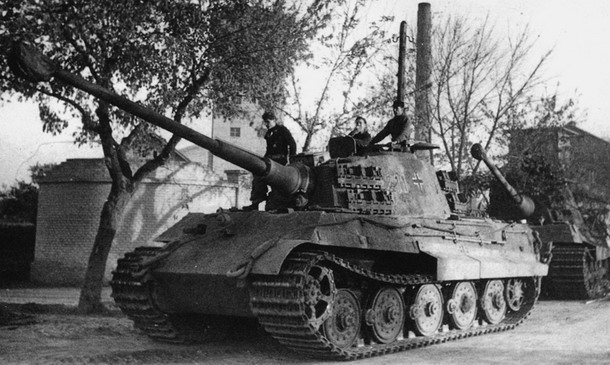
Tiger IIs with the series turret. Source: Flickr.com, with permission of the publishing user, edited
Series Production
As already noted, the first complete Tiger II prototype, bearing serial number V1, was built in November 1943 (some sources say October, though the army did not formally accept it until November). The other two ordered prototypes were completed in January 1944, together with the first three series vehicles. The January prototypes were numbered V2 and V3; the series vehicles carried hull numbers 280001, 280002, and 280003. The ramp-up of series production was very gradual: five tanks were delivered in February, six each in March and April. In May 1944, fifteen new Tiger IIs left Henschel's Factory No. 3 in Kassel, and in June, 32. July 1944 was the first month in which the target output of 45 tanks per month was met.
The initial difficulties were overcome and production gained momentum. The plan for August called for 80 tanks, and Henschel delivered 94. Then came a reversal. On 22 September 1944 the Kassel factory was struck by Allied bombing. Further raids followed on 27 and 28 September, and again on 2 and 7 October. The bombing caused enormous damage, yet production was somehow kept running, albeit at reduced capacity. In September, 63 of the planned 100 tanks were delivered; in October, only 26 out of the planned 120. Production of the Tiger II continued until March 1945. That month the factory managed to hand over the last 30 tanks before it was overrun by advancing Allied forces. In total, 492 Tiger IIs including the three prototypes were completed and delivered to the army between November 1943 and March 1945.
All tanks were assembled by Henschel und Sohn — specifically at their Werk III facility in the Mittelfeld district of Kassel. Plans reportedly existed to involve the Nibelungenwerke, but this never materialised. A wide range of suppliers and subcontractors were involved in production, however. The welded armoured hulls and turret shells were supplied primarily by Krupp of Essen, with DHHV (Dortmund-Hörder-Hütten-Verein) and Škoda joining later — though each managed to produce only a small number of armoured bodies. Engines were supplied by Maybach and Auto Union; gearboxes were built by the Adlerwerke in Frankfurt am Main and Waldwerke in Passau. DHHV was responsible for the guns, and Ernst Leitz supplied the sights. The Wegmann Waggonfabrik in Kassel assembled the turrets.
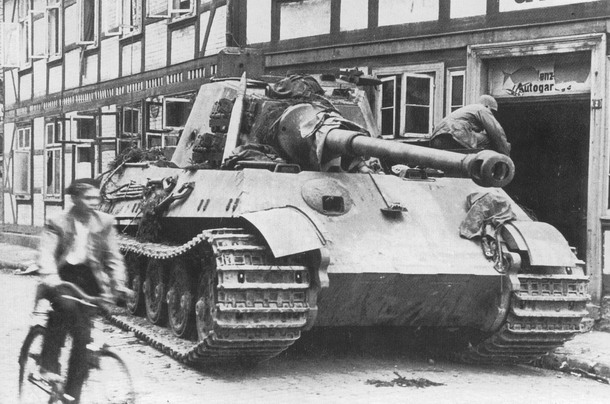
A Tiger II with a penetrated turret side, somewhere in Germany in March 1945. Note the round leaning against the side of the turret. Source: Flickr.com, Public domain, edited
All the components converged at the Henschel factory in Kassel, where approximately 8,000 workers assembled the finished tanks. The factory ran alternating twelve-hour day and night shifts, keeping production going around the clock. The assembly process was divided into nine stations (Takt), with a tank spending several days at some of them. The total time required to complete one vehicle was 14 days.
As noted at the very beginning of this article, Königstiger was never the official designation of this heavy tank. The name nonetheless appeared in some reports from January 1945 onwards and became very popular among post-war historians — it is short, clearly distinguishable from the original Tiger I, and easily translatable into English. The alternative name Tiger II was official but used mainly during development, not for the production vehicles. The correct official designation was Panzerkampfwagen Tiger Ausf. B, from which the abbreviation Tiger B was also derived. The more cumbersome name Panzerkampfwagen Tiger (8.8 cm KwK 43 L/71) was occasionally used as well. And then there was the ordnance inventory code: Sd.Kfz. 182.
Ongoing Improvements
Throughout the production run, various improvements and simplifications were progressively introduced. In May 1944, new combat tracks of a revised design entered service. These were again made of double-link sections, but the design was different: the drive sprocket teeth now engaged only the main link of each section rather than both links. New drive sprockets with only nine teeth were introduced alongside the new tracks (compared to eighteen teeth on the original sprockets).
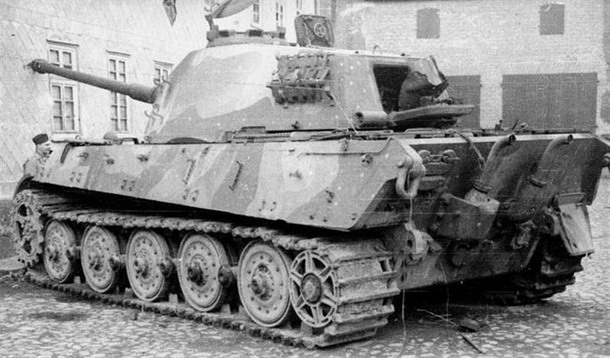
Although it was not permitted, photographs occasionally show Tiger IIs going into action on the narrower transport tracks — as with this example. Source: Flickr.com, Public domain, edited
May 1944 also saw the original binocular TZF 9b/1 sight replaced by the newer monocular TZF 9d. This sight required only a single aperture in the turret front plate; the second was blanked off with an armour plug. The TZF 9d offered two selectable magnification levels: 3× and 6×. The guns on the earliest tanks had a one-piece barrel of uniform diameter along its entire length. This was later replaced by a stepped barrel with a thicker — and therefore larger in outer diameter — first section. Guns with the new barrel were introduced into Tiger II production progressively between April and June 1944. The older one-piece barrel is found only on tanks with the original turret type, i.e. on some vehicles from the first fifty.
The "Series" Turret
Let us step back briefly in time. In August 1942, Krupp had been tasked with completing the fifty already-in-progress turrets of the original curved-front design and simultaneously developing a new, simpler, and more protective turret to replace it from the 51st Tiger II onwards. That moment arrived in June 1944, when the tank with hull number 280047 — the 47th series vehicle, but the 50th tank built when counting the three prototypes — left the factory. With this vehicle the supply of original turrets was exhausted, and the following tank, hull number 290048, was fitted with the new turret design.
The new turret had a flat front face angled at 10 degrees, a design that gave no opportunity for incoming rounds to be deflected downward against the hull roof. The front armour of the new turret was an extraordinary 180 mm thick and was therefore essentially impenetrable. The front face was also narrower than on the original version, presenting a smaller target. The side walls were 80 mm thick and angled at 20 degrees. Thanks to the reduced side wall angle and a slight shift of the commander's cupola towards the centreline, there was no longer any need for the troublesome bulge in the left side wall.
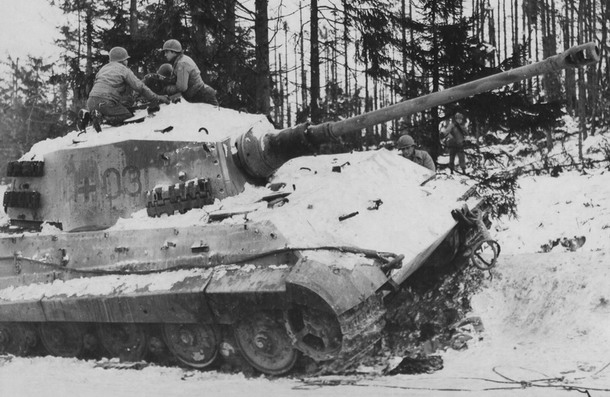
Belgium, January 1945: American soldiers examine an abandoned Tiger II with the Henschel turret. The tank has towing cables attached, suggesting it broke down or became stuck and could not be recovered. Source: Worldwarphotos.info, Public domain, edited
The reduced side wall angle also meant more internal space, which translated into increased ammunition stowage in the extended rear bustle — from 16 to 22 rounds. The total ammunition load on board thus rose from 80 to 86 rounds. The new turret was heavier than the original, however, which pushed the total weight of the Tiger II up to 69.8 tonnes.
The original turret is often referred to as the "Porsche" turret (because it was designed around Porsche's VK 45.02 (P) project). The new turret is often called the "Henschel" turret, which is in fact misleading — both turrets were designed by Krupp. A far more accurate, and equally used, term for the new turret is the "series" turret.
From the end of June 1944, hooks for hanging spare track links were welded to the sides of the turret — four on each side, two at the front and two at the rear. Tests showed that the suspended spare links had neither a positive nor a negative effect on armour protection; in other words, they did not function as additional side armour for the turret.
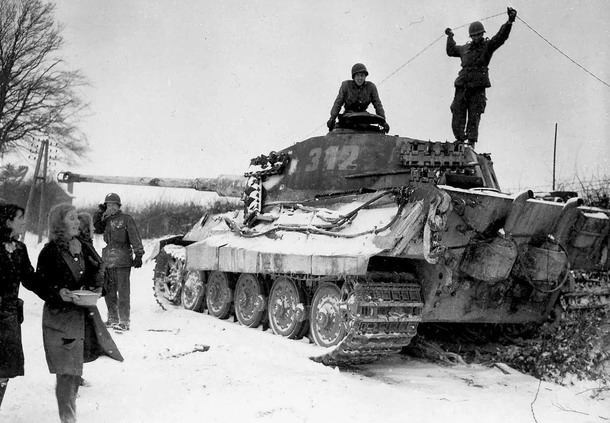
American soldiers examine an abandoned Tiger II (and enjoy the company of local girls), Belgium 1944/45. Source: Waralbum.ru, Public domain, edited
As a production simplification measure, from August 1944 the interiors of new tanks were no longer painted in the usual ivory colour but left with only the standard red oxide anti-corrosion primer. In September 1944, application of the anti-magnetic Zimmerit paste was discontinued at the factory. This was apparently also a production simplification, though some authors attribute it to an unsubstantiated report that frontline units had observed Zimmerit igniting when struck by enemy rounds.
From January 1945, a small profile was welded above the gun sight aperture in the turret front to deflect rainwater. Shortly before production was involuntarily ended in March 1945, a new type of combat track was introduced: instead of double-link sections, it consisted of conventional single links, which necessitated reintroducing the eighteen-tooth drive sprocket. New brackets for spare track links were also welded to the turret sides — instead of the original two double-link sections, three smaller single-link sections were now carried. It is not entirely clear from the literature whether tanks with these tracks and the new-style spare link brackets actually made it into production; in any case, photographs of turrets with the new-style brackets were taken by American soldiers inside the Henschel factory after its capture.
The changes described here are by no means a complete list of all modifications and improvements introduced during the Tiger II production run. Beyond those mentioned, a great many smaller and larger modifications were made throughout. A large proportion of the improvements concerned oil and fuel sealing and the drivetrain, which on early vehicles in particular exhibited frequent faults.
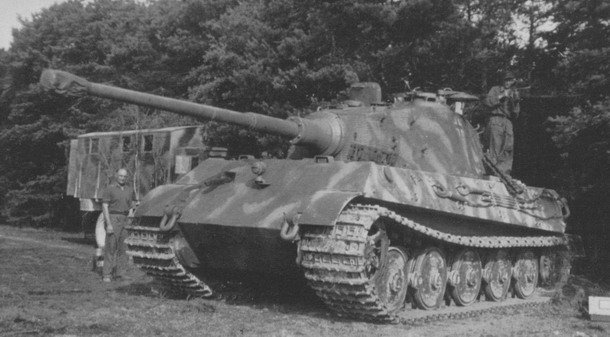
A Tiger II in the care of a field workshop. Source: Flickr.com, with permission of the site operator, edited
There were also numerous plans for the tank's future development that never came to fruition. A few more months of production would likely have seen the vehicles equipped with stabilised sights and coincidence rangefinders for more accurate target range estimation. Plans also existed — scheduled for the second half of 1945 — to replace the powerplant with the Maybach HL 234, capable of up to 900 horsepower. Installation of a semi-automatic loading system was also envisioned for the longer term.
Command Version
As with most German tanks, a command version was produced alongside the standard fighting vehicle — the Panzerbefehlswagen Tiger Ausf. B. And as with other German tank types, two command variants were produced. The first carried the ordnance code Sd.Kfz. 267 and was equipped with FuG 5 and FuG 8 radio sets. The FuG 8 was accompanied by a star-shaped aerial (the so-called Sternantenne D) positioned in the centre of the rear engine deck. A second two-metre rod aerial was installed on the turret roof, and the original aerial on the right side of the engine deck was retained, giving the command tank three aerials in total. The Sd.Kfz. 267 was used for communication with higher ground force headquarters. The second command variant was designated Sd.Kfz. 268 and was intended for liaison with air support. Its communications equipment consisted of FuG 5 and FuG 7 sets. This vehicle also had three aerials, though all were straight rod types without branching.
Command tanks retained their full armament and were therefore capable of engaging in combat when required. However, their gun ammunition was reduced to 63 rounds, as the additional radio set, electric generator, and associated equipment left insufficient room for more. Command tanks were deployed at battalion staff level. A total of only approximately 20 command Tiger IIs of both variants are believed to have been produced.
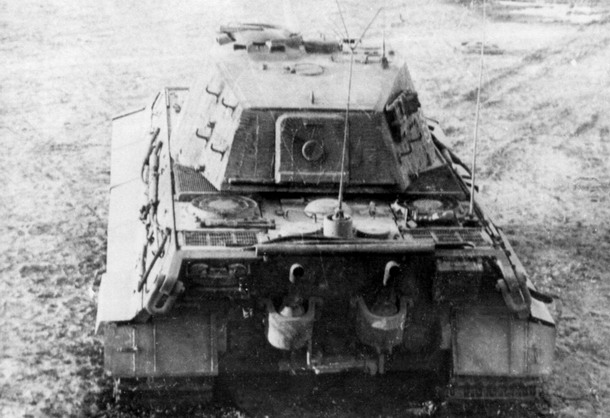
A Tiger II command tank. Note the three aerials — the branched Sternantenne identifies this as the Sd.Kfz. 267 variant. Source: Flickr.com, with permission of the publishing user, edited
Unit Organisation
Tiger IIs were organised into independent heavy tank battalions (schwere Panzer Abteilung, abbreviated s.Pz.Abt.), where they were to progressively replace the older Tiger I. These heavy tank battalions were formed within both the Wehrmacht and the Waffen SS. Each battalion consisted of three companies, each with two command tanks and three combat platoons of four Tigers. A full-strength company therefore fielded 14 tanks in total (2 plus 3 × 4), meaning all three companies in a battalion had 42 tanks (3 × 14). The battalion headquarters was additionally equipped with three Tiger II command vehicles, bringing the complete battalion to a total of 45 tanks.
The first battalion to receive the new tanks was schwere Panzer Abteilung 503. This unit had been withdrawn from the Eastern Front in May 1944 (having been nearly destroyed there) for rest and replenishment, and was stationed at the training centre in Ohrdruf. On 6 June 1944, however, the Allied landings in Normandy occurred, and the battalion had to be rushed to the newly opened Western Front. There was not enough time for a complete re-equipping with the new tanks. When schwere Panzer Abteilung 503 departed by rail for France on 27 June, it carried only 12 Tiger IIs; the remaining 33 vehicles were the older Tiger I. The new Königstigers made their combat debut on approximately 18 July 1944 near the town of Demouville.
The first unit to take the new tanks to the Eastern Front was s.Pz.Abt. 501. During the fighting retreats around Minsk, this battalion had been effectively destroyed, not a single operational tank remaining. The survivors were withdrawn to Ohrdruf in July 1944, where the battalion was to be rebuilt. Trains began arriving with new personnel and new Tiger IIs, but the situation on the Eastern Front was deteriorating by the day and deliveries were slow. It was therefore decided not to wait for full strength but to send the battalion back to the front in two waves. The 2nd and 3rd Companies, already at full complement, would depart first. The 1st Company would wait for the missing tanks to arrive and then follow.
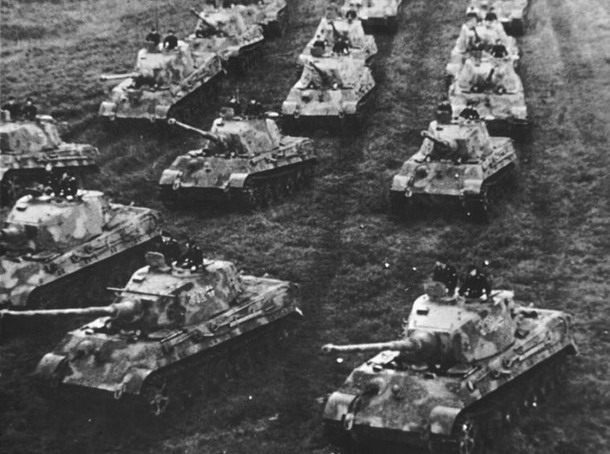
Tiger IIs saw significant action during the Ardennes Offensive. Before the operation, tanks from the 503rd battalion posed for film cameramen — all fitted with the narrower transport tracks, apparently for lack of time to change them. Source: Flickr.com, with permission of the publishing user, edited
Combat Deployment
The Eastern Front debut, however, was far from glorious. On 5 August 1944, the tanks of the 2nd and 3rd Companies arrived at Jedrzejów railway station. The tanks were unloaded, fitted with combat tracks, and were to proceed under their own power eastward towards Chmielnik, where they were to link up with the 16th Panzer Division. During the approximately 50-kilometre march in considerable heat, many tanks began to overheat and suffer engine failures. The crews had to make several stops to let the engines cool. Only roughly half the tanks reached the destination; the rest went straight to the repair shops. Given the insufficient number of operational tanks, the commander of the 16th Panzer Division decided to wait before attacking until the damaged vehicles were repaired. On 9 August, the 1st Company arrived at Jedrzejów — now at full strength — and its tanks likewise set off toward Chmielnik under their own power. Regrettably, the same problems recurred: of the 14 tanks in the 1st Company, only four arrived without a breakdown. The remaining ten had to be towed.
On the morning of 11 August 1944, the Germans launched an attack on the Soviet bridgehead on the Vistula. The spearhead consisted of 8 Tiger IIs and a number of Panthers. Over the course of the day, the Germans gradually captured the towns and villages of Szydłów, Korytnica, Kotuszów, Kurozwęki, and Ogledów. At 9 pm the advance was halted and the troops spent the night in Ogledów. The Soviets, who did not have enough tanks in the area, used the time to occupy the best available positions in the terrain towards Staszów. Some tanks were even camouflaged inside haystacks. On 12 August, the Germans advanced again and drove into what was essentially a prepared ambush. The Russians had no idea they were facing an unknown new tank type, yet left nothing to chance — they waited until the enemy had come within just 400 metres before opening fire.
Several other factors worked in the Soviets' favour. Heavy morning fog further improved the concealment of their tanks, and the sandy terrain caused the German colossi to bog down, advancing only very slowly and manoeuvring with great difficulty. The battle reportedly lasted into the night, and only on the morning of 13 August did the Russians venture out to examine the battlefield. All eight Königstigers that had been committed lay where they had fallen. Thanks to the ambush, the Soviet tanks had been able to fire into the Germans' flanks from very close range, penetrating their side armour. Some of the stricken vehicles caught fire and exploded; others simply stopped and their crews fled on foot. Only now did the Soviets realise that the destroyed tanks were not Panthers, but something entirely new.
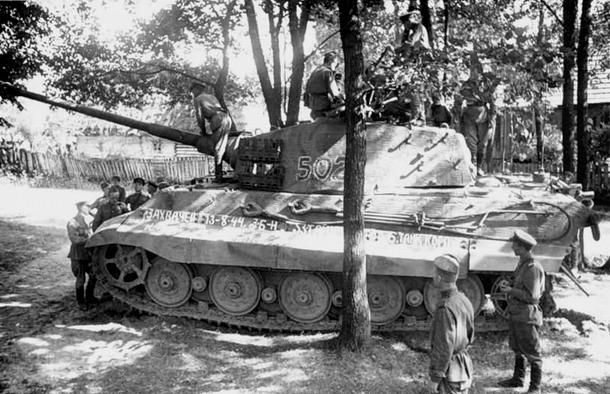
The Tiger II's Eastern Front debut did not go as planned. This command Tiger fell into Soviet hands in undamaged condition, along with many important documents. The inscription on the hull reads "Captured 13.8.44". Source: Worldwarphotos.info, with permission of the site operator, edited
Overall Assessment
The Tiger II is very frequently described as an unreliable vehicle prone to mechanical breakdowns. The reality is, however, less clear-cut. It is true that early series vehicles suffered from a wide range of defects and were often knocked out of action by mechanical failure before they even reached the fighting. Some of these problems were mere "teething troubles" related to immature engineering details or manufacturing processes — issues that afflicted every new tank, not just German ones. In the Tiger II's case, matters were made worse by the fact that the vehicle had virtually no prototype testing phase: only two months elapsed between the completion of the very first prototype and the start of series production. Most of these early problems were gradually addressed to a greater or lesser extent over time. Other issues, however, were permanent by nature — for example, a powerplant whose output was inadequate for the tank's weight, making overheating and engine damage a relatively common occurrence. To illustrate the point: the Tiger II used the same engine — the Maybach HL 230 P30 — as the medium Panther tank, which was a full one-third lighter.
The vehicle's reliability was also significantly affected by factors beyond its engineering. As the military situation on both fronts deteriorated continuously, the Germans suffered a chronic shortage of time to properly train new tank crews. Drivers in particular often received only very limited training, frequently on a completely different vehicle type. They would then sit behind the controls of a Tiger II for the first time when heading into combat. It is unsurprising that they sometimes pushed their machines hard and inadvertently overloaded the engine or drivetrain, causing entirely avoidable failures. Combined with a desperate shortage of spare parts, the consequences were often fatal. Statistics from the final months of the war show that the Tiger II's breakdown rate was entirely comparable to that of other German tank types — as measured by the ratio of operational to non-operational vehicles in frontline unit reports.
Setting aside reliability and focusing purely on combat performance, the Tiger II possessed truly formidable survivability. According to the relevant penetration tables, there was not a single tank in the Red Army's or the Allies' arsenals capable of penetrating the German vehicle's frontal armour — even at point-blank range. Consider the American Sherman with the 76 mm M1 gun: attacking a Tiger II from the front was tantamount to suicide for its crew. From the side, there was at least some chance — but to penetrate the turret side, the Sherman had to close to within at least 1,100 metres. The Königstiger, by contrast, had no difficulty penetrating the front of a Sherman's turret from 3,500 metres (assuming, of course, it could score a hit at such a range). The comparison with the Soviet T-34/85 was essentially identical.
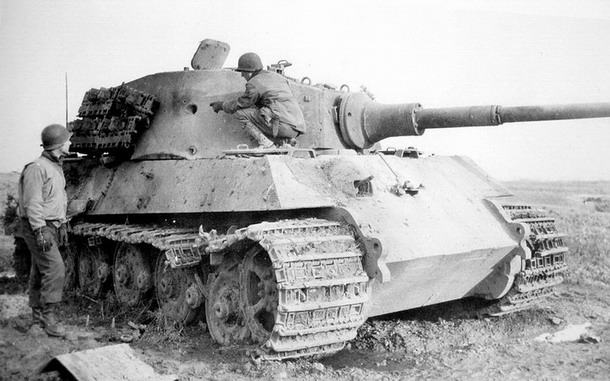
The Tiger II's frontal armour was virtually impenetrable. Both Soviet and Allied tank crews knew this well and always tried to attack from other angles. This vehicle received hits to the track and the turret side. Source: Flickr.com, Public domain, edited
The heavy armour was, on the other hand, the root cause of one of the tank's main problems: its enormous weight. A water-logged meadow or a sandy riverbank was enough to bog the tank down completely, beyond any hope of self-recovery. Many Tiger IIs had to be abandoned by their crews in fully operational condition, with adequate fuel and ammunition, simply because the tank was stuck. The historian Vladimír Kos, for example, gives a vivid account of three Königstigers from schwere Panzer Abteilung 503 making their way across southern Bohemia in May 1945, trying to reach the American lines. The tanks travelled under their own power from Jindřichův Hradec towards the southwest, as far as the village of Brloh — approximately 80 kilometres. Of the three that set out, only one reached the destination. The other two were lost not to mechanical failure, but to bogging: one sank into waterlogged terrain and the other drove over a section of road that collapsed under its weight.
When the tank was in the hands of a crew that knew how to handle it, however, it became a truly fearsome weapon that rightfully struck terror into the enemy. Many tank aces earned or built upon their reputations in this vehicle. One such example was Karl Brommann, then 24 years old, commander of the 2nd Company of schwere SS-Panzer Abteilung 503. From mid-February 1945, the battalion fought in the Danzig (present-day Gdańsk) area against the advancing Red Army. During the fighting there, Brommann's tank destroyed 66 Soviet tanks, 44 anti-tank guns, and several trucks.
Serving in the same battalion — and, by coincidence, in Brommann's own 2nd Company — was Hauptscharführer Karl Körner. In April 1945, he and his comrades were fighting the Red Army east of Berlin. On 19 April, his 25th birthday, Körner commanded a trio of Königstigers guarding the area near the town of Strausberg. On the road from Bollersdorf to Strausberg, the Germans surprised a column of 11 heavy IS-2 tanks and a further 100 to 150 T-34/85s. The Soviet crews were in the process of refuelling and rearming their vehicles. Without hesitation, the three Tigers attacked, unleashing absolute chaos among the Soviets. Körner turned first to the heavy IS-2s and methodically destroyed all 11. He then shifted to the lighter T-34s. At that moment he had exactly 39 rounds remaining on board. One shot, one tank — he went on to destroy 39 T-34/85s with those 39 rounds. The other two Tigers also acquitted themselves well, destroying several dozen more Soviet tanks. After expending all their ammunition, the Germans withdrew back to Strausberg. Körner fought in further engagements, and his final tally from the Battle of Berlin stood at exactly one hundred Soviet tanks destroyed.
Technical Data
|
weight: |
69.8 t |
|
length: |
10.29 m |
|
length (hull only): |
7.38 m |
|
width: |
3.76 m |
|
height: |
3.09 m |
|
engine: |
Maybach HL230 P30 |
|
engine output: |
700 hp / 3,000 rpm |
|
gearbox: |
Maybach Olvar OG 40 12 16 B |
max. road speed: |
38 km/h |
|
average cross-country speed: |
15 – 20 km/h |
|
fuel capacity: |
860 l |
|
road range: |
170 km |
|
cross-country range: |
120 km |
|
hull armour: |
|
|
- front: |
150 mm |
|
- sides: |
80 mm |
|
- rear: |
80 mm |
|
turret armour: |
|
|
- front: |
180 mm |
|
- sides: |
80 mm |
|
- rear: |
80 mm |
|
crew: |
5 men |
|
armament: |
KwK 43 L/71 gun, 88 mm calibre 3 × MG 34 machine gun, 7.92 mm calibre |
ARTICLE
CONTENTS:
Reproducing text from the Panzernet website without the written consent of the operator is prohibited.