NEUBAUFAHRZEUG
a dead end of interwar development
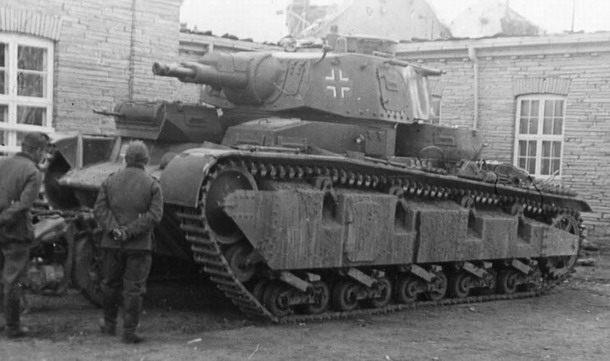
Neubaufahrzeug with the "production" Krupp turret, source: Flickr.com with permission, edited
Origins of the Project
In October 1932, development began on the first German heavy tank since the end of the First World War. In conceptual terms, this project drew to some degree on the medium tanks Grosstraktor, whose prototypes were being tested virtually until 1933. The new heavy tank is surrounded by a number of uncertainties — both regarding its later combat deployment and its very designation. Originally, the tank may have been intended to carry the designation Panzerkampfwagen VII (why the number seven, I have no idea) or Panzerkampfwagen IV neuer Art. The universally known name Neubaufahrzeug was apparently introduced only in October 1933. The term Neubaufahrzeug (abbreviated NbFz) literally means "newly constructed vehicle".
Development of the tank was entrusted to Rheinmetall-Borsig, whose Grosstraktor II had emerged as the uncontested winner of a prototype competition between three rival firms. Krupp, however, was tasked with designing an alternative turret and armament configuration for the new tank. As a result, two variants of the Neubaufahrzeug eventually came into being, differing precisely in the turret used. For formal distinction, the version built entirely by Rheinmetall was to receive the designation Ausf. A, and the version with the Krupp turret Ausf. B (Ausf. = Ausführung = version or variant).
On the subject of designations, many authors suggest that the vehicles were later to have received names consistent with the rest of the German tank family — PzKpfw NbFz V for the Krupp-turreted version and PzKpfw NbFz VI for the Rheinmetall-turreted one. Other sources, however, argue that this is simply a misunderstanding and these names were never officially considered. Personally, it seems very unlikely to me that the Germans would have reserved two Roman numerals — V and VI — for this tank, since they never planned to put both variants into series production. The whole point was a competition from which a single winning version would emerge and then perhaps go into production. In any case, history shows that the designations V and VI were ultimately used for the Panther and Tiger, which were developed later in the war. For simplicity, the text below will use the designation Neubaufahrzeug or the abbreviation NbFz.

Neubaufahrzeug with the Rheinmetall turret (note the guns mounted one above the other), source: Flickr.com with permission, edited
First Prototypes
At the end of 1934, the first two prototypes were built from unarmoured mild steel. One was fitted with the Krupp turret, the other with the Rheinmetall turret. The chassis and hull were identical on both. The running gear consisted of ten road wheels on each side, paired together with each pair mounted on a sprung swing arm. The road wheels were fitted with rubber tyres and were of the double-disc type, with the gap between the discs allowing the guide teeth of the tracks to pass through. At the rear was a toothed drive sprocket, at the front an idler wheel. The front section of the track beneath the idler was additionally supported by what was in effect an eleventh road wheel. The upper run of the track then rested on four return rollers.
In keeping with older design practice, the sides of the tank were partially covered by armour skirts. Rectangular emergency escape hatches were cut into these skirts at the front, with single-piece doors opening toward the front of the tank. There was one such hatch on each side, though they were placed asymmetrically — the hatch in the right side was set further forward than the one on the left. On the right side there was also a further opening at the rear for service access to the engine compartment. The tracks were 380 mm wide and were covered along their full length from above by mudguards.
The hull was partly welded and partly riveted. As already noted, the first two prototypes were built from soft unarmoured steel, apparently also of lesser thickness than was planned for the production tanks. The hull had a fairly tall nose formed by the junction of the upper and lower armour plates. From the right section of the upper plate rose the base of the front machine gun turret. This was borrowed, as a cost-saving measure, from the light tank Panzer I Ausf. A then being developed, but slightly modified for its new purpose and fitted with a single MG 13 machine gun of 7.92 mm calibre. The machine gunner entered his turret through a hatch in its roof. On the left side, the upper hull plate gave rise to an extended cab section beneath which the driver's station was located. The driver's view was provided by one rectangular vision port in front of him and one in the left side wall beside him. In dangerous areas the ports were closed by covers and the driver observed only through the slits in those covers. For entry and exit, the driver used a hatch in the roof directly above his seat, fitted with a single-piece cover opening to the rear. Worth mentioning is a headlight mounted centrally in the upper nose plate that could be retracted into an armoured housing.

Neubaufahrzeug with the "production" Krupp turret, source: Flickr.com with permission, edited
The driver's cab led into the raised central hull section beneath which the main fighting compartment was housed. This section of the hull also served as the pedestal for the main turret, which had to sit elevated above the secondary turrets to allow it to rotate freely. The smaller machine gun turrets, given their position at the lower level, could only traverse partially. On both sides of the main turret pedestal were closable rectangular vision ports that could apparently also be used as loopholes for small arms fire by the crew if needed.
Behind the main turret, a rear machine gun turret of the same design as the front one was installed on the left side. To its right began the engine section, whose roof was covered with vents for drawing in cooling air. Two exhaust pipes also emerged here, their tubes running along the right mudguard to the very rear of the tank. The engine compartment occupied the entire rear section of the hull as well. In its roof was the cooling air exhaust, covered by a raised armour piece that directed the airflow through a grilled opening at the back of the tank. In the rear hull plate was an oval service opening. The engine could also be accessed by removing the raised armour section over the air exhaust. The powerplant chosen was an aircraft-derived BMW Va engine producing 290 horsepower — the same unit as in Rheinmetall's Grosstraktor II prototype. The gearbox offered five forward gears and one reverse.
Main Combat Turret
Let us now look more closely at the main combat turret. As already noted, it existed in two versions from two different manufacturers, with each of the two prototypes carrying one of them. The Rheinmetall turret had rounded contours and was overall of more complex construction than its competitor. The most striking difference was the arrangement of the weapons. In this case the guns were mounted one above the other — the 75 mm weapon below and the 37 mm above it. To the right of the main guns protruded a rounded ball mount for a turret-mounted MG 13 machine gun. In addition to the front wall, a frame antenna for the FuG6 radio set encircled the entire turret. From the turret roof protruded a commander's cupola fitted with observation ports, through which the entry and exit hatch also passed. Further hatches were provided in the side walls of the turret, one on each side.

Neubaufahrzeug with the "production" Krupp turret — note the antenna folded into its retaining fork, source: Flickr.com with permission, edited
The Krupp turret, unlike its competitor, was angular and extended further to the rear. The armament was the same — a 7.5 cm KwK L/24 and a 3.7 cm KwK L/45 — but in this case the guns were mounted side by side rather than stacked. The more powerful weapon was on the right, the lighter one on the left. To the left of both guns, in the front wall, was a ball mount for another MG 13 machine gun. To the right was an observation window closed by an armoured cover. From the turret roof again rose a commander's cupola with an entry hatch, and again two hatches were provided in the side walls. The radio antenna was in this case a simple rod type, attached at the rear upper edge of the left side wall of the turret. It could be folded forward and secured in a retaining fork.
On both turret types the guns were mounted very close together, which made loading them difficult. Even so, the Krupp solution with guns side by side proved more practical, and the Krupp turret itself was simpler to manufacture. For this reason, the Krupp turret was selected for any further Neubaufahrzeugs — and further vehicles were not long in coming. As early as 1935, three more evaluation vehicles were built, this time from hardened armour steel and naturally with the Krupp turret. According to some sources, these tanks were fitted with new engines of the Maybach HL 108 TR type, producing a maximum of 250 horsepower at 3,000 rpm — the same units used in the early versions of the Panzer IV.
The combat weight of the Neubaufahrzeug was 23.4 tonnes. By later wartime standards, this placed it closer to a medium than a heavy tank. Its maximum road speed was around 30 km/h with a range of approximately 120 km. Cross-country, however, its speed apparently dropped dramatically. Armour thickness ranged from 13 mm on the roof panels to 20 mm on the frontal plates. The total crew numbered six men: aside from the driver, there were two machine gunners in the small turrets and a commander, loader and gunner in the main turret. The on-board ammunition supply comprised 80 rounds of 75 mm, 50 rounds of 37 mm and 6,000 machine gun cartridges. With the completion of these three tanks, production of the type ended and the project was terminated in favour of the Panzer IV.

Neubaufahrzeugs deployed in Norway in 1940, source: Flickr.com with permission, edited
According to some authors, the Neubaufahrzeug was intended to complement the planned core family of German tanks — the light PzKpfw I, PzKpfw II and medium PzKpfw III and PzKpfw IV. It is clear, however, that this was not part of the concept from the very beginning of the NbFz's development. The backbone of German armoured units was to consist of two tank types: the Panzer III with its 37 mm (later 50 mm) gun, intended primarily to destroy enemy armour, and the heavier Panzer IV with its 75 mm gun, designed to eliminate infantry and fortified positions. The Neubaufahrzeug therefore brought nothing genuinely new — by virtue of its armament it simply combined the purpose of both medium tanks in one vehicle. The NbFz was not an additional link in the Panzerwaffe's arsenal; it was more of an alternative to the Panzer IV, to which it ultimately had to yield its place.
Deployment in Norway
In April 1940, three fully combat-capable Neubaufahrzeugs were sent to Norway. On 19 April, the vehicles arrived in Oslo as part of the special detachment Panzer Abteilung zur besonderen Verwendung 40. More than actual combat reinforcement, however, the Germans were motivated by propaganda — a fact suggested by the detachment's very name: "for special use". They wanted to show the world that the Wehrmacht had at its disposal tanks larger and heavier than the Panzer IV. Despite this, the NbFz vehicles did see combat. On 25 April, the tanks clashed with British forces near the village of Kvam. The British had mortars and light French anti-tank guns at their disposal, and managed to immobilise one of the Neubaufahrzeugs. The crew abandoned the tank and escaped to safety. After the British withdrew, the damaged tank was towed away and repaired.
Some time later, however, a different Neubaufahrzeug was lost completely. It became stuck in waterlogged ground and, to prevent it falling into enemy hands, the Germans destroyed it themselves. As for the subsequent fate of the remaining four tanks (including the first two prototypes), sources diverge quite significantly. According to one version, one of the first two prototypes — built from unarmoured steel — was sent to Norway to replace the lost vehicle. This was the Krupp-turreted tank. All three vehicles then supposedly remained in Norway until its liberation, and were later scrapped by the Allies. The fate of the last example (i.e. the unarmoured vehicle with the Rheinmetall turret) is not addressed in this account.

Neubaufahrzeug with the Rheinmetall turret undergoing repairs in a workshop, source: Bundesarchiv_Bild_183-L04352, Wikimedia, Creative Commons, edited
According to another version, the Neubaufahrzeugs were deployed on the Eastern Front in 1941 and some were destroyed in fighting against Soviet forces. This version of events is unlikely to be accurate. The last account I have encountered states that the two remaining "Norwegian" tanks stayed in Oslo until autumn 1940, after which they were sent back to Germany, having fulfilled their propaganda and deception purpose. In Germany they apparently served as instructional vehicles at tank training schools until they were scrapped in 1941 and 1942. What is certain is that not a single example of this interesting fighting vehicle survived the war.
Conclusion
Like multi-turret tanks in general, the Neubaufahrzeug proved to be a dead end of development. The German army chose other tank types as its primary fighting vehicles — ones in which greater firepower (in the form of multiple turrets) was sacrificed in favour of mobility. The practice of Blitzkrieg showed that this was the right decision.
ARTICLE
CONTENTS:
Reproducing text from the Panzernet website without the written consent of the operator is prohibited.