MICHAEL WITTMANN
SS Hauptsturmführer, 22. 4. 1914 – 8. 8. 1944
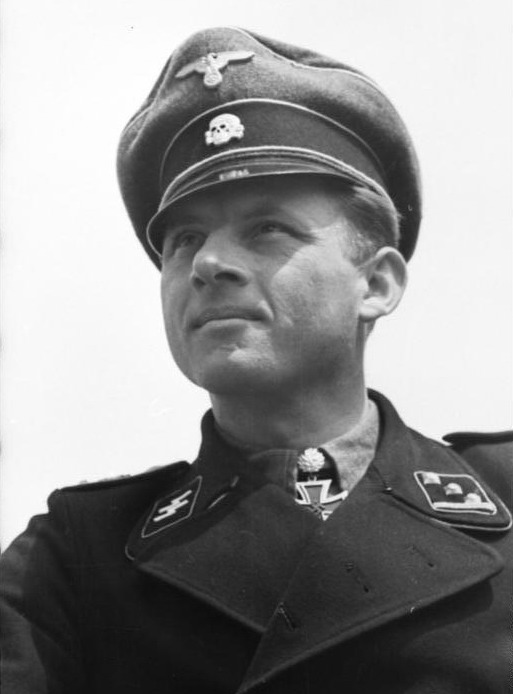
Michael Wittmann here holding the rank of SS Obersturmführer, source: Bundesarchiv_Bild_101I-299-1802-09, Wikimedia, Creative Commons, edited
Childhood and Youth
Michael Wittmann was born on 22 April 1914 in the small Bavarian village of Vogelthal, one of five children of farmer Johann Wittmann and his wife Ursula. After completing secondary school in 1930, the sixteen-year-old Michael began working on the family farm.
In February 1934 he left the farm to enlist in the Reichsarbeitsdienst (Reich Labour Service). After six months in this paramilitary organisation, which placed great emphasis on discipline and camaraderie, Michael decided to try his luck in the newly rebuilt German army. On 30 October 1934 he began his two-year military service with the 10th Company of the 19th Infantry Regiment in the town of Freising near Munich.
It was during this period of military service that the young Wittmann first came into contact with a new weapon: the tank. Specifically with the PzKpfw I, on which soldiers trained in combined arms cooperation between infantry and armour. Like many other soldiers, Wittmann was fascinated by these machines and quickly learned everything about the strengths and weaknesses of this weapon.
Joining the Waffen-SS
In September 1936 Wittmann left the army with the rank of Gefreiter and found work as a railway labourer in the nearby town of Reichertshofen. He soon became interested in the Schutzstaffel – the SS – and before the end of the year he applied to join. The twenty-two-year-old passed a lengthy series of physical and medical tests and was accepted. As a member of the Allgemeine-SS (General SS) he was assigned the personal number 311623.
On 1 April 1937, Wittmann became a member of the military branch of the SS organisation, the SS-Verfügungstruppe, from which the notorious Waffen-SS would later emerge. On 5 April, SS-Mann (equivalent to the army rank of private) Wittmann was assigned to the elite Leibstandarte SS Adolf Hitler (LSSAH) as a crew member of the light four-wheeled armoured car Sd.Kfz. 222 and later the heavier six-wheeled Sd.Kfz. 232. He served first as driver and later became vehicle commander.
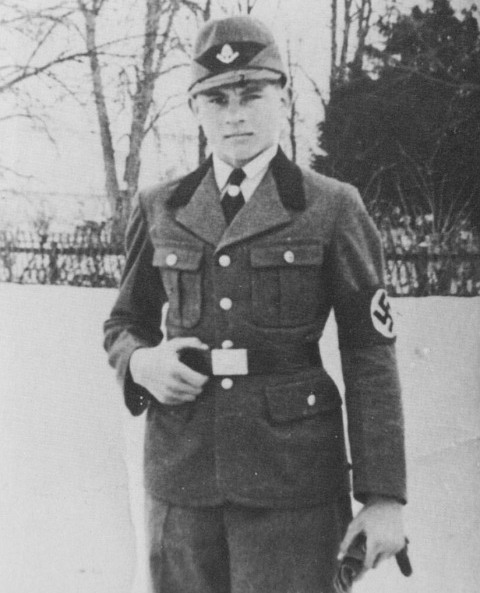
nineteen-year-old Wittmann in Reichsarbeitsdienst uniform, source: Panzerace.net with the permission of the operator, edited
In November 1937 Wittmann was promoted to SS-Sturmmann (equivalent to army Gefreiter). In March 1938 he took part with the Leibstandarte in the German army's triumphant march into Austria during the Anschluss, and eight months later was also present during the occupation of the Sudetenland. In April 1939 he was promoted again, this time to SS-Unterscharführer (Corporal).
Training on the StuG III
In September 1939 Wittmann and his armoured car platoon took part in the fighting in Poland. On returning from this brief combat experience, Wittmann was appointed as an instructor for recruits on armoured cars and proved extremely capable. On 25 April 1940 he was transferred to the 1st Self-Propelled Artillery Platoon of the LSSAH. This unit was at that time equipped with a new weapon – the assault gun StuG III. Wittmann became commander of one of these vehicles.
For Wittmann this meant a period of intensive and thorough training, but also of getting acquainted with an entirely new fighting machine. Switching from a wheeled vehicle armed with a 20 mm cannon to a fully tracked vehicle four times heavier and carrying a 75 mm gun was no small step.
After completing his training, April 1941 brought Wittmann's first combat action in the StuG III. His unit was deployed in Yugoslavia, where it was to capture the city of Skopje together with the 9th Panzer Division. The Yugoslav operation lasted only a week, but the fighting did not end there for Wittmann's unit: the Leibstandarte was immediately committed to combat in Greece. Greece too was unable to hold out long against the German war machine and capitulated before the end of April. Wittmann was sent, along with his fellow soldiers, on a well-earned holiday to western Bohemia.
Into Russia
The rest was not to last long. On 22 June 1941 the Germans unleashed the most devastating and bloodiest military operation in human history – Operation Barbarossa, the invasion of the Soviet Union. Wittmann's unit was committed as part of Army Group South in Ukraine. The Eastern Front was to become the cradle of Wittmann's fame.
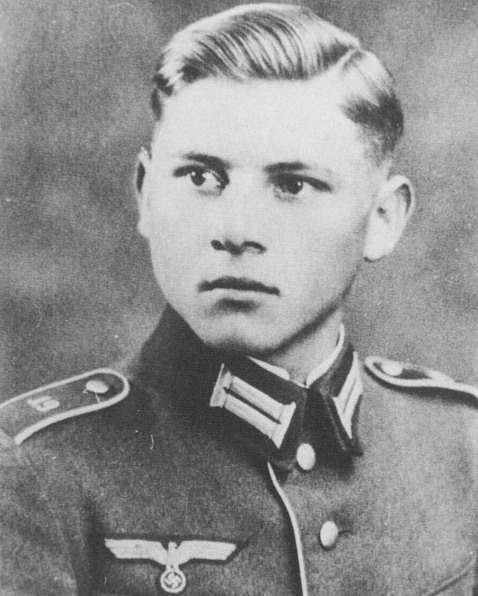
Wittmann during his service with the 19th Infantry Regiment, source: Panzerace.net with the permission of the operator, edited
On 12 July, Wittmann was tasked with taking up a patrol position with his vehicle on a hill designated as height 65.5. From there he spotted a total of 18 Soviet T-34/76 tanks approaching him in two groups. None of the Soviet crews noticed the low-profile StuG, and so at the moment of his first shot Wittmann enjoyed the advantage of complete surprise.
He managed to destroy two Bolshevik tanks before he was spotted and forced to leave his position. Wittmann drove to the edge of a nearby wood, concealed himself, dismounted and went on foot to reconnoitre the area. The Russians, however, closed in very quickly, and one T-34 got dangerously close before Wittmann had time to get back to his vehicle. His gunner, Rottenführer Klinck, was therefore forced to take temporary command and deal with the bold Russian himself.
The fighting continued, and in the moments that followed Wittmann's StuG managed to knock out three more Russian tanks. In total, Wittmann had destroyed six enemy tanks that day and captured three wounded crew members. The achievement was all the more significant given that these were modern tank types that were at this stage of Operation Barbarossa causing genuine alarm among the Germans.
That same day, Leibstandarte commander Sepp Dietrich decided to decorate Michael Wittmann with the Iron Cross Second Class. When Dietrich asked him at the award ceremony whether he had any special wish he could fulfil, Wittmann asked that the three wounded Russian tankmen be given proper medical care.
In August 1941, during fighting near the Ukrainian town of Uman, Wittmann was wounded. He suffered a laceration to the head and face. Although the injury was not serious, it was a combat wound and so earned Wittmann the Wound Badge. He did not leave his unit even while recovering and continued to take part in the fighting. On 8 September he was awarded the Iron Cross First Class for his combat achievements.
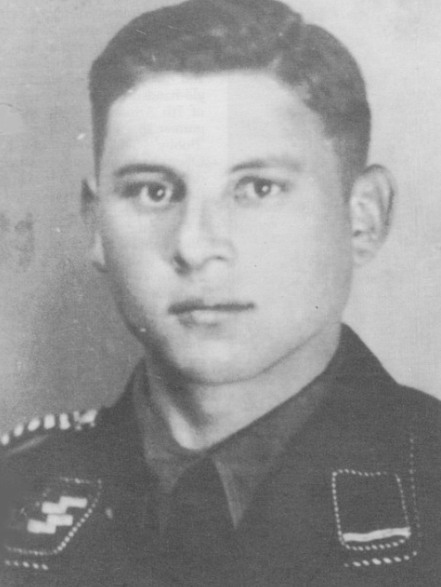
Michael Wittmann holding the rank of SS Sturmmann, source: Panzerace.net with the permission of the operator, edited
At the turn of September and October 1941, Wittmann's unit was in the area around the town of Perekop, where it had to steadily beat back one Russian counter-attack after another. During this hard fighting, Michael Wittmann was wounded again on 8 October, this time in the head and right thigh. On 9 November he was promoted to SS-Oberscharführer (Warrant Officer) and recommended for the Waffen-SS officer school.
The SS Officer Cadet School
In November 1941, following participation in the capture of Rostov, Wittmann received the Silver Close Combat Clasp for 25 completed assaults. The harsh Russian winter soon brought German offensive activity to a virtual standstill. Wittmann fought with his unit on the Eastern Front until June 1942, when he returned to Germany to attend the SS officer cadet school at Bad Tölz.
The training Wittmann underwent at Bad Tölz was genuinely thorough. Young Waffen-SS officers were developed physically and mentally. Alongside demanding physical exercises, they learned to handle various types of weapons, to understand different kinds of fighting vehicles, and above all to know and apply the most effective combat tactics for a given weapon type, terrain, or opponent. There was also, of course, political and ideological instruction.
Throughout the training, enormous emphasis was placed on comradeship and teamwork. Waffen-SS officers were not to be desk soldiers. They were expected to fight alongside their subordinates and set an example for them. Wittmann completed his studies in September 1942 and was then assigned to a reserve tank battalion, where he awaited posting to a combat unit. After two years he thus exchanged the grey-green artillery uniform worn also by assault gun crews for the black uniform of the armoured troops.
The Tiger Tank
On 21 December, Wittmann was promoted to SS-Untersturmführer (Second Lieutenant) and assigned to the 500th Training Tank Battalion in Paderborn, then immediately sent to a training centre at Ploermel in northern France to learn to handle the latest weapon of the German Panzerwaffe – the heavy tank Tiger.

Wittmann (centre) on his StuG III, Russia 1941, source: Flickr.com with the permission of the publishing user, edited
Like the great majority of his colleagues, Wittmann was awestruck by this machine. Although one might say he was this time "switching" to a vehicle not entirely unlike the one he already knew well, it was perhaps an even greater leap than when two years earlier he had moved from an armoured car to an assault gun. The Tiger tank was more than twice as heavy as the StuG III, powered by an engine twice as powerful, and above all armed with the finest gun of its day – a weapon of unprecedented effectiveness, accuracy and effective range.
Wittmann already had considerable combat experience, however, and was a realist. He was aware that even a machine of such size, power and armour protection had its weak points and was not indestructible. He therefore devoted careful attention to studying its characteristics and identifying those weaknesses. It was here too that Wittmann met for the first time the man who would become his faithful comrade-in-arms, gunner Balthasar Woll.
Although Wittmann was fully qualified on the Tiger, one of these vehicles was not yet entrusted to him. Instead he was given command of a platoon of medium Panzer III tanks, whose role was to support the Tigers. In autumn 1942 the original 1st Motorised Division of the Waffen-SS Leibstandarte Adolf Hitler was upgraded to the status of a Panzergrenadier Division. Wittmann's tank platoon was part of the 13th Company of this division. His tank carried the number 4L1.
Back East
In January 1943, Wittmann's unit became part of the newly formed 1st SS Panzer Corps of the Waffen-SS, and Wittmann was sent with the entire corps to the Eastern Front. The timing could not have been more critical: the Russians had just launched their offensive at Stalingrad, broken through the German flanks, encircled the Sixth Army and were rolling westward. The Waffen-SS was tasked with stopping them – and temporarily succeeded, recapturing Kharkov in March 1943 and stabilising the front.
After this celebrated victory over the Bolsheviks, the Germans began preparing for the summer, which would offer conditions suited to their offensive. Trains laden with reinforcements and new equipment – naturally including Tiger tanks – began flowing into southern Russia. This meant that in April 1943, Wittmann was able for the first time to take the controls of his own Tiger, with the tactical number 1331 (this number was not actually applied to the tank until May).

Wittmann here already as SS Untersturmführer, source: Bundesarchiv Bild 146-2004-0131, Wikimedia, Creative Commons, edited
Operation Zitadelle
On 5 July 1943, Operation Zitadelle was launched, aiming to eliminate the Russian salient around Kursk and capture that important city. Wittmann's unit was committed on the southern flank of the attack. On the first day of fighting, Wittmann's Tiger crew consisted of gunner Balthasar Woll, driver Siegfried Fuss, loader Walter Koch and radio operator Karl Lieber. Although tank crews changed relatively often in combat conditions, Wittmann was careful to ensure that whenever possible his gunner was Balthasar "Bobby" Woll. Woll was a highly gifted gunner capable of accurate shooting even on the move. He eventually earned the Knight's Cross for his achievements and in 1944 became a Tiger commander in his own right.
On the very first day, however, loader Walter Koch was wounded. Max Gaube was assigned as his replacement. There was also one more inconvenience on the first day of fighting: a mine struck by the tank damaged one of the tracks and the vehicle had to be repaired. Otherwise 5 July 1943 was a great success for Wittmann, as his Tiger destroyed a total of 13 enemy tanks and 2 anti-tank guns.
Operation Zitadelle did not develop as planned, however. Losses mounted and the advance stalled. On 13 July Hitler himself finally acknowledged that the operation's objectives could not be achieved and called off the entire offensive. By its conclusion, Wittmann could add a total of 30 destroyed Russian tanks and 28 anti-tank guns to his score.
On 29 July 1943, the 13th Company of the Panzergrenadier Division LAH was assigned to the newly formed 101st Heavy Tank Battalion of the Waffen-SS, of which Wittmann thus became a member. Command of the battalion was given to SS-Hauptsturmführer Heinz Kling. Wittmann transferred to a new tank with the tactical number S21 and became commander of the 2nd Platoon in the 3rd Company. On 8 August the entire battalion was sent to Italy for rest and to make good the losses suffered at Kursk.
The return to the front came in October. The 101st Waffen-SS Heavy Tank Battalion was deployed in the area around Kyiv in Ukraine to hold back a Russian offensive. In the weeks that followed, the German tankmen endured a series of gruelling engagements against seemingly endless waves of Russian armour. As always, the traditional Russian ally – the weather – also made their lives difficult. The tanks waded once again, as every spring and autumn, through oceans of mud and suffered the mechanical breakdowns that came with it. Despite the difficult conditions, the victory rings on the barrel of Wittmann's Tiger kept growing in number.
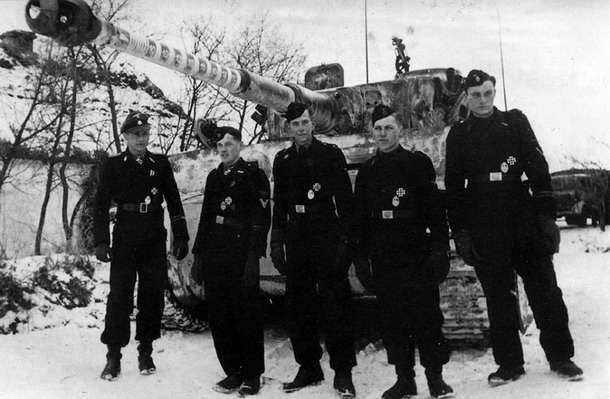
January 1944: the barrel of the 88 mm gun on Wittmann's Tiger now bears exactly 88 victory rings; from left: Michael Wittmann (commander), Balthasar Woll (gunner), Werner Irrgang (radio operator), Josef Rössner (loader) and Eugen Schmidt (driver), source: Flickr.com with the permission of the publishing user, edited
At the end of December 1943, when the mud had long since been replaced by bitter frost, Wittmann was promoted to commander of the 2nd Company, giving him overall command of 12 Tiger tanks.
During the night of 7–8 January, Wittmann destroyed three Soviet tanks and one anti-tank gun. On 9 January he added another 6 enemy tanks to his score, bringing his total to 66 destroyed enemy armoured vehicles. On the basis of these achievements, Wittmann was nominated on 10 January for the Knight's Cross by divisional commander Theodor Wisch. On 14 January 1944 he duly received it.
Wittmann celebrated his decoration in truly spectacular style. Between 10 January, when the nomination was submitted, and 14 January, when the cross was awarded, Wittmann's tank destroyed an astonishing 22 enemy vehicles in combat, bringing his total to the symbolic figure of 88 victories. After this brilliant run, Wittmann's gunner Bobby Woll was also nominated for the Knight's Cross. He received it from Theodor Wisch on 15 January.
The Darling of the Propaganda Machine
Wittmann's dazzling career had of course not escaped the notice of the German propaganda apparatus. To mark his 88th victory, Wittmann and his crew therefore posed for propaganda photographs in front of their tank, with the same number of victory rings painted on the barrel of the 88 mm gun – one for each destroyed enemy armoured vehicle.
On 20 January another honour awaited Wittmann: he was promoted to SS Obersturmführer (First Lieutenant). He wasted no time resting on his laurels, and before the end of January his tally had reached a full hundred destroyed opponents! On 30 January he received a personal telegram from Adolf Hitler reading:
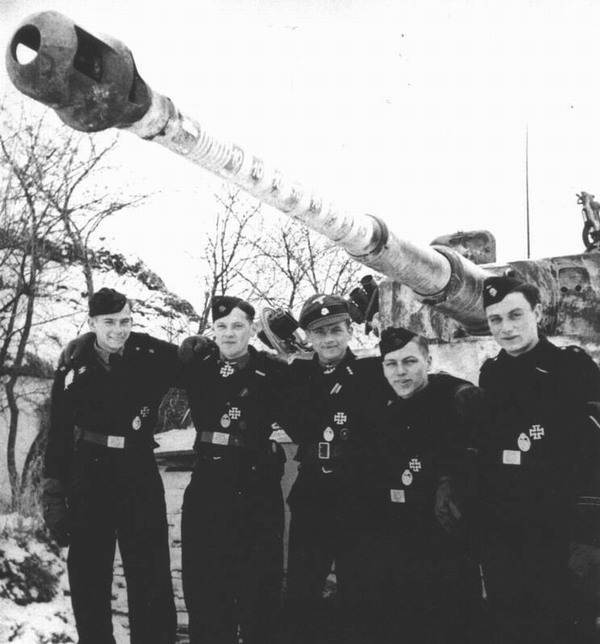
another photograph taken to mark the 88 victories, source: Flickr.com with the permission of the publishing user, edited
"In gratitude for your heroic deeds on the field of battle for the future of our people, I hereby award you, as the 380th soldier of the German Wehrmacht, the Oak Leaves to the Knight's Cross of the Iron Cross. Adolf Hitler."
On 2 February 1944 Wittmann duly received the Oak Leaves in person from the Führer himself, becoming the first holder of this decoration in the ranks of the 101st Waffen-SS Heavy Tank Battalion. A genuine hero had arrived. His name began filling the headlines of the wartime press throughout Germany.
His last 9 victories on the Eastern Front came during the fighting to rescue the German troops encircled in the Cherkasy Pocket. At the turn of February and March, most of the 101st Heavy Tank Battalion was then sent to Belgium to rest and bring its strength back up. For Wittmann a round of duties began that was somewhat different from his daily experience at the front. He was now a national hero and had to accept a constant stream of invitations to official events and press interviews.
On 1 March 1944 Michael Wittmann got married. He wed his girlfriend and fiancée Hildegard Burmester, whom he had met during his studies at the Waffen-SS officer cadet school at Bad Tölz. His best man was crew member and close friend Balthasar Woll. Although the wedding was conducted in a very modest spirit with only family and friends present, the press gave it the attention it felt the occasion deserved.
Under the scrutiny of the press, Wittmann also paid a visit to the Henschel factory in Kassel on 16 April 1944. After touring the factory that produced the fighting machine he knew so well, the Tiger, Wittmann delivered a brief speech in which he thanked the workers for the excellent work they were doing. By this time Wittmann was a genuine celebrity. He received hundreds of letters from admirers and could barely walk down the street without being surrounded by a crowd of curious onlookers and autograph hunters.
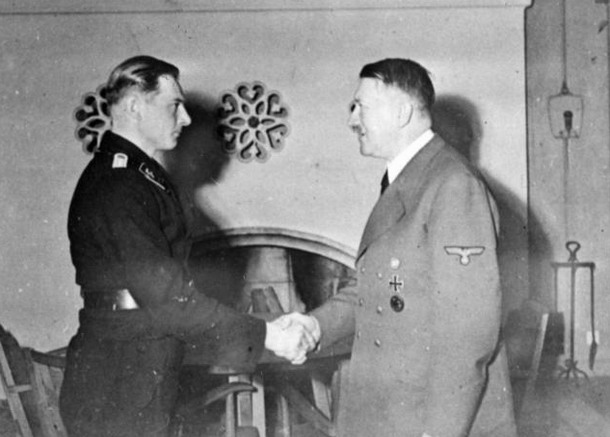
SS Obersturmführer Michael Wittmann receiving the Oak Leaves to his Knight's Cross from Hitler, February 1944, source: Bundesarchiv_Bild_146-1989-099-15, Wikimedia, Creative Commons, edited
The Western Front
In May 1944, Wittmann, along with his entire 2nd Company of the 101st Battalion, was transferred to France in anticipation of the imminent Allied invasion. Combat conditions in France were fundamentally different from those in the Soviet Union. Instead of vast open plains there was rolling terrain with frequent patches of woodland, and towns and villages were much closer together. This deprived the German tankmen of the advantage offered by the Tiger's powerful gun. In Russia they had been able to destroy enemy tanks at enormous range across open terrain, compensating for the Russians' numerical superiority. In France that was far less straightforward.
On 6 June the Allies landed in Normandy. The following day Wittmann's unit received orders to move towards the fighting. Around this time Wittmann switched to a new Tiger of a late production version, with the tactical number 205.
From 7 to 12 June, Wittmann's 2nd Company of the 101st Battalion was on the march towards the front in the Bayeux area, where it was to link up with the 12th SS Panzer Division Hitlerjugend and the Panzer Lehr Division. The route was made difficult by Allied air attacks, which inflicted significant losses on Wittmann's unit. The tank commanded by Wittmann's friend Bobby Woll was also damaged in an air raid. Since Woll found himself without his own vehicle, Wittmann added him to his own crew as gunner.
On 13 June at around six o'clock in the morning, Wittmann set out with six other Tiger tanks for the village of Villers-Bocage, which he was to hold and defend against the British advance on Caen. As he approached, he spotted from a hill above the village a long column of Allied vehicles. The battle that followed over the next few hours became one of the most famous episodes of the Second World War. The events at Villers-Bocage are described separately elsewhere on this site. To summarise: that day Wittmann's company destroyed 30 enemy tanks and the same number of other armoured vehicles, plus two formidable six-pounder anti-tank guns. Wittmann's own tank accounted for 27 vehicles, of which 11 were tanks.
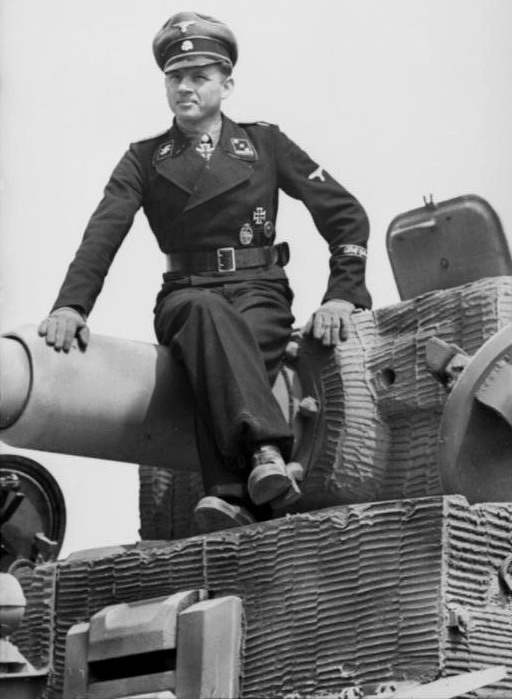
SS Obersturmführer Michael Wittmann posing on the barrel of his Tiger, source: Bundesarchiv_Bild_101I-299-1802-08, Wikimedia, Creative Commons, edited
After this action, SS General and LSSAH divisional commander Sepp Dietrich nominated Wittmann for a further decoration. To his Knight's Cross and Oak Leaves, Swords were now to be added. Dietrich himself presented him with the second highest decoration of the Reich on 22 June 1944. On the same day Wittmann was also promoted to SS Hauptsturmführer (Captain). On 25 June the Swords were symbolically presented to him a second time by Hitler himself at his mountain retreat in Berchtesgaden. The propaganda machine was operating at full capacity, and photographs of the young hero once again filled the pages of the newspapers.
Wittmann meanwhile was enjoying a well-earned holiday with his family in their new home in Erbstdorf. Around this time he received an offer to become an instructor at the Panzer troops school in Paderborn. He declined it, however, saying that his comrades at the front needed him more. This decision was to prove fateful.
On 10 July, following the serious wounding of Obersturmbannführer Heinz von Westernhagen, Wittmann was appointed in his place as commander of the entire 101st Heavy Tank Battalion. He also took over his predecessor's tank, with the tactical number 007.
At the end of July 1944, the fighting around Caen was intensifying and the 101st Waffen-SS Heavy Tank Battalion was right in the middle of this hell. Wittmann and the entire 2nd Company of the battalion were at this time assigned to the 12th SS Panzer Division Hitlerjugend under the command of the legendary Kurt Meyer. On 7 August, the Allies launched another series of attacks – Operation Totalize. General Patton's 3rd US Army, together with British and Canadian units, was to encircle the German forces in the Falaise area. That would spell catastrophe, and the Germans therefore had to counter-attack and prevent the worst.
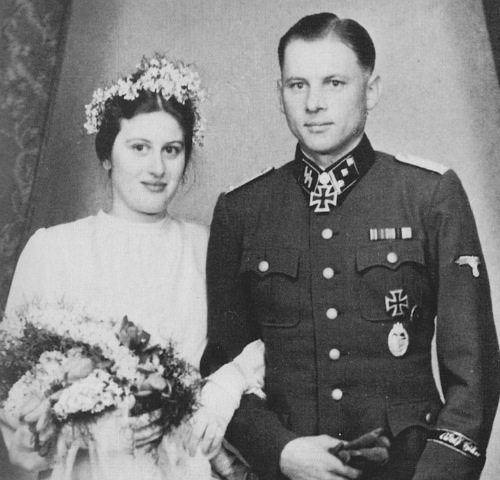
in March 1944 Wittmann married Hildegard Burmester, source: Panzerace.net with the permission of the operator, edited
The Final Action
The tanks of Wittmann's company were therefore ordered to strike Allied units north of the town of Cintheaux and block Road 158 between Caen and Falaise. On the morning of 8 August, Wittmann's tank number 007 set out with two other Tigers towards Cintheaux. The crew of Wittmann's tank that day consisted of gunner SS Unterscharführer Karl Wagner, loader SS Sturmmann Günther Weber, radio operator SS Sturmmann Rudolf Hirschel and driver SS Unterscharführer Heinrich Reimers.
Wittmann had not originally been scheduled to go into action that day at all. The group of tanks was to be led by the newly promoted 3rd Company commander, SS Hauptsturmführer Franz Heurich. Wittmann, however, took over his assignment given Heurich's insufficient combat experience. Wittmann was unaware that the target area was also operating British Sherman Firefly tanks armed with 76.2 mm guns capable of penetrating even the armour of a Tiger.
Near the town of Cintheaux, around noon, were the tanks of A Troop from the 33rd Armoured Brigade of the Northamptonshire Yeomanry. At 12:20, Sherman Firefly commander Sergeant Gordon reported spotting three Tiger tanks advancing slowly one behind another through a field beside Road 158. As the Tigers closed to within approximately 700 metres, Gordon fired at the last tank in the column. At 12:40, two armour-piercing rounds stopped and set ablaze Tiger number 213, which was bringing up the rear.
The middle German tank immediately began turning to face the direction from which the shot had come. It was tank number 007 – Michael Wittmann's tank. Wittmann fired at the Sherman but the round only grazed its turret. Sergeant Gordon, however, was seriously wounded in the head by the impact shock. Command of the tank was quickly taken over by Lieutenant James, who ordered fire to be opened on the opponent. His shot struck the Tiger squarely. The vehicle stopped and stood motionless. The turret did not move; the hatches remained shut. It was approximately 12:45.
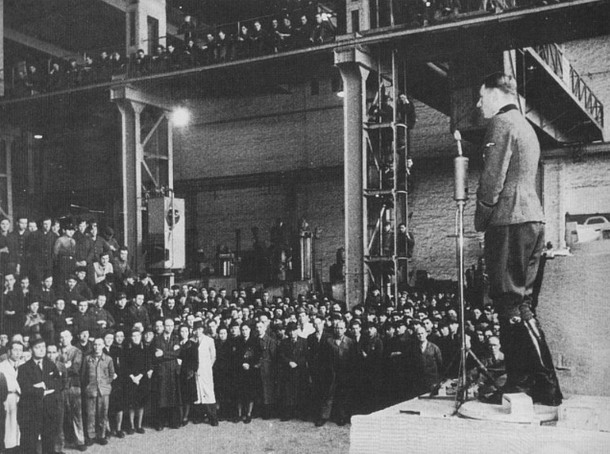
Wittmann addressing the workers of the Henschel factory on 16 April 1944 (note that his platform is nothing other than a Tiger tank), source: Panzerace.net with the permission of the operator, edited
Hauptscharführer Hans Höflinger, commander of tank number 213 – which had been knocked out first – tried to reach Wittmann's tank to assist its crew. Further enemy fire, however, forced him to withdraw. At 12:47 flames burst from Tiger number 007. Moments later a tremendous explosion shook the area. The tank's onboard ammunition had detonated. The explosion was so violent that it completely tore off the eight-tonne turret and hurled it several metres from the hull. None of the crew survived.
The last of the three German armoured vehicles turned to withdraw, but within moments was halted by further fire from the Sherman. The British did not lose a single tank in this engagement. A few hours later, Michael Wittmann and his crew were reported as missing. During the night of 8–9 August, members of the 12th SS Panzer Division Hitlerjugend searched for Wittmann in vain. In the days that followed, the Germans were confronted with entirely different problems. The Allies had succeeded in closing the Falaise Pocket, and over the next two weeks more than 10,000 soldiers were massacred inside it in air attacks. A further approximately 30,000 surrendered. The Germans lost 190 tanks, 160 armoured vehicles, 250 guns and 1,800 lorries.
The location of Wittmann's death had passed irrevocably into Allied hands, making it impossible to repatriate his remains for burial in his homeland. German propaganda naturally had no interest in colourfully recounting the hero's death, and the increasingly desperate situation of the Third Reich merely ensured that this event was soon largely forgotten. He was simply another fallen German soldier. The Allies themselves did not initially realise what a catch they had made at Cintheaux. It is therefore unsurprising that considerable confusion surrounded the precise circumstances of his death after the war.
The Germans themselves put out a story that Wittmann's tank had been destroyed by an aerial bomb – most likely a deliberate lie. For German propaganda it was unacceptable for the public to think that one of Germany's finest tank commanders had been killed in a tank engagement. Some post-war historians also argued that Wittmann's Tiger had been destroyed by a rocket fired from a Hawker Typhoon aircraft. According to Allied command reports, however, no aircraft carried out an attack on enemy tanks in the Cintheaux area on 8 August 1944. Moreover, several other Allied ground units that had been operating in or near the area that day subsequently came forward to claim credit for knocking out the tank ace.
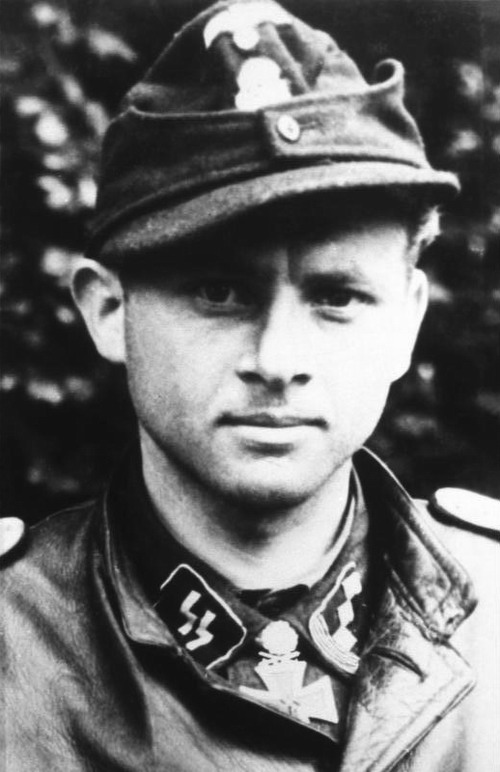
Michael Wittmann in 1944 as a seasoned tank ace holding the rank of SS Hauptsturmführer, decorated with the Knight's Cross with Oak Leaves and Swords, source: Bundesarchiv_Bild_146-1983-108-29, Wikimedia, Creative Commons, edited
The charred bodies of the tank crew were most likely later buried by local villagers near the wreck of the tank. In March 1983, workers repairing the road between Caen and Falaise came across an unmarked grave. The skeletons inside were identified by war graves researcher Jean Paul Pallud as the crew of tank number 007. Wittmann himself was identified by a deformed jaw and false teeth – the lasting result of his wounding in Ukraine. A dog tag belonging to the tank driver, Heinrich Reimers, was also found at the scene.
At the request of the German War Graves Commission, the bodies were exhumed and transferred to the German military cemetery at La Cambe. There Wittmann and his crew from tank 007 rest to this day. Michael Wittmann was killed in action at the age of 30. At the time of his death, his tally stood at 138 destroyed enemy tanks, 132 anti-tank and other guns, and countless light vehicles.
On that fateful day of 8 August 1944, Wittmann was the oldest member of tank 007's crew. Driver Heinrich Reimers was just 20 years old, as were radio operator Rudolf Hirschel and loader Günther Weber. Gunner Karl Wagner was 24.
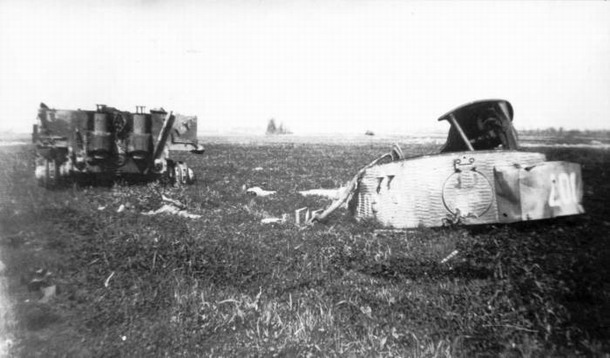
the destroyed wreck of Wittmann's tank number 007 with its turret blown off, source: Flickr.com with the permission of the publishing user, edited
Wittmann's former gunner and close friend Balthasar Woll was wounded on 2 August 1944 and had to be hospitalised. This may well have saved his life, as Wittmann was unable to take him along on that fateful day. Woll survived the war and died of natural causes in 1996.

ARTICLE
CONTENTS:
Reproducing text from the Panzernet website without the written consent of the operator is prohibited.