Sd.Kfz. 232 (6 Rad)
six-wheeled armoured radio car
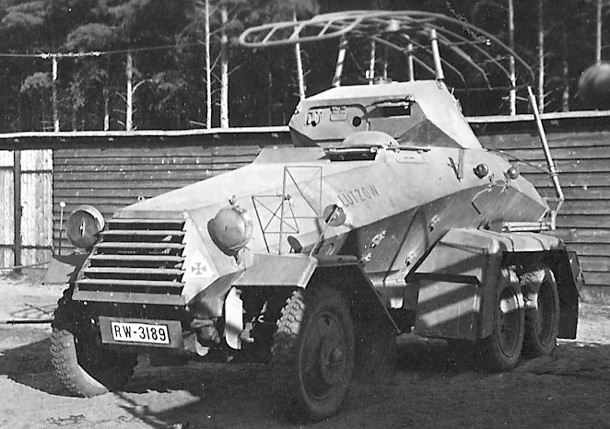
Sd.Kfz. 232 on the Büssing-NAG chassis, source: warwheels.net with the permission of the site operator, edited
A note by way of introduction... the designation Sd.Kfz. 232 (Sd.Kfz. = SonderKraftwagen = vehicle for special purposes) was used for two entirely different types of heavy armoured radio cars. This article describes the older of the two, identified by the suffix "6 Rad". The later eight-wheeled version, Sd.Kfz. 232 (8 Rad), is covered in a separate article.
Origins of the Vehicle
Even while the six-wheeled armoured car Sd.Kfz. 231 was still being developed, the designers were working in parallel on a radio-equipped version. As early as 1932, a first prototype of such a radio car was built on the Büssing-NAG G31 chassis. The vehicle still had a pre-production hull and a circular-plan turret with walls perpendicular to the ground. At this stage it carried only a single MG 13 machine gun in 7.92 mm. Above the hull, a frame antenna was mounted on six struts — at this point still in a very simple form without any internal bracing. Development continued alongside that of the Sd.Kfz. 231 itself until both vehicles reached their final production form.
Vehicle Description
The radio cars designated Sd.Kfz. 232 were built on the basis of all three production variants of the armoured car Sd.Kfz. 231, and were therefore produced on the Daimler-Benz G3a (p), Büssing-NAG G31 (p) and Magirus M206 (p) chassis. All three chassis were three-axle layouts of the 6×4 type with a front-mounted engine. The front axle was steerable and fitted with single wheels; the two rear axles were driven and had doubled wheels. Depending on the chassis used, the vehicles differed in various details.
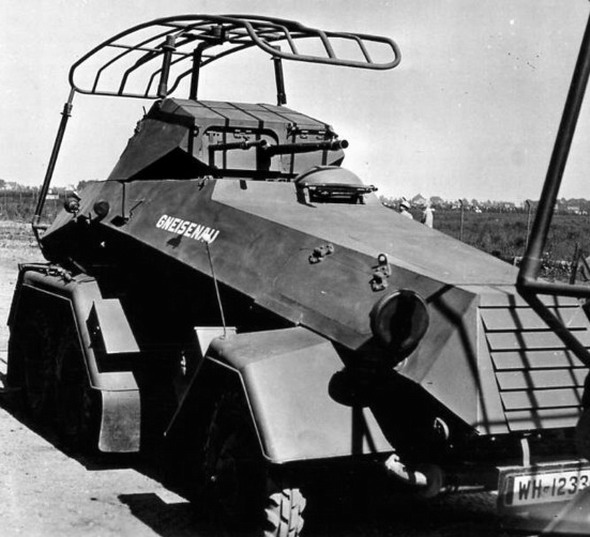
an interesting variant of the Sd.Kfz. 232 — a prototype hull fitted with the production-series turret, source: Flickr.com with the permission of the publishing user, edited
Vehicles built on the Daimler-Benz G3a (p) chassis were powered by the six-cylinder Daimler-Benz M09 engine with a displacement of 3,668 cc and a maximum output of 68 horsepower at 2,900 rpm (some sources give 65 hp). The fuel capacity was 105 litres. As for the number of gear ratios, various figures appear in the sources; four forward and one reverse is the most commonly cited.
Vehicles on the Büssing-NAG G31 (p) chassis had a four-cylinder Büssing-NAG G engine with a displacement of 3.92 litres, producing a maximum output of 65 horsepower (some sources give only 60 hp). The gearbox offered 3 forward and 1 reverse ratio. The vehicle also had a transfer gearbox enabling switching between standard and off-road gear ranges, giving it effectively 6 forward and 2 reverse ratios in practice.
Radio cars based on the Magirus M206 (p) chassis were powered by the six-cylinder Magirus S88 with a displacement of 4,562 cc, delivering a maximum output of 70 horsepower at 2,200 rpm. As for the number of gear ratios, at least three different accounts can be found in the sources. Some state 4 forward and 1 reverse; a second version adds a two-speed transfer gearbox that doubled this figure; a third claims the vehicle had 4 ratios in both directions and could therefore travel at the same speeds forward and in reverse. The most plausible version appears to be the second: that the vehicle had the standard 4 + 1 ratios, supplemented by a transfer gearbox providing the same number of ratios again in off-road mode.

Sd.Kfz. 232 on the Daimler-Benz chassis, with the later-pattern gun mantlet with the machine gun on the left, source: Flickr.com with the permission of the publishing user, edited
The hull, turret and armament were all taken directly from the standard armoured car Sd.Kfz. 231. Were it not for the large frame antenna, the Sd.Kfz. 232 and the 231 were externally identical. The armoured hull consisted of upper and lower halves with walls angled in opposite directions, so the vehicle widened from the floor upwards, then the side walls kinked and narrowed again towards the roof. This angling meant there was no flat surface on the sides that an enemy projectile could strike at a right angle — it would always hit obliquely. This increased the walls' resistance to penetration and compensated, at least in part, for the necessarily limited absolute armour thickness.
The armour plate from which the hull was welded was 14.5 mm thick at the front and 8 mm on the side walls. The roof and floor were 5 mm thick. The hull extended significantly forward to accommodate the engine compartment. The crew compartment occupied the rear half of the hull, topped by a fully rotating fighting turret.
The engine compartment glacis was sloped, and virtually its entire surface was taken up by the air intake opening for the powerplant, covered by horizontal steel grilles. The headlights were mounted on the sides of the engine bonnet, behind which were service access hatches. The crew had several hatches available for entry and exit. In the lower section of both side walls, in the space behind the front wheel mudguards, were diamond-shaped hatches closed by two-part covers.
Sd.Kfz. 232 on the Magirus chassis, note the long front mudguards, source: warwheels.net with the permission of the site operator, edited
A further large hatch was located in the rear hull wall, with two-piece doors that opened outwards to the sides. On most vehicles a spare wheel was mounted across the rear hull wall, so the bracket had to be swung downwards before the hatch could be opened. For this reason the rear hatch served primarily as an emergency exit. A final hatch was located in the cabin roof forward of the turret on the right-hand side (to the right of the cupola above the driver's head) and was used mainly by the driver.
Above both driver's stations — in the left portion of the cabin roof ahead of the turret and in the centre of the cabin roof behind it — were circular openings with domed lids. In a safe environment a driver could open the lid, push his head through the roof opening and gain a direct view outside the vehicle, at the cost of exposing himself to external hazards.
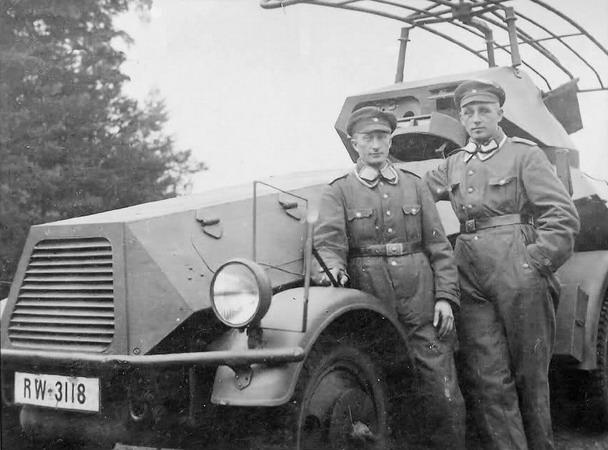
From the safety of the armoured cabin the front driver could look out through vision ports in the left portion of the front wall and in the left side wall beside his station. The ports were fitted with hinged covers incorporating narrow observation slits. The rear driver had three similar ports available — one in the rear wall and one on each side of his station. In summary, each driver could observe the outside world either by pushing his head through the roof opening, through the open rectangular vision ports in the walls, or through the slits in the port covers. Small raised lips were welded above all observation openings to prevent rainwater from running into them. As can be seen in certain photographs, some vehicles had false vision ports painted onto the right-hand portion of the front wall and the right side wall — the only purpose I can imagine for these was to confuse the enemy.
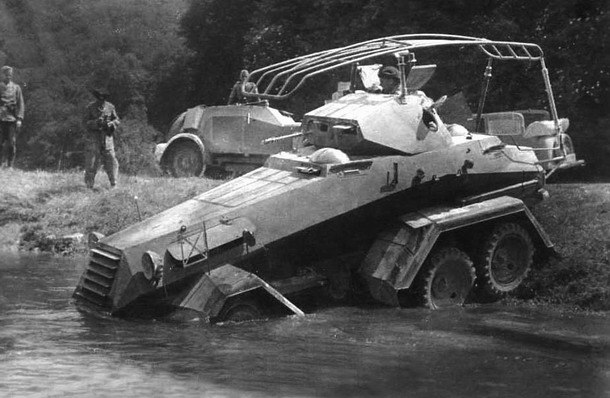
Sd.Kfz. 232 on the Büssing-NAG chassis, source: warwheels.net with the permission of the site operator, edited
Both driver's stations were fully equipped with a steering wheel, pedals and a gear lever (though the rear station apparently lacked an instrument panel). The rear control post was added to make reversing easier — from the front station, the rearward view was almost non-existent, and since the vehicle was intended for combat deployment in built-up areas and the confined spaces of narrow streets, easy reversing was considered very important.
The vehicle's crew comprised four men, though their exact roles are not entirely clear from the sources. As with the Sd.Kfz. 231 itself, it is unclear whether the vehicle had two permanent drivers or just one who moved between the two positions as needed. In all likelihood the crew consisted of two drivers, a commander and a gunner, with the commander or gunner probably also acting as loader. Who served as the radio operator is equally unclear. The most logical arrangement would have been to assign this task to the rear driver, who for most of the time had the least to do of anyone on board — he only drove when the vehicle was reversing.
But back to the vehicle's construction. On each side of the hull, in its widest section, were two headlights — one facing forward and one rearward. An interesting feature was a further folding headlight located in both side walls above the rear wheel mudguards. Under normal circumstances this light was folded flush into the armour and its cover was barely noticeable. Its purpose was to provide additional illumination for night-time aiming — which is probably why I have never come across a single photograph showing it in the deployed position.
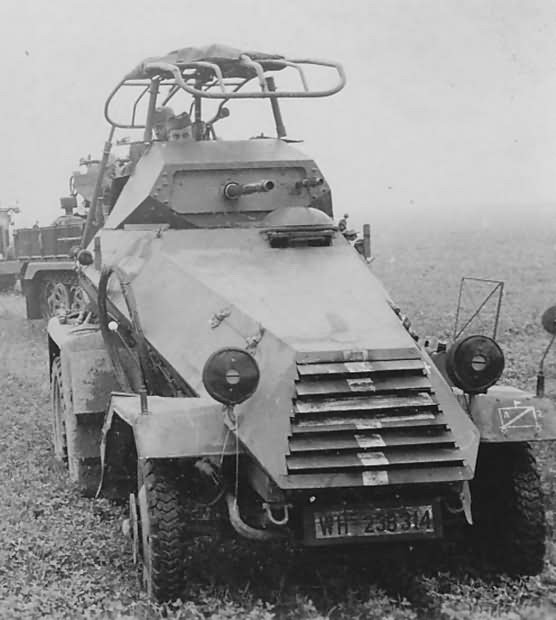
Sd.Kfz. 232 on the Büssing-NAG chassis, with the later-pattern gun mantlet with the machine gun on the left, source: worldwarphotos.info with the permission of the site operator, edited
Mounted on the cabin roof was a fully rotating fighting turret with a horseshoe-shaped footprint. Its side and rear walls were angled, so the turret narrowed towards the roof. The turret roof was sloped at the front and flat at the rear. In the flat rear portion of the roof was a crew hatch with a two-piece lid, the halves of which opened outwards to the sides. A further large hatch was located in the curved rear wall of the turret, also with a two-piece cover. In the side walls were circular openings fitted with covers incorporating observation slits, which could serve as vision ports when closed and also as firing ports for the crew's personal weapons when open.
The front wall of the turret was vertical and housed the vehicle's armament: the rapid-fire KwK 30 L/55 cannon in 20 mm and the MG 13 machine gun in 7.92 mm (later replaced by the MG 34). 200 rounds were carried for the cannon and 1,300 for the machine gun (1,500 is also cited). On early production vehicles, the movable gun mantlet was positioned in the right-hand portion of the turret's front wall and occupied approximately two-thirds of its width. The right third was fixed, with a small closable observation port cut into it. Within the mantlet, the cannon was on the left and the machine gun on the right, with additional openings between their barrels including the port for the TZF (Turmzielfernrohr) cannon sight. Lateral traverse was provided by the rotating turret and was therefore a full 360 degrees. Vertical elevation was controlled by the mantlet and ranged from −2° to +12°. On later production vehicles the weapon installation changed: the movable mantlet was enlarged to span almost the full width of the front wall, with the cannon placed roughly in the centre and the machine gun to its right.
Communications Equipment
No less important a "weapon" than the guns was the vehicle's radio equipment. Which radio set — or sets — was actually fitted is not entirely clear from the sources. The Fu Spr.Ger. "a" is most commonly cited, but on its own this would have been rather limited for a dedicated radio car, as it was a short-range set. It was therefore probably supplemented by a more capable medium-range set, most likely the Fu 11 SE 100. The radio equipment was complemented by a large frame antenna that extended across more than half of the vehicle's footprint. At the rear, the antenna was fixed to the engine compartment hull by two rigid struts. The other two struts were mounted on the turret and connected to the antenna via a rotating joint, which meant turret rotation was not impeded in any way.
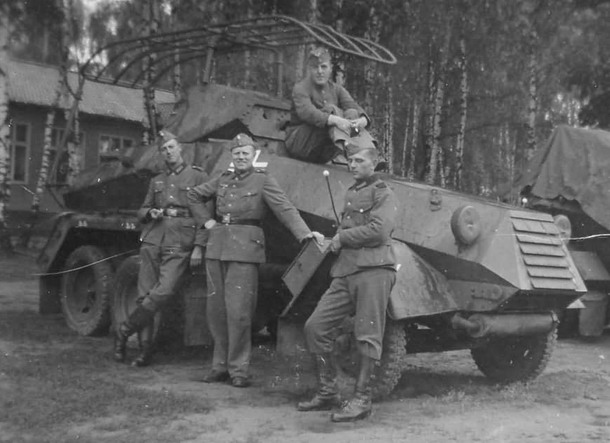
Sd.Kfz. 232 on the Magirus chassis, note the long front mudguards, source: warwheels.net with the permission of the site operator, edited
Series Production
Series production of the Sd.Kfz. 232 was apparently launched at the same time as that of the Sd.Kfz. 231, in 1933. Production took place directly in the Daimler-Benz and Büssing-NAG factories, to which the armoured hulls — and presumably the turrets — were supplied by the already-mentioned Deutsche Werke. Armament was supplied by Rheinmetall. Unlike the early prototypes, the production vehicles were fitted with angular mudguards. The wheels were fitted with armoured hub caps, which varied in shape.
The vehicle's original official designation was gepanzerter Kraftwagen (Fu) Kfz 67 a. It became far better known, however, under its later name schwere Panzerspähwagen (Fu) (Sd.Kfz. 232). Still later, the suffix "6 Rad" was added to distinguish it from the newer eight-wheeled version — though strictly speaking the vehicle did not have 6 wheels but 10, as the rear axle wheels were doubled up.
As far as basic characteristics such as weight and speed are concerned, these were probably very similar to those of the standard Sd.Kfz. 231 without radio equipment. The Daimler-Benz variant weighed 5.7 tonnes and could reach a top speed of 70 km/h (65 km/h is also cited). The Büssing-NAG variant weighed 5.35 tonnes and likewise had a top road speed of 70 km/h (again, 65 km/h is also given). The Magirus variant weighed a full 6 tonnes and could reach up to 62 km/h (here too, 65 km/h appears as an alternative figure). What did change significantly was the vehicle's height, which on the Sd.Kfz. 232 rose to 2.87 metres thanks to the antenna, compared to 2.25 metres for the Sd.Kfz. 231.

a closer view of the Sd.Kfz. 232; note the painted false vision ports on the front and side walls of the cabin, and the rotating joint on the antenna strut above the soldiers' heads, which allowed the turret to traverse, source: Bundesarchiv_Bild_102-04757A, Wikimedia, Creative commons, edited
While fitting radio equipment into a standard armoured car fulfilled the requirement, it also brought certain problems: the installation of the radio sets considerably reduced the interior space available to the crew and caused them significant discomfort when carrying out combat tasks. The desire for a more satisfactory solution eventually led to the development of another radio car based on the same platform — the vehicle that received the designation Sd.Kfz. 263.
The Sd.Kfz. 232 radio cars served alongside their sister vehicles, the Sd.Kfz. 231, in reconnaissance units. Like their counterparts, they were gradually replaced by the more modern eight-wheeled radio cars, though they appear to have remained in service somewhat longer than the classic Sd.Kfz. 231 6 Rad — continuing in use until 1942.
Technical Specifications
|
|
Büssing-NAG |
Daimler-Benz |
Magirus |
|
weight: |
5,35 t |
5,70 t |
6,00 t |
|
length: |
5,57 m |
5,57 m |
5,57 m |
|
width: |
1,82 m |
1,82 m |
1,82 m |
|
height: |
2,87 m |
2,87 m |
2,87 m |
|
engine: |
Büssing-NAG G |
Daimler-Benz M 09 |
Magirus S88 |
|
engine output: |
65 hp |
68 hp |
70 hp |
|
max. speed: |
70 km/h |
70 km/h |
62 km/h |
|
hull armour: |
5 - 14,5 mm |
5 - 14,5 mm |
5 - 14,5 mm |
|
crew: |
4 men |
4 men |
4 men |
|
armament: |
KwK 30 L/55 cannon, 20 mm MG 34 machine gun, 7.92 mm |
KwK 30 L/55 cannon, 20 mm MG 34 machine gun, 7.92 mm |
KwK 30 L/55 cannon, 20 mm MG 34 machine gun, 7.92 mm |
ARTICLE
CONTENTS:
Reproducing text from the Panzernet website without the written consent of the operator is prohibited.