Sd.Kfz. 263 (6 Rad)
six-wheeled armoured radio car
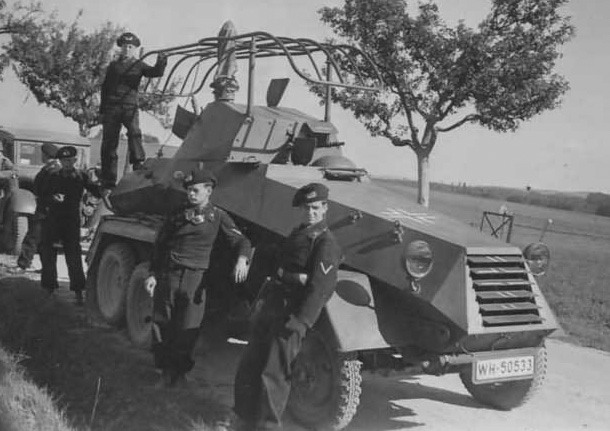
six-wheeled Sd.Kfz. 263, the telescopic Stabantenne is covered by its canvas sleeve, source: worldwarphotos.info with the permission of the site operator, edited
A note by way of introduction... the designation Sd.Kfz. 263 (Sd.Kfz. = SonderKraftwagen = vehicle for special purposes) was used for two entirely different types of heavy armoured radio cars. This article describes the older of the two, identified by the suffix "6 Rad". The later eight-wheeled version, Sd.Kfz. 263 (8 Rad), is covered in a separate article.
Origins of the Radio Car
In the early 1930s, the German Army introduced the six-wheeled armoured cars Sd.Kfz. 231 into service. These were vehicles built on the chassis of standard commercial trucks, with drive to the two rear axles and steering on the front axle. In their standard form these cars were not fitted with a radio, which was regarded as a serious shortcoming. The designers therefore developed a radio-equipped version, the Sd.Kfz. 232, at virtually the same time as the parent vehicle. This was essentially a standard Sd.Kfz. 231 fitted with a radio set and a large frame antenna. It served its purpose, and the vehicle was capable of communicating over distances of tens of kilometres, but it was far from an ideal solution. The installation of the radio equipment significantly reduced the interior space and made life considerably less comfortable for the crew when carrying out combat duties. The designers' efforts continued until they eventually produced the Sd.Kfz. 263 radio car.
This vehicle was designed from the outset with its role as a radio car as the primary consideration, with combat capability being secondary. For this reason no cannon was fitted at all — only a single machine gun, apparently of the MG 13 type.
Vehicle Description
The turret was designed as a fixed, non-rotating structure. These modifications freed up enough interior space for the comfortable installation of two radio sets — the short-range Fu Spr.Ger. "a" and, most likely, the medium-range Fu 12. The radio equipment was complemented by a large frame antenna that extended across more than half of the vehicle's footprint. The antenna was supported on four struts — two attached to the engine compartment hull and two to the turret roof. Since the turret did not rotate, the struts on it could be fixed rigidly without any rotating joint. A second, telescopic antenna — the Stabantenne — also emerged from the turret roof. Under normal operating conditions this was retracted and usually covered with a canvas sleeve. Due to its length, it could only be fully extended when the vehicle was stationary.
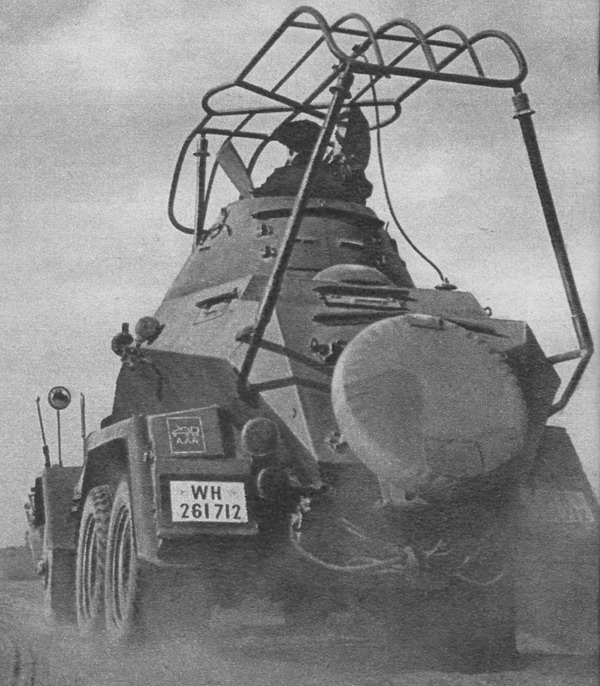
rear view of the Sd.Kfz. 263, source: Flickr.com with the permission of the publishing user, edited
The original armoured car, the Sd.Kfz. 231, was built on three different chassis types — Daimler-Benz G3a (p), Büssing-NAG G31 (p) and Magirus M206 (p). The radio car Sd.Kfz. 232 likewise used all three. The Sd.Kfz. 263, however, was built exclusively on the Magirus chassis, which was the most modern of the three. Along with this chassis came the associated running gear and powerplant — a Magirus S88 six-cylinder engine with a displacement of 4,562 cc, producing a maximum output of 70 horsepower at 2,200 rpm. The chassis was originally derived from a truck and therefore required some modification, including the addition of a rear driver's station.
As for the number of gear ratios, at least three different accounts can be found in the literature. Some sources state that the gearbox offered 4 forward and 1 reverse ratio. A second version adds a two-speed transfer gearbox that doubled this figure. A third account claims that the vehicle had 4 gear ratios available in both directions and could therefore travel at the same speeds forward and in reverse. One thing seems fairly clear: if the armoured car did indeed have a gearbox with an equal number of ratios in both directions, this would almost certainly have been added as part of the modifications made to the truck chassis when the armoured vehicle was built. No ordinary truck — from which the chassis was taken — would have had any need for such a gearbox (who would want to drive a lorry at high speed in reverse?). The most plausible version appears to be the second: that the vehicle had the standard 4 + 1 gear ratios, supplemented by a transfer gearbox that provided the same number of ratios again in off-road mode.
The armoured hull consisted of upper and lower halves with angled walls that sloped in opposite directions. From the bottom upwards the hull widened, then the side walls kinked and from there narrowed again towards the roof. This angling meant that there was no flat surface on the sides of the hull that an enemy projectile could strike at a right angle — it would always hit at some oblique angle. This solution increased the walls' resistance to penetration and thus compensated, at least in part, for the necessarily limited absolute thickness of the armour. The armour plate from which the hull was welded was 14.5 mm thick at the front and 8 mm on the side walls. The roof and floor were 5 mm thick. The hull extended significantly forward to accommodate the engine compartment. The crew compartment occupied the rear half of the hull, with the aforementioned non-rotating turret above it.
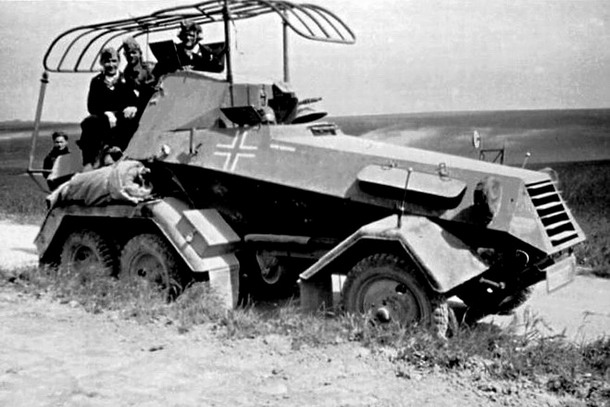
six-wheeled Sd.Kfz. 263, the telescopic Stabantenne is covered by its canvas sleeve, source: worldwarphotos.info with the permission of the site operator, edited
The engine compartment glacis was sloped, and virtually its entire surface was taken up by the air intake opening for the powerplant, covered by horizontal steel grilles. The headlights were mounted on the sides of the engine bonnet, behind which were service access hatches for the engine. The crew had several hatches available for entry and exit. In the lower section of both side walls, in the space behind the front wheel mudguards, were diamond-shaped hatches closed by two-part covers.
A further large hatch was located in the rear wall of the hull. This had two-piece doors that opened outwards to the sides. On most vehicles a spare wheel was mounted on brackets across the rear hull wall, so the bracket had to be swung downwards before the hatch could be opened. For this reason the rear hatch served primarily as an emergency exit. A final hatch was located in the cabin roof forward of the turret on the right-hand side (to the right of the cupola above the driver's head) and was used mainly by the driver. Above both driver's stations — in the left portion of the cabin roof ahead of the turret and in the centre of the cabin roof behind it — were circular openings with domed lids. In a safe environment the driver could open the lid, push his head through the roof opening and gain a direct view outside the vehicle, at the cost of exposing himself to external hazards.
From the safety of the armoured cabin the front driver could look out through visors in the left portion of the front wall and in the left side wall beside his station. The visors were fitted with hinged covers in which narrow observation slits were cut. The rear driver had three similar visors at his disposal — one in the rear wall and one on each side of his station. In summary, each driver could observe the outside world either by pushing his head through the roof opening, through the open rectangular visors in the walls, or through the slits in the visor covers. Small raised lips were welded above all observation openings to prevent rainwater from running into them.
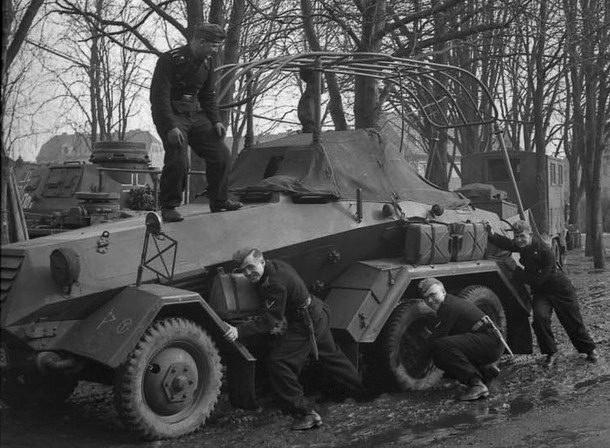
Sd.Kfz. 263, the turret is covered by a tarpaulin, but the radio car can easily be identified by the design of the antenna struts above the turret, source: Flickr.com with the permission of the publishing user, edited
Both driver's stations were fully equipped with a steering wheel, pedals and a gear lever (though the rear station apparently lacked an instrument panel). The rear control post was added to make reversing easier — from the front station, the rearward view was almost non-existent. The vehicle's crew consisted of four men: two drivers, a commander and a radio operator. The vehicle was not intended for direct combat and was not well suited to it. When it did become necessary to fire the machine gun, this was apparently done by the vehicle commander. Some sources suggest the crew actually numbered five.
But back to the vehicle's construction. Mounted on the cabin roof was the aforementioned fixed, horseshoe-shaped turret. Its side and rear walls were angled, so the turret narrowed towards the roof. The turret roof was sloped at the front and flat at the rear. In the flat rear portion of the roof was a crew hatch with a two-piece lid, the halves of which opened outwards to the sides. A further large hatch was located in the curved rear wall of the turret, also with a two-piece cover. In the side walls were circular openings fitted with covers incorporating observation slits. When closed, these openings could serve as vision ports thanks to the slits; when open, they could also be used for firing the crew's personal weapons. In the centre of the front wall was a machine gun of the MG 13 type, calibre 7.92 mm. A small aiming port was positioned directly above the main weapon, and to its left was a further, larger slit-type visor in the front wall.
The radio car weighed 5.7 tonnes. On roads it could reach a maximum speed of 70 km/h. Thanks to its tall antenna, the vehicle stood 2.93 metres high (compared to 2.25 metres for the Sd.Kfz. 231). The vehicle's official designation was Panzerfunkwagen Sd.Kfz. 263. The suffix "6 Rad" was added later to distinguish it from the eight-wheeled version — though strictly speaking the vehicle did not have 6 wheels but 10, as the rear axle wheels were doubled up.
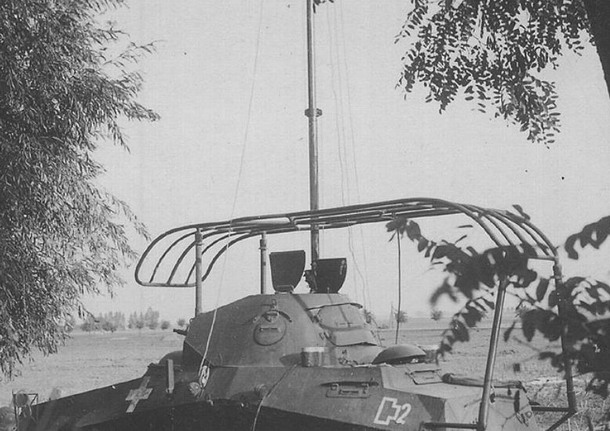
Sd.Kfz. 263 with the telescopic Stabantenne extended, source: Flickr.com with the permission of the publishing user, edited
The production period of the radio car is not clearly established in the literature, and there is also disagreement regarding the total number of units built. Essentially two figures appear in the sources: either 12 or 28 examples. Either way, it is certain that this was an extremely rare vehicle produced in very small numbers. The Sd.Kfz. 263 served with reconnaissance and intelligence units. The last vehicles of this type appear to have still been in service as late as 1943.

ARTICLE
CONTENTS:
Reproducing text from the Panzernet website without the written consent of the operator is prohibited.