THE THIRD BATTLE OF KHARKOV
"The commander who is not interfered with by the ruler will be victorious."
Sun-C', The Art of War
"The commander who is not interfered
with by the ruler will be victorious."
Sun-C', The Art of War
one of today's legendary photographs from the Third Battle of Kharkov — soldiers of the 1st Panzergrenadier Regiment of the Leibstandarte division entering Kharkov along the road from Belgorod, source: flickr.com with the permission of the publishing user, modified
Catastrophe in Southern Russia
The so-called Third Battle of Kharkov of March 1943 marked the culmination of Manstein's masterful counteroffensive against the forces of the Soviet Voronezh and South-Western Fronts. The road to that battle, however, was long and painful, and it began in essence with the encirclement of German forces at Stalingrad at the end of November 1942. After the ring around Stalingrad was closed on 23 November 1942, the Soviets prepared to push on towards Rostov-on-Don (Operation Saturn), which would have effectively cut off all German forces stationed in the Caucasus (Army Group A). The German armies in southern Russia faced nothing short of catastrophe, and a very swift response was required. To consolidate their forces in the area, the Germans formed a new army group from available units — Heeresgruppe Don — and Hitler appointed one of his most capable commanders, Field Marshal Erich von Manstein, to lead it. His task was clear but enormously difficult: stop the Soviet advance, stabilise the front and organise a counterattack to relieve the forces encircled in the Stalingrad pocket (Operation Winter Storm).
Achieving these goals, however, proved beyond German capabilities. The attempt to rescue the 250,000 soldiers encircled at Stalingrad failed, and the German defensive line on the Chir River west of Stalingrad came under heavy Soviet pressure that it clearly could not withstand. Manstein therefore appealed to the Führer to forget about Stalingrad and order the withdrawal of all German forces in southern Russia to the relative safety of the Northern Donets River line. Very reluctantly and after prolonged hesitation, Hitler eventually issued the order to retreat, yet continued to believe that the troops encircled at Stalingrad could still be rescued by an attack "from outside". It was specifically for this purpose that he ordered the SS Panzer Corps — composed of the Das Reich, Leibstandarte and Totenkopf divisions, then undergoing refitting and reorganisation in France — to transfer to southern Russia.
It was clear to Manstein — and most likely to everyone except Hitler — that any further attempt to relieve the 6th Army at Stalingrad was simply beyond hope. The fight was no longer about saving Stalingrad; it was about saving the entire southern wing of the Eastern Front. Manstein made no objection to the transfer of the SS Panzer Corps from France to Russia, since he knew it would come in useful regardless. As far as he was concerned, the encircled 6th Army was doomed. Yet it still played an important role in his plans. Before its final destruction, it was to perform one last heroic act: hold on as long as possible, tying down as many Soviet forces as it could, thereby buying time for the other German armies to retreat. The 6th Army fulfilled its final task with honour, and contributed decisively to ensuring that the Soviets lacked sufficient strength to completely cut off German Army Group A in the Caucasus.

a Marder III tank destroyer involved in the defensive fighting around Kharkov during the Soviet Operation Star, source: flickr.com with the permission of the publishing user, modified
Soviet Operation Star
By January 1943 the Soviets once again had their hands relatively free to resume the offensive. Soviet high command began planning two highly ambitious operations: Operation Gallop and Operation Star. We are concerned here only with Operation Star, whose objective was the capture of the cities of Kharkov and Kursk. When this Soviet operation was launched on 2 February 1943, the Russian units involved had already been fighting continuously for two months. Their ranks had thinned, the men were brimming with confidence but considerably exhausted, their equipment was heavily worn and supply lines had grown very long. Soviet generals cared little that they were flogging a half-dead horse, since they believed the Germans were in an incomparably worse state.
In many respects the Soviet assessment of the enemy's condition was not far from reality. Manstein had considerably fewer forces than the Soviets, and German morale had been badly shaken by a series of defeats. Manstein, however, was able to assess the situation coolly and knew precisely what he had to do to have any chance of success. He would let the Soviets continue attacking and exhausting themselves, use skilful evasive manoeuvres to minimise his own losses while enticing the enemy's leading formations ever deeper into the German lines — and then cut them off like the tentacles of an octopus with a well-planned counterattack and transition to a counteroffensive. All he needed for this were reinforcements and permission from the Führer, who was obsessed with holding every metre of ground and would not hear of any "elastic defence" or tactical withdrawals.
As Soviet Operation Star approached Kharkov with a 6:1 superiority in forces, Hitler decided to reinforce the city's defence with units of the SS Panzer Corps, whose transfer from France he had ordered, as we know, back in late December. In practice the transfer of the SS troops was proceeding rather slowly and piecemeal. Even as the divisions of the SS Panzer Corps arrived at Kharkov one by one and joined the fighting, holding the city against the enormous Soviet superiority was untenable. A critical crisis developed in the sector north of the city, where the Soviet 40th Army under General Moskalenko pushed the German 168th Infantry Division back towards the city of Belgorod, some 70 km north of Kharkov. On the night of 7–8 February 1943 the German 168th Infantry Division began evacuating Belgorod, and on 9 February the city fell into Soviet hands. The defence of Kharkov was beginning to collapse. The Soviet 40th Army continued south towards Kharkov after taking Belgorod and prepared to encircle it from the west. Only the Grossdeutschland Panzergrenadier Division stood in its way. Despite very determined resistance, one division could accomplish little against an entire Soviet army, and by 14 February Moskalenko's leading elements stood to the west of Kharkov with the front of Rybalko's 3rd Tank Army from the south a mere 10 km away. That was how close the Soviets came to closing the ring around Kharkov and encircling most of its defenders. The spectre of a "second Stalingrad" was in the air.

Marder III tank destroyers loaded with Panzergrenadiers during a transfer somewhere in the Kharkov region, source: worldwarphotos.info with the permission of the site operator, modified
Hausser Evacuates Kharkov
Throughout 14 February 1943, General Hubert Lanz (responsible for the defence of Kharkov) and the SS Panzer Corps commander Paul Hausser held urgent discussions about the next course of action. Neither of them likely believed any longer in the possibility of holding Kharkov — yet hanging over them was Hitler's personal order to defend the city to the last man. At 15:30 Hausser received a disturbing report from the Das Reich division commander Herbert Vahl: the division had exhausted all its reserves, the situation was hopeless, and unless the order to withdraw was issued by evening the division would be encircled and lost. On top of this, reports were beginning to appear suggesting a possible uprising among the civilian population of the city — the last thing the Germans needed. Hausser therefore contacted Army Group Lanz headquarters and demanded the order to withdraw the Das Reich division, by 16:30 at the latest. Instead he received only a reminder of Hitler's order not to retreat. Hausser decided to act. On 14 February 1943 at 16:45 he issued the Das Reich division, on his own authority, the order to abandon the sector east of Kharkov, withdraw to the south-western outskirts of the city and hold new positions on the Udy River.
At 18:00 General Lanz called Hausser personally and ordered him to cancel his withdrawal order immediately. According to official records Hausser complied, and at 18:15 he did indeed send the Das Reich division a cancellation of his previous order — only to receive the terse reply that the division had begun its withdrawal and this could no longer be stopped. Some historians believe that Hausser and Lanz had in fact agreed on this course of action since their personal meeting that morning, and that the attempted cancellation of the withdrawal was merely theatre — a kind of alibi for any subsequent inquiry. However that may be, the withdrawal order came at the very last moment. That same evening (14 February) the situation escalated in other sectors of the city's defence as well. In the south, Soviet units reached the Kharkov suburb of Osnova, while in the north, Russian infantry advancing west of Kharkov were pushing steadily southward and beginning to threaten the road to Lyubotin. On the morning of 15 February 1943, both the Leibstandarte and Grossdeutschland divisions reported that they could no longer control the situation in their sectors and risked being cut off.
The width of the German corridor through which the last possible escape route from Kharkov ran had now narrowed to just 2.5 km. All morning on 15 February frantic radio exchanges took place between Hausser, Lanz and Manstein. All three certainly knew what needed to be done, but none of them was willing to risk his career — or perhaps his life — by issuing the necessary order. In the end it was once again SS Panzer Corps commander Paul Hausser who summoned the courage, and at 13:00 he gave his men the inevitable order to retreat. The Leibstandarte and all other parts of the SS Panzer Corps under Hausser's command were to begin withdrawing westward immediately. Who issued the withdrawal order to the Grossdeutschland division — which did not fall under the SS Panzer Corps — is not clear from the sources; in any case, at 14:00 on 15 February that division too reported it had begun pulling back to the south-west.

the SS Panzer Corps divisions may not have had a dazzling number of tanks, but they were very well equipped with half-tracked APCs, tank destroyers, assault guns, cross-country vehicles and other vehicles, making them extremely fast and agile formations, source: flickr.com with the permission of the publishing user, modified
At this point the Soviets were flooding into Kharkov from three different directions simultaneously: the 3rd Tank Army from the south, the 40th Army from the north-west and the 69th Army from the east. The retreating German units had to pass through the city, which proved quite an adventure. Civilians expecting imminent liberation began producing hidden rifles and attacking the retreating Germans in partisan fashion. There were also first encounters with the Red Army's forward elements — the Das Reich division reported, for instance, that during the retreat through the city it had destroyed at least 15 Russian tanks in street fighting. Whatever could not be taken had to be destroyed. Some German soldiers reportedly left the city loaded down with tinned food and bottles of wine grabbed bare-handed from supply stores before these were set alight. In two days — 14 and 15 February — Kharkov and its surroundings were evacuated. On 16 February 1943 Soviet forces took the city and began celebrating wildly. This so-called Second Battle of Kharkov had ended in a Soviet victory — the third battle for the city was at that moment no more than a distant thought.
Manstein vs. Hitler
The loss of Kharkov enraged Hitler to the point that on 16 February he flew personally to Manstein's army group headquarters (which had in the meantime been renamed from Army Group Don to Army Group South). When his four-engine Focke-Wulf FW 200 Condor landed at the airfield in Zaporizhzhia, Hitler was, according to many historians, already resolved to relieve Manstein of command. The field marshal, however, was well prepared for his Führer's visit. Hitler was consumed by a single idea: to use the SS Panzer Corps without delay to retake Kharkov. Manstein took his breath away, however, with a proposal of his own that was far more ambitious. He had been working on this plan with his staff for several weeks and believed it could be set in motion within a matter of days.
Manstein's aim was not merely to retake the just-evacuated Kharkov, but above all to cut off and destroy, through coordinated attacks from north and south, all Soviet armies located west of the imaginary line Taganrog–Slavyansk–Kharkov. Once this was accomplished, he intended to continue with the capture of Belgorod and Kursk. Before the attack itself could begin, however, a first essential step was to ensure that the Soviet forward units did not reach the Dnieper River and threaten the strategically vital railway bridges at Dnipropetrovsk (modern Dnipro) and Zaporizhzhia, through which all German supplies flowed.

Manstein spent two interminable days convincing the Führer of the merits of his plan for a major offensive — the approaching Russian tanks proved a very powerful argument in his favour, source: Bundesarchiv, Bild 146-1995-041-23A, Wikimedia, Creative Commons, modified
Hitler was naturally attracted to the idea of a major offensive, especially as the SS Panzer Corps — in which the Führer had begun placing greater faith than in Wehrmacht formations — was to play the leading role. At the same time he was reluctant to abandon his own plan for a swift direct attack on Kharkov, and a lengthy debate followed about which plan was better and more feasible. Hitler argued that carrying out Manstein's plan would take so long that the spring thaw would catch up with it before it was complete, bogging down German tanks in oceans of mud — making it more sensible for the SS Panzer Corps to strike at Kharkov without delay. He also dismissed as a waste of time any effort to halt the Soviet advance towards the Dnieper, going so far as to claim that no serious threat to the vital bridges actually existed since no significant Soviet formations had advanced that far yet. After a full day of negotiations Manstein proposed deferring the final decision to the following day — a completely brilliant move on his part. It meant losing more precious time, but Manstein knew that one more day of "doing nothing" would prove him right.
And so it did. The morning reports from Army Group South on 17 February 1943 fully vindicated Manstein. Soviet forces had just occupied the towns of Pavlograd and Pereshchepyne, closing to within 60 km of Dnipropetrovsk from two directions simultaneously. To compound matters, reports arrived that Russian infantry and tanks were advancing towards Synelnykove, 60 km from Zaporizhzhia — the very place where Hitler and Manstein were meeting. Hitler's entourage grew nervous and pressed the Führer to leave the area immediately. Under the impression of these unfolding events, Hitler finally abandoned his concept of a rapid direct attack on Kharkov and agreed to Manstein's far broader counteroffensive plan. From that moment the discussion focused solely on how to put that intention into effect.
Manstein's Plan
Manstein divided his planned counterattack into three phases. The first step was to eliminate the Soviet "tentacles" — the 6th Army and the 1st Guards Army — reaching towards the bridges over the Dnieper. These tentacles were to be severed by two simultaneous attacks from north and south. The northern jaw of the German pincers was to be formed by part of the SS Panzer Corps, which was at that time concentrating in the area between Poltava and Krasnograd (modern Berestyn). The SS Panzer Corps was now complete, but only two of its divisions — Das Reich and Totenkopf — were to take part in the attack against the Soviet forward formations. The third division, Leibstandarte, was for the time being to remain with Army Group Kempf (formerly Group Lanz, renamed after a change of commander) around Krasnograd, covering the backs of the other two against continuing Soviet attacks in that sector.

exhausted but superbly equipped and highly motivated — Das Reich division tank crews and Panzergrenadiers advancing in the course of Manstein's offensive towards Kharkov, source: flickr.com with the permission of the publishing user, modified
The southern jaw of the German pincers was formed by the XXXXVIII Panzer Corps under General Knobelsdorff. Its 6th and 17th Panzer Divisions were to advance from the area south-east of the village of Chaplyne. To ensure unified command of both jaws, all attacking units were placed under the 4th Panzer Army under General Hoth (who in turn answered to Manstein). Once the first phase of the operation was complete — the destruction of the Soviet armies heading for the Dnieper — the Wehrmacht and Waffen-SS units were to transition to the second phase: the attack on Kharkov. The third phase was to be the capture of Belgorod and Kursk.
The SS Panzer Corps Attacks
The German counteroffensive began on the evening of 19 February 1943. And not a moment too soon — at that point the leading formations of the Soviet 6th Army were already in the town of Novomoskovsk (modern Samar), a mere 20 km from the bridge over the Dnieper at Dnipropetrovsk. Moreover, the Soviets controlled a large stretch of the railway running from the Dnieper towards Pavlograd and on to Kharkov. The German divisions' task was therefore to cut off the tip of the Soviet 6th Army's advance and regain control of the railway east of the Dnieper. Das Reich was the first to strike, setting out from the Krasnograd area on the evening of 19 February. Going into action with it were 33 Panzer III tanks, 7 Panzer IV tanks, one Tiger, 15 StuG III assault guns and several tank destroyers, most likely of the Marder III type. At first glance this might not seem an overwhelming force, but it must be added that the division was very well equipped with additional assets: self-propelled guns, half-tracked anti-aircraft gun carriers, armoured cars, APCs, cars and trucks, motorcycles, and command and signals vehicles, making it a highly mobile and highly effective fighting force.
Das Reich advanced southward from Krasnograd, captured the town of Pereshchepyne and the following day (20 February) pressed on towards Novomoskovsk (modern Samar). Late that evening the town was taken and the main body of Das Reich continued east towards Pavlograd. The Totenkopf division advanced almost parallel to Das Reich, also heading for Pavlograd. On the afternoon of 21 February the Germans threw their full weight at the town. Stuka dive-bombers and the self-propelled guns of the Das Reich 4th Regiment delivered a spectacular overture, then tanks and half-tracked APCs packed with Panzergrenadiers surged forward at full speed, all guns pouring fire into the suburban houses of Pavlograd. It was a textbook display of the aggressive fighting style of these elite Waffen-SS units — the aim was to exploit mobility and firepower to the maximum: pin the defenders down with ferocious fire, drive straight in among them as fast as possible, and destroy them before the moment of surprise could pass. By 16:00 the southern part of Pavlograd was in German hands, though fighting for the rest of the city continued until the end of the following day, 22 February 1943 — not to mention the clearance of the surrounding villages.

Sd.Kfz. 250 and Sd.Kfz. 251 half-tracks in a Russian village... the German units attacking Kharkov were heavily mechanized and therefore capable of rapid operations, source: flickr.com with the permission of the publishing user, modified
The units forming the southern jaw of the German pincers — the XXXXVIII Panzer Corps with its 6th and 17th Panzer Divisions — were also advancing towards Pavlograd, setting out from the area around the village of Chaplyne, some 50 km south-east of Pavlograd. The 6th Panzer Division moved quickly north-west to Synelnykove and then continued north-east. The XXXXVIII Panzer Corps divisions were not attacking Pavlograd directly but occupying its surroundings: the 6th Panzer Division captured the villages of Boguslavka and Dmytrivka east of Pavlograd, while the 17th Panzer Division pushed even further east and on 23 February captured the town of Petropavlivka, about 35 km from Pavlograd.
Even though fighting around Pavlograd was still fairly intense, German high command could be well satisfied with the course of the offensive so far. In just four days the threat to the Dnieper bridges had been averted and control had been regained over Pavlograd itself as well as the railway running to it from the east. The leading formations of the Soviet 6th Army and 1st Guards Army had been cut off from their rear areas and thus left without supply. This robbed these Soviet units of any further offensive ambition — their sole remaining goal became simply to find some way back to their own lines to the north-east.
How was it possible for the German offensive to proceed so smoothly? It was a combination of several factors that Manstein had correctly identified. The enemy's exhaustion after a long advance played a role, as did the dangerous overextension of the Soviet forward units far to the west with lengthening supply lines, the element of complete surprise, and last but not least the combat effectiveness of the elite Waffen-SS divisions. Soviet high command was convinced that German forces in southern Russia were in ruins and the entire Nazi army was fleeing westward. Nobody imagined the Germans capable of going on the offensive in such circumstances. Even when the German counterattack began, Soviet generals at first dismissed it as a local action. They only grasped the true scale of the German counteroffensive when it was too late.
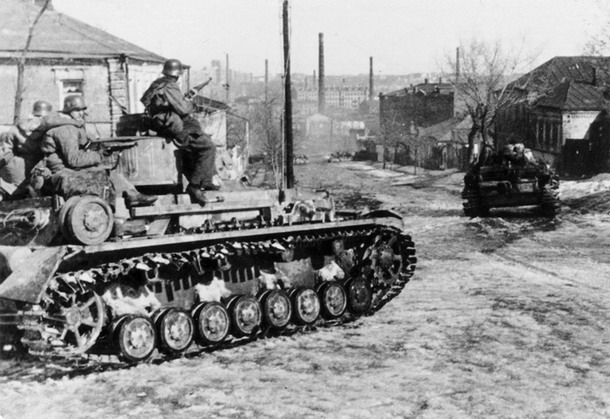
the speed and intensity of the German offensive completely caught the enemy off guard — German tanks on the outskirts of Kharkov, source: Bundesarchiv_Bild_101III-Zschaeckel-189-13, Wikimedia, Creative Commons, modified
Pavlograd was thus taken on 23 February, and although the surrounding area was still quite active, the Germans had no intention of lingering. They moved on rapidly northward from Pavlograd. On 24 February they captured the small towns of Vyazivok and Verbky and pressed on north again towards the towns of Orilka, Lozova and Panyutyne (modern Limanivka), all lying on the route of advance towards Kharkov. The first Totenkopf units reached Orilka as early as 25 February but were unable to break through from there towards Panyutyne, hampered by both fierce Russian resistance and a shortage of fuel and ammunition. Supply was faltering because the area between Pavlograd and Orilka was constantly roamed by remnants of shattered Soviet units that threatened the German supply convoys. Other elements of Totenkopf and Das Reich advanced towards Lozova more slowly precisely because they had to continuously clear their route of advance of Russians. The full attack on the two adjacent towns of Lozova and Panyutyne did not begin until the morning of 27 February. Das Reich attacked Lozova from the south and Totenkopf attacked Panyutyne from the north-west. Hard fighting raged throughout the afternoon until most of the Russian defenders began withdrawing northward in an effort to reach the town of Krasnopavlivka, some 25 km away. At 16:00 the town of Lozova was in German hands.
Before dawn on 28 February, units from both SS divisions set off after the retreating Red Army soldiers towards Krasnopavlivka, advancing essentially along the railway line from Panyutyne. Further elements of Totenkopf were also approaching Krasnopavlivka from Orilka. The attack on Krasnopavlivka was led by the Das Reich 4th Panzergrenadier Regiment with a battery of StuG III assault guns in support. Fighting for Krasnopavlivka lasted until nightfall before the remaining Soviet defenders again withdrew northward out of the town.
Rybalko's Attempted Counterattack
When Soviet high command finally understood that the Germans had launched a fairly large-scale counteroffensive, it acted. On 28 February Lieutenant General Rybalko was ordered to counterattack with his 3rd Tank Army and halt the advancing SS Panzer Corps divisions. Rybalko's army was to concentrate around Kehychivka during 1 March and attack the following day. Soviet high command, however, completely ignored the fact that Rybalko's 3rd Tank Army had behind it not only the capture of Kharkov but subsequently several days of unsuccessful attempts to take Krasnograd — which, as mentioned above, was being defended by the Leibstandarte division temporarily subordinated to Army Group Kempf. The Soviet 3rd Tank Army had gradually bled itself white in these engagements. For the ordered counterattack, Rybalko therefore had at his disposal only around thirty operational tanks.

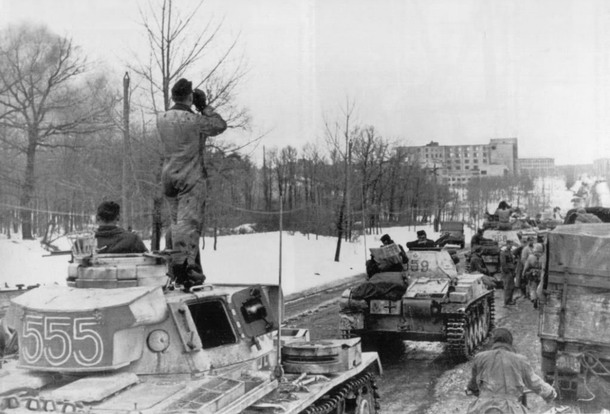
Panzer II light tanks in the streets of Kharkov — these vehicles were long past their prime by 1943, but evidently not yet entirely without utility, source: waralbum.ru, modified
German aerial reconnaissance naturally detected the large movement of Soviet forces, allowing the German command to react accordingly. Das Reich and Totenkopf were ordered to set out from the Krasnopavlivka area (which, as we know, they had taken on the evening of 28 February) towards the area where Rybalko's forces were concentrating — the town of Kehychivka, about 40 km north-west of Krasnopavlivka. The Leibstandarte division, which had until now been holding the defence at Krasnograd and thereby covering the backs of the other two SS divisions, was also now to go on the offensive and strike at Rybalko from the west. Thanks to intensive Luftwaffe attacks on the moving Russian columns, Rybalko was forced to postpone the start of his attack from 2 to 3 March.
In the event, however, Rybalko never got the opportunity to carry out his ordered attack. By 2 March he found himself in a trap, almost encircled by German forces from three sides: Leibstandarte from the west, Totenkopf from the east and Das Reich from the north. Only to the north did a narrow free corridor remain, offering a possible escape. Rybalko was forced to abandon any offensive aspirations and instead issued his units that afternoon with the order to attempt to break through northward and withdraw towards Russian positions. Rybalko's army did manage to escape complete encirclement, but at the cost of many lives and much equipment. Fighting north of Kehychivka continued until 5 March.
Second Phase of the Offensive
The first phase of Manstein's plan — the destruction of the Soviet armies threatening the strategically vital Dnieper bridges — had been successfully completed. The Soviet 6th Army and 1st Guards Army were in ruins, and Rybalko's decimated 3rd Tank Army was in retreat. On the other sectors of Army Group South's front the situation had also stabilised from the German perspective. The time had now come to move to the next phase of the offensive before the spring thaw made it impossible. That next phase was nothing less than an attack on the recently and humiliatingly evacuated Kharkov. Responsibility for conducting the attack still rested with Generaloberst Hermann Hoth and his 4th Panzer Army, which encompassed the XXXXVIII Panzer Corps, the LVII Panzer Corps, Army Group Kempf and, most importantly, the entire SS Panzer Corps. It was the SS Panzer Corps — with its Leibstandarte, Das Reich and Totenkopf divisions — that was to form the main striking force of the coming operation.

Panzer IV tanks loaded with Panzergrenadiers on the outskirts of Kharkov — the frost is clearly easing and mud is appearing on the roads, source: worldwarphotos.info with the permission of the site operator, modified
On the afternoon of 4 March, Generaloberst Hoth issued fresh orders. The SS Panzer Corps was given one more day to clear its rear of any significant remnants of Russian forces, and was to advance northward towards Kharkov from 6 March. The XXXXVIII Panzer Corps, now reinforced with the 11th Panzer Division, was ordered to advance on the right (eastern) flank of the Waffen-SS troops from Krasnopavlivka further north, cross the Mzha River and clear the area east of the town of Merefa. Covering the ground still further east was the LVII Panzer Corps, while on the left (western) flank of the SS Panzer Corps, Army Group Kempf — whose main striking force was the Grossdeutschland division and the SS Infantry Regiment Thule — was to join the offensive.
The entire operation thus hinged on the three SS Panzer Corps divisions. Let us consider the state these units were actually in. As of 3 March 1943, Das Reich had only 8 operational tanks of the Panzer III type plus several Marder III tank destroyers, along with several dozen towed anti-tank guns and other weaponry. Totenkopf could deploy 64 combat-ready tanks: 42 Panzer III, 16 Panzer IV and 6 heavy Tigers, plus 16 StuG III assault guns and a small number of Marder III tank destroyers. Finally, Leibstandarte had a total of 46 tanks of the Panzer III, Panzer IV and Tiger types plus a further 7 light Panzer IIs — all figures for vehicles in operational condition.
On 6 March the SS Panzer Corps divisions set off with the aim of bypassing Kharkov from the west before encircling it. Totenkopf advanced on the left, Das Reich on the right and Leibstandarte in the centre. On 7 March the Waffen-SS troops approached the Mzha River in the area between the towns of Valky and Nova Vodolaha. Das Reich captured Nova Vodolaha around midday. At Valky, however, Leibstandarte ran into strong Russian positions with numerous well-concealed anti-tank guns. The Panzer III and Panzer IV tanks could not deal with them, and a pair of Tigers had to be called up. These slowly but steadily closed on the Russian positions, impervious to enemy fire, and proceeded to methodically destroy the concealed guns one by one. Valky was taken around 16:30.

and again tanks and Panzergrenadiers of the Das Reich division on the outskirts of Kharkov — the high-rise buildings in the city centre are visible in the distance, source: waralbum.ru, modified
After Das Reich captured Nova Vodolaha and began crossing the Mzha River, it sent a small battle group during the morning — one company of Panzergrenadiers escorted by a few tank destroyers and StuG III assault guns — further north-east. Meeting little resistance, this group advanced some 15 km and reached the Merefa River. It crossed this river too and by evening the troops had pushed all the way into the area between the small towns of Lyubotin and Korotyach, already almost within sight of Kharkov's western outskirts. The Germans decided to spend the night in the forests alongside the road, but the Russians had no intention of letting them sleep. The SS men repelled all Russian night attacks and retained control of the area they held. During the night of 7–8 March the main forces of all three Waffen-SS divisions continued crossing the Mzha River, so that by morning they stood firmly on the opposite bank, ready to push further north.
How were both German flanks faring? On the right flank of the SS Panzer Corps advanced, as we know, the XXXXVIII Panzer Corps. It moved northward from Krasnopavlivka, via today's Zlatopil towards the village of Taranivka and further still until its leading elements reached the Mzha River at the small town of Sokolove. Overall, however, the XXXXVIII Panzer Corps was advancing more slowly than the Waffen-SS units. On the left flank of the SS Panzer Corps, Army Group Kempf was attacking. Its troops advanced from west to east and north-east, broadly following the railway line from Poltava to Kharkov. With varying degrees of difficulty they pushed through the villages of Iskrivka and Shelestove, then through the town of Kolomak, Perekip and Kovyahy, ending their day's advance at the railway station in the village of Shlyakh.
Generaloberst Hoth's order of the day for 4th Army on 8 March 1943 brought no change to the previous intention — the gradual encirclement of Kharkov was to continue. Concretely, the SS Panzer Corps was to keep advancing north along the western outskirts of Kharkov and cut all roads and railways entering the city from that side, thereby preventing Soviet troops in the area west of the city from withdrawing into Kharkov to reinforce its defences. The XXXXVIII Panzer Corps was tasked with crossing the Mzha River, advancing east south of Kharkov and cutting first the railway and main road running from Kharkov south to Zmiyiv, and then also the railway and road from Kharkov to Chuhuiv — an assignment that, it must be said at once, was beyond the XXXXVIII Panzer Corps's capabilities.

German soldiers are already in sight of the Kharkov city centre with the high-rise buildings on Dzerzhinsky Square, source: flickr.com with the permission of the publishing user, modified
Totenkopf set off on the morning of 8 March from the Mzha River (roughly from the area of the town of Valky) in its assigned direction. One regiment of the division advanced to the village of Shlyakh, where it linked up with its comrades from the Grossdeutschland division (Army Group Kempf), while the second regiment reached the small town of Staryi Merchyk around 17:00. The Leibstandarte division set off on 8 March from the Mzha River in the area east of Valky. Around 15:00 its troops reached the town of Lyubotin and concluded their day's advance in the area north of it. Das Reich moved that day from the Mzha River roughly from the area of the village of Bakhmetivka. Around midday its troops reached the village of Odrynka, which they had to take by force from the Russians. Das Reich's forward battle group meanwhile continued to hold the area near the road between Lyubotin and Korotyach.
Tuesday 9 March 1943 arrived. SS Panzer Corps units continued their encircling movement around Kharkov along its western outskirts. Totenkopf that day occupied the evacuated town of Vilshany without a fight, then pushed on to the Udy River, crossed it east of the town and established a bridgehead on the eastern bank. Das Reich captured the small town of Korotyach and continued north towards the small town of Solonychivka. And finally Leibstandarte advanced through Lyubotin, crossed the Udy River at the village of Peresichne and pushed on towards the town of Derhachi, north-west of Kharkov. While the SS divisions were making progress according to plan, the XXXXVIII Panzer Corps on their right flank proved unable to cross the Mzha River and fulfil its task of cutting the roads leading south out of Kharkov. What was holding the Germans back here was Lieutenant General Rybalko, who with the remnants of his 3rd Tank Army and additional reinforcements was holding a defensive line on the Mzha River between the towns of Merefa and Zmiyiv.
Hausser and Ambiguous Orders
9 March 1943 was a decisive day in one respect. SS Panzer Corps commander Paul Hausser received a query from 4th Panzer Army headquarters (Hermann Hoth) asking whether in his opinion Kharkov could be taken by a rapid attack the following day. Hausser was evidently confused by this query, since his existing orders called for him to bypass and encircle the city, not to enter it. He requested clarification but apparently received no reply. The prospect of a direct assault on Kharkov must have been very tempting for Hausser. He and his men undoubtedly still felt the bitterness of having been effectively thrown out of the city by the Soviets less than a month earlier. Hausser therefore most likely decided to interpret the query from 4th Panzer Army headquarters as a change of plan and ordered his corps to prepare for an attack on Kharkov — to begin the very next day, 10 March.

heavy Tiger tanks participated in the attack on Kharkov in limited numbers, helping to overcome Russian resistance in the most heavily defended sectors, source: worldwarphotos.info with the permission of the site operator, modified
Leibstandarte was first to capture the town of Derhachi and then enter Kharkov from the north. Das Reich was to attack from the west, reinforced by some of Totenkopf's tanks, while Totenkopf itself would cover the other two divisions' backs against any Russian moves from the north and north-west. The Waffen-SS soldiers were very tired after prolonged fighting, but the prospect of capturing Kharkov was evidently a powerful motivator. Morale was high, but tank numbers were not. Totenkopf had 49 operational tanks: 5 Tigers, 30 Panzer IIIs and 14 Panzer IVs. Leibstandarte had 40 combat-ready tanks, but a full quarter of these were lightly armed Panzer IIs. Das Reich was in the worst shape of all and could only muster 26 tanks for action. The entire SS Panzer Corps thus had no more than 115 combat-ready tanks as of 10 March 1943 — and all motorised vehicles were running well into the red in terms of maintenance and repairs.
Although acting essentially without a direct order from above, Hausser made no secret of his planned attack on the city. He briefed his superiors and even submitted an official request for air support. Hausser expected the Soviets to attempt to pull their troops back from the western outskirts of Kharkov and fortify themselves in the city centre, which would mean a very demanding and very bloody fight in densely built-up areas. He therefore pressed Leibstandarte to capture Derhachi and then advance as quickly as possible south along the main road to Kharkov, following the Lopan River. If the division could seize all the bridges across this river, it would prevent the Russians from shifting troops from west to the city centre — since the Lopan River separates the western part of Kharkov from its centre.
The launch of a full attack on Kharkov on 10 March 1943 ultimately proved impossible, because capturing the town of Derhachi took far longer than expected. The Russians fought tenaciously for Derhachi and the Germans were forced to send their tanks directly into the streets, which was of course very dangerous. One who could testify to this was Untersturmführer Rudolf von Ribbentrop, commander of the 7th Company of the 2nd Battalion of Leibstandarte's 1st Panzer Regiment — and son of the German Foreign Minister Joachim von Ribbentrop — who found himself with his tanks in the streets of Derhachi without the support of his own infantry. At one point his tank was rocked by a very powerful explosion. Nobody aboard was hurt, but everyone was naturally in shock when the radio crackled to life with the voice of Untersturmführer Stollmeier, whose tank was immediately behind Ribbentrop's in the column. Stollmeier informed his colleague that he had just knocked a group of Russians off his tank with a high-explosive shell — Russians who had been climbing on it armed with Molotov cocktails. Asked why he had not used a machine gun, Stollmeier replied that the machine gun was not available at that moment and the situation required immediate action. Clearly, without the support of their own infantry, German tank crews had to cover each other's backs by such drastic means.

street fighting is always difficult and costly — Panzergrenadiers take careful cover and wait as a Panzer IV "checks" whether it is safe around the corner of the building, source: waralbum.ru, modified
Derhachi was finally captured during the afternoon of 10 March. Totenkopf then positioned strong outposts on the northern approaches to the town — its main task, it will be recalled, was to cover the other divisions' backs against Russian attacks from the north. The Leibstandarte soldiers, meanwhile, hurried on from Derhachi. The division's 1st Panzergrenadier Regiment advanced further east, while the 2nd Panzergrenadier Regiment moved south from captured Derhachi towards Kharkov itself. By the end of the day the men of the 2nd Regiment had approached the edge of Kharkov, but were met with ferocious Russian resistance, causing the SS troops to pull back and prepare for the main assault on the city the following day.
One battle group from Leibstandarte — composed of the 1st Reconnaissance Battalion (Sturmbannführer Kurt Meyer) and the 1st Battalion of the 1st Panzer Regiment (Sturmbannführer Max Wünsche) — did not take part in the fighting for Derhachi. Instead it bypassed the town entirely and pressed east to the small town of Cherkaska Lozova, which it captured without too much difficulty. This secured another road leading out of Kharkov — in this case the road to Belgorod. Meyer's battle group immediately set off south along this road towards Kharkov. By nightfall the Germans had on this axis advanced all the way to the airfield on the northern edge of Kharkov (today's private Kharkiv North airfield). They were unable to capture it, however, and decided to leave it to the 1st Panzergrenadier Regiment following behind them, simply bypassing it to the east. Wünsche's and Meyer's men spent the coming night in the wooded area of Velyka Danylivka between the airfield and the main road leading north from Kharkov to the town of Tsyrkuny. In essence, all roads out of Kharkov to the west, north and north-east were now under German control — the city was encircled by roughly two thirds. Cutting the remaining roads and railways leading south and south-east from the city was (as we know) the task of the XXXXVIII Panzer Corps, which remained unable to accomplish it, having become embroiled in fighting against Rybalko on the Mzha River.
Throughout the whole of 10 March Hausser received no unambiguous prohibition of a direct attack on Kharkov. A message from Manstein himself on the evening of 10 March again reiterated that the SS Panzer Corps's primary task was to encircle the city from the north, but also allowed for an attack on the city if "enemy defensive activity declines." Hausser therefore interpreted the situation as having the green light from above for his planned action and continued to count on a direct attack on Kharkov — simply delaying it by one day. Leibstandarte commander Sepp Dietrich viewed the situation similarly: on the evening of 10 March he spoke by telephone with Hitler himself, who reportedly expressed his conviction that if "his" Leibstandarte struck with its usual élan the Russians would have no chance of holding Kharkov.
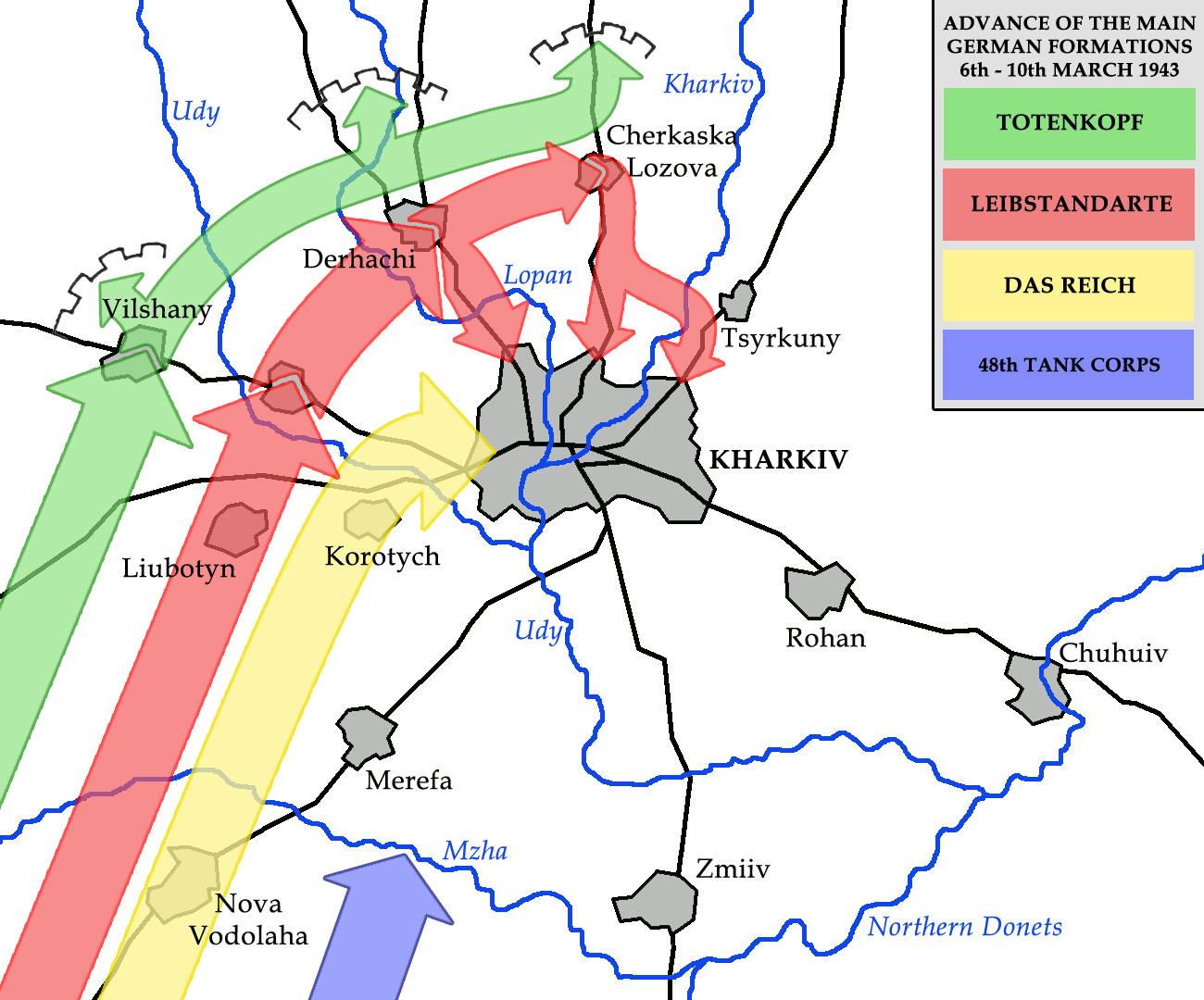
simplified map of the main German forces' advance during the attack on Kharkov, approximately from 6 to 10 March 1943, source: Panzernet
The SS Panzer Corps Enters Kharkov
11 March 1943 arrived. Before first light, after barely a few hours of rest, the Waffen-SS soldiers launched the main assault on the city of Kharkov from all the directions they controlled. The Leibstandarte division played the leading role, so let us first follow its actions. From the north, from the direction of Derhachi, the 2nd Panzergrenadier Regiment entered Kharkov in two columns. The 2nd Battalion led by Sturmbannführer Rudolf Sandig advanced along the western side of the railway line. Before entering the built-up area, it ran into stubborn resistance from defenders dug in on high ground to its right. The battalion then continued roughly along today's Kurylivska Street, following the railway line.
The other two battalions of the same 2nd Regiment entered the city on the opposite side of the railway tracks. The 1st Battalion under Sturmbannführer Hugo Kraas led, followed in reserve by the 3rd Battalion under Sturmbannführer Joachim Peiper. Kraas's 1st Battalion quickly ran into fierce Russian resistance in the Oleksiivka suburb and by midday it was clear that it could not manage without assistance. A battery of StuG III assault guns was brought up and air support requested. At 13:25 dive-bombers plastered the Russian positions with bombs while assault guns and self-propelled anti-aircraft guns added their fire. Despite every effort, the Russian resistance in Oleksiivka could not be broken that day, and the Germans even lost one StuG III and one half-track.
Some distance to the east, the 1st Panzergrenadier Regiment was also entering the city, again split into several columns. Roughly along Prospekt Lenina (today Prospekt Nauky), the 2nd Battalion under Sturmbannführer Max Hansen was advancing. Still further east, the 1st and 3rd Battalions under Sturmbannführer Albert Frey and Sturmbannführer Wilhelm Weidenhaupt operated together. From around 04:00, soldiers from these two battalions had been trying to deal with the defenders of the already-mentioned Kharkiv North airfield. The Red Army soldiers there made a critical mistake by attempting a counterattack — the moment they left their trenches and moved out across the flat airfield surface, they became easy prey for German machine guns and 20 mm automatic cannon. Several salvoes from Nebelwerfer rocket launchers and StuG III assault guns completed the work. At 07:50 the airfield was clear and German Panzergrenadiers entered Kharkov, advancing on both sides of the then Karl Liebknecht Boulevard (today Sumska Street) towards the then Dzerzhinsky Square (which less than a month earlier had been called Wehrmacht Square).

armoured vehicles of Leibstandarte's 1st Panzergrenadier Regiment rolling down Karl Liebknecht Boulevard (today Sumska Street) towards the centre of Kharkov, source: waralbum.ru, modified
Then there was Meyer's battle group, which had reached the Kharkiv North airfield the previous day, bypassed it and spent the night in the wooded area of Velyka Danylivka. This battle group entered the city on the morning of 11 March from the east, along the road leading to the town of Tsyrkuny — most probably along Akademika Pavlova Street (which bore that name then as it does now). Their objective was to reach the intersection with Stalin Prospekt (today Prospekt Kharkivskykh Heroiv) and occupy this wide boulevard to prevent the Russians from using it to withdraw towards Rohan and Chuhuiv. This was thus a continuation of the effort to encircle, if not the entire city, then at least its central section. Meyer's battle group did reach its objective, becoming the unit that had penetrated deepest into Kharkov on 11 March. It came at the cost of consuming almost all their fuel, however. Meyer therefore established a all-round defensive position on the spot and sent out the 2nd Reconnaissance Company under Hauptsturmführer Hermann Weiser to find a route by which supply trucks could safely come in. That company soon found itself in serious trouble of its own and its men had to take shelter in a school building and defend themselves against Russian attacks. Meyer thus remained cut off in the middle of Kharkov and held out bravely against Russian pressure throughout the night.
That covers the Leibstandarte division's advance; now let us look briefly at how the Das Reich division fared on 11 March as it attacked the city from the west. This division too entered Kharkov in two streams. The first was the so-called Kampfgruppe Harmel, named after the commander of the 3rd Panzergrenadier Regiment, Standartenführer Heinz Harmel. The group set out from the area of the towns of Korotyach and Solonychivka around 08:00 and from the very start had to overcome very fierce Soviet resistance. Around 16:00 the Kampfgruppe reached the Zaljutino suburb, where it ran into a deep anti-tank ditch protected by Russian artillery, anti-tank guns and infantry dug in among the buildings on the far side.
A frontal assault would have been suicidal, so Harmel decided to wait for nightfall and under the cover of darkness send a diversionary group of engineers under Obersturmführer Karl Macher to try to eliminate the defenders. The operation began silently at 02:40. The Russians were alert, however, and detected the movement of enemy troops near the ditch. Macher's engineers came under fire. But the muzzle flashes of the Russian weapons in the darkness allowed German assault guns to return fire with great precision. After a period of fighting the Russian defence was suppressed sufficiently for Macher's engineers to resume crossing the ditch.
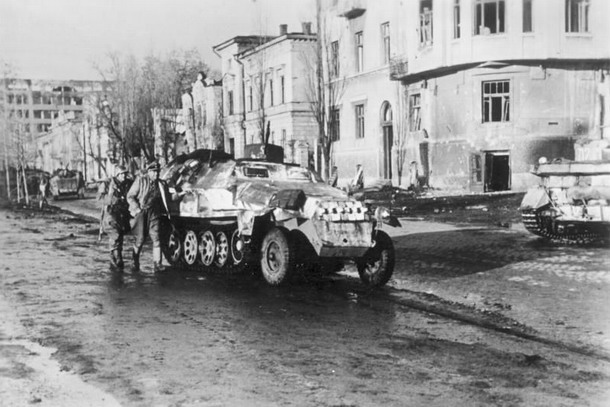
the city is almost in German hands — an Sd.Kfz. 251 half-tracked APC and a Panzer IV tank in the streets of Kharkov, source: Bundesarchiv_Bild_183-J22454, Wikimedia, Creative Commons, modified
At 02:53 Macher requested by radio that friendly fire be halted, as his men were about to storm the first row of buildings on the far side of the ditch. The engineers rushed forward, throwing grenades into every window and doorway and eliminating the remaining Russian infantry in the houses at close range with submachine gun fire. At some particularly stubbornly defended buildings they even laid larger explosive charges and essentially demolished them on top of the defenders. The Panzergrenadiers then joined the engineers and helped clear more and more buildings. Around 04:00, however, the Red Army soldiers launched a counterattack. The Germans again deployed StuG III assault guns to repel it. Meanwhile other engineers began filling in the anti-tank ditch at selected points. At 05:15 the first German tanks and half-tracks began crossing over the filled-in sections. Parallel to Harmel's Kampfgruppe's action, the Das Reich 4th Panzergrenadier Regiment under Obersturmbannführer Otto Kum also went on the attack, advancing south of Harmel and trying to cut the road leading from Kharkov towards the town of Merefa.
Hoth Orders the Encirclement Completed
On the afternoon of 11 March, however, a crucial development occurred. The commander of the 4th Panzer Army (to which all units fighting in the Kharkov area were subordinated), Hermann Hoth, watched with great concern as the XXXXVIII Panzer Corps continued to fail in breaking through Rybalko's defensive line on the Mzha River between the towns of Zmiyiv and Merefa. According to Hoth's original plan, the XXXXVIII Panzer Corps should long since have been on the far bank of the Mzha, advancing north-east and occupying the road from Kharkov to Chuhuiv — none of which had come to pass. That road from Kharkov to Chuhuiv was a constant thorn in Hoth's side, as it continued to offer the Soviets not only a supply and reinforcement route into the entire area but, crucially, an escape route. The encirclement of Kharkov and its surroundings had simply not yet been completed, meaning that as the SS Panzer Corps divisions pushed the Red Army soldiers out of Kharkov to the south-east, the Russians still had somewhere safe to withdraw — there were simply no German forces south-east of Kharkov to form the second jaw of a crushing pair of pincers. The defenders of Kharkov had not an enemy behind them, but a clear escape route to safety across the Northern Donets River. And Hoth was not prepared to leave it that way. He urgently needed to seize the last escape route from Kharkov to the south-east towards Chuhuiv, and thereby finally close the encirclement of the entire area.
At 15:05 on 11 March, Hoth therefore issued his units new orders, whose primary objective was the cutting off and destruction of Soviet forces fighting in the triangle of cities Zmiyiv–Kharkov–Merefa. The XXXXVIII Panzer Corps received a new reinforcement in the form of the 106th Infantry Division so that it would finally have sufficient forces to break through (or bypass) Rybalko's defensive line. New orders were also issued to the Totenkopf and Das Reich divisions of the SS Panzer Corps. Harmel's battle group from Das Reich was to immediately break off its attack on Kharkov from the west, transfer to the north-east of the city and link up with part of the Totenkopf division. Together they were then to bypass Kharkov along its eastern edge and seize the aforementioned road from Kharkov to Chuhuiv.

a Panzer IV tank and Panzergrenadiers near Dzerzhinsky Square (today Freedom Square), source: flickr.com with the permission of the publishing user, modified
SS Panzer Corps commander Paul Hausser naturally disagreed with the new orders, as they did not fit his own plans. At 21:00 he sent Hoth a dissenting reply, arguing that Das Reich was too deeply engaged in the attack on the city and that disengaging it and transferring it north-east would require a great deal of precious time. At 01:15 (that is, already on 12 March) Hausser received a message again repeating Hoth's orders. Hausser protested again, which infuriated Hoth, who at 11:50 on 12 March (before noon) sent Hausser a direct order and held him personally responsible for its execution. Hausser had no choice but to comply. Shortly after noon on 12 March 1943 he therefore ordered Harmel's battle group from Das Reich to halt its advance into the centre of Kharkov and transfer north-east.
The Battle for the City Centre
While the two senior officers debated through their communications staff for nearly 21 hours, the fighting in the streets of Kharkov naturally continued. The 2nd Battalion of Leibstandarte's 2nd Panzergrenadier Regiment, led by Sturmbannführer Rudolf Sandig, advanced on the morning of 12 March further south along the western side of the railway line. Before entering the built-up area it had encountered stiff resistance from defenders on high ground to its right. The battalion then continued roughly along today's Kurylivska Street alongside the railway line. It pushed through the Lisa Hora residential area and around 10:15 approached the main railway station (today's Pasazhyrskyi station). The battle for the station raged throughout the afternoon and only at nightfall did the Germans have the station fully under their control. On the opposite side of the railway tracks, the 1st Battalion of the same regiment (Sturmbannführer Hugo Kraas) was fighting for the Oleksiivka suburb. This neighbourhood was only taken after an intense artillery and rocket barrage. The battalion then advanced towards the city centre roughly along today's Klockhivska Street and through the district called Pavlivka. Close on the heels of Kraas's 1st Battalion followed the 3rd Battalion of Sturmbannführer Joachim Peiper, again in reserve.
About half a kilometre to the east, the 2nd Battalion of the 1st Panzergrenadier Regiment (Sturmbannführer Max Hansen), supported by tanks from the 7th Company of the 2nd Battalion of Leibstandarte's 1st Panzer Regiment (Untersturmführer Rudolf von Ribbentrop), was advancing in the same direction along Lenin Prospekt (today Prospekt Nauky). Throughout the day (12 March) Hansen made relatively rapid progress and by evening had reached the western edge of Dzerzhinsky Square (today Freedom Square). A good number of his men fell victim to Russian snipers concealed in the upper floors of apartment buildings. Hansen sent part of his troops to bypass the square from the south (through the zoo and park) and reach its eastern edge.

Panzer IV tanks bearing the Leibstandarte division symbol standing in a street in the centre of Kharkov, source: flickr.com with the permission of the publishing user, modified
Heading towards the same point from the north-east were also the 1st and 3rd Battalions of the 1st Panzergrenadier Regiment (Sturmbannführer Albert Frey and Sturmbannführer Wilhelm Weidenhaupt), advancing along the then Karl Liebknecht Boulevard (today Sumska Street). It was a slow and cautious advance, with soldiers having to cross barricades erected at almost every intersection and laboriously "clear" block after block of enemies. Behind them the SS men left only empty cartridge cases, smouldering wrecks of Russian tanks, shot-up buildings and dead Red Army soldiers. By evening the troops from these two battalions stood close to the eastern edge of Dzerzhinsky Square, where they linked up with Hansen's men.
And how did the Das Reich division fare in the western sector of Kharkov on 12 March? After Harmel's battle group managed around 05:00 to cross the anti-tank ditch at the Zaljutino suburb, German armoured vehicles began rolling along Sverdlov Boulevard (today Poltavsky Shlyakh Street) towards the centre of the city. Shortly before noon the soldiers of the 3rd Battalion of the 3rd Panzergrenadier Regiment under Sturmbannführer Günther Wisliceny approached the main railway station, which their comrades from Leibstandarte (Sandig's 2nd Battalion of the 2nd Regiment) were already fighting for. At 12:10, however, Standartenführer Harmel received new orders (as described above) and had no choice but to pull his men back from the action and prepare for the transfer.
Harmel gave his troops the entire afternoon to disengage from the enemy; during the night they were to regroup and set out north at dawn on 13 March through those parts of Kharkov already controlled by the Leibstandarte division. Harmel was then to turn east and advance to the town of Tsyrkuny. The new orders did not apply to the entire Das Reich division, but specifically to Harmel's battle group, which consisted mainly of the 3rd Panzergrenadier Regiment. By contrast, the Das Reich 4th Panzergrenadier Regiment (Obersturmbannführer Otto Kum) was to remain in its current sector and advance from west to east through the southern parts of Kharkov, heading towards the tractor plant at the south-eastern tip of the city.
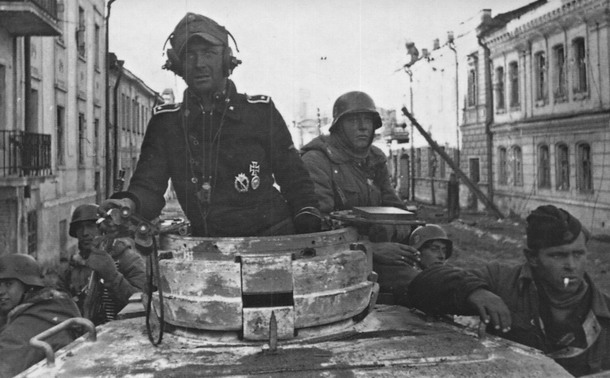
a PzKpfw IV tank with Panzergrenadiers on its hull passes through the streets of Kharkov — the men are enjoying a cigarette, but their faces look fairly tense… the fighting is clearly not over yet, source: flickr.com with the permission of the publishing user, modified
New orders were also issued to the greater part of the Totenkopf division. Elements of both its regiments, which had until then been securing the area north of Kharkov, were to move further east to the town of Tsyrkuny (where Harmel was also heading). This town was to be the starting point for the subsequent encirclement of Kharkov from the east and the cutting of that last free road to Chuhuiv. The actual attack on Chuhuiv was then to be carried out by a battle group from Totenkopf under the command of Obersturmbannführer Otto Baum. On the night of 12–13 March Baum's men were already in the area around Tsyrkuny, preparing to set out towards Chuhuiv at first light (via the town of Rohan, which lies halfway between Chuhuiv and Kharkov).
From 13 March 1943 onward, the continued clearing of the Kharkov city centre fell overwhelmingly on the shoulders of the Leibstandarte division. That day the division reported only 22 operational tanks — 17 Panzer IVs and 5 Panzer IIIs. Now at last the moment also came for Peiper's 3rd Battalion of the 2nd Panzergrenadier Regiment, which had until now remained in reserve. Sturmbannführer Peiper was tasked with continuing south from Dzerzhinsky Square, crossing the Kharkov River (yes, the river bears the same name as the city) and relieving Meyer, who had been cut off since 11 March in the south-eastern part of the city. Peiper set out south along Klockhivska Street, passed through the university district, turned east and reached the bridge over the Kharkov River. Fortunately for the Germans, the Soviet defenders were reluctant to blow up the bridges inside the city, as they had no information on how many of their own comrades were still on the other side. As a result, a significant number of the bridges in Kharkov remained usable.
Peiper crossed the river and continued along Stalin Prospekt (today Prospekt Kharkivskykh Heroiv) for roughly another 2.5 km before reaching Meyer. It was no stroll in the park, however. Peiper was a seasoned soldier with extensive experience of urban combat. He accordingly brought with him 105 mm and 150 mm howitzers. Whenever his men encountered Soviets fortified in a building, they pulled back a short distance, unlimbered a howitzer and simply sent several rounds into the building from a distance of sometimes only a few dozen metres — which usually caused part of the building to collapse and eliminated the defenders inside. At 13:00 Peiper made contact with Meyer's cut-off group, and shortly afterwards the reconnaissance company of Hauptsturmführer Hermann Weiser, encircled some distance away in a school building, was also freed.

Waffen-SS soldiers left behind them in the streets of Kharkov broken barricades and wrecked Russian equipment (specifically T-34 and KV-1 tanks on Karl Liebknecht Boulevard, today Sumska Street), source: flickr.com with the permission of the publishing user, modified
The Last Russian Resistance
The Russian defenders of Kharkov were slowly but surely giving ground, pulling back to the south-east towards the road leading to Chuhuiv. On the south-eastern outskirts of Kharkov stood — and still stands — the Kharkov Tractor Plant, which was serving as a large tank repair facility. The plant complex gradually became the last significant epicentre of Russian resistance and was accordingly given the Germans' full attention. Approaching from the west was Obersturmbannführer Otto Kum with soldiers from Das Reich's 4th Panzergrenadier Regiment. As the sun set over Kharkov on 13 March 1943, two thirds of the city were already in German hands.
And how was the planned encirclement of Kharkov from the east developing on 13 March — the operation to be carried out by Kampfgruppe Baum (Totenkopf division) and Kampfgruppe Harmel (Das Reich division)? Harmel ultimately received the task of advancing from the Tsyrkuny area not towards Chuhuiv but towards the already-mentioned tractor plant, to assist his colleague Otto Kum by attacking from the east. Harmel's group effectively managed to join the attack on the industrial complex only around 15:00. Baum's group set out from the Tsyrkuny area towards Chuhuiv — more precisely towards the town of Rohan, lying on the road from Kharkov to Chuhuiv.
The Soviets, however, very quickly realised that the Germans were trying to cut their last escape route and began to act. On the one hand they launched several counterattacks against Baum's group to prevent it from reaching Rohan; at the same time they also began, to be safe, evacuating the entire area south of Kharkov. This meant that Lieutenant General Rybalko received permission to withdraw from the defensive line on the Mzha River, which he had until then held so firmly against the XXXXVIII Panzer Corps. Baum's battle group thus faced Russian counterattacks throughout 13 March, but even so managed to push forward, and around 18:00 Obersturmbannführer Baum reported that the town of Rohan was under his control.

Kharkov is taken — soldiers of the SS Panzer Corps enjoy a brief moment of rest in the spring sunshine, source: flickr.com with the permission of the publishing user, modified
During 14 March, Rybalko effectively began withdrawing from the defensive line on the Mzha, and the XXXXVIII Panzer Corps finally got moving, crossed the river and advanced north-east towards Kharkov, tightening the encirclement of the city still further. Shortly before 18:00 the SS Panzer Corps reported that only isolated pockets of resistance remained in Kharkov. Fighting continued for two more days, however. On 15 March Baum's group finally captured the city of Chuhuiv as well, though thanks to the still partly frozen Northern Donets River many Russian soldiers managed to reach safety on its far bank regardless — but had to leave all their heavy equipment behind (for which they no longer had enough fuel anyway).
Kharkov Back in German Hands
On 16 March 1943 Kharkov was finally cleared. Dzerzhinsky Square in the city centre was renamed Leibstandarte Square (Platz der Leibstandarte) in honour of the division that had borne the brunt of the fighting for the city centre. Manstein's plan, however, was far from complete. On 17 March the Germans therefore regrouped their forces to continue the offensive before the thaw set in. The LVII Panzer Corps took over the Northern Donets River line, the XXXXVIII Panzer Corps covered the area to the east and south-east of the city, and the SS Panzer Corps moved north, from where it was to advance towards Belgorod. Early in the morning of 18 March the SS troops set out towards the objective some 60 km away. The transfer to Belgorod proceeded very quickly, and the same could be said of its capture — the fighting for the city lasted only four hours and was over before the end of 18 March.
According to Manstein's intentions, the German troops were now to march on Kursk — but nature had other ideas. The freezing weather relented, the thaw arrived, and the rasputitsa put an end to offensive operations on both sides. From 19 March onward the Germans could focus only on consolidating their positions. The attack on Kursk had to wait. Although Field Marshal Manstein was not entirely satisfied, what he had achieved was nothing short of extraordinary. In barely one month he had managed to avert a catastrophe of strategic significance and completely reverse the operational situation on the southern front. Manstein had demonstrated that he was a brilliant commander. He had acted without emotion and with deliberation, never underestimated the enemy, gathered all available information consistently, evaluated it flawlessly and done precisely what was required. A crucial factor in his success was also that he had persuaded Hitler to give him a free hand on the battlefield and not interfere with the direction of the entire counteroffensive. When Hoth's 4th Panzer Army tallied its achievements, it calculated that during the counteroffensive it had destroyed 567 Russian tanks and about 2,000 guns, killed more than 40,000 Russian soldiers and taken around 12,000 more prisoner. German losses, while significantly lower, were also far from negligible. The SS Panzer Corps alone suffered over 11,000 killed and wounded.

ARTICLE
CONTENTS:
Reproducing text from the Panzernet website without the written consent of the operator is prohibited.