HEINZ GUDERIAN
Generaloberst, 17. 6. 1888 – 14. 5. 1954
"If the tanks succeed, then victory follows!"
"If the tanks succeed, then victory follows!"
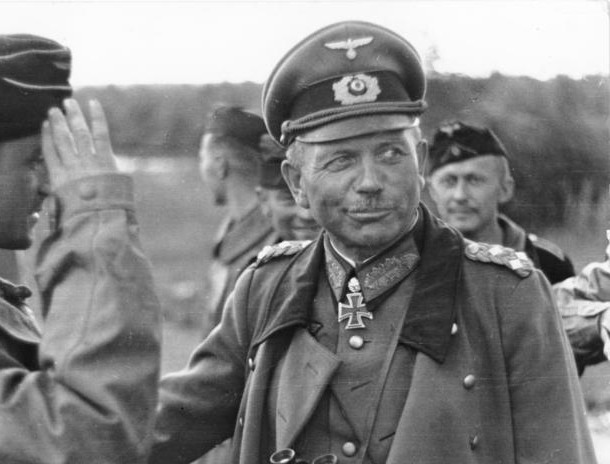
source: Bundesarchiv_Bild_101I-139-1112-17, Wikimedia, Creative Commons, edited
Childhood and Youth
Heinz Guderian was born on 17 June 1888 in the town of Kulm in West Prussia, into the family of army officer Friedrich Guderian and his wife Clara. The Guderians were by no means a family with a long military tradition – quite the opposite: his father Friedrich was the only member of Heinz's family who had made a career in the army.
Young Heinz decided to follow in his father's footsteps and become a soldier himself. On 1 April 1901, at the age of twelve, he entered the cadet school in Karlsruhe in Baden at his own request. Two years later he transferred to the main cadet school at Gross-Lichterfelde near Berlin. In February 1907 he successfully completed his studies by passing his final examinations and immediately joined the 10th Hanoverian Jäger Battalion at Bitche, which was commanded by his father.
From April to December 1907 young Guderian attended the military school in Metz, and in January 1908 was promoted to Leutnant. In October 1909 the battalion was transferred to its home district around Hanover, and Guderian himself took up garrison duty in the town of Goslar. It was there that he met, and later became engaged to, his future wife Margarete Görne.
On 1 October 1912 Guderian joined the 3rd Telegraph Battalion in Koblenz, where he prepared for the entrance examinations to the military academy while gaining his first experience with telegraph and radio communications. He passed the entrance examinations on his first attempt, and in October 1913 began his studies at the military academy in Berlin. After just one year, however, his studies were interrupted by the outbreak of the First World War – though not before he had married his fiancée Margarete on 13 October 1913.
The First World War and After
Mobilisation was declared on 1 August 1914 and Guderian's course at the war academy was dissolved. He never completed his studies, and instead reported back to the last unit he had served with – the 3rd Telegraph Battalion, attached to the 1st Cavalry Regiment of the 5th Cavalry Division. By 20 October of that year, however, he had already been transferred to the 14th Radio Section at the headquarters of the 4th Army, and simultaneously promoted to Oberleutnant. By 1916, now holding the rank of captain, he was serving as an intelligence officer.
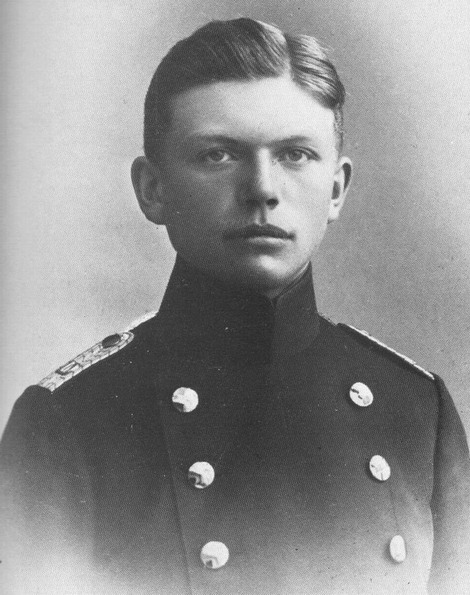
young Heinz Guderian in a photograph from 1908; source: tumblr.com, public domain, edited
In June 1918 Guderian witnessed a large-scale French tank attack that was remarkable for its time, and the success of those vehicles made a deep impression on him. Yet the then thirty-year-old Captain Guderian almost certainly had no idea what a central role these machines would one day play in his life.
Immediately after the war Guderian fought for a time in Freikorps units in the Baltic against Bolshevik forces. In May 1919 the terms of the Treaty of Versailles were published. Germany was permitted to maintain a regular army, but its strength could not exceed 100,000 men, and the Germans were forbidden from producing or owning tanks, heavy artillery, submarines, warships, and so on.
In September 1919 Guderian was recalled to the 10th Reichswehr Brigade in Hanover. He now faced a choice: return to the diminished regular army or continue fighting with the Freikorps. Guderian followed his professional conscience and reported to Hanover – one of many practical demonstrations of his strong sense of duty, which he would show again and again in later years even when his fiery temperament brought him into conflict with his superiors. In January 1920 he returned to the very first unit he had ever served in, the 10th Hanoverian Jäger Battalion at Goslar, this time as commander of one of the battalion's companies.
Motorised Transport
In the autumn of 1921 Guderian's superior, Colonel von Amsberg, approached him with an offer of work on the General Staff. Without knowing the exact details, Guderian accepted. Von Amsberg gave him no further information, and it was not until January 1922 that he received a telephone call from Lieutenant Colonel Joachim von Stülpnagel at the General Staff asking why he had not yet reported to his unit in Munich. It was thus that Guderian learned he had been assigned to the Inspectorate of Transport Troops, in the motorised transport section, then headed by General von Tschischwitz.
Guderian was officially to report on 1 April 1922, and in the meantime was attached to the 7th Bavarian Motorised Transport Battalion in Munich to gain the practical experience needed for his future work. He was delighted by the news and immediately set off for Munich. The commanding officer of the 7th Transport Battalion at that time was Major Oswald Lutz, with whom Guderian would have a great deal more to do in the years ahead.
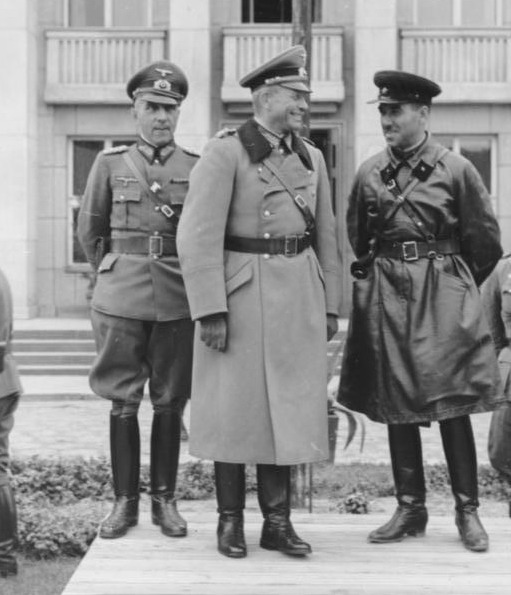
Guderian during the meeting of the German and Soviet armies in occupied Poland; source: Bundesarchiv_Bild_101I-121-0011A-22, Wikimedia, Creative Commons, edited
On 1 April 1922, with his practical experience gathered, Guderian reported for duty at the Inspectorate under General von Tschischwitz – only to be told that due to bureaucratic obstructions he would have to be assigned to a different department than originally planned. His remit would cover road administration, repair workshops, fuel depots, and the like. Guderian was so infuriated that he requested a return to his old unit in Hanover, but von Tschischwitz rejected the request. In compensation, however, he promised that despite his official posting Guderian would still be able to contribute to the work of the motorised transport section.
Guderian discovered a genuine passion for the subject and threw himself into it with great energy. The use of motor vehicles for transporting men and materiel had already begun in the German army during the First World War, but always in movements away from the fighting, behind the front line. The trench warfare typical of that conflict had meant more or less static front lines.
An Interest in Tanks
Now, however, Germany had been stripped of its military strength, and Guderian's thinking started from the premise that a small army without heavy weapons would be unable to hold stable defensive lines for any length of time in the event of a conflict. It would have to fall back and redeploy flexibly, and in doing so would not always be able to avoid moving through areas of active fighting. Unarmoured lorries would therefore not be an ideal means of transport in such circumstances – what was needed were armoured vehicles. Guderian went further still, reasoning that such vehicles should also be capable of fighting when necessary. In this way his thinking gradually shifted from transport to combat vehicles, and eventually to tanks.
He sought out veterans who had taken part in the sporadic German tank attacks of the First World War. He collected British and French publications on tank deployment, and combined what he learned with his own ideas in articles published in the weekly Militär-Wochenblatt. These articles soon attracted attention, and in 1924 he was offered a position as an instructor of combat tactics and military history, which he accepted.
Converting his superiors to the idea that motorised units should play a combat role rather than merely a support role remained elusive, however. Von Tschischwitz's successor as Inspector of Transport Troops, Colonel von Natzmer, told him coldly that he could forget such ideas, since transport vehicles were there to carry flour, not to fight.
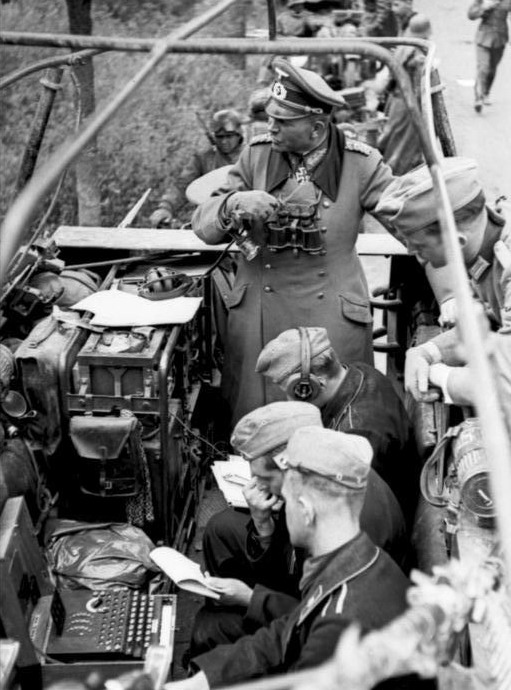
Guderian aboard his Sd.Kfz. 251 command vehicle during the conquest of France; source: Bundesarchiv_Bild_101I-769-0229-12A, Wikimedia, Creative Commons, edited
In 1927 Guderian was promoted to Major and recalled to the transport section, bringing his academic work to an end. He was once again to focus on the use of motor vehicles for cargo transport. Around this time, however, Germany had gained a secret partner for developing and testing its own tanks – paradoxically the Soviet Union – and this gave new impetus to theoretical work on tank tactics. From 1928, Guderian was once again able to devote himself to this field officially.
Guderian often despaired at the fact that he was working on the theory of armoured warfare yet had never actually sat inside a tank. That changed in 1929 when he was sent to Sweden. Sweden and Germany had very good relations in the interwar period, and after the First World War Sweden had purchased the design of Germany's most modern tank of the time, the LK II. Guderian had the opportunity not only to observe this tank in training but also to sit inside it and try driving it himself.
He continued to encounter incomprehension from his superiors, however. Whenever he spoke enthusiastically about armoured formations at divisional level he was typically met with a cold bucket of water: tank divisions were a utopia, and tanks could at most be deployed at the level of a company or battalion. Moreover, the prevailing view among the army's senior officers was still that tanks were a support weapon for the infantry or cavalry, and certainly not an independent main fighting arm.
To demonstrate that deploying tanks in larger formations was not only possible but highly effective, Guderian had himself appointed commander of the 3rd Bavarian Motorised Battalion in Berlin. He intended to shape this unit into his vision of what a future tank division should look like. The battalion consisted of four companies, which Guderian had re-equipped. The 1st company was fitted with armoured cars, which the Treaty of Versailles permitted. The 2nd company was equipped with mock tanks built on automotive chassis using wood and canvas. The 3rd was an anti-tank artillery company, again armed with wooden guns. The 4th and final company was equipped with motorcycles carrying heavy machine guns.
On the rare occasions when Guderian managed to get this unit included in larger exercises, the sight of it invariably provoked ridicule from other officers and ordinary soldiers alike. Men from other units frequently amused themselves by puncturing the canvas walls of the mock tanks with their bayonets.

Guderian during the French campaign; source: Bundesarchiv_Bild_146-1980-004-32, Wikimedia, Creative Commons, edited
General Lutz Takes Over
In 1931, however, General Lutz – Guderian's friend and a supporter of his innovative ideas – became Inspector of Transport Troops. At last Guderian no longer had to fight his own superiors. The commanders of other arms still remained, particularly those of the infantry and cavalry, who were prepared to accept tanks at most as a support weapon for their own units and stubbornly refused the idea of tank divisions and a Panzerwaffe as a new queen of battle to replace the infantry. Convincing them was still no easy task, especially when almost none of them had ever actually seen the wonderful weapon Guderian talked about with such enthusiasm – the only things they knew were those laughable mock-ups.
The arrival of General Lutz brought Guderian's promotion to Oberstleutnant in February 1931 and his appointment in October of the same year as Chief of Staff of the Inspectorate of Motorised Troops. The development of armoured vehicles was also moving forward, and by the 1932 manoeuvres Guderian's men were able to field six-wheeled armoured cars with proper steel armour. The mockery and bayonet-punctured canvas were a thing of the past.
Tank development had also been under way in Germany since the second half of the 1920s, but it had been unsystematic, and the resulting vehicles did not meet what Guderian expected of future tanks. He therefore planned the shape of the German Panzerwaffe entirely independently of existing types such as the Grosstraktor. In his vision, the backbone of the armoured force would consist of two types of tank: a lighter one armed with an anti-tank gun, and a heavier one carrying a larger-calibre weapon.
Both Guderian and Lutz understood clearly that it would be many more years before such vehicles actually existed, let alone entered mass production. In the meantime, an interim tank was needed on which both manufacturers and future crews could learn. With General Lutz's backing, Guderian drew up a set of requirements for this vehicle, and the specification was issued to leading German engineering firms in 1932. The machine that resulted from those requirements became known as the PzKpfw I. Driver training was eventually supported by the NSKK (Nationalsozialistischer Kraftfahrkorps), an organisation that in pre-war Germany functioned as a kind of driving school for all manner of motor vehicles, including tanks.
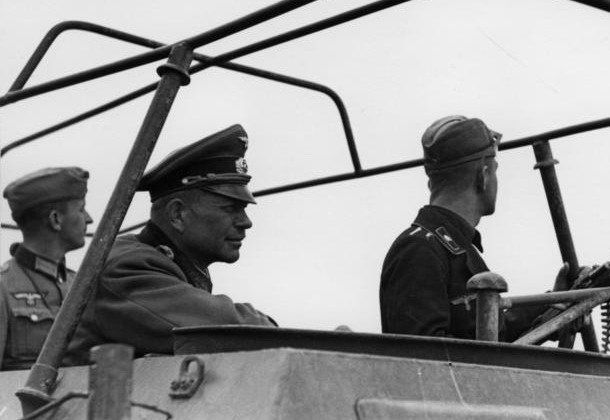
Guderian in his Sd.Kfz. 251; source: Bundesarchiv_Bild_101I-769-0229-15A, Wikimedia, Creative Commons, edited
In 1933 Guderian was promoted to Oberst. That same year Adolf Hitler became Chancellor. Guderian saw and heard Hitler for the first time in February 1933 at the opening of the Berlin Motor Show. His speech caught Guderian's full attention: Hitler spoke of abolishing the car tax, of mass motorisation, of producing cheap cars for ordinary people, and of building motorways to connect the whole of Germany. Guderian immediately sensed that in this man he might find support for his own equally visionary ideas.
And Hitler did indeed begin to show genuine interest in the new type of weapon – particularly after watching an exercise at Kummersdorf involving light PzKpfw I tanks operating in conjunction with armoured cars and infantry.
Guderian's most stubborn opponents remained the officials of the General Staff, above all its chief, General Beck – an officer of the old school who was willing to accept the existence of armoured units as support for the traditional arms but resolutely rejected the idea of tank divisions and a Panzerwaffe as the new queen of battle in place of the infantry.
Events continued to move forward regardless. In 1934 specifications were drawn up for three further tanks. The first was the PzKpfw II, which was still regarded as only an interim solution rather than a fully fledged combat tank, but which now carried not only machine gun armament but also a small-calibre cannon, further expanding the knowledge and experience of both manufacturers and crews. Before the end of 1934, requirements had also been formulated for the fully capable combat tanks that matched Guderian's vision of what the armoured force should be equipped with.
In March 1935 Hitler openly and completely violated the Treaty of Versailles by reintroducing conscription and declaring Germany's right to self-determination in military affairs. Guderian's sympathy for the Führer was growing, though it was not uncritical: he was not at all pleased, for instance, that Hitler had ended the secret cooperation with the Soviet Union on the development and testing of armoured vehicles. The ranks of army figures who listened to Guderian's ideas with genuine interest were also growing.
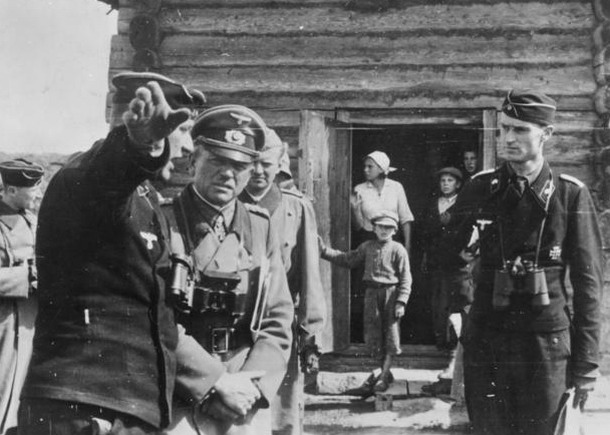
Guderian during a briefing with armoured unit commanders in Russia; source: Bundesarchiv_Bild_183-L19885, Wikimedia, Creative Commons, edited
In the summer of 1935 General Lutz organised manoeuvres of an improvised tank division assembled from available units, which proved a great success and attracted the desired attention. On 15 October 1935 the Panzerwaffe was at last formally consecrated. That day saw the official establishment of the first three panzer divisions. General Lutz became historically the first German General of Panzer Troops, while Guderian himself was appointed commander of the 2nd Panzer Division.
The divisions were for the moment armoured in name more than in reality, but it was nonetheless a very significant step. The Panzerwaffe was now an officially recognised arm of the service, and its legitimate equipment requirements carried far greater weight. Before the end of 1935 the first series of Panzer II Ausf. a1 tanks had been produced, and prototypes of the Panzer III and Panzer IV were under test.
In 1936 General Lutz suggested to Guderian that he put his ideas about the Panzerwaffe into writing and publish them. Guderian agreed, and a year later his book Achtung, Panzer! duly appeared.
On 1 February 1938 Guderian was promoted to Generalleutnant and replaced Lutz, who was sent into retirement. He was simultaneously appointed commander of XVI Army Corps, handing over command of his 2nd Panzer Division to General Veiel. On 10 March, however, Guderian received command of the 2nd Panzer Division again, this time as part of XVI Corps alongside the Waffen-SS division Leibstandarte. Within two days the units were to be ready to join the forces that would occupy Austria. On 12 March Guderian duly drove into Austria with his tanks – but this was not to be a combat operation, and that had been clear from the outset. Guderian therefore had the tanks decorated with flags so that their advance would look more like a parade than an invasion.
General of Panzer Troops
On 1 November 1938 Guderian was promoted to General der Panzertruppen, becoming the true master of the force he had built. The effect was immediate: on 10 November the 4th Panzer Division was formed, and on 24 November the 5th. In April 1939 the 10th Panzer Division followed. The gap in the numbering was not an error: as early as 1936, four so-called Leichte Divisionen (light divisions) had been formed, also equipped with tanks but falling under cavalry command.
These light divisions had come about at the insistence of the cavalry's representatives, who wanted armoured vehicles under their own command and simply could not accept that tank units had won their independence from the traditional arms. Guderian bore their creation with considerable irritation, regarding them as an utterly misconceived solution and a waste of the tanks being produced.
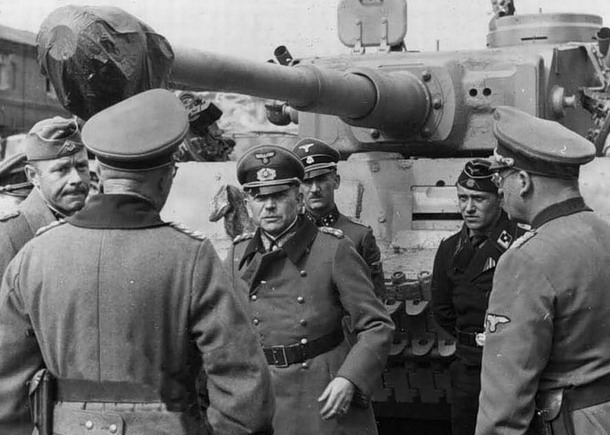
Guderian during an inspection with the Leibstandarte SS; source: Flickr.com with permission of the publishing user, edited
On 22 August 1939 Guderian was appointed commander of XIX Army Corps, consisting of the 2nd and 20th Motorised Infantry Divisions and the 3rd Panzer Division, which by that time was equipped not only with light tanks but also with the most modern Panzer III and Panzer IV. Guderian's units were to take part in the German attack on Poland, for which Hitler had issued the order on 26 August. XIX Corps was for this operation assigned to the command of General von Kluge's 4th Army.
The Invasion of Poland
At 4:45 a.m. on 1 September 1939 all three divisions of Guderian's corps crossed the Polish frontier. The 3rd Panzer Division advanced on the right flank, the 2nd Infantry in the centre, and the 20th Infantry on the left. Guderian later recalled how on the very first day of the attack he nearly became a victim of his own artillery when his armoured car drove through fog ahead of the advancing 3rd Panzer Division. His advance was rapid and uncompromising. By 5 September fighting in Pomerania was over, and that day Hitler himself made an unannounced visit to the front.
Together with Guderian, Hitler was taken along the route of XIX Corps' advance. When their vehicle passed the shattered Polish artillery positions, Hitler asked whether this had been the work of dive-bombers. Guderian replied that his tanks had done this. The answer made a fitting impression on Hitler – but what truly astonished him were the casualty figures. The entire corps had suffered only 150 killed and around 700 wounded. Guderian was immediately awarded the Iron Cross Second Class. His corps then fought on alongside XXI Corps until 17 September, when it concluded its Polish campaign with the capture of Brest-Litovsk. In the meantime, on 13 September, Guderian had received the Iron Cross First Class.
After the Polish campaign ended, Guderian was recommended for the Knight's Cross by the commander of 4th Army, General von Kluge, and on 27 October received it from the hands of the Führer himself.
Hitler was greatly impressed by the success of the armoured units and by Guderian's abilities in particular. This allowed Guderian to quickly put into practice his ideas for the further development of the Panzerwaffe. He had all the light divisions under cavalry command disbanded and converted into full panzer divisions, since in the reality of war these hybrid formations had proven to be the wrong approach. The 1st, 2nd, 3rd and 4th Leichte Divisionen were thus converted between October 1939 and January 1940 into the 6th, 7th, 8th and 9th Panzer Divisions.
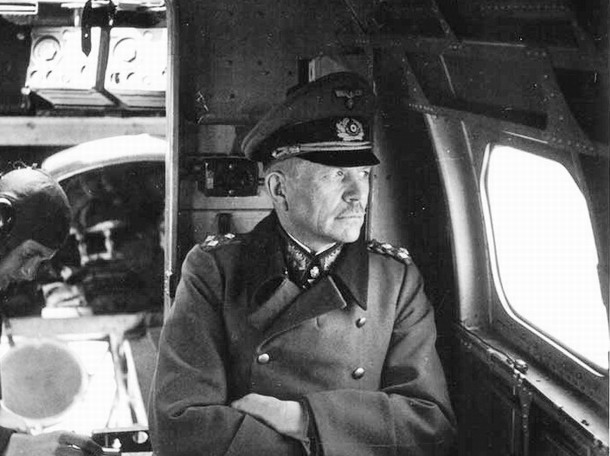
aboard an aircraft; source: Oberst Ludwig v. Eimannsberger, Wikimedia, Creative Commons, edited
At the same time the panzer divisions were slimmed down, as experience had shown that two tank regiments within a single division was too many; going forward each division was to have only one. Poland had also demonstrated that the Panzer I and Panzer II were not fully capable combat tanks, and Guderian pressed for the accelerated re-equipping of the divisions with the heavier Panzer III and Panzer IV.
Immediately after the fall of Poland, Hitler ordered the German army to begin preparing for the attack in the west, with France as the primary objective. The plan envisaged using the so-called Schlieffen Plan from the First World War – flanking the Maginot Line and directing the main thrust into Flanders.
In Guderian's view this plan lacked the spark of a new idea that would exploit the potential of armoured forces. He was therefore surely pleased when on 10 January 1940, a German staff officer's aircraft made a forced landing in Belgium due to poor visibility, and the Germans consequently considered the invasion plan compromised from that point on. The task of drawing up a new plan of attack was then entrusted to one of Germany's finest strategists, Erich von Manstein.
Manstein's new plan called for the main attack to pass through the Ardennes, advance to the River Meuse, and then fan out westward to the English Channel coast. Guderian's XIX Corps was assigned the role of the main strike force. Manstein therefore met with Guderian to ask whether he considered the plan feasible and whether his tanks could pass through the Ardennes. Guderian studied the plans and maps of the area and assured Manstein that his tanks could carry out the operation.
PAGE UNDER CONSTRUCTION...

ARTICLE
CONTENTS:
Reproducing text from the Panzernet website without the written consent of the operator is prohibited.