WESPE
a wasp with a sharp sting
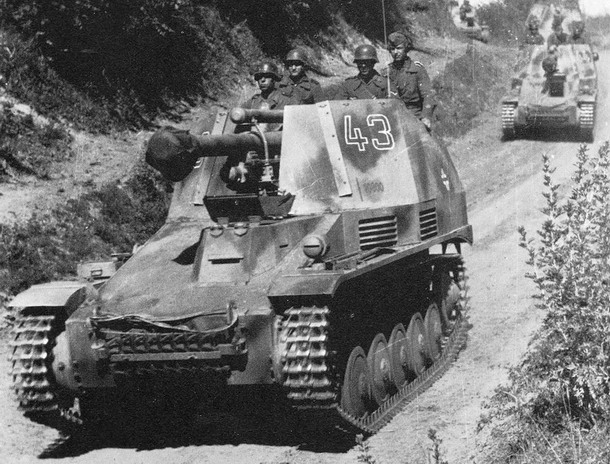
Wespe self-propelled gun, source: Flickr.com, with permission of the publishing user, edited
Origins of the Vehicle
Although the first mentions of German plans for developing a self-propelled gun to support armoured units appear in documents from the turn of 1934–35, no project had progressed beyond the prototype stage by September 1939. At the outbreak of the Second World War, German panzer divisions therefore had virtually no self-propelled artillery at their disposal at all. For fire support they had to rely on conventional towed artillery and on the Luftwaffe's dive bombers. The experience of the Polish campaign made clear, however, that Blitzkrieg simply would need self-propelled artillery capable of keeping pace with tanks in both speed and cross-country mobility.
A year later, during the invasion of France, the Wehrmacht already had available the hastily developed Sturmpanzer I self-propelled gun, combining the heavy 150 mm sIG 33 weapon with the chassis of the light Panzer I tank. This was, however, very much an emergency stopgap with no future. At the time, the army was counting on the early completion of the 105 mm leFH 18 self-propelled howitzer on the Geschützwagen IVb chassis being developed by Krupp. Development dragged on, however — the first prototypes were not delivered for testing until January 1942, and the start of series production was not planned until January 1943.
At the same time, large numbers of Panzer II light tanks — generally considered obsolete and inadequate — were being withdrawn from combat units from the end of 1941. The chassis of these tanks were, however, reasonably reliable and well known to drivers and mechanics alike. The obvious solution was to use the retired tanks as the basis for conversion into another type of fighting vehicle. With the protracted development of the aforementioned Geschützwagen IVb-based self-propelled gun in mind, the Ordnance Office tasked the firms Rheinmetall-Borsig and Alkett with urgently designing a conversion of the retired Panzer II chassis to carry the leFH 18 light howitzer. The resulting vehicle was to be a Zwischenlösung — an interim solution — until the more capable vehicle mentioned above became available. Initial experiments with the Panzer II chassis established that the howitzer had to be positioned as far to the rear as possible; otherwise the front of the chassis became overloaded, severely impairing the vehicle's steering. Rheinmetall-Borsig and Alkett therefore proposed relocating the engine to the centre of the hull and creating the fighting compartment in the freed-up rear section.
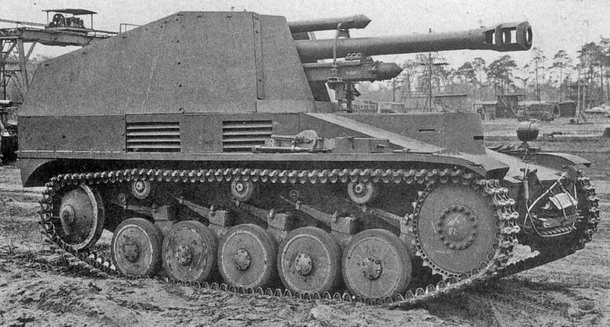
Presumably the Wespe self-propelled gun prototype, source: Flickr.com, with permission of the publishing user, edited
In July 1942 the firms confirmed that mounting a 105 mm howitzer on the light tank chassis was feasible. The army was satisfied with the design and demanded the start of series production as quickly as possible. The new self-propelled gun looked so promising that in November 1942 the original Geschützwagen IVb-based project was cancelled, and an order was placed for 1,000 Wespe vehicles outright (though in August 1943 the order was reduced to 835).
First Prototype
The first prototype of the new vehicle was completed by Alkett, probably still in 1942, under the designation Gerät 803. Incidentally, the popular name Wespe was never recognised as the official designation of this vehicle (and according to some authors was even officially prohibited in 1944). The literature contains many different versions of the official name, including leichte Feldhaubitze 18/2 (Sf) auf Geschützwagen II, leichte Feldhaubitze 18/2 auf Fahrgestell Panzerkampfwagen II (Sf), and Geschützwagen II für leFH 18/2 (Sf). Entirely beyond doubt, however, is the vehicle's ordnance designation: Sd.Kfz. 124.
The first prototype of the new self-propelled gun, built by Alkett, differed from the later production version only in minor details. The front wall of the small driver's cab was rounded without an openable vision port, the howitzer had a wider muzzle brake, the road wheel springs did not yet have rubber bump stops, and so on. After minor modifications, series production was launched. The first two vehicles came off the production line in February 1943.
Design Description
Series production Wespe vehicles were based on a modified version of the PzKpfw II Ausf. F light tank chassis. The main modification was relocation of the powerplant from the rear of the hull to the centre. Louvred openings were cut in the side walls of the superstructure to allow cooling air to flow to the engine and its radiator. The running gear consisted on each side of five 550 mm diameter rubber-tyred road wheels for a smoother ride. The wheels were individually suspended and sprung by leaf springs. Since the self-propelled gun was heavier than the original tank, the springs on the first, second and fifth road wheel positions were fitted with rubber bump stops to limit maximum spring deflection and prevent failure under overload. At the front of the track assembly was the toothed drive sprocket and at the rear the idler wheel. The upper run of the track was supported by small return rollers, the number of which was reduced from four on the original Panzer II Ausf. F to just three. The modified tank chassis received the designation Geschützwagen II (Geschützwagen — literally "gun carriage").
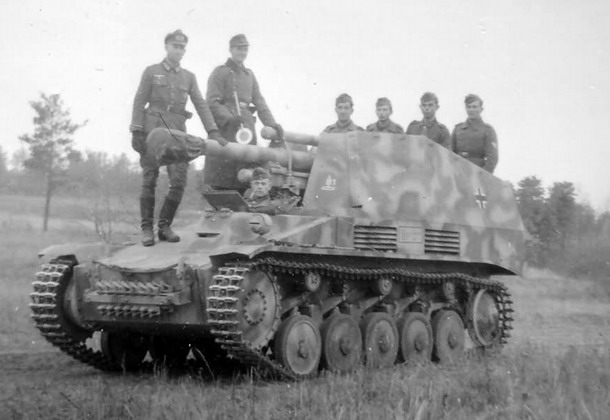
Wespe, source: worldwarphotos.info, with permission of the operator, edited
The powerplant was taken over from the original tank — the six-cylinder Maybach HL 62 TR petrol engine with a displacement of 6.191 litres, producing a maximum of 140 horsepower at 2,600 rpm. Two fuel tanks under the fighting compartment floor held a combined 200 litres of petrol. Connected to the engine was the Zahnradfabrik SSG 46 gearbox with six forward gears and one reverse, housed on the right in the front section of the hull. To the left of it was the driver's station. The driver had something of a small cab of his own, the armour of which projected from the steeply angled glacis plate of the hull.
The driver's view of the road ahead was provided by three vision ports. The main one was naturally in the wall directly in front of him. When moving in a safe area, the driver could open this port fully for a reasonably unobstructed view ahead. In combat areas the cover stayed closed and the driver looked out only through an elongated slit protected internally by a block of bulletproof glass. In each side wall of the driver's cab there was also a small slit-type vision port. The driver's entry and exit hatch was directly above his head in the roof.
Approximately midway along the hull began the main fighting compartment, protected by a tall armoured shield. The armour was highest at the front and tapered toward the rear down to a comparatively low rear wall. The top of the fighting compartment was left completely open. In bad weather the crew could shelter by pulling a waterproof tarpaulin over the opening.
The leFH 18 Light Howitzer
Inside the fighting compartment was installed the 105 mm leFH 18 (leichte Feldhaubitze) light field howitzer — more precisely the leFH 18/2, a variant adapted specifically for installation in a self-propelled gun. The howitzer fired 14.81 kg high-explosive fragmentation shells to a range of up to ten kilometres. 32 rounds of ammunition were stowed on board. A supplementary MG 34 machine gun was carried by the crew in the compartment, from which fire could be directed over the top of the armour walls. Two MP 38 or MP 40 submachine guns were also carried.
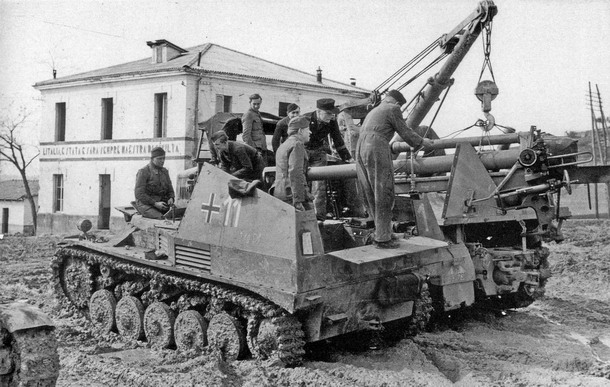
Wespe during gun removal, source: Flickr.com, with permission of the publishing user, edited
The central section of the fighting compartment's front wall was connected to the howitzer and traversed with it when the barrel was moved laterally. When it comes to the weapon's range of movement, the literature is rather confused. The vertical elevation range is sometimes given as -10° to +40° and sometimes as -5° to +42°. Information on horizontal traverse is even less reliable — in one source the howitzer can traverse up to 35 degrees to each side, in another only 20 degrees to each side, and some authors give as little as 17 degrees to each side.
The fighting compartment armour was only 10 mm thick (and a mere 8 mm at the rear wall), offering protection only against small arms fire and light shell splinters. The rest of the vehicle was not much better: the strongest plate was the 30 mm hull front, the driver's cab front was 20 mm, the hull roof plates 10 mm, and the hull floor just 5 mm. The thin armour was not, however, a fatal shortcoming, since the Wespe was not designed for direct confrontation with the enemy. It was to advance close behind the tanks and provide them with fire support to neutralise obstacles the tanks themselves could not deal with — typically bunkers or enemy anti-tank artillery.
The Wespe self-propelled gun weighed 11 tonnes — 1.5 tonnes more than the original Panzer II Ausf. F. The chassis loading had therefore increased by around 15%, and on top of this the chassis had to absorb the intense momentary shock of the howitzer firing. The Wespe could achieve a top speed of 40 km/h, and a full fuel load was sufficient for approximately 140 km on road and 95 km cross-country. The crew of the self-propelled gun consisted of 5 men: driver, commander, gunner and two loaders (some publications give only one loader, making the crew four men). As already noted, the driver sat separately in the left front section of the hull while the rest of the crew were stationed in the main fighting compartment with the howitzer. They used the partially foldable rear wall of the compartment for entry and exit, and ammunition was also loaded through this opening.
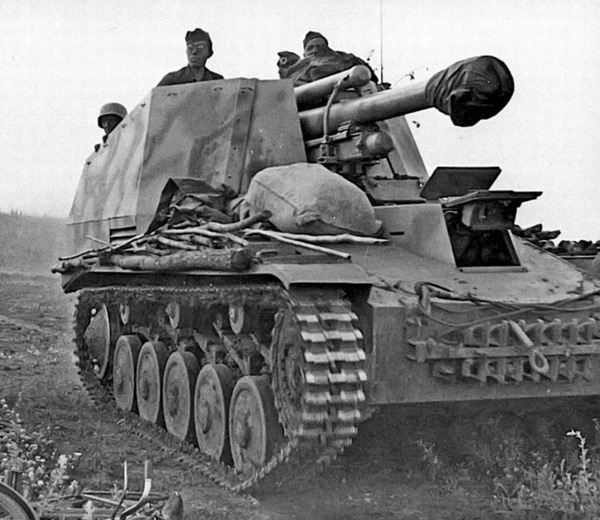
Wespe on the Eastern Front — the driver has both his vision port and his hatch open, source: Waralbum.ru, with permission of the operator, edited
Ammunition Carrier Variant
From the very start of the Wespe's development it was clear that the vehicle would not be able to carry a sufficient ammunition supply for its own needs and that a dedicated ammunition carrier capable of resupplying combat vehicles in the field would be required. It was therefore decided that a proportion of Wespe vehicles would be built as unarmed ammunition carriers. When the army placed its order for 1,000 vehicles, this figure included these ammunition carriers — and the same applied when the order was later reduced to 835.
The ammunition carrier, known as the Munitions Schlepper, was identical to the standard Wespe but without the howitzer. The gun opening in the front wall of the fighting compartment was covered by an armour plate and the interior was adapted to carry 90 rounds of 105 mm ammunition. If required, ammunition vehicles could be relatively easily re-fitted with the howitzer and used as fully functional self-propelled guns.
Some sources state that during the production run a new lengthened version of the chassis was introduced. The reason was reportedly to gain more room in the fighting compartment, as the howitzer's recoil stroke brought the breech very close to the rear wall of the compartment. Later-production self-propelled guns were supposedly 22 cm longer than early examples, with the extension reflected in a greater gap between the last road wheel and the rear idler. Judging purely from photographs it is difficult to determine whether some vehicles really did have a noticeably smaller gap between these wheels than others. What is curious is that even sources which mention this change quote only a single overall length figure for the Wespe — 4.81 metres (which corresponds to the length of the original PzKpfw II Ausf. F tank) — whereas at least some vehicles, according to this theory, would have measured 5.03 metres.
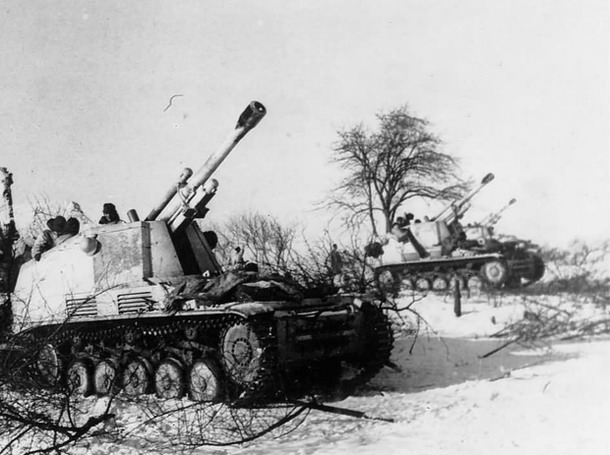
A battery of Wespe self-propelled guns prepared for firing, source: worldwarphotos.info, with permission of the operator, edited
Series production of the Wespe was entrusted to the firm FAMO (Fahrzeug und Motoren Werke GmbH) in Wrocław, Poland (German: Breslau), and its subsidiary plant Ursus in Warsaw. The first two examples of the new vehicle were completed in February 1943 and production continued until June 1944. During this period, 676 armed self-propelled guns and a further 159 unarmed ammunition carriers came off the production lines.
Organisational Structure
Wespe self-propelled howitzers were assigned to the artillery regiments (Artillerie Regiment) of panzer divisions. The artillery regiment consisted of three battalions (Artillerie Abteilung), of which only one was equipped with self-propelled guns. The remaining two in the regiment used conventional towed artillery. The self-propelled gun battalion consisted of three artillery batteries (Batterie). Two of the batteries were equipped with Wespe howitzers and the third with the heavier Hummel type. Each battery had 6 combat vehicles. In total, therefore, the battalion (and effectively the regiment) had 18 self-propelled howitzers of two types, plus a large volume of supporting equipment — ammunition carriers, staff cars, motorcycles, half-tracked prime movers, and observation and fire direction vehicles.
Combat Deployment
The first panzer divisions began receiving their Wespe vehicles in the spring of 1943. The new self-propelled gun's first major combat deployment was the Kursk offensive in the summer of 1943. From then on the Wespe fought on both the Eastern and Western Fronts until the end of the war. Combat unit reports on experience with this self-propelled howitzer contained both praise and criticism. On the Eastern Front, a general quality of self-propelled artillery was viewed very positively: the ability to strike unexpectedly and then disappear. The Wespe could simply surprise the enemy with fire from an unexpected location and pull out before the enemy's counter-battery fire arrived. Criticism, on the other hand, was directed at the small ammunition supply. Given that the Wespe fired indirectly at greater distances, it required large quantities of ammunition. The 32 rounds on board were therefore seen more as an emergency minimum, and continuous resupply with additional ammunition was an absolute necessity.
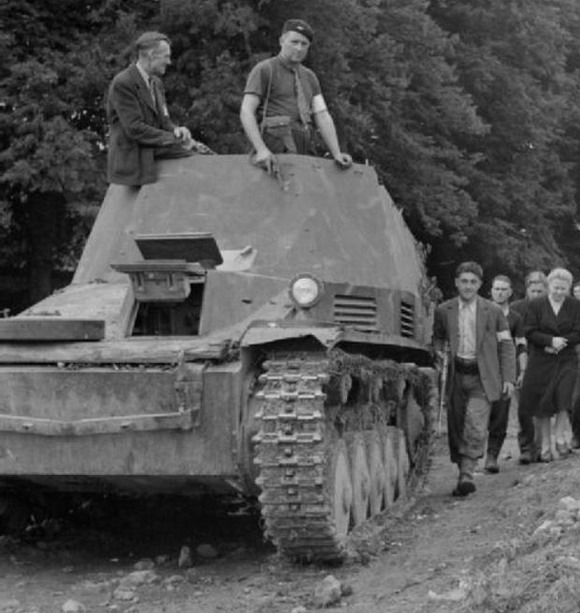
Unarmed Wespe Munitions Schlepper ammunition carrier, source: Flickr.com, with permission of the publishing user, edited
While reports from the Eastern Front mentioned no significant technical problems, units fighting in Italy complained strongly about a range of difficulties. The reason was the mountainous terrain in which the Wespe was deployed there. Soldiers grumbled about the vehicle's weak engine, which made it slow when climbing hills — and the strain on the engine also led to more frequent overheating and breakdowns. This applied not only to the engine but also to the steering mechanism, which suffered in the sharp bends of mountain roads. Complaints were also heard about the cramped space inside the fighting compartment: the crews simply had nowhere to put their personal belongings, blankets, mess kits, toiletries and the like.
Despite their relatively light armament, the Wespe self-propelled guns proved to be valuable assets to panzer units. They were most effective when deployed in larger numbers and together with the heavier Hummel 150 mm self-propelled howitzers.
Technical Data
|
weight: |
11 t |
|
length: |
4.81 m |
|
width: |
2.28 m |
|
height: |
2.3 m |
|
engine: |
Maybach HL 62 TR |
|
engine power: |
140 hp |
|
max. speed: |
40 km/h |
|
fuel capacity: |
200 l |
|
range – road: |
140 km |
|
range – cross-country: |
95 km |
|
hull armour: |
|
|
- front: |
30 mm |
|
- sides: |
15 mm |
|
- rear: |
15 mm |
|
superstructure armour: |
|
|
- front: |
10 mm |
|
- sides: |
10 mm |
|
- rear: |
8 mm |
|
crew: |
5 men |
|
armament: |
1 x leFH 18/2, 105 mm |
ARTICLE
CONTENTS:
Reproducing text from the Panzernet website without the written consent of the operator is prohibited.