10,5 cm GESCHÜTZWAGEN IVb
a missed opportunity for self-propelled artillery
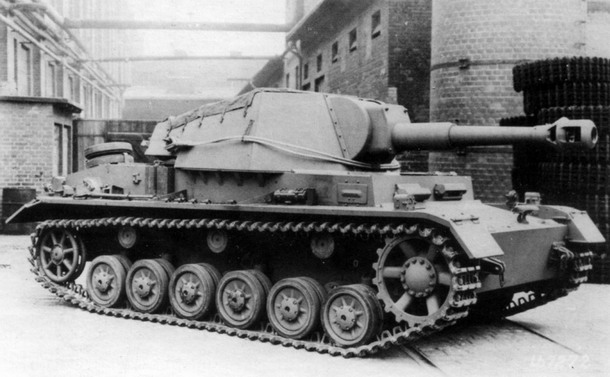
the Geschützwagen IVb für 10,5cm leFH 18/1, also known as the Sd.Kfz. 165/1, was the first German self-propelled gun developed specifically for that purpose, source: Flickr.com with permission of the publishing user
Origins of the First Self-Propelled Gun
The German ordnance office first approached Krupp with a request to develop a 105 mm self-propelled gun as early as 1935 — at that time essentially a proposal to rearm the planned Panzer IV tank with a larger-calibre weapon. A prototype was built in 1938 on the basis of the experimental B.W. II chassis (one of the variants developed in the course of the Panzer IV programme). The Army was not satisfied, however, and the prototype was disassembled in November 1938 and effectively forgotten. Krupp's self-propelled gun project nonetheless continued in two parallel directions, both again based on the Panzer IV chassis but involving its fundamental redesign. The first direction led to the bunker-buster nicknamed Dicker Max, whose chassis was designated Pz.Sfl. IV (sometimes also Pz.Sfl. IVa). The second direction led to the vehicle described on the following pages, whose chassis received the designation Pz.Sfl. IVb — the abbreviation Pz.Sfl. standing for Panzer Selbstfahrlafette, literally "armoured self-propelled mounting".
Krupp presented a technical drawing of the self-propelled gun on the Pz.Sfl. IVb chassis to Army representatives in September 1939. The basic concept was approved by the ordnance office, but accompanied by a whole series of larger and smaller change requests — regarding armour thickness, the quantity of ammunition carried, the range of vertical gun movement, and other details. Further negotiations between the two parties took place in October 1939, covering the type of gearbox, final drives, the height of the gun mounting inside the superstructure, and other questions. A further round of discussions in January 1940 led among other things to the decision to install a second, dummy vision port in the front wall of the crew superstructure.
In February 1940, a full-scale wooden model of the vehicle was produced. The model was inspected by the ordnance office representative Dr. Ing. Herbert Olbrich on 18 March 1940 — and once again a further set of change requests followed. The commander's seat was to be positioned somewhat higher so that he could see over the gunner's head without difficulty; a gun travel lock was to be fitted to the rear of the recoil housing; the driver's hatch was to be enlarged; and so on and so forth. Refinement of the vehicle dragged on until November 1940, when contracts were finally signed for the construction of two prototypes and a subsequent pre-series run of ten vehicles. A contract for the supply of modified 105 mm howitzers was simultaneously signed with Rheinmetall-Borsig.
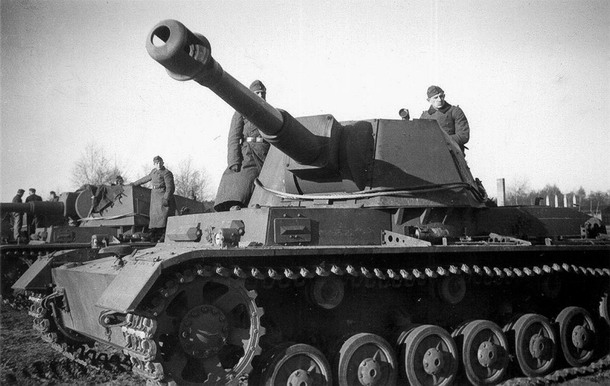
the Sd.Kfz. 165/1 offered a generous lateral traverse for the gun; note also the periscopic sight protruding from the turret, source: Flickr.com with permission of the publishing user
The new vehicle was referred to under various names over the course of its development, including the rather unwieldy Geschützwagen IVb für 10,5cm leFH 18/1 (Sf.) Ausf. A. Its ordnance code was Sd.Kfz. 165/1 (Sd.Kfz. = Sonderkraftfahrzeug = special-purpose vehicle).
Description of the Design
As noted above, the new self-propelled gun was built on the Panzer IV Ausf. F chassis, which had been fundamentally redesigned for this purpose — even more so than for the Dicker Max. The front drive sprocket and rear idler wheel were taken over without modification. Between them, however, were only six road wheels — compared to eight on the Panzer IV. Moreover, these were not wheels taken from the original tank, even though they appeared identical at first glance. The road wheels of the Panzer IV Ausf. F had a diameter of 470 mm, whereas those used on the Pz.Sfl. IVb were 520 mm. The need for custom-made wheels undoubtedly added to costs. One might ask why the designers did not simply borrow the road wheels from the Panzer III (from the Ausf. E onwards), which also had a diameter of 520 mm. Those wheels were designed for tracks only 360 mm wide, but one might still expect that widening them would have been cheaper than manufacturing entirely new wheels.
The smaller number of road wheels — even if slightly larger — makes it clear that the self-propelled gun's chassis was somewhat shorter than the original tank's (by approximately 35 cm according to some sources). This in turn allowed a reduction in the number of return rollers supporting the upper run of the track — the Panzer IV Ausf. F had four, but the Pz.Sfl. IVb only three. The 400 mm wide tracks, on the other hand, were taken from the tank without modification. Road wheel suspension used leaf springs, as on the Panzer IV. The hull and crew superstructure closely resembled the original tank in outward appearance, but were by no means the same construction. The armour thickness alone tells the story: the PzKpfw IV Ausf. F had 50 mm frontal armour, whereas the Pz.Sfl. IVb had a mere 20 mm. The designers sensibly concluded that a self-propelled gun, given its intended role, did not need extremely thick armour — it was enough for the plates to withstand armour-piercing rounds from rifles and machine guns of 7.92 mm calibre. The weight saved was put to good use by mounting a heavy weapon.
At the Army's request, two vision ports were provided in the front wall of the crew superstructure. The left one was real and served the driver; the right one was false, apparently intended solely to deceive the enemy. The driver was therefore the only crew member seated in this section of the superstructure, and he accessed his seat through his own roof hatch. Further rearward, mounted on the superstructure roof, was a fighting turret — yes, this early self-propelled gun had a rotating fighting turret, even if its traverse was far from a full 360 degrees. The front wall of the turret was its highest point; the sides tapered downward toward the rear, ending at a relatively low rear wall. The turret roof was left open, which was considered an appropriate solution for a self-propelled gun. An open roof would have been a risk in close combat — an enemy infantryman could easily throw a grenade into the vehicle — but this type of engagement was not expected for a self-propelled artillery piece. Conversely, an open roof provided a better view of the sky, essential for observing shell bursts and correcting aim.

Sd.Kfz. 165/1 during driving trials, source: Flickr.com with permission of the publishing user
All turret walls were angled for greater ballistic protection, which meant the turret base was quite wide. Accordingly, sponson-like extensions had to be added to the sides of the hull beneath the turret to match its footprint. The front wall of the turret carried a bolted-on gun mantlet that allowed vertical movement of the weapon and protected its recoil mechanism. The vehicle's armament was a modified version of the light field howitzer 10.5 cm leFH 18 (leichte Feldhaubitze), which received the distinguishing designation leFH 18/1. The mount allowed elevation from -10° to +40°, while traverse was provided by rotating the entire turret through 35 degrees in each direction — a total of 70 degrees. The howitzer used separate-loading ammunition (a projectile loaded independently of the propellant cartridge). The 105 mm high-explosive shell weighed 14.81 kg and left the barrel at 470 m/s. Maximum range was approximately 10,650 metres. The onboard ammunition supply was a generous 60 rounds. The leFH 18/1 also received a two-chamber muzzle brake of the type typically used on tank guns.
The vehicle's crew consisted of four men. The driver, as already noted, sat alone inside the hull; the remaining three had their stations in the turret. To the left of the gun sat the gunner, who had a choice of two sights: the Sfl.Z.F.1a for direct fire and the Rundblickfernrohr 36 panoramic sight for indirect fire. Behind the gunner, on a raised seat, sat the vehicle commander, who also operated the radio. His primary observation tool was the binocular artillery scissors periscope Scherenfernrohr 14 Z f.Sfl. The fourth crew member was the loader, stationed to the right of the gun. The vehicle had no built-in secondary armament, though the crew carried two MP 38 or MP 40 submachine guns.
A Funksprechgerät a radio set — combining a shortwave receiver and transmitter with a range of approximately 5 km — was stowed on a shelf on the rear wall of the turret. A loudspeaker connected to it allowed all crew members in the turret to hear incoming transmissions. Behind the turret was the engine compartment. The first prototypes used a Maybach HL 66 P six-cylinder petrol engine developing 180 horsepower; for series production, the more powerful Maybach HL 90 P20K was planned. The gearbox was a Zahnradfabrik SSG46 with six forward speeds and one reverse. The fuel tanks held 410 litres of petrol, sufficient for approximately 240 km on roads and around 130 km cross-country. The new self-propelled gun weighed 18 tonnes and had a maximum speed of 35 km/h.

the Geschützwagen IVb für 10,5cm leFH 18/1 was ahead of its time in many respects, source: Flickr.com with permission of the publishing user
Production and Deployment
The two ordered prototypes were apparently delivered at the end of 1941. The first vehicle from the ten-strong pre-series run was completed in August 1942, followed by three more in September, four in October, and one each in November and December. Contrary to the original plans, the "series" vehicles ultimately also received the weaker Maybach HL 66 P engine with which both prototypes had been fitted. To conduct thorough evaluation of the new self-propelled guns, a special battery — the Feld-Versuchs-Batterie — was formed and subsequently assigned to the artillery regiment of the 16th Panzer Division. This battery received six of the ten "series" vehicles and took them to the Eastern Front for live combat testing. The remaining four vehicles were used for training.
The available literature says nothing about the results of the combat evaluation. Since the 16th Panzer Division was encircled and subsequently destroyed at Stalingrad at the end of 1942, it is possible that the entire Feld-Versuchs-Batterie shared the same fate, and that no evaluation reports ever made their way back to Germany. In any case, the leFH 18/1 self-propelled howitzer on the Pz.Sfl. IVb chassis never entered series production. Compared to the improvised self-propelled guns the Wehrmacht had in the meantime introduced into service, the new vehicle stood in a class of its own — yet the ordnance office was not satisfied. The gentlemen of WaPrüf 4 (the ordnance office department responsible for artillery weapon development) had taken it into their heads that a proper self-propelled gun should offer full 360-degree traverse and should also be capable of removing its own gun from the chassis under its own power, so that the weapon could be used in a fixed ground-based firing position.
As early as the beginning of 1942, the ordnance office therefore launched an extensive programme to develop several entirely new self-propelled guns that would meet these requirements. The 10.5 cm leFH 18/1 auf Pz.Sfl. IVb immediately fell from favour. It was unsuitable for adoption as a new standard because it did not meet the ordnance office's latest requirements — yet it was also too expensive to put into even limited production as a stopgap until the new "proper" self-propelled guns became available. That role of cheap interim solution was instead earmarked for the simpler-to-produce Wespe, which made elegant use of surplus Panzer II light tank chassis. Once it was confirmed in July 1942 that mounting the leFH 18 howitzer on the Panzer II chassis was feasible, the Pz.Sfl. IVb project was immediately cancelled.

rear view of the Geschützwagen IVb für 10,5cm leFH 18/1, also known as the Sd.Kfz. 165/1, source: Flickr.com with permission of the publishing user
As noted above, only six of the ten built examples went to the front. Of the remaining four that stayed in Germany, only one is known about in any detail: it was disassembled in approximately mid-1943 and its howitzer was used in the development of another self-propelled gun, the Heuschrecke IVb. The remaining three vehicles presumably completed their service lives quietly and without distinction as driver and gunner training vehicles.
Overall Assessment
The Geschützwagen IVb für 10,5cm leFH 18/1 (Sf.) was a very modern fighting vehicle for its time. Unlike its "cousin" the Dicker Max, it was reasonably agile, and with the more powerful engine that had been planned for it, it would certainly have been livelier still. Retaining the engine compartment at the rear made for better weight distribution and undoubtedly contributed to its better handling characteristics. Mounting the gun in a turret with a generous 70-degree traverse greatly simplified combat operations. On the other hand, three crew members in the turret inevitably had considerably less room than they would have had in a fixed superstructure built on the same size chassis. This was the first German Selbstfahrlafette developed specifically for its purpose — and it might fairly be described as a missed opportunity. The subsequent development of self-propelled artillery in Germany was quite literally driven into a dead end by the absurd requirements of the ordnance office described above, and the Wehrmacht was left making do until the end of the war with self-propelled guns that had originally been conceived as "interim" solutions.

ARTICLE
CONTENTS:
Reproducing text from the Panzernet website without the written consent of the operator is prohibited.