BEGLEITWAGEN II
the "guinea pig" for Panzer IV modifications
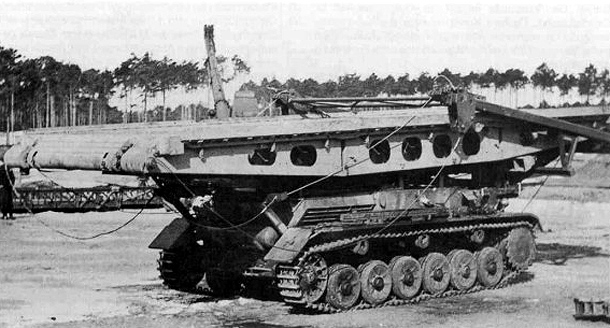
in 1939 Krupp used the "surplus" B.W. II prototype to test the engineering design for the Brückenleger IV bridge-laying tank, source: flickr.com, edited
Origins of the Vehicle
The name alone may give many readers a hint that the vehicle discussed here must have had something to do with the Panzer IV. During the development of the Panzer IV — and indeed throughout its subsequent series production — the Germans used the code designation B.W., short for Begleitwagen. And yes, this is certainly no coincidence. The vehicle designated B.W. II was nothing other than an alternative design submitted by Krupp in the competition to develop the Panzer IV.
This competition was announced by the army in February 1934, with two leading industrial firms approached: Rheinmetall and Krupp. Krupp was not the favourite, and perhaps for that very reason tried a little harder than its competitor — submitting two chassis variants for the army's consideration rather than one. The first, designated B.W. I, had eight small road wheels on each side, sprung by leaf springs. The second variant, designated B.W. II, had only six larger-diameter road wheels on each side, suspended by what appear to have been torsion bars. In 1935, the army ordered Krupp to build evaluation prototypes of both proposed variants, at this stage constructed only from soft unarmoured steel and without turrets or armament.
Krupp delivered its two prototypes in the second quarter of 1936, so that during the summer of that year they could compete not only against each other but also against the third competing prototype from Rheinmetall. The convincing winner of the comparison was Krupp's B.W. I prototype with its eight smaller road wheels, laying the foundation for the most numerous German tank, the Panzer IV.

again the B.W. II serving as the Brückenleger IV prototype, here seen laying the bridge span, source: flickr.com, edited
The "Guinea Pig"
The second Krupp prototype, B.W. II, did not win the trials, but it did not fail outright either. It was therefore not condemned to being scrapped, but was instead kept for use in various further evaluation tests. It differed from its "brother" B.W. I only in its running gear. Its hull, however, was virtually identical to the B.W. I prototype and, by extension, to the series-production Panzer IV. This made the otherwise surplus vehicle an ideal — and inexpensive — tool for designing and testing various specialised superstructures intended for the Panzer IV.
And this is precisely how the B.W. II was put to use in 1939, when the army ordered Krupp to convert six series-production Panzer IV tanks into bridge-laying vehicles. The vehicles were to be stripped of their combat turrets, and their hulls were to be modified to accept a structure for carrying and laying a steel bridge span. For the B.W. II prototype, this meant another moment in the spotlight after a longer period of inactivity. Its hull was fitted with the necessary beams, jacks, and steel cables, and under the designation Brückenleger IV the modified vehicle underwent trials with a 9-metre bridge span.
Almost in parallel with the development of the Brückenleger IV bridge-laying tank, work began on another similar vehicle — this one intended primarily for infantry use. It was to be equipped with an extendable walkway by which infantry could cross both artificial and natural obstacles. The vehicle, which received the designation Infanterie Sturmsteg, was again to be based on the Panzer IV chassis. Once again, the necessary hull modifications had to be designed and tested. So once again, Krupp unerringly reached for the "surplus" B.W. II prototype and used it to evaluate the engineering design of the extendable walkway before committing to the production version.
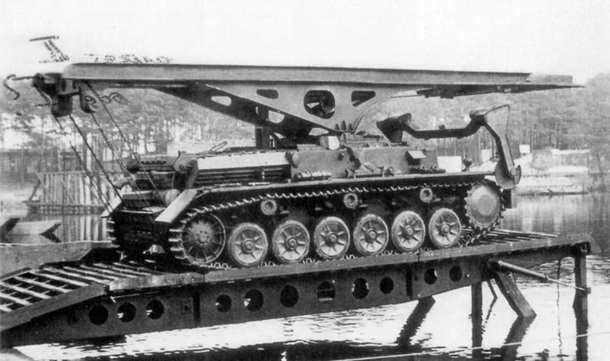
the B.W. II also served as the prototype for testing the design of the infantry assault footbridge (in this photograph the extendable walkway itself is not installed — only its supporting beam is visible), source: flickr.com, edited
What Happened Next?
That more or less accounts for what the B.W. II prototype was doing in 1939 and 1940. But what became of it afterwards? Unfortunately no source provides an answer. It is clear, however, that the vehicle's career continued — as evidenced by several surviving photographs. One series of images shows the B.W. II crossing an engineer bridge. The photographs were evidently not taken at the front but rather at some testing facility. On the hull of the vehicle sit what appear to be two large wooden crates, and in one of the photographs these crates are even wrapped in heavy chains. The most plausible explanation is that the crates contained ballast weights to increase the vehicle's mass for bridge load testing, with the heavy iron chains serving the same purpose.
Particularly interesting are photographs showing the B.W. II being transported on a railway flatcar. The hull is completely bare — no bridge-laying brackets, no pulleys or steel cables for handling the span, no extendable walkway, not even the wooden crates mentioned above. Just the plain hull. And what makes this interesting? The fact that on the adjacent flatcar sits a Panzer III Ausf. L with supplementary armour on the front of the crew compartment and turret. This means the photograph could not have been taken any earlier than March 1942! It is quite remarkable that the B.W. II prototype survived to such an advanced age. But why was it being transported by rail in 1942 with no sign of any further special modifications being prepared for it? No source provides an answer to this, nor does any source shed light on the subsequent fate of this prototype or the final chapter of its long journey.
ARTICLE
CONTENTS:
Reproducing text from the Panzernet website without the written consent of the operator is prohibited.