HEUSCHRECKE IVB
prototype of a next-generation self-propelled gun
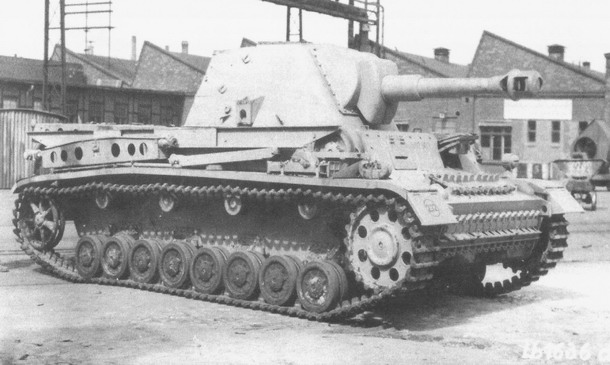
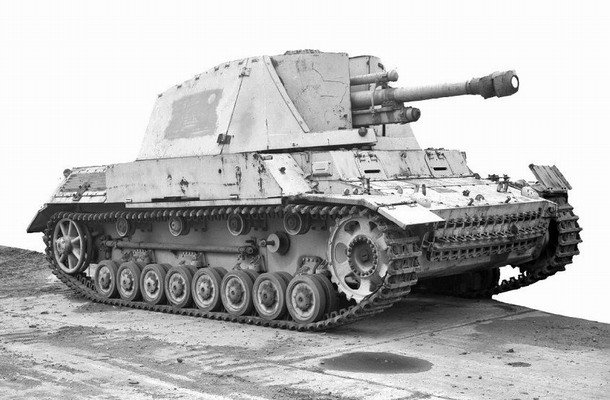
Krupp's Heuschrecke IVb prototype — this is the later version with the manually operated turret-removal mechanism, source: Flickr.com, with permission of the publishing user, edited
Origins of the Project
Early in 1942, Section 4 of the Ordnance Office (WaPrüf 4) launched an extensive development programme covering several types of self-propelled gun that were intended to become the backbone of the artillery in German panzer and other divisions in the future. The vehicles developed under this programme were designated Grille (cricket) and Heuschrecke (grasshopper), with several specific types under each name (Grille 10, Grille 12, Grille 15, etc.). The Ordnance Office's requirements were extremely demanding, and the designs were also planned around the chassis of tanks still in development — the Leopard (VK 16.02) and the Panther (VK 30.02). It was therefore obvious from the outset that these new self-propelled guns would not be available for some time. The army could not be left without equipment in the meantime, so a decision was made to build "interim" types that could be produced quickly and satisfy the army's needs until series production of the new advanced vehicles began. This may come as a surprise, but those interim types turned out to be the Wespe and Hummel self-propelled howitzers.
Around mid-1943, however, the Grille / Heuschrecke programme ran into difficulties. Development was not progressing fast enough — partly due to the demanding design requirements — but there were also other external pressures. One was the cancellation of the Leopard tank project in 1943. That tank's chassis had been earmarked as the basis for the 105 mm self-propelled howitzer being developed within the Grille / Heuschrecke programme. It was therefore decided that the Panther chassis would simply have to be used instead for carrying the lighter weapon. Unfortunately, however, word came very shortly afterwards that Panther components would not be released for the production of any vehicles other than the tanks themselves, which were in enormous demand.
Ordnance Office Requirements
The Ordnance Office suddenly found itself with a knife at its throat. The new 105 mm self-propelled howitzer project had effectively stalled, and production of its "interim" replacement, the Wespe, was scheduled to end in May 1944 with no possibility of extension. The Waffenamt therefore had to find a solution quickly. Its representatives decided to fall back on an existing basis — the Geschützwagen III/IV chassis, the platform developed for the Hummel self-propelled gun, which combined components from the Panzer III and Panzer IV tanks (hence its designation Geschützwagen III/IV). On this carrier, the 10.5 cm leFH 18/1 howitzer was to be installed, taken from the earlier, already cancelled Sd.Kfz. 165/1 project.
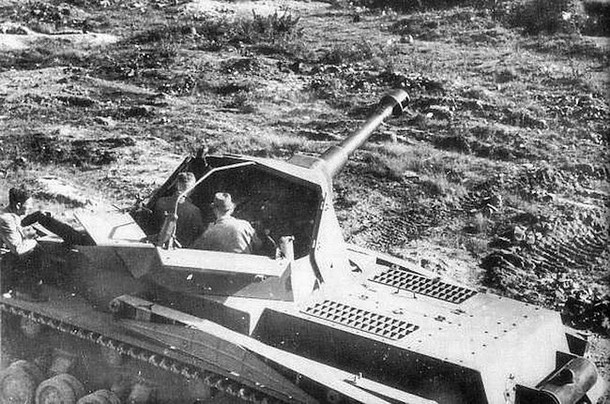
The first version of the Heuschrecke IVb prototype during trials — the plan had been for the turret-removal mechanism to be driven by the vehicle's own engine, but this proved essentially unworkable, source: Flickr.com, with permission of the publishing user, edited
Up to this point, this represents a perfectly rational attempt to resolve the situation quickly and efficiently — making use of existing components to reduce the cost and time needed to develop the new vehicle. What followed from the Ordnance Office, however, turned all of that on its head. WaPrüf 4 wanted the new vehicle to be capable of removing its own howitzer under its own power, without assistance from any other vehicle, so that the gun could be used in a static firing position on the ground. On top of that, a full 360-degree traverse was required for the weapon. The task of designing the vehicle was assigned to the firm Krupp, which had extensive experience in this area. To dovetail production of the new type with the planned end of Wespe production, the design had to be completed by September or October 1943 at the latest.
The vehicle under development received the designation Heuschrecke IVb. At the end of May 1943, one example of the Sd.Kfz. 165/1 self-propelled gun was sent from the armoured troops school at Jüterbog to the Krupp-Grusonwerk factory in Magdeburg. Krupp's workers then removed the 105 mm leFH 18/1 howitzer from it to use in the new proposed vehicle. At the beginning of July 1943, the Hummel self-propelled gun chassis with production number 320148 also arrived in Magdeburg. However, at an interim meeting held on 30 June 1943, Krupp had already informed Ordnance Office representatives that installing the turret-removal mechanism would require substantial modification of the Hummel chassis — not merely cosmetic changes, but a fairly major rebuild including relocating the engine to the rear.
It also became clear that even the leFH 18/1 howitzer could not be used as-is, but would need to be modified. In particular, the breech from the 10.5 cm Sturmhaubitze 42 was to be used (itself another variant of the leFH 18), along with possibly part of the recoil mechanism from the Pak 40 anti-tank gun. The original sensible intention of using existing components had been almost entirely abandoned. And the reason for all of it was those thoroughly unreasonable requirements for full weapon traverse and the ability to remove it from the chassis under the vehicle's own power. Despite these complications, the Ordnance Office continued to insist that both features were absolutely essential for a modern self-propelled gun.
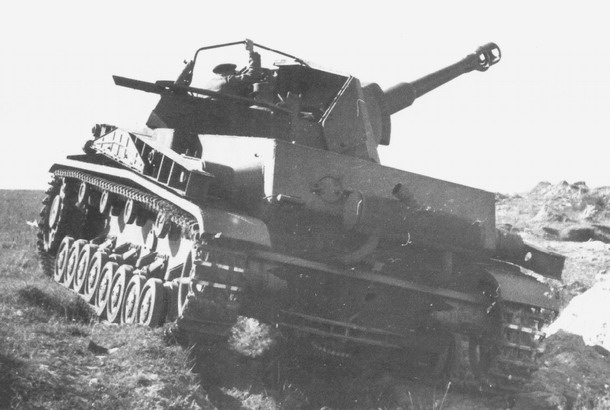
The first version of the Krupp Heuschrecke IVb prototype did not yet carry the wheels for the howitzer turret on the hull rear, which meant the exhaust silencer could still be fitted in its usual position, source: Flickr.com, with permission of the publishing user, edited
And what had actually led the Waffenamt to these ideas in the first place? In self-propelled guns with limited horizontal weapon traverse, repositioning the entire vehicle was necessary for any significant change in firing direction. These frequent small movements of the whole vehicle caused increased wear and failures in the tracks, drive and idler sprockets, clutches and final drives. Hence the requirement for unlimited horizontal weapon traverse — and in this case the underlying logic at least made sense. But why such a radical solution? A weapon traverse of, say, 70 degrees would surely have been more than adequate, and achieving it would have been far less demanding from a design standpoint than full 360-degree rotation.
If the justification for the first requirement "limped on one leg," as it were, the reasoning behind the second special requirement was entirely "legless." WaPrüf 4 argued that if the howitzer could be removed from the self-propelled gun in the field and used independently in a static position, its carrier could then drive away, meaning the gun and vehicle would no longer present a single combined target for enemy fire, the vehicle would not suffer the wear and stress of firing, and in the meantime it could perform other duties such as bringing up additional ammunition. But what would actually be the point? What would then be the difference between a self-propelled gun and a conventional towed gun with a half-tracked prime mover? Removing the weapon from a self-propelled gun was simply pointless — but the men in Section 4 of the Ordnance Office saw it differently.
In July 1943 the vehicle under development received its official designation: 10.5 cm leFH 18/6 (Sf.) auf Geschützwagen III/IV. It was also commonly referred to by the much simpler name Heuschrecke IVb. Heuschrecke is the German word for grasshopper — and the name was quite apt. The crane arms for removing the howitzer, running along the sides of the vehicle, did indeed look rather like the hind legs of a grasshopper, if one used a little imagination. In July 1943, the Krupp brief was supplemented with a request to also design a modified unarmed version of the new self-propelled gun that would serve as an ammunition vehicle to supply the others — one ammunition vehicle for every three combat vehicles.
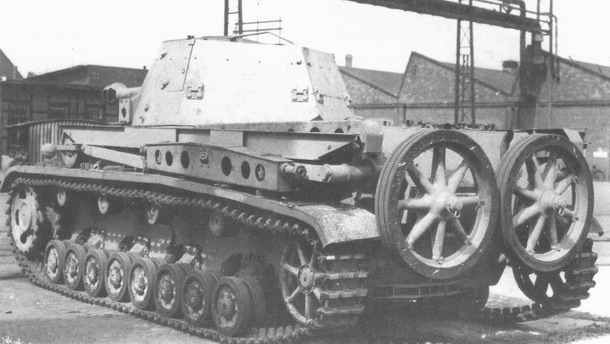
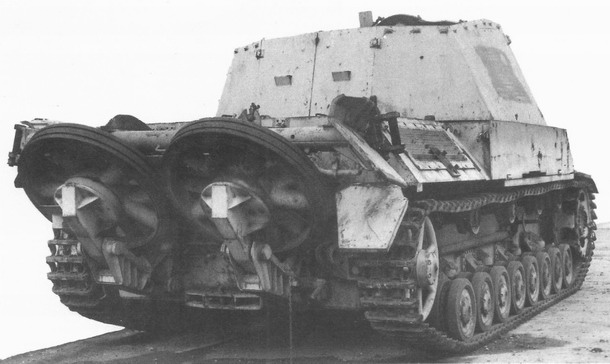
The later version of the Krupp Heuschrecke IVb prototype already carried large wheels at the rear that could be attached to the removed fighting turret, which could then be towed behind the vehicle as a trailer (the prototype in this photograph has later-pattern drive sprockets), source: Flickr.com, with permission of the publishing user, edited
Removing the Turret
In designing the new vehicle, Krupp's engineers drew on their earlier Sd.Kfz. 165/1 project. Their plan was to mount the howitzer in a fighting turret that could both be traversed horizontally and removed from the chassis. In other words, it was not just the gun itself that would be removed, but the entire turret. In July 1943 Krupp completed the design of the mechanism for removing — and replacing — the turret with the howitzer inside it. The lifting device itself was not particularly complex, consisting of a system of metal sections connected by hinges. The mechanism that drove it, however — transmitting power from the vehicle's main engine to the lifting device — was complicated. Moreover, Krupp had to apologise that due to the enormous workload at its factories, it would not be able to guarantee series production of the powered drive mechanism within the Ordnance Office's required timescale.
The Waffenamt insisted on keeping to the schedule, however, and on 5 August 1943 approved a kind of interim solution. The first production examples of the new self-propelled gun would simply not have their own integral lifting mechanism; instead, a simple portal crane with a system of pulleys would be used for removing the turrets. Disassembled into its component parts, this crane was to be transported on the accompanying ammunition vehicles — one crane to every three self-propelled guns. Krupp prepared the design of the required portal crane (Bockkran), and on 3 September 1943 the Ordnance Office approved it and ordered 100 units to be manufactured.
Alkett's Competing Design
Alkett, as the supplier of the Wespe self-propelled howitzer, was clearly unwilling to accept that the successor to their vehicle would be designed and manufactured by the competing Krupp-Grusonwerk. Alkett therefore decided to prepare its own design for the next-generation self-propelled gun, one that would meet the Ordnance Office's demanding requirements and secure the continuation of their lucrative army contract. Alkett too reached for the 105 mm howitzer and the Geschützwagen III/IV chassis (on which the Hummel was built), but their engineers solved the problem of removing the weapon from the chassis in a different way from their competitors.
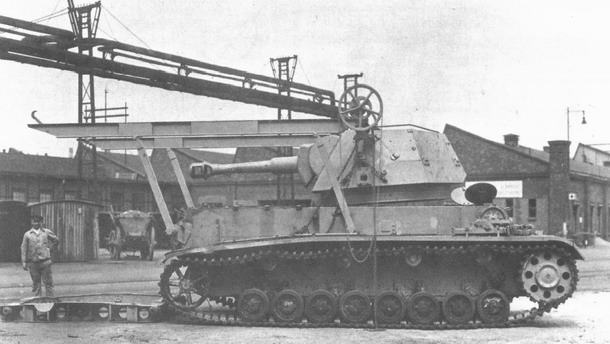
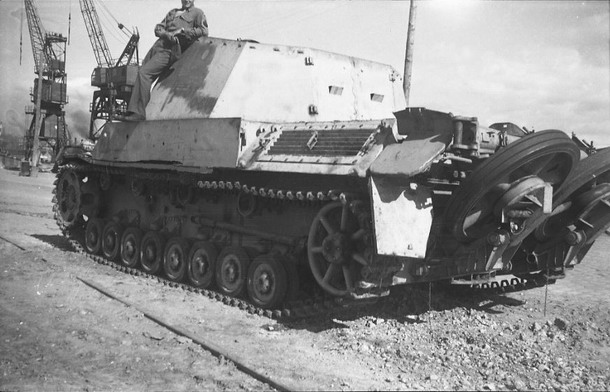
On the later prototypes, the originally planned engine-driven lifting mechanism was replaced by a simpler manually-operated crane — seen here in action. Behind the vehicle, the frame on which the turret was to be placed is already laid out on the ground, source: Flickr.com, with permission of the publishing user, edited
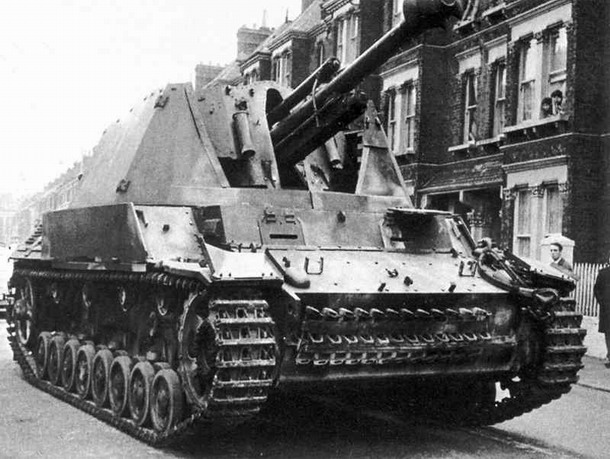
Having entered the project somewhat later, Alkett only completed its drawings in September 1943 and presented them immediately to Ordnance Office representatives, apparently attracting their interest. In this case too, the Hummel chassis required considerable redesign, including relocating the engine from the centre to the rear. A fighting compartment was created in the centre section, topped by a large turret with an open roof. Inside the turret was a rotating cradle to which a standard towed 10.5 cm leFH 18/40 howitzer was clamped — stripped of its wheels and rear trail legs, which were then hung on the rear of the hull. To allow full traverse of the essentially unmodified howitzer, the turret needed to be quite large in diameter, which in turn required the hull beneath the turret to be widened somewhat.
Along the sides of the chassis, above the road wheels, were stored the components of a simple manually-operated tubular crane. The crane could be erected directly above the turret and hull of the vehicle (its tubes fitting into prepared sockets), and with its help the howitzer was lifted out of its cradle. Wheels and rear trail legs were then attached to it and the howitzer was slid down to the ground along a ramp placed alongside the vehicle. The vehicle itself, however, carried no such ramp (at least nothing of the kind is mentioned anywhere or visible in photographs), so presumably an accompanying vehicle carried one — or the crew in the field simply had to make do with wooden planks or the like. Removing the howitzer from its cradle was made easier by the ability to open the turret's front wall like a gate. Once off the chassis, there stood a completely standard, series-produced, towed leFH 18/40 howitzer.
Comparing the Designs
On 28 September 1943 a major meeting of WaPrüf 4 staff took place, at which the two competing designs were to be assessed and one selected for series production. It is worth noting that both proposals at this stage still existed only as documents. During the meeting the main advantages and disadvantages of each design were discussed. The unquestionable strength of Krupp's self-propelled gun was the faster and simpler mounting and dismounting of the weapon — assuming, of course, that the planned powered drive mechanism worked as intended. Dismounting the howitzer on Alkett's competing design was by contrast quite laborious.
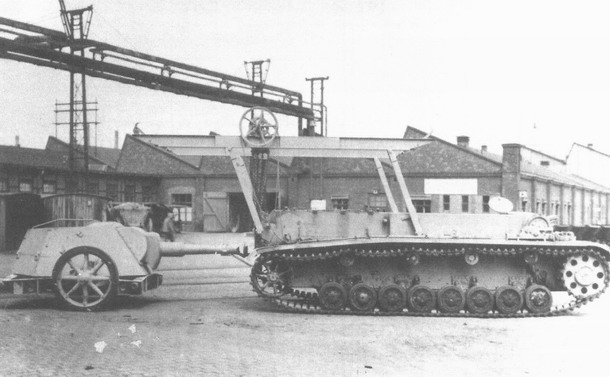
The fighting turret has been removed, wheels have been bolted to its sides, and the whole assembly has been connected to the vehicle via the howitzer barrel for towing... a pity that in practice this solution proved completely unworkable, source: Flickr.com, with permission of the publishing user, edited
Removing the wheels and trail legs from their brackets on the hull rear, getting them up to the howitzer and fitting them — all of this was entirely manual work, and each of the two wheels weighed 145 kg and each of the two rear trail legs 110 kg. Lowering the assembled howitzer to the ground afterwards was also presumably no easy matter: a ramp had to be prepared, ropes attached to the howitzer, and the descent of a load approaching two tonnes had to be carefully controlled and braked. And that is without even mentioning the reverse process — hauling those two tonnes back up the ramp onto a hull nearly two metres high. A special winch was supposedly planned to handle the lowering and raising. However, no winch is visible in either photographs or drawings of the later prototype. Was it to be carried by an accompanying vehicle? Or was the gun to be lowered manually using pulleys? Either way, it is just one more complication.
In Krupp's design, the entire turret was removed from the vehicle and lowered onto a square frame on the ground. This frame allowed the turret to be fully traversed even in the static emplacement position. The turret placed on the frame was, however, quite low — photographs suggest approximately one metre — leaving little room inside for the crew and restricting the howitzer's maximum elevation to around 20 degrees. The recommended solution was therefore to dig a sufficiently large and deep pit beneath the turret to provide space for both crew and gun recoil. Any clear-thinking person can see how primitive and impractical this was. Setting aside the need to manually excavate roughly two cubic metres of earth, one need only imagine what such a pit beneath the gun would look like after the first rain — the crew would be standing ankle-deep in mud! And on rocky ground or frozen soil, digging a pit would be impossible altogether. The Ordnance Office representatives, however, saw things differently and were delighted at what a futuristic machine they were going to have!
The disadvantages identified in Krupp's design were higher production costs, the complexity of the planned engine-powered turret-lift drive, and the fact that the removed howitzer (still inside the complete turret, sitting on a frame over a dug pit) could not be towed anywhere by another vehicle. Alkett's competing design, by contrast, offered these advantages: lower purchase cost, use of the standard series-produced 10.5 cm leFH 18/40 howitzer, and the ability to move the removed howitzer using a conventional prime mover if necessary. Its disadvantages were the laborious process of dismounting and remounting the howitzer, the fact that the removed howitzer did not allow full horizontal traverse when aimed (being a standard gun on a wheeled trail), and the fact that the front section of the howitzer's recoil mechanism was not protected by the turret armour and was therefore more vulnerable.
Alkett's competitor to the Heuschrecke IVb had a wide turret housing a standard towed howitzer stripped of its trail legs and wheels; removal was achieved using a simple crane whose components were stored along the hull sides, source: Flickr.com, with permission of the publishing user, edited
The Ordnance Office representatives at the September meeting agreed that they were unable to declare one design clearly superior to the other, and that prototypes of both should therefore be built, with the final selection to take place after practical trials. Krupp promised to deliver its prototype in October and Alkett in December 1943, with comparative testing then planned for January and February 1944. The planned prototype comparison meant, however, a delay in the start of series production. If production of the existing Wespe self-propelled guns ended as scheduled in May 1944, this would create a three-to-four month gap during which the Wespe would no longer be in production and its successor would not yet be in production either. The Ordnance Office took note of this and concluded that production of the heavier Hummel in 150 mm calibre would continue in any case, and could compensate for the gap in production of the lighter 105 mm vehicle.
The responsible officials of the Waffenamt were therefore prepared to leave the army without deliveries of new self-propelled guns for several months — again, purely because of their obsession with the entirely pointless 360-degree traverse and the even more pointless ability to easily remove the weapon from the chassis at will. This was late September 1943 — a time when the German army on the Eastern Front was already on the defensive and its losses were mounting. But the Ordnance Office had apparently decided that rather than give the soldiers a self-propelled gun whose weapon could not be removed whenever the fancy struck them, it would give them nothing at all. It is astonishing that no one in a position of authority put a stop to this supremely irresponsible conduct and made an example of those responsible.
Prototypes
Krupp completed its prototype on 13 October 1943. Initial driving trials and test removal and replacement of the fighting turret using the mobile portal crane followed. Everything worked without significant problems. Before the end of October, the Ordnance Office and Krupp agreed on approximately twenty modifications and simplifications — to name just two of the more significant: reduction of the hull front armour from 30 to 20 mm, and replacement of the complex engine-driven turret-lift mechanism with a much simpler hydraulic pump that could run off either the engine or manual power. On 21 January 1944 the Krupp prototype also underwent firing trials.
The wheels and trail legs of the 10.5 cm leFH 18/40 howitzer were stowed on the hull rear, enabling a complete standard howitzer to be "extracted" from the vehicle, source: Flickr.com, with permission of the publishing user, edited
Alkett delivered its prototype apparently in January or February 1944, and the comparative trials of both vehicles took place on 28 March 1944. The Krupp prototype weighed 24 tonnes, measured 657 cm in length and could achieve a top speed of around 38 km/h. Alkett's vehicle was one tonne heavier, 63 cm longer and could travel at up to 42 km/h. Both vehicles retained the engine and gearbox from the Geschützwagen III/IV — the twelve-cylinder Maybach HL 120 TRM petrol engine producing 300 horsepower and the six-speed Zahnradfabrik model SSG 77 gearbox. Both had a five-man crew and identical radio equipment in the form of the Fu.Spr.Ger. f. radio set. The amount of howitzer ammunition carried was also very similar — 87 rounds for Krupp and 85 for Alkett. The Krupp prototype had smaller fuel tanks, yet for some reason a greater range is usually quoted for it.
Change Requests
One of the new findings from the practical trials of both vehicles was a restriction on the Alkett prototype's negative elevation when the howitzer was aimed rearward. In a roughly 60-degree arc at the rear of the vehicle, the howitzer could not be depressed below +2 degrees of elevation (elsewhere a negative elevation of -5 degrees was possible). The obstacle to firing at lower elevation in this arc was the wheels and trail legs for the howitzer stored on the hull rear. The Ordnance Office declared this a serious problem that would have to be resolved somehow.
But that was nothing compared with the further observations and demands that WaPrüf 4 brought forward after the comparative trials. To begin with, WaPrüf 4 asked both firms to investigate the possibility of basing the production version of their self-propelled guns on the newly planned universal chassis Einheitsfahrgestell Pz.III/IV, which was being developed at that time as part of an entirely separate project. Why not delay the already considerably behind-schedule development with yet another fundamental change, after all? When Ordnance Office representatives saw how a completely standard series-production howitzer on a wheeled trail could simply be driven off the Alkett prototype's hull and the vehicle could then quietly tow it behind on its wheels, they were apparently delighted — and came up with the demand that Krupp also devise a way for the howitzer removed from its vehicle to be towed by some prime mover. Krupp's engineers must have been tapping their foreheads in disbelief. Nothing of the sort had been in the original specification — and how exactly were they supposed to achieve it now, given that they were removing not just the gun but the entire turret?! At the same time, Krupp was tasked with modifying the turret design and/or its ground frame so that no pit would need to be dug beneath the lowered turret.
Alkett's vehicle received the official designation leFH18/40/2 (Sf.) auf Geschützwagen III/IV, source: Flickr.com, with permission of the publishing user, edited
The prize for absurdity, however, went to the task assigned to Alkett following the trials. On the one hand, the WaPrüf 4 gentlemen were impressed that a standard leFH 18/40 howitzer complete with wheels could be extracted from Alkett's self-propelled gun — but they simultaneously began to object to the fact that this standard howitzer was incapable of traversing through the full unlimited 360 degrees they wanted! Krupp's competitor's removed turret could manage that, after all. The officials therefore asked Alkett to design a special ground platform on which the removed howitzer could be rotated and fired in any direction (a so-called Schiesspilz). For heaven's sake — what on earth for?!
The only sensible outcome of the prototype demonstration appeared to be the decision that Krupp's self-propelled gun's turret-lifting mechanism should use neither a complex engine-powered drive nor a hydraulic pump, but a simple and inexpensive manual gear mechanism. And what, then, was the overall conclusion of the comparative trials? Effectively none at all. Each of the two manufacturers was to deliver two trial batteries of their guns. The vehicles in each battery were, for further comparative purposes, to incorporate a different set of the proposed modifications (yes, really). Each battery was to number five vehicles, one of which would be retained by a trial artillery battalion and four sent to a selected front-line unit for live combat testing. Each battery was also to include one ammunition vehicle. In total, therefore, each firm was to deliver 12 vehicles.
Representatives of both Krupp and Alkett announced on the spot that producing the required vehicles would take five to six months, meaning that testing of the delivered vehicles would be possible at the earliest in September 1944. From that date, three months had to be allowed for front-line trials and a further two months for incorporating any change requirements. Only then was a definitive decision to be made about which vehicle would actually enter series production. And from that glorious moment, a further approximately six months had to be counted for production to get up and running. Adding it all up, the army would most likely receive its first series-production 105 mm self-propelled howitzers in September 1945. Never mind that production of the existing Wespe was ending in May 1944. Since WaPrüf 4 had already decided that the troops at the front could perfectly well manage without light self-propelled howitzers for three months, why couldn't they manage for a year? After all, we're doing this for them — they'll have to wait, but then they'll receive a fighting vehicle the world has never seen! Just imagine — the gun will be removable, and can then be towed elsewhere by any prime mover. Who could resist such a wonder?
Alkett's self-propelled gun prototype was captured by the Allies and taken to England, where it is today probably part of the private collection of Mr Kevin Wheatcroft, source: Flickr.com, Public domain, edited
The unfortunate engineers at both firms therefore set to work. The fighting turret on Krupp's vehicle was fitted with new brackets on its sides for attaching wheels so it could be towed behind a vehicle. When not in use, these wheels were hung on the rear wall of the hull (similar to the Alkett arrangement) — for which the hull rear first had to be modified. Among other changes, the original horizontally-mounted exhaust silencer had to be replaced by a pair of simple vertical exhaust pipes without silencers. The improvised solution for hitching the wheeled turret to a prime mover involved connecting it by the howitzer barrel itself.
In May 1944, driving trials of the towed turret were conducted. With the howitzer, mounting frame and wheels, the turret weighed 3.8 tonnes, and towing it off-road proved virtually impossible. On 31 May 1944 the Krupp Heuschrecke IVb project was officially terminated — along with the order for two trial batteries. Alkett's vehicle was now the one intended for series production, with production to begin as soon as possible. The prepared production plan foresaw delivery of the first series vehicles in October 1944 — a date subsequently pushed back to November, then December, then January, and finally February 1945. On 12 December 1944, however, the entire project was definitively cancelled, and in the end not a single production vehicle was ever built.
Overall Assessment
The Heuschrecke IVb was a textbook example of a bungled armaments project. Nonsensical requirements — dreamed up at a desk rather than drawn from practical experience, and changing throughout the course of development — quite literally buried the project. The responsible officials of WaPrüf 4 failed to distinguish which characteristics mattered for a fighting vehicle of this type and which did not. They failed to understand what the German army needed in 1943, and above all what it would need in the years ahead. For two years the project needlessly tied up the precious capacity of two armaments firms and a great many Ordnance Office officials. While the Soviets were rolling out primitively simple but fully functional tanks by the thousand, the Germans were wasting time and money on the fine-tuning of a complex vehicle whose "special" capabilities would in all probability have seen only the most marginal use at the front — if any at all.

ARTICLE
CONTENTS:
Reproducing text from the Panzernet website without the written consent of the operator is prohibited.