DICKER MAX
a nutcracker for bunkers and tanks alike
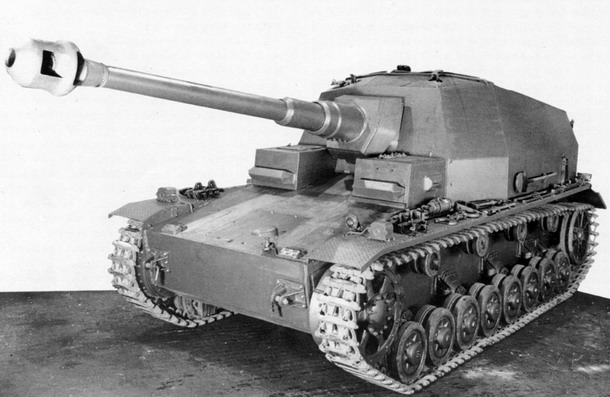
Bunker-buster 10.5 cm K (gp.Sfl.), the Dicker Max – one of the two prototypes built, seen here in a factory photograph. Source: Flickr.com, with the permission of the publishing user, edited.
In Search of a Bunker-Buster
When Adolf Hitler and his generals contemplated future offensive warfare in the second half of the 1930s, one thing was broadly clear to all of them. If – or rather when – Germany unleashed such a war, one of the obvious targets would be neighbouring France. An attack on that country meant having to deal in some way with a significant element of its defensive strategy: the fortification system known as the Maginot Line. But there were other states too – Belgium and Czechoslovakia among them – which, fearing their German neighbour, had invested enormous resources in building border fortifications. The Germans had no intention of being drawn into a protracted siege and bombardment of fixed fortifications. They planned to wage their war differently – in a new, modern way: with lightning speed. For this style of warfare they needed a fighting vehicle that could close with an enemy fortification very quickly (and if possible undetected), destroy it with accurate fire (from as great a distance as possible) and then move on. The vehicle should be armoured, to give its crew at least a measure of protection, and its gun should ideally combine long range with high destructive power.
Development
The first weapon considered as the main armament for the proposed bunker-buster (German: Schartenbrecher) was the 88 mm Flak 18 anti-aircraft gun. While this weapon had proved itself well in the ground role, it was not really up to the task against the stronger concrete bunkers. Attention therefore shifted to the heavy 10 cm schwere Kanone 18, a 105 mm gun (sometimes listed simply as 10 cm K 18). This weapon had been developed in the late 1920s and early 1930s jointly by Rheinmetall and Krupp and entered service in 1934. It was not particularly well liked by artillery units, as it was rather too heavy for its relatively modest calibre. In its firing position it weighed 5.6 tonnes, and in travelling configuration as much as 6.4 tonnes. A substantial part of this weight was accounted for by the wheeled carriage and two long, very robust trail legs – components that were obviously unnecessary in a self-propelled mounting, so the weight of the gun as adapted for vehicle installation was somewhat lower.
Even without the carriage and trail legs, the K 18 remained a substantial weapon, and finding a chassis capable of carrying it was no simple matter. The task of developing the new bunker-buster was assigned to Krupp, whose engineers decided to design an entirely new chassis with torsion-bar suspension for the vehicle. This, as we can reveal straightaway, was not a particularly happy decision and ultimately led to unnecessary delays in the whole project. Development work apparently began around the turn of 1938–39 (by which time the need to reduce Czechoslovak fortifications was already moot). In April 1939 Krupp presented two initial design proposals to representatives of the Waffenamt. The main topic of discussion between the two parties was the location of the engine. One proposed version had the engine at the rear of the hull behind the gun; in the other the engine was in the middle of the hull with the gun mounted directly above it. After weighing the pros and cons of both concepts, the Waffenamt favoured the version with the engine below the gun, while tasking Krupp with designing the arrangement so that the gun would be as low as possible.
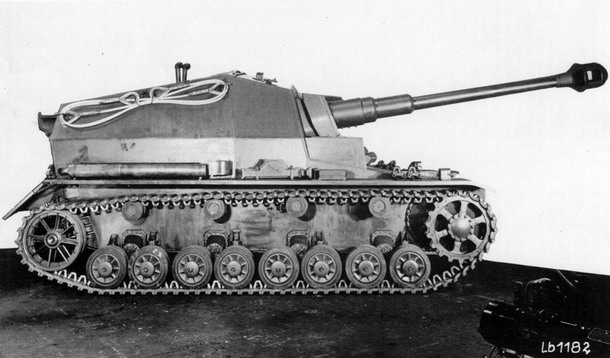
Another factory photograph of the Dicker Max – note the commander's periscope protruding above the superstructure armour. Source: Flickr.com, with the permission of the publishing user, edited.
During May 1939 no fewer than three rounds of discussions were held between the Waffenamt and Krupp, covering the engine, the chassis and the necessary modifications to the gun. Krupp offered the Waffenamt a choice between two Maybach powerplants. The first option was the HL 116 six-cylinder petrol engine of 11 litres displacement, producing a maximum output of approximately 300 horsepower. Its disadvantage was its greater height: a gun mounted above this engine would sit approximately 210 cm above the ground, which was too high. The second option was the equally powerful twelve-cylinder Maybach HL 120 of 11.9 litres displacement. This was about 10 cm lower but around 200 kg heavier. Neither option was attractive to the Waffenamt, so the Army put forward its own suggestion: they asked Krupp's designers to consider installing the smaller and lighter Maybach HL 66 Pla engine, which produced only 180 horsepower at 3,200 rpm.
The May discussions also covered the gun itself. The use of the heavy 105 mm K 18 was by now well established; the question was what modifications would be needed to install it in an armoured vehicle. The recoil mechanism certainly had to be redesigned. A robust muzzle brake was also fitted, which reduced the gun's recoil travel from the original 100 cm to 80 cm. Then there was the matter of the chassis itself. Krupp had originally planned to develop an entirely new torsion-bar-sprung chassis for the bunker-buster, but gradually moved away from this intention, and by the end of May 1939 proposed basing the new vehicle on the chassis of the Panzer III Ausf. E (also known as Z.W. 38), which had recently entered production and whose running gear was regarded as very successful.
The Waffenamt apparently gave this proposal due consideration and over the following months opened discussions with Krupp on yet another option: using the chassis of the Panzer IV, with its eight road wheels sprung by leaf springs. Krupp carried out the necessary technical analysis and confirmed in August 1939 that using the Panzer IV chassis was not only feasible but actually appeared to be the better choice compared to the Panzer III chassis. Calculations showed that a vehicle on this chassis could be nearly half a tonne lighter, and the absence of torsion bars would allow the engine to sit lower in the hull tub, in turn allowing the gun to be mounted lower (the torsion bars used on the Panzer III ran transversely across the hull tub, occupying a certain amount of internal depth).
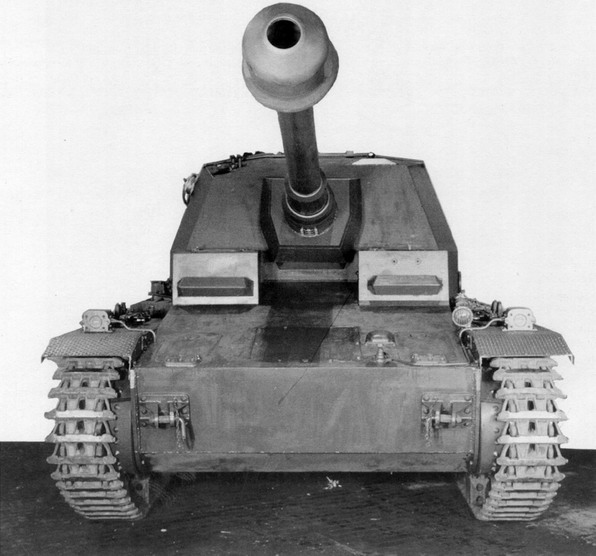
A fine frontal view of the Dicker Max – the left housing (as seen from the direction of travel) served the driver, while the one on the right was a dummy. Source: Flickr.com, with the permission of the publishing user, edited.
The Waffenamt accordingly confirmed the Panzer IV chassis as the preferred solution. For some reason, however, it also required the installation of the Maybach Variorex gearbox, taken from the prototype light tank VK 9.02. On 21 August 1939 the Waffenamt authorised the construction of two full prototype vehicles, to be delivered in May and June 1940. For completeness, the idea of using the Panzer III chassis lingered a while longer before finally being abandoned in September 1939.
On 19 September 1939, the Waffenamt issued what it described as a final specification for the new vehicle: Panzer IV chassis, Maybach HL 66 P or HL 66 Pla engine, Maybach Variorex gearbox (from the VK 9.02), 10 cm K 18 gun mounted above the engine roughly in the centre of the vehicle, capability for both direct and indirect fire, ammunition stowage of at least 25 rounds, five-man crew comprising driver, commander, gunner and two loaders, total weight below 20 tonnes, 50 mm frontal armour and 20 mm on the sides and rear. Less than a month later, on 11 October 1939, the Waffenamt updated its "final" specification again. The Maybach Variorex gearbox was to be replaced by a Zahnradfabrik SSG 46 (a sound decision, given the problems that were plaguing the VK 9.02 project). Krupp naturally required time to assess whether the SSG 46 could operate correctly with the HL 66 engine, and confirmation of the arrangement's feasibility did not arrive until 4 November 1939. Krupp's engineers estimated that the vehicle's top speed with the chosen gearbox and engine would be only around 27 km/h. The Waffenamt did not regard this reduction in speed as an insurmountable obstacle – after all, the vehicle was intended to engage stationary targets.
The delay caused by the gearbox change naturally affected the prototype production schedule. The original plan had called for the two prototypes to be delivered in May and June 1940; the revised plan pushed this back to August of that year. In the event, the pair of Schartenbrecherswere not delivered until January 1941. By that time, the burning question was obvious: what were they actually for? The new vehicle had been developed from the outset for a specific purpose – destroying fortifications. By January 1941, arriving like a solution to a problem that no longer existed, all the fortifications it had been designed to tackle – Czechoslovak, Belgian and French alike – had long since been captured or bypassed. In March 1941 the prototypes were demonstrated to senior Army leadership including Hitler himself, with the argument that they might in future be usefully employed in destroying enemy tanks. Army representatives were clearly undecided, and ultimately resolved that the prototypes should be subjected to combat trials with front-line units and that a decision on possible series production would be made on the basis of the results. Some of those present already knew, it seems, that the battlefield chosen to put the prototypes to the test would be the new Eastern Front.
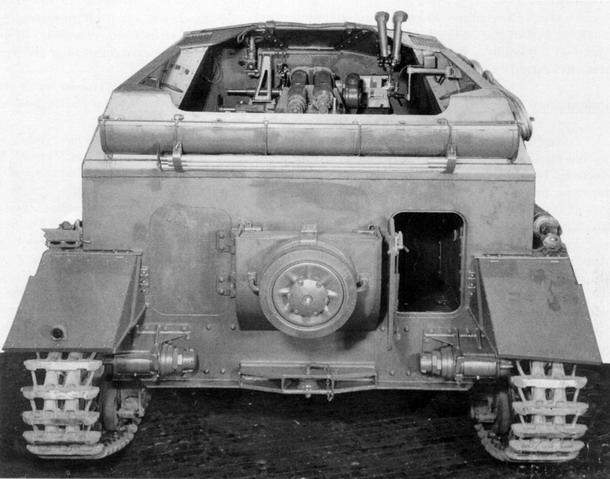
The partly open fighting compartment was entered through two hatches in the rear wall. Source: Flickr.com, with the permission of the publishing user, edited.
Vehicle Description
As already noted several times, the new fighting vehicle was based on the chassis of the medium tank PzKpfw IV, specifically the Ausf. E. On each side it had eight road wheels, suspended in pairs and sprung by leaf springs. The wheels were of the double-disc type, with the track guide tooth passing through the gap between the discs. The wheel discs were fitted with rubber cushion tyres for a smoother ride. At the front sat the drive sprocket, at the rear the idler, and the upper run of the track was supported by four small return rollers. A welded superstructure of hexagonal plan was mounted on the tank chassis. Projecting forward on either side of this superstructure were two separate armoured "housings." The left-hand one served the driver, who sat inside the hull body, separated from the rest of the crew; the housing protected his head as it protruded above the hull roof plate. Directly in front of the driver's eyes was his main visor, filled with a block of bullet-resistant glass and protected externally by a hinged armoured cover. For use in hazardous areas, the driver also had a K.F.F.2 observation periscope, whose lenses looked forward through two small apertures drilled in the housing's front armour. A further observation visor was provided in the left-hand side wall of the housing. Above his head, the driver had his own entry hatch. The second armoured housing, on the right-hand side, was a dummy, serving purely to confuse the enemy. The visor cover on its front face was likewise false.
The fighting compartment was tallest at its front. The walls decreased in height toward the rear, though they remained high enough to protect the gun crew standing at their posts. The forward section of the compartment was the only part with a roof; the rest was open to the sky. Entry and exit was via a pair of small hatches in the rear wall; in an emergency, the crew could also scramble out over the side walls.
Roughly in the centre of the chassis sat the engine compartment, housing the liquid-cooled six-cylinder Maybach HL 66 Pla petrol engine producing 180 horsepower. Forward of the engine was the Zahnradfabrik SSG 46 gearbox with six forward speeds and one reverse, connected via final drives and steering clutches to the front drive sprockets. The radiator was mounted immediately behind the engine. Since the engine compartment was below the floor of the fighting compartment – directly beneath the gun – the designers had to find the most effective and safest way to channel cooling air into it. Their solution was ingenious: angular air ducts were routed along the inner sides of the fighting compartment walls, opening at the top of the superstructure and directing air downward to the engine and radiator (photo HERE). The heated exhaust air was then expelled through a separate duct running down the centre of the fighting compartment and exiting through its rear wall.
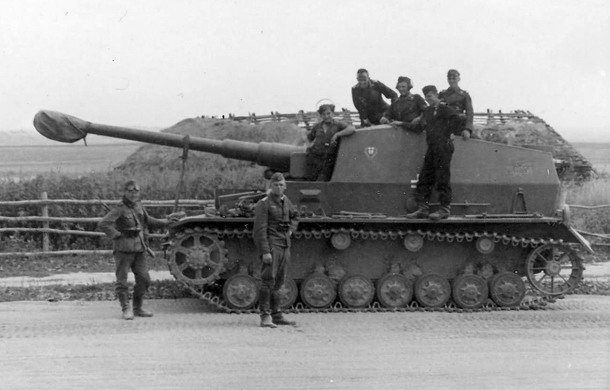
Dicker Max of the 521st Tank Destroyer Battalion on the Eastern Front. Source: worldwarphotos.info, with the permission of the site operator, edited.
The crew numbered five. The driver already mentioned sat alone in the hull forward of the main superstructure; the remaining crew members had their positions inside the main fighting compartment. At the front, the gunner sat on the left and the commander on the right. Behind the gun stood the two loaders. The compartment walls had no observation openings: the gunner observed through the gun sight, while the commander had a conventional scissors periscope that extended above the armour. If the loaders wished to look outside, they simply had to stick their heads up through the open roof. Two loaders were needed because the gun used separate-loading ammunition – projectile and propellant charge were loaded independently.
The prototypes were originally fitted with no radio equipment at all. The crew in the open fighting compartment communicated directly with each other, and the commander communicated with the driver via a speaking tube. The crew had no means of receiving information or orders from outside except by signal or messenger. Photographs from the later front-line deployment of the vehicles clearly show, however, that they were eventually fitted with radio equipment and an intercom. This is evident in numerous photographs showing a rod antenna mounted on the right side armour of the superstructure (HERE, HERE, and HERE), and in at least one photograph showing crew members wearing headsets (HERE). The antenna position suggests the radio was installed in the right-hand forward section of the fighting compartment (under the roof section), most likely operated by the commander who sat there.
The vehicle's main armament was, as noted repeatedly, a modified 105 mm K 18 gun. The gun could fire both high-explosive and armour-piercing rounds, and was capable of both direct and indirect fire. It therefore had two interchangeable sights – one for each mode of engagement – both periscopic and extending through a small opening in the superstructure roof. The weapon's maximum range was approximately 19 km, though the effective range was 10.5 km for indirect fire and 3.4 km for direct fire. The mounting allowed horizontal traverse of 16 degrees, 8 degrees either side of centre. Vertical elevation ranged from -15 to +10 degrees. The fact that maximum depression was greater than maximum elevation is significant: it indicates that the designers wanted the vehicle to be able to engage targets in hull-down positions, firing from behind the crest of a rise. The onboard ammunition supply was only 26 rounds. The 10 cm Pzgr.rot armour-piercing round weighed 15.6 kg (projectile only, not the complete round) and left the muzzle at 822 m/s. At a range of one kilometre it could penetrate 138 mm of sloped homogeneous armour, and at two kilometres it defeated 111 mm. The vehicle had no integral secondary armament, but the crew had three MP 40 submachine guns with a total of 576 rounds between them.
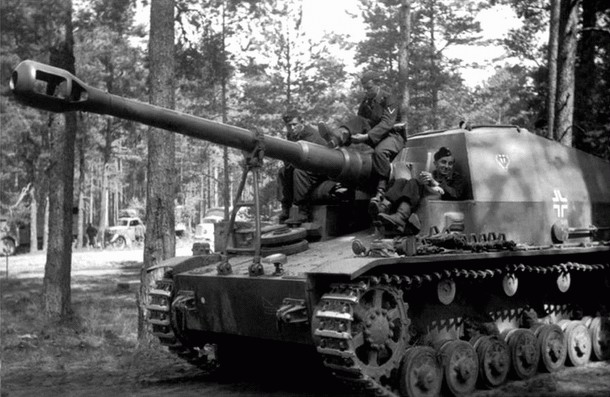
Dicker Max bearing the emblem of the 521st Tank Destroyer Battalion – note the barrel support in the raised position. Source: worldwarphotos.info, with the permission of the site operator, edited.
The armour was 50 mm on the hull front (the same as on the Panzer IV Ausf. E), 30 mm on the fighting compartment front, 20 mm on the sides and 10 mm at the rear. The vehicle weighed 22 tonnes – somewhat more than originally expected, but exactly the same as a Panzer IV Ausf. E, meaning the original tank chassis was carrying the same weight as before. Even so, the chassis did suffer to some degree, particularly when the gun fired and the chassis had to absorb a portion of the considerable recoil energy. What suffered most, however, was unquestionably the engine. The 22 tonnes of a standard Panzer IV Ausf. E were propelled by a 300-horsepower engine; moving the same 22 tonnes of the Schartenbrecher had to be managed with a mere 180 horsepower – a very substantial difference. It is therefore no surprise that the vehicle's top speed was only 27 km/h and the typical practical speed was considerably lower still. The operational range was approximately 170 km on road and 120 km cross-country.
The tank chassis adapted as a carrier for a large-calibre gun received the designation Pz.Sfl. IV (sometimes also Pz.Sfl. IV(a)), an abbreviation of Panzer Selbstfahrlafette – literally "armoured self-propelled gun carriage." The new fighting vehicle itself was initially designated 10 cm K Pz.Sfl.IV. In August 1941, however, the new official designation 10.5 cm K (gp.Sfl.) was introduced (the abbreviation gp.Sfl. standing for gepanzerte Selbstfahrlafette – again, simply "armoured self-propelled gun carriage"). The vehicle was also commonly referred to by the already-mentioned term Schartenbrecher, which deserves a brief explanation. Die Scharte is the German word for the embrasure or firing slit in a bunker wall, while the verb brechen means, among other things, to break or breach. A Schartenbrecher is therefore literally a "bunker embrasure breacher." And then there is one more name – the one under which this vehicle is perhaps most widely remembered: the unofficial nickname Dicker Max, meaning "Fat Max." This unflattering name was given to the vehicle by the soldiers themselves, a reference to its sluggishness and clumsiness (hardly surprising for a vehicle powered by an engine no more capable than a modern saloon car). After the vehicle was "reclassified" as a tank destroyer (see below), it was also referred to in front-line reports under yet another designation: schwere Jäger (10 cm Sfl.).
Combat Deployment
Let us return to the fate of the two prototypes, completed in January 1941. In March of that year an Army delegation inspected them and decided to put both vehicles through combat trials in the front line, primarily in the role of tank destroyer. Shortly before the invasion of the Soviet Union, both vehicles were therefore assigned to the 521st Tank Destroyer Battalion (Panzerjäger-Abteilung 521, Pz.Jg.Abt 521). This battalion joined the attack on the Soviet Union as part of the XXIV Army Corps (XXIV. Armee Korps (mot.)), subordinate to General-Colonel Heinz Guderian's Panzergruppe 2, which formed part of Army Group Centre.
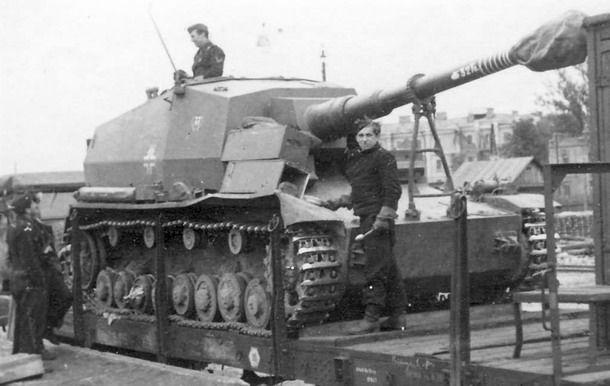
Late 1941: the sole surviving Dicker Max is withdrawn from the front for a general overhaul, at which point it carries seven kill rings on the barrel of its 105 mm gun. Source: worldwarphotos.info, with the permission of the site operator, edited.
The Dicker Max vehicles first entered combat on 23 June 1941, near the Belorussian town of Kobrin, engaging Russian anti-tank artillery positions and infantry. In July 1941, one of the two vehicles was lost in an accident. During a march toward the town of Slutsk, one of the propellant charges on board apparently ignited spontaneously – at least, that was the crew's account. Without warning, flames suddenly erupted from the area where the charge was stored. The crew did not hesitate and immediately abandoned the vehicle, including the driver. The unmanned machine rolled on for a few metres before exploding. The day in question was extremely hot, but heat alone would not have been sufficient to ignite a propellant charge. The most likely explanation is a combination of very high ambient temperature, heat from the engine and possibly a manufacturing defect in the particular charge. Whatever the cause, the subsequent explosion of the ammunition and fuel tore the vehicle virtually to pieces.
The destroyed vehicle remained at the roadside, and over the following weeks attracted the attention of many passing soldiers with cameras. The photographs allow us to piece together what happened to the wreck over time. After some period, the components salvageable for Panzer IV tanks – drive sprockets, idler wheels, road wheels and apparently one track – were removed. Later the wreck was pushed off the road to clear the route, apparently being rolled onto its roof in the process (causing the right-side track mudguard to be heavily buckled). After some further time it was evidently righted again and towed to the edge of a small wood. What became of it thereafter the photographs cannot tell. The complete "photo story" of this wreck can be seen HERE.
The second Dicker Max continued to serve with the 521st Tank Destroyer Battalion. On 20 August 1941, near the village of Oskolkovo (approximately 100 km west of Bryansk), the unit encountered a column of Russian tanks on the move. The Germans had to decide whether to let the column pass or open inevitably inaccurate fire from a range of approximately 4 kilometres. The commander's decision was clear: the Russian tanks must not be allowed through. The Dicker Max was called into action – the only vehicle present with any realistic chance of success at that range. A high-explosive round was loaded, the gunner set the sight for direct fire at the maximum elevation it permitted for that ammunition type (2,400 metres), then elevated the barrel somewhat further based on his own estimation and fired. He then adjusted his aim and continued to engage with both high-explosive and armour-piercing rounds. When the German fire ceased, three Russian tanks stood motionless on the road. A subsequent inspection of the wrecks showed that not one of them had been hit by an armour-piercing round. All three had been immobilised by near-miss detonations of high-explosive shells, which had damaged their running gear. The Russian tank crews abandoned their disabled machines and fled, setting fire to at least one of them before doing so.
On 29 August 1941, the Dicker Max crew managed to destroy a heavy KV-1 that they came upon unexpectedly in broken terrain at a range of only 100 metres. The tank was destroyed by a clean penetration of its side armour and subsequently burned out completely. That same afternoon, the same vehicle scored a hit on another KV-1 at a range of approximately one kilometre. The tank came to a halt but did not catch fire; a close inspection of the wreck was impossible since the Germans could not approach it for the remainder of the day, and during the night the Russians towed it away. The following day, 30 August 1941, the Dicker Max destroyed another KV-1, this time at a range of approximately 1,200 metres. Again the tank did not catch fire but simply stopped in place. The German crew made no attempt to deliver a finishing shot, as their armour-piercing ammunition was running critically low. History repeated itself – the immobilised tank remained in place until nightfall, when its owners returned under cover of darkness to tow it away for repair.
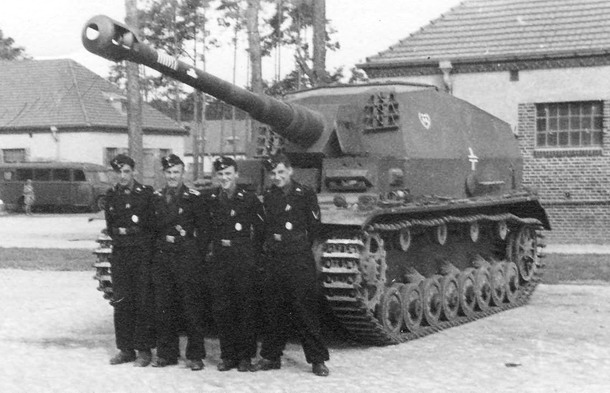
May 1942: the Dicker Max returns to the 521st Battalion after its general overhaul – spare track links have been added to the front wall of the fighting compartment. Source: worldwarphotos.info, with the permission of the site operator, edited.
Before the end of 1941, the Dicker Max was withdrawn from the front and sent to the Krupp-Grusonwerk factory for a general overhaul. At that time, a more extensive modernisation including a chassis replacement was considered, but was ultimately set aside and the vehicle received only thorough maintenance and minor modifications (such as the addition of spare track link brackets to the fighting compartment front wall). The combat experience gained was also evaluated. The 521st Tank Destroyer Battalion's report, however, was largely negative. The chief failing was, unsurprisingly, the weak engine and the low speed that went with it. Given the gun's limited traverse, the vehicle frequently had to be repositioned during the aiming process, and the engine's inadequate power made itself felt particularly keenly when the vehicle was not standing on firm ground. Another recurring nuisance was that any major service work on the engine first required the complete removal of the gun – an unnecessarily laborious and time-consuming procedure.
The 105 mm gun was the most powerful "anti-tank" weapon then available in a self-propelled mounting, yet it too was not without problems. The muzzle brake, while necessary, caused an enormous cloud of dust to be thrown up in front of the vehicle when the gun fired, making it impossible for the gunner to observe the trajectory of the round. In such cases, someone else had to position themselves further from the vehicle and act as an observer, reporting the point of impact back to the gunner. The Dicker Max could boast seven kill markings on its barrel by the end of 1941, but there was only one confirmed armour penetration of a heavy KV-1 – on 29 August 1941, at only 100 metres and from the side. For the two other KV-1s immobilised at longer range (29 and 30 August 1941), armour penetration could not be confirmed. The Max had clearly not distinguished itself as any kind of super-killer of heavy tanks, and in German high command's view this was the only possible justification for series production. It is therefore no surprise that series production was definitively ruled out.
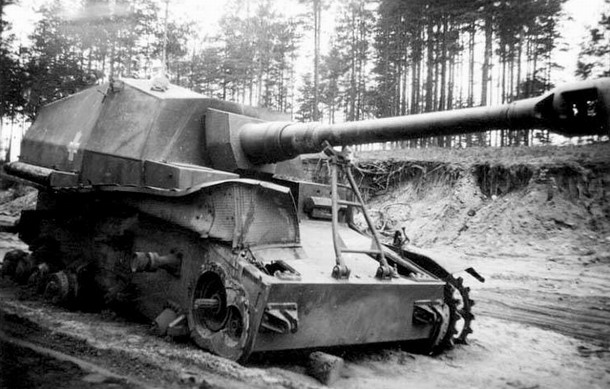
One of the two prototypes built ended its career barely a month after its first engagement, destroyed in an accident when the ammunition and fuel exploded. Source: worldwarphotos.info, with the permission of the site operator, edited.
The repaired Max was now the last of its kind. In May 1942 it rejoined its parent unit, which was at that moment garrisoned at Jüterbog. In June 1942 it was loaded onto a train along with the rest of the 521st Battalion's equipment and headed east again. The unit joined the summer offensive in southern Russia and advanced alongside the 6th Army toward Stalingrad. The 10.5 cm K (gp.Sfl.) appeared for the last time in the 521st Battalion's combat strength returns in October 1942. Neither the November nor the December reports mention the vehicle. The details of its fate are unknown. One can only speculate, primarily on the basis of what is visible in the last known photograph of the vehicle.
That photograph is said to date from January 1943 and was apparently taken by a Red Army photographer. It shows the vehicle standing in a snow-covered landscape, with what is probably a Soviet soldier examining it. The hull front armour bears what appear to be impact marks, but no penetrations are visible. No other major damage is apparent – the tracks are in place, there are no missing armour sections and no signs of fire. It is therefore theoretically possible that the last Dicker Max was left immobile due to a mechanical failure that the Germans were unable to recover it from in time. The vehicle has no winter camouflage and a pile of dry grass lies on the hull nose, which might suggest it was abandoned in autumn rather than winter – consistent with the fact that the 521st Battalion last reported it as operational in October 1942 and thereafter it vanished from the returns.
What the Russians did with the vehicle they found is not known at all. It is worth noting, however, that the Dicker Max is not part of the collection at the Russian museum at Kubinka, where virtually every other German rarity can be found – including the Sturer Emil and the Maus. Why did this captured and essentially undamaged Dicker Max never make it into the Kubinka collection? Was it scrapped? Did the Russians repair it, put it into service themselves and perhaps lose it in combat? The last known photograph cannot answer these questions. There is, however, one further detail worth highlighting. That final photograph of Fat Max shows that the seven kill markings it wore at the end of 1941 had grown to nineteen by the time it was lost somewhere between June and October 1942. The vehicle's total score of 19 confirmed kills is, by any measure, an impressive achievement.
Technical Data
|
weight: |
22 t |
|
length: |
7.47 m |
|
width: |
2.86 m |
|
height: |
2.53 m |
|
engine: |
Maybach HL 66 Pla |
|
engine output: |
180 hp |
|
max. speed: |
27 km/h |
|
range – road: |
170 km |
|
range – cross-country: |
120 km |
|
crew: |
5 men |
|
armament: |
1 × 10.5 cm K18 gun |
|
ammunition stowage: |
26 rounds |

ARTICLE
CONTENTS:
Reproducing text from the Panzernet website without the written consent of the operator is prohibited.