SPRENGLADUNGSTRÄGER B-IV
remote-controlled demolition vehicle
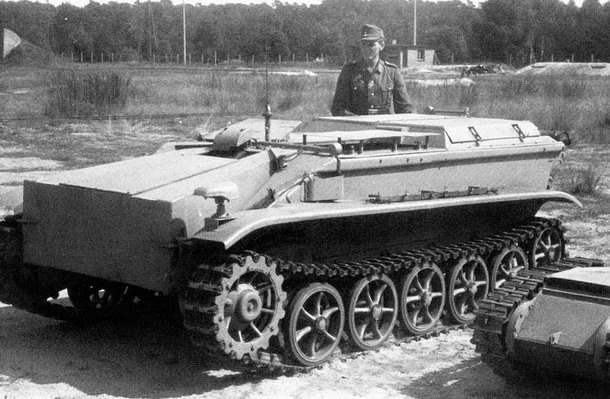
the Sprengladungsträger B IV remote-controlled demolition vehicle, probably Ausf. B; source: Flickr.com with permission of the publishing user, edited
Origins of the Vehicle
As early as the beginning of the Common Era, Roman armies made systematic use of pressure-triggered traps to slow or halt the advance of enemy infantry. These were of course nothing more than passive, non-explosive devices — metal caltrops with sharp spikes — but their effectiveness in strengthening defensive positions was undeniable. Many centuries passed, various types of explosives were invented, and those once-primitive pressure traps evolved into land mines — first anti-personnel, later anti-tank as well. Their use in the First World War was not particularly intensive, since tanks were in their infancy and the combination of barbed wire entanglements and machine gun nests was more than sufficient to stop infantry attacks. The Second World War, however, gave land mines enormous scope. Tens of millions of land mines of all types were laid during the Second World War, particularly in Africa and Russia but also along the coastal areas of western Europe.
Clearing minefields has traditionally been the domain of combat engineers, and the Second World War was no different. It is in itself an extremely dangerous activity, which moreover frequently had to be carried out under enemy fire. It is therefore no surprise that engineers — not only German ones — looked for technical means to make their task as straightforward as possible. To this end, the firm Borgward developed two variants of a remote-controlled minefield-clearing vehicle in 1940, designated the Minenräumwagen B I and Minenräumwagen B II. These were vehicles intended essentially for single use, since they were destroyed along with the mines (or other targets) when the charge was detonated. They were in essence little more than tracked bombs, and great emphasis was therefore placed on keeping their production cost as low as possible. The old saying that you get what you pay for proved apt, however. Experience with the testing and deployment of the "B Is" and "B IIs" was largely negative — the vehicles were slow, unable to handle broken terrain, and occasionally detonated spontaneously on impact with an obstacle. Their wireless control system was also reportedly prone to frequent failures.
The army therefore decided that future development of this type of equipment should place greater emphasis on quality. The next-generation minefield clearer was to be more robust and reliable. And in order to justify the higher production cost, it had to be reusable rather than expendable. Development of such an engineer vehicle was entrusted in October 1941, once again, to the firm Borgward of Bremen. The designers decided to base the new vehicle's chassis on a number of already existing components from the ammunition carrier VK 3.02, whose production at Borgward had itself just begun in October 1941. The road wheels with their torsion-bar suspension system were taken over from the VK 3.02. These were spoked wheels with solid rubber tyres around the rim. While the ammunition carrier VK 3.02 had only four road wheels on each side, the new engineer vehicle had five per side. The rear idler and front drive sprocket were also taken from the VK 3.02. Both the road wheels and the idler were of the double type — formed from a pair of "discs" — so that the track guide teeth could pass through the gap between them. The tracks were 200 mm wide and fitted with rubber pads for smoother travel on hard surfaces.
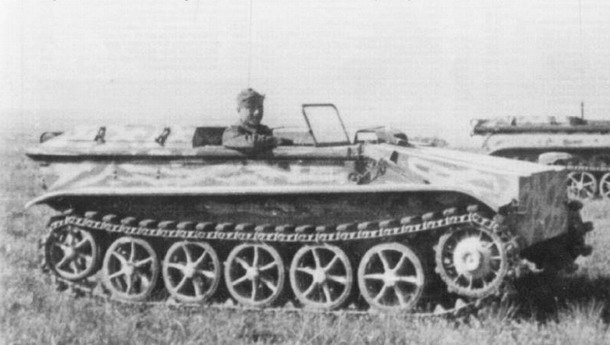
the driver of the Sprengladungsträger B IV Ausf. A originally had only a folding frame with a Plexiglas screen in front of him; source: Flickr.com with permission of the publishing user, edited
Ausführung A
The tracked chassis carried a low hull welded from steel plate. The frontal walls used armoured (hardened) plate 10 mm thick, while the sides and rear consisted of plain unarmoured steel only 5 mm thick. The hull nose was sharply angled, forming a kind of ramp — this was where the enormous box filled with explosive was attached to the vehicle, as we shall describe shortly. Roughly amidships, on the right side of the hull, was the driver's station. This was used during longer transfers away from the combat zone, when remote control of the vehicle made little sense. The driver had a reasonably comfortable padded seat with a backrest, an instrument panel in front of him, a throttle and brake pedal, a hand brake, two gear levers, and handlebars for steering. The seat was positioned so that the driver's head protruded above the hull. The earliest vehicles gave the driver no head protection at all — in front of him was merely a folding frame with a Plexiglas screen, which of course offered no protection against fire. It served only as a windscreen, providing protection from dust, wind, and flying grit during travel.
The rear of the hull housed the six-cylinder Borgward 6M 2.3 RTBV engine, producing a maximum output of 49 horsepower. The engine was positioned along the left side of the hull, with the radiator and a large fan directly behind it. In the right rear corner of the hull was the main fuel tank, holding 95 litres of petrol. A second tank with a capacity of 28 litres was located much further forward, to the left of the gearbox. The vehicle could therefore carry a total of 123 litres of fuel, sufficient for approximately 200 km on road and around 125 km cross-country. Also in the rear section of the hull, to the right of the engine, were the main battery, the wireless receiver (which received instructions from the remote controller), an assembly of electromagnetic relays that switched contacts in response to the received commands, and a hydraulic unit that converted the received electrical impulses into mechanical force to operate the throttle, brakes, and gearbox. Above the wireless receiver, a short base for mounting the whip radio antenna protruded from the hull roof.
The gearbox was positioned in front of the engine, along the left side of the hull (to the left of the driver's station). Strictly speaking, it was actually two simple gearboxes. The first provided one forward gear and one reverse. The second was in effect a reduction unit with two speed ranges — a higher ratio for road travel and a lower ratio for cross-country use. Two forward speeds and two reverse speeds were thus available, each gearbox having its own gear lever.

this Sprengladungsträger B IV Ausf. A, captured by Allied soldiers, already has the later typical folding armour plates protecting the driver's head; source: Flickr.com, public domain, edited
The remote control system of the engineer vehicle consisted of three main components: a power supply, the wireless transmitter Fu KS 8, and the controller itself — designated KoG 2 (KoG = Kommandogeber) — with a set of control buttons and a joystick. The remote controller could send the following commands to the vehicle: stop, slow forward, fast forward, slow reverse, fast reverse, turn right, turn left, drop charge, detonate charge, fire smoke grenade. The full assembly also naturally included a whip radio antenna. It is clear, therefore, that this was not a pocket-sized device but a set of equipment that had to be carried aboard some form of controller vehicle. For this purpose, modified Panzer III tanks and StuG III assault guns were most commonly used. These controller vehicles (both tanks and assault guns) retained their main armament, meaning they could simultaneously provide fire support for the remotely controlled vehicles. The maximum range of the remote controller was approximately 2,000 metres. The vehicle was set up so that if it lost contact with the controller, it would stop and remain stationary.
The new engineer vehicle was designated Sprengladungsträger B IV — literally "explosive charge carrier". Its ordnance code was Sd.Kfz. 301. The designation was later changed to schwere Ladungsträger, meaning "heavy charge carrier". The vehicle weighed 3.6 tonnes, was 365 cm long, 180 cm wide, and only 118.5 cm tall. Maximum speed in forward travel was approximately 38 km/h; in reverse it could reach up to 35 km/h.
Combat Tactics
The Sprengladungsträger B IV could be used against minefields, bunkers, and other static targets — and theoretically even against stationary armoured vehicles. Its deployment followed roughly this procedure. The driver would bring the vehicle up to the edge of the safe distance from the target by sitting in the cab and driving it physically. He would then dismount, fit the whip antenna, arm the charge, and switch the vehicle to remote control. From that point the vehicle continued without a crew, guided wirelessly by an operator from the safety of the controller vehicle. Once the Sprengladungsträger reached the designated target, the locking mechanism of the explosive box was released via the appropriate button on the controller, and the box immediately slid to the ground in front of the vehicle. The release of the box lock probably also activated the detonator — with a time delay. The vehicle then had to reverse as quickly as possible and withdraw to a safe distance before the explosion. It would then return to the safe zone to collect a new explosive box and set off on another run. The blast from the explosive detonated mines within a radius of approximately 40 metres, thereby clearing a passage through the minefield.
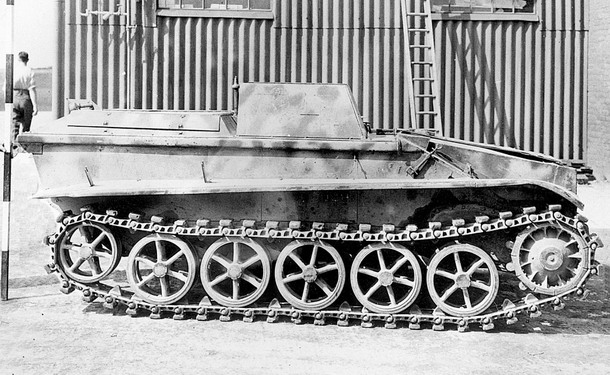
a Sprengladungsträger B IV captured by Allied soldiers; source: Flickr.com, public domain, edited
If the vehicle was damaged by enemy fire (or a mechanical failure) during its approach and could not continue its mission, the operator pressed the detonation button and simply blew up the entire vehicle. If the Sprengladungsträger struck one of the mines itself while crossing a minefield, this would naturally cause serious damage to the vehicle — but it did not necessarily trigger the detonation of the carried charge. The designers did want it to do so in such cases, however, and therefore fitted a pressure switch in the hull floor that would close when a mine detonated beneath the tracks, triggering the detonation of the carried charge as well. If the operator saw that the engineer vehicle was coming under too heavy enemy fire and risked destruction, he could remotely ignite a smoke grenade mounted at the rear of the vehicle, obscuring the enemy's line of sight and preventing accurate aimed fire.
The detachable box contained, according to some authors, 450 kg — and according to others, as much as 500 kg — of the explosive ecrasite. The explosive was loaded into the box in several moulded pieces, shaped to fill it completely. Ecrasite was by no means a cutting-edge or widespread explosive at the time, but its properties made it well suited to precisely this type of application. Its most important quality was inertness. Ecrasite is unaffected by moisture, which significantly simplified its storage and transport under field conditions without the need to carefully protect it from rain. A charge of ecrasite will not detonate when struck by a rifle or machine gun bullet, meaning the hanging box itself did not need to be bulletproof. If the vehicle came under machine gun fire during its approach and several rounds penetrated the charge, nothing would happen. Ecrasite is unaffected by shock, friction, and even fire — placed in flames, it simply burns away slowly. The only means of detonating it is via a detonator, which was therefore not inserted into the charge until just before the vehicle was despatched toward the target — that is, after the driver had already left the cab. The disadvantage of ecrasite was that it became unstable in contact with certain metals or alloys (such as copper or brass), but in the context of this demolition vehicle that was not an issue.
The first 12 pre-production Sprengladungsträger B IVs were built in April 1942, followed immediately in May by the start of series production, which continued until June 1943. During that period, 616 vehicles were produced (plus those 12 pre-production examples). To distinguish it from the two subsequent generations, the designation of this first production version was supplemented with the letter "a", giving the full designation Sprengladungsträger B IV a (or, as it is also sometimes written, Sprengladungsträger B IV Ausf. A).
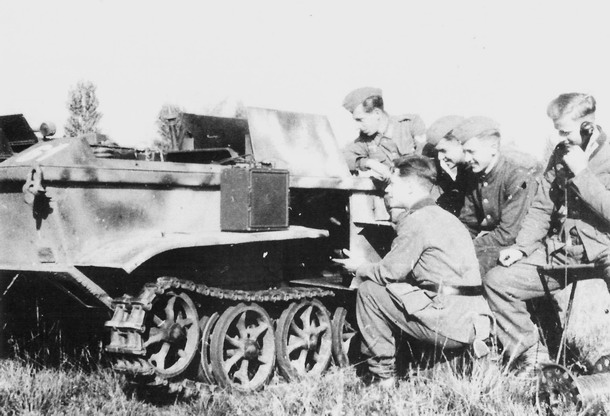
wireless remote control of the Sprengladungsträger B IV required very frequent tuning and corrections, as seen in this photograph; source: Flickr.com with permission of the publishing user, edited
In February 1943, all Sprengladungsträger B IVs were withdrawn from the front to Germany for a general overhaul and modernisation. During the technical inspection, the most worn-out vehicles were removed from the combat units and handed over to training formations, where they were to finish their service lives in the instruction of new drivers. Less worn vehicles still capable of further front-line service underwent modernisation: additional 8 mm armour plates were welded onto the original 5 mm sides and rear of the hull. A folding armoured cover protecting the driver's exposed head was also fitted, consisting of a frontal plate and two side plates, all 8 mm thick with observation slits. When the driver dismounted and switched the vehicle to remote control, he simply folded these plates down so they did not unnecessarily increase the vehicle's silhouette. Some vehicles reportedly also received new dry-pin tracks without rubber pads as part of the modernisation. These new tracks were accompanied by a redesigned front drive sprocket. The modifications described were applied not only retrospectively to older vehicles but were simultaneously introduced into the production of new ones. They resulted in the vehicle's weight increasing from 3.6 to approximately 4 tonnes.
Ausführung B
In July 1943, the second generation of the Sprengladungsträger B IV entered production, designated simply with the letter "b" or sometimes Ausf. B. The modifications that had been introduced retrospectively or during production on the first generation became standard from the outset on the second. This meant the 8 mm additional armour on the 5 mm sides and rear of the hull, the folding driver's head cover, and the dry-pin tracks without rubber pads.
The Sprengladungsträger B IV Ausf. B also brought other innovations. An emergency escape hatch was cut into the right side of the hull just above the track, through which the driver could squeeze out if exiting over the top was too risky. At some point during production, the Sprengladungsträger B IV b also received an improved remote control system, which was accompanied by a repositioning of the radio antenna further forward, ahead of the driver's cab. In all other basic specifications — dimensions, speed, fuel capacity, and so on — the second version was identical to the first. Its weight matched the modernised first-generation vehicles at approximately 4 tonnes.
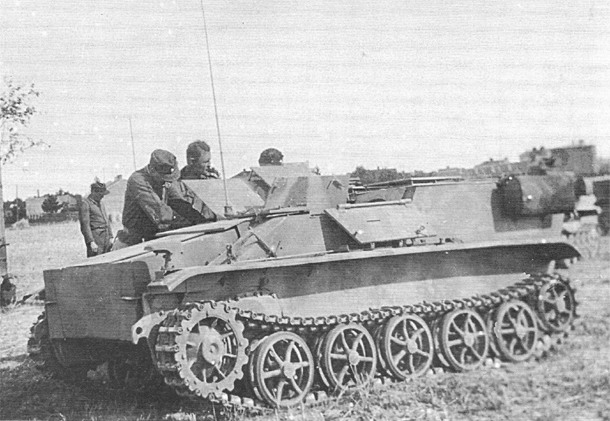
in the Sprengladungsträger B IV Ausf. C, the driver's station was moved from the right to the left side; source: Flickr.com with permission of the publishing user, edited
Production of the demolition vehicle B IV b lasted only five months, from July to November 1943, with a total of 260 vehicles built. Combined production of Ausf. A and Ausf. B thus reached 876 series vehicles plus 12 pre-production examples, though some sources give the combined series total as only 868 vehicles.
Ausführung C
In December 1943, the third production variant of the Sprengladungsträger B IV appeared, designated "c" or Ausf. C. The designers focused primarily on improving the vehicle's overall survivability, as frequent complaints had been reaching them from combat units about how easily it was put out of action by enemy fire. The hull armour on the Ausf. C was therefore strengthened to 20 mm on the front, sides, and rear alike. The hull roof plates were 5 mm thick, the bottom of the hull tub was 6 mm, and the driver's folding armoured shield consisted of 15 mm plates. The vehicle also grew somewhat in overall size — particularly in length, which increased from 365 to 410 cm. The running gear and tracks had to be lengthened accordingly. The number of road wheels remained the same as on the two earlier versions, but the gaps between individual wheels were increased.
The substantially heavier armour and increase in overall size naturally affected the vehicle's weight, which rose to 4.58, 4.8, or even 5 tonnes depending on which source you choose to believe (it is also quite possible that some authors give the weight without and others with the charge, which accounts for a half-tonne difference). To ensure the vehicle retained its mobility despite the weight gain, a more powerful engine had to be fitted. The original six-cylinder Borgward 6M 2.3 RTBV producing 49 horsepower was replaced by the Borgward 6B 3.8 TV, which produced 78 horsepower at 3,000 rpm. The more powerful engine naturally consumed more fuel, so the total fuel tank capacity was increased from the original 123 litres to 135 litres.
Another significant change was the relocation of the driver's cab from the right to the left side of the hull, which of course required a mirror-image repositioning of many other components (including the gearbox). The engine exhaust was no longer routed through the rear wall but through the left side, where the silencer was also mounted. The rear section of the hull was in fact redesigned throughout, including the roof ventilation apertures. According to some sources, the army ordered 400 Sprengladungsträger B IV Ausf. C from Borgward; other sources say more than 1,000. As for the actual number built, the spread between authors is somewhat narrower: T. L. Jentz gives 322 vehicles, while M. Jaugitz gives only 305. According to the former, production ended in November 1944; according to the latter, already in October of that year.
Photographs show a total of four different variants of drive sprocket. The first belonged to the original lubricated tracks with rubber pads; the remaining three were used on vehicles fitted with dry-pin tracks without rubber pads. A comparative photograph can be viewed HERE. On some Ausf. C vehicles, photographs show what appear to be two "antennas" with a small light fitted at the end. These lights faced rearward and were probably intended to help the operator keep track of the vehicle's position and direction of travel in poor visibility conditions (at dusk, in fog, etc.).
The attentive reader may have wondered during the course of this article why the vehicle described above carries the designation B IV. The previous Borgward engineer vehicles were designated B I and B II... so what happened to number three? The literature is largely silent on this. Only M. Jaugitz mentions that German archives contain a reference from July 1941 to the rail transport of a prototype designated Borgward B III from Bremen to the Eastern Front and subsequently back to Wünsdorf. No further information is available.
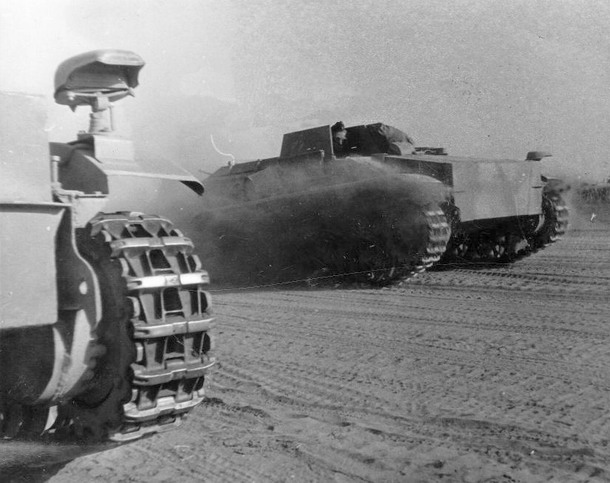
Sprengladungsträger B IV; source: Flickr.com with permission of the publishing user, edited
Organisation and Deployment
When series production of the Sprengladungsträger B IV began in May 1942, the German Army had just one combat unit equipped with remote-controlled vehicles: Panzer Abteilung 300 (FL). The letters FL in its name stood for Funklenk — radio-controlled. This battalion had previously used the older Borgward B I and Borgward B II engineer vehicles, but from May 1942 began to be re-equipped with the new B IVs. The controller vehicles were also changed at the same time: instead of the previously used Kleiner Panzerbefehlswagen Ausf. B, the battalion began receiving modified Panzer III tanks designated Leitpanzer III (leiten = to guide or lead). The battalion's 1st and 2nd Companies received their first brand-new "B IVs" as early as May, and in June 1942 set off for the Eastern Front to assist in reducing the fortifications around Sevastopol. In July and August the battalion was engaged in the fighting around Donetsk and Rostov.
In the summer of 1942, the so-called Versuchs-Kommando (FL) Tropen was established to test the engineer vehicles under African battlefield conditions. This special unit was apparently deployed in north-eastern Libya. In September 1942, a new training and reserve battalion — Panzer-Ersatz-Abteilung (Fkl) 300 (later redesignated Panzer-Versuchs und Ersatz-Abteilung (Fkl) 300) — was formed at Neuruppin. This formation served both for testing new equipment and, above all, for training personnel who would then be used to replenish the strength of the combat units. At the same time, the combat Panzer Abteilung 300 (FL) was renamed Panzer Abteilung (Fkl) 301 and expanded from the original three to four companies. So reorganised, the battalion moved to the northern sector of the Eastern Front and engaged in the fighting in the Leningrad area, where it remained until December 1942, when it was withdrawn to Germany to replenish its strength.
At the turn of 1942 and 1943, the Germans had enough Sprengladungsträger B IV vehicles available to begin building additional combat units. In January 1943, four independent remote-controlled "tank" companies were therefore formed: Panzer-Kompanie (Fkl) 311, 312, 313, and 314. Each company had its headquarters section and two combat platoons. The headquarters section had two StuG III assault guns or two Panzer III tanks. Each combat platoon had four StuG IIIs or Panzer IIIs in total: one for the platoon commander and three serving as controller vehicles (Leitpanzer). Each controller vehicle was assigned four remote-controlled Sprengladungsträgers, meaning a platoon had 4 StuGs or Panzer IIIs and 12 engineer vehicles; in two platoons that was 24 engineer vehicles. The company additionally had 12 more Sprengladungsträgers in reserve, bringing the total to 10 tanks/assault guns and 36 remote-controlled charge carriers per company. The company also had a considerable amount of other equipment, including 6 half-track Sd.Kfz. 11 vehicles, each carrying four spare ecrasite charges.
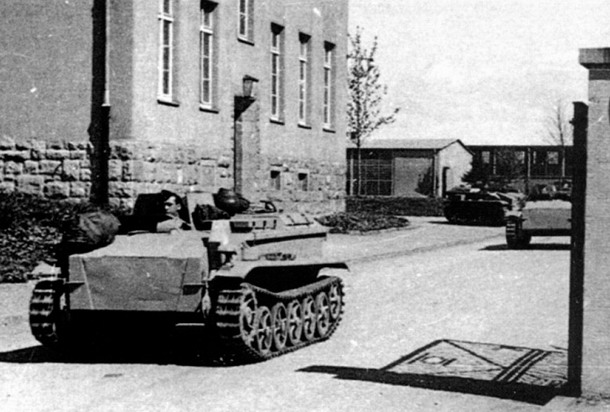
two Sprengladungsträger B IVs and a controller StuG III leave the barracks gate; source: Flickr.com with permission of the publishing user, edited
During May and June 1943, Panzer-Kompanie (Fkl) 312, 313, and 314 were despatched to the Orel area with Army Group Centre. The knowledgeable reader will recognise from the place and time that this was preparation for Operation Zitadelle. The 312th Company was assigned to the 505th Heavy Tank Battalion, equipped with the legendary Tigers. The other two companies cleared paths through minefields for the Ferdinands of the 656th Heavy Tank Destroyer Regiment. The last independent company, Panzer-Kompanie (Fkl) 311, did not take part in Operation Zitadelle in time. Shortly after it ended, however, it was sent to southern Russia to participate in the defensive battles alongside the Grossdeutschland tank regiment.
According to surviving records, the "B IVs" at Kursk proved useful in clearing minefields, destroying anti-tank guns and concrete bunkers, and in at least one case succeeded in destroying a Russian T-34 tank. Overall experience with the deployment of schwere Ladungsträgers in the operation was positive. It is true that many vehicles were put out of action by the enemy before reaching the charge-drop point, but when they did succeed, the explosion of half a tonne of explosive had a truly devastating effect on the target. Complaints also came in about the limited range of the wireless remote controller — instead of the theoretical 2,000 metres, in practice it was often only 1,000 or even just 800 metres. The combat units also raised one proposal regarding the controller vehicles. The StuG III assault guns were reportedly too low to the ground, leaving the operator with insufficient visibility to guide the demolition vehicle to its target accurately. The Panzer IIIs, on the other hand, were reportedly not sufficiently armoured to safely remain near the target area. The combat units therefore suggested that the ideal controller vehicle would be the heavy Tiger tank, which thanks to its height provided a broader field of view and was also very resistant to enemy fire. One might think it a reckless idea to waste the most powerful combat tanks in the role of bomb-guider — and yet, remarkably, that is exactly what eventually happened, as we shall see shortly.
At the end of July 1943, a further independent remote-controlled demolition vehicle company was formally established — Panzer-Kompanie (Fkl) 315. In reality this was not a newly built unit but rather an organisational detachment of the 1st Company of Panzer Abteilung (Fkl) 301 (one company was made independent, leaving the battalion with only three companies). In August, the sixth independent company, Panzer-Kompanie (Fkl) 316, was established. The German Army now had one Funklenk battalion (of three companies), six independent Funklenk companies, and one training and reserve Funklenk battalion. By the end of 1943, most of these formations had been withdrawn from the front to Germany for rest, replenishment, and further reorganisation.
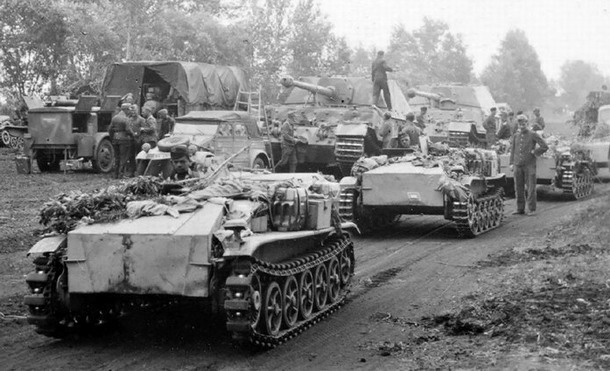
in the opening phases of Operation Zitadelle, Sprengladungsträger B IVs cleared passages through minefields for the Ferdinand heavy tank destroyers; source: Flickr.com with permission of the publishing user, edited
During January and February 1944, independent company Panzer-Kompanie (Fkl) 313 was reorganised as the 3rd Company of the 508th Heavy Tank Battalion (schwere Panzerabteilung 508, or sPzAbt 508), the company's new designation becoming 3.(Fkl)/sPzAbt 508. Similarly, the original independent company Panzer-Kompanie (Fkl) 314 was incorporated as the 3rd Company of the 504th Heavy Tank Battalion, becoming 3.(Fkl)/sPzAbt 504. Both companies handed over their former StuG III and Panzer III controller vehicles and received Tiger tanks as their new controller vehicles. The literature notes that the commanders of the affected heavy tank battalions (sPzAbt 504 and sPzAbt 508) were not exactly thrilled at having their precious heavy tanks relegated to this role — but what could they do. Totalling all Funklenk units in the German Army by the end of February 1944, there was: one three-company battalion (Panzer Abteilung (Fkl) 301), four independent companies (Panzer-Kompanie (Fkl) 311, 312, 315, and 316), two companies attached to the 504th and 508th heavy tank battalions, and one training and reserve battalion — Panzer-Versuchs-und Ersatz-Abteilung (Fkl) 300.
During the first half of 1944, some of the remote-controlled demolition vehicle units were engaged in Italy, some on the Eastern Front in the Lvov area, and some were kept in France. In May 1944, yet another independent company — number 317, Panzer-Kompanie (Fkl) 317 — was established. Its independent existence was short-lived, however, as in June 1944 it was decided that the existing independent companies 311, 315, 316, and 317 would be formed into a new battalion designated Panzer Abteilung (Fkl) 302. The last remaining independent company, number 312, had already been absorbed into Panzer Abteilung (Fkl) 301 in April of that year, meaning the German Army now had no independent remote-controlled vehicle companies remaining at all.
The newly formed battalion number 302 was sent to Poland in August 1944 to help suppress the Warsaw Uprising, where it saw very intensive action and suffered heavy losses. In September 1944, another independent Funklenk company was formed — Panzer-Kompanie (Fkl) 319 (the literature makes no remark about skipping number 318). By the end of 1944, battalion 301 was fighting on the Western Front and battalion 302 on the Eastern Front. In January 1945, one company was detached from each of the 301st and 302nd Battalions; together with the independent company 319, these formed a third Funklenk battalion designated Panzer Abteilung (Fkl) 303. By that time, however, so little remote-controlled equipment was available that the battalion was reorganised as early as February 1945 into a conventional tank battalion designated Panzer Abteilung Schlesien. Armed with Panzer IV tanks, it was then deployed against the Red Army.
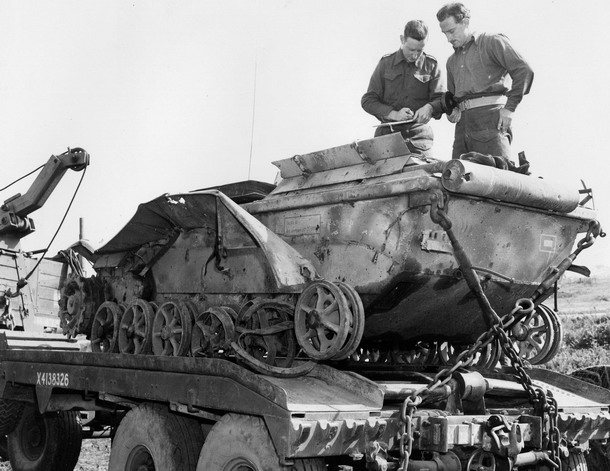
British soldiers load the wreck of a Sprengladungsträger B IV; source: Flickr.com, public domain, edited
Television Camera
As early as the beginning of 1943, the idea arose of fitting the remote-controlled Borgward B IV with a television camera. The image would be transmitted to a television screen in the controller vehicle, greatly assisting the operator when guiding the vehicle by remote control. During 1943, at least one evaluation prototype was built, fitted with a camera designated "Tonne P". The controller vehicle received a receiver with a small screen designated "Seedorf P" — both devices were the work of the Berlin firm Fernseh AG.
The camera was enclosed in a protective metal housing and mounted on the roof of the Sprengladungsträger's cab, beside the driver's station. Additional equipment was housed in a box above the engine bay. The antenna for transmitting the TV signal was mounted at the rear on the left side of the hull. The prototype was subsequently subjected to thorough testing at Panzer-Versuchs-und Ersatz-Abteilung (Fkl) 300, where it did not succeed. It emerged that the sensitive television technology could not withstand the vibrations generated while the vehicle was moving, resulting in very frequent failures.
Amphibious Version
Like the earlier Minenräumwagen B II, the Sprengladungsträger B IV was also the subject of an attempt to create an amphibious version. Details of this vehicle have unfortunately not survived, and only a handful of photographs are available. Testing of the amphibious "B IV" apparently took place in 1943, on the Baltic coast. The vehicle was fitted with floats along its sides to keep it buoyant. Each float incorporated a propeller, which was apparently driven by the rear wheels of the track assembly. This meant that during water travel, the tracks continued to run normally, and direction of travel was controlled in the same way as on land — by braking one track or the other. During longer overland transfers, the floats could be raised or removed entirely.
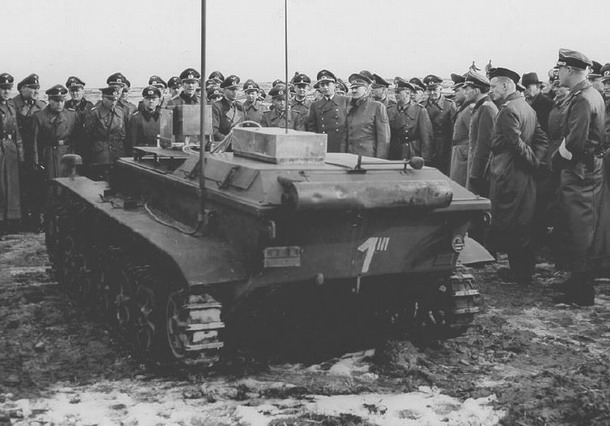
the Sprengladungsträger B IV prototype fitted with the television camera is demonstrated to the Führer and other senior officers; source: Flickr.com with permission of the publishing user, edited
The vehicle was of course not intended for use against targets on the water surface. Its role was exactly the same as the standard land-based B IV, with the added advantage that it could deal with minefields and bunkers on shorelines — something that was otherwise extremely difficult. Crossing a river or lake under enemy fire is risky enough in itself, without then having to land on a mine-strewn shore. The amphibious engineer vehicle promised the possibility of sending it ahead of a water obstacle to destroy not only mines buried in the sand on the bank but also, for example, machine gun nests positioned there. After driving up onto the bank, there was no need to jettison the floats (and it was apparently impossible to do so remotely in any case), since they were mounted along the sides and did not obstruct the laying of the explosive charge. The amphibious Sprengladungsträger was simply to drive up out of the water, drop its charge, reverse back into the water, and float to safety. The tests apparently did not produce impressive results, however, as series production of this special variant was never started.
Anti-Tank Version
At the very end of the war, 56 Sprengladungsträger B IV vehicles received a very interesting modification. Plans for their conversion were apparently conceived in January 1945. The training and reserve battalion Panzer-Versuchs-und Ersatz-Abteilung (Fkl) 300 had already begun seeking volunteers among trained drivers for the formation of a special unit. The selected volunteers subsequently travelled to Grafenwöhr, where they underwent a short course in firing the anti-tank rocket launcher Raketenpanzerbüchse 54. They then moved to the 5th Reserve Tank Battalion at Neuruppin. In February 1945, the Waffenamt ordered 56 stored Sprengladungsträger B IVs to be collected from the ordnance depot at Magdeburg and sent likewise to Neuruppin and the 5th Reserve Tank Battalion.
In the workshops there, the components necessary for remote control were removed from the engineer vehicles. The front box was retained but left empty — with no explosive. The roof plate beside the driver's station was cut away, widening the "cab". A simple seat for a second crew member was constructed from wooden planks next to the driver, above the gearbox. An armoured shield was erected around the cab, protecting the occupants on all sides except the top. On the left side of the hull (on the right side on Ausf. C vehicles) a mounting was installed carrying six coupled Raketenpanzerbüchse 54 rocket launchers, also known as the Panzerschreck. The mounting allowed a limited degree of movement for aiming. An armoured shield for the gunner's protection was also part of the mounting. The crew of this improvised tank destroyer therefore consisted of two men — driver and gunner. The gunner aimed the launchers manually by traversing the entire assembly, and fired the individual tubes using buttons on a small control panel in front of him. In addition to the six rounds loaded directly in the tubes, a further 18 rockets could be stowed on board. To reload, the gunner had to lean quite far out of the cab — possibly he even had to dismount. Three smoke grenade launchers were fitted to the front face of the former charge box, presumably to allow the vehicle to disappear behind a smoke screen after firing.
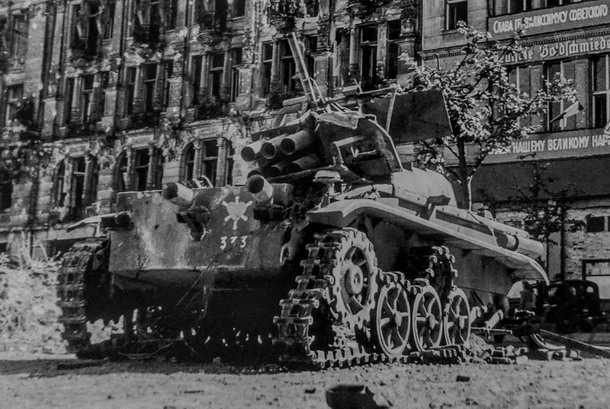
an improvised tank destroyer based on the Sprengladungsträger B IV; this wreck remained in East Berlin — rubble and wrecked vehicles have not yet been cleared from the street, but the celebratory Soviet inscriptions are already hanging on the buildings; source: Flickr.com with permission of the publishing user, edited
The 56 Panzerjäger B IVs built — as they were apparently called — formed the battalion Panzer-Vernichter-Abteilung 1 (Vernichter = destroyer), which subsequently took part in the fighting in Berlin itself. Wrecks of these vehicles were found in front of the Reich Chancellery, at the Brandenburg Gate, and elsewhere in the city centre. It hardly needs to be emphasised that this vehicle was nothing more than an expression of German desperation in the final months and weeks of the war, with virtually no real combat value. Due to the limited range of the Panzerschreck, the vehicle had to approach the target to within approximately 150 metres. In a lightly armoured and fairly slow machine, facing overwhelming enemy superiority, this was in practice tantamount to suicide. According to some authors, this improvised fighting vehicle earned the nickname Wanze among the troops — meaning "bedbug".

ARTICLE
CONTENTS:
Reproducing text from the Panzernet website without the written consent of the operator is prohibited.