NAMES AND ABBREVIATIONS
nomenclature of German armoured vehicles
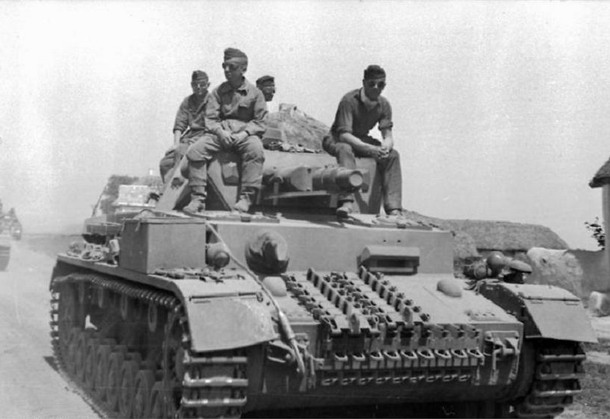
Panzerkampfwagen IV Ausführung F1, also known as PzKpfw IV Ausf. F1 or Sd.Kfz. 161, source: Bundesarchiv_Bild_101I-216-0445-18, Wikimedia, Creative commons, edited
German tanks used during the Second World War bore the official name Panzerkampfwagen — literally "armoured fighting vehicle." The official abbreviation was PzKpfw. An earlier abbreviation, PzKw, had been in use but was changed to avoid confusion with the very similar PKw, which was used for army staff cars.
Individual tank types were distinguished by Roman numerals following the abbreviation — for example PzKpfw IV. The Germans followed a straightforward numerical sequence, numbering their tanks upward from one. Production tanks reached the numeral VI. Beyond the series-produced vehicles, however, a considerable number of prototypes and design studies also existed, for which the PzKpfw abbreviation is sometimes used as well — in such cases, Roman numerals higher than VI may occasionally be encountered.
Most tank types — particularly those produced over the longest periods — existed in many different variants. The combat value of tanks of the same type but different variants could often differ quite substantially, which made it necessary to distinguish between individual versions. This was done using letters following the abbreviation Ausf. (Ausf. = Ausführung = variant or mark). A full tank designation might therefore look like this: PzKpfw III Ausf. D.
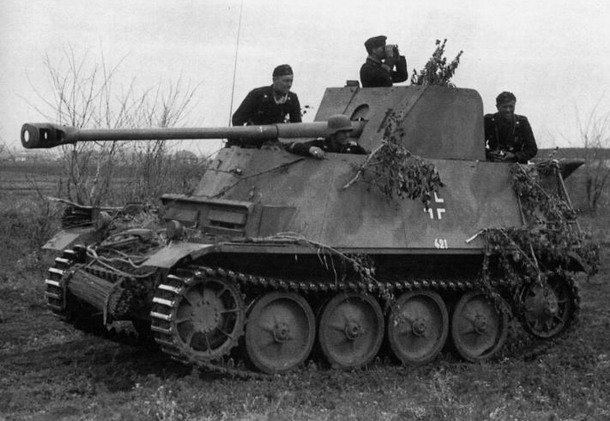
the Marder II tank destroyer, with its remarkably unwieldy official name: Panzer Selbstfahrlafette I für 7,62cm PaK 36(r) auf Fahrgestell Panzerkampfwagen II Ausf. D1 und D2, also known as Sd.Kfz. 131, source: Flickr.com, courtesy of the publishing user, edited
The letters indicating the variant were not always assigned in alphabetical order, nor were all letters of the alphabet used. In the case of the Tiger, for example, the letters following Ausf. originally stood for the names of the manufacturers — Ausf. H for Henschel and Ausf. P for Porsche.
The last three German tank types produced during the Second World War also carried their own names. These were the Panther, the Tiger, and the Tiger II — also known as the Königstiger (King Tiger). A full designation in this case might read, for example: PzKpfw V Panther Ausf. G. Proper names were also given to a number of planned and experimental tanks that, for various reasons, never reached series production — among them the Maus, the Leopard, and the Löwe.
Different conventions applied to the naming of another category of vehicle — self-propelled anti-tank guns. In German these were referred to generally as either Jagdpanzer or Panzerjäger, both terms meaning roughly "tank hunter." In English they are commonly called tank destroyers. Tank destroyers were built on the chassis of standard German tanks as well as on captured ones.
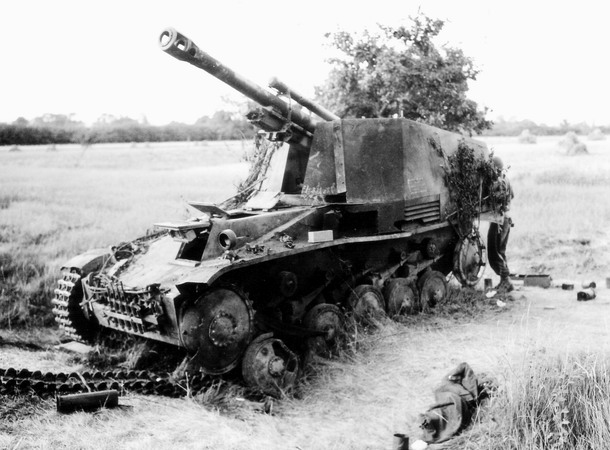
the Wespe self-propelled gun, officially the 10,5 cm leichte Feldhaubitze 18/2 auf Fahrgestell Panzerkampfwagen II, source: Wikimedia, Public domain, edited
The official names of vehicles in this category were considerably more cumbersome than those of tanks, as they included a full description of the vehicle — both the chassis used and the weapon mounted on it. This gave rise to unwieldy designations such as Jagdpanzer 38 (t) für 7,5cm PaK 39 L/48, 7,5cm PaK 40/1 auf Panzerjäger Lr.S, or Panzer Selbstfahrlafette für 7,62cm PaK 36 (r) Fahrgestellt II Ausf. 02.
Such names were obviously too cumbersome for everyday use. For the sake of brevity, many vehicles were therefore also given official shortened names referring only to the tank type on which the destroyer was based. This applied to vehicles such as the Panzerjäger I, Jagdpanzer IV, Jagdpanther, and Jagdtiger. Many other vehicles of this type received their own combat names — names that said nothing about the vehicle's construction or armament, but were far more practical and popular with the crews. This gave rise to names such as Marder (marten), Hetzer (baiter), Ferdinand, Nashorn (rhinoceros), and others.
It is also worth noting that alongside the official combat names assigned by manufacturers or at Hitler's personal request, crews frequently gave their own vehicles nicknames that sometimes entered wider usage. The aforementioned Nashorn tank destroyer, for instance, was nicknamed Hornisse (hornet) by its crews.
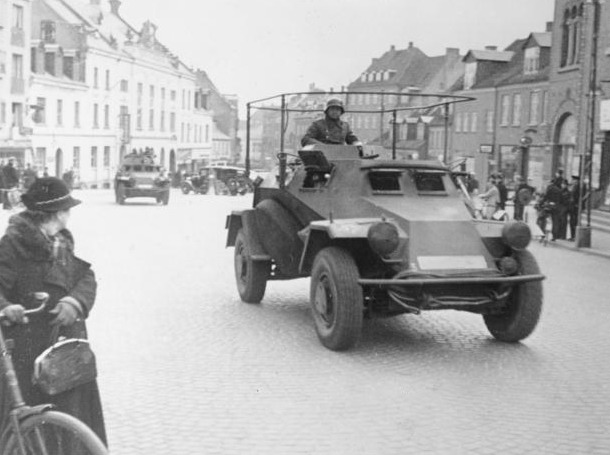
light armoured radio car Leichter Panzerspähwagen (Fu), also known as Sd.Kfz. 223, source: Bundesarchiv_Bild_101I-753-0010-19A, Wikimedia, Creative commons, edited
Similar conventions applied to the naming of self-propelled guns. Official designations were long and detailed, specifying both the chassis and the weapon, so shortened names or combat names were again the ones commonly used. The vehicle with the official designation 10,5 cm leichte Feldhaubitze 18/2 auf Fahrgestell Panzerkampfwagen II became widely known as the Wespe (wasp), while the 15cm schwere Infanteriegeschütz 33 auf Panzerkampfwagen I Ausf. B was better known as the Sturmpanzer I.
Anti-aircraft tanks used the same system. Complex designations such as 2cm Flak 38 auf Panzerkampfwagen I Ausf. A or 2cm Vierling auf Selbstfahrlafette Panzerkampfwagen IV were replaced in practice by the shortened name Flakpanzer I and the combat name Wirbelwind respectively.
In addition to these specialist designations, every vehicle in the German army was assigned a further number under the Sd.Kfz. system (Sd.Kfz. = Sonderkraftfahrzeug = special purpose vehicle). For half-tracked vehicles and armoured cars, the Sd.Kfz. number was usually the only designation in common use. One notable exception was the Sd.Kfz. 234/2, which became well known under its combat name Puma.
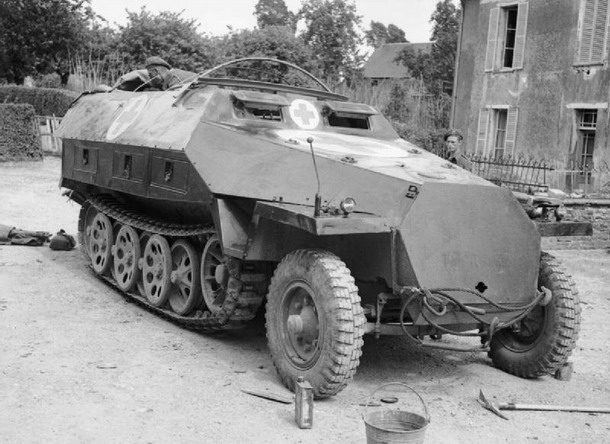
half-tracked armoured ambulance Mittlerer Krankenpanzerwagen, also known as Sonderkraftfahrzeug 251/8 Ausführung D, source: Wikimedia, Public domain, edited
Prototypes and experimental vehicles were designated from 1938 onwards with the abbreviation VK (Vollkettenkraftfahrzeug = fully tracked vehicle), followed by a four-digit number. The first two digits indicated the vehicle's weight in tonnes, while the second two distinguished between successive prototypes. If more than one manufacturer was working on a given prototype, the manufacturer's abbreviated name was appended to the designation — for example (H) for Henschel. From 1943 onwards, experimental tanks and developmental prototypes were designated with the letter E (Entwicklungtyp = development type), followed by a weight class indicator — for example E-100.
A specific designation system was also used for captured tanks taken into German service. This is described in the dedicated Captured Tanks section.
Reproducing text from the Panzernet website without the written consent of the operator is prohibited.