FLAKPANZER I
Germany's first series-produced Flakpanzer
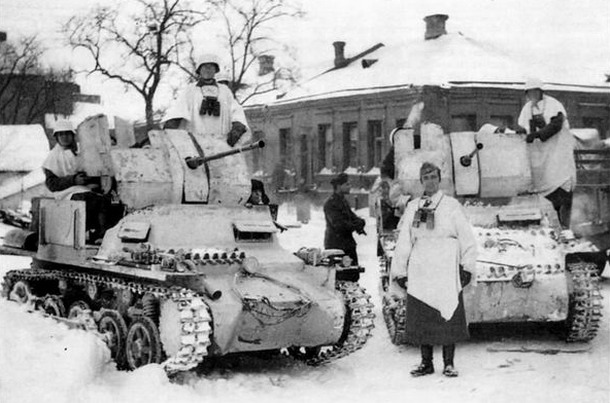
a pair of Flakpanzer I anti-aircraft tanks on the Eastern Front, winter 1941/42, source: Flickr.com with the permission of the publishing user, edited
Origins of the Flakpanzer
In the early years of the war, anti-aircraft defence within German panzer divisions was the responsibility of an anti-aircraft company (Flak-Kompanie) organised under the anti-tank battalion. This company was typically equipped with self-propelled 20 mm cannon on half-tracked chassis (Sd.Kfz. 10/4). Sometime around the turn of 1940 and 1941, however, someone hit upon the idea that the chassis of Panzer I tanks — then being withdrawn from frontline units as obsolete, with the Germans looking for alternative uses for them — could also be employed as carriers for light anti-aircraft cannon.
The task of working out the technical solution was apparently entrusted to Alkett and Daimler-Benz. However, the ammunition supply battalion Munitions Transport-Abteilung 610 was also drawn into the project, since it had on its strength a considerable number of Munitionspanzer I ammunition carrier vehicles — themselves built on the very Panzer I chassis in question (specifically the Ausf. A variant). The battalion reportedly received orders to release 24 of its Munitionspanzer I vehicles from its inventory for conversion into anti-aircraft tanks (Flakpanzers). In addition, it was to provide the personnel who would crew the new combat vehicles. If this account is accurate, it means the Flakpanzer I was not converted directly from combat Panzer I tanks, but was instead built on chassis that had previously served as ammunition carriers. Some sources, however, dispute this version of events.
"Series" Production
Similar uncertainty surrounds the question of which firm actually built the "series" vehicles. Given the lack of definitive information, we will limit ourselves to stating that the design of the combat vehicle was most likely worked out jointly by Alkett and Daimler-Benz, while the actual assembly took place at the Stöwer factory in the Prussian city of Stettin (today the Polish city of Szczecin). The argument put forward by some authors — that Stöwer was essentially just a car manufacturer and would therefore not have had the equipment needed to build armoured vehicles — is in our view irrelevant. This was not the manufacture of armoured vehicles in the true sense, but merely their conversion. The heaviest component requiring handling was the Flak 38 cannon, which weighed around 400 kg. And since Stöwer produced not only automobiles before the war but also tractors, for example, one can safely assume the factory would have been perfectly capable of handling the Flakpanzer conversions. The "production" of Flakpanzer Is apparently ran from March to May 1941, and a total of just 24 examples were built.
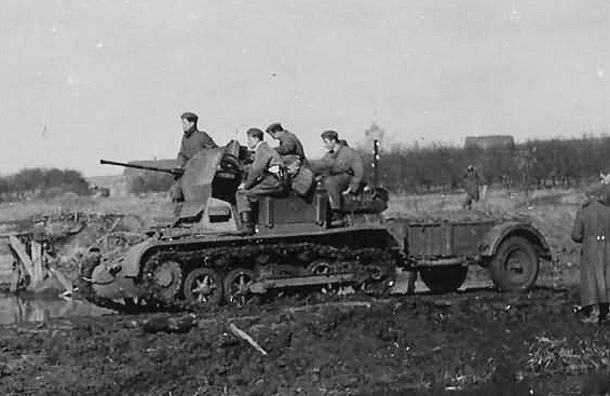
Flakpanzer Is served with the newly formed anti-aircraft battalion Flak Abteilung 614 (Mot), with which they travelled the length of Russia all the way to Stalingrad, source: Flickr.com with the permission of the publishing user, edited
Vehicle Description
Whether the chassis for the new Flakpanzer came directly from combat Panzer I tanks or from Munitionspanzer I ammunition carriers, they were one and the same chassis in either case — carrying five road wheels on each side, a front drive sprocket, and three small return rollers supporting the upper run of the track. The 530 mm diameter road wheels were spoked with rubber tyres around their circumference. The last road wheel, however, had a diameter of 630 mm and also served as the idler wheel, tensioning the track. The first road wheel, which was subjected to the greatest stress during travel, was sprung independently by a coil spring; the remaining four wheels were sprung in pairs on a shared leaf spring.
Along with the tank chassis, the entire powertrain was also retained. At its heart was the Krupp M305 petrol engine with a displacement of 3.45 litres, producing a maximum output of 60 horsepower at 2,500 rpm. The engine was connected via a driveshaft to the five-speed Zahnradfabrik F.G.35 gearbox, mounted at the front of the hull. The fuel supply was 140 litres of petrol carried in two separate tanks. The Flakpanzer also retained part of the original tank's armoured hull, with walls 13 mm thick. Of the original enclosed crew compartment, however, only the front wall and the adjoining portions of both side walls remained — the rest of the compartment, including the roof, was removed. These surviving front and side wall sections were then raised by 18 cm by welding on strips of armour plate. All three original vision ports on these walls were retained, complete with their armoured covers.
The removal of most of the tank's crew compartment created an open space. This was fitted with a new floor, on which a rotating mount with the Flak 38 cannon in 20 mm calibre was installed (the floor naturally did not extend all the way to the front wall, or it would have blocked the driver's station). The Flak 38 offered a theoretical rate of fire of up to 480 rounds per minute, though in practice this was at most 220 rounds per minute. The cannon's effective ceiling was approximately 2 km. The weapon was installed in the vehicle together with its standard gun shield.
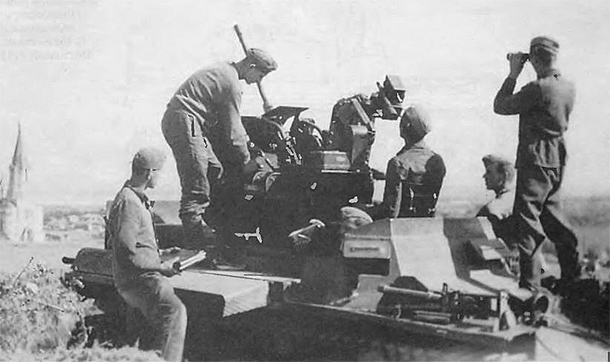
the exact crew size of the Flakpanzer I is not entirely clear; this photograph shows six soldiers, which could well be a plausible number, source: Flickr.com with the permission of the publishing user, edited
Folding side panels were added to both sides of the fighting compartment. Their purpose was not so much to provide better protection for the crew as to increase the floor area of the fighting space: the panels folded down to a horizontal position and were sturdy enough to support a standing soldier. The vehicle could reportedly carry a total of 250 rounds of 20 mm ammunition on board — a somewhat surprising figure, since the Flak 38 was loaded using 20-round magazines and the on-board ammunition was stored pre-loaded in magazines (and 250 is not cleanly divisible by 20). In any case, the ammunition was stowed beneath the floor of the fighting compartment; beyond this, the Flakpanzer typically also carried additional rounds in a towed SdAh 51 trailer.
As for the crew size, the figure of eight men is sometimes given — a number that is hard to credit. There are photographs showing seven soldiers crammed aboard a Flakpanzer I (the eighth presumably being behind the camera), but what practical role would that many men have served? Without question there would have been a driver, a commander, a gunner, a loader, and one or two ammunition handlers — that is five or six men, which would match the crew size of the similarly armed Sd.Kfz. 10/4. Sources that quote an eight-man crew include a radio operator, for instance — which is plainly nonsensical, since the Flakpanzer I was not equipped with any radio at all (try finding a single photograph showing the vehicle with an antenna). The logical objection that eight soldiers simply could not fit on board is explained in these sources by the claim that at least three of them travelled in a supporting vehicle nicknamed the Laube — but we will come to that in a moment.
Organisation and Deployment
The personnel provided by the aforementioned Munitions Transport-Abteilung 610 formed the nucleus of the newly established Flak Abteilung 614 (Mot). This battalion consisted of three companies, each with eight Flakpanzers — totalling exactly the 24 vehicles produced. The summer of 1941 was spent by the battalion's men in intensive training in Pomerania in north-eastern Germany, most likely including gunnery training at the nearby army range at Putlos. At the end of August the unit was dispatched to the Romanian border town of Iași, from where it moved on into the USSR to take part in the fighting on the southern sector of the Eastern Front. One might expect a fully tracked combat vehicle to be assigned to one of the panzer divisions, but this apparently was not the case. According to some authors, Flak Abteilung 614 (Mot) was deployed primarily as air defence for various infantry formations; according to others, it simply escorted and protected supply columns.
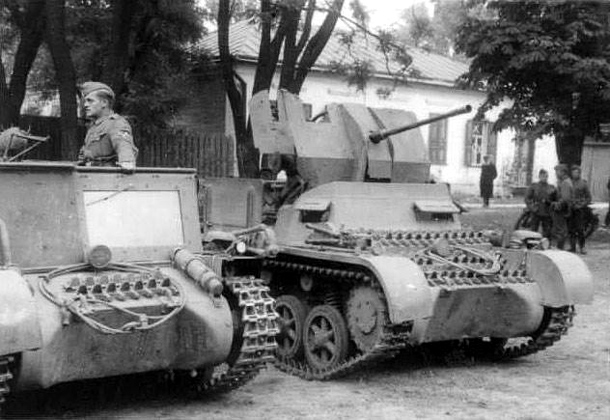
a special support vehicle nicknamed the Laube was developed for the compact Flakpanzer I, carrying not only additional ammunition but also part of the crew, source: Flickr.com with the permission of the publishing user, edited
The extreme climatic conditions, the appalling state of the roads, and the brutal fighting of the Eastern Front were a severe test even for far more robust equipment than the Flakpanzer I — built as it was on worn-out chassis of obsolete light tanks. Even so, at least some of these vehicles managed to travel all the way to Stalingrad, nearly 1,300 km as the crow flies from Iași. Such remarkable longevity argues in favour of the account that Flak Abteilung 614 (Mot) really did escort "merely" supply columns and was therefore not exposed to the hardest fighting in the front line. Nevertheless, the unit eventually found itself encircled, and the Stalingrad pocket became its grave. The last Flakpanzer I was reportedly destroyed at the end of 1942 somewhere in the vicinity of the town of Kalach.
Support Vehicles
The Flakpanzer I was overall a rather small vehicle, offering very limited "usable" space. On the other hand, it carried a weapon that was demanding both in terms of the number of crew needed to operate it (target acquisition, aiming, loading) and in terms of ammunition consumption (high rate of fire). It was therefore clear that there was simply not enough room on board for everything required. The towed trailer partially addressed the ammunition problem, but was not sufficient. For this reason a special support vehicle was created for the needs of the anti-aircraft tanks. Like the Flakpanzer I itself, this vehicle was based on the chassis of the light Panzer I tank. On these support vehicles not only the original fighting turret was removed, but the entire crew compartment beneath it as well. The resulting open space was enclosed by a fairly tall sheet-metal surround. The driver's forward view was provided by a large "window" filled with plexiglass.
The tall, boxy enclosure around the open crew space earned these vehicles the nickname Laube — meaning a garden arbour or summerhouse. Twenty-four of these support vehicles were built, giving exactly one Laube for each Flakpanzer. As already noted, these vehicles carried not only additional ammunition but also some of the Flakpanzer crew members, their personal kit, and most likely a range of other equipment including spare barrels for the Flak 38 cannon.
ARTICLE
CONTENTS:
Reproducing text from the Panzernet website without the written consent of the operator is prohibited.