MAUS
the super-heavy tank project
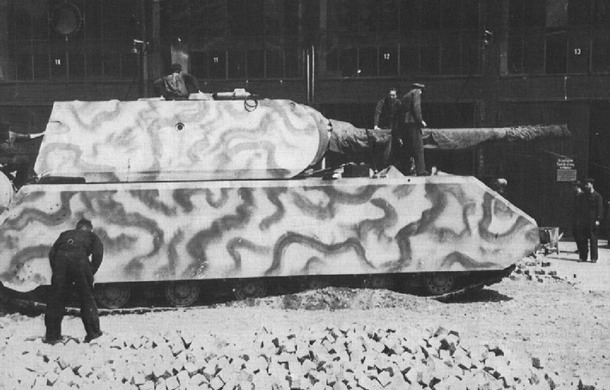
The second, fully complete, Maus prototype, source: Flickr.com with permission of the publishing user, edited
Origins of the Project
The idea of building a super-heavy tank in the over-one-hundred-tonne class most likely arose as early as March 1942. At the time, Germany was developing new heavy tanks intended to help shift the balance of power on the Eastern Front. Chief among these was the 57-tonne Tiger, which was by then virtually ready to enter production. Development of the even heavier Tiger II, weighing nearly 70 tonnes, was also underway, and since November 1941 theoretical work had been proceeding on the Löwe, a 90-tonne tank. Hitler, however, believed that the Russians were also working on their own heavy vehicles, and that the superiority of the new German types would last only a limited time. He therefore wanted to go one step further and acquire a super-heavy tank that would ensure superiority even over Soviet types still under development.
Development of the new fighting vehicle was divided between two companies. The design of the complete tank — excluding the turret — was entrusted to Hitler's favourite and champion of heavy tanks, Professor Ferdinand Porsche. The turret was to be designed and built by Krupp. According to some sources, the new vehicle was initially carried under the working designation Mammut (mammoth), but the name was soon changed to the somewhat sardonic Mäuschen (literally "little mouse"), before finally receiving its definitive designation Maus (mouse). Porsche himself referred to the project as Typ 205, while the ordnance office designated it VK 100.01 (the number 100 referring to the anticipated weight in tonnes).
The First Design
The first drawings of the super-heavy monster were apparently shown to Hitler in June 1942. Many important details were still unclear at this stage. Regarding armament, it was already settled that the tank would have two guns. The secondary gun was to be 75 mm calibre — on that there was no dispute. The main weapon had not yet been determined, however, and guns of 105, 128, and even 150 mm calibre were under consideration. Ultimately the 128 mm gun with a barrel length of 55 calibres — over seven metres — was selected as the most suitable. Hitler was so taken with the new super-heavy tank project that in July 1942 he ordered the Löwe project cancelled in its favour, to avoid splitting available resources.
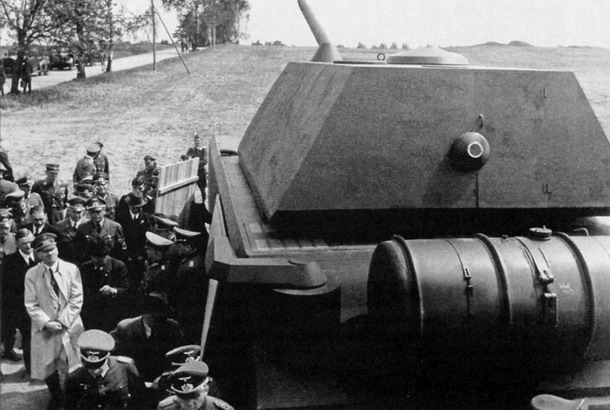
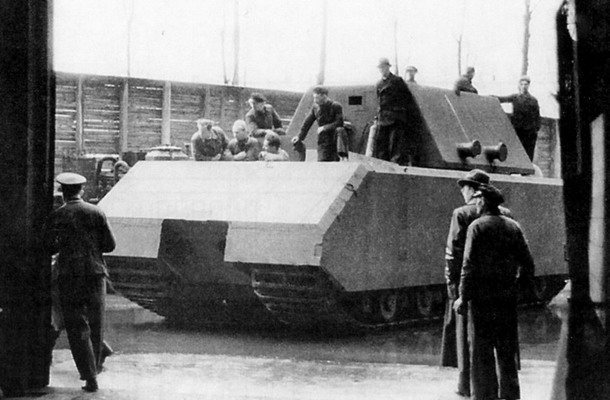
May 1943: Adolf Hitler inspects a full-scale wooden model of the Maus tank. Note the flamethrower arm on the rear wall of the hull — this was later dropped from the design. Source: Flickr.com with permission of the publishing user, edited
By October or November 1942 the design of the new tank was complete and engineering drawings had been produced. Porsche was at that time still planning a running gear arrangement similar to the one he had used on his unsuccessful Tiger prototype. There were to be approximately 10 axles with two wheels each on each side. Porsche also pushed through his petrol-electric drive system for the new tank — the same system he had used on his Tiger prototype. The primary power source was thus to be a conventional internal combustion engine. This engine, however, would not drive the tank's wheels directly, but rather an electric generator. Current from the generator would then feed two electric motors, which would actually turn the tank's wheels. It was a fairly complex system, but Porsche was convinced that only this solution would allow smooth control of such a heavy vehicle.
The designers also had to think about a host of details that had nothing to do with the tank itself. The possibility of transporting such a monster by rail had to be considered. The Reichsbahn had no suitable wagons, so these too had to be developed — and not only in terms of load capacity, but also height. The tank itself was so tall that low-loading wagons had to be built for it to keep within the height limits for rail transport (on account of bridges and tunnels). It was also clear that a vehicle of this weight would be unable to use bridges. The tank therefore had to be capable of crossing waterways by other means — by fording (more on this later).
In January 1943 the design of the new tank was approved and the ordnance office ordered the construction of an evaluation prototype. It was to be ready by September 1943 at the latest, with a further five evaluation examples to follow before year's end. From the beginning of 1944, series production of ten units per month was to begin, with a total of 120 tanks to be manufactured. Porsche was responsible for the overall vehicle design; Krupp was to supply the armoured hull and turret including armament; Daimler-Benz the internal combustion engine; and Siemens the electrical components. Production of the running gear was entrusted to the Prague Škoda works, and final assembly of the tank was to be carried out by the Alkett workshops.
The first Maus prototype with a ballast weight in place of the turret. Its very first drive took place on the grounds of the Alkett factory. Source: Flickr.com with permission of the publishing user, edited
The Flamethrower
Apparently in February 1943, Porsche received an additional requirement to arm his tank with a flamethrower as well. Porsche disagreed and protested, but was of course obliged to comply with the customer's wishes. Finding a sensible and safe location for the flamethrower was far from straightforward, since the original tank design had made no provision for anything of the sort. Porsche eventually found a solution, however, and placed the projector nozzles in both rear corners of the hull.
The flamethrower itself was to be supplied by the firm Hermann Köbe Feuerwehr Gerätefabrik, and it was certainly no small piece of equipment. The entire system consisted of a pump, its drive motor, a 1,000-litre tank of flammable mixture, and two projector nozzles — plus two electric motors for rotating the nozzles. There was no room for the rather large flammable liquid tank inside the vehicle, so it was mounted externally on the rear wall of the hull. The complete assembly including its flammable charge weighed a staggering 4.9 tonnes! Operating the flamethrower was assigned to the radio operator. From his station at the very front of the vehicle, he would have had to remotely control the flamethrower mounted at the rear — some 8 metres behind him. How exactly the radio operator was supposed to aim it, I have been unable to find anywhere.
Development work continued and estimates of the total weight of the new vehicle became more precise. When it became abundantly clear that the tank would weigh over 170 tonnes, Professor Porsche concluded that the running gear as he had originally envisaged it would not be up to the task, and began work on an entirely new solution. The new chassis design was completed in April 1943. In May, a full-scale wooden model of the tank was built and shown to army officials and Hitler himself (alongside a smaller radio-controlled model that military officials could try driving themselves — photograph HERE, source: Flickr.com with permission of the publishing user).
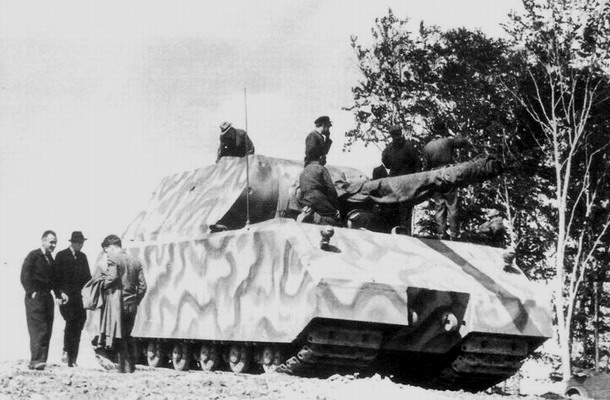
The second complete Maus prototype, source: Flickr.com with permission of the publishing user, edited
After reviewing the model, representatives of the ordnance office apparently concluded that fitting a flamethrower had been an unfortunate idea and withdrew the requirement. By that point, however, work was already underway in the Krupp workshops on the actual prototype, and openings for the flamethrower nozzle brackets had already been cut into the rear armour. These cutouts were therefore welded shut again with armour plate (the welds at these locations are clearly visible on the sole surviving Maus at the Russian museum in Kubinka). An external tank on the rear wall of the hull was still planned, however — only now, instead of the flammable mixture for the flamethrower, it was to carry additional fuel for the tank's main engine.
In June 1943, Daimler-Benz delivered the engine for the new tank. The petrol-powered MB 509 unit was created specifically for this purpose by adapting the aircraft engine DB 603. It produced a maximum output of an impressive 1,080 horsepower. This was evidently only a provisional solution for the first prototype, as Porsche had specified a diesel engine for his creation. Krupp's workers apparently completed the first armoured hull in July 1943, after which it was dispatched to the Alkett works for assembly. By 22 December 1943, the assembled and fully functional chassis and hull — without the combat turret, whose completion was running behind schedule — stood in Alkett's workshops. The chassis carried the serial number 351451.
Description of the Design
The tank's chassis consisted of six independent bogies on each side. Given the enormous weight the chassis had to bear, the bogie axles had to be anchored to the hull at both ends — otherwise they would certainly have bent or snapped. The side armour of the tank was therefore unusually extended downward. In the space between the inner and outer side armour panels, the bogies forming the running gear were housed. Each was mounted on a massive steel tube, with both ends of the tube connected to the hull armour. This tube was rigidly fixed and did not serve any suspension function. Suspension was provided by swing arms carrying the actual road wheels beneath the tube, fitted with heavy coil springs. Each bogie had four road wheels. In total, each side therefore had 24 road wheels (6 bogies × 4 wheels). Above the tube connecting each bogie to the hull were small return rollers supporting the upper run of the track. The running gear was completed by a front idler wheel and a rear toothed drive sprocket.
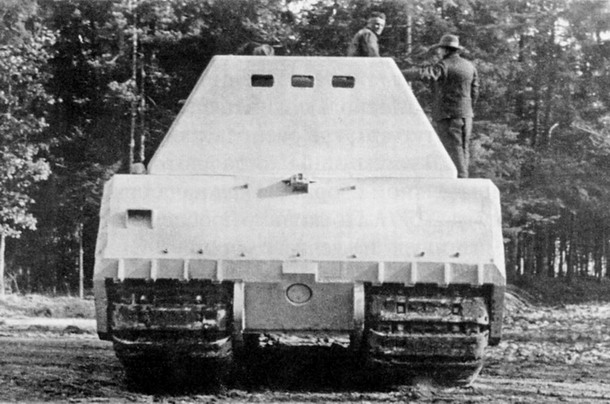
The first Maus prototype with the ballast weight in place of the turret, not yet in camouflage paint. This photograph gives a clear impression of just how wide the tracks were and how little space remained between them. Source: Flickr.com with permission of the publishing user, edited
The tracks were an extraordinary 110 cm wide. This extreme width was essential to distribute the tank's enormous weight and reduce ground pressure — which even so remained fairly high at 1.45 kg/cm². The designers considered widening the tracks further to reduce ground pressure, but there was no room to do so. Outward expansion was already at the limit imposed by rail transport clearances, and inward expansion was impossible since it would have left insufficient space in the hull between the tracks for the electric generator.
The hull was welded from flat armour plates and had a relatively simple shape overall. The hull nose was formed by an upper and a lower plate — the lower plate being relatively narrow to fit between the wide tracks. The thickness of these plates was an extraordinary 200 mm. Two massive towing hooks were welded to the lower nose plate (absent on the first chassis prototype). The tracks were partially covered at the front by armour 100 mm thick. The rear wall of the hull was also formed by upper and lower plates, in this case 150 mm thick. The side walls of the hull were perpendicular to the ground, with a thickness of 180 mm above the tracks. The extended side armour that partially covered the tracks was "only" 100 mm thick. The horizontal hull roof was thickest at the front, over the driver's and radio operator's compartment, where it reached 100 mm. The remainder of the roof was only 50 mm thick. The same applied to the floor of the hull pan — 100 mm at the front, tapering to just 50 mm further back.
Although the Maus was an enormous vehicle, its interior was packed to the absolute limit. A large portion of the usable interior space was "stolen" by the wide tracks. Between them only a relatively narrow central strip remained where the interior could be used at full height; the space above the tracks on either side was naturally lower. At the very front of the hull sat the driver and radio operator in a completely enclosed compartment, separated from the rest of the crew. The two men sat very close together, the driver slightly to the left and forward of the radio operator (the positioning of both seats is clearly visible in the photograph HERE, source: Flickr.com with permission of the publishing user). They shared a single overhead hatch in the roof above them for entry and exit, and also had an emergency escape hatch in the floor of their compartment. Cutting vision ports into 200 mm frontal armour would have been excessively difficult and would needlessly have compromised the integrity and thus the protective value of the armour. The driver's and radio operator's visibility was therefore provided by periscopes in the hull roof plate.
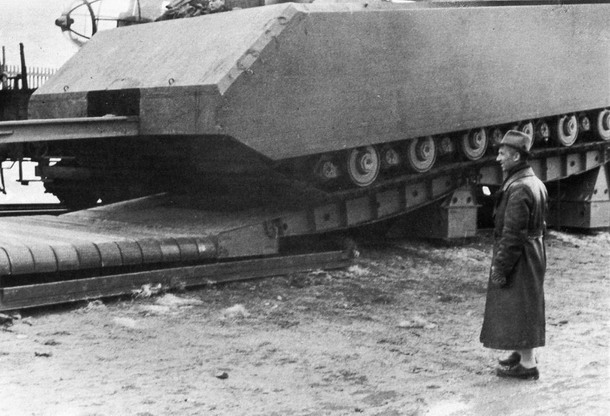
A specially developed railway wagon had to be designed for transporting the Maus, source: Flickr.com with permission of the publishing user, edited
On either side of the driver and radio operator's compartment were the fuel tanks for the main engine. The engine itself was housed directly behind their compartment. As already mentioned, this main engine was the petrol-powered Daimler-Benz MB 509 with a displacement of 44.5 litres and a maximum output of 1,080 horsepower at 2,400 rpm. The engine was seated in the deep central "trough" between the tracks. The lower spaces above the tracks on either side of the engine were used for the cooling apparatus — coolant tanks, fans, and so on. The engine exhausts were routed on both sides of the hull through the roof and outward through the hull sides (photograph HERE, source: Flickr.com with permission of the publishing user or HERE, source: Flickr.com with permission of the publishing user). Immediately behind the engine, aligned along the tank's centreline, sat the massive electric generator — again housed longitudinally in the deep central trough between the tracks. The spaces on either side were used for ammunition stowage. Directly above the generator was the floor of the combat turret. At the very rear of the hull, two electric motors were located in the side spaces above the tracks. The central area of the hull at the rear was filled by the transmission connecting the electric motors to the drive wheels.
To recap: the petrol engine drove the electric generator, which supplied current to the electric motors, which in turn drove the tank's wheels. Thanks to this system, no conventional gearbox was needed and therefore no gear-changing was required. Accelerating, braking, and steering the enormous colossus was smooth and fluid, making no special demands on the driver. On the other hand, it was a complex system that drove up the manufacturing cost, and its components took up a great deal of interior space. The hull was truly filled to the very last corner — and that was before the already-mentioned external fuel tank on the rear wall of the hull!
The combat turret was not fitted on the first prototype. In its place sat a large ballast weight simulating the turret's mass. The hull roof armour in front of the ballast weight (and thus in front of the turret, had one been fitted) was provided with grilled openings through which air flowed to the combustion engine and cooling system. The filler necks for the fuel and coolant tanks also opened here. Behind the turret position (the ballast weight), where the electric motors were housed, the hull roof was also grilled to allow airflow.
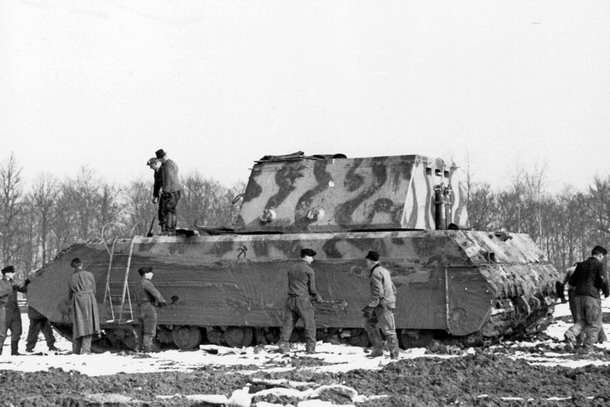
The first Maus prototype during testing. During one of the test drives the tank became stuck in deep mud. This photograph was taken shortly after it was recovered, and the mud-caked side gives a vivid impression of how incredibly deeply the vehicle had sunk. Source: Flickr.com with permission of the publishing user, edited
The First Prototype
Returning now from the description of the vehicle to its history: as already noted, the first complete Maus chassis and hull, serial number 351451, was completed on 22 December 1943. The combat turret was not yet finished at that point. To avoid unnecessary delay, it was decided to test the prototype chassis without the turret. In its place, the chassis was fitted with a ballast weight simulating the turret, the so-called Balastungsgewicht. The weight of this ballast — the same as that of the actual turret — was an extraordinary 55 tonnes (nearly the same as the total weight of a Tiger heavy tank!). The tank with its ballast weight carried out its first brief proving drive still in December 1943, on the grounds of the Alkett factory. It was then dispatched to Böblingen in January 1944 for thorough driving trials.
In the meantime, however, the situation in Germany had changed. The war was not going well for the Germans, and the priorities of armaments production were being reassessed. At the end of October 1943, a decision was taken to terminate further development work on the Maus and redirect all capacity toward maximising the output of other, already established types of fighting vehicle. In November the original order was revised — the army now requested the construction of only two evaluation chassis and a single combat turret. By that point, however, Krupp's factory in Essen already had four more welded hulls and five turrets in progress (since the original order had been for six evaluation examples). Work on these "surplus" items ceased in November, and the hulls and turrets were simply left sitting in storage.
Prototype Trials
The first prototype chassis with its ballast weight arrived in Böblingen on 14 January 1944. For its transport, a specially developed 27-metre-long railway wagon with a low-loading platform and no fewer than 14 axles was used. From the station, the tank made its own way to the barracks some 5 km distant. According to contemporary records, this move was completed without any problems whatsoever. Official driving trials then began the following day. The overall outcome of the tests was positive. Many individual problems arose, of course, but as a whole the vehicle functioned very well. Reports were particularly complimentary about the steering system. Despite the enormous weight and dimensions, the vehicle was easy and very precise to control. The precision of the steering is also demonstrated by surviving factory photographs showing the Maus literally squeezing through tight spaces where truly only centimetres were available. Porsche's petrol-electric drive, which made this possible, had at last received the recognition it deserved.
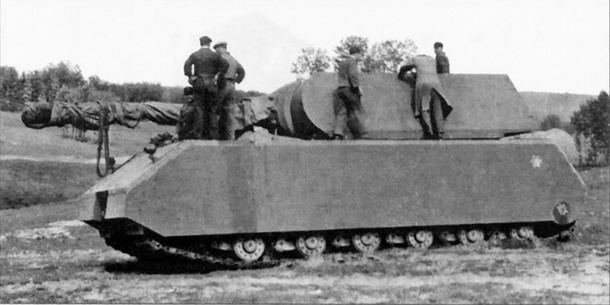
The second Maus prototype was fully complete, including its turret and armament. In this photograph it has not yet received its camouflage paint scheme. Source: Flickr.com with permission of the publishing user, edited
During the trials, however, a number of problems also arose. The rubber tyres on the road wheels quickly gave way under the enormous load, and the manufacturing plant had to supply new wheels with improved, more durable tyres. The mechanics at least had the opportunity to practice, under field conditions, how to carry out such a complex operation as replacing road wheels. In the course of the test drives, the tank also became stuck in deep mud. Photographs show that it sank to approximately two-thirds of the hull's height. Again, this provided an excellent opportunity to test how the crew and support personnel would handle such a situation under combat conditions — the very thought of recovering a 188-tonne vehicle must have been a nightmare for anyone familiar with the practicalities. After shovelling away some of the mud and apparently placing wooden logs under the tracks, the tank eventually managed to extract itself under its own power. Minor incidents such as torn-up cobblestones in a corner through which the Maus had passed are hardly worth mentioning :-)
As photographs show, the tank received a camouflage paint scheme at some point during its time at Böblingen. That in itself would be unremarkable, were it not for the fact that the scheme included the symbol of a crossed hammer and sickle. Why the Germans painted their arch-enemy's symbols on the tank is not clear. It was certainly not any attempt at camouflage — that would be rather like trying to pass an elephant off as a zebra by painting two black-and-white stripes on its side. During the testing period, towing cable attachment eyes were also added to both the front and rear walls of the hull, and can be seen in photographs from that point onwards.
The Second Prototype
The second chassis and hull prototype carried serial number 351452. Externally it differed from the first only in details. For instance, it had no cutouts for flamethrower nozzles in the rear hull wall (which the first prototype had had and which had to be retrospectively welded shut). The second prototype also incorporated new details such as front and rear headlights and armoured covers over the grilled vents in the hull roof above the radiators. The most significant novelty, however, was hidden inside the hull. The second example received a new engine — the diesel-powered DB 517 with a 44.5-litre displacement, producing a maximum output of 1,200 horsepower at 2,500 rpm. Once again, this prototype also had to be built without its combat turret, as it was still not available. The second Maus chassis arrived in Böblingen for testing on 10 March 1944.
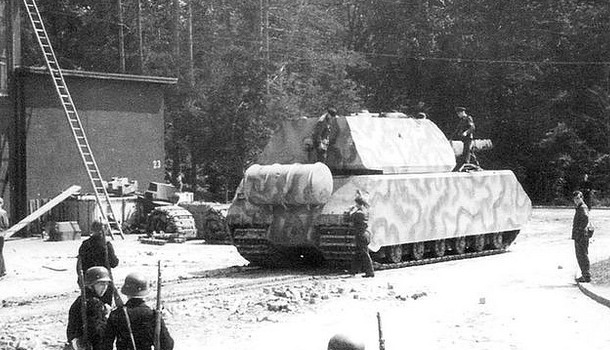
The second complete Maus prototype during trials, here already wearing its camouflage paint scheme. Source: Flickr.com with permission of the publishing user, edited
The Combat Turret and Armament
The first combat turret was not completed until April 1944. Like the hull, the turret had a fairly simple overall shape. The side and rear walls were conically sloped, but were otherwise flat armour plates. Only the front wall of the turret was rounded. At its centre projected a massive cast mantlet housing two guns. The tank's main weapon was the 12.8 cm KwK 44 L/55 cannon. As the name suggests, this had a calibre of 128 mm and a barrel length of 55 calibres. To the right of the main gun was a secondary 7.5 cm KwK 44 L/36 cannon of 75 mm calibre with a barrel length of 36 calibres. Both weapons were mounted in the same mantlet, so they aimed together. The mantlet allowed vertical elevation from -7 to +23 degrees.
Both guns were developed specifically for the Maus. The 7.5 cm KwK 44 L/36 was derived from the short-barrelled 7.5 cm KwK 37 L/24 tank gun. It shared the same chamber and used the same ammunition, but received a longer barrel. To the left of the gun mantlet, a small opening in the front turret wall housed an MG 34 machine gun of 7.92 mm calibre. The ammunition load carried for the larger gun was 68 rounds in total; 100 rounds were stowed for the secondary 75 mm gun; and the machine gun supply amounted to 1,000 rounds.
In the centre of each side turret wall was a small circular firing port for the crew's personal weapons. In the rear wall there was a slightly larger opening which, besides firing, apparently also served for loading ammunition. The turret roof featured a whole array of openings. There were two circular entry hatches closed by single-piece covers. In front of the right hatch, a rotating observation periscope for the tank commander protruded from the roof. Two electric fans provided ventilation of the turret interior; to the front-left, an armoured housing for the periscopic gun sight projected from the roof; and at the very rear was a smoke grenade launcher operated from inside the turret. The frontal turret armour was an extraordinary 220 mm thick. The side and rear walls were 200 mm. The turret roof consisted of 60 mm armour. Little wonder that the turret, including its armament, weighed nearly 55 tonnes!
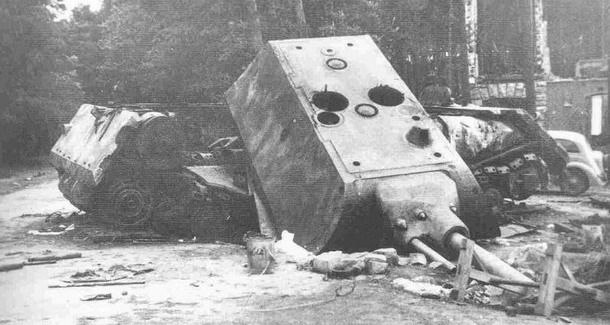
This is how Soviet troops found the sole complete Maus — the retreating Germans had blown it up. Source: Flickr.com with permission of the publishing user, edited
On 3 May 1944 the first completed turret arrived in Böblingen to be fitted onto the chassis. At that point, however, the turret was not yet fully equipped. The guns, the turret traverse mechanism, and other fittings arrived in Böblingen somewhat later. The turret first had to be fully assembled, and only on 7 or 8 June 1944 was it installed on the chassis — specifically on the second prototype, serial number 351452. Testing of the very first fully complete Maus prototype then began. Photographs once again confirm that the entire tank was initially painted in a single colour, apparently standard grey, and only received its camouflage scheme at some point during testing.
The Complete Tank
The complete Maus including its turret and armament weighed 188 tonnes. It measured 10.085 metres in length, 3.7 metres in width, and 3.649 metres in height. Its crew consisted of six men. The driver and radio operator sat in a separate compartment at the front of the hull. The turret housed the commander, gunner, and two loaders. On road, the heavy colossus could achieve a maximum speed of 20 km/h, though cross-country this was considerably less. Fuel capacity was 1,600 litres in two internal tanks, plus a further 1,000 litres in a jettisonable drum on the rear of the hull (originally intended to hold the flammable mixture for the flamethrowers). 2,600 litres of fuel may sound like an enormous quantity at first glance — but the Maus consumed approximately 1,600 litres per 100 km on road, and in heavy terrain fuel consumption shot up to an astronomical 4,000 litres per 100 km!!! A full load of fuel was therefore sufficient for around 160 kilometres on road.
The drum of fuel mounted externally on the rear hull might at first glance appear to be sheer madness. It is worth bearing in mind, however, that the series-production Maus was intended to have a diesel engine, and diesel fuel, unlike petrol, does not ignite nearly as easily. External fuel tanks were, after all, entirely commonplace on Soviet T-34 tanks, which also had diesel engines. On the first Maus prototype, which was still provisionally powered by a petrol engine, the external drum was not fitted for safety reasons — and understandably so.
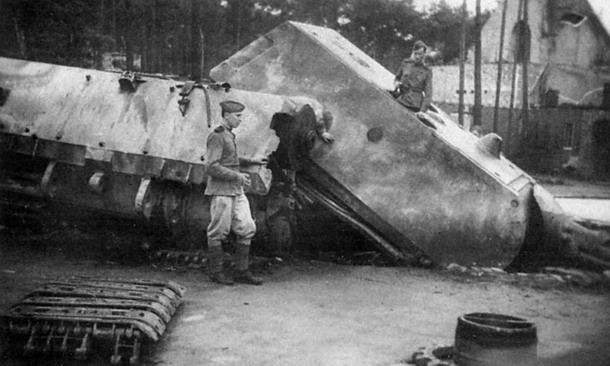
May 1945, Kummersdorf: Soviet soldiers examine the wreck of the Maus with great interest. Source: Flickr.com with permission of the publishing user, edited
Given its enormous weight, the Maus could not use bridges to cross waterways — they simply could not support it. The designers therefore had to equip the tank for deep fording. Before entering the water, the crew had to fit covers over all the grilled openings in the hull roof and seal the turret hatches and its ring. A 6-metre-tall tube was then raised above the driver's and radio operator's hatch, supplying air not only to both crew members but also to the combustion engine. Starting the combustion engine was, however, only a backup solution for movement underwater. The primary propulsion method when submerged was through the electric motors alone — with the combustion engine off and the current for the electric motors supplied by cables from a second Maus standing on the bank with its engine running. That, at least, was the theoretical concept of the designers... whether it was ever put to a practical test is doubtful.
As noted above, the first complete Maus was assembled in June 1944 and testing began shortly afterwards. These trials did not last long, however. As early as August 1944, the decision came to terminate the entire Maus project definitively. As a consequence, both existing prototypes — the first fitted with the ballast weight and the second with its complete combat turret — were sent to Kummersdorf at the end of 1944, apparently for "storage." This is where the end of the war found both vehicles in May 1945. To prevent the sole complete Maus from falling into the hands of the advancing Soviets in a combat-ready state, the fleeing Germans blew it up. As photographs confirm, the explosion caused considerable damage to the hull and chassis, though the turret survived in one piece — albeit clearly no longer battle-worthy.
The Russians decided to preserve this unique product of the Hitler era and take it back east. They removed the ballast weight from the first chassis and replaced it with the turret that had survived the explosion of the second prototype. Thanks to this, the world has retained a complete Maus tank, which can be seen today at the museum in Kubinka, Russia. Other versions of the story of how this prototype met its end do exist, but the photographs confirm the account given here fairly clearly (and the vehicle on display at Kubinka stands on the first chassis, as evidenced by the welded-over cutouts for the originally planned flamethrower nozzles in the rear hull wall — photograph HERE, source: Wikimedia, Creative Commons, edited). Photographs of the tank being loaded onto a railway wagon for transport to the USSR also reveal one further interesting detail: judging by the impact marks on the frontal armour, the Russian soldiers evidently could not resist testing the Maus's resistance to shellfire.
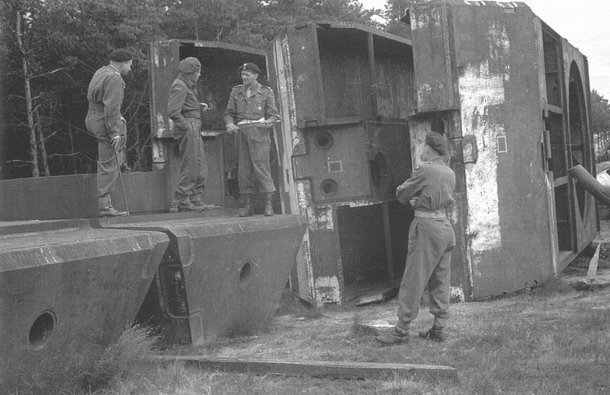
Allied soldiers inspect the never-completed hulls and turrets for Maus tanks at the captured Krupp factory in Essen, source: Flickr.com, Public domain, edited
Besides the two functional prototypes, four more hulls and five turrets stored at the Krupp factory in Essen also survived to the end of the war. These fell into British hands at the war's end and were most likely subsequently scrapped.
The Maus project was, from a historical perspective, more a waste of resources than anything else. History has shown that the path to qualitative superiority over an enemy does not lie in simply increasing armour thickness and firepower at any cost. The Maus was a slow and expensive colossus with enormous maintenance and logistics requirements. At first glance it may have appeared indestructible, but in reality it was just as vulnerable as any other tank — a single well-placed aerial bomb or rocket, an anti-tank mine damaging a track, or a soldier with a fire bottle thrown into the right spot were all that was needed to destroy it. Many army officials saw this from the very beginning — including Guderian — but were overruled.
Technical Data
|
weight: |
188 t |
|
length: |
10.09 m |
|
width: |
3.7 m |
|
height: |
3.65 m |
|
engine: |
DB 517 (44.5 l) |
|
engine power: |
1200 hp |
|
max. speed: |
20.0 km/h |
|
fuel capacity: |
2600 l |
|
fuel consumption – road: |
1600 l / 100 km |
|
fuel consumption – cross-country: |
4000 l / 100 km |
|
hull armour: |
|
|
- front: |
200 mm |
|
- sides: |
180 mm |
|
- rear: |
150 mm |
|
turret armour: |
|
|
- front: |
220 mm |
|
- sides: |
200 mm |
|
- rear: |
200 mm |
|
crew: |
6 men |
|
armament: |
1× 12.8 cm KwK 44 L/55 1× 7.5 cm KwK 44 L/36 1× MG 34 7.92 mm machine gun |
ARTICLE
CONTENTS:
Reproducing text from the Panzernet website without the written consent of the operator is prohibited.