E-100 (& TIGER-MAUS)
rival to the super-heavy Maus tank
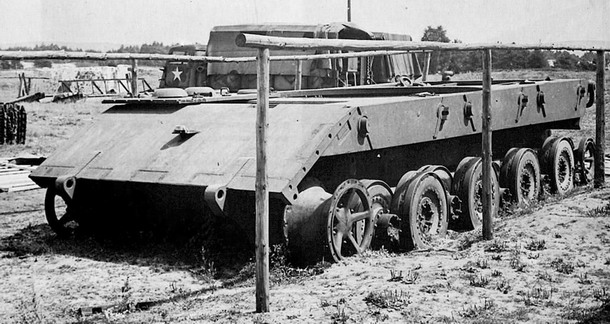
American soldiers discovered the unfinished E-100 prototype at the Haustenbeck proving ground. Note the fender mounting brackets on the hull sides. Source: internet, Public Domain, edited
Tiger-Maus
Although the E-100 designation places this vehicle within the series of standardised fighting vehicles developed under the Entwicklungsreihe (or more commonly Entwicklungserie) programme, in this particular case the history is somewhat more involved. The origins of the super-heavy E-100 are closely bound up with the development of another comparably heavy tank — the Maus — and especially with its rival, known as the Tiger-Maus. It is worth beginning, therefore, with a brief excursion back to 1942.
In March of that year, development of the super-heavy Maus tank was set in motion. The chassis, including all mechanical components and the armoured hull, was to be designed by Hitler's favourite, Professor Ferdinand Porsche, while Krupp was to supply the fighting turret with its armament. During a joint meeting in September 1942, representatives of the Waffenamt dropped hints to senior Krupp staff that Professor Porsche was encountering considerable difficulties with his Maus project. This was a large contract with a great deal of money at stake, and the Krupp representatives promptly sensed an opportunity to turn Porsche's troubles to their advantage. Why should they merely supply a turret and armament for Porsche's Maus when they could theoretically develop a complete tank of their own design? Krupp's chief designer, Ing. Erich Wölfert, accordingly proposed to the Weapons Office officials that his firm would be very happy to prepare its own alternative design for the required tank.
One thing led to another, and on 17 November 1942 a follow-up meeting took place at which Krupp presented a conceptual design for their own "Maus" — in fact in two variants, one with the turret placed centrally and one with it at the rear of the hull. Both variants were designed around the engine and steering gearbox from the Tiger tank, which was intended to speed up development and reduce production costs. At the expected weight of 155 tonnes, however, this would also have meant a power-to-weight ratio of just 4.5 horsepower per tonne, and a maximum speed of barely 13 km/h — which the Weapons Office representatives found unacceptable.
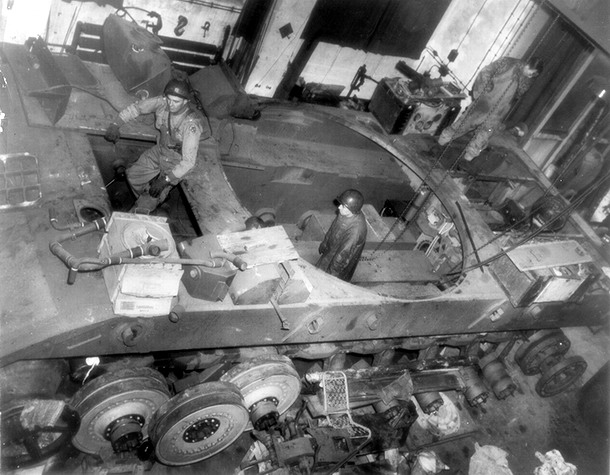
American soldiers examine the unfinished E-100 prototype at the Haustenbeck proving ground. This photograph clearly shows the enormous diameter of the turret ring. Source: Worldwarphotos.info, Public Domain, edited
Krupp therefore proposed fitting the tank with a different engine and gearbox, while also developing entirely new and more powerful final drives and a new steering gearbox. The Weapons Office representatives were deeply uneasy about Krupp beginning to stray from the original idea of using established components from the Tiger — that was supposed to be the whole point of their design's advantage over Porsche's Maus. Developing new steering gear threatened delays, expense, and far more extensive testing. Officials insisted that Krupp should stick to their original approach and adapt the project so that Tiger components would suffice. And since series production of the new Tiger II, or Königstiger, had been approved in November 1942, Krupp was urged to consider using the steering gearbox and final drives from this new type.
Krupp accordingly put the entire project through a rigorous "weight-loss programme", bringing the expected weight down to just under 130 tonnes — the calculated limit at which components from the Tiger and Königstiger could be used (specifically the Maybach HL 230 engine, the Olvar OG 40 12 16 B gearbox, and the Lenkgetriebe L 801 steering unit). This proposal was well received by the Weapons Office. Ing. Kniepkamp was not exactly thrilled by the still-low power-to-weight ratio, but reassured himself and his colleagues with the fact that Maybach was working on the more powerful HL 234 engine, expected to produce 1,000 to 1,100 horsepower, which offered the prospect of improving the tank's performance in the future. The Weapons Office representatives were, by all accounts, fairly pleased to have a more "conventional" alternative to Porsche's Maus. They had a nagging suspicion that the enormous Maus, crammed with newly developed components, would be a production nightmare and that all those involved faced serious headaches down the line. They therefore gladly took the latest version of Krupp's design and presented it to the Ministry of Armaments as an alternative to Porsche's creation. The response, however, was a cold shower: the Ministry of Armaments, followed by Hitler himself, decided that Porsche's Maus project would take priority, and Krupp's design — which had by now acquired the working designation Tiger-Maus — was cancelled in December 1942.
The Entwicklungsreihe Programme
So what did the cancelled Tiger-Maus project from Krupp have in common with the E-100 project from Adlerwerke? Almost everything. In essence, the two were practically the same vehicle. The link between them was the already-mentioned Ing. Kniepkamp. As head of one of the development departments at the German Army Weapons Office, Kniepkamp had been preoccupied since May 1942 with the question of how to enable a substantial increase in the production of armoured fighting vehicles. He had reached the conviction that the path to mass production lay through consolidation, standardisation, and technical simplification — producing fewer types, of simpler construction, sharing as many components as possible. It took almost a year before Kniepkamp managed to convince his superiors, and in April 1943 the official programme known as the Entwicklungsreihe (often also Entwicklungserie — roughly "development series" in English) was launched. The aim of the programme was to develop several new fighting vehicles to replace existing types, meeting the conditions for affordable mass production outlined above.
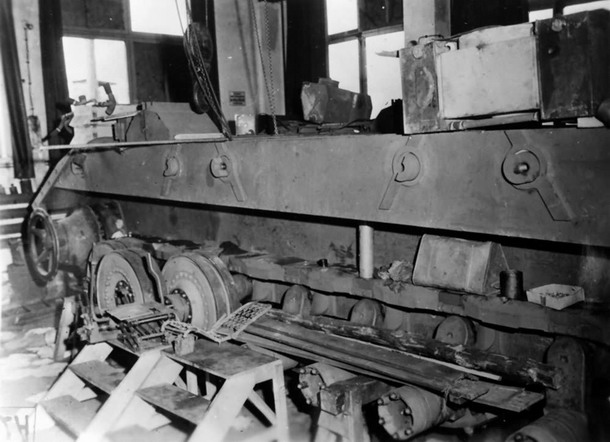
A view of the incomplete running gear, and again the fender mounting brackets on the hull sides. Source: Worldwarphotos.info, Public Domain, edited
Five types of armoured fighting vehicle of different weight categories and roles were designed under the programme. The tank destroyers E-10 and E-25 were to replace the existing Hetzer, StuG III, StuG IV, and Jagdpanzer IV. The tanks E-50 and E-75 were to replace the Panzer IV, Panther, Tiger, and Königstiger. And finally, the E-100 was to become the standard super-heavy tank, replacing the production-intensive Maus. The letter E in the designations stood for Entwicklungstyp (development type), while the number indicated the vehicle's expected weight in tonnes — though, it must be said, only very approximately.
The E-100 Specification
Development of the E-100 within the Entwicklungsreihe programme was entrusted to Adlerwerke of Frankfurt, which received from Ing. Kniepkamp the technical drawings of Krupp's rejected Tiger-Maus project as the starting point for its work. The E-100 was thus in effect a continuation of the Tiger-Maus, differing from it in essentially only one respect: the road wheel suspension system. The Adlerwerke design team, led by Dr. Jenschke, began development work on the E-100 in June 1943. Krupp only somehow learned of the "resurrection" of their Tiger-Maus project in May 1944. When chief designer Wölfert subsequently asked why the continuation of the project had not been entrusted to their firm, Kniepkamp replied that Krupp was already overwhelmed with other work and that Adlerwerke had spare capacity. It is possible, however, that the real reason Kniepkamp did not assign the work to Krupp was to avoid drawing unnecessary attention to the fact that he was, in effect, reviving an already-cancelled project.
Vehicle Description
The E-100's chassis was to have eight axles for road wheels on each side. Each wheel consisted of two all-metal discs with a thin rubber tyre beneath a steel rim band. The wheels were arranged in inner and outer rows with a partial overlap, each mounted on an individual swingarm suspended and sprung by a pair of vertically mounted coil springs. The springs were located outside the hull, while supplementary shock absorbers were fitted inside. Some sources claim that Belleville disc spring assemblies were used on the E-100 — this is not correct.
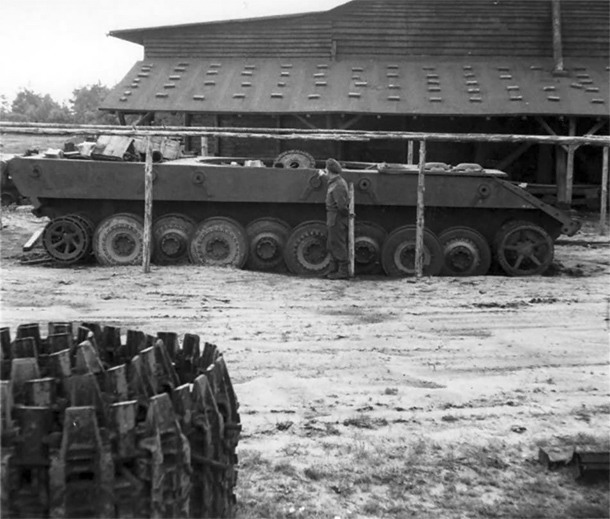
The Allies completed the fitting of the road wheels and towed the vehicle out of the assembly hall. In the foreground the rolled-up combat tracks can be seen. Source: Worldwarphotos.info, Public Domain, edited
The overall layout of the tank followed the German standard of the period: engine at the rear, gearbox at the front of the hull, fighting turret in the centre. Accordingly, the drive sprocket was at the front and the idler wheel at the rear. The upper front hull armour was 200 mm thick, angled at 60°; the lower front plate was 150 mm at 52°. The rear hull wall was 150 mm and the side walls 120 mm. Along the sides of the hull above the tracks, however, removable hollow "fender" skirts with 60 mm walls were fitted, providing considerable additional protection. These fenders consisted of three large sections on each side and had to be removed for rail transport to keep the vehicle within the loading gauge — as did the 1,000 mm wide combat tracks, which had to be replaced with narrower transport tracks for the same reason. Removing the fender sections was naturally not feasible without some mechanical assistance; the tank was accordingly to be equipped with a small crane that could be hung from the sides of the fighting turret. The hull roof was 40 mm thick. The hull floor was also 40 mm, except in the front quarter where it was reinforced to 80 mm, most likely for improved mine protection.
In the rear of the hull sat the already-mentioned Maybach HL 230 P30 — a 23-litre petrol V12 producing a maximum of 700 horsepower at 3,000 rpm. The Olvar OG 40 12 16 B gearbox offered eight forward gears and four reverse. The turret originally envisaged for the E-100 was the one Krupp had designed for the Tiger-Maus: a rounded front wall with two guns — 150 mm and 75 mm — mounted side by side. This was later superseded by a decision to fit a simpler turret with a flat, sloped front plate and two guns — 128 mm and 75 mm — mounted one above the other. The turret's front wall was to be 200 mm thick, the rear 150 mm, the sides 80 mm, and the roof 40 mm.
In its intended final form, the E-100's armament was to consist of a 12.8 cm KwK L/55 gun with a 7.5 cm KwK L/24 mounted above it. Both guns were to have a vertical elevation range of -7° to +20°. A coincidence rangefinder for more accurate target range measurement was to be fitted under the turret roof. The crew was to consist of six men: driver, commander, radio operator, gunner, and two loaders. The tank's total length including the gun overhang was calculated at 11.073 metres, height at 3.375 metres, and width including the fender skirts at 4.480 metres. The entire colossus was expected to weigh around 123.5 tonnes. The designers anticipated a maximum speed of approximately 23 km/h and a range of roughly 160 km on road and around 100 km cross-country — for which an astonishing 2,050 litres of petrol would have needed to be loaded into the tanks.
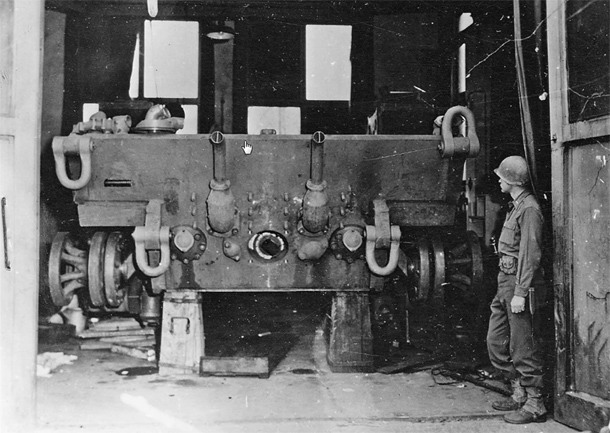
The unfinished E-100 prototype standing on blocks in the assembly hall at the Haustenbeck proving ground. Source: Worldwarphotos.info, Public Domain, edited
The Only Prototype
Construction of the evaluation prototype began sometime in 1944 and proceeded somewhat off to the side of the main war effort, at the Henschel proving ground in Haustenbeck. It must also be said that progress was extremely slow. Deliveries of ordered components were delayed, or in some cases sent erroneously to entirely different destinations, and reportedly only three workers from Adlerwerke were assigned to the assembly on a long-term basis. By the end of the war, not even the chassis with its tracks and drivetrain had been completed. The incomplete hull fell into the hands of the advancing Americans at Haustenbeck. They inspected and photographed it with obvious interest, and apparently towed it out of the assembly hall into the open air, even fitting the remaining road wheels. After the war the chassis was apparently taken to Great Britain, where it was most likely scrapped at some point thereafter.
ARTICLE
CONTENTS:
Reproducing text from the Panzernet website without the written consent of the operator is prohibited.