E-25
the unified light tank destroyer project
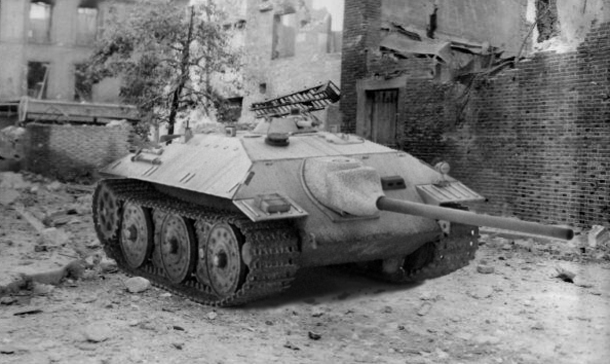
E-25 tank destroyer in the streets of a ruined German town near the end of the war. Background: internet (public domain), plastic model: Vincent Dethoor (panzervoran.blogspot.com), composite image: Panzernet
Entwicklungsreihe
In April 1943, the German Army Weapons Office officially launched a programme to develop several new types of armoured vehicle, which became known under the designation Entwicklungsreihe (or more commonly Entwicklungserie, abbreviated E-Serie — roughly "development series" in English). The programme's primary aim was the consolidation of production and standardisation of armoured vehicles — producing fewer types, of simpler construction, sharing as many components as possible. Five armoured fighting vehicles of different weight categories and roles were designed under the programme: the tank destroyers E-10 and E-25, and the tanks E-50, E-75, and E-100. As the reader may have already guessed, the number in each vehicle's designation indicated its weight category — though, it must be said, only very approximately. The driving force behind the entire programme was Ing. Kniepkamp of the Waprüf 6 department at the Weapons Office.
The two intended tank destroyers — Entwicklungsfahrzeug E-10 and Entwicklungsfahrzeug E-25 — were to share as many components as possible. Beyond that, the Weapons Office specification placed considerable emphasis on making the vehicles as simple as possible to manufacture and maintain. The suspension system, for example, was to allow straightforward like-for-like component replacement without any need to access the interior, and easy service access to the engine and gearbox was another key requirement. Unusually for the German design tradition, the vehicle was to have its drive sprocket at the rear — which naturally also determined the placement of the gearbox and other transmission components. A rear-mounted gearbox was well suited to the requirement for easy service access, and at the same time helped to distribute weight more evenly, counterbalancing the heavy front armour and gun.
Development of the E-25 was entrusted to the Berlin-based firm Argus Motoren GmbH — a somewhat surprising choice, since the company was primarily an aviation manufacturer (it built, for example, the pulse-jet engines for the V-1 flying bomb) and had at most supplied armoured vehicle programmes as a minor subcontractor. All the German armaments firms focused on armoured vehicle production were, however, swamped with work, and the E-25 was most likely not seen as a particularly high-priority project. The experienced Dr. Hermann Klaue was appointed chief designer of the new vehicle. The armoured vehicle was required to weigh between 25 and 30 tonnes; for development purposes the 7.5 cm PaK 42 L/70 gun was to be used as a reference weapon, with the definitive armament for any eventual series production to be selected at a later stage.
E-25 tank destroyer — in this visualisation the vehicle carries a small machine gun turret on the roof, which in reality was almost certainly never planned. Background: internet (public domain), plastic model: Vincent Dethoor (panzervoran.blogspot.com), composite image: Panzernet
Dr. Klaue's design called for a running gear with five large road wheels on each side, of identical construction to those of the lighter E-10. These were all-metal wheels with a thin rubber tyre around the rim protected by a steel band, each consisting of a single disc 100 cm in diameter. The wheels were arranged in two slightly overlapping rows, with each wheel independently suspended and sprung.
The New Running Gear
The army's requirement for a fully external suspension system ruled out the proven torsion bar arrangement. The solution chosen was essentially the same as that of the E-10: each wheel was mounted on a large but hollow swingarm, whose movement was damped by a stack of pre-loaded conical disc springs — known as Belleville washers, after their French inventor — housed inside the arm's tubular body. This is a fairly common type of washer available at any hardware shop. It has a slightly conical shape, flattens under the pressure of a tightened bolt, and springs back when the bolt is loosened — in other words, it acts as a spring. A single ordinary hardware-shop washer of this type allows only a few millimetres of travel under compression, but if you take somewhat larger washers and stack several dozen of them together — alternating the orientation of each one as you go — you end up with a spring with a respectable working range (a spring of this kind looks something like THIS).
The entire swingarm assembly, complete with its disc spring stack inside, was bolted to the side of the hull from the outside. Once the road wheel disc itself had been removed, a mechanic could very easily unbolt the entire damaged arm and bolt a new one straight on in its place — a simple, quick, like-for-like swap. The five road wheels on each side were complemented by a front idler wheel and a rear drive sprocket. The track contact length was just 296 cm — only 1.08 times the track spacing, which promised excellent manoeuvrability. On the other hand, this arrangement risked high ground pressure, a problem the designers solved by fitting the new vehicle with extraordinarily wide tracks measuring 700 mm across.
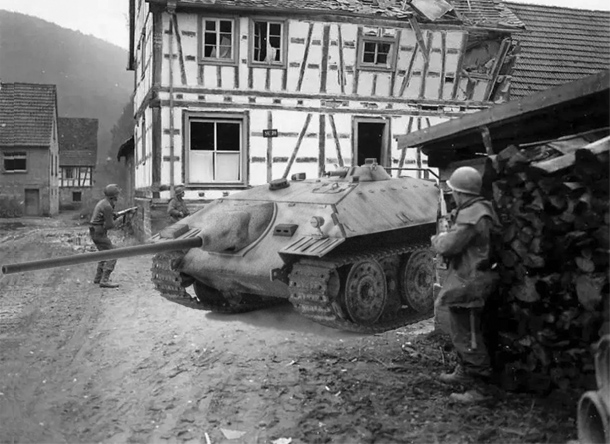
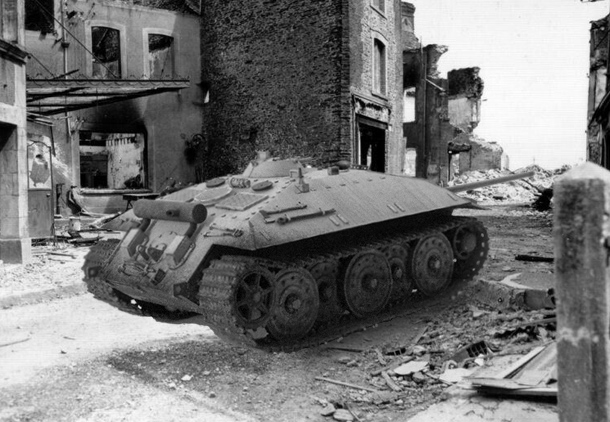
American soldiers cautiously search the area around an abandoned E-25 in a captured German village. Background: internet (public domain), plastic model: Vincent Dethoor (panzervoran.blogspot.com), composite image: Panzernet
Vehicle Description
The hull shape bore a faint resemblance to that of the Jagdpanzer 38(t) Hetzer. Both the upper and lower sections of the front plate were 50 mm thick, angled at 50° and 55° respectively. The side and rear walls were 30 mm, while the hull floor and roof were both 20 mm. The vehicle's total length without the gun was calculated at 566 cm, height at 203 cm, and width at 341 cm — yes, you read that correctly, 341 cm. This exceptional width was a result of the engine being mounted transversely across the hull rather than lengthwise, combined with the already-mentioned wide tracks. Even so, the E-25 would still have fallen within the maximum width permitted for rail transport. The powerplant was to be the same as on the lighter E-10 — either the Maybach HL 100 producing 400 horsepower, or the HL 101 with 550 horsepower — paired with a new semi-automatic gearbox being developed by Zahnradfabrik.
The E-25 project underwent an army review in January 1945. Although the final armament and powerplant had still not been decided upon, the review approved continuation of development and the construction of several evaluation prototypes. According to post-war testimony from Ing. Kniepkamp, the firm Alkett had completed three armoured hulls for the E-25 by the end of the war — though none were found when the factory was captured. One final point worth mentioning: the E-25 is frequently depicted with a small machine gun turret on the roof of the fighting compartment, including in the plastic model kits used for the composite images in this article. No such turret appears anywhere in the official project documents, however, and it is most likely an error — possibly a confusion with Professor Porsche's Schwerer kleiner Panzerkampfwagen project.

ARTICLE
CONTENTS:
Reproducing text from the Panzernet website without the written consent of the operator is prohibited.