DUBNO 1941
the Soviet attempt to halt the German Panzergruppe 1
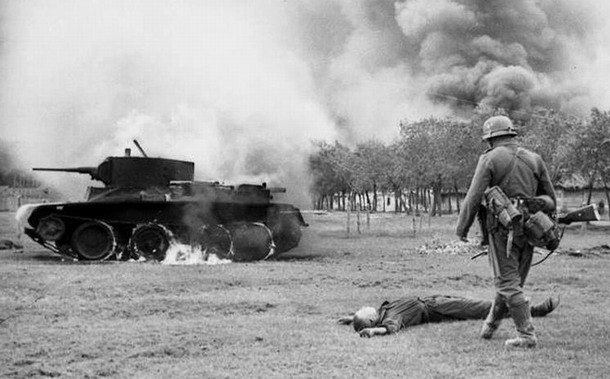
a burning Soviet BT-5 tank and one unfortunate member of its crew, source: Bundesarchiv_Bild_101I-020-1268-36, Wikimedia, Creative Commons, edited
Introduction
On 22 June 1941, around three o'clock in the morning, German forces crossed the borders of the Soviet Union and launched the gigantic operation codenamed Barbarossa. For the invasion of the USSR, the Germans divided their forces into three army groups, tasked with covering a front nearly two thousand kilometres long, stretching across the entire continent from the Baltic to the Black Sea. Army Group North (Heeresgruppe Nord) set out from East Prussia with orders to destroy Soviet forces in Lithuania, Latvia and Estonia, and to advance toward Leningrad. Army Group Centre (Heeresgruppe Mitte) was based in Polish territory and its primary mission was to encircle and annihilate Soviet forces in Belorussia and push toward Smolensk and possibly Moscow. Army Group South (Heeresgruppe Süd) was responsible for the longest section of the front and was tasked with eliminating Soviet forces in Ukraine and capturing Kyiv.
Of the actions that followed in the first days after the German crossing of the Soviet border, the one that entered general consciousness most prominently was the famous encirclement operation near Minsk, carried out by units of Army Group Centre. The fighting that took place in those same days on Army Group South's sector tends to be mentioned only briefly, under the blanket term "border battles." And yet it was precisely here, in northwestern Ukraine, that a tank engagement unfolded which many historians regard as the largest in the entire Second World War — and indeed in all of recorded history up to that point.
At this point, the reader will likely pause and think: surely the greatest tank battle of all time was the Battle of Kursk in July 1943 — everyone knows that! But how exactly does one define the greatest tank battle of all time? Presumably by the number of tanks involved — but does that mean how many entered the fight, or how many were destroyed? And how do you draw the boundaries of such a battle in time and space? Both the Ukrainian fighting and Kursk were spread over multiple days and multiple locations. Let us leave the comparison open for now and instead look at what was actually happening in late June 1941 in the area of the German Army Group South and the Soviet Southwestern Front.
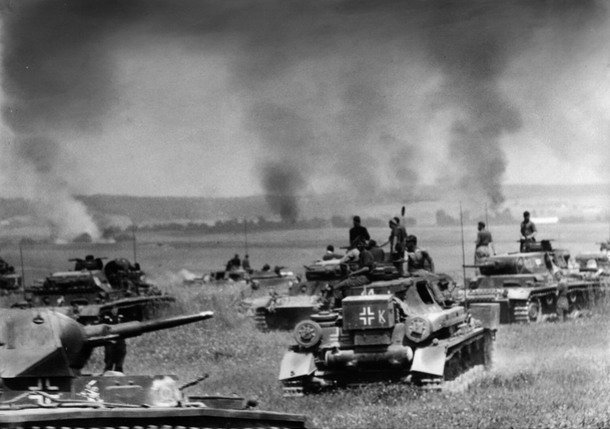
PzKpfw III and PzKpfw IV tanks of the 11th Panzer Division advancing through Ukraine; the letter K refers to their affiliation with the Panzergruppe of Generaloberst von Kleist, source: Flickr.com with permission of the publishing user, edited
German Forces
It is the night before Sunday, 22 June 1941, and the German Army Group South stands at full combat readiness on the borders of the Soviet Union. The commander of this formation, numbering 972,000 men, is Field Marshal Gerd von Rundstedt. The primary striking force of Army Group South was the 1st Panzer Group (Panzergruppe 1), led by Generaloberst von Kleist. Panzergruppe 1 comprised three motorised corps (III, XIV and XLVIII) and had five panzer divisions at its disposal (9th, 11th, 13th, 14th and 16th Panzer Division). The total tank strength of Panzergruppe 1 stood at 728 machines. Of these, 211 were light PzKpfw II and 355 were medium PzKpfw III (of which 100 were equipped with the older 37 mm gun and 255 with the newer 50 mm gun). There were also an even hundred of the medium PzKpfw IV, 54 command tanks, and even 8 examples of the obsolete light PzKpfw I (some authors suggest considerably more of these were actually deployed). In addition to tanks, the group also had assault guns StuG III, tank destroyers Panzerjäger I and self-propelled guns Sturmpanzer I. According to some authors, these together amounted to a further 180 armoured vehicles.
The German command identified three main axes of advance for the armoured units of Army Group South. These so-called "Panzerstrassen" (literally tank roads or tank highways) followed existing roads or gentler terrain, so that not only large numbers of armoured vehicles but also the enormous supply convoys behind them could pass through without difficulty. The northern Panzerstrasse began at the border village of Ustyluh and led through the town of Volodymyr-Volynskyi toward Lutsk, Rivne and further east to Zhytomyr and Kyiv. This route was taken by the units of the German III Motorised Corps, including the 14th Panzer Division. The central route passed through the villages and towns of Sokal, Radekhiv and Berestechko, continuing toward Dubno, Ostroh and Zhytomyr, where it merged with the northern route. This was the designated axis for the German XLVIII Motorised Corps, which included the 11th Panzer Division among others. The third and southernmost Panzerstrasse ran from the border village of Rava-Ruska through Zhovkva, skirting north of Lviv, to Ternopil and then in the direction of Khmelnytskyi and Vinnytsia. This route was assigned to the XIV Motorised Corps, which included the 9th Panzer Division.
Soviet Forces
Facing Army Group South were the units of the Soviet Southwestern Front (or more precisely, its predecessor, the Kiev Special Military District). The front commander, Generaloberst Mikhail Petrovich Kirponos, had 907,000 soldiers at his disposal. In terms of manpower he was thus broadly comparable to his opponent, but he had a far greater number of tanks. How many exactly is a matter of some debate among sources, with figures ranging from around 4,500 to over 5,400 tanks — meaning the Soviet tank superiority in this sector was sixfold to sevenfold. It is true that nearly three quarters of that total consisted of light tanks of the BT and T-26 types in various sub-variants. Nevertheless, the force also included around five hundred modern medium T-34 tanks and roughly 250 heavy tanks of the KV-1 and KV-2 types, which far outclassed all their German counterparts in both armour and firepower. For the sake of objectivity, it should be noted that not all Soviet tanks were in serviceable condition at the time of the German attack.
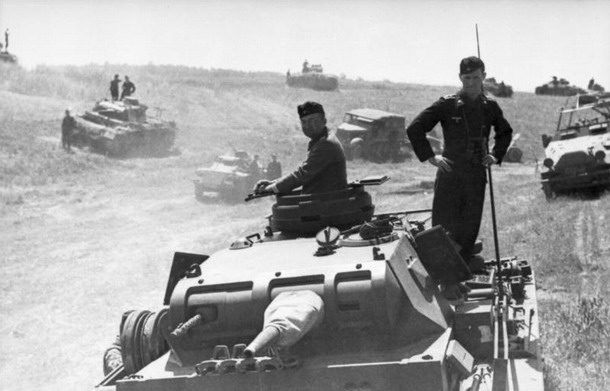
The 13th Panzer Division advancing through Ukraine in the early days of Operation Barbarossa; in the foreground is a Panzerbefehlswagen III command tank, source: Bundesarchiv_Bild_101I-185-0139-20, Wikimedia, Creative Commons, edited
For our purposes, however, let us focus on the five Soviet mechanised corps that will feature in the account of the enormous tank battle ahead. These were the 8th, 9th, 15th, 19th and 22nd Mechanised Corps. The strongest on paper was the 8th Mechanised Corps, which on the fateful day found itself near the town of Sambir, southwest of Lviv and well outside the main German axes of advance. This corps boasted an impressive 858 tanks (some sources cite as many as 899). Yes, it is true that 277 of them were BT types and 344 were T-26 — light and far from modern machines. But it also had 100 tanks of the T-34 type and 71 of the KV-1, which on their own represented enormous striking power. The corps also reported over 80% of its vehicles as mechanically fit.
Another very powerful formation was the 15th Mechanised Corps with 716 tanks (higher figures also exist in some sources). Light BT-7 tanks dominated its inventory with 471 vehicles, but there were also 72 medium T-34 and 64 heavy KV. This corps was based north of Ternopil, near the town of Brody. The 22nd Corps was also reasonably strong, with 707 tanks, though the vast majority were light T-26 vehicles. It had just 31 heavy tanks in total, specifically of the KV-2 type. On the day of the German attack, the 22nd Mechanised Corps was located north of Lutsk, roughly 90 kilometres from the border.
Each of these three Soviet corps thus had on its own a tank strength comparable to the entire German Panzergruppe 1. The remaining two Soviet mechanised corps were somewhat weaker. The 19th Mechanised Corps had a total of 450 tanks. Of these, 291 were T-26, five were KV-1 and two were T-34. The remaining 152 were of the T-37 type — a light amphibious machine armed only with a machine gun and of negligible combat value. This corps was part of the Soviet reserves and was therefore situated more than three hundred kilometres from the western border, dispersed across the area between Zhytomyr, Berdychiv and Vinnytsia. The last corps relevant to this article was the 9th. This formation had only 296 tanks, all of them light types — T-26, BT and T-37. It was garrisoned in its barracks approximately 240 kilometres from the border, in the towns of Shepetivka and Novohrad-Volynsky. It should also be mentioned that the battle we are examining also involved one tank division from the 4th Mechanised Corps, which numbered somewhere in the region of three hundred tanks.
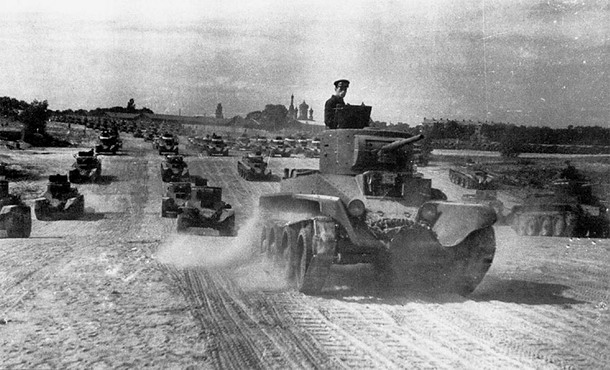
In June 1941 the Red Army had enormous numbers of tanks, but most of them were light types such as these BT-5s, source: Flickr.com with permission of the publishing user, edited
The enormous disparities in strength between individual Soviet corps were a result of the fact that in June 1941 these formations were still in the process of being built up. Their creation had begun in 1940, with the aim of raising a total of 30 mechanised corps, each with a planned strength of 1,031 tanks — meaning 30,930 tanks in total, of which more than half were to be medium T-34 and heavy KV types. By June 1941 this programme was nowhere near complete, yet the Red Army still had somewhere between 23,000 and 24,000 tanks at its disposal. Even though most of them were light and not particularly modern, the Soviet Union almost certainly possessed more tanks than the rest of the world combined.
In addition to tanks, which were primarily an offensive weapon, the Soviets naturally also thought about defending their country and placed considerable faith in static fortifications. Construction of defences along the western border of the USSR had been ongoing since the 1920s, and the resulting network became known unofficially as the Stalin Line. After Soviet territory expanded westward following 1939, however, this line lost much of its relevance, and the Soviets began constructing a new line of fortifications along the new western border — the so-called Molotov Line. When the German attack came in June 1941, Russia found itself in an awkward situation: the original Stalin Line had been largely abandoned and left unmaintained, while the new Molotov Line was not even half finished, let alone equipped, armed and manned. The Molotov Line fortifications were situated about two kilometres from the border. When the Germans reached them, they were met with resistance mostly from engineering units that were still working on the defences. At the cost of near-total self-sacrifice, Soviet soldiers managed to delay the German advance along this line by roughly two hours, though some individual bunkers held out for several more days.
22 June 1941
Well before dawn, in the deep of night, special German commando units dressed in Soviet uniforms and equipped with Soviet vehicles and weapons — all captured from the Red Army during the Winter War and willingly shared by the Finns — crossed into Soviet territory. Their mission was to seize intact the key bridges over the border rivers Bug and San by means of deception, and they succeeded. At 3:30 a.m. German artillery opened up along the entire Soviet border, showering mostly still-sleeping Soviet soldiers with fire. Shortly afterwards, around three quarters of a million soldiers of Army Group South surged forward from Polish territory. Much further south, along the Romanian-Soviet border, the remaining elements of Army Group South held their positions for the time being, guarding the approaches to the Romanian oil fields against any potential Soviet counterattack.
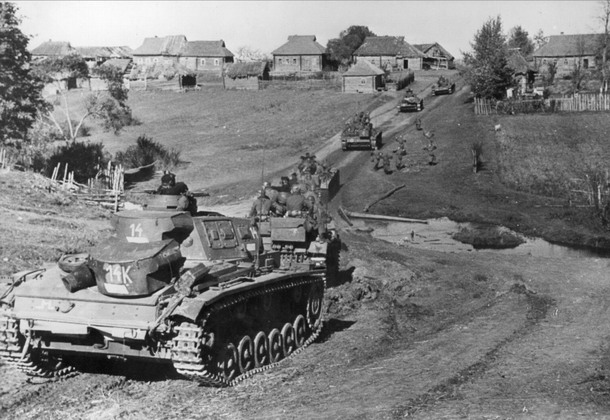
A column of PzKpfw III tanks from von Kleist's Panzergruppe 1 passing through a Ukrainian village, source: Flickr.com with permission of the publishing user, edited
On the Soviet side, the first hours of the German attack were characterised by utter chaos. It was a Sunday, the army was not on a war footing, and many commanders were not even with their units. A large proportion of formations had lost communications, leaving them unable to receive any orders — German bombing raids had severed telephone lines in many places, and radio communication was not yet widespread in the Red Army. In such circumstances, commanders broke open their sealed envelopes containing secret contingency instructions for wartime and acted accordingly. These instructions had of course been written in advance and bore little relation to the actual situation. As a result, it was possible for something like the following to happen: the Soviet 41st Tank Division, commanded by Colonel Pavlov, set out from its barracks near Volodymyr-Volynsky (a mere 12 kilometres from the border) not westward toward the front, but in the opposite direction — northeast toward the town of Kovel, which was the assembly point specified in the sealed orders.
The only larger Soviet units to mount a counterattack on the first day were the 87th and 124th Rifle Divisions, largely thanks to the initiative of their commanders. The first of these moved from Volodymyr-Volynsky toward Ustyluh, against the German III Motorised Corps (which comprised the 298th and 44th Infantry Divisions and the 14th Panzer Division). The Soviet infantry was supported by around fifty T-26 tanks, generously "lent" by the aforementioned Colonel Pavlov before he marched his 41st Tank Division away from the front. These tanks entered the fighting somewhere between 9 and 11 in the morning, and it was probably the only notable tank engagement of the day. Within a few hours, however, most of the fifty Soviet tanks had been lost and the remainder pulled back.
Stalin and the Red Army high command were demanding situation reports from the Southwestern Front. The Front staff, however, had little information to offer, and its commanders appear to have been reluctant to be the bearers of bad news. As a result, the report dispatched to Moscow around 3 p.m. significantly underestimated the strength of the German attack — and this would soon come back to haunt the Southwestern Front's leadership. The headquarters spent the entire day desperately trying to piece together a picture of the situation with only fragmentary intelligence to go on. Nevertheless, the sector toward the town of Radekhiv was identified as the most threatened, where the German 11th Panzer Division was advancing rapidly. Front commander Generaloberst Kirponos therefore intended to focus his attention on that area.

Light Panzer II tanks from von Kleist's Panzer Group, source: Flickr.com with permission of the publishing user, edited
The Soviet Counterattack Plan
Between ten and eleven o'clock that evening, however, Kirponos received an order from the Red Army high command. Moscow was apparently basing its assessment on the earlier, overly optimistic afternoon report and had formed the impression that only around ten to fifteen German divisions were attacking the Southwestern Front. The high command therefore ordered the Front to immediately launch a general counterattack, destroy the attacking enemy forces, and penetrate as far as the town of Lublin — some 100 kilometres deep into what had once been Polish territory — no later than 26 June. The commanders of the Southwestern Front could barely believe what they were reading. The idea of capturing Lublin was, under the circumstances, utterly absurd (purely for the record: Lublin was not taken by the Red Army until three years later, on 24 July 1944).
Behind Kirponos stood the uncompromising political commissar of the Front, Nikolai Vashugin, who would not entertain any thought of disobeying Stalin's order. Kirponos tried to explain that it would take several days to concentrate sufficient forces for such a large-scale counterattack and that in the meantime the Front should remain on the defensive and buy time. He was overruled, and so he began planning the ordered counterattack, even though he personally considered it senseless. Kirponos's plan called for six mechanised corps: the 4th, 8th and 15th were to attack on the southern wing, while the 9th, 19th and 22nd would strike on the northern wing. The attack was scheduled to begin the following day (23 June) at 10 p.m. Never mind that most of the designated units were at that moment several days' march away from their intended start positions — the relevant corps were simply issued orders to move up to their jumping-off points with all possible speed.
In the meantime, the Germans had managed to bypass the only significant Soviet units offering resistance — the 87th and 124th Rifle Divisions — between Ustyluh and Sokal. By the end of the first day of fighting (22 June), the Germans had taken Volodymyr-Volynsky and were preparing to push toward Lutsk the following day. Further south, Sokal had also fallen, and the spearheads of the 11th Panzer Division had pushed roughly 35 kilometres into Soviet territory. Around 11 p.m. the 11th Panzer Division halted near the small town of Stoyaniv, just 9 kilometres north of Radekhiv.
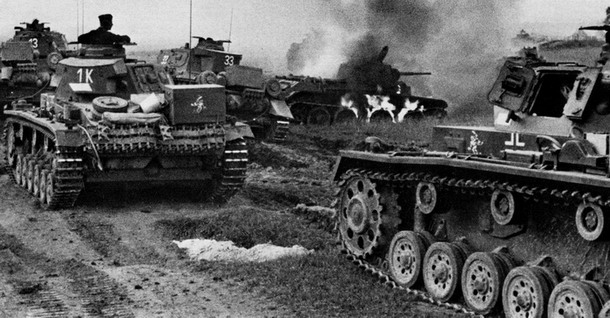
The armoured spearheads of the 11th Panzer Division pressing forward past a burning wrecked BT-7 light tank, source: Flickr.com with permission of the publishing user, edited
23 June 1941
The second day of Operation Barbarossa. After a brief rest, the German soldiers were on the move again at 3:30 a.m. The commander of the 11th Panzer Division, Generalmajor Crüwell, split his division into two battle groups: one pushed east toward Berestechko, the other south toward Radekhiv. Radekhiv was an important transport hub that the Germans needed for their future supply lines. The designated elements of the 11th Panzer Division reached the town at 5:30 a.m. At that moment, only a small part of the Soviet 32nd Tank Division from the 4th Mechanised Corps was in Radekhiv. From the south, however, part of the 10th Tank Division belonging to the 15th Mechanised Corps was already moving toward the town. A clash of German and Soviet armour near Radekhiv was about to begin.
Let us briefly recall the order the Soviet mechanised corps had received the previous evening from high command in Moscow. They were to move immediately to their assembly areas and prepare to launch a counterattack. Moscow was not willing to wait — Moscow wanted to attack. The movement of Soviet units therefore proceeded at a frantic pace. Tank formations were of course the fastest, able to move under their own power without being dependent on roads. Artillery and infantry were another matter. Soviet artillery relied on outdated and slow tractors and was left far behind the advancing tanks. The infantry, meanwhile, mostly had to march to the assembly areas on foot, since Soviet units did not maintain sufficient numbers of trucks in peacetime (civil trucks were supposed to be requisitioned in the event of mobilisation, but there was no time for that now). The Soviet tank spearheads thus arrived at Radekhiv without the support of their own artillery.
The German 11th Panzer Division, by contrast, had strong artillery support, and with its help the Germans were able to put the Soviet forces in Radekhiv under heavy pressure. Fearing encirclement if they remained inside the town, the Soviet defenders moved out during the afternoon to engage the Germans and launched a powerful tank counterattack north of Radekhiv. Their main striking force was the 10th Tank Division of the 15th Mechanised Corps. The manner in which the attack was executed, however, left much to be desired. Without the support of their own artillery, the Soviets sent as many tanks as possible across open ground, which was moreover marked by a large terrain ridge. Thanks to aerial reconnaissance, the Germans knew that a substantial number of tanks had moved up from the south toward Radekhiv and were ready for the Soviet counterattack. They took up favourable positions approximately 400 metres from the ridge and waited.
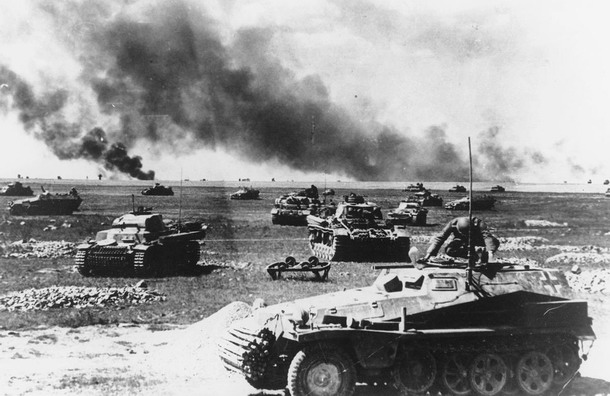
Armoured formations of Army Group South advancing through the Soviet countryside, source: Flickr.com with permission of the publishing user, edited
The Soviet tanks rolled downhill, firing furiously as they went. They then disappeared briefly from German view behind the terrain ridge before reappearing on its crest, directly in front of the German guns. The result was a massacre. Over thirty Soviet tanks were left burning on the battlefield — German sources give the figure as 33, Soviet sources say 37. Most were light T-26 tanks, but among the wrecks were also 6 of the modern T-34. As for German tank losses at Radekhiv, Soviet sources cite 18 to 20 destroyed vehicles, while German sources claim only 7 (in theory, 18 to 20 may well have been knocked out, but perhaps only 7 proved irreparable). After this failed counterattack the Soviet 10th Tank Division was forced to withdraw, but the town of Radekhiv itself was held for the time being.
The large Soviet counteroffensive with six mechanised corps (4th, 8th and 15th from the south, 9th, 19th and 22nd from the north) had been scheduled for 10 p.m. on this day — 23 June. When Front commander Kirponos and commissar Vashugin sat down together over the map, however, they had to acknowledge that only a fraction of the intended forces had reached their starting positions (what a surprise). The 4th Mechanised Corps had been drawn into defensive fighting in its own sector west of Lviv and had not moved toward its designated assembly area at all. The 8th Mechanised Corps was on the march from Lviv but was significantly behind schedule, having lost much of the previous day to confused and aimless back-and-forth movements. The 15th Mechanised Corps was the closest to its objective. On the northern axis, the 22nd Mechanised Corps was nearest to the enemy, while the other two (the 9th and 19th) were still on the road from the east. But commissar Vashugin regarded the Moscow order as sacrosanct and insisted that the Southwestern Front must attack. It was therefore decided that the attack would go ahead regardless, even if this meant committing far fewer forces than originally planned.
New Soviet Plan
Even Vashugin himself, however, acknowledged that capturing Lublin as Moscow had ordered was entirely beyond the Front's capabilities, and the Soviet counterattack was given a completely new objective: destroying the spearheads of the German advance on the two most critical axes. In the north, that meant the direction of Lutsk (the northern Panzerstrasse), where the 13th and 14th Panzer Divisions were pushing forward. Further south, it was the central Panzerstrasse, along which the 11th Panzer Division was rolling from Radekhiv toward Berestechko. The new plan was approved by two representatives of the high command who had arrived at Kirponos's headquarters from Moscow to oversee proceedings: Chief of the General Staff of the Red Army Georgy Zhukov and Stalin's political representative Nikita Khrushchev.
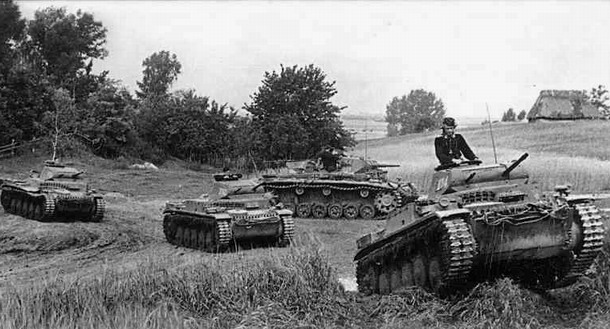
PzKpfw II and PzKpfw III tanks of Panzergruppe 1, source: Waralbum.ru with permission of the operator, edited
Under the revised plan, the Soviet counterattack was no longer to be a two-pronged encirclement but rather two parallel strikes against the German forward formations. In the north, the Soviet 135th Rifle Division and the 22nd Mechanised Corps (specifically its 19th Tank Division and 215th Motorised Rifle Division) were to attack, supported by the 1st Anti-Tank Artillery Brigade and the 406th Artillery Regiment. The northern strike was to be launched from Lutsk in the direction of Volodymyr-Volynsky. The parallel attack in the south was to be directed from Brody toward Berestechko, with the 15th and especially the 8th Mechanised Corps providing the main force. The 15th could commit its 37th Tank Division and part of its 10th Tank Division (the rest of the 10th was holding the line at Radekhiv). The 8th Mechanised Corps was a different matter: it was still making its way up from Lviv to the assembly area. Although it was the strongest Soviet formation on paper and the Front's command placed great hopes in it, it would not be ready in the designated area until the following day — 24 June — in the morning. The plan itself was essentially ready, but its fundamental weakness was a simple fact: not even the specifically selected units could actually begin the attack at 10 p.m. Commissar Vashugin therefore reluctantly agreed to a slight postponement, moving the start time to the following day, 24 June, at four in the morning.
How did the Germans end the second day of fighting? While part of the 11th Panzer Division was fighting at Radekhiv, the rest pressed on from Stoyaniv eastward and southeastward. By the end of the day (23 June), the forward elements of the 11th Panzer Division had reached the towns of Lopatyn and Berestechko, roughly 70 kilometres inside Soviet territory. A little further north, the Germans had a firm hold on Volodymyr-Volynsky, and the spearheads of the 14th Panzer Division were standing at the village of Voinytsia, around 40 kilometres into Soviet territory (note: the name Voinytsia is consistently given in various sources, but no such village appears on modern Ukrainian maps; it is most likely the village now known as Vynytsia — not to be confused with the city of Vinnytsia).
24 June 1941
The morning of 24 June. The Soviet 19th Tank Division (part of the 22nd Mechanised Corps) still was not ready for the counterattack planned for 04:00. Without this division, the northern strike would be too weak, and so commissar Vashugin (presumably through gritted teeth) agreed to yet another postponement until the afternoon. But the enemy was not inclined to wait for anyone. Around 8 a.m., advancing German motorised infantry belonging to the 14th Panzer Division ran into the Soviet 135th Rifle Division north of the village of Vynytsia, where it had already been concentrating for its upcoming action. The Germans managed to catch this division off guard and pushed it back five to six kilometres to the east. The Soviets could not delay their attack much longer. Around 1 p.m., the first elements of the long-awaited 19th Tank Division finally appeared in the assembly area — just 45 T-26 tanks and 12 BA-10 armoured cars, but there was no waiting for the rest of the division. The Soviet attack in the north began at 14:00, with additional tanks of the 19th Tank Division to join the battle as they arrived.
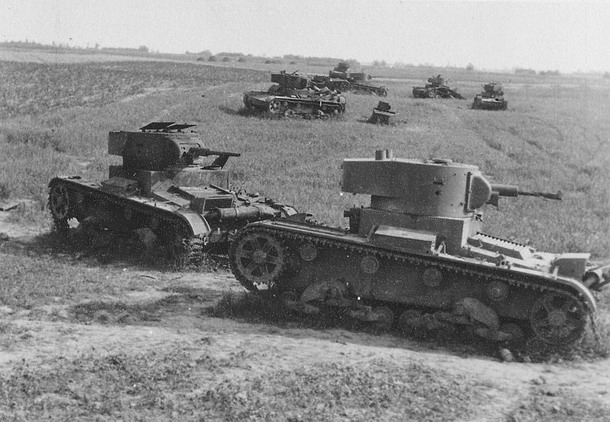
Destroyed T-26 tanks — the result of the failed counterattack by the 19th Tank Division of the 22nd Mechanised Corps near the village of Vynytsia, source: Wikipedia, Public Domain, edited
The German infantry was initially caught off guard by the Soviet attack and began to fall back, withdrawing roughly 6 kilometres to the line Lokachi–Vynytsia. Here, however, it was joined by tanks of the 14th Panzer Division, and together they turned and faced the Soviet assault with determination. Over the following two and a half hours, a classic tank-versus-tank battle raged east of the village of Vynytsia. When it was over, 21 destroyed Soviet T-26 tanks lay on the battlefield. German losses amounted to just 6 tanks. The remaining Soviet vehicles broke off the attack and withdrew. Up to this point the sources we have drawn on are in reasonably good agreement. What followed, however, is subject to considerable dispute. According to one version, this was the sum total of what the Soviet 19th Tank Division accomplished that day, as it had no more tanks to commit. According to another version, this was merely the first round: more and more tanks from the division were arriving in the area and hurling themselves at the Germans almost straight off the march. Records of the German 14th Panzer Division reportedly state that the fighting near Vynytsia continued with intervals until the morning of the following day (25 June), after which German soldiers counted an astonishing 156 destroyed Soviet tanks on the battlefield. This figure need not be exaggerated, as the Soviet 19th Tank Division itself reported in the morning of 26 June 1941 that only 4 tanks remained (having started with 183 on 22 June).
The Soviet 19th Tank Division had in effect ceased to exist. Its commander was wounded in the fighting, and the commander of the entire 22nd Mechanised Corps was killed. German losses for the 14th Panzer Division are noted only as "heavy." The battle of Vynytsia was a showcase of Soviet command incompetence. The 19th Tank Division was equipped solely with light BT and T-26 tanks. In a direct frontal clash with the superior German Panzer III and Panzer IV, these Soviet vehicles were at a serious disadvantage due to their thin armour — yet their commanders drove them into suicidal frontal attacks with no trace of imagination or cunning, and to make matters worse, they committed them piecemeal rather than in one concentrated mass that might have had some chance of breaking through.
The other Soviet units committed to the northern thrust fared similarly. The 135th Rifle Division and the 1st Anti-Tank Artillery Brigade both suffered heavy losses at the hands of the German 13th Panzer Division and were forced to fall back toward Lutsk. The German 13th Panzer Division itself also bled significantly. At first glance, the Soviet northern counterattack was a fiasco. And yet the truth is that the advance of both German panzer divisions was halted for essentially an entire day because of it, buying the Soviets time to strengthen the defences of Lutsk.
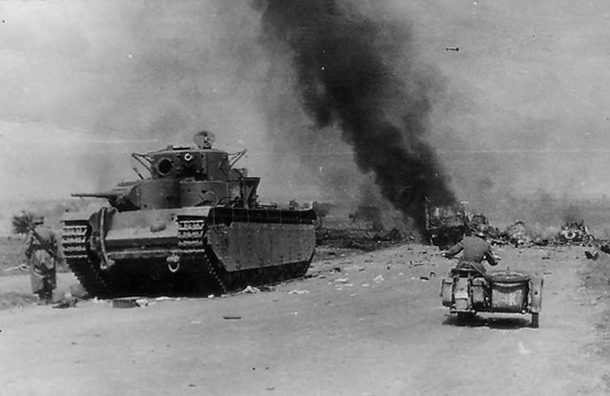
The route of Panzergruppe 1's advance was literally lined with Soviet tank wrecks — here a heavy T-35, source: Worldwarphotos.info with permission of the operator, edited
What about the second Soviet axis of attack? The 8th and 15th Mechanised Corps were to strike from the south, directed from Brody toward Berestechko, with the aim of cutting off the spearhead of the German 11th Panzer Division. The powerful 8th Mechanised Corps, however, was still making its way up from Lviv — a very long journey. Since it was intended to be the main striking force on the southern axis, beginning without it made no sense. The start of the attack was therefore postponed while everyone waited. Time passed, the evening of 24 June came, and the 8th Mechanised Corps was still nowhere to be seen. Front command deliberated on how to proceed. Kirponos proposed waiting one more day, but Zhukov disagreed. The decision was taken: the southern attack would begin on 25 June at 7 a.m. with whatever parts of the 8th Mechanised Corps had managed to arrive by then.
While the Soviets waited on the southern axis, the German 11th Panzer Division was anything but idle. Its engineers repaired a damaged bridge over the Styr river east of Berestechko, allowing the German tanks to push further east toward Dubno. The forward elements of the 11th Panzer Division thus advanced roughly 40 kilometres during 24 June and reached the village of Verba, approximately 20 kilometres southeast of Dubno. Around noon, the fresh 16th Panzer Division set off from the Soviet border and advanced in the tracks of the 11th, ready to help it extend its drive along the central Panzerstrasse.
25 June 1941
The fourth day of Operation Barbarossa. The staff of the Soviet Southwestern Front was frantically trying to gather news about the condition of its mechanised corps, which were supposed to attack that morning. In the north, the remnants of the 19th Tank Division (from the 22nd Mechanised Corps) were retreating after being decimated in the fighting near Vynytsia. The other two mechanised corps assigned to this axis (the 9th and 19th) were still marching toward their assembly area, located roughly 10 kilometres southeast of Lutsk, around the village of Horodok. The closest units were: the 131st Motorised Division from the 9th Mechanised Corps, which was approaching Lutsk from the east via Rivne; the 35th Tank Division from the 9th Mechanised Corps, whose forward elements had reached the town of Olyka some 30 kilometres east of Lutsk; and the 40th Tank Division from the 19th Mechanised Corps, whose forward units were approximately 15 kilometres east of Mlyniv, roughly 30 kilometres southeast of Lutsk. Not a single one of these divisions was ready to attack.
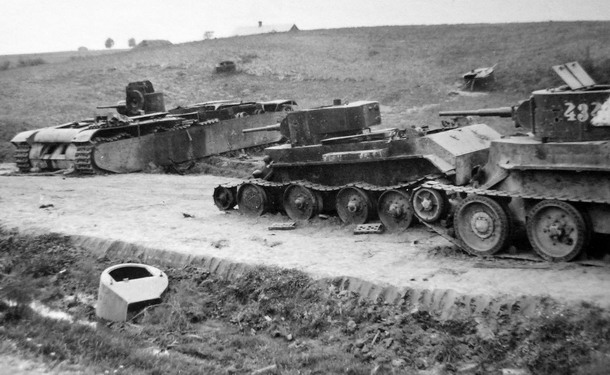
Another road scattered with Soviet wrecks — the heavy T-35 here was apparently torn apart by an ammunition explosion, with the turret wreckage strewn around it, source: Worldwarphotos.info with permission of the operator, edited
The situation on the southern axis, where the 8th and 15th Mechanised Corps were to attack, looked no better. The 15th Corps reported that it could only commit a fraction of its forces (part of its men were still holding the line at Radekhiv and the rest were worn out after spending the previous day marching back and forth between Lopatyn, Leshnyv and Brody). The 8th Mechanised Corps reported that it would be able to commit its two tank divisions (the 12th and 34th) to the attack, but would not be ready in the assembly area until the following morning (26 June).
There was nothing to be done — attacking on 25 June was simply impossible because there was nothing to attack with. The Germans had no such problem and pressed forward relentlessly. During the afternoon they occupied the area east of Lutsk, depriving the 9th and 19th Mechanised Corps of the very assembly area from which their long-delayed attack was supposed to launch. Soviet defenders began hastily withdrawing from the threatened city of Lutsk northward toward Rozhyshche. Lutsk was left undefended, and in the late afternoon of 25 June the German 13th Panzer Division entered it victoriously.
The town of Rozhyshche became a magnet not only for the Lutsk defenders but also for other Soviet units retreating from the west in front of the German tanks. As a result, an enormous mass of soldiers and equipment accumulated there, drawn from the following formations among others: the 135th Rifle Division, the 1st Anti-Tank Artillery Brigade, and the 19th Tank Division of the 22nd Mechanised Corps. For the most part these were survivors of the units mauled at Vynytsia, and they had a single goal: to reach the far bank of the Styr river before the Germans arrived at Rozhyshche.
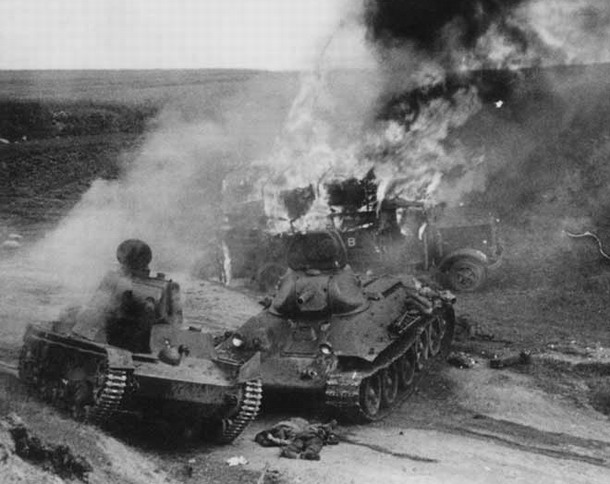
The images of destruction of the Soviet mechanised corps seemed endless — here wrecks of T-34s and T-26s in the flamethrower version, source: Worldwarphotos.info with permission of the operator, edited
The retreating Soviet soldiers found an unpleasant surprise waiting for them in Rozhyshche. There was only one usable bridge left — and it was a railway bridge at that. Everyone pressed forward desperately, trying to reach the relative safety of the far bank. On the railway bridge, lorries and cars, artillery tractors, horse-drawn wagons, armoured vehicles and infantry all became hopelessly intermingled. Panic erupted. Horses tripped on the railway sleepers and lay on the ground with broken legs; soldiers threw away their weapons and equipment and jumped over the sides of the bridge into the water to avoid being trampled. Within moments the bridge was completely blocked, impassable in either direction. Order was only restored when the commander of the 1st Anti-Tank Artillery Brigade, Major General Moskalenko, sent two KV-1 heavy tanks onto the bridge. These crushed and shoved aside everything in their path with their tracks, including the wounded horses. Once all the soldiers were across, Soviet engineers blew up the bridge.
Equally dramatic events were unfolding along the central Panzerstrasse. The spearheads of the German 11th Panzer Division were continuing to push eastward. The reconnaissance battalion of this division first seized the town of Mlyniv, located between Dubno and Lutsk, then pressed on toward Dubno from the north. A second German formation, advancing from the village of Verba, simultaneously attacked Dubno from the south. At 14:00 the 11th Panzer Division reported that Dubno had been taken.
Yet Another New Soviet Plan
The unexpected speed of the German advance was wrecking Soviet plans even before they could be put into action. The Soviets were aiming at a moving target that was moving faster, and in a different direction, than anticipated. The Southwestern Front command was therefore forced to revise its counterattack plan yet again. The 9th and 19th Mechanised Corps received new orders, now tasked with attacking the freshly captured towns of Mlyniv and Dubno, driving out the German forces and retaking both. The 8th and 15th Mechanised Corps were to strike simultaneously from the south and southwest in the direction of Berestechko and Dubno.
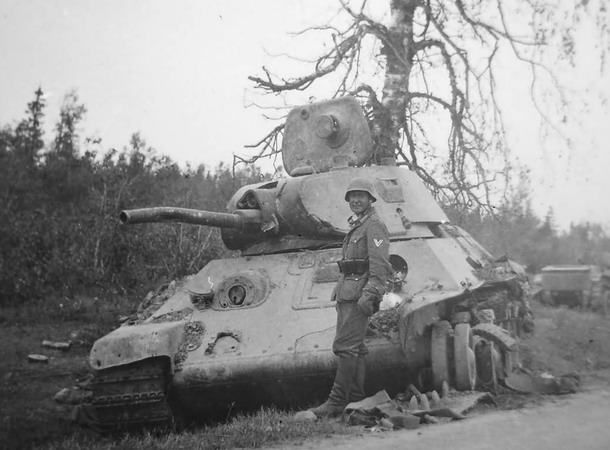
German tank guns were unable to penetrate the armour of the modern T-34, but concentrated sustained fire would eventually find something critical — and this is what that looked like: the ground around the tank is churned up and the tank itself is battered by the blast waves of numerous explosions, source: Worldwarphotos.info with permission of the operator, edited
The overall concept of the Soviet counterattack had changed once again. The northern and southern axes were now to function as two jaws of a great pair of pincers, intended to meet somewhere in the vicinity of Dubno and cut off the powerful German forward formations — not just those of the 11th Panzer Division. The entire attack was now concentrated on the enemy advancing along the so-called central Panzerstrasse, where the Germans had achieved the greatest successes and where the situation had become most critical for the Soviets. After just four days of operations, the forward elements of the 11th Panzer Division stood some 120 kilometres inside Soviet territory. The Southwestern Front command was also growing concerned that this German spearhead might now turn south and drive toward Ternopil, thereby cutting off all Soviet forces in the Lviv area in an enormous flanking manoeuvre (even though German intentions were in fact entirely different). The revised Soviet attack was set for 9:00 a.m. on 26 June.
26 June 1941
After several postponements and plan revisions, the day of the Soviet counterattack had finally arrived. Four Soviet mechanised corps were preparing to go into action. Despite the enormous losses these formations had sustained over the preceding days of long marches, fighting and attacks by the German Luftwaffe, they still had enough strength to cut off and destroy the spearhead of the German forces racing along the central Panzerstrasse. But first, let us look at how the Germans began this day.
Along the northern Panzerstrasse, part of the German 14th Panzer Division occupied Rozhyshche (north of Lutsk), through which the remnants of retreating Soviet units had been streaming to the far bank of the Styr the previous day. The rest of the 14th Panzer Division and its sister formation, the 13th Panzer Division, set out from Lutsk further eastward toward Rivne. Here, however, they ran into the Soviet 131st Motorised Division from the 9th Mechanised Corps, which put up a resolute defence. The Germans were in a hurry and had no interest in spending the day in costly frontal fighting. The 13th Panzer Division therefore turned south to outflank the enemy, and a little further south resumed its eastward push through the village of Ostrozhets.
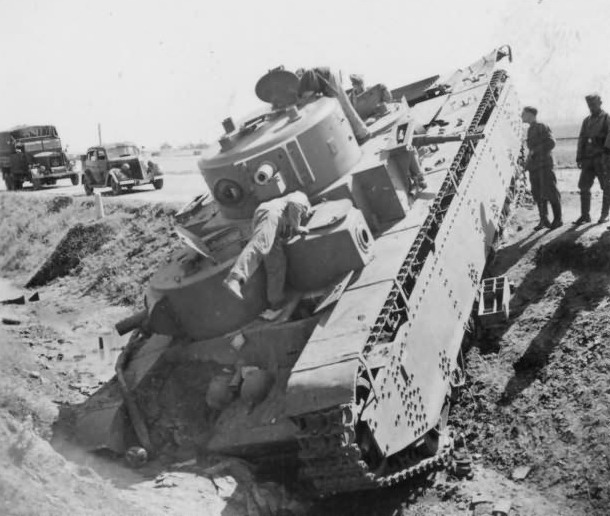
Most of the obsolete heavy T-35 tanks did not even survive the march to the front — this broken-down vehicle was apparently pushed into a ditch by the Soviets themselves to clear the road for other traffic, source: Worldwarphotos.info with permission of the operator, edited
Along the central Panzerstrasse, the 11th Panzer Division (split into two battle groups) continued its eastward drive from Dubno toward the town of Ostroh (the southward turn feared by the Soviets never materialised). Hot on the heels of the 11th Panzer Division came massive forces comprising three infantry divisions (the 111th, 299th and 75th Infanterie Division) and the 16th Panzer Division, none of which yet had any idea that four Soviet mechanised corps were about to strike them from two directions.
And the Soviet counterattack? Let us work through it systematically. From the north, the 9th and 19th Mechanised Corps were to attack together. As had been typical throughout the fighting thus far, the two formations had no contact with each other and were therefore unable to coordinate properly. The 19th Mechanised Corps committed its two tank divisions — the 40th and 43rd. On the day of the German invasion (22 June 1941), the first had 158 tanks on its rolls (of which 139 were the hopelessly obsolete T-37) and the second had 237 (of which 230 were light T-26). As for the actual number of tanks these two divisions sent into battle on 26 June, we have only been able to establish the figure for one of them — the 43rd Tank Division. It committed 79 tanks in total to the counterattack: 2 KV-1, 2 T-34 and the remaining 75 of the T-26 type. Those 79 vehicles represented only a third of the number the division had possessed barely a week earlier — though it must be borne in mind that over the previous five days the division had covered more than two hundred kilometres under its own power, which took a severe toll in breakdowns and abandoned vehicles.
Both tank divisions of the 19th Mechanised Corps launched their attack at 14:00 (the plan had called for 09:00) and advanced side by side. The 40th Tank Division's objective was Mlyniv, while the 43rd drove toward Dubno. They were accompanied by an infantry battalion from the 228th Rifle Division, which was also operating in the area, and had limited artillery support. The 43rd Tank Division engaged the enemy, most likely between the villages of Molodava and Varkivtsi, about ten to twelve kilometres northeast of Dubno. At the tip of the division's thrust, serving as a battering ram, were its four most modern and heaviest tanks — two KV-1 and two T-34. Behind them rolled 75 light T-26 tanks. Some sources claim the Soviet division managed to push all the way to the eastern outskirts of Dubno; others suggest the fighting raged around Varkivtsi all day. Either way, the 43rd Tank Division fought bravely until dusk before pulling back under threat of encirclement, never having taken Dubno. In the process it lost both its KV-1 heavy tanks and 15 light T-26 tanks. German losses are mentioned in sources only as 2 to 3 tanks destroyed at the very start of the fighting near Molodava, though actual German losses were probably higher. The 40th Tank Division appears to have fared very similarly; its losses are not recorded in the sources, but its attack was also called off at dusk.
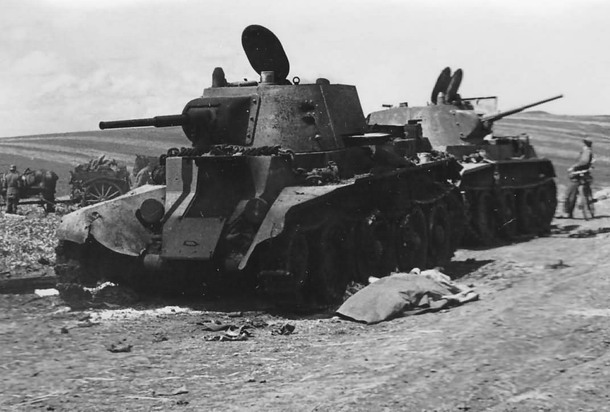
Light BT tanks made up nearly a third of all tanks available to the Soviet Southwestern Front, source: Worldwarphotos.info with permission of the operator, edited
The 9th Mechanised Corps also sent both of its tank divisions into action on 26 June — the 20th and 35th. The entire 9th Mechanised Corps was one of the weakest Soviet formations of its type. On the day of the German invasion, the two tank divisions together counted only 178 tanks, of which 142 were in the 35th Tank Division while the 20th had just 36. Not a single one was a modern T-34 or KV — they were all light T-26 and BT types. And that was the state on 22 June. By the time the attack was launched on 26 June, the 20th Tank Division could field around thirty tanks and the 35th managed to put slightly over a hundred into the fight. The rest had fallen victim to mechanical breakdowns and losses during the march to the assembly area. Armed with light tanks only, out of contact with the neighbouring 19th Corps, without adequate infantry and artillery support, the 9th Mechanised Corps did not rush blindly into the attack. It advanced cautiously, made virtually no territorial gains and quickly transitioned from offence to defence. By the end of the day, both of its divisions were holding positions east of Ostrozhets (roughly 15 kilometres north of Mlyniv), facing the German 13th Panzer Division.
The Soviet attack from the south promised somewhat better chances of success, as considerably stronger formations were committed here. The most powerful on paper was the 8th Mechanised Corps, which had counted 858 tanks on the day of the German invasion. Of these, 71 were heavy KV and 100 were modern T-34. But what condition was the corps in by 26 June, after having covered roughly 400 kilometres under its own power? Its commander, Generaloberst Ryabyshev, estimated that between 50 and 60 percent of his vehicles were still in running order. Not a single one of the corps' 49 heavy T-35 tanks had made it to the assembly area. And the bad news did not end there. The corps had only meagre artillery support, as most of its guns were either lagging far behind or had been destroyed by German air attacks during the march. Then there was the terrain over which the corps was to attack, which was threaded with several watercourses with very muddy banks.
Both tank divisions of the 8th Mechanised Corps (the 12th and 34th) set out from the Brody area northward and northeastward toward Berestechko and Dubno. Initially things went reasonably well. The Soviet 12th Tank Division covered roughly 15 kilometres and stood on the bank of the Slonivka stream near the town of Leshnyv. Here it encountered a smaller number of tanks from the German 16th Panzer Division that were moving through the area. The Germans put up some resistance but suffered heavy losses, fell back and cleared the way toward Berestechko. The situation was serious. The German command immediately began redirecting available forces toward the area south of Berestechko — specifically part of the 16th Panzer Division and the 57th Infanterie Division. These units hastily organised an improvised defensive line roughly 6 kilometres south of Berestechko.
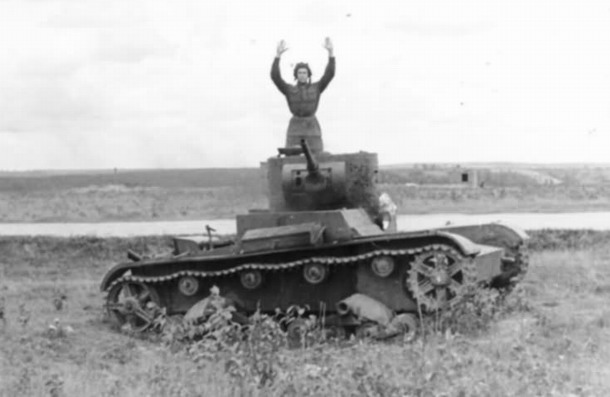
At the start of the German attack, the units of the Soviet Southwestern Front had nearly two thousand light T-26 tanks in their ranks — here one of them in an obviously staged photograph, source: Worldwarphotos.info with permission of the operator, edited
When the Soviet tanks arrived, a fierce battle broke out. Sources do not specify whether the German forces in this engagement had 88 mm anti-aircraft guns available. Only 37 mm and 50 mm anti-tank guns are mentioned, and these would have been powerless against Soviet T-34 and KV-1 tanks. Nevertheless, the Germans apparently succeeded in repelling the 12th Tank Division's assault, reportedly destroying 18 Soviet tanks in the process. The Luftwaffe then arrived and spent several hours attacking the Soviet tanks, artillery and supply vehicles. By the end of the day the 12th Tank Division had lost 33 tanks, including five KV-1 and eighteen T-34 (note: the accounts of the 12th Tank Division's fighting on 26 June 1941 differ considerably between the two main publications we consulted).
The sister 34th Tank Division (also part of the 8th Mechanised Corps) was advancing in a similar direction but somewhat further east, and was doing considerably better — it mostly encountered German infantry on its route, which it was able to drive off. Apparently sometime after noon, the division occupied the towns of Khotyn and Ridkiv (roughly 10 kilometres southeast of Berestechko), then sent its tanks northward toward the town of Ostriv, which lay on an important road running from Berestechko all the way to Dubno. The Germans needed this road to supply their forward elements further east and Ostriv was in serious danger — the Germans were even preparing to blow up the local bridges to prevent the Soviets from crossing the Styr and pushing north.
However, the 34th Tank Division was mostly equipped with light tanks, and the Germans ultimately managed to halt its advance with artillery fire before it could reach Ostriv. The division fought on bravely, but when it failed to make progress over an extended period, its commanders grew concerned about being outflanked. By the end of the day the unit prudently pulled back to the area around Khotyn, having lost 31 T-26 tanks, 5 BT tanks and 3 armoured cars in the day's fighting.
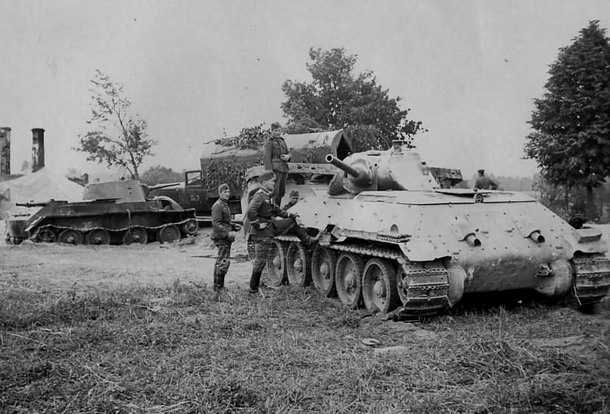
Knocked-out T-34 and BT-7, source: Worldwarphotos.info with permission of the operator, edited
On how the 15th Mechanised Corps fared on 26 June, the available literature has relatively little to say. This corps was deployed on the left flank of the 8th Mechanised Corps. Its 10th and 37th Tank Divisions were to advance roughly in the direction of Lopatyn and on toward Berestechko. Although both divisions together had 64 heavy KV tanks on the day of the German invasion, each could now commit only ten. These heavily armoured machines led the assault, shielding the light tanks behind them. But the 15th Mechanised Corps encountered something even worse than German tanks — enemy heavy artillery and air defences equipped with the 88 mm dual-purpose gun. Their fire, combined with Luftwaffe attacks, reliably halted the Soviet advance. Sources unfortunately do not provide the exact number of tanks the 15th Mechanised Corps committed that day, but by the end of the fighting it had around 260 remaining (from over seven hundred on 22 June), including 44 modern KV-1 and T-34 — still a force not to be underestimated.
The Soviet counterattack of 26 June had thus failed to achieve its objectives. Front commander Generaloberst Kirponos watched the course of the fighting with deepening concern. Late that evening, a staff conference considered a proposal to pull back the 8th and 15th Mechanised Corps so they could regroup, receive reinforcements and attack again later. Kirponos believed the Red Army high command would agree to a change of approach after the disappointing first day of the counteroffensive and immediately forwarded his proposal to Moscow. The high command, however, held a rather different view, and during the night of 26 to 27 June Kirponos received a firm order to continue the attack the following day. The problem was that in the meantime Kirponos had already dispatched messengers to the 8th and 15th Corps with orders to withdraw, and now had to issue and circulate entirely contradictory orders. When commissar Vashugin learned about the ordered withdrawal, he was furious and drove personally to the 8th Corps headquarters to ensure its attack would go ahead. In German reports, the Soviet counteroffensive of 26 June was noted as follows: while the situation in the north appeared to pose no further serious concern, in the south the situation was very serious and reinforcements were urgently needed there.
27 June 1941
The 9th Mechanised Corps in the north launched yet another attack this day with its 35th and 20th Tank Divisions. North of Mlyniv they clashed with elements of the German 13th Panzer Division and the 299th Infanterie Division. Fighting continued for most of the afternoon without the Soviet forces gaining any ground. In the evening, the soldiers of the 9th Mechanised Corps received orders to break off the attack and withdraw northeast toward the town of Olyka. The 19th Mechanised Corps, which was also supposed to be attacking in this sector, managed no offensive action whatsoever on 27 June; its 40th and 43rd Tank Divisions were instead fighting tooth and nail to defend the approaches to the town of Rivne, being slowly but surely pushed east by the German 13th Panzer Division. So there was no Soviet breakthrough toward Dubno in the north — but on the other hand, the Germans lost another day without capturing Rivne, which can be counted as a limited Soviet success.
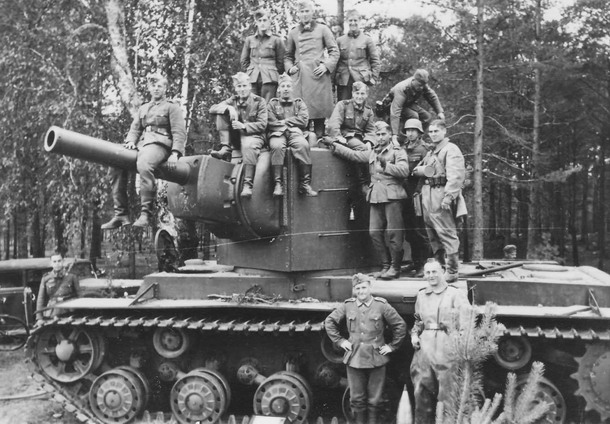
The wrecks of the monstrous KV-2s attracted well-deserved attention, and German soldiers felt it almost obligatory to be photographed beside them, source: Worldwarphotos.info with permission of the operator, edited
More interesting events were unfolding on the southern sector, where the 8th and 15th Mechanised Corps were to attack. The commander of the 15th Mechanised Corps had received Kirponos's original order to halt the offensive during the night, and in accordance with it had ordered his 10th and 37th Tank Divisions to withdraw. The new orders to continue the attack did not reach the corps command until 10 a.m. on 27 June. Another two hours passed before the orders were delivered to the two tank divisions. The units halted and began turning back toward the front. As a result of this confusion, the 15th Mechanised Corps was unable to mount any attack at all that day.
Within the 8th Mechanised Corps, only the 12th Tank Division had received Kirponos's unfortunate night order to withdraw and had immediately begun pulling back. An enraged commissar Vashugin arrived at corps headquarters early in the morning, shouting and threatening, ordering corps commander Generaloberst Ryabyshev to immediately cancel the withdrawal and attack Dubno as instructed. Due to the chaos described above, however, Ryabyshev could not commit the entire corps and had to improvise. From whatever was available he assembled an ad hoc battle group to be dispatched toward Dubno at once. The remainder of the corps — the 12th Tank Division and the 7th Motorised Division — was to follow in the same direction as soon as it was capable of doing so, which was expected to be the following day, 28 June. Command of the improvised battle group was given to the political commissar of the 8th Mechanised Corps, Nikolai Kirilovich Popel. Commissar Vashugin reportedly told him before the attack that if he captured Dubno by evening he would receive a decoration, but if he failed he would be shot. The backbone of Popel's battle group was 150 to 160 tanks from the 34th Tank Division. The entire battle group numbered around 210 tanks in total. At around 2 p.m. Popel set off with everything at his disposal from the Brody area in the direction of Verba and Dubno.
The Germans were expecting the Soviet counterattack to continue toward Berestechko and had concentrated their defences there. Popel's group attacking toward Dubno thus took them by surprise. The Germans had insufficient forces in that area to resist and Popel advanced very quickly. Near the village of Hranivka he caught the rear formations of the German 11th Panzer Division in transit and virtually destroyed them. Popel's tanks met light resistance in the village of Verba, overcame it, and pressed on. The possibility of capturing Dubno suddenly seemed real. At the village of Tarakaniv, less than 5 kilometres southwest of Dubno, however, Popel's advance was stopped by strong German resistance. Heavy fighting raged at Tarakaniv until evening.
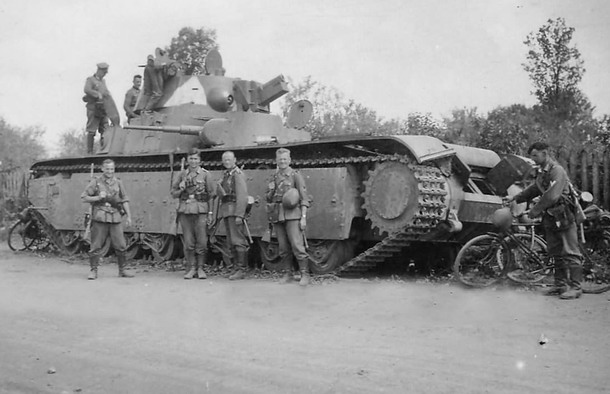
The wrecks of the enormous T-35 tanks were a veritable magnet for German camera lenses, source: Worldwarphotos.info with permission of the operator, edited
While the Soviet counterattack was attempting to take Dubno, the forward elements of the German 11th Panzer Division were pressing further east and by the morning of 27 June were approaching the town of Ostroh (roughly 50 kilometres east of Dubno). The Soviets had few forces available in the area to defend Ostroh. Fortunately, a Soviet 16th Army happened to be passing through on the railway line north of Ostroh at the time, on its way to fight in Belorussia. The 16th Army's chief of staff, Generaloberst Mikhail Fyodorovich Lukin, detached part of the 109th Motorised Division and sent it to defend the threatened town. Some Soviet soldiers did arrive in Ostroh before the Germans (during the night of 26 to 27 June), but before they could dig in and fortify their positions the German attack forced them to fall back to the northeastern part of the town. During the day (27 June) Lukin's battle group made two attempts to drive the Germans out of Ostroh. Both failed. After heavy fighting with significant losses on both sides, the Soviets withdrew to the eastern bank of the Viliya river.
28 June 1941
Although the Soviet mechanised corps had been ordered to attack toward Dubno this day as well, on the northern wing there was no question of any such attack. The badly depleted 20th and 35th Tank Divisions of the 9th Mechanised Corps were fighting with everything they had east of Olyka, trying to hold back the advance of the German 14th Panzer Division and 299th Infanterie Division. Even though they managed to push the Germans back in places, their overall position was untenable. The neighbouring 19th Mechanised Corps was in no better shape — its 40th and 43rd Tank Divisions were resisting the pressure of the German 13th Panzer Division near Rivne, and by evening their position had become so desperate that the corps commander ordered a withdrawal to the east.
How did the Soviet counterattack fare on the southern wing? The 15th Mechanised Corps, which the previous day had begun withdrawing in response to contradictory orders, managed to re-engage on 28 June. Its 10th and 37th Tank Divisions attacked toward Lopatyn and Berestechko to cover the left flank of their comrades in the 8th Mechanised Corps. The 15th Mechanised Corps was also given the 8th Tank Division from the 4th Mechanised Corps to support the attack. The corps' main striking force, however, was the 37th Tank Division, which went into battle with 211 tanks: 26 of the T-34 type, 177 light BT-7 and 8 light T-26. In addition, the division could deploy 16 armoured cars of the BA-10 and BA-20 types. What was lacking, as almost always, was infantry and artillery. The division could field only about five thousand soldiers and had just 11 field guns for support (four of 152 mm, three of 122 mm and four of 76 mm).
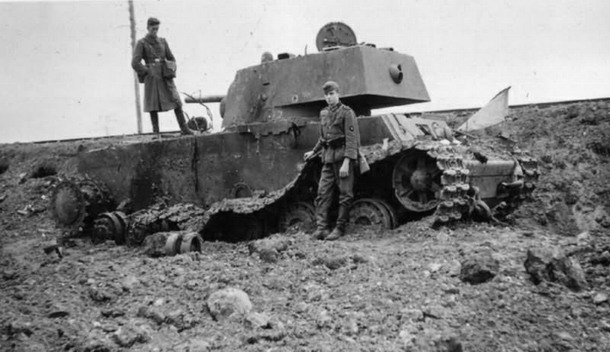
German tank guns had no chance against the heavy KV-1, but they could count on the support of their artillery — and this is what the result looked like: the ground around the tank is churned up and the tank itself battered by nearby explosions, source: Worldwarphotos.info with permission of the operator, edited
The attack began around noon. The 37th Tank Division crossed the Styr river near the village of Stanislavchyk and drove toward Lopatyn. It did not get very far. Before reaching Lopatyn the Soviet tanks were stopped by intense fire from German anti-tank and field artillery. Hours passed, casualties mounted, and the Soviets repeatedly failed to push across the Ostrivka river that lay between them and Lopatyn. Only around midnight did the corps commander conclude that further effort was pointless and ordered both tank divisions to pull back south of the Radostavka river. The 15th Mechanised Corps had suffered enormous losses for nothing gained.
That left only the 8th Mechanised Corps, now split between Popel's group and the remainder (the 12th Tank and 7th Motorised Division). Recall that the previous day Popel's battle group had pushed from Brody all the way to the village of Tarakaniv, less than 5 kilometres southwest of Dubno. From the German perspective, this was an extremely grave situation. The Soviet penetration toward Dubno had paralysed the supply lines of the German forward units fighting some 50 kilometres further east near Ostroh. If the Soviets actually took Dubno, the supply system would collapse entirely. The Germans therefore immediately began redirecting all available forces to the threatened area, specifically part of the 16th Panzer Division and the 57th Infanterie Division. At the same time, the Soviets were also moving the rest of the 8th Mechanised Corps (the 12th Tank and 7th Motorised Division) from Brody toward Dubno to link up with Popel's group and finally take the town together. During the night of 27 to 28 June, Soviet and German units in the area south of Dubno became thoroughly intermingled. Dubno itself was held by the German 111th Infanterie Division. From the southeast, Popel's battle group was pressing against the town. From the east, the German 75th Infanterie Division was approaching Popel's men, while during the previous night the German 16th Panzer Division had inserted itself into the area south of Popel's group. This last manoeuvre drove a wedge between Popel and the Soviet 12th Tank and 7th Motorised Divisions rushing to his aid. Popel's group was effectively encircled south of Dubno.
28 June became the decisive day of the battle for Dubno. The Soviet 12th Tank and 7th Motorised Divisions (of the 8th Mechanised Corps) pushed north to break through to Popel. Around 1 p.m. they reached the Pliashivka river between the villages of Kozyn and Tarnovka (probably the village now called Hranivka). At Tarnovka, however, German soldiers of the 16th Panzer Division were waiting for them, supported among other things by a battery of 88 mm Flak guns. From 3 to 7 p.m. a furious battle raged around the village. Tarnovka shook under artillery fire and buildings burned — but the Germans held. When the Soviets finally broke off their assault and pulled back, around 22 of their destroyed tanks lay around the village.
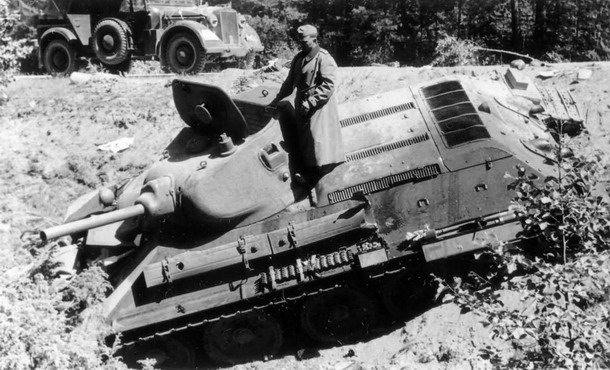
A T-34 with its right track damaged has slid into a ditch and become stuck; the crew apparently abandoned the vehicle, judging by the open hatches, source: Worldwarphotos.info with permission of the operator, edited
While the Soviet 12th Tank and 7th Motorised Divisions were trying to push northeast through Tarnovka to reach Popel's group, a very dangerous situation was developing in their rear. The German 57th Infanterie Division advanced from Berestechko southeastward and smashed the positions of the Soviet 212th Motorised Division, which had been tasked with protecting the left flank of the 12th Tank and 7th Motorised Divisions. By the end of the day the German infantry had pushed as far as Brody, cutting the two Soviet divisions off from the southwest. Both Soviet divisions now found themselves surrounded on three sides. This was the main reason why they abandoned their efforts to take Tarnovka in the early evening and began withdrawing south toward the small town of Sytne — the only direction still open. The Germans were not about to let them leave quietly and sent them on their way with intense artillery fire and air attacks from Sytne. When both retreating Soviet divisions finally halted east of Brody late at night and tallied their losses from the withdrawal around Sytne, they found they had lost six KV tanks, fifteen T-34 tanks, seven BT-7 tanks and eleven T-26 tanks (thirty-nine tanks in total), as well as 18 armoured cars and 190 other wheeled vehicles.
And how was Popel's group faring? Overnight the Germans had brought additional reinforcements into Dubno and prepared their defences. Popel's tanks renewed their assault on the town around 9 a.m. They pushed to within reach of the southwestern outskirts of Dubno but were then halted by German artillery fire from both the town itself and from the northwest, near the village of Myatyn. The German 111th Infanterie Division held Dubno firmly in its grip. The Soviet breakthrough attempt had failed and cost Popel's group around 30 tanks. Commissar Vashugin, who had been driving Popel and his men into the assault on Dubno, could not bear the way events had turned and took his own life that day.
Let us also look at how 28 June went for the German 11th Panzer Division near Ostroh. The division was starting to feel the strain of supply difficulties, for which nobody else but Popel and his breakthrough toward Dubno was responsible. The German supply route had been cut and the forward units of the 11th Panzer Division had to start rationing fuel and ammunition. The Germans even attempted to compensate for the loss of overland supply by an airlift, but this had virtually no chance of meeting the enormous needs of a large armoured formation. Further advance beyond Ostroh was out of the question under these circumstances, and the 11th Panzer Division lost another day marking time — all while enduring unpleasant Soviet air raids and repelling repeated attacks by Lukin's battle group.

A KV-2 heavy tank knocked out by a hit to its track; the last line of the inscription on the side of the turret reads "Dubno 29.6.41", source: Worldwarphotos.info with permission of the operator, edited
29 June 1941
The Red Army high command continued to press the Southwestern Front commander to maintain the counterattack. But Generaloberst Kirponos was running out of units to commit. The 9th and 19th Mechanised Corps in the northern sector had been on the defensive for several days. The decimated tank divisions of the 9th Mechanised Corps (the 20th and 35th) had just 32 tanks left between them and were barely holding their ground in the area between Olyka and Klevan. The 19th Mechanised Corps had evacuated Rivne the previous evening and fallen back east to the Horyn river. Now its two tank divisions (the 40th and 43rd) were ordered to attack toward Rivne again. They did manage to inflict significant losses on the Germans, but bled heavily themselves. By the end of the day these Soviet divisions had been pushed back to the Horyn river and the town of Hoshcha by the German 13th Panzer Division.
Soviet units on the southern wing still had a reasonable number of tanks remaining, but they too were in no position to mount any meaningful counterattack. The 15th Mechanised Corps had suffered heavy losses in its previous day's attempt to take Lopatyn and had withdrawn south of the Radostavka river. On 29 June it was given permission to retreat further south. The corps spent the day withdrawing toward Olesko and Zolochiv, while its rearguards (especially the 8th Tank Division borrowed from the 4th Mechanised Corps) kept the persistent Germans at bay.
The 8th Mechanised Corps, as we know, had been split into Popel's group (formed primarily by the 34th Tank Division) and the remainder (the 12th Tank and 7th Motorised Divisions). Popel's group remained encircled south of Dubno; the 12th Tank and 7th Motorised Divisions had been pulling back south to avoid encirclement themselves. The withdrawal of these latter two divisions and the 8th Mechanised Corps headquarters continued on 29 June. By the end of the day the units were in the area around Pidkamin, roughly 15 kilometres south of Brody.
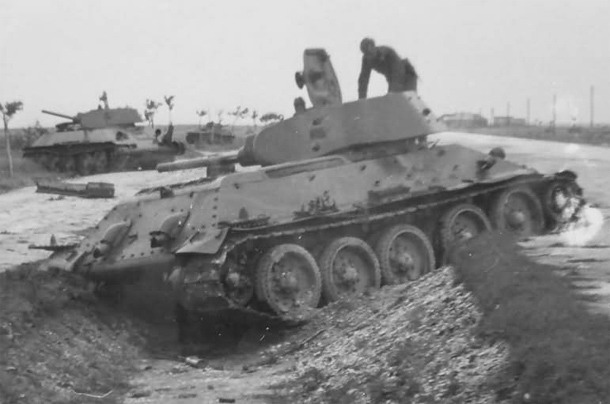
Another stretch of road lined with wrecks — this time T-34 tanks, source: Worldwarphotos.info with permission of the operator, edited
Popel's group remained encircled south of Dubno throughout 29 June, and its situation was worsening rapidly. The noose around Popel's men was being tightened by four German divisions simultaneously (the 111th Infanterie from the northeast, the 44th Infanterie from the north, the 57th Infanterie from the northwest and the 16th Panzer Division from the south). Without resupply, Popel's group was running short of fuel and ammunition. German pressure was intensifying and Soviet losses were mounting. Over the course of 29 June alone, Popel's battle group lost roughly 80 tanks. The last opportunity to take Dubno had passed. At 7 p.m. commissar Popel ordered his men to withdraw toward the town of Kremenets. The river Ikva was to be crossed using a bridge on the road between the villages of Ptycha and Stara Nosivka. The withdrawal began after dark. At first everything went smoothly, but when crossing the river the Soviets were spotted by the artillery of the 16th Panzer Division. The Germans drenched the retreating column with heavy fire, making it impossible to continue along the chosen route. Popel's group broke apart into several fragments, each of which began independently searching for other ways out of the encirclement.
The forward elements of the German 11th Panzer Division now held the entire town of Ostroh firmly in their hands. The eastern outskirts, by contrast, were firmly in the hands of Soviet soldiers from Lukin's battle group. Supply to the German units had still not been properly restored, so the 11th Panzer Division was unable to continue its advance eastward and lost yet another day.
30 June 1941
The ninth day of Operation Barbarossa. The advance of the German 13th Panzer Division along the northern Panzerstrasse had reached the Horyn river, some 25 kilometres east of Rivne. Here the Germans were stopped by the determined resistance of Soviet forces that had crossed to the eastern bank of the river and were using this watercourse as a natural defensive line. The Soviet mechanised corps still had orders to attack, and their commanders were doing their best to carry them out. On the northern wing, the badly thinned 9th and 19th Mechanised Corps rallied for one last attempt to cut off the German spearhead, now joined in the effort by the 22nd Mechanised Corps as well.
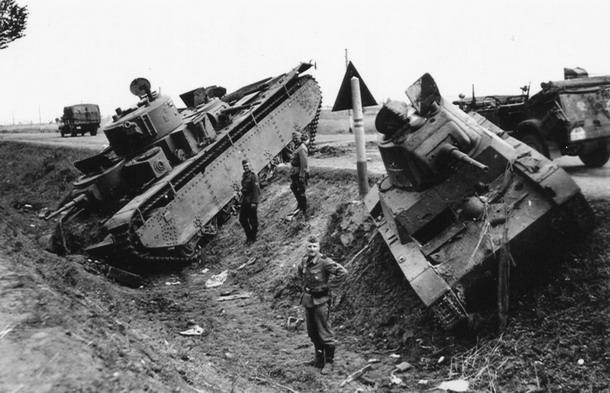
Again the same recurring scene — German columns advancing along a road lined with wrecks, in this case knocked-out T-26 and T-35 tanks, source: Worldwarphotos.info with permission of the operator, edited
The 22nd Corps was at this point the strongest of the three. Two of its divisions (the 19th Tank and 215th Motorised Rifle Division) had been nearly destroyed in the fighting near Vynytsia on 24 June 1941, but the corps still had its 41st Tank Division, which mustered over a hundred T-26 tanks and 16 KV-2 tanks. Adding the remnants of the other two battered divisions, the 22nd Mechanised Corps had more than 150 tanks available in total. The 22nd Mechanised was to concentrate near the town of Tsuman (about 10 kilometres north of Olyka), launch its attack on the morning of 1 July in a southwesterly direction, advance roughly 40 kilometres and capture the town of Mlyniv. The 9th Mechanised Corps was prepared to commit the pitiful remains of its two tank divisions (the 20th and 35th) to the attack on 1 July. From the area around Klevan they were to push toward Mlyniv as well. And finally, the 19th Mechanised Corps — whose 40th and 43rd Tank Divisions were at that moment fighting on the Horyn river — was tasked with outflanking the German forward positions near Rivne from the south and also attacking toward Mlyniv. This was itself a rather convoluted manoeuvre, particularly for the battle-worn 19th Corps.
While on the northern wing the Soviets were still preparing to attack, in the south there was no longer any thought of offensive action. The 15th Mechanised Corps was withdrawing south toward Zolochiv (as it had been doing the previous day). Near Zolochiv, however, the German Luftwaffe spotted the long columns of retreating Soviet troops and pounced on this easy prey with full force. The road east of Zolochiv was soon transformed into an enormous graveyard of Soviet equipment. The remnants of what had been Popel's group (now broken into several smaller elements) continued on 30 June to try to break out of the German encirclement. Most of them failed. Commissar Popel himself eventually reached Soviet lines during the night of 30 June to 1 July (though a much later date is sometimes cited) — but without a single tank, accompanied by roughly a thousand of his men. They were probably the only survivors from the entire Popel battle group. And the rest of the 8th Mechanised Corps was that day retreating unstoppably eastward from the area around Pidkamin.
Late on 30 June, the Southwestern Front command received a momentous message from Moscow. The Supreme Command of the Red Army, assessing the overall situation across the entire front, had decided to order a general withdrawal to the so-called Stalin Line — the old pre-1939 Soviet border fortifications. Selected units were to continue launching local counterattacks to slow the German advance. For Front commander Generaloberst Kirponos (and he was far from alone), this came as an enormous relief. At last, what he had been proposing from the very beginning had come to pass — withdraw, buy time and prepare a proper counterattack. But it was already a minute past midnight.
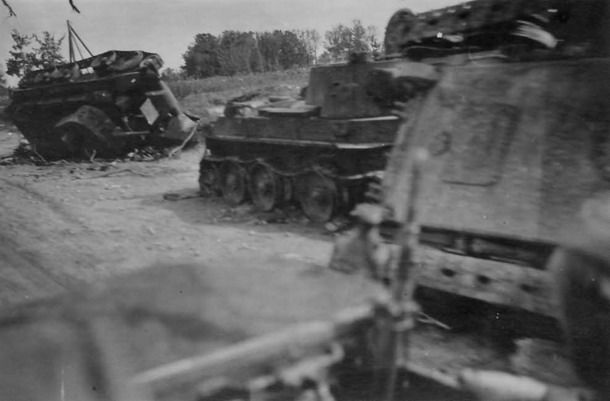
A snapshot taken from a moving vehicle — BT-5 tanks lie scattered at the roadside like discarded toys, source: Worldwarphotos.info with permission of the operator, edited
1 July 1941
As we know, this day had been earmarked for the attack by the remnants of three mechanised corps toward Mlyniv on the northern wing. This plan was not cancelled even after Moscow issued its order to withdraw to the Stalin Line — the attack was intended to delay the German advance and allow the rest of the Soviet forces to pull back in good order.
The two badly depleted tank divisions of the 9th Mechanised Corps launched their attack on the morning of 1 July. It is true that the Germans were not expecting any Soviet counteroffensive toward Mlyniv and were therefore caught off guard. The Soviet tanks managed to push forward some 7 to 12 kilometres and inflict significant losses on the enemy (10 German tanks destroyed, and up to around a thousand German soldiers killed and wounded). By around 3 p.m., however, the element of surprise had been exhausted and the Soviet advance stalled. By the end of the day the 9th Mechanised Corps pulled back to its starting positions and joined the general retreat.
The 22nd Mechanised Corps achieved even greater success. Its strongest formation, the 41st Tank Division, managed to push forward roughly 20 kilometres before being stopped. The surprised Germans could not bring up ground reinforcements quickly enough, but called in the Luftwaffe, which began hitting the Soviet division hard. The division was forced to pull back (according to some sources on 1 July, according to others not until 2 July) and suffered significant losses in doing so. The closest any unit came to Mlyniv was, paradoxically, the weak remnants of the 19th Tank Division (also belonging to the 22nd Mechanised Corps). During its advance this unit mostly encountered only German infantry, so its small number of tanks was not a critical obstacle. The division moved slowly but steadily forward not only throughout 1 July but even during the morning of the following day. Only around 2 p.m. on 2 July did soldiers of the German motorised division SS Leibstandarte Adolf Hitler catch up with this Soviet unit and turned it firmly and finally around.
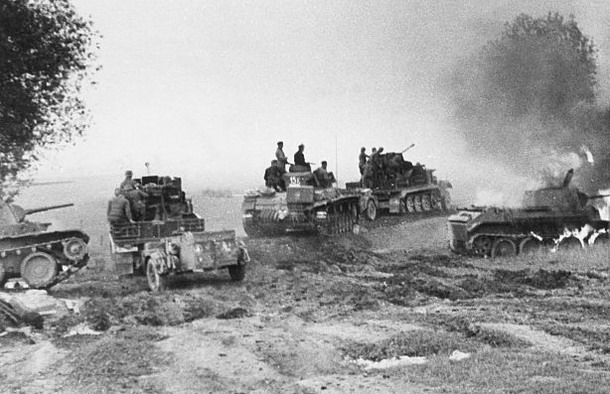
A PzKpfw III and two half-tracks with anti-aircraft guns weaving through the wrecks of BT-7 tanks, source: Worldwarphotos.info with permission of the operator, edited
The third Soviet mechanised corps that was to join the attack toward Mlyniv on 1 July — the 19th Mechanised Corps — was simply no longer capable of carrying out that task. Its divisions were too heavily committed in defensive fighting along the Horyn river.
The Largest Tank Battle?
1 July 1941 was effectively the last day on which the mechanised corps of the Southwestern Front attempted a counterattack. The battle of Dubno was over, and so were the border battles as a whole — the fighting would now shift deep into Soviet territory.
So was the battle in Ukraine in June 1941 the largest tank battle of all time or not? Let us summarise. On the German side, the fighting in the area between the towns of Lutsk, Rivne, Dubno, Brody and Radekhiv involved units totalling around 650 tanks and approximately a hundred assault guns and tank destroyers. On the Soviet side, the forces engaged had roughly 3,300 to 3,400 tanks on 22 June 1941. The engagement thus involved (or could have involved) some 4,050 to 4,150 tanks, assault guns and tank destroyers in total. In this respect, the Ukrainian battle is clearly outmatched by Operation Zitadelle, in which around six thousand Russian and German tanks and self-propelled guns faced each other.
What about losses? The report of the German Panzergruppe 1 dated 5 July 1941 records just 85 tanks as total write-offs, with a further 200 damaged. The number of tanks completely destroyed may seem almost unbelievably low at first glance. However, it must be remembered that the Germans had an enormous advantage in that they were advancing and gaining ground. This allowed them to recover and repair their damaged tanks. Moreover, this figure is fully consistent with another available report, from the turn of August and September 1941 (barely two months later), in which Panzergruppe 1 reports that since the start of Operation Barbarossa it had written off 198 tanks in total, with a further 226 currently under repair.
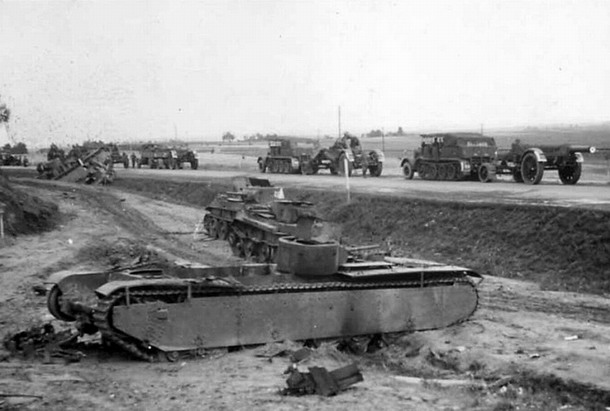
German artillery tractors pass the wrecks of a T-35 and two BT-5 tanks, source: Worldwarphotos.info with permission of the operator, edited
Establishing Soviet losses is somewhat more difficult. Most sources simply state that the mechanised corps involved effectively ceased to exist. Some specific figures can be found online; how accurate they are is unclear, but they are broadly consistent with the grim overall picture. According to this data, the Soviet mechanised corps were left with the following tank counts: the 19th Corps with 66 tanks as of 7 July, the 9th Corps with 32 tanks as of 15 July, the 8th Corps with approximately 200 tanks as of 29 June, the 15th Corps with 66 tanks as of 7 July, and the 22nd Corps with 340 tanks as of 7 July. If these figures are correct, the Soviets lost over 2,500 tanks in the fighting described. Total tank losses on both sides thus amounted to around 2,600 machines. In this respect, the Ukrainian battle clearly surpasses Operation Zitadelle, in which "only" slightly under 1,900 tanks were destroyed. A pedant might argue that a large proportion of the Soviet tanks were knocked out not by enemy action but by mechanical failure during long marches. But so what — these were still casualties of the war with Germany and rightfully count toward the overall tally. Had it not been for the German attack, they would not have been lost.
Both battles are also comparable in duration. The fighting in northwestern Ukraine described here lasted from 23 June to 1 July 1941 — nine days. Operation Zitadelle ran for essentially eleven days, from 5 to 15 July 1943. It is true that within Operation Zitadelle the climactic battle near the village of Prokhorovka on 12 July 1943 is frequently highlighted, in which roughly a thousand tanks took part (around three hundred German and seven hundred Soviet). If we were to identify a similarly decisive peak day in the Ukrainian engagement, it would likely be 26 June 1941, when the Soviet counterattack began with four mechanised corps (the 9th and 19th in the north, the 8th and 15th in the south). The exact number of tanks the Soviets committed that day is not known, but based on the overall strengths it can be estimated that roughly half their initial war establishment was available on average — meaning around 1,100 tanks on the Soviet side alone. Given that the majority of German tanks were at the tip of the advance, we would venture to estimate that no more than two hundred German machines could have been facing the Soviet assault. That would mean some 1,300 tanks facing each other in a single operation on a single day — a figure that, in this parameter too, exceeds that of Operation Zitadelle in 1943.
Why then has the Battle of Kursk been so consistently and one-sidedly elevated for all these years? Let us think about it together. Both engagements were fought between Nazi Germany and the Soviet Union. Only these two parties therefore had reasonably accurate information about both battles. But while in 1943 at Kursk the Soviets won, two years earlier in Ukraine the Wehrmacht rolled right over them. History, it is said, is written by the victors, and the victors would certainly not have been pleased to see the world know that they had lost the largest tank battle of all time. The information that leaked out of the USSR for many years after the war thus spoke clearly: yes, the border battles were bloody, but the greatest tank battle was undoubtedly Kursk — the battle won by Stalin's USSR. The conclusion, however, the reader may draw for themselves.

The fighting is over — German supply columns pass an abandoned T-34 wreck, source: Worldwarphotos.info with permission of the operator, edited
Conclusion
The ratio of German to Soviet tank losses was an astonishing 85 to 2,500 — nearly 1 to 30. How is such a thing even possible? Especially when we consider that the Soviets had not only enormous numbers of light tanks but also significant quantities of medium and heavy types — the T-34 and KV — which vastly outclassed their opponents in both armour protection and firepower. Behind the Soviet failure lies a combination of several causes. The Soviet mechanised corps were not at combat readiness and were dispersed far from the front. They therefore needed time to properly prepare for action. The Moscow high command gave them none and insisted on an immediate counterattack. The frantic rush of units to the front caused them to be committed in fragmented fashion — the infantry and artillery lacked adequate transport (too few trucks, slow and unreliable artillery tractors) and these supporting arms fell far behind the rapidly moving tanks.
In the general haste, units were thrown into battle the moment they arrived in the assembly area. This meant tanks attacked without support, often in relatively small groups that the Germans could deal with more easily. Soviet attacks were not preceded by any reconnaissance, so tanks drove forward with no idea of how many enemies were waiting for them, where they were or how they were armed. The absence of radio communications meant the actions of the individual mechanised corps were not coordinated. Long marches under their own power exacted an enormous toll in mechanical breakdowns, and Soviet units lacked sufficient equipment for recovering disabled vehicles and repairing them in the field. Crews also routinely neglected the regular maintenance of their tanks. Older types such as the BT and T-26 were mostly well worn out, while with the new types such as the T-34, crews had not had time to complete proper training and gain experience operating them. A hugely important factor was also that the Soviet air force had been decimated essentially within the first hours of the German attack, leaving Soviet ground forces frequently at the mercy of unopposed Luftwaffe strikes.
When the Soviets did manage to concentrate significant numbers of tanks for an attack — including substantial numbers of the powerful T-34 and KV — the German commanders showed how flexibly they could adapt their operational approach to the situation. Against T-34 and KV tanks leading the Soviet attacks, the German tank crews stood little chance in direct combat. They therefore tried to avoid a head-on fight and fell back, drawing the Soviets within range of their own artillery. Field guns of 105 mm and 150 mm calibre and 88 mm anti-aircraft guns then went to work on the armoured monsters leading the Soviet advance. Simultaneously, German tanks swung out to the flanks, bypassed the heavy tanks and attacked the light BT and T-26 vehicles from the sides, where they posed no problems. It must also be noted, however, that despite their crushing victory in terms of the loss ratio, the Germans themselves considered the Soviet resistance unexpectedly tough (compared to what they had experienced a year earlier in France) and their own advance unacceptably slow.

ARTICLE
CONTENTS:
Reproducing text from the Panzernet website without the written consent of the operator is prohibited.