PANZERJÄGER I
Germany's first series-produced tank destroyer
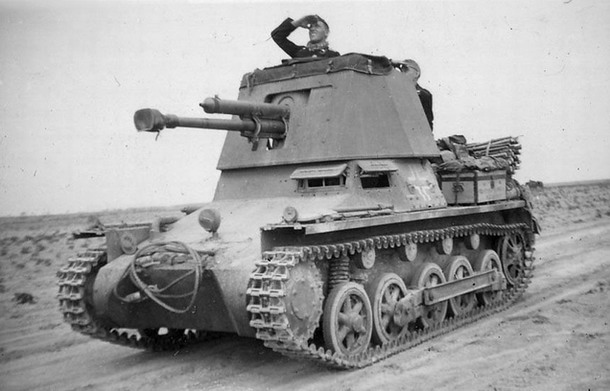
Panzerjäger I from the first production series. Source: Flickr.com, with the permission of the publishing user, edited.
Origins of the Vehicle
Following its defeat in the First World War, Germany was subjected to a series of severe military restrictions. Among the weapons whose development and production were explicitly forbidden were tanks, leaving interwar Germany to watch with envy as its former – and likely future – enemies developed and built this type of fighting vehicle. The commanders of the Reichswehr (as the German Army was known after 1919) quickly arrived at the pragmatic conclusion that if they could not have tanks of their own, they had to be capable of defending effectively against enemy tanks, and they accordingly began to build and expand specialised anti-tank units (Panzerabwehrtruppen).
In the second half of the 1920s, Rheinmetall developed a new gun for these units, designated the 3,7cm TaK (Tankabwehrkanone). By 20 October 1932 the Reichswehr had 264 of these guns at its disposal, and they were planned to form the backbone of German anti-tank capability for the foreseeable future. By that time, however, the more forward-thinking section of the German officer corps was already looking further ahead – at least in theory – envisaging a future for the German Army in which the leading role was played not only by tanks but also by fast, highly mobile support units, including self-propelled anti-tank artillery. The 3,7cm TaK fitted poorly into this concept. It rode on a carriage with wooden spoked wheels, had no suspension, and was designed to be moved only at low speed by horse-drawn traction. A modernisation programme was therefore launched in 1934, giving the gun a new carriage with steel wheels, rubber tyres and springing. The updated weapon was redesignated the 3,7cm PaK 36 (Panzerabwehrkanone) and, unlike its predecessor, was intended to be towed at high speed behind a car, a truck or even a half-tracked prime mover.
When the first German Panzer divisions were formed in 1935 – each of which included an integral anti-tank artillery battalion – thinking moved on yet further. Tanks were a purely offensive weapon, and Panzer divisions were built as offensive formations. Within these units, the very concept of anti-tank defence had to change. Following the principle that attack is the best form of defence, the anti-tank elements of these divisions were to be armed with weapons capable of actively hunting enemy tanks. Purpose-built fighting vehicles were to be created for this role, known in German as Panzerjäger – literally "tank hunters," or tank destroyers in standard English terminology. In the second half of the 1930s, at the German Army's request (now renamed the Wehrmacht), several such tank destroyer projects were launched based on half-tracked prime mover chassis. None of them reached series production, partly for financial reasons. When the Second World War broke out, the anti-tank elements of the German armoured divisions still had to rely on towed 37 mm PaK 36 guns.
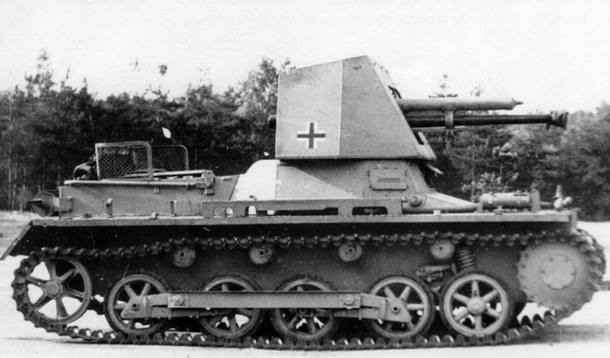
Panzerjäger I from the first production series. The rear of the vehicle shows the storage rack and the folded-down tarpaulin support frame. Source: Flickr.com, with the permission of the publishing user, edited.
Polish light tanks posed no particular challenge to these German guns. Over 10,000 PaK 36s deployed during the Polish campaign fired approximately 2 million rounds and managed to deal with every armoured opponent the Wehrmacht encountered. French armoured forces were a tougher nut to crack. The Germans knew very well that France fielded large numbers of tanks with frontal armour over 40 mm thick – such as the Renault R35, the Somua S35 or the Char B1 bis – and against that thickness the PaK 36 was inadequate, at least with standard PzGr 39 ammunition. The more powerful 50 mm PaK 38 was not yet in production, so the Germans turned their attention to the originally Czechoslovak 4,7 cm KPÚV vz. 38 gun. Following the occupation of the Czech lands in 1939, the German Army had taken over a contract for 51 of these guns that had been placed by the Czechoslovak military with the Škoda works in Plzeň. The captured weapon substantially outperformed the German PaK 36, so the Wehrmacht incorporated it into its arsenal without hesitation under the designation 4,7cm Pak 38(t) and immediately ordered further production from Škoda. By the end of 1939 the Germans had taken delivery of 132 new guns in total.
While German efforts to develop and produce dedicated Panzerjägers in the mid-1930s had foundered partly on grounds of cost, an entirely new opportunity now presented itself to obtain such a vehicle cheaply and quickly. On one hand there were dozens of excellent Czechoslovak 47 mm guns available (with more in production at a reasonable price); on the other, there were hundreds of their own Panzer I light tanks, which had little left to offer in their original role and needed a new purpose. At the turn of 1939–40, the Waffenamt therefore commissioned the Berlin firm of Alkett to design a simple and inexpensive tank destroyer that would use the Panzer I chassis to carry the 4,7cm Pak 38(t) gun.
The First Prototype
Alkett prepared the first prototype and demonstrated it to representatives of the Army high command, including Hitler himself, on 10 February 1940. It is unlikely that the military officials were wildly enthusiastic about the vehicle on display – it was to a significant degree an improvised design that made do with what was available. On the other hand, it carried sufficiently powerful armament for its intended purpose, was reasonably mobile, and could be made available in useful numbers at short notice (which was crucial, since only a few months remained before the planned attack on France). It came as no surprise, therefore, that series production was ordered immediately.
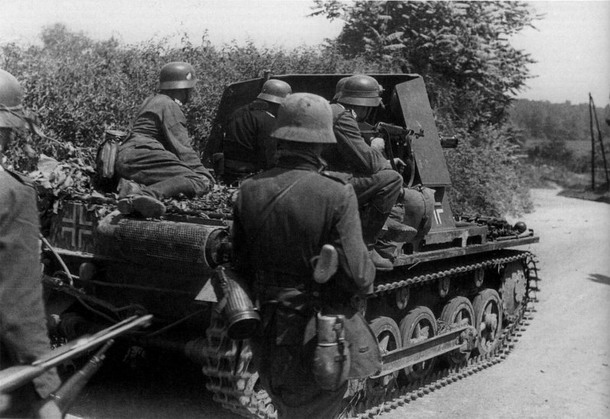
Panzerjäger I from the first production series in action – note that the crew have kept their steel helmets on. Source: Flickr.com, with the permission of the publishing user, edited.
Vehicle Description
The official designation of the new tank destroyer was 4,7 cm Pak (t) (Sfl.) auf Pz.Kpfw. I (Sd.Kfz. 101) ohne Turm, though it became far better known under the more memorable name Panzerjäger I. The basis of the vehicle was the chassis and hull of the Panzer I Ausf. B. The running gear consisted of five road wheels on each side, a front drive sprocket, a rear idler and four return rollers supporting the upper run of the track. The original tank hull and crew compartment were retained, but the roof of the crew compartment and part of its rear wall above the engine deck were removed. On the standard Panzer I Ausf. B, the engine deck immediately behind the crew compartment had a raised section fitted with horizontal louvres through which the engine drew its intake air. As part of the hull modifications, this raised section was removed and the air intake was relocated to open directly in the flat upper surface of the engine deck.
The original driver's entry hatch in the left side wall of the crew compartment was eliminated. The outer leaf of what had been the two-part hatch cover was left in place but welded shut. Above the crew compartment, a new fixed superstructure was built up, welded from five armour plates 14.5 mm thick. The base of this superstructure projected slightly beyond the walls of the original crew compartment on the front and sides, though it tapered inward toward the top because its walls were slightly angled. The front wall of the superstructure had a cutout through which the barrel of the 4,7cm Pak 38(t) projected. The cutout had to be relatively large to allow the gun to move when being aimed. On the inside, the area of the cutout was covered by a small armour shield fixed directly to the gun barrel and thus moving with it as the weapon was traversed or elevated. The cutout in the front armour of the superstructure was extended to the left at its upper corner to accommodate the lens of the gun sight.
The armoured superstructure protected the gun compartment from the front and sides only. The thickness of its walls was sufficient to stop armour-piercing rifle-calibre bullets (7.92 mm) and small shell splinters. The gun crew originally had no observation periscopes and had to look out from the fighting compartment simply by peering over the top of the armour – which was not exactly safe. In the combat zone, the crew therefore kept their steel helmets on at all times, as is clearly visible in a large number of photographs. However, other photographs show observation periscopes extending above the front armour of the fighting compartment. It appears that some vehicles had these retrofitted in response to crew complaints – most likely by field workshops acting on their own initiative (photo HERE).
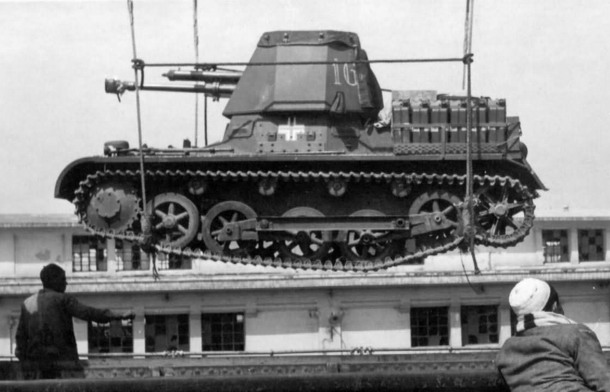
Panzerjäger I from the second production series being unloaded from a ship in the port of Tunis. Source: worldwarphotos.info, with the permission of the site operator, edited.
The main armament of the Panzerjäger I was the 4,7cm Pak 38(t), already mentioned several times. The gun was mounted slightly to the right of the vehicle's centreline on a specially designed pedestal connected to the front and rear armour of the former tank crew compartment and further braced by two metal struts standing on the floor of the fighting compartment. The mounting provided a traverse of 35 degrees (17.5 degrees either side of centre) and elevation from -8 to +10 degrees. Aiming was accomplished via a monocular sight with 2× magnification and a 30-degree field of view. The gun barrel measured 2,040 mm, approximately 43.4 calibres (hence the German designation L/43.4). The standard anti-tank round was an armour-piercing shell weighing 1.65 kg, which left the muzzle at 775 m/s. The Germans designated this ammunition Pz.Gr. 36(t) (Pz.Gr. = Panzergranate). At 1,500 metres it could penetrate 35 mm of sloped homogeneous armour, at 1,000 metres it dealt with 41 mm, and at 500 metres it defeated 48 mm (though significantly different figures are sometimes quoted). Also available was a high-explosive fragmentation round for use against soft targets, and from 1940 onwards a sub-calibre round, the Pz.Gr. 40, with a tungsten core capable of penetrating 59 mm of armour at 500 metres.
The onboard ammunition supply for the gun was 84 rounds, of which 74 were armour-piercing and only 10 were high-explosive – understandable given the vehicle's purpose. The ammunition stowage boxes were placed virtually everywhere space permitted: the loader and gunner each had 12 rounds directly beneath their seats, 10 more were stowed on the right side wall of the compartment, 16 were located directly beneath the gun pedestal, and the remaining 34 occupied the largest stowage box in the right-hand front section of the hull. The Panzerjäger I carried no integral anti-personnel armament, though the crew did have an MP 38 (or MP 40) submachine gun on board with a total of 192 rounds.
Since the armoured superstructure around the fighting compartment was left open at the top and rear, the vehicle's equipment included a waterproof tarpaulin that could be used to cover the open roof. The tarpaulin was secured by leather straps to small hooks welded just below the upper edge of the fighting compartment armour. At the rear it was suspended from a tubular frame which first had to be erected – in normal use this frame lay folded flat along the engine deck. The folded frame can be seen in photographs HERE, HERE and HERE; I have not come across a single photograph showing the frame fully erected – rigging the tarpaulin over it was evidently not a task the crews looked forward to. Tarpaulin or not, rainwater could find its way into the open fighting compartment quite easily, so a closable drain hole was built into the left rear section of the floor to allow any water that did get in to drain away quickly.
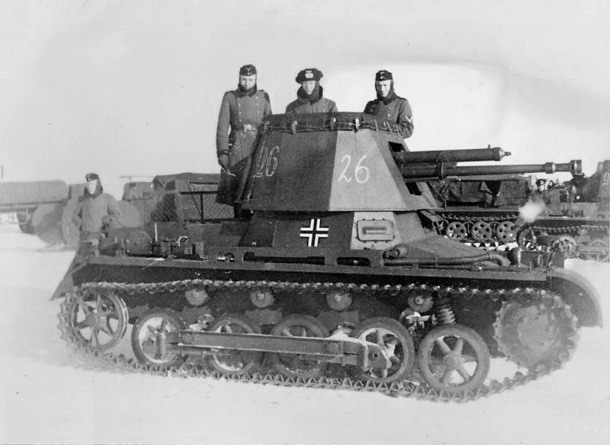
Panzerjäger I from the second production series in the Russian winter – note the tarpaulin fitted over the roof of the fighting compartment. Source: Flickr.com, with the permission of the publishing user, edited.
At the rear of the hull sat the engine compartment, housing a Maybach NL 38 TR six-cylinder petrol engine of 3.8 litres displacement, producing a maximum output of 100 horsepower at 3,000 rpm. This drove a Zahnradfabrik F.G. 31 gearbox offering five forward speeds and one reverse. Air was drawn into the engine compartment through a grille immediately behind the fighting compartment and exhausted through a vent in the right rear corner of the engine deck. The fuel tank held 146 litres, giving the vehicle a range of approximately 170 km on road and 115 km cross-country. The tank destroyer's top speed was a respectable 40 km/h, though its typical cruising speed was only around 25 km/h on road and 10–15 km/h off it. Fitted to the rear of the engine deck was a storage rack of sorts made from wire mesh, which the crew could apparently use for personal belongings.
The Panzerjäger I was 442 cm long, 206 cm wide and 214 cm tall (some sources give 225 cm). The gun breech was located at a height of 172 cm from the ground. The vehicle weighed approximately 6.4 tonnes, compared to around 5.8 tonnes for the standard PzKpfw I Ausf. B – meaning the chassis taken from that tank had to bear some 600 kg more than it was originally designed to carry. That is not a dramatic figure, but according to some authors the original tank chassis and hull still had to be reinforced in a number of places to handle the increased load without problems.
The tank destroyer's crew consisted of three men. The driver sat on the left inside the hull and was also responsible for operating the radio, which was housed in a metal box suspended to his right. The box was mounted on flexible brackets to isolate the sensitive radio equipment from the vehicle's vibrations. Panzerjäger Is from the first production series were fitted with a Fu 2 radio receiver – receive-only. A 140 cm rod antenna was attached to a folding bracket on the right side of the hull. The other two crew members had their seats at the rear wall of the fighting compartment: the loader on the right and the commander, who also served as gunner, on the left.
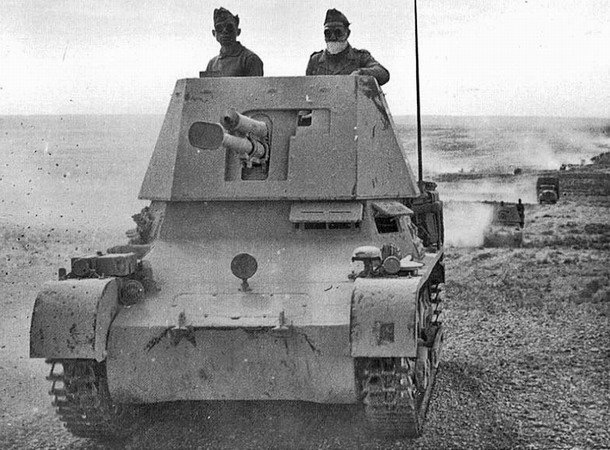
Panzerjäger I from Pz.Jg.Abt 605 in the African sand – a second production series vehicle. Note the antenna on the left side and the jerricans of drinking water stored on the rear mudguard. Source: Flickr.com, with the permission of the publishing user, edited.
Series Production
As already mentioned, the first prototype was demonstrated to army representatives on 10 February 1940, and series production of 132 vehicles was ordered immediately. Time was of the essence, and Alkett managed to deliver the first 40 machines during March, followed by another 50 in April and the remaining 42 in May 1940. One other author gives a slightly different delivery schedule, though the sources agree on the total number of first-series vehicles. The second production series is more complicated. According to T. L. Jentz (Panzer Tracts series), deliveries from the second series ran from November 1940 to February 1941 and totalled only 70 vehicles – 10 completed at Alkett and the remaining 60 at Klöckner-Humboldt-Deutz A.G. That would put the overall total at 202 Panzerjäger Is (132 + 70). H. F. Duske, on the other hand, in his Nuts & Bolts publication, does not give a specific figure for the second series but quotes an army report dated 1 June 1941 listing no fewer than 361 Panzerjäger Is available in total. The number of units equipped with this vehicle also points to a higher overall production figure – but readers may draw their own conclusions.
The Second Generation
Whether 70 or considerably more were built, the second-series vehicles received a redesigned fighting compartment armour arrangement. The side walls of the superstructure were now the same height as the front wall, and the entire structure was extended rearward by the addition of two further armour plates. This was a definite improvement, though the fighting compartment remained open at the top and rear. The engine deck access hatches – used to reach the engine and radiator – were given ventilation louvres on second-generation vehicles to improve airflow into the engine compartment. Some second-series Panzerjäger Is also received new Funksprechgerät "a" radio transceivers, which entailed moving the radio antenna from the front of the right side of the crew compartment to the rear of the left side. Photographs confirm that some second-series vehicles also received new observation periscopes that extended above the front armour of the fighting compartment, allowing the gun crew to observe safely from behind cover (photo HERE).
Organisational Structure
Perhaps because the Panzerjäger I was at the time the only weapon of its kind and available only in limited numbers, these vehicles were not distributed among the Panzer divisions but instead concentrated in Army-level anti-tank battalions (subordinate to Army command rather than divisional command). In March 1940 the formation of a training company for self-propelled tank destroyers was ordered – the Pz.Jg.Ersatzkp. (Sfl.) (in full: Panzerjäger Ersatzkompanie (Selbstfahrlafette)). This company was responsible for training crews for the combat units equipped with the new tank destroyers. In the same month, four existing anti-tank battalions were ordered to reequip from towed guns to Panzerjäger Is: the existing Panzerabwehr-Abteilung 521, 616, 643 and 670 were reorganised as Panzerjäger-Abteilung 521, 616, 643 and 670 (abbreviated Pz.Jg.Abt). The change of name was intended to signal the shift from merely defending against tanks to actively hunting them – whether that was more than a psychological word game is another question. A tank destroyer battalion (Panzerjäger-Abteilung) consisted of a headquarters, a signals platoon and three combat companies (Panzerjäger Kompanie, official abbreviation Pz.Jg.Kp (mot S), where (mot S) stood for motorisierte Selbstfahrlafette). Each combat company fielded 9 tank destroyers, giving the battalion a total of 27.
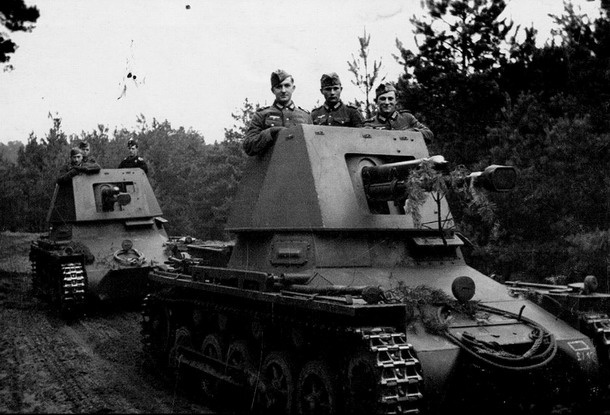
Two Panzerjäger Is from the mixed training unit Lehrbrigade 900 (mot). Source: Flickr.com, with the permission of the publishing user, edited.
Combat Deployment
The Panzerjäger I received its baptism of fire in May 1940 during the attack on the Low Countries and France. On 10 May 1940 – the opening day of Operation Fall Gelb – probably only two of the four battalions equipped with these tank destroyers were fully combat-ready. One was Pz.Jg.Abt. 521, assigned to Panzergruppe von Kleist, 12th Army, Army Group A. The other was Pz.Jg.Abt 670, attached to the 6th Army of Army Group B. The remaining two battalions, numbers 616 and 643, were apparently still completing their training at the time. Pz.Jg.Abt 643 was therefore held in reserve with the 12th Army (Army Group A), and Pz.Jg.Abt 616 became part of the 2nd Army, which formed part of the strategic reserve. These latter two battalions did not enter the fighting from the very first day of the operation but joined somewhat later once they had achieved combat readiness – Pz.Jg.Abt 643, for example, only completed its conversion to the new tank destroyer on 13 May 1940 and then travelled by rail from Germany to France, joining the 3rd Infantry Division at Signy-l'Abbaye.
After the French campaign, the Germans continued building additional tank destroyer battalions, and units numbers 529, 543, 605 and 625 were gradually formed or converted. In addition, several other formations received this type of tank destroyer – for instance, the Leibstandarte SS Adolf Hitler was allocated one company of them. By the time Operation Barbarossa was launched on 22 June 1941, the German Army had eight battalions equipped with Panzerjäger Is. Only six took part in the Russian campaign, however: Pz.Jg.Abt 521, 529, 543 and 643 were assigned to various formations under Army Group Centre; Pz.Jg.Abt 616 became part of Army Group North; and Pz.Jg.Abt 670 fell under Army Group South. The remaining two battalions? Pz.Jg.Abt 605 did not take part in the Eastern campaign because it was fighting in Africa with the 5th Light Division, and Pz.Jg.Abt 625 was stationed in Norway as part of the reserves.
Between 22 June and 31 December 1941, a total of 140 Panzerjäger Is were lost on the Eastern Front, with a further 13 destroyed in Africa during the same period. Long past their prime – if they ever truly had one – Panzerjäger Is remained in front-line service at least until the autumn of 1942, both on the Eastern Front and in North Africa.
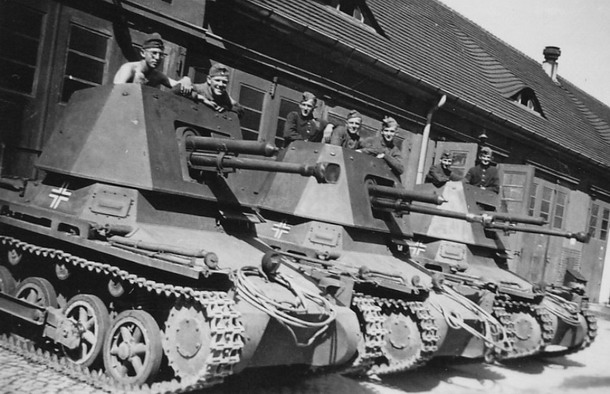
Three Panzerjäger Is in a barracks yard – the centre vehicle is from the second production series, the other two from the first. Source: worldwarphotos.info, with the permission of the site operator, edited.
Overall Assessment
A number of surviving combat reports give us a good picture of what soldiers thought of the Panzerjäger I in action. Pz.Jg.Abt 643, for example, reported during the French campaign that the tank destroyer needed a halt of 15 to 30 minutes after every roughly 30 km of march to prevent the engine from overheating, and that the maximum daily march distance was between 120 and 150 km depending on the difficulty of the route. The crew considered the vehicle's considerable height a serious drawback, as it made the Panzerjäger I an easy target for enemy fire. Complaints about the thin armour go without saying. The men also grumbled about the extremely cramped interior and asked for external stowage boxes for food and personal belongings. On the positive side, the vehicle's main armament received warm praise for its ability to defeat armour up to 45–50 mm thick at 500 metres without difficulty.
The Panzerjäger I had no intercom system, so communication between the commander and driver had to be direct. In the heat of battle, however, the driver sat – from the commander's perspective – "deep" inside the hull with his head pressed against the eyepiece of his visor, and simply could not hear the commands being shouted at him from behind. Yet good cooperation between the two men was absolutely essential, since the gun had only a limited traverse and the driver frequently had to swing the entire vehicle to face a target designated by the commander. Crews solved this problem in various ways in practice. The simpler approach might be described grandly as "communication by agreed signals" – in reality, nothing more than kicking the driver in either the right or left side of the back. The somewhat more sophisticated solution was a speaking tube (Sprechslauch), which some field workshops fitted at crew request: the commander spoke orders into one end, while the other end opened up near the driver's head.
Technical Data
|
weight: |
6.4 t |
|
length: |
4.42 m |
|
width: |
2.06 m |
|
height: |
2.14 or 2.25 m |
|
engine: |
Maybach NL 38 TR |
|
engine output: |
100 hp |
|
max. speed: |
40 km/h |
|
fuel capacity: |
146 l |
|
fuel consumption – road: |
85 l / 100 km |
|
fuel consumption – cross-country: |
125 l / 100 km |
|
range – road: |
170 km |
|
range – cross-country: |
115 km |
|
hull armour: |
13 mm |
|
superstructure armour: |
14.5 mm |
|
crew: |
3 men |
|
armament: |
1 x 4.7 cm PaK 38(t) gun |
|
ammunition stowage: |
74 armour-piercing rounds 10 high-explosive rounds |
|
radio: |
Fu 2 resp. Fu.Spr.Ger. "a" |
ARTICLE
CONTENTS:
Reproducing text from the Panzernet website without the written consent of the operator is prohibited.