Sd.Kfz. 231 (8 Rad)
eight-wheeled armoured car
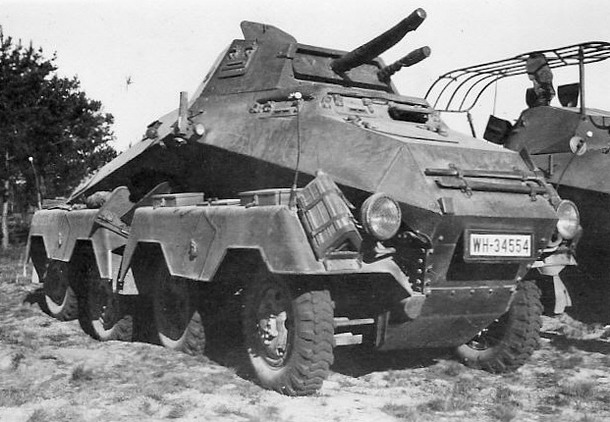
Early-production eight-wheeled Sd.Kfz. 231. Source: Flickr.com, used with permission of the publishing user, edited
The designation Sd.Kfz. 231 (Sd.Kfz. = Sonderkraftwagen = special-purpose vehicle) was used for two completely different types of heavy armoured car. This article covers the more modern of the two, identified by the suffix "8 Rad". The older six-wheeled version, Sd.Kfz. 231 (6 Rad), is covered in a separate article.
Origins of the Vehicle
The six-wheeled armoured cars Sd.Kfz. 231 (6 Rad) had been built on standard truck chassis as a cost-saving measure, and this ultimately proved to be their greatest weakness. Only the two rear axles were driven, while only the front axle steered. The considerable gap between the first and second axles further increased the risk of the vehicle becoming beached on a terrain obstacle. Soft ground or broken terrain presented these vehicles with an almost insurmountable obstacle — and it was precisely this fact that led the army command to order the development of new armoured cars capable of coping with genuinely difficult terrain.
The new vehicle was to have eight wheels on four axles, spaced relatively close together — with a maximum distance of 1.4 metres between any two adjacent axles. All wheels were to be both driven and steerable. The vehicle was to be capable of reaching up to 85 km/h in both directions of travel. The armour was to resist 7.92 mm armour-piercing rifle ammunition. The required armament combined a 20 mm cannon and a 7.92 mm machine gun, both mounted in a fully rotating turret. In specifying these requirements the army had in effect returned to the previously rejected armoured car project ARW from the late 1920s. According to some sources, even the new project was internally carried by the manufacturer under the same code designation — ARW (Acht Rad Wagen = eight-wheeled vehicle).
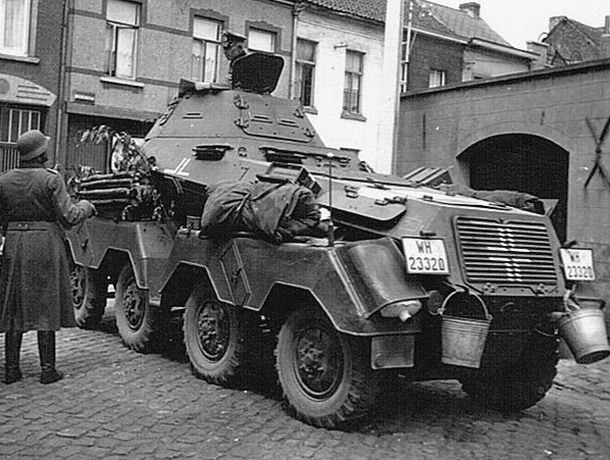
Rear view of the early-production Sd.Kfz. 231. Source: Flickr.com, used with permission of the publishing user, edited
Development of the new armoured car was contracted to Büssing-NAG, apparently in 1934. The first step was the construction of a suitable chassis, which received the factory designation GS. Sources disagree on its origin. Some authors hold that the chassis was designed from scratch specifically for the ordered armoured vehicle. Others suggest that Büssing-NAG used a chassis intended for one of its heavy trucks. The first theory seems more probable, however.
On the GS chassis, the powerplant was located at the rear — which would make no sense on a truck, where the rear is normally the cargo space. A standard truck chassis would also not have been adapted for full-speed travel in both directions (who would need to reverse a truck at 85 km/h?), and a rear driver's position would have no place on a truck either. One can of course argue that a truck chassis could simply have been adapted for the new purpose.
Vehicle Description
Whichever theory is correct, the GS chassis that Büssing-NAG used for the new armoured car fully met the army's requirements. It had eight individually suspended wheels, all driven and all steerable. Power came from the Büssing-NAG L8V eight-cylinder engine, displacing 7.913 litres and producing a maximum of 150 horsepower at 3,000 rpm. The gearbox offered six forward and six reverse gears — though some authors give only three, which seems unlikely. It is theoretically possible that both figures are correct: if the vehicle had a three-speed main gearbox supplemented by a two-speed reduction gearbox, the effective total number of ratios would indeed be doubled.
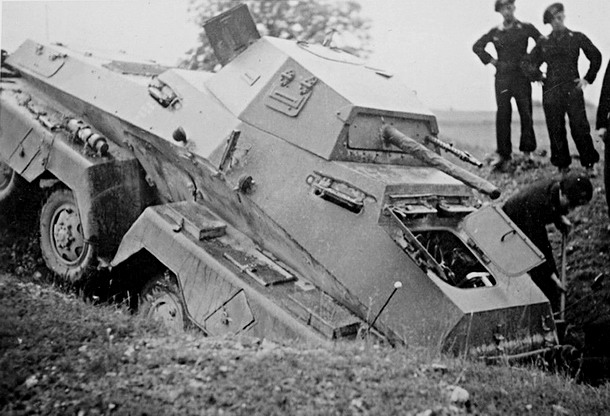
Early-production eight-wheeled Sd.Kfz. 231. Source: Flickr.com, used with permission of the publishing user, edited
Fuel capacity was 150 litres. The wheels were fitted with special reinforced self-sealing tyres. The bare chassis with its mechanical components weighed approximately 4.1 tonnes. One weakness of the chassis was its relatively large height, which also added to the cost.
The armoured hull was developed by Deutsche Werke of Kiel. Like the older six-wheeled vehicles, the hull of the new model consisted of upper and lower sections with walls angled in opposite directions — the vehicle widened upward from the chassis and then narrowed again toward the roof. This angling improved resistance to enemy fire. The steel plate from which the hull was welded was 14.5 mm thick at the front, 10 mm on the sides, 8 mm at the rear, and 5.5 mm on the floor and roof. The armour could therefore realistically be described as protection only against small arms fire and shell fragments.
The hull nose consisted of upper and lower plates. The upper plate carried brackets for mounting an axe and a pickaxe; a tow rope was hung from the lower plate. The upper nose plate transitioned into the steeply angled front bonnet, under which was the forward driver's position. In the right section of this bonnet, an access hatch was cut, closed by a two-piece cover whose halves on the early vehicle opened outward to the sides. This hatch was primarily for the forward driver's use.
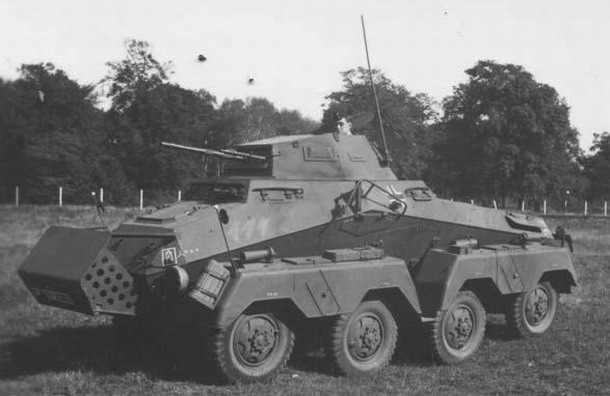
Eight-wheeled Sd.Kfz. 231 with supplementary front armour — the turret has the old weapon mantlet but new vision ports; the aerial indicates a radio-equipped vehicle. Source: Flickr.com, used with permission of the publishing user, edited
Behind the bonnet, the crew compartment's front wall rose in a step. It contained two identical vision ports, each with a cover that opened upward and an observation slit in the cover for use when the port itself was closed. Two further ports of the same design were provided in the side walls of the compartment. Small drip rails were welded above all ports to divert rainwater. All of these observation openings served the forward driver, stationed in this part of the hull — though he sat not at the centreline but slightly to the left, and therefore primarily used the left-hand front and side ports.
At the rear, the crew compartment stepped back down into the engine compartment roof. The rear wall of the crew compartment carried an identical set of vision ports to the front wall — two ports facing rearward and one on each side. These served the rear driver, who again sat slightly to the left of the centreline — though from his own perspective, facing rearward, this was effectively to the right.
The horizontal hexagonal roof plate of the crew compartment provided the surface on which the fighting turret was mounted. The turret likewise had a hexagonal plan, with all walls sloped for improved protection.
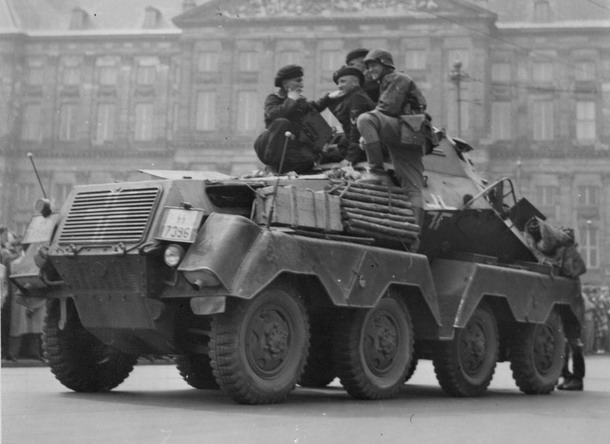
Eight-wheeled Sd.Kfz. 231. Source: Flickr.com, used with permission of the publishing user, edited
In the front half of each turret side wall was a large vision port with a single-piece cover opening upward, fitted with an observation slit. The rear halves of the side walls had only non-openable slit-type ports. Virtually the entire rear wall was taken up by the double-leaf crew access hatch, whose leaves opened outward to the sides, each containing one observation slit.
The turret roof was angled at the front and flat at the rear, where a further crew access hatch was located, closed by a single-piece cover opening rearward. The roof also had an opening for deploying signal flags. In the turret's front wall, a movable mantlet housed the rapid-fire cannon and its coaxially mounted machine gun. The cannon was a KwK 30 L/55 in 20 mm calibre; the machine gun was an MG34 in 7.92 mm. The cannon was positioned near the centre of the mantlet, with the machine gun to its left. The mantlet allowed vertical elevation from -10° to +26°. Ammunition stowage was 180 rounds of 20 mm and 2,100 rounds of machine gun ammunition. Despite the relatively small calibre, the cannon theoretically allowed the armoured car to engage even light enemy tanks. With standard armour-piercing PzGr. ammunition the weapon could penetrate 20 mm of armour angled at 30° at 100 metres range; with the subcalibre PzGr. 40 round it could penetrate up to 40 mm.
The engine compartment at the rear of the hull housed the already-mentioned Büssing-NAG L8V, displacing 7.913 litres and producing 150 horsepower at 3,000 rpm. In the front section of the engine compartment roof was a louvred opening for engine cooling airflow. Further back, the bonnet roof had a large service hatch for engine access, closed by a two-piece cover whose halves opened outward to the sides. Smaller service hatches were provided in the bonnet's side walls. A final large service opening occupied practically the entire upper section of the hull's rear wall, protected by a single-piece cover opening downward. This cover was louvred rather than solid, to allow continued airflow.
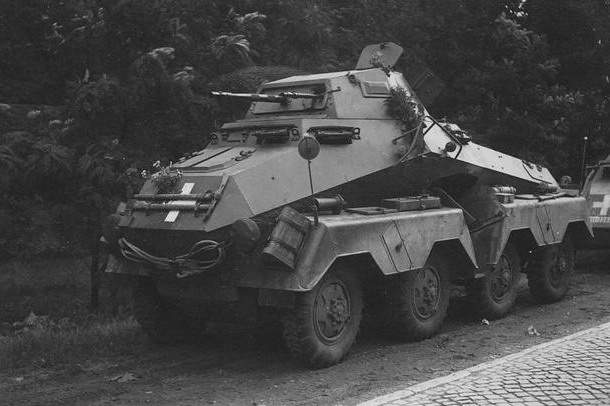
Sd.Kfz. 231 8 Rad — the vehicle still has the original weapon mantlet but already has new-style vision ports in the turret sides. Source: Flickr.com, used with permission of the publishing user, edited
Along practically the entire length of the vehicle on each side ran two large double mudguards, each covering two adjacent wheels. The space between the two double mudguards was used for an emergency escape hatch in the lower section of the hull side wall. The mudguards themselves served as mounting points for various equipment, as well as for the forward driver's rear-view mirrors, the horn, and the two exhaust pipes at the very rear.
Standard headlights were fitted at both the front and rear of the hull. A very interesting feature were two additional folding headlights set into the hull sides at the highest point of the lower section of the side walls — that is, at the widest part of the hull. Under normal circumstances these lay flush with the armour and their covers were almost invisible. Their purpose was to provide extra illumination for night-time aiming. (Note: I found only a single photograph showing one of these covers open, though the lamp itself is unfortunately not visible in the image.)
The crew consisted of four men. Both drivers sat in the hull; the gunner and commander — the latter also serving as loader — were stationed in the turret. The vehicle weighed 8.3 tonnes. Its maximum road speed was a very impressive 90 km/h in both directions (95 km/h is also cited). In length it measured 5.85 metres, in width 2.2 metres, and in height 2.35 metres — meaning the vehicle was actually taller than it was wide. This was partly a result of the chassis's inherent height. The excessive height was one of the vehicle's principal weaknesses, making it a more visible and larger target for enemy fire. Another weakness was communications equipment: the Sd.Kfz. 231 originally had no radio at all — a rather significant handicap for a reconnaissance vehicle. Only from 1941 onwards was at least a portion of Sd.Kfz. 231 vehicles fitted with a Fu.Spr.a radio set with a rod aerial mounted on the turret side — though this set had a range of only around one kilometre.
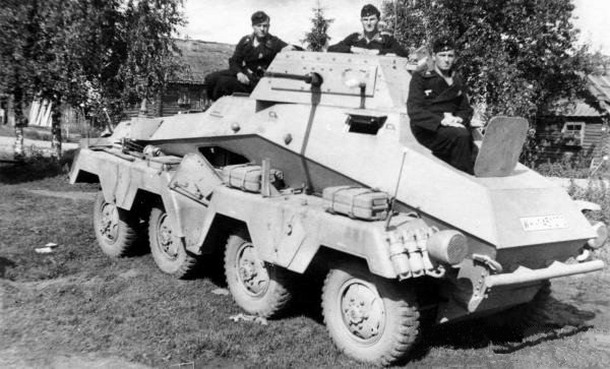
Late-production Sd.Kfz. 231 — note the single-piece driver's hatch cover, the late weapon mantlet, the tubular bumper, and smoke dischargers on the front of the mudguard. As a result of production consolidation with the Sd.Kfz. 232, the vehicle has an aerial mounting bracket on the right side of the engine section, but without the aerial itself. Source: Flickr.com, used with permission of the publishing user, edited
Series Production
Development of the heavy armoured car was apparently completed in 1935, after which prototype testing began. During the development phase the army tracked the new vehicle under the code designation VsKfz 623 (Versuch Kraftfahrzeug). When taken into service, however, it received the official designation schwerer Panzerspähwagen (Sd.Kfz. 231) — the same as its six-wheeled predecessor. The assumption was presumably that the new vehicle would quickly replace the old ones in service entirely. As it turned out, both types overlapped in service, and the suffixes "6 Rad" and "8 Rad" were therefore introduced to distinguish them — apparently retrospectively, in 1940.
Series production of the eight-wheeled vehicle began only in 1937 and continued until 1943 — though some sources give September 1942 as the end date. In a sense both figures may be correct, and the explanation relates to the modernisation of a companion vehicle — the radio car Sd.Kfz. 232. From July 1942, the large frame aerials on the Sd.Kfz. 232 began to be replaced by simpler star-branched rod aerials. This largely eliminated the constructional differences between the radio car and the standard Sd.Kfz. 231, and the Germans proceeded to consolidate production of both types. From that point all vehicles were built with provision for radio equipment — that is, essentially as Sd.Kfz. 232 — with the radio set and star aerial simply not fitted to those designated as Sd.Kfz. 231. Late-production Sd.Kfz. 231 vehicles therefore have an aerial mounting bracket on the right side of the engine section, but without the aerial itself.
Modifications and Improvements
During the production period, many minor and major changes and improvements were gradually introduced. None was significant enough to merit designation as a new variant (Ausführung). Changes included, for example, the design of the access hatch cover in the front bonnet: the original two-piece cover opening sideways was replaced by a single-piece cover opening forward. The original vision ports in both the front and rear walls of the crew compartment were replaced by new standardised ports used across the armoured car range. Their number initially remained the same, but was later reduced — from two to one in both the front and rear walls, the single remaining port being shifted to the left to align with the driver's position. These new standardised ports were also fitted to the turret side walls. Somewhat later, the ports in the front half of each turret side wall were eliminated entirely.
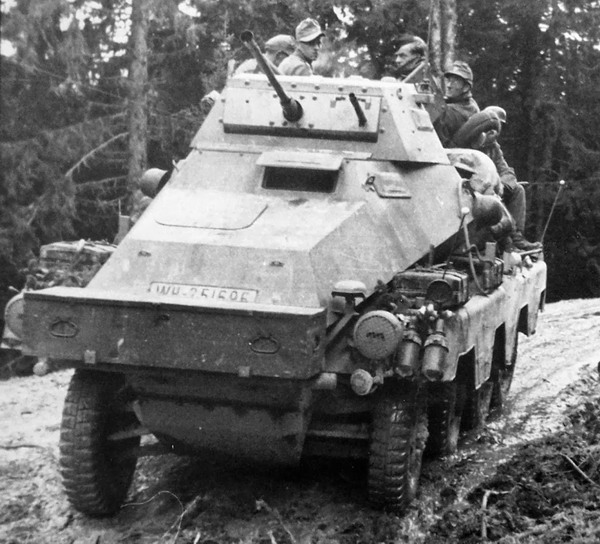
Late-production Sd.Kfz. 231 — the new weapon mantlet and revised vision port arrangement are clearly visible; the tubular bumper is partly obscured by a stowed crate. Source: Flickr.com, used with permission of the publishing user, edited
The weapon mantlet was also modernised. The new mantlet was wider than the original and better matched the turret walls across the full range of weapon elevation and depression. From 1940, supplementary front armour — designated Zusatzpanzer or Zusatzfrontplatte — began to be fitted. This consisted of a wedge formed by two 10 mm armour plates following the shape of the hull nose, hung on brackets approximately 50 cm in front of the hull itself. Crew instructions reportedly explicitly prohibited using this appliqué armour as a battering ram. The supplementary armour was later removed when the hull front plate itself was thickened to 30 mm from 1942, simultaneously with a planned increase in the turret's front armour thickness. With the reinforced armour, the vehicle's weight was expected to rise to as much as 9.1 tonnes.
In 1941 the powerplant was uprated. An increase in cylinder bore raised the engine displacement to 8.363 litres and maximum output to 180 horsepower. This improvement apparently did not increase the maximum speed, but certainly improved acceleration and cross-country mobility. A very significant change was the installation of a new main weapon: the original KwK 30 was replaced by the more modern KwK 38 of the same calibre. The original weapon had a rate of fire of 280 rounds per minute; the new one achieved 450. On late vehicles the front and rear sections of the wheel mudguards were shortened, and smoke dischargers were added to the front mudguards. The hull nose received a simple tubular steel bumper. Another late change was covering the louvred opening in the hull's rear wall with solid armour plate.
From 1941 the already-mentioned Fu.Spr.a radio set reportedly began to be fitted to Sd.Kfz. 231 vehicles. Those so equipped are identifiable by the simple rod aerial mounted on the left side of the turret. Photographs suggest that radios were also retrofitted to older vehicles. Also worth noting is a change introduced as a cost-saving measure: the self-sealing tyres were replaced by standard pneumatic tyres, and vehicles were newly equipped with spare wheels — either hung on the rear wall of the hull or laid across the engine bonnet over the service hatch.
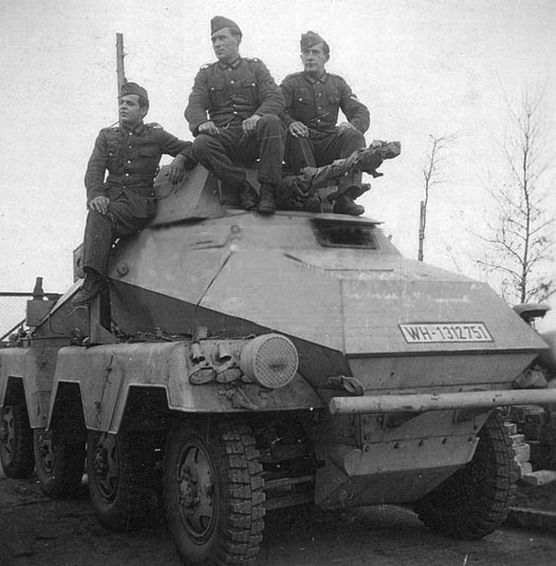
Late-production Sd.Kfz. 231 — note the tubular bumper and the single vision port in the front crew compartment wall. As a result of production consolidation with the Sd.Kfz. 232, the vehicle has an aerial mounting bracket on the right side of the engine section, without the aerial. Source: Flickr.com, used with permission of the publishing user, edited
As with the older six-wheeled vehicles, a radio car variant of the eight-wheeled Sd.Kfz. 231 was also produced, designated Sd.Kfz. 232, and later a more capable version designated Sd.Kfz. 263. Both of these radio cars again kept the same numerical designation for both the six-wheeled and eight-wheeled variants, with "6 Rad" or "8 Rad" suffixes used to distinguish them. The eight-wheeled Sd.Kfz. 231 and Sd.Kfz. 232 formed the heavy platoons (schwere Zug) of reconnaissance detachments (Aufklärungs Abteilung).
Combat Deployment
The vehicles first saw action during the bloodless operations in Austria and Czechoslovakia. Their baptism of fire came in Poland in 1939, after which they participated in virtually every Wehrmacht campaign, including the North African theatre. Deployment in Africa revealed a new shortcoming — poor cooling and a tendency for the engine to overheat — and this experience later placed heavy emphasis on tropical capability during development of the successor vehicle, the Sd.Kfz. 234. Beyond Africa, the Sd.Kfz. 231 (8 Rad) of course also fought in the Soviet Union, where the spring and autumn Russian terrain stripped these vehicles of one of their few advantages — their speed. Even as they were gradually replaced by the more modern Sd.Kfz. 234, the Sd.Kfz. 231 remained in service until the very end of the war.
Technical Data
|
weight: |
8.3 t (later 9.1 t) |
|
length: |
5.85 m |
|
width: |
2.20 m |
|
height: |
2.35 m |
|
engine: |
Büssing-NAG L8V |
|
engine output: |
150 hp (later 180 hp) |
|
max. speed: |
90 km/h |
|
hull armour: |
|
|
- front: |
14.5 mm (later 30 mm) |
|
- sides: |
10 mm |
|
- rear: |
8 mm |
|
turret armour: |
|
|
- front: |
14.5 mm |
|
- sides: |
10 mm |
|
- rear: |
8 mm |
|
crew: |
4 men |
|
armament: |
20 mm KwK 30 cannon (later KwK 38) 7.92 mm MG 13 machine gun |

ARTICLE
CONTENTS:
Reproducing text from the Panzernet website without the written consent of the operator is prohibited.