Sd.Kfz. 231 (6 Rad)
six-wheeled armoured car
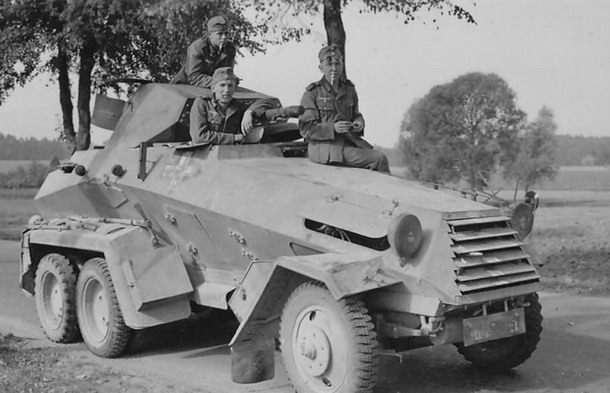
Sd.Kfz. 231 on the Büssing-NAG chassis. Source: worldwarphotos.info, used with permission of the site operator, edited
Origins of the Vehicle
The designation Sd.Kfz. 231 (Sd.Kfz. = Sonderkraftwagen = special-purpose vehicle) was used for two completely different types of heavy armoured car. This article covers the older of the two, identified by the suffix "6 Rad". The later eight-wheeled version, Sd.Kfz. 231 (8 Rad), is covered in a separate article. At the outset I feel it necessary to warn the reader that the literature surrounding the early development phases of the Sd.Kfz. 231 is in considerable disarray. The more sources I tried to compare, the more contradictions I found. As a result, I will frequently have to resort to words such as "apparently", "reportedly", "probably" and so on throughout the following text, and refer to multiple possible versions of events. I ask for the reader's understanding.
Development of the heavy armoured car ARW, which had been under way since 1927, had yielded one very unwelcome finding. Developing an entirely new vehicle that would meet the army's demanding requirements was enormously expensive, and the unit cost of such a vehicle was completely beyond the modest budget of the German Reichswehr. The army therefore had to accept sacrificing some of its earlier requirements — such as all-wheel drive or amphibious capability — on the altar of economy. The soldiers began looking for the basis of a new armoured vehicle among existing trucks.
The Mercedes-Benz Chassis
In 1929 the Waffenamt carried out its first theoretical analyses and concluded that this approach was genuinely viable and that the market offered suitable platforms. The Weapons Office's attention focused particularly on the new (produced from 1928) Mercedes-Benz G3 truck. On 14 February 1930, approval was given to begin evaluation work on this vehicle's chassis.
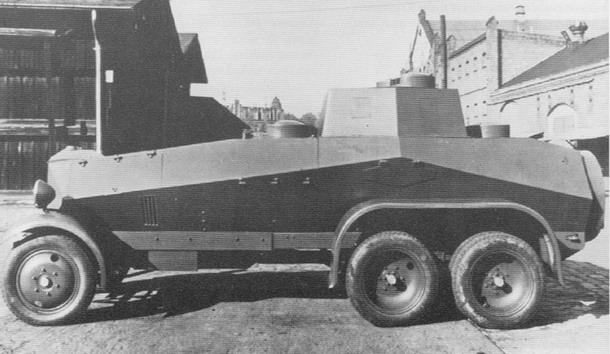
One of the first prototypes of the six-wheeled armoured car, built on the Daimler-Benz chassis — note the dummy turret and raised roof hatches. Source: Flickr.com, used with permission of the publishing user, edited
The chassis had three axles. The front axle was steerable and fitted with single wheels. The two rear axles were driven and had twin (dual) wheels. All mechanical components, including the powerplant, were taken over with the chassis. The six-cylinder Daimler-Benz M09 engine, displacing 3,460 cc, produced a maximum of 60 horsepower. Fuel capacity was 105 litres. The number of gears is given differently in various sources; four forward and one reverse is the most commonly cited figure. The engine and gearbox were mounted at the front of the vehicle.
The chassis required minor modification for its new purpose. A second driver's position was added for reversing. At the front driver's post, the steering wheel angle had to be adjusted to fit within the armoured hull. The bare chassis weighed approximately 2.2 tonnes. The armoured hull added approximately 2.3 tonnes. A further 1 to 1.2 tonnes was expected to come from the turret, armament, ammunition, and various other equipment, giving an expected all-up vehicle weight of around 5.5 to 5.7 tonnes.
The armoured hull for the new vehicle was designed and built by Deutsche Werke of Kiel. Its design evolved through further testing and gradually matured toward the form we know from series production. The turret design and the method of mounting the weapons in it also changed during this process. The basic hull concept, however, remained the same throughout development: it consisted of upper and lower sections with walls angled in opposite directions. The hull widened upward from the floor, then the side walls broke angle and the hull narrowed again toward the roof. This angling meant that no surface on the sides presented a flat face perpendicular to enemy fire — projectiles would always strike at some oblique angle, improving resistance and compensating for the necessarily limited absolute thickness of the armour.
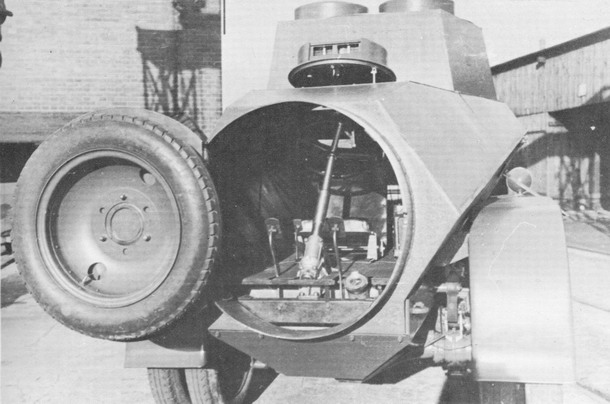
Rear hull of one of the first Daimler-Benz prototypes — the open circular rear hatch gives a fine view of the rear driver's position. Source: Flickr.com, used with permission of the publishing user, edited
The armour plate from which the hull was welded was 14.5 mm thick at the front and 8 mm on the side walls. The roof and floor were 5 mm. The hull was considerably elongated at the front to house the engine compartment. The crew compartment occupied the rear half of the hull, with a fully rotating fighting turret above it.
Initial prototype tests carried out in 1930 revealed, among other things, certain weaknesses of the chassis — including overloading of the front axle and an inadequate engine cooling system.
Alongside the ongoing development work and testing, Daimler-Benz introduced an upgraded version of the truck chassis in March 1931, designated G3a (also briefly referred to as G4). This new chassis brought a more powerful variant of the original M09 engine, displacing 3,668 cc and producing a maximum of 68 horsepower at 2,900 rpm (some sources give 65 hp). For armoured vehicle construction, this new chassis also had to be modified. Not only was a rear driver's post added and the forward post revised again, but the lessons of previous tests led to strengthened wheel suspension and the installation of a larger radiator with a more effective fan. The modified chassis was then designated G3a (p). Some authors note that the modifications also included a new gearbox — the Maybach DSG40 type, offering five forward and two reverse gears.
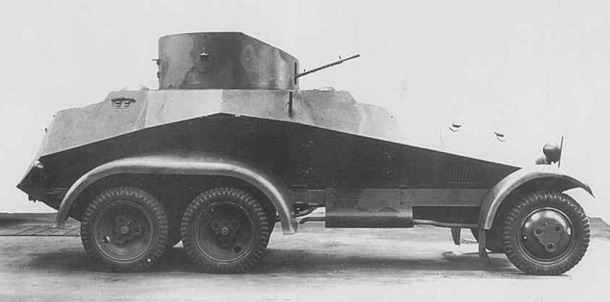
A further development phase of the six-wheeled armoured car prototype on the Daimler-Benz chassis. Source: Flickr.com, used with permission of the publishing user, edited
As already noted, the hull details changed gradually during development. The earliest variants had a vertical front wall. From it the bonnet rose gently before transitioning directly into the flat roof of the crew compartment. There was no step between the engine bonnet and the compartment roof (unlike later series production), which meant the compartment had no front wall in which vision ports could be cut. The crew's forward view therefore had to be provided by other means.
From the compartment roof, in front of and behind the turret, two raised circular hatches protruded like chimneys. These hatches were fitted with observation ports. The front one was offset slightly to the left of the centreline; the rear one was central. Their positions corresponded to those of the front and rear drivers they served. The driver thus sat with his head effectively projecting up into the tubular hatch, using the vision ports in the tube to observe ahead of or behind the vehicle. When circumstances permitted, the driver could open the entire hatch cover and gain a direct unobstructed view — at the cost of exposing his head entirely to the outside. This solution was later abandoned as unnecessarily complex.
In the rear wall of the hull there was a large circular access hatch for the rear driver. On the inside and outside of this hatch cover, a spare wheel was mounted on each face. Another feature characteristic of the early development vehicles was the rounded mudguards, which were later replaced by angular ones on production vehicles. On the first variants what appears to have been only a trial turret was fitted — hexagonal in plan, with two raised circular hatches on its roof fitted with observation ports, identical to those of the drivers already described. From available photographs this turret carried no armament, and it is quite possible it was not a functional turret at all, but simply an unpanelled mock-up.
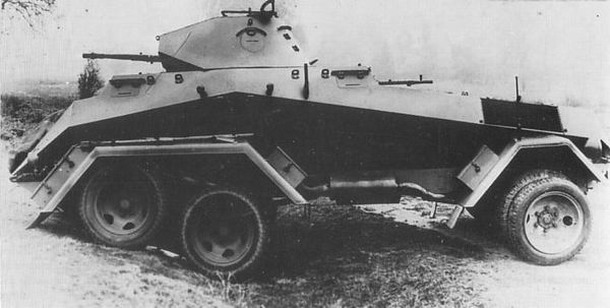
Development variant of the Sd.Kfz. 231 on the Magirus chassis — note the louvred openings in the engine bonnet sides, the hull machine gun, and the twin front wheels. Source: Flickr.com, used with permission of the publishing user, edited
The Büssing-NAG Chassis
During 1932 (some sources say as early as 1931), a second manufacturer's chassis was brought into the development programme alongside the Daimler-Benz G3a (p). This was again a three-axle chassis taken from a truck — this time the Büssing-NAG type G31. The two rear axles were driven and fitted with twin wheels. The front axle had single wheels and was steerable. Again, the powerplant was taken over with the chassis: a Büssing-NAG G four-cylinder engine, displacing 3.92 litres and producing a maximum of 65 horsepower (some sources give only 60 hp).
The gearbox offered three forward gears and one reverse, but the vehicle also had a reduction gearbox providing switching between normal and cross-country gear ratios — giving a practical total of six forward and two reverse gears. For armoured vehicle construction, a second driver's post was again added to this chassis, and the modified version received the obligatory designation G31 (p).
Development of the armoured car continued in parallel on both chassis. The armoured hull was adapted for fitting to the new chassis and testing continued. On this chassis the front grille was no longer vertical but slightly angled. The prototypes were fitted with a new turret variant — this time complete with armament. The turret had a circular plan with walls perpendicular to the ground. The front section of its roof was angled, the rear section horizontal. The turret carried at this stage only a single 7.92 mm MG13 machine gun.
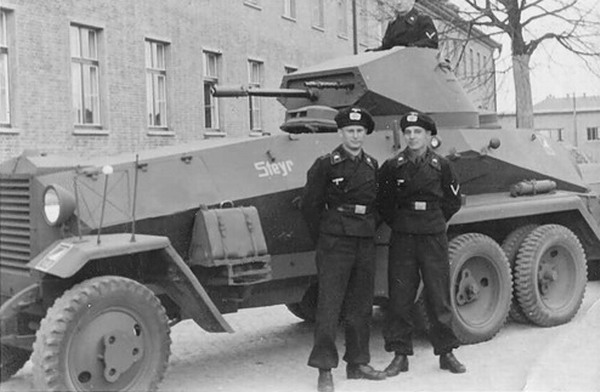
Early Daimler-Benz hull variant with the vertical front grille and raised hatches, but fitted with the series-production turret — such mixed combinations were evidently also taken into service. Source: Flickr.com, used with permission of the publishing user, edited
The vehicle's design continued to mature until apparently by the end of 1932 it had reached a more or less final form. The hull design has already been described in connection with the first prototypes and its basic configuration changed very little. It was a thoroughly modern design, bearing no resemblance to the boxy constructions of the 1920s such as the Sd.Kfz. 3. With some imagination the hull resembled a coffin bent in the middle. One significant change compared to the first prototypes was that the crew compartment roof was raised relative to the rest of the hull. This gave the compartment both a front and a rear wall in the form of a small step, in which observation ports could be cut — eliminating the need for the unnecessarily complex raised hatches of the first prototype.
The engine compartment grille was angled, and virtually its entire area was occupied by the engine air intake opening, covered by horizontal steel louvres. The headlights were attached to the sides of the engine bonnet, with service hatches for engine access behind them. The crew could use several hatches for boarding and alighting. In the lower section of both side walls, behind the front wheel mudguards, were diamond-shaped access hatches closed by two-piece covers.
A further large hatch was in the rear wall of the hull, with double doors whose leaves opened outward to the sides. On most vehicles, a spare wheel was mounted across the rear wall on a folding bracket, so the bracket had to be swung down before the hatch could be opened. For this reason the rear hatch served only as an emergency exit. A final hatch was located in the compartment roof, to the right of the turret in front of it, and appears to have been used primarily by the driver.
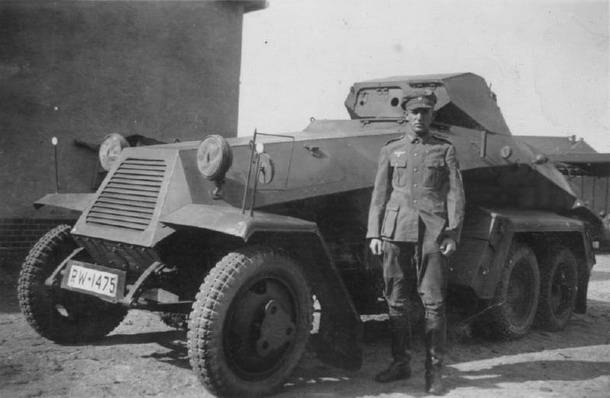
The final form of the Sd.Kfz. 231 on the Daimler-Benz chassis, here with armament removed. Source: Flickr.com, used with permission of the publishing user, edited
Above both driver's positions — in the left section of the compartment roof in front of the turret, and in the centre of the roof behind it — were circular openings with domed covers. Unlike the prototype, these no longer needed to be raised or fitted with built-in vision ports, since observation was provided by the ports cut into the front and rear compartment walls. The covers were still openable, however, so in a safe area the driver could lift his hatch and push his head through the roof opening for a direct unobstructed view — at the obvious cost of exposure to the outside world.
From the safety of the armoured compartment, the forward driver looked out through vision ports in the left section of the front wall and in the left side wall beside his position. The ports were fitted with hinged covers incorporating narrow observation slits. The rear driver had three similar ports — one in the rear wall and one on each side of his position. In summary, each driver could observe outside the vehicle in three ways: with his head projecting through the open roof hatch, through the open rectangular vision ports in the walls, or finally through just the slits in the closed port covers. Small drip rails were welded above all observation openings to prevent rainwater running into them. As some photographs show, false vision ports were painted on the right half of the front wall and on the right side wall of some vehicles — the only purpose I can think of for this was to confuse the enemy.
Both driver's positions were fully equipped, each with a steering wheel, pedals, and gear lever (though the rear position apparently lacked an instrument panel). The rear post was added specifically to facilitate reversing: forward visibility from the front position was virtually non-existent for reversing, and since the vehicle was intended for deployment in urban environments and the confined space of narrow streets, easy reversing was considered essential. Whether the vehicle carried two permanent drivers or only one who moved between the two positions as needed is not entirely clear from available sources.
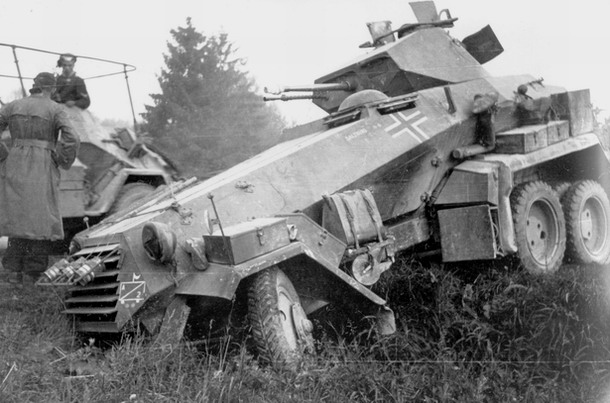
Sd.Kfz. 231 on the Büssing-NAG chassis — note the unusual smoke dischargers fitted to the engine grille. Source: Flickr.com, used with permission of the publishing user, edited
On the question of crew size, sources are in agreement: four men. The commonly cited composition of driver, commander, gunner, and loader is, however, somewhat questionable. With that arrangement, only a single man would be seated inside the relatively spacious hull compartment while the remaining three would be crammed into the small turret. From this perspective it seems more probable that there were two drivers on board, with one of the remaining two men performing a dual role — the commander, for example, most likely also serving as loader. One might object that the rear driver would be merely a passenger for most of the time. In my view, however, that is an easier arrangement to imagine than the front driver having to squeeze past three soldiers in the turret to reach the rear steering wheel in the middle of combat.
But back to the vehicle's construction. At the widest part of the hull, two headlights were mounted on each side — one facing forward and one rearward. A noteworthy feature was an additional folding headlight set into both side walls above the rear wheel mudguards. Under normal circumstances it lay flush with the armour and its cover was almost invisible. Its purpose was to provide extra illumination for night-time aiming (which is probably why I have not been able to find a single photograph showing one deployed).
On the hull roof was a fully rotating fighting turret. In its final form the turret had a horseshoe-shaped plan. Its side and rear walls were sloped, so the turret narrowed toward the roof. The turret roof was angled at the front and flat at the rear. In the flat rear section of the roof was a crew access hatch with a two-piece cover whose halves opened outward to the sides. A further large hatch was in the curved rear wall of the turret, also with a double-leaf cover. The side walls had circular openings fitted with covers incorporating observation slits; when closed these served as vision ports, and when open they could be used for firing personal weapons.
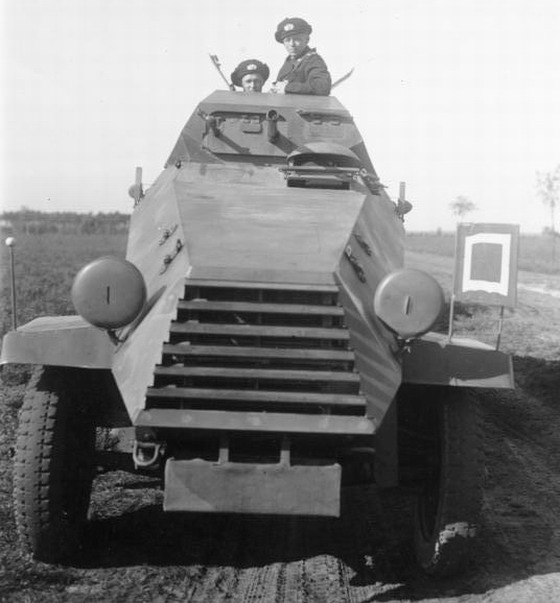
Sd.Kfz. 231 on the Büssing-NAG chassis — this vehicle has the early weapon mantlet with the machine gun to the right of the cannon. Source: Bundesarchiv_Bild_102-04721A, Wikimedia, Creative commons, edited
The turret's vertical front wall housed the vehicle's armament: the KwK 30 L/55 rapid-fire cannon in 20 mm calibre and a 7.92 mm MG13 machine gun (later MG34). 200 cannon rounds were carried, along with 1,300 rounds for the machine gun (1,500 is also cited). Despite its relatively small calibre, the cannon theoretically allowed the armoured car to engage even light enemy tanks. With standard armour-piercing PzGr. ammunition, the weapon could penetrate 20 mm of armour angled at 30° at a range of 100 metres. With the subcalibre PzGr. 40 round, it could penetrate as much as 40 mm.
On early series vehicles, the movable weapon mantlet within the turret's front wall was positioned in its right section, occupying approximately two-thirds of the front wall. The right third was fixed and contained a small closable observation port. Within the mantlet, the cannon was on the left and the machine gun on the right, with additional openings between the barrels including the aperture for the TZF (Turmzielfernrohr) gun sight. Lateral traverse was provided by the rotating turret and was therefore a full 360°. Vertical elevation was governed by the mantlet and ranged from -2° to +12°.
On later series vehicles the weapon installation changed. The movable mantlet was enlarged to occupy nearly the full width of the front wall. The cannon was placed roughly centrally and the machine gun to its right. During production, a mounting bracket for a second machine gun was added to the turret roof on some vehicles, intended primarily for anti-aircraft defence. Operating it required one of the crew to sit in the open rear hatch, with his entire upper body outside the vehicle and unprotected from enemy fire.
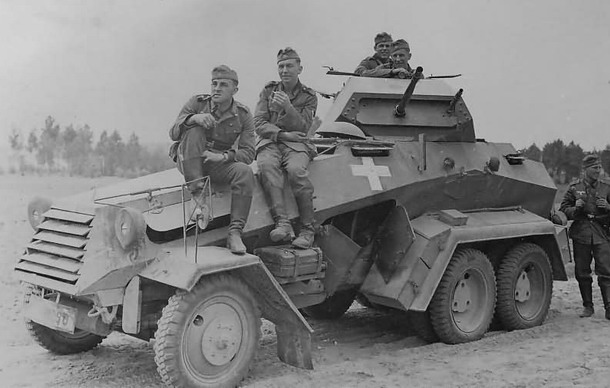
Sd.Kfz. 231 on the Büssing-NAG chassis — note the later-version weapon mantlet with the machine gun to the left of the cannon. Source: worldwarphotos.info, used with permission of the site operator, edited
Unlike the first prototypes, series vehicles used angular mudguards. The wheel hubs were fitted with armoured covers of various shapes. Series production began in 1933, carried out directly at the Daimler-Benz and Büssing-NAG factories, to which the armoured hulls — and presumably also the turrets — were supplied by the already-mentioned Deutsche Werke. The armament was supplied by Rheinmetall. The vehicle's original official designation was gepanzerter Kraftwagen Kfz 67, but it became far better known under the designation schwere Panzerspähwagen (Sd.Kfz. 231), which was introduced later, and still later supplemented by the suffix "6 Rad" to distinguish it from the eight-wheeled version — though strictly speaking the vehicle had not 6 but 10 wheels, since the rear axle wheels were twin-tyred.
The Magirus Chassis
In 1934 a third chassis type was brought into production. Again it was a truck-derived basis — this time the Magirus type M206. Again a 6×4 layout with the two rear axles driven and the front axle steerable. The powerplant was again taken over with the chassis: a Magirus S88 six-cylinder engine, displacing 4,562 cc and producing a maximum of 70 horsepower at 2,200 rpm. A modified version of the chassis with a second driver's position was of course again created, receiving the obligatory designation M206 (p).
On the number of gears, at least three different accounts exist. Some sources state the gearbox offered 4 forward and 1 reverse gear. Another version adds a two-speed reduction gearbox that doubled the above figures. A third version claims the vehicle had 4 gears in each direction and could therefore travel equally fast forward and in reverse. One thing is fairly clear: if the vehicle truly had an equal number of gears in both directions, that gearbox would most likely have been added during the chassis modifications for armoured vehicle construction. A standard truck, from which the chassis was derived, would certainly not have needed such a gearbox (who would want to drive a truck at high speed in reverse?). The second version — 4 + 1 standard gears plus a reduction gearbox adding an equal number of cross-country ratios — seems the most plausible.
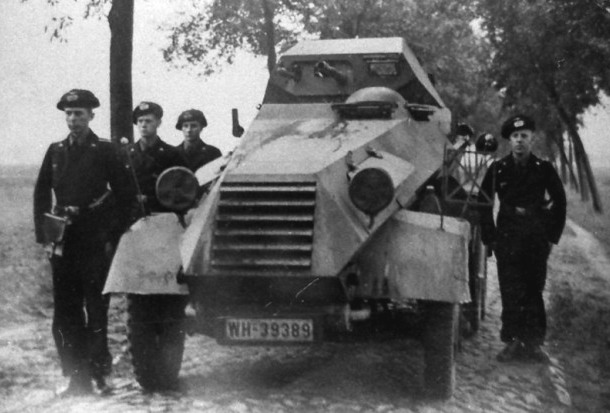
Sd.Kfz. 231 on the Magirus chassis, identifiable by the long front mudguards. Source: warwheels.net, used with permission of the site operator, edited
The Magirus-based armoured car also went through a development phase during which its hull differed slightly from the later series form. This Sd.Kfz. 231 variant was the heaviest of the three produced. The designers therefore attempted to reduce wheel loading and ground pressure by fitting twin wheels on the front axle — giving the vehicle a total of 12 wheels in this experimental form. Another feature that did not carry over to later production was a hull machine gun, fitted in the right half of the crew compartment's front wall. I have not come across any explanation of who was supposed to operate it — and it was not just the gun; a further closable vision port was even provided in the right side wall. Two explanations suggest themselves: either Magirus envisaged a fifth crew member, or the intention was to make use of the rear driver who otherwise had nothing to do. In any case, neither the gun nor the right-side port were retained in the production version.
The Magirus engine appears to have had more demanding cooling requirements. For this reason, the prototype had large louvred openings cut into the sides of the engine bonnet for airflow, roughly where the standard Sd.Kfz. 231 had its service hatches. On the Magirus prototype, engine access was provided instead by a single large opening in the bonnet's upper plate. These side ventilation openings did not carry into production either. In their place, ventilation slots were cut at a less exposed location on the armour — in the lower section of the side walls immediately behind the front mudguards. The Magirus-based variant ultimately became the most widely produced version of the Sd.Kfz. 231.
Telling apart vehicles from the three different manufacturers — Daimler-Benz, Büssing-NAG, and Magirus — is a popular topic of discussion among Sd.Kfz. 231 enthusiasts. The main distinguishing features are the wheel discs and hub armour covers, the front mudguard design, the engine grille, and the already-mentioned ventilation slot behind the front mudguards on the Magirus. A particularly reliable identifier of Magirus vehicles is the unmistakably longer forward section of the front wheel mudguards.
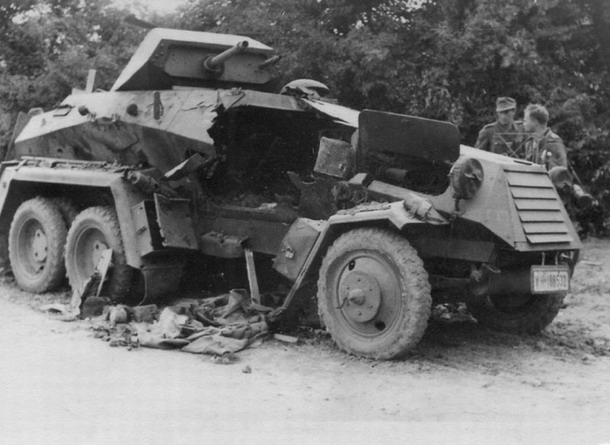
Destroyed Sd.Kfz. 231 on the Büssing-NAG chassis. Source: Flickr.com, used with permission of the publishing user, edited
Series Production
Production of the six-wheeled Sd.Kfz. 231 described here continued until 1936 or 1937. The total number of vehicles built is also a very contentious question — both the overall figure and the individual tallies for each manufacturer. The uncertainty is compounded by the fact that production numbers are given practically only as a combined figure for the Sd.Kfz. 231 and its radio car variant Sd.Kfz. 232. Claims of over a thousand vehicles exist but are certainly not accurate. More realistic estimates speak of just over one hundred. The most commonly cited overall total is 123 vehicles of both types (Sd.Kfz. 231 and 232 combined), of which perhaps 12 were built by Daimler-Benz, 36 by Büssing-NAG, and 75 by Magirus.
The Daimler-Benz Sd.Kfz. 231 weighed 5.7 tonnes and had a maximum road speed of 70 km/h (65 km/h is also cited). The Büssing-NAG variant weighed 5.35 tonnes and likewise reached 70 km/h on road (65 km/h is also given). The Magirus variant was a full 6 tonnes and could achieve up to 62 km/h (65 km/h is again sometimes cited).
Strassenpanzerwagen
Photographs confirm that the Reichswehr and later the Wehrmacht did eventually take into service some of the prototype vehicles, fitted with the production turret. An unknown number of Büssing-NAG prototypes were handed over — or rather sold — to the police. Only the hull was taken from the prototype; a different turret was fitted for this purpose, circular with sloped walls and a single machine gun, apparently the MG 08 type. The vehicle received the designation Strassenpanzerwagen and served with the police in Karlsruhe.
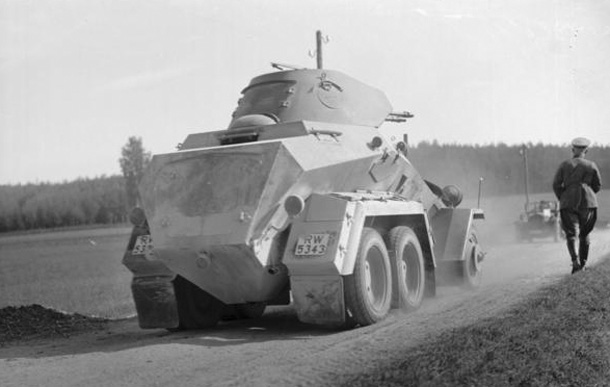
Rear view of the Sd.Kfz. 231. Source: Bundesarchiv_Bild_136-B3092, Wikimedia, Creative commons, edited
Railway Version
A railway variant of the Sd.Kfz. 231 was apparently built as a single evaluation prototype. It was based on the Büssing-NAG chassis. Four small rail wheels were added alongside the standard road wheels: the first pair was mounted ahead of the front road wheels, and the rear pair sat between the second and third road axles. When operating off the rails, the rail wheels were raised clear of the ground. Judging by the fairly simple construction of the rail wheel mountings, these wheels were unpowered. The height of the rail wheel supports was presumably set so that the standard road wheels of the two rear axles remained in contact with the rails, providing the traction to drive the vehicle along the track.
Combat Deployment
The Sd.Kfz. 231 saw combat during the Wehrmacht's campaigns in Poland, the Benelux countries, and France. By this time, however, these vehicles were already beginning to be withdrawn from front-line units to rear-area service — training establishments, police duties, and anti-partisan operations. They were being replaced in first-line units by the more capable eight-wheeled vehicles. Even so, a small number of examples accompanied German forces during the opening months of the campaign in the Soviet Union.
The most acutely felt shortcoming of these armoured cars was the absence of a radio. The effort to remedy this weakness led to the development of a modified radio variant designated Sd.Kfz. 232, and later to a further radio car designated Sd.Kfz. 263.
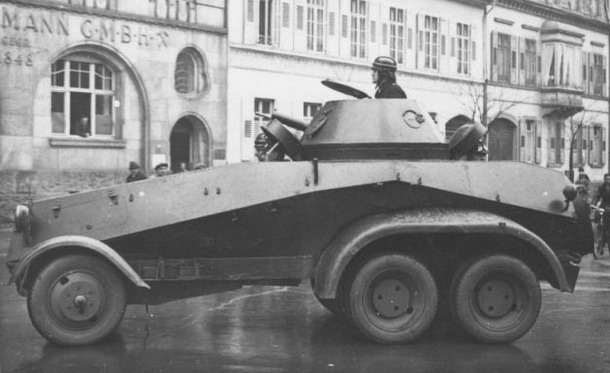
A Büssing-NAG prototype, fitted with a new turret, served as the police Strassenpanzerwagen. Source: warwheels.net, used with permission of the site operator, edited
The six-wheeled armoured cars proved to be very useful vehicles in practice, but their operational possibilities were severely restricted by terrain. From the outset these vehicles were designed and developed for movement and combat on paved roads, and off them they were rather clumsy. Soft ground or broken terrain presented them with an almost insurmountable obstacle. This was one of the principal reasons why, already in the second half of the 1930s, a successor was developed based on an eight-wheeled chassis with drive and steering on all wheels.
Technical Data
|
|
Büssing-NAG |
Daimler-Benz |
Magirus |
|
weight: |
5.35 t |
5.70 t |
6.00 t |
|
length: |
5.57 m |
5.57 m |
5.57 m |
|
width: |
1.82 m |
1.82 m |
1.82 m |
|
height: |
2.25 m |
2.25 m |
2.25 m |
|
engine: |
Büssing-NAG G |
Daimler-Benz M 09 |
Magirus S88 |
|
engine output: |
65 hp |
68 hp |
70 hp |
|
max. speed: |
70 km/h |
70 km/h |
62 km/h |
|
hull armour: |
5–14.5 mm |
5–14.5 mm |
5–14.5 mm |
|
crew: |
4 men |
4 men |
4 men |
|
armament: |
20 mm KwK 30 L/55 cannon 7.92 mm MG 34 machine gun |
20 mm KwK 30 L/55 cannon 7.92 mm MG 34 machine gun |
20 mm KwK 30 L/55 cannon 7.92 mm MG 34 machine gun |

ARTICLE
CONTENTS:
Reproducing text from the Panzernet website without the written consent of the operator is prohibited.