Sd.Kfz. 3
armoured car for the Reichswehr
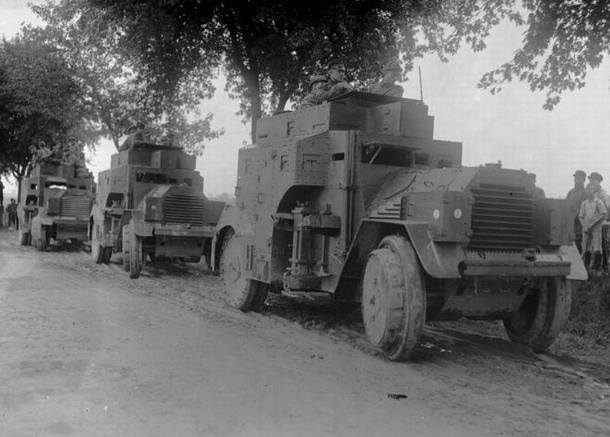
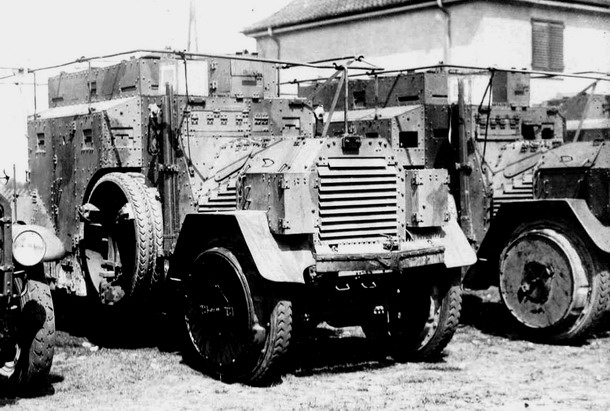
three Sd.Kfz. 3 armoured cars, apparently during Reichswehr manoeuvres in 1928; source: Bundesarchiv_Bild_102-06342, Wikimedia, Creative Commons, edited
An Armoured Vehicle Without Weapons
Although the Sd.Kfz. 3 armoured car cannot really be described as a "Second World War" machine, it is certainly worth a mention, as it was the first German army armoured vehicle developed after the First World War (police armoured cars not counted). The development and production of armoured cars was not forbidden to the Germans by the Treaty of Versailles in the way that tanks were, but quotas were imposed on their numbers. Moreover, the vehicles that were built were intended primarily for the police rather than the military. The army was permitted to own only armoured cars serving as infantry carriers and not as fighting vehicles. For this reason the vehicles were not allowed to carry integral armament – and this applied to the Sd.Kfz. 3 as well.
Vehicle Description
The Sd.Kfz. 3 armoured car was produced for the German army by Daimler-Benz between 1921 and 1922. It was based on a chassis designated DZVR, derived from an original lorry. The hull was simply designed, though very angular, formed from flat steel plates joined by riveting. The thickness of these plates ranged from 7.5 to 10 mm (figures of 4 to 12 mm are also cited). The vehicle had no elegance whatsoever and resembled a large box on wheels.
One interesting feature was the headlights, which were housed in closeable armoured boxes – one on each side of the front radiator mask, and on some vehicles also one centrally above the driver and commander's cab and another in a similar position at the rear. Whether the headlight boxes could be opened and closed remotely from inside the vehicle I was unable to establish. Another interesting feature found on at least some of the vehicles were hinged semaphore-style turn signals mounted on the side walls of the driver and commander's cab.
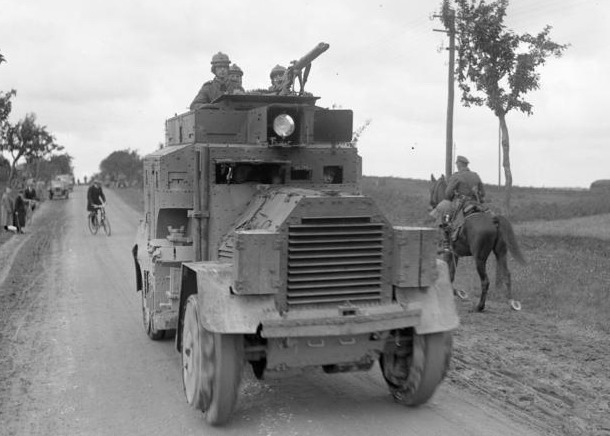
Sd.Kfz. 3 – note the machine gun on the roof; source: Bundesarchiv_Bild_102-10893, Wikimedia, Creative Commons, edited
The vehicle ran on four large-diameter wheels. Instead of pneumatic tyres, the wheels were fitted with solid rubber rings – single on the front wheels and double on the rear. Spare rubber rings were carried suspended on the sides of the hull. The wheels were of spoke construction, but the vulnerable wooden spokes were completely covered on the outside by armour plating. The wheel armour incorporated closeable access points for the wheel hub fixings on the axles. All four wheels were driven.
The powerplant was mounted at the front. It was a four-cylinder, water-cooled Daimler M1574 engine with a displacement of 12 litres, producing a maximum output of 100 horsepower at 1,200 rpm. The gearbox offered five forward and five reverse gears. The reason for this was the desire to allow the vehicle to reverse quickly rather than perform a slow and complicated turn. For the same reason the vehicle was fitted with two drivers and two driving positions, one for forward travel and one for reverse. The third permanent crew member was the commander. Visibility from the vehicle was provided by a number of closeable vision ports.
The large wheel diameter gave the designers a reasonable level of ground clearance. This vehicle was not, however, intended for cross-country use but almost exclusively for road travel. On roads it could reach a top speed of 50 km/h, which was quite respectable given its weight of 12 tonnes. Range was between 250 and 300 km.
two Sd.Kfz. 3 command variants – note the frame antennas; source: Aviarmor.net, edited
The armament of the Sd.Kfz. 3 consisted of either one or two MG 08 machine guns, 8 mm calibre. The weapons were not permanently built into the vehicle; instead they were fired over the edge of the roof after opening the roof hatch. This two-part hatch occupied virtually the entire roof surface, with its panels opening forwards and rearwards.
The rear section of the vehicle provided a troop compartment for six to twelve soldiers. As already noted, the Treaty of Versailles classified the vehicle as an armoured personnel carrier rather than a fighting vehicle. The Sd.Kfz. 3 was therefore intended primarily to transport infantrymen safely to the point of battle. The soldiers could, however, fire from the vehicle, as the walls of their compartment were fitted with closeable firing ports. A large single-piece door on each side wall provided entry and exit. A fold-down step was installed beneath each door to ease boarding.
Production, Organisation and Service
According to the original plan, 105 vehicles were to be produced and subsequently distributed in batches of 15 among 7 motor battalions. Some sources suggest, however, that fewer than 105 examples were actually built. The Sd.Kfz. 3 served in the Reichswehr and later the Wehrmacht primarily in a training role throughout the 1920s and for much of the 1930s.
A command variant of the Sd.Kfz. 3 was also produced in smaller numbers, carrying an expanded radio fit and distinguished by a large frame antenna mounted above the hull on several support struts.

ARTICLE
CONTENTS:
Reproducing text from the Panzernet website without the written consent of the operator is prohibited.