ARW / ZRW
an armoured car too complicated for its own good
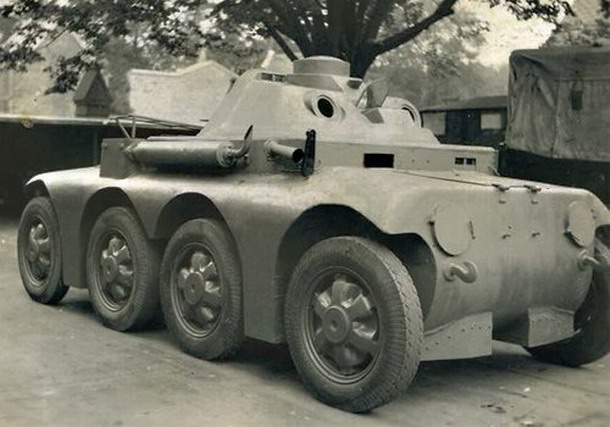
Magirus prototype fitted with an unarmed turret — note the distinctive aluminium alloy wheel discs, source: leadwarrior.com, modified
A New Armoured Car
The armoured cars that had appeared in Germany after the First World War were very simply engineered machines built primarily for police units and with limited finances in mind. Based on commercial chassis, their cabs looked like plain boxes riveted together from flat sheet metal with little ingenuity, and the vehicles were utterly unsuited to movement off paved roads. For police service they were usable enough, since they were intended for deployment primarily in city streets. The same spirit informed the construction of the first army armoured car described elsewhere, the Sd.Kfz. 3. It comes as no surprise, therefore, that by the mid-1920s even this was considered obsolete and a successor had to be found.
The requirement for a new vehicle was issued by the Reichswehr's arms procurement office in 1927 — effectively the first purpose-built German post-war armoured car intended from the outset for military use. The specifications were genuinely demanding. The vehicle was to have eight wheels, ideally all driven. The front and rear axles were to be steerable. Weight was not to exceed 7.5 tonnes. Top road speed was set at 65 km/h, with a normal cruising speed of 32 km/h. Armour of at least 13.5 mm was required, along with a 37 mm gun and a machine gun in a rotating turret. The vehicle was additionally required to be amphibious.
In March 1927 these requirements were passed to three German firms along with an order for two prototypes from each: Magirus, Büssing-NAG and Daimler-Benz. According to some sources, the armoured hulls for all three were to be manufactured by a fourth party, the firm Martini-Hünecke. The project was given the code name ARW, an abbreviation of Acht Rad Wagen — literally eight-wheeled vehicle. The army expected delivery of all six prototypes the following year (1928), with testing to take place during 1929.
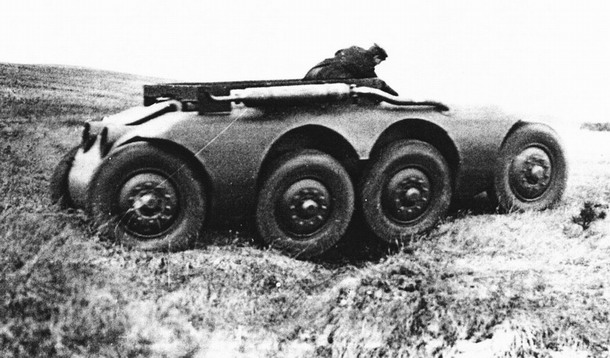
Daimler-Benz prototype during trials, without turret or armament, source: Aviarmor.net, modified
Competing Designs
Magirus and Daimler-Benz followed the army's specification and produced eight-wheeled vehicles, while Büssing-NAG went its own way and developed an armoured car with five axles and ten wheels. The Magirus and Daimler-Benz prototypes looked very similar at first glance — both had low, aerodynamic hulls full of modern rounded forms. On both vehicles the engine was mounted in the rear of the hull, with the crew cab and turret positioned closer to the bow. Bow and stern were somewhat relative terms on the Daimler-Benz, however, as it was reportedly capable of travelling at the same speed in either direction and presumably had two driving positions accordingly. The hull on both vehicles was comparatively low with a flat roof, from which the crew cab projected as the only angular element of an otherwise rounded body.
The planned fighting turret also had a very futuristic appearance, with strongly sloped walls. The slope of the front wall was particularly sharp, intended to allow a large positive elevation of the weapons — perhaps as much as +70°. Turrets for all the prototypes were most likely to be supplied by a fourth participant, Rheinmetall-Borsig. The prototypes were, however, built and tested without turrets, and the crew cabs were not fully completed either. Only one of the Magirus prototypes was later finished and subjected to further testing with turret and armament installed.
The Daimler-Benz prototype was powered by — unsurprisingly — a Daimler-Benz M36 engine producing 100 horsepower. As for the Magirus prototype's powerplant, two different accounts exist: one states it used the same Daimler-Benz M36 engine, while the other gives it a six-cylinder Maybach unit, again rated at 100 horsepower. Top speed was identical for both manufacturers' vehicles at 90 km/h. A notable feature of the Magirus prototype were its wheel discs, which were reportedly made from a lightweight aluminium alloy to save weight and featured a strikingly modern design. Both the Magirus and Daimler-Benz vehicles had steerable front and rear axles, precisely as the army's specification demanded.
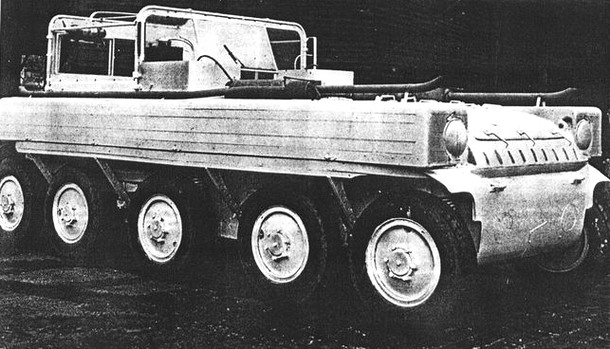
ZRW prototype by Büssing-NAG — instead of a cab and turret, only a frame with a windscreen is fitted, source: Aviarmor.net, modified
The Daimler-Benz prototype's amphibious capability was provided in a particularly interesting manner. A cork-filled superstructure was fitted over the hull roof to act as a float. Once in place, this boxy addition completely covered the vehicle's rounded armour profile and radically altered its appearance. Propulsion on the water was provided by a propeller that was fitted only for swimming and removed at all other times. I was unable to establish anywhere where the fairly sizeable float was stowed when not in use — it certainly could not have gone inside the vehicle, so a support vehicle would presumably have had to carry it, adding yet another layer of impracticality. The necessity of fitting the float before entering water must have counted heavily against this vehicle during trials.
Whether the Magirus prototype was capable of swimming under its own buoyancy, or required a similar device to the Daimler-Benz, I was also unable to determine. What is certain is that here too a propeller was fitted into an aperture in the hull stern only immediately before swimming and was not carried during road travel.
The Büssing-NAG prototype differed markedly from the other two. It had five axles with ten wheels, none of which could be steered sideways (!!!). Steering was instead achieved in the same way as on a tank — by braking the wheels on one side of the chassis. This proved a deeply unfortunate solution, as turning in this manner caused extreme tyre wear. The prototype was powered by an eight-cylinder engine producing 150 horsepower. On account of its wheel count, Büssing-NAG designated its vehicle the ZRW (Zehn Rad Wagen — ten-wheeled vehicle).
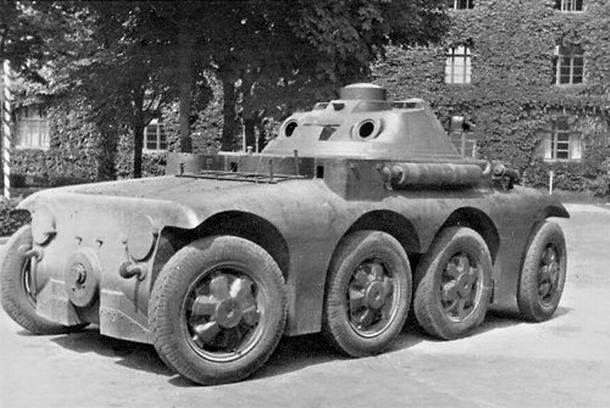
rear of the Magirus prototype — note the aperture for the propeller between the towing hooks, source: leadwarrior.com, modified
Unlike its competitors, the Büssing hull was angular rather than rounded. Its shape was dominated by two box-shaped sponsons running the full length of the hull on both sides above the mudguards. These sponsons were hollow and served as floats, providing the vehicle with the buoyancy needed for swimming. On this prototype too neither the crew cab nor the turret were completed; for testing purposes a railing was mounted around the open cab roof and a windscreen erected.
As for armour thickness, all three manufacturers apparently met the 13.5 mm requirement, most likely on all walls. Some sources state, however, that the Magirus prototype had thicker armour than the others, which is why the manufacturer had to save weight elsewhere — hence the distinctive aluminium wheel discs already described. I was unfortunately unable to find any information on the weight of any of the three prototypes.
Regarding crew size, figures of four and five men are both cited in the sources. It is possible that both are correct, as crew complement may have varied between the prototypes of the different firms.
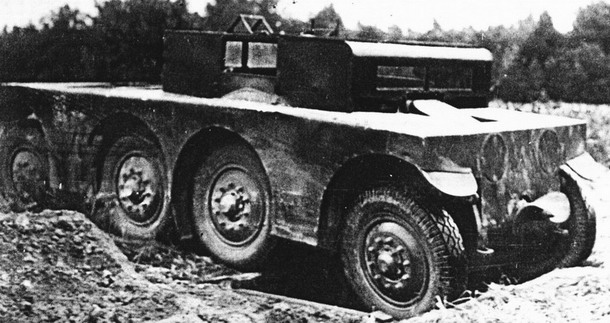
Daimler-Benz prototype with the cork float fitted, source: Aviarmor.net, modified
Trials and Cancellation
Initial trials of the delivered vehicles took place in Germany, apparently in 1929, without turrets or armament. As already noted, only one of the Magirus prototypes was subsequently completed, fitted with a turret and armed. The specified gun and machine gun combination was not installed, however — instead a pair of water-cooled machine guns was fitted (most likely the MG-08/15 type). Complete with turret and armament, the prototype then underwent further testing, including at a police unit as photographs confirm.
In 1930 the prototypes were sent for further trials to the secret Kama base in the Soviet Union. In June 1930, however, the entire project was cancelled. The reason was not only the technical complexity of the vehicles but above all their enormous cost — reportedly as much as a quarter of a million marks per vehicle. Such expenditure was wholly unacceptable for the drastically reduced German army of the time. Further development of heavy armoured cars therefore shifted, in the interests of economy, towards cheaper machines based on the existing chassis of commercial trucks — the six-wheeled versions of the Sd.Kfz. 231 and Sd.Kfz. 232.
ARTICLE
CONTENTS:
Reproducing text from the Panzernet website without the written consent of the operator is prohibited.