Sd.Kfz. 263 (8 Rad)
eight-wheeled armoured radio car
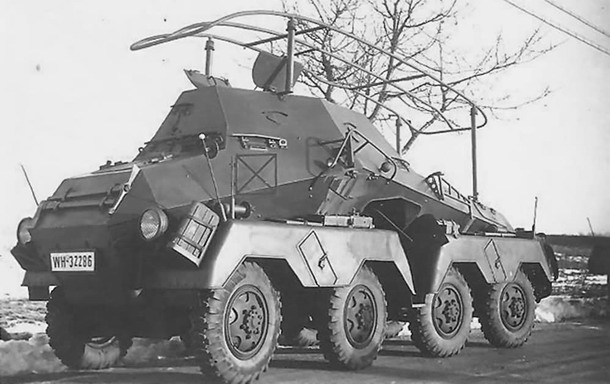
Sd.Kfz. 263 (8 Rad), source: Worldwarphotos.info with the permission of the site operator, edited
A note by way of introduction... the designation Sd.Kfz. 263 (Sd.Kfz. = SonderKraftwagen = vehicle for special purposes) was used for two entirely different types of heavy armoured radio cars. This article describes the more modern of the two, identified by the suffix "8 Rad". The older six-wheeled version, Sd.Kfz. 232 (6 Rad), is covered in a separate article.
Origins of the Radio Car
From 1937 onwards, the German Army began taking delivery of the heavy eight-wheeled armoured cars Sd.Kfz. 231. In their standard form these vehicles were fitted with either no radio at all or only a weak set with limited range — a significant shortcoming for a vehicle intended for reconnaissance duties. The designers therefore developed a radio-equipped version, the Sd.Kfz. 232, at virtually the same time as the parent vehicle. This was essentially a standard Sd.Kfz. 231 fitted with an additional, more powerful radio set and a large frame antenna. It served its purpose, and the vehicle was capable of communicating over distances of tens of kilometres, but it was far from an ideal solution. The installation of the radio equipment significantly reduced the interior space and made life considerably less comfortable for the crew when carrying out combat duties. The designers' efforts continued until they eventually produced the Sd.Kfz. 263 radio car.
This vehicle was designed from the outset with its role as a radio car as the primary consideration, with combat capability being secondary. For this reason no cannon was fitted at all — only a single machine gun of the MG 34 type.
Vehicle Description
The vehicle did not have a turret in the true sense of the word, but rather a fixed superstructure built onto the hull — considerably larger than the original fighting turret. These modifications provided enough interior space for the comfortable installation of two radio sets: the short-range Fu Spr.Ger. "a" and, most likely, the medium-range Fu 12. The radio equipment was complemented by a large frame antenna that extended virtually the entire length of the engine compartment and the cabin superstructure. The antenna was supported on four struts — two attached to the engine bonnet and two to the roof of the superstructure. A second, telescopic antenna emerged from the hull roof behind the cabin. Under normal operating conditions this was retracted and usually covered with a canvas sleeve. When fully extended the antenna was nine metres long, so it could only be raised with the vehicle stationary.
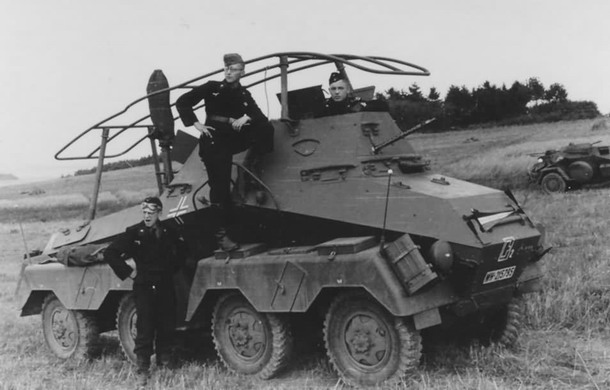
Sd.Kfz. 263, note the telescopic antenna covered by its canvas sleeve, source: Worldwarphotos.info with the permission of the site operator, edited
Like the original Sd.Kfz. 231 and the earlier radio car Sd.Kfz. 232, the eight-wheeled Sd.Kfz. 263 was built on the Büssing-NAG chassis designated GS. The vehicle had eight individually suspended wheels, all of which were both driven and steerable. Power was provided by the Büssing-NAG L8V eight-cylinder engine with a displacement of 7.913 litres, delivering a maximum output of 150 horsepower at 3,000 rpm. The gearbox offered six forward and six reverse ratios. Some authors cite only three ratios, which seems unlikely — though it is theoretically possible that both figures are correct if the vehicle had a three-speed main gearbox combined with a two-speed transfer gearbox, effectively doubling the available ratios.
The fuel capacity was 150 litres. The wheels were fitted with special reinforced self-sealing tyres capable of closing punctures caused by bullet hits. The armoured hull was developed by Deutsche Werke of Kiel. It consisted of upper and lower halves with walls angled in opposite directions, so the vehicle widened from the chassis upward and then narrowed again towards the roof. This angling of the walls increased their resistance to enemy fire. The steel plate from which the hull was welded was 14.5 mm thick at the front, 10 mm on the sides, 8 mm at the rear, and 5.5 mm on the floor and roof. The armour could therefore offer meaningful protection only against small arms fire and shell fragments.
The front of the hull was formed by upper and lower plates. The upper plate carried brackets for mounting an axe and a pickaxe, while the towing rope was attached to the lower plate. The upper front plate transitioned into a steeply raked forward glacis, beneath which was the main driver's station. A crew entry hatch was cut into the right-hand side of this glacis, closed by a two-piece lid; on early production vehicles the two halves of the lid opened outwards to the sides. This hatch served primarily as the front driver's entry point.
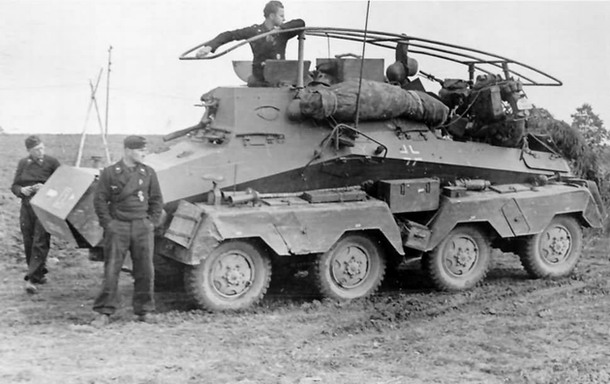
Sd.Kfz. 263 with additional frontal armour on the hull front, note the amount of stowage carried, source: Worldwarphotos.info with the permission of the site operator, edited
Moving rearward, the glacis stepped up into the front wall of the crew compartment, which featured two identical vision ports, each fitted with a cover that hinged upwards. The covers incorporated narrow observation slits for use when the covers themselves were closed. Two further vision ports of the same design were located in the side walls of the compartment. Small raised profiles were welded above all vision openings to channel away rainwater running down the armour. All of these observation openings were intended for the front driver, whose station was in this part of the compartment. The driver did not sit on the vehicle's centreline but slightly to the left of it, and therefore made most use of the left-hand front and side vision ports.
At the rear, the cabin stepped back down again to the level of the engine compartment roof. The rear wall of the crew compartment had an identical set of vision ports to the front wall — two facing directly rearward and one on each side. These served the rear driver, who also sat slightly to the left of the vehicle's centreline — though from his own perspective, facing backwards, this was effectively to the right of the axis.
Where the Sd.Kfz. 231 and 232 had a rotating turret, the Sd.Kfz. 263 instead had a fixed superstructure rising from the side walls of the hull. In the right-hand portion of the superstructure's front wall was the mount for the MG 34 machine gun — the vehicle's sole armament. The weapon was not fixed in place permanently; it could be removed and the opening closed with a cover. Above the gun port was an aiming visor, also closable with a cover. Each side wall of the superstructure had two circular openings closed by teardrop-shaped covers, which could serve both as vision ports and as firing ports for the crew's personal weapons. In the rear wall of the superstructure was a crew entry hatch with two-piece doors, and a further large hatch was located in the front portion of the superstructure roof, also fitted with a two-piece lid.
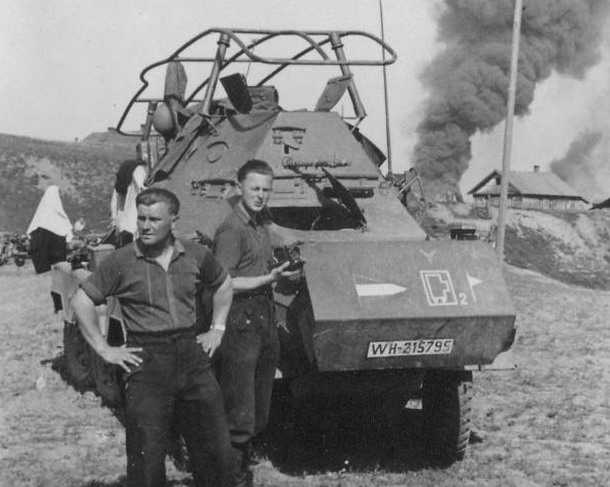
Sd.Kfz. 263 with additional frontal armour on the hull front, source: Flickr.com with the permission of the publishing user, edited
The rear of the hull housed the engine compartment with the already-mentioned Büssing-NAG L8V unit. In the front portion of the engine compartment roof was a grilled air intake opening for the powerplant. Further back, a large service access hatch in the bonnet roof allowed access to the engine; it was closed by a two-piece lid whose halves opened outwards to the sides. Additional smaller service hatches were located in the side walls of the bonnet. A final service opening occupied virtually the entire rear hull wall — or rather its upper portion — protected by a single cover that opened downward. This cover was not solid but louvred to allow airflow.
Running along almost the entire length of the vehicle on each side were two large double mudguards, each covering two adjacent wheels. The space between the two double mudguards was used for a crew escape hatch cut into the lower portion of the hull side wall. The mudguard surfaces themselves provided storage space for various equipment, and also carried the front driver's rear-view mirrors, the horn, and at the very rear, the two exhaust pipes.
Sources disagree on the size of the Sd.Kfz. 263's crew. Some state four men, the same as the Sd.Kfz. 231 and 232; others say the crew grew to five. In the latter case, the composition would presumably have been a commander, two drivers and two radio operators. The vehicle was not intended for direct combat and was not well suited to it. When it did become necessary to fire the machine gun, this was apparently done by the commander or one of the radio operators.
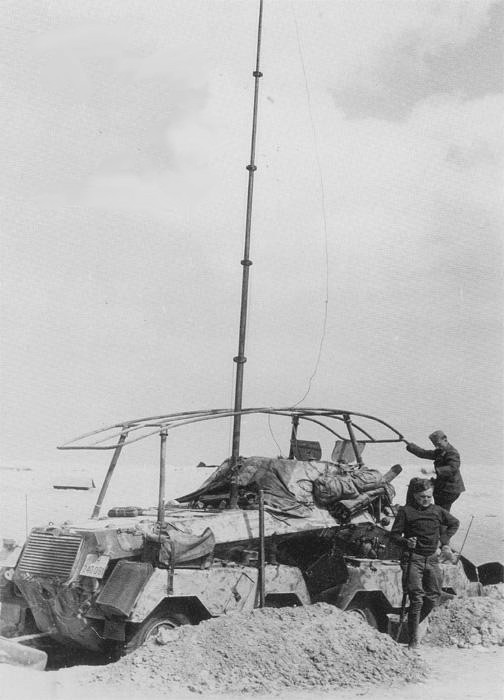
Sd.Kfz. 263 in Africa, note the fully extended telescopic antenna, source: Flickr.com with the permission of the publishing user, edited
Similar contradictions exist in the literature regarding the technical specifications. The radio car's weight is most commonly given as 8.68 tonnes. Maximum road speed was apparently the same as for the standard Sd.Kfz. 231 — somewhere between 85 and 90 km/h — and this applied in both directions of travel. The vehicle's length and width likewise corresponded to those of the standard Sd.Kfz. 231: the radio car measured 5.85 metres in length, 2.2 metres in width, and stood a full 2.9 metres tall thanks to its antenna (compared to 2.35 metres for the standard armoured car).
Series Production
The vehicle's full official designation was apparently schwerer Panzerfunkwagen Sd.Kfz. 263 (8 Rad). Series production most likely began in 1937 or 1938. When exactly it ended is a matter of debate: some sources state late 1941, others early 1942, and the year 1943 also appears. Those authors who cite the earlier end dates argue that production of the Sd.Kfz. 263 was halted because its role had been successfully taken over by half-tracked vehicles such as the Sd.Kfz. 250 and Sd.Kfz. 251, which handled Russian terrain considerably better.
Progressive Improvements
During its production run the radio car adopted a number of the design modifications that were being introduced on the parent type, the Sd.Kfz. 231. For example, the original vision ports in both the front and rear walls of the cabin were replaced with new ones in the pattern standardised for armoured cars. From 1940 onwards, additional frontal hull armour designated Zusatzpanzer or Zusatzfrontplatte began to be fitted. This consisted of a wedge formed by two 10 mm armour plates that roughly followed the contours of the hull front and was suspended on brackets approximately 50 cm ahead of the hull itself. Crew instructions apparently explicitly prohibited using this appliqué armour as a battering ram.
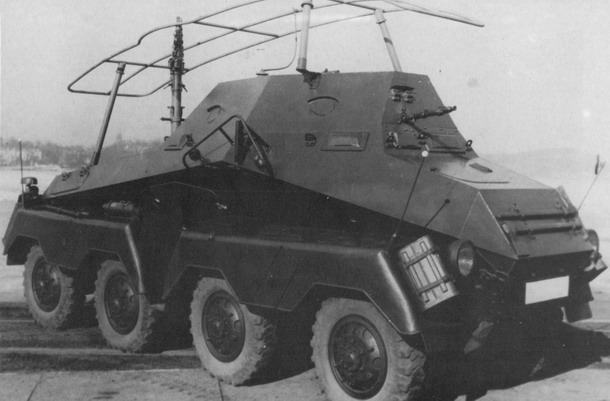
Sd.Kfz. 263 late production version, note the new-pattern vision ports; the folded telescopic antenna is clearly visible in this photograph, source: Flickr.com with the permission of the publishing user, edited
In 1941 the powerplant was upgraded. A wider cylinder bore increased the engine displacement to 8.363 litres and raised the maximum output to 180 horsepower. Among other changes, the louvred opening in the rear hull wall was covered over with solid armour plate. Also worth noting is a modification introduced for reasons of economy: the self-sealing tyres were replaced with standard pneumatics, and the vehicles were equipped with spare wheels, which were subsequently carried on the engine bonnet or on the rear portion of the superstructure roof.
A total of 207 examples of the eight-wheeled Sd.Kfz. 263 are said to have been produced. These vehicles served with reconnaissance and intelligence units, as well as with senior staff commanders.

ARTICLE
CONTENTS:
Reproducing text from the Panzernet website without the written consent of the operator is prohibited.