Sd.Kfz. 232 (8 Rad)
eight-wheeled armoured radio car
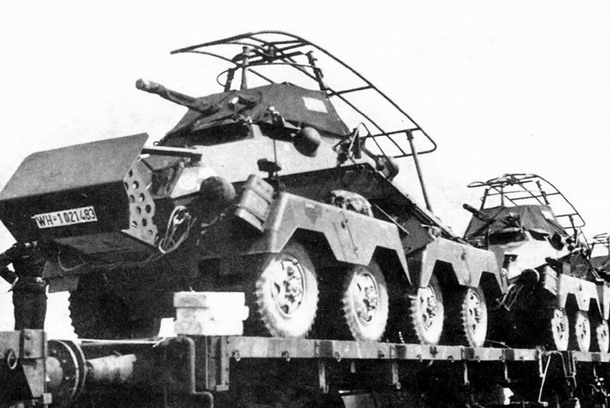
eight-wheeled Sd.Kfz. 232 radio cars on railway flatcars; the first vehicle has additional frontal armour fitted at the front, source: www.tehnikapobedy.ru with the permission of the site operator, edited
A note by way of introduction... the designation Sd.Kfz. 232 (Sd.Kfz. = SonderKraftwagen = vehicle for special purposes) was used for two entirely different types of heavy armoured radio cars. This article describes the more modern of the two, identified by the suffix "8 Rad". The older six-wheeled version, Sd.Kfz. 232 (6 Rad), is covered in a separate article.
Origins of the Vehicle
The older generation of radio cars, the Sd.Kfz. 232 (6 Rad), was based on the six-wheeled armoured cars Sd.Kfz. 231. For reasons of economy, these vehicles were built on the chassis of standard commercial trucks, which ultimately proved to be their greatest weakness. Only the two rear axles were driven, and only the front axle was steerable. There was also a fairly long gap between the first and second axles, which only increased the likelihood of the vehicle becoming high-centred on uneven ground. Soft surfaces or more broken terrain presented an almost insurmountable obstacle for these cars — and it was precisely this fact that led the army command to decide on the development of new armoured cars capable of tackling genuinely difficult terrain.
The result was the eight-wheeled Sd.Kfz. 231 (8 Rad), built on the Büssing-NAG chassis designated GS. And just as had been done earlier with the six-wheeled variant, an armoured radio car was developed on the basis of the new eight-wheeled vehicle as well.
Vehicle Description
The vehicle had eight individually suspended wheels, all of which were both driven and steerable. Power was provided by the Büssing-NAG L8V eight-cylinder engine with a displacement of 7.913 litres, delivering a maximum output of 150 horsepower at 3,000 rpm. The gearbox offered six forward and six reverse ratios. Some authors cite only three ratios, which seems unlikely — though it is theoretically possible that both figures are correct if the vehicle had a three-speed main gearbox combined with a two-speed transfer gearbox, effectively doubling the available ratios.
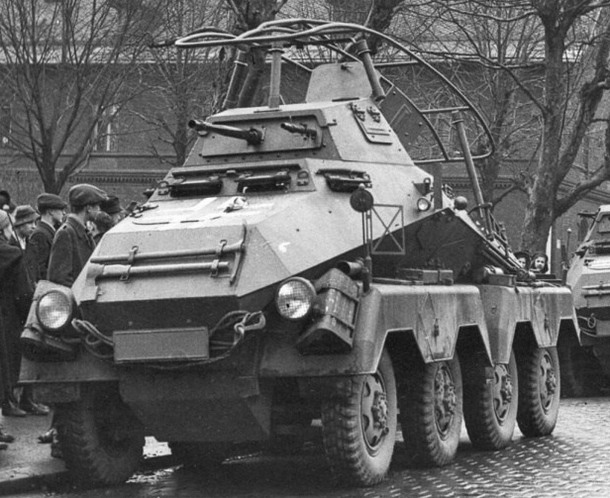
early-production Sd.Kfz. 232, the vehicle has the original pattern of vision ports in both the hull and the turret, source: dolin.estranky.cz with the permission of the site operator, edited
The fuel capacity was 150 litres. The wheels were fitted with special reinforced self-sealing tyres capable of closing punctures caused by bullet hits. The armoured hull was developed by Deutsche Werke of Kiel. It consisted of upper and lower halves with walls angled in opposite directions, so the vehicle widened from the chassis upwards and then narrowed again towards the roof. This angling of the walls increased their resistance to enemy fire. The steel plate from which the hull was welded was 14.5 mm thick at the front, 10 mm on the sides, 8 mm at the rear, and 5.5 mm on the floor and roof. The armour could therefore offer meaningful protection only against small arms fire and shell fragments.
The front of the hull was formed by upper and lower plates. The upper plate carried brackets for mounting an axe and a pickaxe, while the towing rope was attached to the lower plate. The upper front plate transitioned into a steeply raked forward glacis, beneath which was the main driver's station. A crew entry hatch was cut into the right-hand side of this glacis, closed by a two-piece lid; on early production vehicles the two halves opened outwards to the sides. This hatch served primarily as the front driver's entry point.
Moving rearward, the glacis stepped up into the front wall of the crew compartment, which featured two identical vision ports, each fitted with a cover that hinged upwards. The covers incorporated narrow observation slits for use when the covers themselves were closed. Two further vision ports of the same design were located in the side walls of the compartment. Small raised profiles were welded above all vision openings to channel away rainwater running down the armour. All of these observation openings were intended for the front driver, whose station was in this part of the compartment. The driver did not sit on the vehicle's centreline but slightly to the left of it, and therefore made most use of the left-hand front and side vision ports.
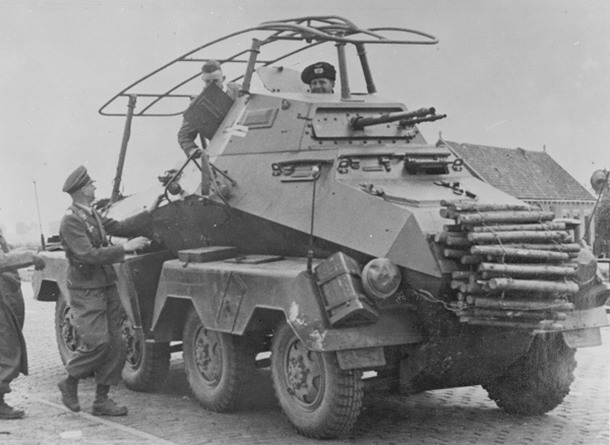
Sd.Kfz. 232, the vehicle has the original-pattern hull vision ports, though those in the turret are already the later version, source: www.waroverholland.nl with the permission of the site operator, edited
At the rear, the cabin stepped back down again to the level of the engine compartment roof. The rear wall of the crew compartment had an identical set of vision ports to the front wall — two facing directly rearward and one on each side. These served the rear driver, who also sat slightly to the left of the vehicle's centreline — though from his own perspective, facing backwards, this was effectively to the right of the axis.
The horizontal hexagonal roof plate of the cabin formed the base for the fighting turret. The turret likewise had a hexagonal footprint, with all of its walls angled for greater protection.
In the forward half of each side wall was a large vision port with a single-piece cover that hinged upwards, fitted in the usual manner with an observation slit. The rear halves of the side walls had only non-opening slit-type vision ports. Virtually the entire rear wall was occupied by two-piece entry doors that opened outwards to the sides, each door panel incorporating a single observation slit.
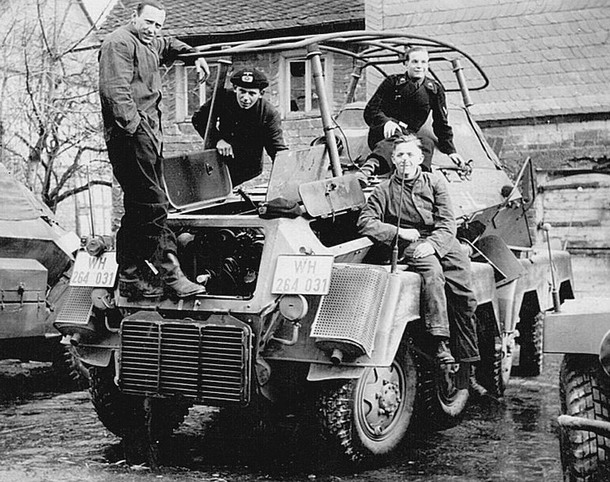
Sd.Kfz. 232 undergoing maintenance; this photograph gives an excellent view of all the engine access hatches, source: Flickr.com with the permission of the publishing user, edited
The turret roof sloped downward at the front; the rear section was flat and contained a further crew hatch with a single-piece lid that hinged rearwards. The roof also had an opening for raising signal flags. In the front wall of the turret was the movable mantlet housing the rapid-fire cannon and coaxial machine gun. The cannon was the KwK 30 L/55 in 20 mm calibre; the machine gun was the MG 34 in 7.92 mm. The cannon was positioned near the centre of the mantlet and the machine gun to its left. The mantlet allowed vertical elevation to be adjusted from −10° to +26°. Despite its relatively modest calibre, the cannon enabled the armoured car to engage even light enemy tanks effectively. With standard armour-piercing PzGr. ammunition it could penetrate 20 mm of vertical homogeneous armour at a range of 100 metres. With sub-calibre PzGr. 40 ammunition, penetration increased to as much as 40 mm.
No less important a "weapon" than the guns was the vehicle's radio equipment, which consisted of two sets: the short-range Fu.Spr. a and the medium-range Fu 11 SE 100. The radio equipment was complemented by a large frame antenna that extended across the entire engine compartment and turret. At the rear, the antenna was fixed to the hull by two rigid struts. The other two struts were mounted on the turret and connected to the antenna via a rotating joint, which meant turret rotation was not impeded in any way.
The rear of the hull housed the engine compartment with the already-mentioned Büssing-NAG L8V unit. In the front portion of the engine compartment roof was a grilled air intake opening for the powerplant. Further back, a large service access hatch in the bonnet roof allowed access to the engine; it was closed by a two-piece lid whose halves opened outwards to the sides. Additional smaller service hatches were located in the side walls of the bonnet. A final service opening occupied virtually the entire rear hull wall — or rather its upper portion — protected by a single cover that opened downward. This cover was not solid but louvred to allow airflow.
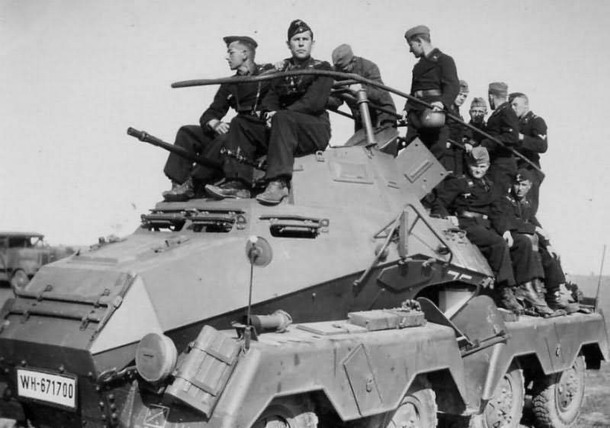
Sd.Kfz. 232, source: worldwarphotos.info with the permission of the site operator, edited
Running along almost the entire length of the vehicle on each side were two large double mudguards, each covering two adjacent wheels. The space between the two double mudguards was used for a crew escape hatch cut into the lower portion of the hull side wall. The mudguard surfaces themselves provided storage space for various equipment, and also carried the front driver's rear-view mirrors, the horn, and at the very rear, the two exhaust pipes.
Standard headlights were fitted at both the front and rear of the hull. A particularly interesting feature was a pair of additional folding headlights set into the sides of the hull at the highest point of the lower hull walls — in other words at the widest part of the vehicle. Under normal operating conditions these were folded flush into the armour and their covers were barely noticeable. Their purpose was to provide additional illumination for night-time aiming — which is probably why I have never come across a single photograph showing them in the deployed position.
The vehicle's crew comprised four men. Both drivers sat in the hull; the gunner and commander had their stations in the turret, with the commander apparently also doubling as loader. Who served as radio operator is not clear from the sources. The most logical arrangement would have been to assign this role to the rear driver, who for most of the time had the least to do of anyone on board — he only drove when the vehicle was reversing.
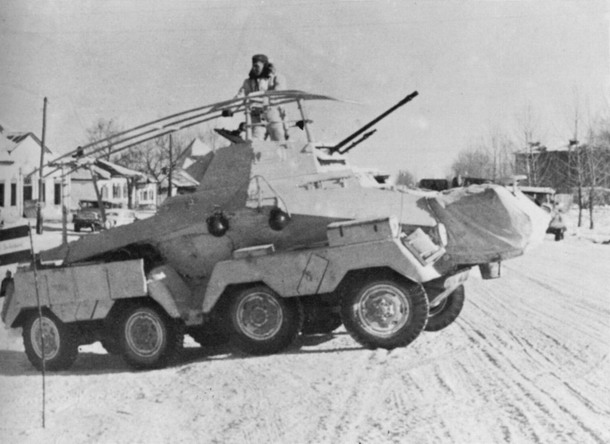
Sd.Kfz. 232 in the Russian winter; the additional frontal armour is covered by a white tarpaulin, source: Flickr.com with the permission of the publishing user, edited
The radio car weighed 8.5 tonnes (8.8 tonnes is also cited). Top road speed was, like that of the standard Sd.Kfz. 231, an impressive 90 km/h in both directions of travel (85 km/h is also given). The vehicle's length and width likewise corresponded to those of the standard Sd.Kfz. 231: the radio car measured 5.85 metres in length and 2.2 metres in width, standing a full 2.9 metres tall thanks to its antenna (compared to 2.35 metres for the standard armoured car).
During development, the army referred to the new vehicle under the code designation VsKfz 624 (Versuchskraftfahrzeug). It entered service, however, under the official name schwerer Panzerspähwagen (Fu) (Sd.Kfz. 232) — the same designation as the older generation of six-wheeled radio cars. The expectation was presumably that the new type would quickly and completely replace its predecessor in service. In the event, both types served in parallel, and the suffixes "6 Rad" and "8 Rad" were therefore added to their designations to distinguish them — apparently not until 1940, and possibly applied retrospectively.
Series Production
Series production of the radio car apparently ran concurrently with that of the standard eight-wheeled Sd.Kfz. 231, between 1937 and 1943. As for total production numbers, unfortunately only combined figures for the eight-wheeled Sd.Kfz. 231 and Sd.Kfz. 232 are usually cited. Both types together are said to have totalled around six hundred vehicles (610 and 604 are figures commonly given). Claims of more than 1,200 examples built appear to have no factual basis.
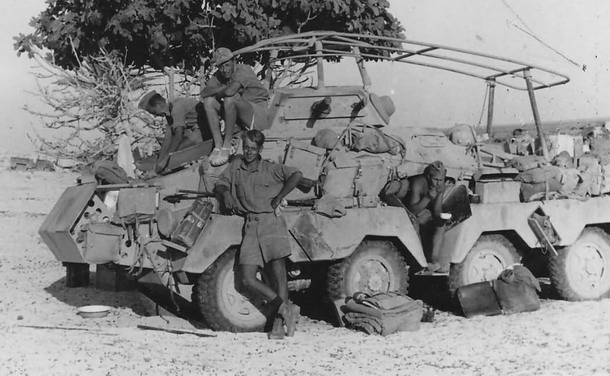
Sd.Kfz. 232 in Africa; the amount of provisions carried shows that the vehicle was truly a home away from home for its crew, source: worldwarphotos.info with the permission of the site operator, edited
Modifications and Improvements
During its production run the radio car adopted numerous minor and major changes and improvements that were being introduced on the parent type, the Sd.Kfz. 231. The original vision ports in the front and rear walls of the cabin were replaced with new ones in the pattern standardised for armoured cars. These new standardised ports were also installed in the side walls of the turret. The gun mantlet was also redesigned: the new version was wider than the original and blended more smoothly into the turret walls even when the weapons were at maximum elevation or depression.
From 1940 onwards, additional frontal armour designated Zusatzpanzer or Zusatzfrontplatte began to be fitted. This consisted of a wedge formed by two 10 mm armour plates that roughly followed the contours of the hull front, suspended on brackets approximately 50 cm ahead of the hull itself. Crew instructions apparently explicitly prohibited using this appliqué armour as a battering ram. The additional armour was later discontinued when the main hull frontal armour itself was strengthened to 30 mm from 1942 onwards. At the same time, the turret's frontal armour was also reportedly increased, causing the vehicle's weight to rise to as much as 9.1 tonnes.
In 1941 the powerplant was upgraded: a wider cylinder bore increased the engine displacement to 8.363 litres and raised the maximum output to 180 horsepower. This apparently did not affect top speed, but certainly improved acceleration and cross-country mobility. A very significant change was the installation of a new main armament: the original KwK 30 was replaced by the more modern KwK 38 of the same calibre. The original weapon had a rate of fire of 280 rounds per minute; the new one achieved 450 rounds per minute. Late-production vehicles also had the front and rear ends of the wheel mudguards shortened. The hull front received a simple bumper formed from a plain steel tube. Another change was the replacement of the louvred opening in the rear hull wall with solid armour plate.
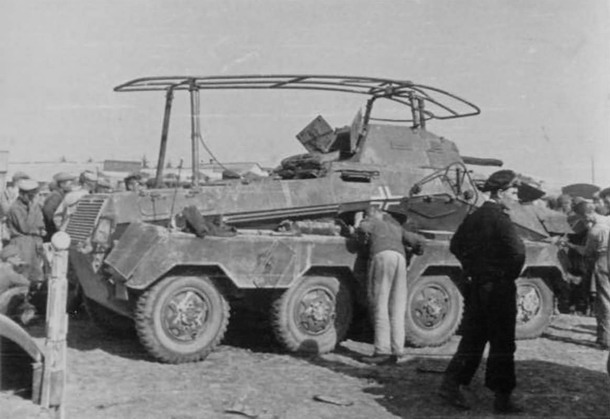
Sd.Kfz. 232, source: worldwarphotos.info with the permission of the site operator, edited
From July 1942, the original Fu 11 SE 100 radio set was replaced by a new Fu 12 SE 80. With this radio, a stationary vehicle could communicate over a range of approximately 60 km; on the move this dropped to around 25 km. Alongside the change of radio equipment, the large frame antenna was discontinued and replaced by a simpler rod antenna with a star-shaped junction — the so-called Sternantenne — mounted on the right side of the engine bonnet. The removal of the frame antenna greatly reduced the visible differences between the Sd.Kfz. 232 and the Sd.Kfz. 231, which in turn allowed their production to be consolidated. From this point on, all vehicles were produced with provision for radio equipment (i.e. primarily as Sd.Kfz. 232), and those designated as Sd.Kfz. 231 simply had the Fu 12 radio set and the star antenna on the right side of the engine section omitted.
Also worth noting is a modification introduced for reasons of economy: the self-sealing tyres were replaced with standard pneumatics, and the vehicles were equipped with spare wheels, which were carried either on the rear hull wall or on the engine bonnet over the service access hatch.
While fitting radio equipment into a standard armoured car fulfilled the requirement, it also brought certain problems: the installation of the radio sets considerably reduced the interior space available to the crew and caused them significant discomfort when carrying out combat tasks. The desire for a more satisfactory solution eventually led to the development of another radio car based on the same platform — the vehicle that received the designation Sd.Kfz. 263.
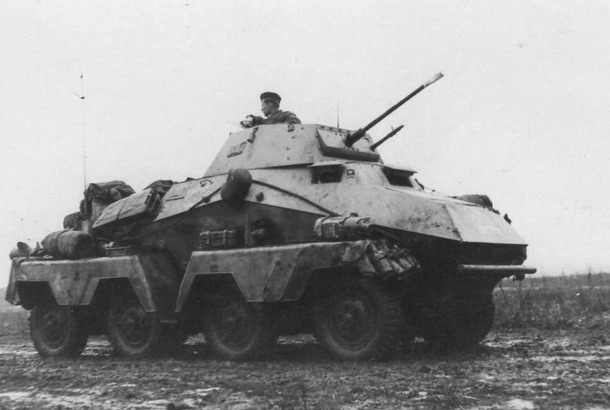
late-production Sd.Kfz. 232; the frame antenna has been replaced by a rod antenna mounted on the right side of the engine bonnet, source: worldwarphotos.info with the permission of the site operator, edited
The Sd.Kfz. 232 radio cars served alongside their sister vehicles, the Sd.Kfz. 231, in reconnaissance units, and appear to have remained in service until the very end of the war.
Technical Specifications
|
weight: |
8.5 t (later 9.1 t) |
|
length: |
5.85 m |
|
width: |
2.20 m |
|
height: |
2.90 m |
|
engine: |
Büssing-NAG L8V |
|
engine output: |
150 hp (later 180 hp) |
|
max. speed: |
90 km/h |
|
hull armour: |
|
|
- front: |
14.5 mm (later 30 mm) |
|
- sides: |
10 mm |
|
- rear: |
8 mm |
|
turret armour: |
|
|
- front: |
14.5 mm |
|
- sides: |
10 mm |
|
- rear: |
8 mm |
|
crew: |
4 men |
|
armament: |
KwK 30 cannon, 20 mm (later KwK 38) MG 13 machine gun, 7.92 mm |

ARTICLE
CONTENTS:
Reproducing text from the Panzernet website without the written consent of the operator is prohibited.