Sd.Kfz. 250
armoured personnel carrier and its specialised variants
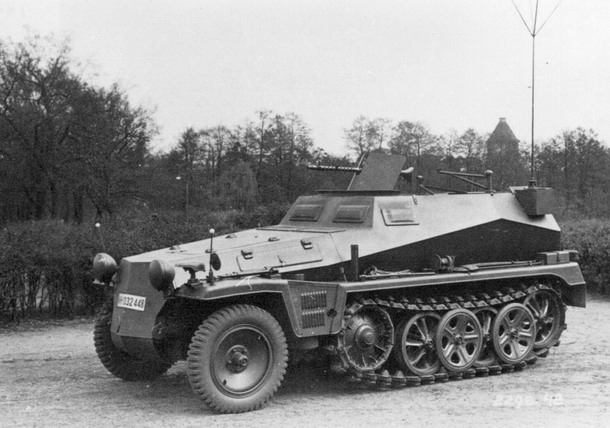
The Sd.Kfz. 250 served as an armoured personnel carrier, a weapons carrier and a specialised vehicle for a wide variety of specific purposes — pictured here is the Sd.Kfz. 250/5, source: worldwarphotos.info with permission, edited
Origins of the Vehicle
Alongside the widely used and well-known armoured personnel carrier Sd.Kfz. 251, the German army operated another type of half-track armoured vehicle intended not only for infantry transport. This was the smaller and lighter Sd.Kfz. 250 (Sd.Kfz. = Sonderkraftfahrzeug = special-purpose vehicle). Although the numbers in both vehicles' designations might suggest the opposite order of development, the Sd.Kfz. 250 was actually the younger of the two. The idea for building this vehicle emerged in 1939, and it was no accident. Two specific circumstances paved the way for it.
That same year, the German army began receiving the first production examples of the aforementioned heavier carrier, the Sd.Kfz. 251, which was designed to carry a ten-man infantry squad. Army commanders quickly realised they would also benefit from a lighter vehicle of similar design — one that could be used for a wide range of specialised tasks where carrying ten soldiers was unnecessary, making the Sd.Kfz. 251 simply too large and too expensive for the job (reconnaissance, for example).
A further impulse towards building a lighter half-track came from the development of two armoured vehicles of a completely different nature — the ammunition carrier Sd.Kfz. 252 and the observation vehicle Sd.Kfz. 253. Both of these half-tracks were built on a shared chassis with the factory designation D7p. Their development had been under way since 1936, but it was in 1939 that the chassis itself was finalised — which made it an obvious foundation for further vehicles of the same kind... such as the Sd.Kfz. 250.
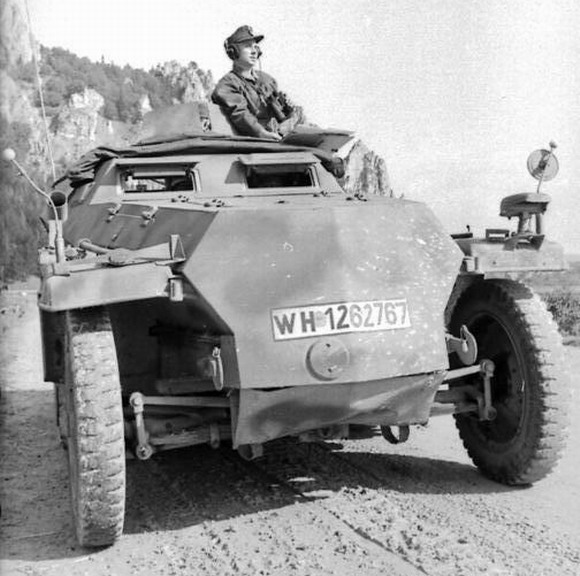
front view of the Sd.Kfz. 250 in the earlier Ausf. A configuration, source: Bundesarchiv_Bild_101I-680-8282-23A, Wikimedia, Creative Commons, edited
I hope the reader will forgive yet another "Sd.Kfz." designation, but the history of this chassis deserves a closer look. The D7p was a modified version of the D7 chassis used in the light artillery tractor Sd.Kfz. 10. The modifications to the original D7 were necessary because the chassis was to be fitted with an armoured superstructure. Practical trials showed that the armoured body placed too great a load on the standard production D7 chassis and its drivetrain. The designers could not reduce the weight of the superstructure by using thinner armour, as that would have compromised its protection. Their only option was therefore to reduce weight by simply shortening the entire vehicle — and in particular its chassis. The shortening was achieved by removing one road wheel from the track assembly. But that was not the only change. The radiator, fuel tank, exhaust and even the steering wheel had to be modified (the latter needed to be tilted downward to fit beneath the armoured front plate of the superstructure).
The D7p Chassis
The chassis consisted of a front steerable wheel axle and a rear track assembly. The front wheels were suspended by a transversely mounted leaf spring. The track assembly comprised a front drive sprocket, a rear idler wheel and four road wheels. The road wheels were sprung by torsion bars and fitted with rubber tyres for better riding characteristics. These wheels were doubled — each one consisting of two steel discs — so the half-track effectively had eight road wheels in total, albeit on only four axles. The wheels were arranged in an interleaved pattern, overlapping one another, which was typical of German half-tracks (and later tanks as well). The discs of the even-numbered wheels were spaced further apart on their axles, with the odd-numbered wheels — whose discs sat close together — fitting into the gaps between them. When viewed from the side, only the even-numbered wheels were fully visible, specifically their outer disc row. The track itself was fitted with rubber pads for smoother travel on hard road surfaces.
Shortening the chassis did achieve the desired reduction in overall weight, but it also shifted the vehicle's centre of gravity. The shorter track assembly meant greater loading on the front wheel axle. The Sd.Kfz. 250 (and in general all vehicles built on the D7p chassis) was reportedly more prone to technical problems with the front axle than the standard tractor Sd.Kfz. 10, which rode on the unshortened D7 chassis.
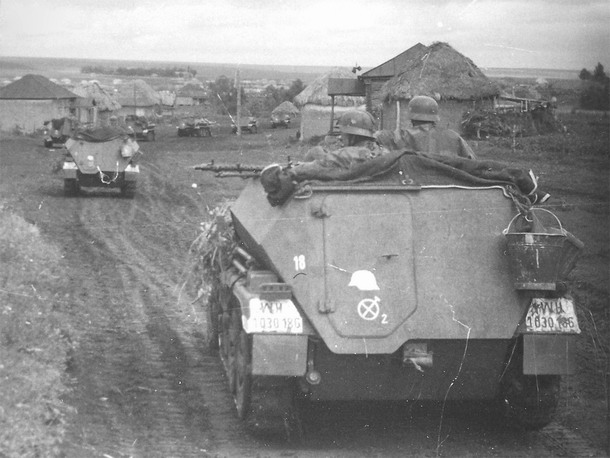
the rear wall of the superstructure featured large entry doors, source: Flickr.com with permission, edited
At the front of the chassis sat the engine compartment, housing a Maybach HL 42 TRKM petrol six-cylinder engine with a displacement of 4.198 litres and a maximum output of 100 horsepower at 2,800 rpm. The gearbox was a Maybach Variorex VG 102 128 H unit with seven forward gears and three reverse. Both the engine and gearbox were carried over from the Sd.Kfz. 10 along with the chassis. Fuel capacity was 140 litres.
The D7p chassis was designed by Demag (Deutsche Maschinenbau Aktiengesellschaft). Given the enormous numbers of Sd.Kfz. 250 carriers the army intended to order, a range of other manufacturers joined the chassis production effort, including Adlerwerke, Büssing NAG and Cottbus.
The Armoured Hull
Mounted on the chassis was an armoured hull that protected not only the crew compartment but the entire forward engine section as well. Excluding the roof of the superstructure, the hull of the Sd.Kfz. 250 was at first glance almost identical to that of the observation vehicle Sd.Kfz. 253 mentioned earlier. It was not, however, the same hull — it was an original design developed specifically for the "250". Hull production was carried out at factories including Deutsche Edelstahlwerke, Böhler Werk, Bismarckhütte and Ferrum Werk.
The front face of the engine compartment consisted of a single armoured plate that could be removed to allow access to the radiator for servicing. In the lower section of this plate was a circular opening for inserting a starting crank — an alternative method of starting the engine if the electric starter failed. The engine bonnet had three service access openings: two smaller elongated ones in the sides and one large one in the main bonnet panel. The largest of these was closed by a two-piece hatch. Further back, the main bonnet panel featured two cutouts for engine airflow, protected by a dense wire mesh grille.
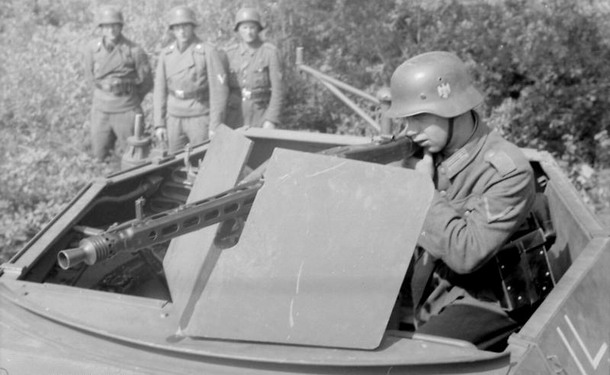
the front machine gun mount was fitted with a shield to protect the gunner; the rear machine gun was hung on a swivel arm that allowed it to engage enemy aircraft as well, source: Bundesarchiv_Bild_101I-259-1389-30A, Wikimedia, Creative Commons, edited
Behind these vents, the front wall of the crew compartment rose up from the engine bonnet. Behind it sat the first two crew members: the driver on the left and the vehicle commander on the right. Each man had his own front and side vision port. All vision ports except the one in the right side wall had hinged covers fitted with narrow observation slits. In safer areas, the crew could open the covers for a better view; even then they were protected by a block of bulletproof glass mounted inside the port. In combat, the covers were closed and the crew observed through the narrow slits only. The vision port in the right side wall was the only one permanently riveted shut and could not be opened. The driver steered the vehicle using a conventional steering wheel. For gentle turns, only the front wheels turned; for sharper turns, the inner track was additionally braked.
Behind the driver and commander lay the main crew compartment, which was used in different ways depending on the specific sub-variant of the half-track (more on this later). The side walls of the superstructure were designed in a manner typical of most German armoured half-tracks and vehicles. Rather than being flat, the sides were angled so that no surface could be struck by enemy fire at a perpendicular angle — the incoming round would always hit at an oblique angle. This arrangement improved the effectiveness of the armour even when using relatively thin plates. In the left half of the rear wall were the large entry and exit doors. Above them, a small metal rain deflector was welded on to channel rainwater running down the hull away from the opening.
The roof of the superstructure was open, except for a short section above the driver's and commander's heads at the front. The open roof helped reduce weight and simplified construction, while also allowing rapid dismounting (by jumping over the sides) and an unobstructed all-round view simply by standing up. In bad weather, the open roof could be covered with a waterproof canvas. On its own, the canvas would have sagged over the open space, so it had to be supported. Metal bowing strips were laid across the opening, anchored to the side walls and bent upward to form arches (these metal strips are visible in the photograph HERE, Bundesarchiv Bild 101I-259-1399-16A, Wikimedia, Creative Commons, edited; the canvas fitted over them can be seen for example HERE, Bundesarchiv Bild 101I-811-2231-37, Wikimedia, Creative Commons, edited). Armour thickness was naturally greatest on the front faces at 14.5 mm. The sides were 8 mm, the rear wall 10 mm and the floor a mere 5.5 mm.
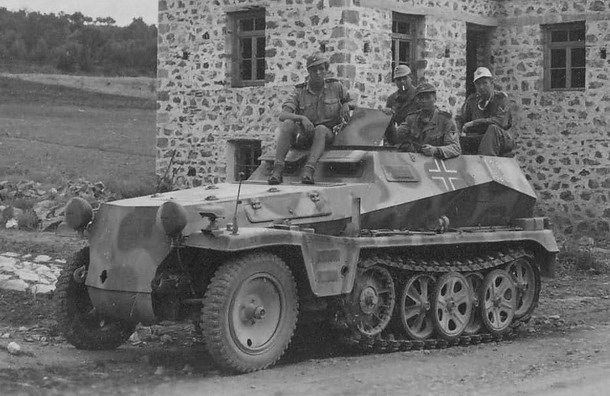
the Sd.Kfz. 250/1 was designed for six soldiers, though in combat practice only five men would often board the vehicle for more comfort and to allow fighting directly from it, source: worldwarphotos.info with permission, edited
Pre-Production Series
Alongside the standard production hull design (designated Panzeraufbau Sd.Kfz.250E), two further hull variants existed. They differed from the production version only in minor details, so the description above applies to them as well. The first of these "non-standard" hull variants was found on half-tracks manufactured as early as 1940, referred to as the pre-production or zero series. The differences from later production vehicles were almost trivial. They included, for example, the design of the hinges on the service hatch covers in the engine bonnet (comparison photo HERE), the positioning of the driver's and commander's side vision ports (comparison photo HERE), and the design of the stowage box behind the right front mudguard. The drive sprocket bolts on production vehicles were fitted with protective caps, while the zero series lacked these (comparison photo HERE). Only a small number of these zero series vehicles appear to have been built, serving as a validation batch.
Panzeraufbau Z
The second non-standard hull variant was the work of Böhler. When this company joined the production of Sd.Kfz. 250 hulls, it did not adopt the standard hull design for some reason and instead simply produced its own version. To keep things in order, this variant received its own designation: Panzeraufbau Sd.Kfz.250/Z. This hull was developed from the hull of the Sd.Kfz. 253 and closely resembled it (even more so than the standard Panzeraufbau Sd.Kfz.250E). It differed from the production hull in, for example, the vision ports in the front wall of the superstructure. These were of the same design as those on the Sd.Kfz. 253, with two observation slits per cover (comparison photo HERE).
Another difference was the positioning of the front headlamps. On the Panzeraufbau Sd.Kfz.250/Z they were mounted further back than on the standard hull and were attached to the sides of the engine bonnet rather than to the wheel mudguards (comparison photo HERE). A difference visible from the rear was an observation port in the main entry door in the rear wall, which the standard Sd.Kfz. 250 lacked (comparison photo HERE). Among other readily noticeable differences, the Panzeraufbau Sd.Kfz.250/Z had lifting hooks located at the corners of the engine bonnet (comparison photo HERE).
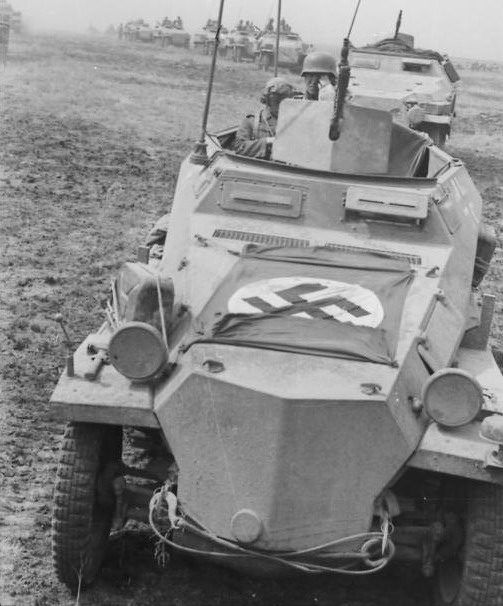
Sd.Kfz. 250 at the head of an armoured column, fitted with the Panzeraufbau Sd.Kfz.250/Z superstructure, source: Bundesarchiv_Bild_101I-218-0504-32, Wikimedia, Creative Commons, edited
The Panzeraufbau Sd.Kfz.250/Z also had a more steeply angled rear wall and was slightly longer overall than the standard hull. One final detail worth mentioning is a small hole cut into the upper rear section of the right side wall. This was originally intended for routing a radio antenna cable, but since the antenna was ultimately placed elsewhere, the hole was subsequently covered with a small steel plate (comparison photo HERE). The exact number of Sd.Kfz. 250 vehicles fitted with this Böhler hull is not known, but it could well have run into the hundreds. Böhler eventually also switched to producing the standard hull design, apparently from November 1941 onwards.
Final assembly of complete vehicles was also handled by several companies, including Büssing NAG, Wegmann, Eisenwerk Wesserhütte and Wumag. The complete vehicle measured 4.56 metres in length, 1.8 metres in height and 1.95 metres in width. Its weight was 5.8 tonnes. The maximum speed was an impressive 65 km/h, though in practice the half-track typically travelled at up to 45 km/h. The Sd.Kfz. 250 was fitted with a Fu.Spr.Ger. a. radio receiver (note: these technical specifications apply primarily to the Sd.Kfz. 250/1 variant).
The official name of the new half-track was leichter Schützenpanzerwagen (Sd.Kfz. 250), meaning roughly "light armoured infantry vehicle". The Sd.Kfz. 250 was by no means used only as a troop carrier. A total of twelve specialised variants were produced, each adapted for a different purpose. To distinguish between them, an additional number was added to the designation after a slash (e.g. Sd.Kfz. 250/2), and most variants also received their own full name (such as leichter Fernsprechpanzerwagen). All of these specialised variants are described below.
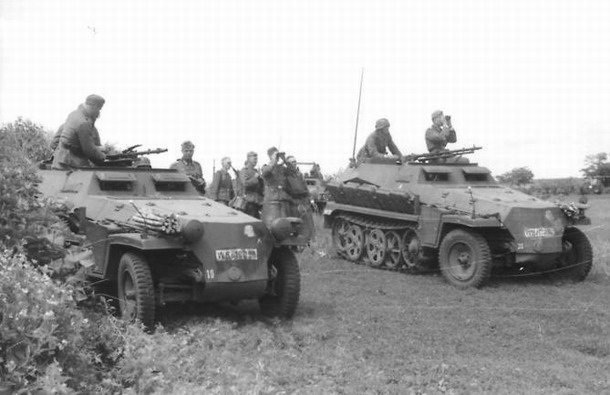
a pair of Sd.Kfz. 250 vehicles; these are fitted with heavy front machine gun mounts operated from inside the vehicle, source: Bundesarchiv_Bild_101I-748-0100-33, Wikimedia, Creative Commons, edited
The first 39 examples of the new half-track were accepted by the army in June 1941. In the following months of 1941, deliveries averaged around fifty vehicles per month. In 1942, production rose to an average of over one hundred vehicles per month, with 1943 becoming the peak production year. That year, a total of 2,895 vehicles were delivered to the army — an average of more than 240 per month. In the following year, the army received a further 1,701 vehicles, and in the first three months of 1945 a final 269. Production of the Sd.Kfz. 250 thus ran from June 1941 to March 1945, with a grand total of 6,628 units built across all variants.
Ausführung B
The year 1943 brought not only peak production but also a significant design change. This change was driven by efforts to simplify and reduce the cost of manufacturing. The war was now in its fourth year, the Eastern Front was consuming vast quantities of equipment and armour, and the Germans had no choice but to economise and rationalise production. Designers focused on reducing the number of armour plates forming the hull and eliminating any curved or complex panels. Fewer plates meant less cutting and welding, saving considerable time and money.
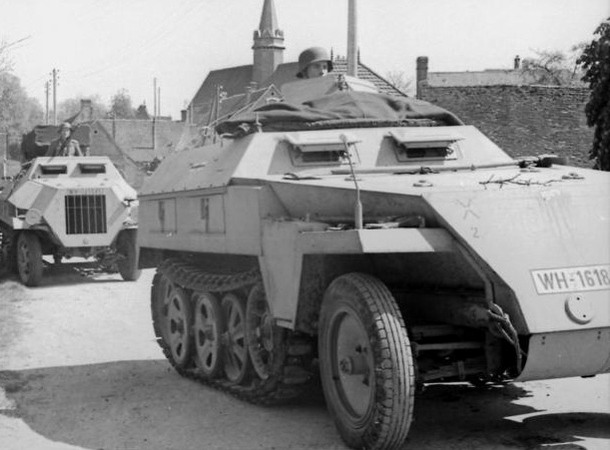
in 1943, the Ausf. B variant entered production with a significantly simplified armoured superstructure, source: Bundesarchiv_Bild_101I-300-1859-21, Wikimedia, Creative Commons, edited
The original and new simplified-hull versions needed to be distinguished to avoid confusion. The terms Alt and Neu (old and new) are commonly encountered, but the official designation was Ausf. A and Ausf. B (Ausf. = Ausführung = version or variant). The full official designation of the half-track thus became even longer and in practice could read, for example: "leichter Fernsprechpanzerwagen (Sd.Kfz. 250/2) Ausf. A".
Sd.Kfz. 250/1
In its basic form, the Sd.Kfz. 250 served as an armoured personnel carrier for a so-called Halbgruppe of four soldiers. The vehicle's crew therefore consisted of the driver, the commander and a four-man dismount team. Three of the transported soldiers sat on a bench along the left side of the compartment, facing sideways. The fourth sat on a separate individual seat on the right side of the compartment, facing forward. The space behind him was occupied by a box for storing ammunition and various other equipment. This basic version was designated the leichter Schützenpanzerwagen (Sd.Kfz. 250/1). Its armament consisted of two MG 34 machine guns chambered in 7.92 mm (later replaced by MG 42 of the same calibre).
The front machine gun was mounted on the roof above the driver's and commander's heads. The standard mount allowed both horizontal and vertical movement and was fitted with a shield to protect the gunner during firing. In addition to this standard mount, some vehicles used a so-called heavy mount — the schwere MG Lafette — in which the machine gun was fixed on the roof with only a limited range of movement, with the gunner aiming and firing it via a periscope from the safety of the armoured interior (this heavy mount configuration can be seen, for example, in the photograph HERE, Bundesarchiv_Bild_101I-748-0100-32, Wikimedia, Creative Commons, edited).
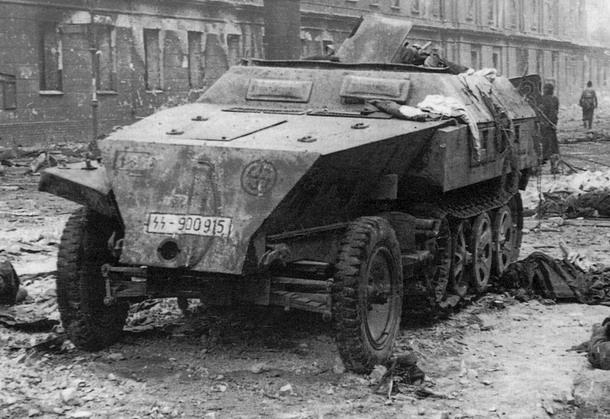
in 1943 the Ausf. B variant entered production with a substantially simplified armoured superstructure — pictured here is a vehicle destroyed near the end of the war somewhere in Germany, source: Flickr.com with permission, edited
The rear machine gun was not permanently installed but was only mounted when needed, hung on a bracket at the rear edge of the superstructure. This swivel bracket allowed a wide range of vertical movement, enabling the rear machine gun to engage enemy aircraft as well. When not in the firing position, the second machine gun was stowed inside the crew compartment on the right inner wall. The original ammunition load for both machine guns was a combined total of 4,600 rounds. Additionally, the vehicle carried the personal rifles of the dismount soldiers and one MP38 submachine gun with 192 rounds. From 1944 onwards, the machine gun ammunition supply was apparently reduced to "merely" 2,010 rounds, while the number of rounds for the MP38 (or MP40) increased to 1,024 — the army seemingly pushing for greater use of the cheaper weapon as part of general austerity measures.
Vehicles assigned to machine gun squads were modified so that the squad could dismount with one machine gun and provide fire support for infantry in the field. For this purpose, a portable sMG Lafette 34 tripod mount was carried, hung on the rear wall of the compartment next to the entry doors. The Sd.Kfz. 250/1 had a combat weight of 5.8 tonnes. Of all twelve variants produced, the basic Sd.Kfz. 250/1 was the most numerous. It is worth noting that not all Sd.Kfz. 250/1 vehicles were equipped with a radio — only those assigned to platoon commanders, originally with the Fu.Spr.Ger. "a" type, later the Fu.Spr.Ger. "f".
Sd.Kfz. 250/2
The second variant of the Sd.Kfz. 250 was designated the leichter Fernsprechpanzerwagen (Sd.Kfz. 250/2). It was a communications vehicle used both for laying telephone cable and for routing telephone communications. The army placed the requirement for this specialised vehicle in February 1940, specifying that it should be equipped with a telephone, a switchboard and cables. The first prototype was delivered for testing in May of that year.
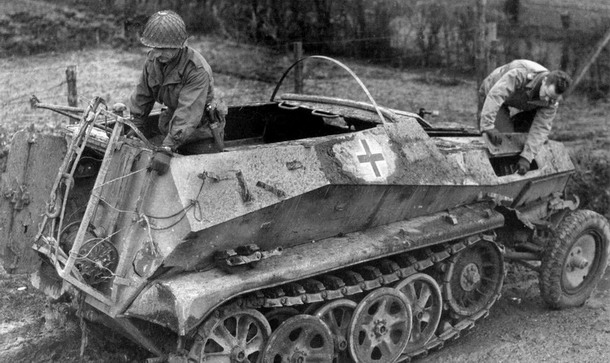
this wreck was most likely an Sd.Kfz. 250/2 — note the cable reel in an improvised bracket on the rear wall, source: internet, Public domain, edited
The individual seat on the right side of the crew compartment was removed and replaced with space for large telephone cable reels. The reels were held in brackets that allowed them to rotate and thus unwind the cable as the vehicle moved. There were three positions inside the vehicle where reel brackets could be mounted to allow the cable to unwind continuously and trail behind as the vehicle drove. The first was on the right side of the compartment as already mentioned. The other two were on the mudguards of the front wheels. When using these forward mounting positions, one crew member had to guide the cable with a long pole with a fork at the end (to prevent it from getting caught in the tracks, for example).
In this way, the cable could be laid not only along the ground but also draped over tree branches, shrubs, telegraph poles and similar structures. Clearly, this type of cable laying required the vehicle to move very slowly so that the soldier with the pole could keep up. If circumstances required it, one soldier could strap a reel bracket to his back and lay the cable on foot. The crew of the communications vehicle most likely consisted of only four men. The Sd.Kfz. 250/2 was armed with a single machine gun.
Sd.Kfz. 250/3
The third variant of the half-track bore the official designation leichter Funkpanzerwagen (Sd.Kfz. 250/3) and was a radio vehicle providing wireless communications between combat units, their commands and air support. This vehicle existed in four sub-variants distinguished by the specific combination of radio sets carried. The radio equipment corresponded to the type of unit to which the vehicle was assigned. The individual sub-variants were designated by Roman numerals.
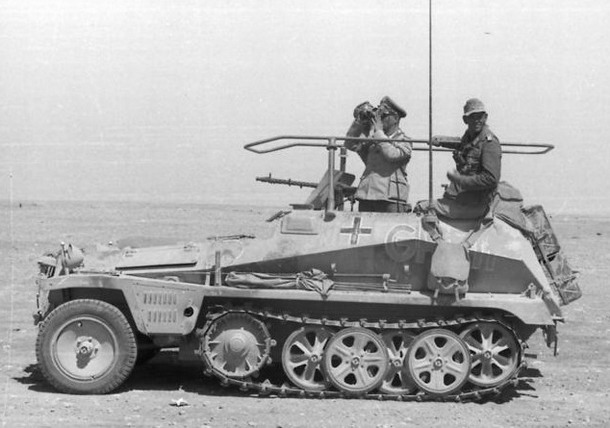
a command Sd.Kfz. 250/3 still fitted with the large frame antenna (the vehicle in the photo is Field Marshal Rommel's famous personal vehicle nicknamed Greif), source: Bundesarchiv_Bild_101I-443-1589-09, Wikimedia, Creative Commons, edited
The Sd.Kfz. 250/3 I carried Fu 12 and Fu.Spr.Ger. f radio sets. This vehicle was intended for ground units — both armoured and infantry. The Sd.Kfz. 250/3 II was equipped with Fu 1, Fu 7 and Fu.Spr.Ger. f sets and provided communications between ground forces and the Luftwaffe. The Sd.Kfz. 250/3 III also served for coordination between ground and air forces and apparently used Fu 8, Fu 4 and Fu.Spr.Ger. f sets. The final sub-variant, the Sd.Kfz. 250/3 IV, carried Fu 8, Fu 5 and Fu.Spr.Ger. f sets and served primarily as a staff command vehicle. In some cases, a portable Torn-Fu. G. radio was also carried on board. It should be noted that some authors list different radio configurations for the individual sub-variants.
The Fu.Spr.Ger. f. set was mounted in a bracket on the front wall of the crew compartment, directly below the co-driver's vision port. The other radio sets were secured in a tubular frame in the right rear corner of the crew compartment. For the long-range sets (Fu 7, Fu 8 and Fu 12), a large frame antenna was fitted, supported on four struts and spanning virtually the entire length of the open compartment. For the other radio sets, there was also a rod antenna 1.4 metres long, typically mounted on the right side of the superstructure.
By late 1942, the conspicuous frame antenna was phased out and replaced for long-range sets by a rod antenna with a star-shaped branching at the top, the so-called Sternantenne, typically positioned at the left rear of the superstructure. The crew of the Sd.Kfz. 250/3 consisted of four men and the vehicle was armed with a single MG 34 or MG 42 machine gun.
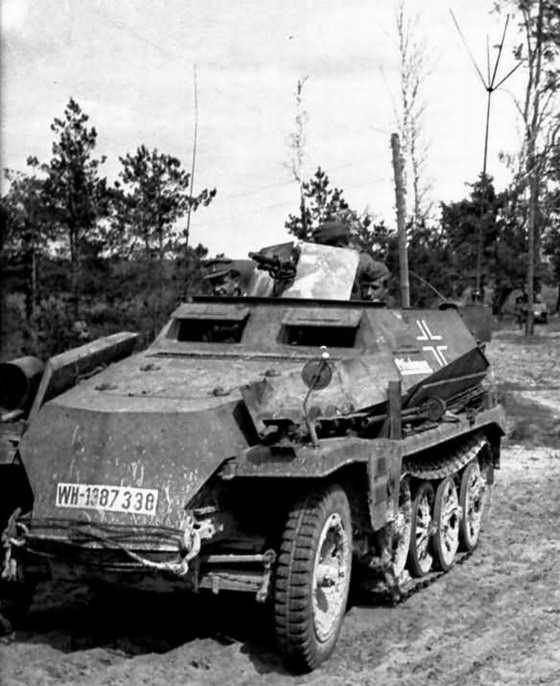
a later-production Sd.Kfz. 250/3 radio vehicle, already fitted with the less conspicuous branching rod antenna, source: worldwarphotos.info with permission, edited
Sd.Kfz. 250/4
Next in line was the Sd.Kfz. 250/4, whose history is somewhat more complicated. Originally, the designation 250/4 was assigned to a vehicle whose full official name was leichter Truppenluftschutzpanzerwagen (Sd.Kfz. 250/4) — literally a light armoured vehicle for the air defence of troops. It was designed to protect ground forces from enemy aircraft. However, this type never entered series production and only a handful of trial examples were built. Photographs confirm that at least one of them did see operational use, most likely in the course of field testing.
Mounted inside the crew compartment was a rotating twin machine gun pedestal mounting for two MG 34s — the so-called Zwillingslafette 36. The mount included a seat for the gunner that rotated together with the entire assembly, as well as an aircraft ring sight to help track fast-moving targets. The mount allowed vertical elevation from -10 to +90 degrees. An armoured shield was fitted to the front edge of the superstructure to provide at least frontal protection for the gunner.
As noted, the Sd.Kfz. 250/4 in this configuration never entered series production. A twin machine gun setup was not a particularly effective anti-aircraft armament, and army officials apparently concluded that this version simply lacked sufficient combat value. Some sources state that after the Truppenluftschutzpanzerwagen was rejected, the designation 250/4 was reassigned to an entirely different version of the half-track — one intended for directing the fire of assault guns. Other sources, however, dispute this and hold that the number 250/4 was simply left unused after the failure of the Truppenluftschutzpanzerwagen.
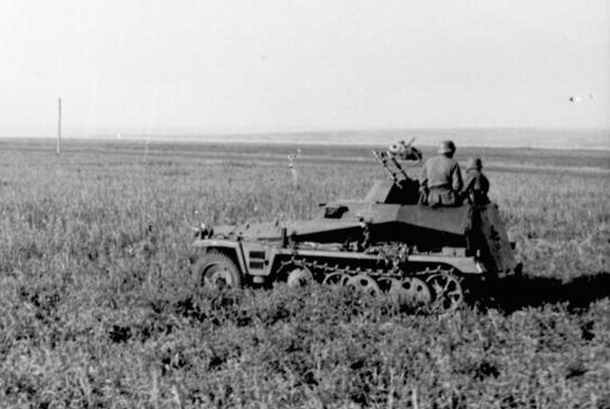
the Sd.Kfz. 250/4 prototype during field trials on the Eastern Front, source: Bundesarchiv_Bild_101I-217-0480-32, Wikimedia, Creative Commons, edited
Sd.Kfz. 250/5
Next came variant number 5, bearing the full designation leichter Beobachtungspanzerwagen (Sd.Kfz. 250/5). According to the original concept, this vehicle was to replace the older half-track Sd.Kfz. 253 and take over its role as an observation and fire control vehicle for the assault guns of Stug III units. Over time, however, its use was extended to artillery units within armoured divisions as well. As a result, the Sd.Kfz. 250/5 could direct the fire not only of Stugs, but also of self-propelled guns such as the Wespe, the Hummel, and even rocket launchers like the Panzerwerfer 43.
The Sd.Kfz. 250/5 was armed with only a single machine gun and had a crew of four. On the left side of the crew compartment was a retractable bracket for an artillery observation periscope. In the right rear section, a frame held radio sets of types Fu 8 and Fu 4. A further Fu.Spr.Ger. f. set was mounted in a bracket on the front wall of the compartment, directly below the co-driver's vision port. Early examples were still fitted with a large frame antenna, while later vehicles had only rod antennas. From the outside, the Sd.Kfz. 250/5 was practically indistinguishable from the radio vehicle Sd.Kfz. 250/3. The interior differences, however, were clearly apparent — aside from the aforementioned periscope bracket, the 250/5 did not have a bench along the left side of the compartment (unlike the 250/3), but only two individual seats, one of which was attached to the periscope bracket.
In 1944, a sub-variant of this vehicle appeared bearing the name leichter Aufklärungspanzerwagen (light armoured reconnaissance vehicle). To distinguish the original and new variants, Roman numerals were introduced into the equipment code: the original leichter Beobachtungspanzerwagen was designated Sd.Kfz. 250/5 I, while the newer leichter Aufklärungspanzerwagen became Sd.Kfz. 250/5 II. This second sub-variant was equipped with Fu 12 and Fu.Spr.Ger. f radio sets and served as a reconnaissance vehicle.
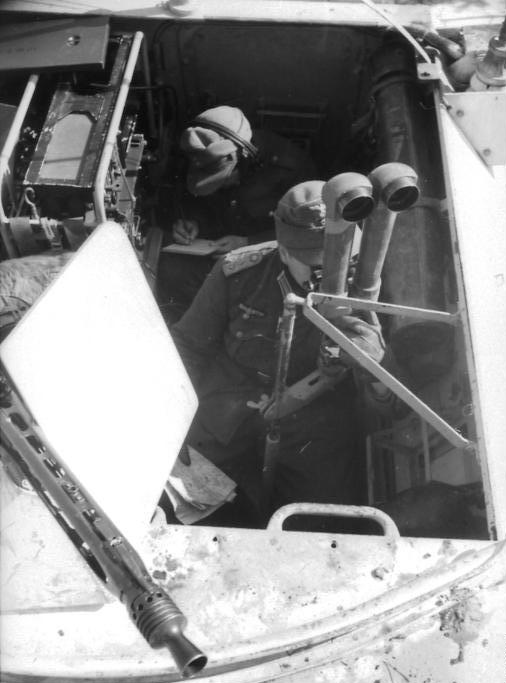
view inside the crew compartment of an Sd.Kfz. 250/5 Ausf. B, source: Bundesarchiv_Bild_101I-667-7130-39, Wikimedia, Creative Commons, edited
Sd.Kfz. 250/6
The sixth variant of the Sd.Kfz. 250 bore the official designation leichter Munitionspanzerwagen (Sd.Kfz. 250/6). This vehicle was intended to replace the older half-track Sd.Kfz. 252, which had served as the ammunition carrier for Stug III assault gun units. Its task was to transport 75 mm artillery ammunition directly to the fighting Stugs in the front line. The crew of the ammunition carrier consisted of just two men — the driver and the commander seated beside him, who also acted as ammunition handler. The interior of the main crew compartment was completely rebuilt. The troop seating was removed and frames for storing ammunition were fitted on both sides.
The Stug III assault guns existed in several different variants and used two different types of cannon. Early Stug III variants from Ausf. A through Ausf. E were armed with short-barrelled guns that fired shorter-cased ammunition. The later Stug III Ausf. F and Ausf. G variants were equipped with more powerful long-barrelled guns using larger ammunition. Two corresponding versions of the Sd.Kfz. 250/6 were therefore needed, each with an interior configured for one type of round. Somewhat unusually, these two versions were not distinguished by Roman numerals but by letters appended after the Ausf. abbreviation. The variant carrying ammunition for the older short-barrelled Stugs was the Sd.Kfz. 250/6 Ausf. A, while the one for the newer long-barrelled Stugs was the Sd.Kfz. 250/6 Ausf. B. The Ausf. A weighed 5.945 tonnes and the Ausf. B 6.09 tonnes. Some sources also mention two further sub-variants designated Ausf. C and Ausf. D, but provide no additional details.
Rounds for the short-barrelled guns were stored two per rectangular metal box. The Sd.Kfz. 250/6 Ausf. A could carry 35 such boxes, for a total of 70 rounds. Rounds for the long-barrelled guns were stored one per cylindrical metal container, and the Sd.Kfz. 250/6 Ausf. B could accommodate 60 of them. In addition, both versions of the Sd.Kfz. 250/6 could tow a trailer carrying further ammunition. The ammunition carrier was apparently armed with only a single machine gun. Alongside the standard radio set mounted directly in front of the commander, a supplementary Fu 16 set was fitted to his right, enabling direct communication with the Stugs themselves.
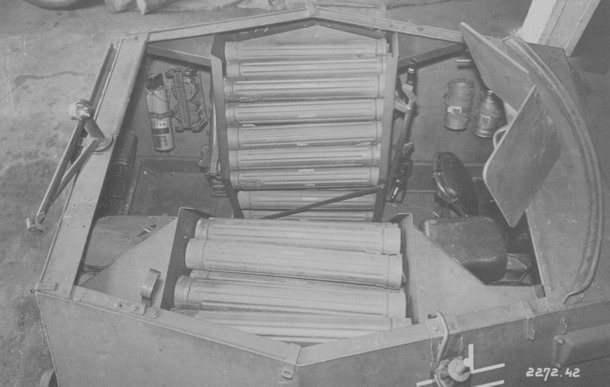
the Sd.Kfz. 250/6 Ausf. B ammunition carrier transported rounds for the later Stug III assault guns armed with long-barrelled guns, source: Flickr.com with permission, edited
Sd.Kfz. 250/7
The seventh variant of the Sd.Kfz. 250 was not a support vehicle but a combat one — unlike most of the variants described above. The vehicle's official name was leichter Schützenpanzerwagen (s.Gr.W.) (Sd.Kfz. 250/7), where s.Gr.W. stood for schwerer Granatwerfer, meaning heavy mortar. The original bench along the right side of the crew compartment was removed. In the centre of the compartment, an 8 cm Granatwerfer 34 (GrW 34) mortar of 81.4 mm calibre was installed. The weapon fired 3.5 kg mortar bombs to a range of up to 2.4 km. The GrW 34 was known for its accuracy and high rate of fire — 15 to 25 rounds per minute.
The mortar baseplate was bolted directly to the floor of the compartment to prevent it shifting during firing. Lateral traversal was therefore only possible within the range allowed by the weapon's traversing mechanism; beyond that, the entire half-track had to be repositioned. A second standard mortar baseplate was also carried, hung on the outside of the rear wall. If necessary, the mortar could be removed from the vehicle and used with this second baseplate as a conventional infantry weapon.
The crew of the Sd.Kfz. 250/7 consisted of four men. Alongside the driver and commander, there were two mortar operators seated on individual seats on either side of the weapon. On board were 22 ammunition boxes, each containing three mortar bombs, for a total of 66 rounds (other figures are sometimes quoted). The front machine gun was removed to avoid interfering with mortar fire, while the rear machine gun was retained. The Sd.Kfz. 250/7 had a combat weight of 5.61 tonnes. Some vehicles of this variant were apparently delivered without the mortar itself and served as dedicated ammunition carriers for the armed vehicles. These too, however, had the baseplate installed in the floor, so in an emergency they could quickly and easily be armed to become fully capable combat vehicles.
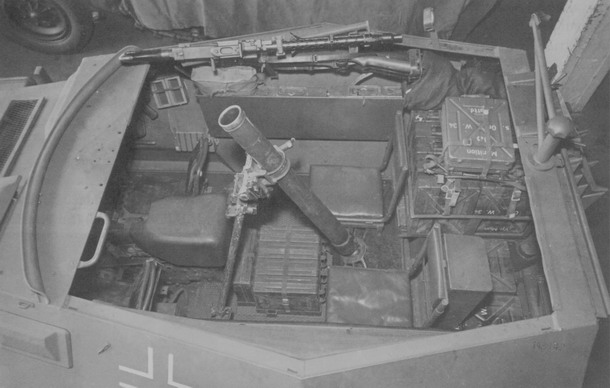
Sd.Kfz. 250/7 — the second baseplate hung on the outside of the rear wall is faintly visible, source: Flickr.com with permission, edited
Sd.Kfz. 250/8
The eighth variant of the "250" was also a combat vehicle. The leichter Schützenpanzerwagen (7,5cm) (Sd.Kfz. 250/8), as its full name read, was armed with a K51 L/24 gun of 75 mm calibre. The front and side walls of the open crew compartment were raised by additional armour plates, 14.5 mm thick at the front and 10 mm on the sides. The short-barrelled gun was mounted centrally in the raised front wall. Its mount allowed vertical movement between -10 and +16 degrees and a maximum lateral traverse of 20 degrees to either side. To the right of the gun was a bracket for an MG 42 machine gun.
The K51 gun was derived from the older KwK 37 tank gun. It was a relatively heavy and bulky weapon that occupied a significant portion of the crew compartment's interior. This was one reason the crew of the Sd.Kfz. 250/8 was reduced to just three men — the driver and a two-man gun crew. The driver sat in his usual position to the left at the front, but had to squeeze through the very limited space along the left side of the gun to reach his seat. The second front seat to the driver's right was eliminated in this variant — it was virtually inaccessible around the gun, and the space was needed for stowing the relatively large ammunition. The front vision port in front of the removed seat was no longer needed and was sealed with a steel plate. The ammunition supply for the gun was a mere 20 rounds. The gunner sat to the left of the gun and aimed using a Sfl.Z.F.1b periscopic sight.
This variant of the half-track weighed 6.3 tonnes. Development of the Sd.Kfz. 250/8 began in 1943, but it did not enter production until the first quarter of the following year. Approximately 60 examples were built in total, all based on the later Ausf. B half-track. Installing such a heavy weapon high up in the vehicle reportedly raised its centre of gravity significantly, meaning drivers had to take particular care not to tilt the vehicle too far to one side on rough terrain, which could cause it to roll over.
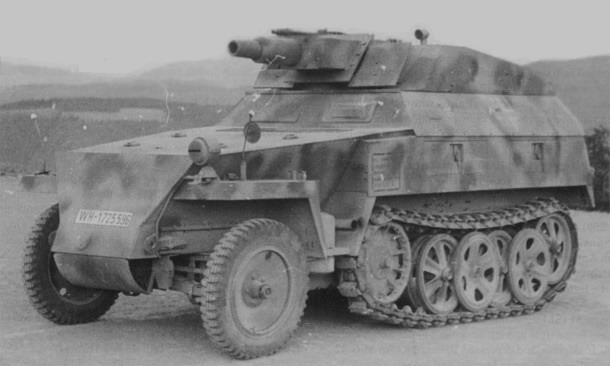
Sd.Kfz. 250/8 (here the Ausf. B) armed with a 75 mm gun, source: Flickr.com with permission, edited
It is also worth mentioning that soldiers sometimes gave this type of armed half-track the nickname Stummel (stump or stub). The name was applied generally to the gun itself and to the vehicles that carried it, alluding to the gun's short barrel which, next to the longer modern guns of the period, genuinely did resemble a cigarette butt.
Sd.Kfz. 250/9
After variant eight came another combat version, the leichter Schützenpanzerwagen (2cm) (Sd.Kfz. 250/9). Development of this ninth variant began in March or May 1942 and was led by the firm Gustav Appel. This half-track was intended to replace the armoured car Sd.Kfz. 222 in the reconnaissance role. As long as the Wehrmacht was fighting in western and central Europe, where the road network was reasonably good, the four-wheeled Sd.Kfz. 222 could handle reconnaissance duties without great difficulty. Things were considerably harder in North Africa and very nearly catastrophic in Russia, particularly during the autumn rains and spring thaw. The wheeled car was simply not up to Russian mud.
The designers borrowed the combat turret from the aforementioned Sd.Kfz. 222 armoured car and simply placed it on the half-track Sd.Kfz. 250. First, of course, the open crew compartment needed a roof to mount the turret onto. The Sd.Kfz. 250/9 therefore had a fully enclosed crew compartment, on the roof of which sat a low rotating turret welded from 8 mm plate. The turret was shaped like an irregular ten-sided truncated pyramid with no roof; only its front section was covered by a raised frame filled with coarse wire mesh. The wings of this mesh cover could be folded outwards to the sides. The mesh was of course incapable of stopping gunfire, but its primary purpose was to prevent hand grenades from being thrown into the vehicle.
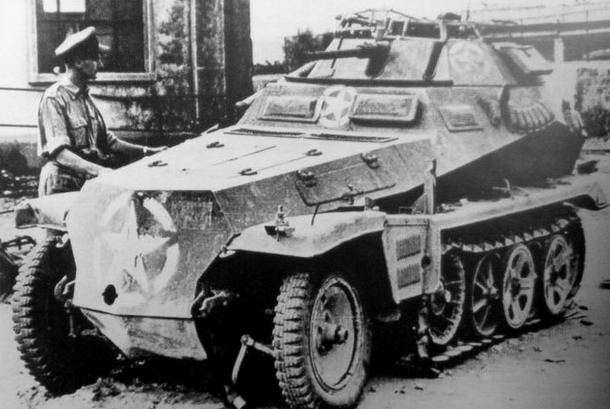
an Sd.Kfz. 250/9 Ausf. A captured by the Allies and marked with American national insignia, source: Flickr.com, Public domain, edited
The main armament of the Sd.Kfz. 250/9 was the 2cm KwK 38 L/55 automatic cannon. To the left of the cannon was an MG 34 machine gun. The barrels of both weapons passed through cutouts in the front of the turret. The cannon and machine gun were mounted together in a so-called Sockellafette — a pedestal mount secured to the floor of the crew compartment. The mount allowed a positive vertical elevation of up to 85 degrees, meaning the vehicle could engage not only ground targets but also enemy aircraft with reasonable effectiveness. The ammunition supply for the cannon was probably 100 rounds, while 2,010 rounds were carried for the machine gun. The crew consisted of the driver, the commander and the gunner. The armoured section of the turret provided visibility through three vision ports — one smaller port on each side and a larger one in the left rear wall.
The first Sd.Kfz. 250/9 vehicles were built on the Ausf. A half-track. From 1944, the Ausf. B version became the basis for new production. On these, the previously open crew compartment roof was enclosed, and the turret was also modernised. Instead of the turret from the four-wheeled armoured car Sd.Kfz. 222, the new 250/9 used the more modern turret from the eight-wheeled armoured car Sd.Kfz. 234. This turret had a hexagonal floor plan and armour 30 mm thick at the front and 14.5 mm on all other faces. It again had only a partial "roof" made of wire mesh.
The weapon mounting inside the turret was also changed. Instead of the original pedestal mount (Sockellafette), a suspended Hängelafette 38 mount came into use. The weight of the Sd.Kfz. 250/9 Ausf. B increased to 6.3 tonnes (compared to 5.9 tonnes for the Ausf. A). The ammunition load was probably unchanged, as was the crew composition. The first production Sd.Kfz. 250/9 vehicles were delivered to the army in May 1943. Aside from an approximately three-month pause at the start of 1944, production of this variant continued at a reasonable pace until February 1945. The total number built is generally quoted as between 750 and 796.
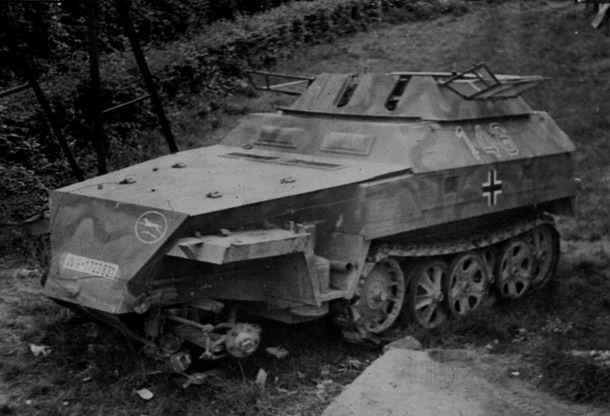
an Sd.Kfz. 250/9 Ausf. B from the 116th Panzer Division, destroyed on the Western Front, source: internet, Public domain, edited
Sd.Kfz. 250/10
In 1942, the 250/10 variant entered production. This vehicle was intended to serve as an accompanying vehicle for platoon commanders within a light motorised infantry company (leichte Schützenkompanie (gepanzert)). The full designation was leichter Schützenpanzerwagen (3,7cm PaK) (Sd.Kfz. 250/10). Instead of the front machine gun, the Sd.Kfz. 250/10 was fitted with a light anti-tank gun — the 3,7cm Pak 35/36 L/45 of 37 mm calibre. Together with the weapon, a small shield was installed to protect primarily the gunner seated to the right of the cannon. The weapon mount allowed vertical movement from -8 to +25 degrees. Horizontal traverse was possible within 30 degrees to either side; beyond that, the entire vehicle had to be moved.
The crew of the Sd.Kfz. 250/10 consisted of four men: the driver, the commander, the gunner and the loader. The standard two-man bench along the left side of the crew compartment was retained. The right side of the compartment was used for storing ammunition boxes. Further ammunition was stowed beneath the bench. The gunner and loader could probably only sit on the bench during transit. In combat, the gunner apparently sat there while the loader stood or knelt to the right of the gun, taking rounds from the stowage on that side and loading the cannon from the right. A total of 216 rounds of 37 mm ammunition were carried on board. The rear machine gun mount was retained.
The Sd.Kfz. 250/10 was built on both the Ausf. A and Ausf. B half-tracks. By mid-war, the PaK 35/36 was a desperately inadequate anti-tank weapon. However, the Sd.Kfz. 250/10 was not expected to fight enemy tanks — it was more suited to engaging lightly armoured or completely unarmoured vehicles, where even this light gun could still prove useful. Production ran during 1942 and 1943, with 151 examples completed in total.
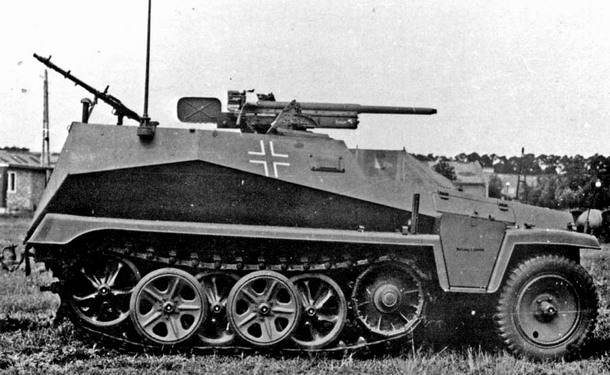
Sd.Kfz. 250/10 Ausf. A armed with the PaK 35/36 gun of 37 mm calibre, source: Flickr.com with permission, edited
In addition to the standard configuration described, photographs show vehicles with noticeably different gun shields. Sometimes the shield appears to have been custom fabricated, while in other cases it looks like the original shield from a towed PaK 35/36 (for example HERE, Public domain). It is therefore an open question whether these are actually Sd.Kfz. 250/10 vehicles whose shields were simply changed in a field workshop, or whether they represent field installations of the PaK 35/36 on entirely different variants of the half-track (such as the basic Sd.Kfz. 250/1).
Sd.Kfz. 250/11
The next in sequence, the Sd.Kfz. 250/11, was also armed with an anti-tank weapon. The full designation of this variant was leichter Schützenpanzerwagen (s.Pz.B.41) (Sd.Kfz. 250/11). Instead of the front machine gun, this half-track carried a heavy anti-tank rifle — the 2,8cm schwere Panzerbüchse 41 of 28 mm calibre. This was a highly interesting weapon with a tapered bore. While the internal diameter of the barrel at the chamber end was 28 mm, at the muzzle it narrowed down to just 20 mm.
This weapon exploited a physical principle whereby, under sufficient pressure, flow accelerates at a constriction — much like pressing a finger over part of a garden hose nozzle to make the water shoot further. As a result, the projectile left the barrel at a velocity of up to approximately 1,400 m/s. In theory, therefore, it was a very powerful weapon, particularly at shorter ranges. The armour-piercing round PzGr.41 could penetrate 46 mm of armour angled at 60 degrees from a range of 300 metres.
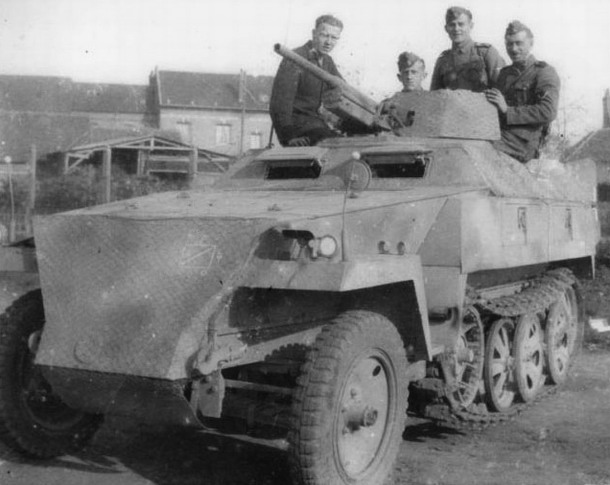
Sd.Kfz. 250/10 Ausf. B, source: Flickr.com with permission, edited
The tapered bore naturally required specially designed ammunition capable of adapting to the constriction. The Panzerbüchse 41 therefore used projectiles with a hard core and a soft outer jacket that deformed as it passed through the narrowing barrel. The core itself could not be made of ordinary steel, since at such extreme velocities it would shatter on impact with enemy tank armour. Tungsten carbide had to be used — a material that was extremely hard but also critically scarce.
The Panzerbüchse 41 was installed on the half-track complete with its standard protective shield. The weapon could be dismounted at any time, placed on its own wheeled carriage and used as a conventional towed weapon — for example if the half-track itself was knocked out. This wheeled carriage was carried on the outside of the rear wall of the crew compartment. A rear machine gun was retained as a supplementary weapon. The on-board ammunition supply consisted of 168 rounds for the anti-tank rifle and 1,100 for the machine gun.
The Sd.Kfz. 250/11 had a combat weight of 5.53 tonnes and a crew of five (some sources quote six). Very few of this variant were produced. The likely cause was the weapon itself, which failed to live up to its theoretical promise in combat. The soldiers who used it reportedly considered it insufficient. While its penetration performance at short range was decent, this meant having to close in on the target — a risky proposition given the thin armour of the half-track.
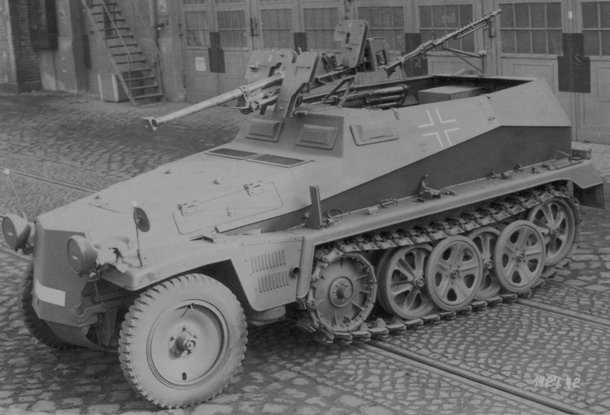
Sd.Kfz. 250/11 armed with the Panzerbüchse 41 anti-tank rifle, source: Flickr.com with permission, edited
Sd.Kfz. 250/12
The final variant of the Sd.Kfz. 250 was the leichter Messtrupppanzerwagen (Sd.Kfz. 250/12). This was a very specialised vehicle whose purpose was to locate enemy artillery. To this end, it carried a range of specialised equipment for visual and acoustic location, ranging, and similar tasks. Several sub-variants apparently existed, differing in their specific fit. One distinctive element of the Sd.Kfz. 250/12 was a bracket for a binocular artillery periscope and optical sight, which was attached to either the front or rear machine gun mount position.
The armament of the Sd.Kfz. 250/12 consisted of a single machine gun, which could be installed in the front mount with shield or hung on the rear swivel bracket as required. The ammunition supply was 1,100 rounds. The vehicle was equipped with two radio sets: the Fu.Spr.Ger. f for short-range communications and the more powerful Fu 8 for longer distances (some authors suggest the Fu 8 was later replaced by the Fu 12). The more powerful set was served by a large frame antenna mounted above the crew compartment on four supports.
The frame antenna makes the Sd.Kfz. 250/12 easy to confuse with the radio vehicle Sd.Kfz. 250/3 in photographs. On closer inspection, however, the 250/12 can be identified by the aforementioned bracket for the periscope and sight, which protruded above the open roof of the crew compartment. The crew of the final variant consisted of three to five men depending on the specific sub-variant. The Sd.Kfz. 250/12 was a fairly rare vehicle and was apparently produced only in limited numbers.
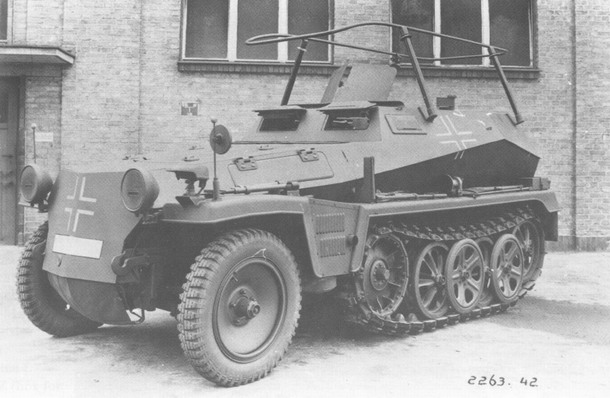
Sd.Kfz. 250/12 recognisable by the periscope bracket protruding through the open roof at the rear of the crew compartment, source: Flickr.com with permission, edited
Field Modifications
Given the large number of vehicles produced and their widespread deployment across all theatres of war, it is only natural that alongside the twelve official variants, a considerable number of unofficial field modifications were also carried out.
Photographic evidence documents an Ausf. B half-track where the standard front machine gun was replaced by a Solothurn S-18/1000 anti-tank rifle. Although this was a Swiss weapon, it was also used by Germany and its allies (the Finns, for example), since the Solothurn firm was a subsidiary of the German Rheinmetall. The Solothurn S-18/1000 was a very robust semi-automatic rifle chambered in 20 mm. It fired powerful ammunition with a cartridge case 138 mm long, fed from ten-round magazines, and at a range of 300 metres could penetrate 35 mm of perpendicular armour.
The photograph shows the new weapon fitted into the original machine gun shield. The mount itself, however, was apparently reinforced, since the original was designed for an MG 34 or MG 42 weighing around 12 kg unloaded — whereas the Solothurn S-18/1000 weighed more than 50 kg without ammunition, and the recoil it generated was incomparably more violent than that of a machine gun.
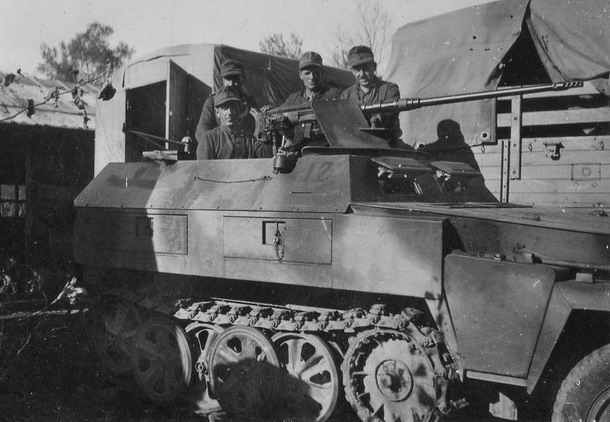
a field installation of the Solothurn S-18/1000 anti-tank rifle in an Sd.Kfz. 250 Ausf. B, source: Flickr.com with permission, edited
A similar re-arming of at least one Sd.Kfz. 250 also took place in the North African theatre. In this case, however, the original front machine gun was replaced by a captured French anti-tank gun — a Hotchkiss of 25 mm calibre. The weapon's original French designation was canon de 25 mm semi-automatique modèle 1934; the Germans used captured examples under their own designation 2,5cm PaK 113(f). Photographs show that the gun was installed on the half-track complete with its shield, which added unwelcomely to the vehicle's silhouette. Surviving images (e.g. HERE, Public domain) reveal the fate of at least one such modified Sd.Kfz. 250 — apparently undamaged, it fell into enemy hands, most likely the British.
Almost no details have come to light regarding another photographically documented field modification, this one armed with an Italian Breda modello 35 cannon of 20 mm calibre. Apparently the only surviving photograph of this vehicle was taken in France in September 1944. The Italian cannon was installed in the crew compartment of an Ausf. B half-track. The Breda modello 35 was a dual-purpose cannon effective against both aircraft and ground targets. With armour-piercing ammunition, it could penetrate 30 mm of armour at a range of 500 metres. The Sd.Kfz. 250 with this cannon was evidently a field modification and was probably unique.
A very interesting and, one might say, intriguing modification of the Sd.Kfz. 250 is on display at the Kalemegdan Fortress in Belgrade, Serbia. The Ausf. B half-track on display there has a 5cm PaK 38 L/60 anti-tank gun of 50 mm calibre installed in the crew compartment. The original compartment was clearly too small for such a large weapon, so it was extended. The builders cut off the rear wall, welded extension armour plates to the sides and then closed the compartment with a new rear wall, this time angled in the opposite direction. After this modification, the hull of the half-track faintly resembled that of the larger Sd.Kfz. 251. The PaK 38 was mounted inside the extended hull along with its shield.
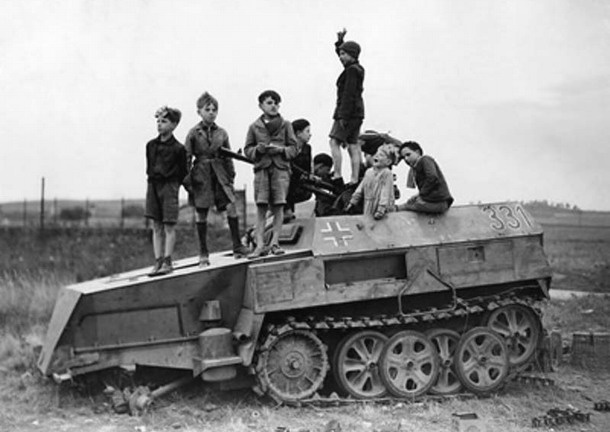
Sd.Kfz. 250 Ausf. B fitted with an Italian Breda modello 35 cannon of 20 mm calibre, source: Flickr.com with permission, edited
The crew compartment of the Belgrade vehicle also has a solid sheet metal roof both in front of and behind the gun, which is rather puzzling. The roof comes so close to the gun that in practice it would necessarily obstruct its vertical movement. It is therefore possible that the original vehicle had no such roof and that it was added by museum staff (perhaps to keep rain off the exhibit or to stop visitors dropping litter into it). A much larger question than the roof, however, is the vehicle's actual origin. According to some sources, it was built by the Germans themselves for use against Yugoslav partisans. According to another source, the Yugoslavs rebuilt the captured half-track and used it against the Germans.
Period photographs also show Sd.Kfz. 250 vehicles with a fully enclosed crew compartment added in the field (see e.g. HERE, Bild 101I-217-0488-04A, Wikimedia, Creative Commons, edited). Angled sheet metal panels were first welded to the edges of the originally open roof in the field workshop, more or less continuing the angle of the original side walls and increasing the height of the compartment. A flat roof was then laid on top of them. In its forward section, an opening was cut that apparently served both as an access hatch for entering and leaving the vehicle and for extending a periscope. The presence of this periscope suggests that the modified vehicle was a version of the Sd.Kfz. 250/5 in its later configuration without the frame antenna. Fitting the enclosed roof required removing both machine gun mounts, leaving the vehicle unarmed. The crew evidently considered the added comfort of a fully enclosed vehicle worth the sacrifice of its weapons.
As the war progressed, petrol became an increasingly scarce resource for the Germans. Not only civilian vehicles but also some military equipment was converted to run on wood gas. In the army, this applied mainly to training vehicles, where performance demands were lower than for combat equipment. It is therefore no surprise that some training Sd.Kfz. 250 half-tracks also received wood gas conversions. A gas producer boiler was hung at the rear of the half-track, with pipes running along the sides connecting it to a condensing and filtering tank at the front, from where the gas was fed to the engine. Such a converted training Sd.Kfz. 250 can be seen in the photograph HERE, Flickr.com — it is even marked with the word Fahrschule ("driving school").
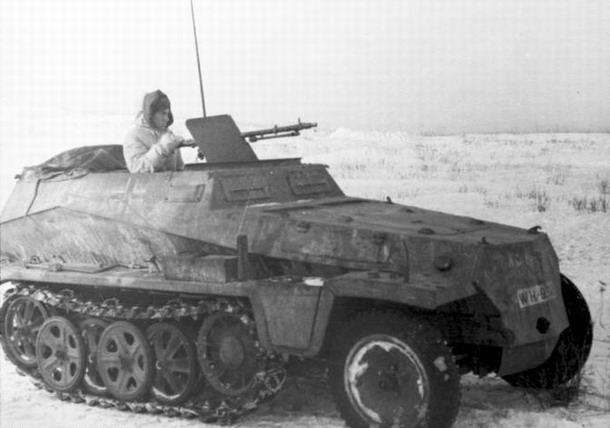
Sd.Kfz. 250 vehicles gave excellent service in the freezing conditions of the Eastern Front... source: Bundesarchiv_Bild_101I-236-1036-31, Wikimedia, Creative Commons, edited
Readers closer to home may be interested to know that after the end of the Second World War, Sd.Kfz. 250 half-tracks entered service with the re-established Czechoslovak army. The reason was an acute shortage of other armoured vehicles suitable for reconnaissance duties. Between 1948 and 1955, a total of 154 half-tracks of both Ausf. A and Ausf. B variants underwent major overhauls before being assigned to reconnaissance units of motorised and rifle divisions. Their official Czechoslovak designation was lehký obrněný transportér D-7p, referring to the factory designation of the Demag chassis. Of these, 136 remained in Czechoslovak service until 1963, when they were finally withdrawn. The following year, all but two examples were scrapped. The two surviving vehicles were preserved in museums in Banská Bystrica and Svidník. It is a curious historical irony that the Sd.Kfz. 250 served in the Czechoslovak army for several times longer than it did in the German one.
Overall Assessment
The Sd.Kfz. 250 half-track was in overall terms a technically accomplished, reliable and well-regarded vehicle among its crews. The commander of one reconnaissance detachment, a certain Captain Deichen, compiled a detailed evaluation report on the operation of this type in April 1943. In it he noted, among other things, that among the Sd.Kfz. 250 half-tracks serving in his unit, 24 vehicles had logged between 10,000 and 15,000 kilometres — a remarkable figure for armoured equipment. What is more, these vehicles remained in excellent condition and required no major repairs during their general inspections after the first year of operation. The report spoke very highly of the engine and gearbox. The author identified the vehicle's main weakness as its shortened D7p chassis. Shortening the track assembly shifted the load towards the front wheel axle, which suffered as a result and was very frequently damaged.
Regarding the combat deployment of the Sd.Kfz. 250, Captain Deichen was unequivocal. In practice, he noted, these vehicles were not used as armoured personnel carriers but as fighting vehicles. Seldom did an engagement follow the pattern of troops dismounting on reaching the battlefield and fighting as infantry. In the vast majority of cases, the crew stayed aboard and simply fought from the moving vehicle, remaining better protected and able to keep pace with the advancing tanks. In this context, the report's author complained about the lack of space inside. The regulation six soldiers, together with their weapons and equipment, were quite cramped aboard the half-track — even just during transit, let alone when fighting from the vehicle. In practice, therefore, only five men typically rode on board.
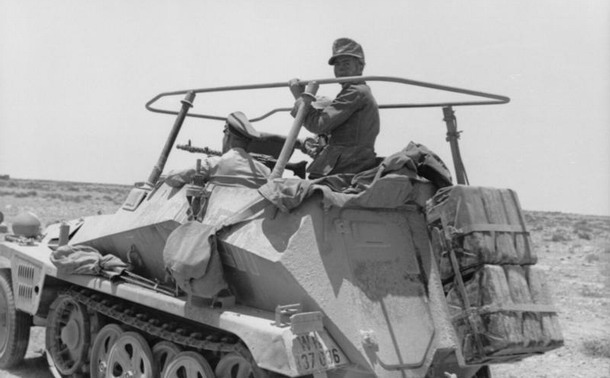
... and equally in the heat of the African sun (pictured again is Rommel's Sd.Kfz. 250/3 nicknamed Greif), source: Bundesarchiv_Bild_101I-784-0249-02A, Wikimedia, Creative Commons, edited
As for combat losses among the Sd.Kfz. 250, these were most often caused by anti-tank rifle fire, which easily penetrated the thin armour — particularly on the sides of the crew compartment. Strengthening the armour to a level that would have resisted anti-tank rifles was of course not a viable option. The report's author further recommended the introduction of a dedicated ambulance variant of the half-track (similar to what existed for the heavier Sd.Kfz. 251). Such a vehicle, he argued, was sorely needed in combat conditions. If even one crew member was wounded aboard, it effectively put the entire vehicle out of the current engagement. With a wounded and bleeding comrade on board, the crew would not continue the attack, and since they typically had no one to hand him over to at that moment, they would usually turn around and head for the nearest aid station.
The author also called for the abolition of the large frame antennas on radio vehicles, which he described as acting as a literal magnet for enemy fire. The report noted that whenever a vehicle with a frame antenna appeared in a formation, it invariably took more hits than any other vehicle present. Captain Deichen was apparently not the only one to make this case, because — as already mentioned — the frame antennas were indeed replaced on later vehicles by the less conspicuous rod antennas.
Technical Data
|
weight: |
5.8 t |
|
length: |
4.56 m |
|
width: |
1.95 m |
|
height: |
1.8 m |
|
engine: |
Maybach HL 42 TRKM |
|
engine output: |
100 hp |
|
max. speed: |
65 km/h |
|
range – road: |
320 km |
|
range – cross-country: |
200 km |
|
superstructure armour: |
|
|
- front: |
14.5 mm |
|
- sides: |
8 mm |
|
- rear: |
10 mm |
|
crew: |
2 men + dismounts |
|
armament: |
2 × MG 34 machine guns, 7.92 mm |
*Technical specifications listed apply to the basic Sd.Kfz. 250/1 variant

ARTICLE
CONTENTS:
Reproducing text from the Panzernet website without the written consent of the operator is prohibited.