Sd.Kfz. 234
eight-wheeled armoured car
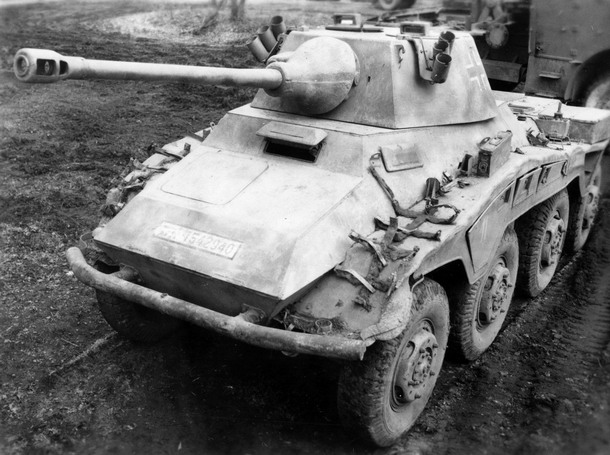
Sd.Kfz. 234/2, better known by its battle name Puma. Source: Flickr.com, Public domain, edited
The heavy armoured car Sd.Kfz. 234 was produced in four variants, which differed quite significantly in armament and in the design of the fighting compartment or turret. Individual versions were identified by an Arabic numeral following a slash at the end of the designation. As a curiosity worth noting upfront: the first variant actually built paradoxically received the designation with the numeral two — Sd.Kfz. 234/2.
Origins of the Vehicle
The history of this armoured car began as early as 1940. In August of that year the Army Weapons Office issued a contract for the development of a new generation of eight-wheeled armoured car capable of coping with the extreme climatic conditions of the African theatre. This fact alone is worthy of attention — it suggests that the Germans were already counting on fighting in Africa sooner or later, even though their actual entry onto that continent ultimately came not from a plan but under pressure of circumstances.
But back to the genesis of the Sd.Kfz. 234. Beyond tropical capability, the new vehicle was expected to overcome several well-known shortcomings of its predecessors, the heavy armoured cars Sd.Kfz. 231 and Sd.Kfz. 232. It was to have a lower profile — presenting less of an easy target — and considerably heavier armament, as both of the older types carried only light 20 mm cannons.
Some sources suggest that as many as three firms were invited to tender for the development contract — Büssing NAG, Daimler, and Schichau-Werke — with Büssing NAG eventually selected as the winner. Most sources, however, state that development was entrusted to Büssing NAG from the outset, given the firm's extensive experience in producing the aforementioned Sd.Kfz. 231, Sd.Kfz. 232, and Sd.Kfz. 233. The latter version of events is also supported by the fact that no mention of any competing designs can be found anywhere.
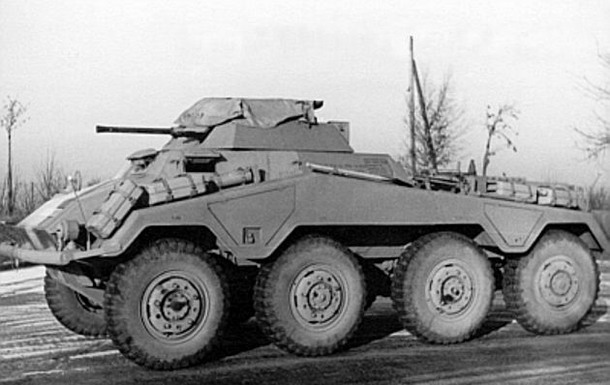
Sd.Kfz. 234/1 with a tarpaulin over the turret roof. Source: Flickr.com, used with permission of the publishing user, edited
Vehicle Description
Büssing NAG developed an entirely new chassis for this purpose, carrying the factory designation ARK. The chassis had eight individually suspended and sprung wheels, all driven and all steerable. Its basic concept was therefore the same as that of the older GS chassis on which the Sd.Kfz. 231, Sd.Kfz. 232, and Sd.Kfz. 233 were based — but it was a thoroughly new-generation design. The same was true of the hull. Like the older vehicles it was formed of upper and lower sections with walls angled in opposite directions, so that the vehicle widened upward from the chassis and then narrowed again toward the roof, the sloped walls improving resistance to enemy fire. Unlike the older types, whose hull walls were carried on a frame structure, the Sd.Kfz. 234's hull was self-supporting.
The chassis was equipped with two driver's positions — one for forward travel and one for reversing. A rear driver's post was a fairly standard feature on heavy armoured cars: driving in reverse from the forward position without a rearward view was extremely risky, and turning such a large vehicle around was not always possible. The designers also managed to increase the chassis's ground clearance compared to the older types while simultaneously reducing the overall vehicle height — the foundations for meeting one of the key requirements, that the new vehicle be lower than its predecessors.
A very important element of the new vehicle was its powerplant, which was to be air-cooled rather than water-cooled — a more suitable solution for tropical conditions. Development of such an engine was contracted to Tatra (then operating under the official name Ringhoffer-Tatra Werke A.G.). In 1941 the first prototype of the new engine appeared under the designation V 850. It was a diesel twelve-cylinder unit with a bore of 105 mm and a stroke of 130 mm, giving a total displacement of 13.5 litres. To meet the requirement for very effective cooling, the engine was fitted with no fewer than four large axial cooling fans. Each bank of cylinders was therefore cooled by two fans — one at each end. The front fans were driven off the camshafts, while the rear fans took their drive from the front ones. A further fan cooled the engine oil.
In the course of further development the cylinder bore was increased to 110 mm, raising the total displacement to 14.825 litres. This variant received the designation T 103, under which the engine was subsequently introduced into series production. Development was far from over, however, as the engine had many shortcomings — it was very noisy and unreliable. Resolving these problems took until 1943, causing significant delays to the start of vehicle production. The car itself had in fact been ready for production as early as July 1942, but the engine difficulties meant that the first series vehicles did not leave the factory until December 1943 (September of the same year is also cited).
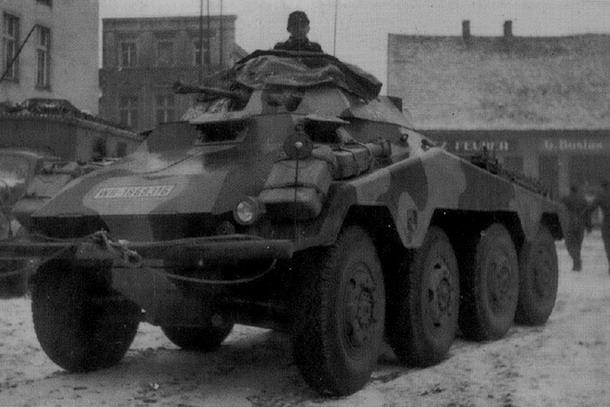
Sd.Kfz. 234/1. Source: Flickr.com, used with permission of the publishing user, edited
As already noted, the hull consisted of upper and lower sections with walls angled in opposite directions, the sloping improving the armour's resistance to enemy fire. The steel plate from which the hull was welded was 30 mm thick at the front, 10 mm on the sides, 8 mm at the rear, and 5.5 mm on the floor and roof. The hull began with a sharp nose formed by upper and lower plates, with a simple tubular steel bumper mounted on the lower plate. The upper nose plate transitioned into the steeply angled front bonnet beneath which was the forward driver's position. In the right section of this bonnet, an access hatch was cut, closed by a large single-piece cover — the primary entry point for the forward driver.
Behind the bonnet, the crew compartment's front wall rose in a step. It contained a single elongated observation port fitted with a cover that opened upward. The port was offset slightly to the left of centre, following the position of the driver's seat, and its cover incorporated an observation slit for use in dangerous areas when the cover itself was closed. Two further vision ports of similar design were provided in the side walls of the compartment, all three serving the forward driver stationed in this part of the hull.
At the rear, the crew compartment stepped down again into the engine compartment roof. Vision ports were also provided here for the rear driver's position: one in the right section of the rear wall (facing to the rear, and from the rear driver's perspective on his left) and one in the right side wall (again, measured in the forward direction of travel). Photographs confirm that on the first vehicles — or at least on the prototype — a third vision port was also provided for the rear driver in the left side wall. On later production vehicles this port was absent, most likely because a radio set was installed at that location — or possibly because it proved impractical, given that the rear driver sat well over to the right, too far from the port to use it.
At the rear of the hull behind the crew compartment was the engine bay, housing the already-mentioned Tatra T 103 diesel, which produced a maximum of 210 horsepower at 2,200 rpm. The gearbox offered three speeds in both directions, supplemented by a two-speed reduction gearbox that doubled the available ratios — giving the driver or drivers a total of six forward and six reverse gears. The designers were particularly generous with the fuel capacity: the Sd.Kfz. 234 could carry up to 360 litres of diesel, giving it a road range of 900 to 1,000 km — a truly remarkable level of autonomy for a reconnaissance vehicle.
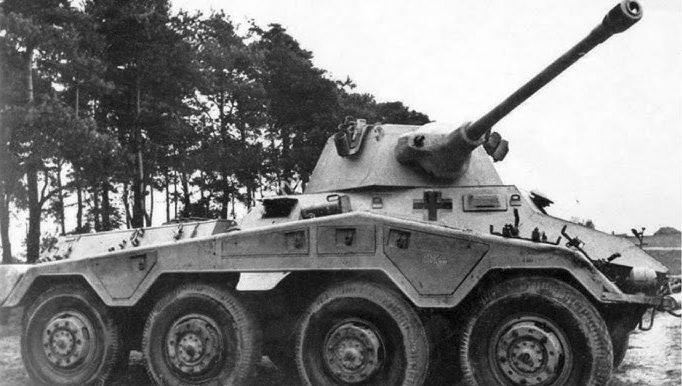
Sd.Kfz. 234/2 Puma. Source: Flickr.com, used with permission of the publishing user, edited
Using a diesel engine did allow the designers to meet the air-cooling requirement and at the same time achieve an enormous range, but it created a logistical headache: the overwhelming majority of German military vehicles ran on petrol.
The engine compartment bonnet was literally covered in openings. There were three ventilation openings fitted with closable louvres and two further service hatches with solid covers. An additional service opening was provided in the upper section of the rear hull wall. On some vehicles — apparently the later ones, which no longer used the special self-sealing tyres that had been dropped as a cost-saving measure — a spare wheel was sometimes mounted on the lower part of the rear wall.
Along each side of the vehicle ran a large mudguard that covered all four wheels simultaneously. Their size allowed for the inclusion of lockable stowage compartments for smaller items of equipment — four on each side (though the exact number may have varied between the different Sd.Kfz. 234 variants). A larger wooden stowage box was mounted on the rear section of each mudguard, running alongside the engine compartment side wall. Further crates, jerry cans, fire extinguishers, and similar items could be lashed to the mudguards with leather straps. At the very rear, the exhausts were also laid along the tops of the mudguards.
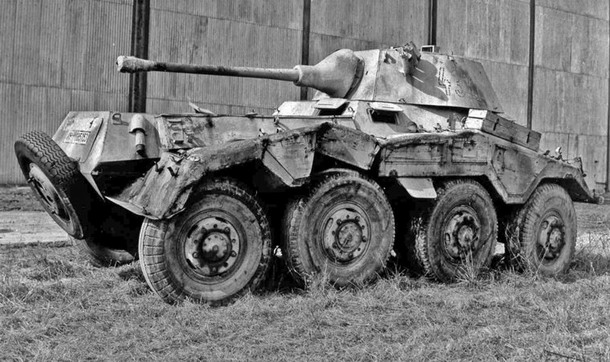
Sd.Kfz. 234/2 Puma — captured by the Allies. Source: Flickr.com, Public domain, edited
Sd.Kfz. 234/2 Puma
The roof of the crew compartment provided a large flat surface for mounting the chosen armament. On the first variant built, this was a 50 mm cannon housed in a fully rotating turret. Although it was the first variant produced, this version received — for reasons I have been unable to establish — the designation Sd.Kfz. 234/2. It became far better known, however, under its battle name: Puma.
The turret, together with its cannon, was taken from the unsuccessful light tank project VK1602 Leopard. The fully enclosed turret had walls 30 mm thick at the front and 14.5 mm on the sides and rear. It had a hexagonal plan with rounded sides and flat front and rear walls. Mounted in the front plate was the vehicle's main weapon — the tank gun KwK 39/1 L/60 in 50 mm calibre, with a barrel 60 calibres long. This was an adapted version of the gun that armed, among others, the late-production PzKpfw III tanks. For installation in the smaller turret of an armoured car, a muzzle brake was added to reduce the length of recoil. Coaxially mounted with the gun was a 7.92 mm MG 42 machine gun. Both weapons shared a common mantlet formed from a single heavy casting, shaped in an "aerodynamic" style similar to the so-called Saukopfblende used on, for example, StuG III assault guns.
The mantlet allowed vertical elevation of the weapons from -10° to +20°. The vehicle carried 55 rounds of cannon ammunition on board, roughly split half-and-half between armour-piercing and high-explosive. Machine gun ammunition totalled 1,950 rounds. On each side of the turret were three smoke grenade dischargers, fired from inside the turret. The turret roof had two crew access hatches, each fitted with a rotating observation periscope. The turret ventilation fan also exited through the roof.
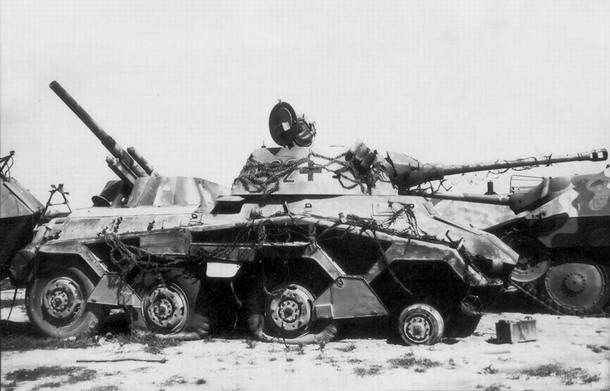
Sd.Kfz. 234/2 Puma. Source: Flickr.com, Public domain, edited
The vehicle was equipped with two radios — a Fu12 SE 80 and a Fu Spr.Ger. "a" or "f" — served by two aerials: a simple rod aerial on the rear edge of the turret and a star-branched aerial on the left section of the engine bonnet. The crew consisted of four men: two stationed in the turret and two in the hull below. The two turret crew had to cover the roles of commander, gunner, and loader between them, meaning one of them necessarily had to perform two functions — the commander most likely also acting as loader. In the hull sat the forward driver and a second man who served primarily as radio operator and took over driving duties from the rear position when necessary.
The Sd.Kfz. 234/2 weighed 11.74 tonnes. It was 6.8 metres long, 2.33 metres wide, and 2.38 metres tall (other height figures are also cited). Its maximum road speed was up to 90 km/h. With its weapon, the Puma was theoretically capable of destroying even some medium enemy tanks on the battlefield.
Several different figures are given for the production period. The start of series production is dated to either September or December 1943, and its end to either June or September 1944. On the number of vehicles built, sources are nearly unanimous: 100, or alternatively 101 examples.
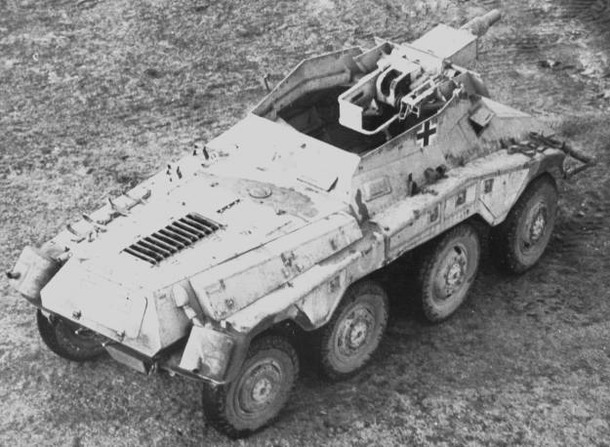
Sd.Kfz. 234/3. Source: Flickr.com, Public domain, edited
Of all the Sd.Kfz. 234 variants, the Puma earned the greatest fame — most likely not simply because it was the first of the family, but because of its genuinely outstanding characteristics. The vehicle combined a solid level of crew protection, powerful armament, and excellent driving performance. Setting aside its wheeled running gear, the Puma's parameters broadly matched those of a light tank — judge for yourself: 11.74 tonnes in weight, up to 30 mm of armour, a 50 mm cannon. For comparison, consider some contemporary light tanks: the German PzKpfw II Ausf. L weighed 11.8 tonnes and carried a 20 mm cannon; the American M5 weighed 14.7 tonnes with a 37 mm gun; and the Soviet T-70 weighed just 9.2 tonnes and was armed with a 45 mm cannon.
Sd.Kfz. 234/1
The second variant to enter service was the Sd.Kfz. 234/1, which entered series production in April or June 1944. This version was designed for engaging enemy aircraft. Above the fighting compartment a new low-profile turret with an open roof was fitted. It had a hexagonal plan with sloped walls, and armour of 30 mm at the front and 14.5 mm on all other faces. Like the cupola on the lighter armoured cars, its front section was protected by a raised frame filled with fine wire mesh whose side flaps could be folded outward. The mesh could not stop bullets, but its purpose was to prevent hand grenades from being dropped into the vehicle. In poor weather the crew had to resort to a waterproof tarpaulin draped over the open top.
The edge between the two front faces of the turret was cut away for the barrel of the KwK 38 L/55 cannon in 20 mm calibre, with an adjacent opening to the left for the MG34 machine gun barrel. Both weapons were mounted together in a Hängelafette 38 suspended mount, which permitted an impressive maximum elevation of 70° (some sources cite up to 87°). The weapons, mount, and turret design all corresponded to those of the late-production light armoured car Sd.Kfz. 222. The cannon ammunition supply was 250 rounds. Given that the same weapon configuration was carried without difficulty by the much lighter and smaller Sd.Kfz. 222, the Sd.Kfz. 234/1 was clearly under-armed for its size — though it was the only variant in the entire Sd.Kfz. 234 family to carry any dedicated anti-aircraft artillery.
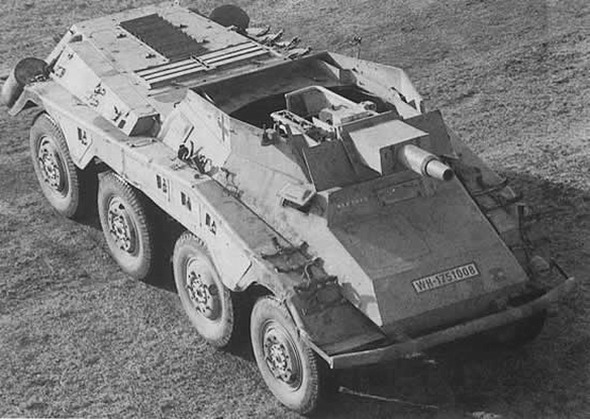
Sd.Kfz. 234/3. Source: Flickr.com, Public domain, edited
Production of this variant continued probably until March 1945 and yielded between 200 and 230 examples — sources differ, as usual. The Sd.Kfz. 234/1 weighed 11.5 tonnes. It was 5.86 metres long, 2.33 metres wide, and just 2.1 metres tall. All other parameters — speed, crew complement, and so on — remained the same as on the Sd.Kfz. 234/2.
Sd.Kfz. 234/3
Third in sequence was the Sd.Kfz. 234/3, intended primarily as a successor to the older Sd.Kfz. 233 and therefore tasked with providing artillery fire support to the other armoured cars. The roof of the fighting compartment was removed and the space left entirely open at the top. For improved crew protection, the side walls of the compartment were heightened by additional armour plates — vertical on the sides, and angled at the front and rear — ranging in thickness from 14.5 mm at the front and sides to 10 mm at the rear.
Mounted centrally in the raised front wall of the fighting compartment was the short-barrelled KwK 51 L/24 cannon in 75 mm calibre (also referred to as K51 L/24). Its ammunition supply was 50 rounds. The gun mount allowed vertical elevation from -10° to +12°. To the right of the cannon, the mount incorporated a dedicated cradle for a machine gun, which when fitted moved together with the cannon and could provide covering fire against attacking infantry. The machine gun could alternatively be mounted on a swivel at the rear of the fighting compartment (not present on all vehicles) or simply fired over the side walls. Machine gun ammunition was probably 1,950 rounds.
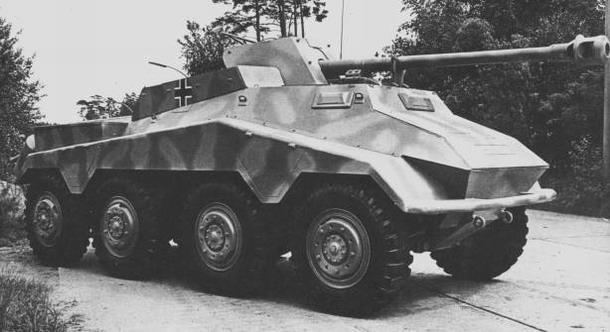
Sd.Kfz. 234/4. Source: Flickr.com, used with permission of the publishing user, edited
The Sd.Kfz. 234/3 was identical in dimensions and weight to the Sd.Kfz. 234/1. Information on the start and end of production again varies between sources, but it most likely ran from June to December 1944 — though some sources suggest production began as early as late 1943 or continued until the very end of the war. During this short period only 88 Sd.Kfz. 234/3 vehicles were built, the vast majority of which were deployed with the 116th Panzer Division on the Western Front.
Sd.Kfz. 234/4
The last series variant was the Sd.Kfz. 234/4, developed at the end of 1944 — a time when the Wehrmacht and Germany as a whole stood on the brink of disaster. Enemy tanks were pouring into the Reich from both east and west in overwhelming numbers, while Germany's own war production had been brought to its knees by Allied bombing. The Germans were desperately seeking any mobile weapon capable of destroying enemy armour. Any chassis that could carry a reasonably effective anti-tank gun was pressed into service — including the armoured car Sd.Kfz. 234.
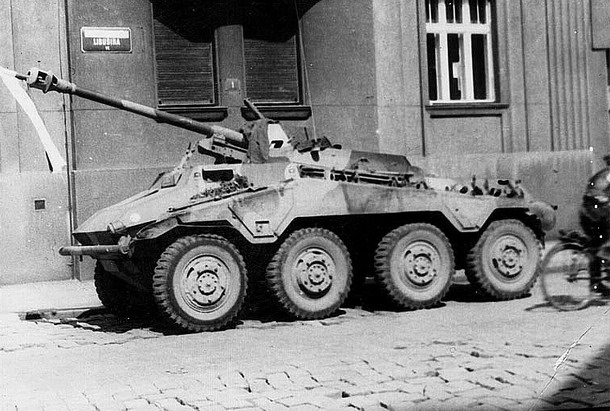
The chosen weapon was the PaK 40 L/46 in 75 mm calibre. Installing such a large gun required more substantial modifications to the fighting compartment than on any previous variant. Due to the weapon's weight and recoil forces, it had to be mounted in the centre of the fighting space rather than at the front as on the Sd.Kfz. 234/3. The roof of the front section of the fighting compartment was retained, but further back it was removed entirely, with portions of the side walls also cut away to widen the fighting space. Supplementary armour plates were welded onto the original side walls for additional crew protection. The gun was installed complete with its standard gun shield, which effectively served as the front armour of the open fighting compartment.
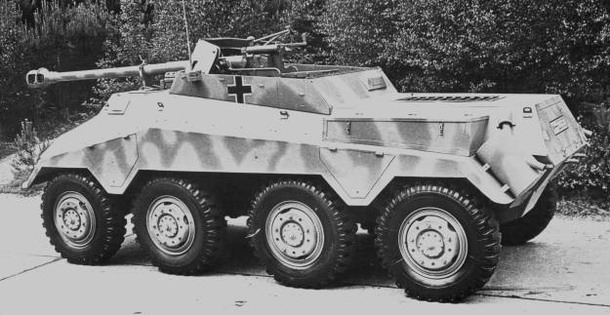
Sd.Kfz. 234/4. Source: Flickr.com, used with permission of the publishing user, edited
The fitted gun was a highly effective weapon: at a range of 1,000 metres it could penetrate armour angled at 30° and 85 mm thick (with PzGr. 39), or 97 mm thick (with PzGr. 40). One might therefore suppose that mounting it on a wheeled chassis gave the Germans a solid combat vehicle. In practice, however, the reality was more mixed. For all its impressive specifications, the Sd.Kfz. 234 was not well suited to carrying such a heavy weapon — the vehicle's structure suffered considerably from the energy of each shot. The confined fighting space allowed only very limited traverse, and could hold a mere 36 rounds of ammunition. Despite these drawbacks, the Sd.Kfz. 234/4 was evidently a useful weapon system, and with a degree of luck it could effectively destroy the overwhelming majority of enemy tanks it encountered. Supplementary armament consisted of an MG 42 machine gun, mounted on a movable swivel to the right of the cannon.
Production of this final variant began in December 1944 and continued until March 1945, when it finally collapsed. The number of vehicles built is again disputed — figures of 89 or 97 examples are cited. The vehicle weighed 11.6 tonnes, was 6.84 metres long, 2.33 metres wide, and 2.35 metres tall. The crew of four was retained, as was presumably the same standard crew composition.
The Sd.Kfz. 234 was the most modern German armoured car of the entire war. According to many experts it was the finest heavy armoured car of its era — one that influenced the design of this vehicle type for many years to come. The Sd.Kfz. 234/4 was, in turn, the most heavily armed German armoured car of the entire conflict. If we add together the disputed production figures for all variants, we arrive at a theoretical lower and upper bound for the total number of vehicles built: a minimum of 477 and a maximum of 516. The true figure almost certainly lies somewhere between these two extremes. In any case, the figure of over two thousand that is sometimes cited is simply incorrect.
Sd.Kfz. 234/4. Source: Flickr.com, used with permission of the publishing user, edited
Unofficial Modifications
To close, two interesting modifications of the Sd.Kfz. 234 are worth mentioning. Both apparently existed as single examples, converted in field workshops. In the first, the cannon was removed from a standard Sd.Kfz. 234/3 and a Schwebelafette 38 — apparently taken from a half-track Sd.Kfz. 251 — was installed in the open fighting space, carrying a 20 mm Flak 38 anti-aircraft cannon. This modified vehicle fell into American hands in May 1945 somewhere in Bohemia. A photograph of the vehicle without its armament can be viewed HERE, a detail of the mount HERE, and a further photograph showing it second from the front in a column of vehicles being taken over by American soldiers from surrendering German forces HERE.
As for the second unusual modification, I was unable to find any detailed information about it. There does exist, however, THIS photograph, which appears to be authentic. It shows what looks like a turret from the light tank PzKpfw II Ausf. L mounted on the hull of an Sd.Kfz. 234. From the surroundings one can surmise that the photograph was taken during the very last days of the war or even after capitulation, most likely during some kind of retreat involving both military vehicles and civilian population.
Technical Data
|
|
234/1 |
234/2 |
234/3 |
234/4 |
weight: |
11.50 t |
11.74 t |
11.50 t |
11.60 t |
|
length: |
5.86 m |
6.80 m |
5.86 m |
6.84 |
|
width: |
2.33 m |
2.33 m |
2.33 m |
2.33 m |
|
height: |
2.10 m |
2.38 m |
2.10 m |
2.35 m |
|
engine: |
Tatra T 103 |
Tatra T 103 |
Tatra T 103 |
Tatra T 103 |
|
engine output: |
210 hp |
210 hp |
210 hp |
210 hp |
|
max. speed: |
90 km/h |
90 km/h |
90 km/h |
90 km/h |
|
fuel consumption – road: |
40 l/100 km |
40 l/100 km |
40 l/100 km |
40 l/100 km |
|
fuel consumption – off-road: |
60 l/100 km |
60 l/100 km |
60 l/100 km |
60 l/100 km |
|
hull armour: |
|
|
|
|
|
front: |
30 mm |
30 mm |
30 mm |
30 mm |
|
sides: |
10 mm |
10 mm |
10 mm |
10 mm |
|
rear: |
8 mm |
8 mm |
8 mm |
8 mm |
|
turret/superstructure armour: |
|
|
|
|
|
front: |
30 mm |
30 mm |
30 mm |
30 mm |
|
sides: |
14.5 mm |
14.5 mm |
14.5 mm |
14.5 mm |
|
rear: |
14.5 mm |
14.5 mm |
10 mm |
10 mm |
|
crew: |
4 men |
4 men |
4 men |
4 men |
|
armament: |
20 mm KwK 38 L/55 cannon 7.92 mm MG 42 machine gun |
50 mm KwK 39/1 L/60 cannon 7.92 mm MG 42 machine gun |
75 mm KwK 51 L/24 cannon 7.92 mm MG 42 machine gun |
75 mm PaK 40 L/46 cannon 7.92 mm MG 42 machine gun |
ARTICLE
CONTENTS:
Reproducing text from the Panzernet website without the written consent of the operator is prohibited.