TANK AMMUNITION
types, construction and designation of artillery shells
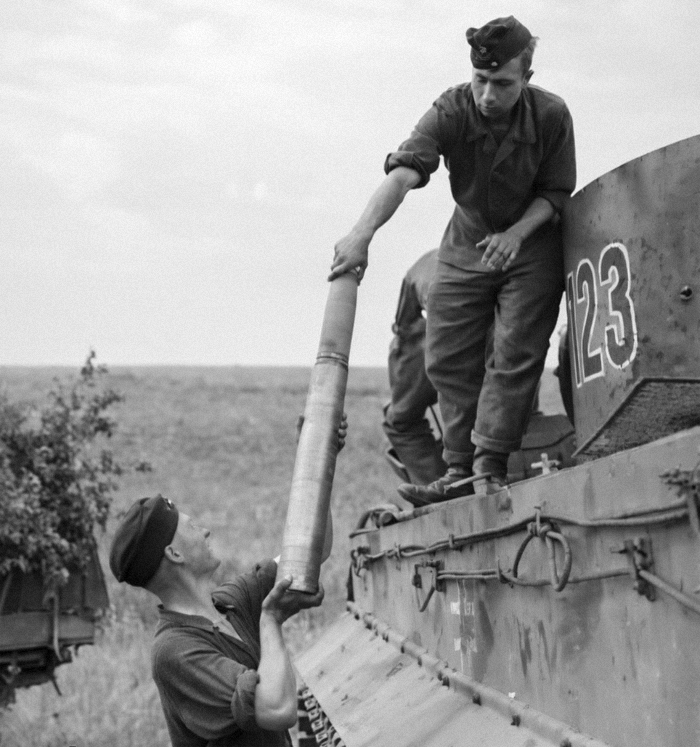
loading 88 mm ammunition into a Tiger tank, source: Bundesarchiv Bild 101I-022-2948-24, Wikimedia, Creative Commons, edited
German tanks in World War II used essentially three main types of artillery ammunition. Against infantry and other "soft" targets (buildings, vehicles, artillery positions and the like), they relied on high-explosive fragmentation shells, known in German as Sprenggranate. Against armoured targets crews used anti-tank shells: either kinetic armour-piercing rounds (Panzergranate) or shaped-charge rounds (Hohlladung Granate). In addition, German tankers could also make use of smoke shells (Nebel Granate), which we will briefly cover as well.
The High-Explosive Sprenggranate
Let us start with the high-explosive fragmentation shells — the Sprenggranate. As the name itself suggests, this type of ammunition destroyed its target through a combination of blast and fragmentation effects. The blast effect is essentially the force of the explosion itself, while the fragmentation effect comes from the shrapnel produced when the shell body ruptures. To maximise both effects, designers tried to pack in as much explosive filling as possible while engineering the shell body to break apart into the greatest number of fragments on detonation. It sounds straightforward, but getting the balance right — lot of fragments, but not so small that they lose their lethal effect — is genuinely complex engineering. To get a sense of the size and quantity of fragments produced when a German Sprenggranate detonated, you can look at these photographs, which show fragments collected after controlled detonations of 75 mm, 88 mm and 105 mm shells (source: US Army Medical Department, Center of History and Heritage, Public Domain).
Ammunition for German tank guns was without exception of the fixed type — meaning the shell was firmly crimped to the cartridge case and the two formed a single round. The opposite of fixed ammunition is separated or bagged ammunition, which we will not discuss here. To emphasise the fact that a round was of the fixed type, the Germans included the word Patrone (cartridge) in the designation — for example, 7.5 cm Sprenggranate Patrone.
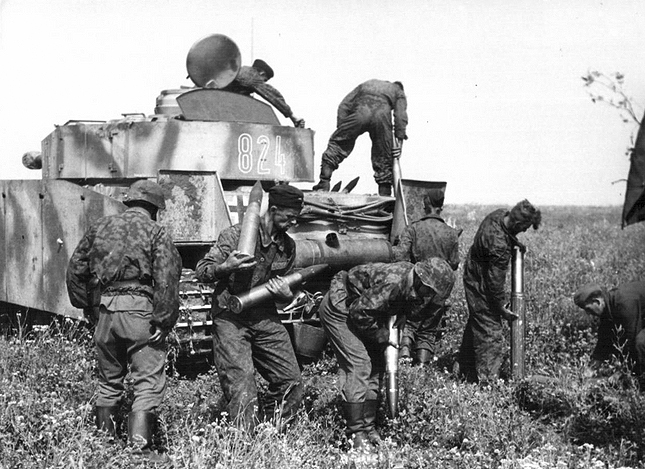
soldiers helping a Panzer IV crew load 75 mm rounds, source: Flickr.com, edited
As already noted, the Sprenggranate was used to neutralise enemy infantry, destroy unarmoured or lightly armoured vehicles, demolish buildings and suppress artillery positions. Throughout the war — and especially in its early years — it was the most widely used type of ammunition in German tanks. The shell itself typically consisted of a steel or cast-iron body filled with explosive. German Sprenggranate used primarily TNT or a mixture of TNT and ammonium nitrate (known as Amatol) as their bursting charge, though other explosives such as Trinitrophenol, PETN and RDX also appeared to a lesser extent.
The shell was fitted with a point-detonating fuze in the nose that initiated the bursting charge on impact. Some types of fuze allowed for a delay to be set. When firing at buildings, for example, this meant the shell would not detonate the moment it struck the wall — effectively outside the structure — but would instead punch through and explode inside the room. The 75 mm Sprenggranate used in the Panzer IV, for instance, was fitted with the kl A.Z. 23 fuze (kl A.Z. = kleiner Aufschlagzünder, or small impact fuze), which allowed a 0.15-second delay to be set. By contrast, the 50 mm Sprenggranate used in the Panzer III carried the A.Z. 39 fuze, which offered no delay option.
Another feature worth mentioning is the so-called driving band (Führungsring). This was a band — or sometimes two bands — of softer metal fitted around the circumference of the shell. Its job was to seal the shell in the gun barrel so that the propellant gases generated by the firing could not escape around the projectile, ensuring all that pressure acted on the shell itself and gave it the highest possible muzzle velocity. The driving band also guided the shell through the barrel and, through direct contact with the rifling, imparted the correct spin. German tank shells typically had one or two driving bands, made from either copper or soft low-carbon steel. In the latter case the shell was marked with the letters FES (Führung Sintereisen).
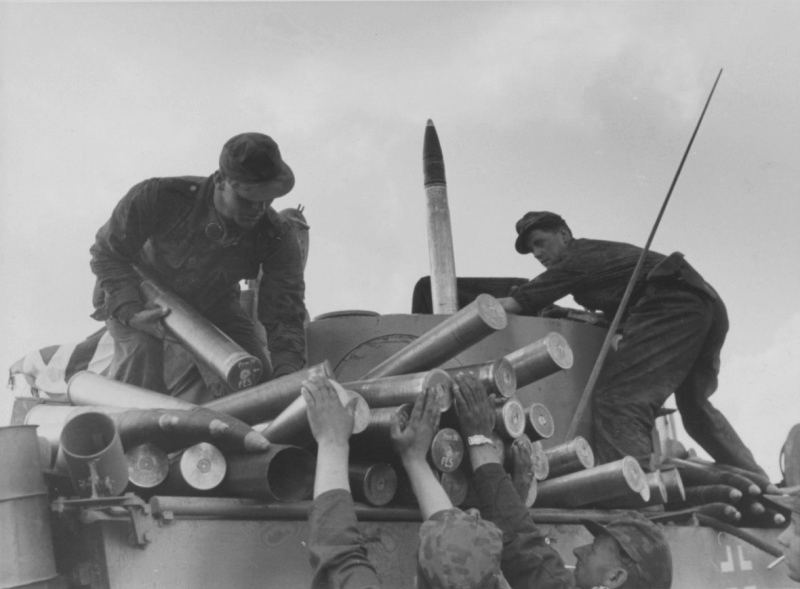
88 mm rounds laid out on the rear deck of a Tiger tank; the letters FES (Führung Sintereisen) can be seen on at least two cartridge cases, indicating that the driving bands are made of soft low-carbon steel, source: Flickr.com, edited
Some types of German high-explosive shells were fitted with a smoke-generating device (Rauchentwickler), which typically contained red phosphorus. The coloured smoke from the burning phosphorus was intended to mark the point of impact for at least a brief period. This was particularly useful when firing indirectly at longer ranges, as it allowed the gunner to observe where previous rounds had landed and adjust his aim accordingly. Shells fitted with a smoke generator were marked with a red band for easy identification. These smoke-marked high-explosive shells must not be confused with dedicated smoke shells, whose primary purpose was to produce the largest possible opaque cloud to deny the enemy observation and accurate fire.
German high-explosive shells were typically painted olive green with black and occasionally white markings — and there was no shortage of letters and numbers on them. The shell body carried the exact date and place of filling with explosive along with the manufacturer's code, the date and place of assembly (which in practice meant the installation of the fuze) along with the relevant manufacturer's code, a code identifying the type of explosive filler, a Roman numeral indicating the shell's weight category, and sometimes the code identifying the driving band material (such as the FES marking mentioned above).
Armour-Piercing Shells
Having covered the high-explosive Sprenggranate, let us turn to the considerably more interesting armour-piercing shells. As mentioned in the introduction, the German armoured forces — and indeed others — used two types of anti-tank shell during World War II: kinetic energy penetrators (Panzergranate), which punch through armour using their momentum, and shaped-charge rounds (Hohlladung Granate), which burn through armour using a focused jet of energy. But the distinction between kinetic and shaped-charge does not exhaust the taxonomy of armour-piercing shells. Kinetic penetrators themselves come in quite a few subtypes based on their construction. We will keep things relatively simple here and focus on the two main types available to Wehrmacht tankers: the Panzergranate 39 and the Panzergranate 40, with only brief mentions of other, more marginal types.
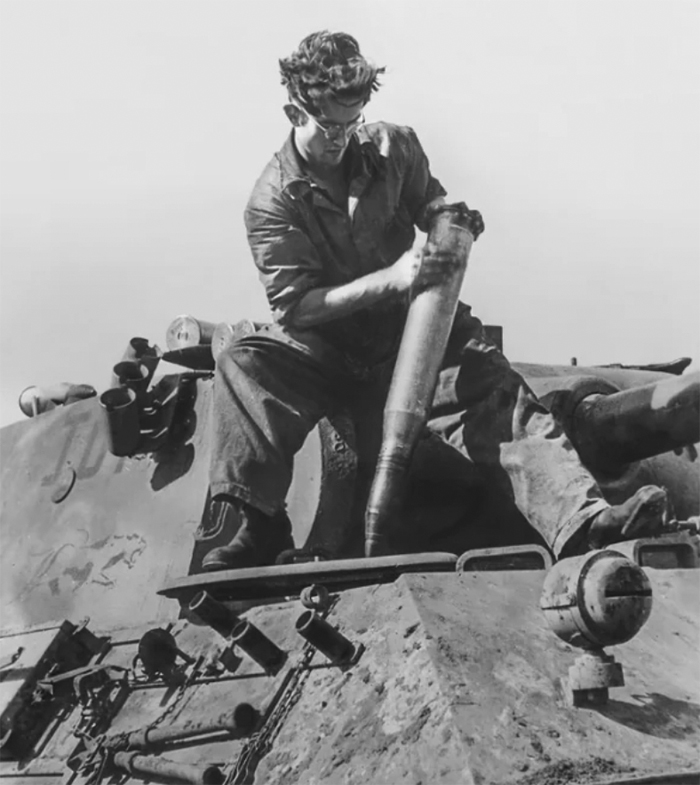
a Panther tank; the soldier in the photo is cleaning a 75 mm round, while more rounds are visible on the turret behind him, source: Flickr.com, edited
The Armour-Piercing Panzergranate 39
The standard German armour-piercing shell of World War II was, without question, the Panzergranate 39 — though it can truly be called the standard only for the 75 mm tank guns (Panzer IV, Panther) and the 88 mm guns (Tiger and Königstiger). A Panzergranate 39 did exist in 50 mm calibre for the Panzer III's gun, but in that case it was a somewhat different design, which we will come to later. And if you encounter the designation Panzergranate 39 applied to 37 mm rounds (early Panzer III) or even 20 mm rounds (Panzer II), this is most likely an inaccurate label — the guns of these early tanks used older types of ammunition designated simply as 3.7 cm Panzergranate or 2 cm Panzergranate (sometimes with additional suffixes, but never with the numeral 39).
Let us not over-complicate things at this stage, however, and concentrate on what can genuinely be considered the standard — the Panzergranate 39 in 75 mm and 88 mm. In modern international terminology this was an APCBC-HE-T round (Armour-Piercing, Capped, Ballistic Capped, High-Explosive, Tracer). Do not be alarmed — we will work through each of those terms in turn.
An armour-piercing shell relies on brute force to defeat armour. Take a piece of hard material such as steel, shape it into a cylinder with a point at the front, and fire it at the highest possible velocity at your target — and you have an armour-piercing shell. Velocity is critical, because such a shell penetrates armour through its hardness and kinetic energy, and kinetic energy depends primarily on speed (kinetic energy = half the mass multiplied by the square of the velocity). If you add a small charge inside the shell designed to explode after it has punched through the armour and finish the job inside, you have an armour-piercing shell with a bursting charge (a solid shot has no explosive filling; a shell does). Simple enough — but also not very effective on its own, because such a plain armour-piercing shell has an unfortunate tendency to glance off the armour plate if it strikes at an angle rather than square on. To address this problem, designers invented the so-called armour-piercing cap: a softer but tough covering fitted over the nose of the shell. Its job is to grip the armour on impact and keep the shell from deflecting, so that it enters the plate at the best possible angle.
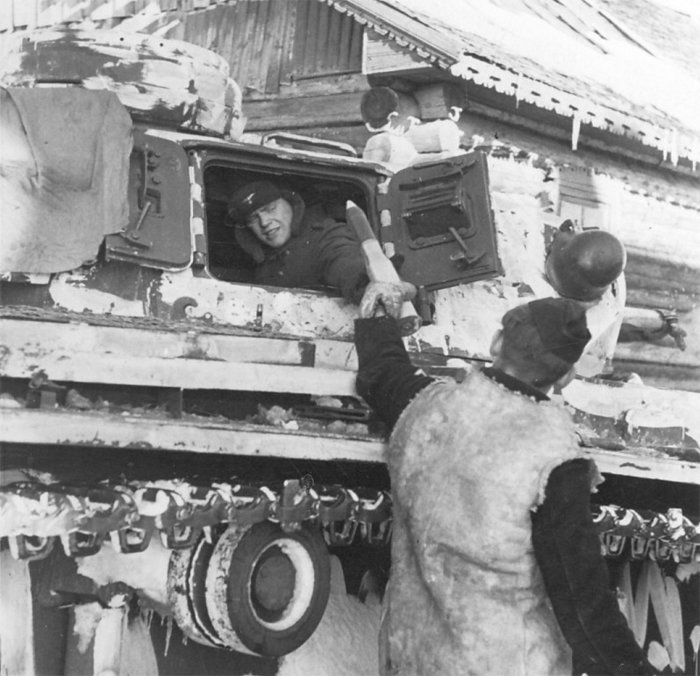
loading 50 mm ammunition into a Panzer III; Panzergranate 39 armour-piercing shells were standardly painted black with a white tip, source: Flickr.com, edited
To do its job well, however, the armour-piercing cap cannot be too sharply pointed. On the contrary, a relatively rounded shape works best — but that in turn worsens the shell's aerodynamic properties. In short, a shell with a blunter cap is worse at pushing through the air and therefore loses speed more quickly. This led to another invention: the ballistic cap. It is nothing more than a sharp point fitted in front of the rounded armour-piercing cap. Its sole purpose is to improve the shell's flight characteristics, which is why it is typically hollow and does not even need to be made of metal — plastic will do perfectly well. The result is a sharp, hard steel shell (with a small bursting charge) covered by a softer, rounder armour-piercing cap, and then a very sharp ballistic cap on top of that (APCBC-HE in international notation).
The last element needed to arrive at the Panzergranate 39 — that is, an APCBC-HE-T round — is the tracer (Leuchtspur). This is simply a small container of brightly burning composition fitted in the base of the shell. The bright light allows the gunner to follow the shell's flight path with the naked eye even in daylight, and to adjust his aim accordingly for subsequent shots. Such a tracer burned for at most two seconds, but given the speed of the projectile in flight, that was more than enough.
The penetrating element of the Panzergranate 39 was therefore its steel body. To deal effectively with the armour of an enemy vehicle, it had to be not only sharply pointed but also as hard as possible. The Germans originally used a nickel-chromium-molybdenum steel, which met the requirements for strength, toughness and machinability. As the war progressed and certain raw materials became increasingly scarce, they were forced to switch to a silicon-manganese-chromium steel. This could achieve comparable hardness through heat treatment, but at the cost of somewhat greater brittleness — meaning a higher risk of the shell shattering on impact with armour.
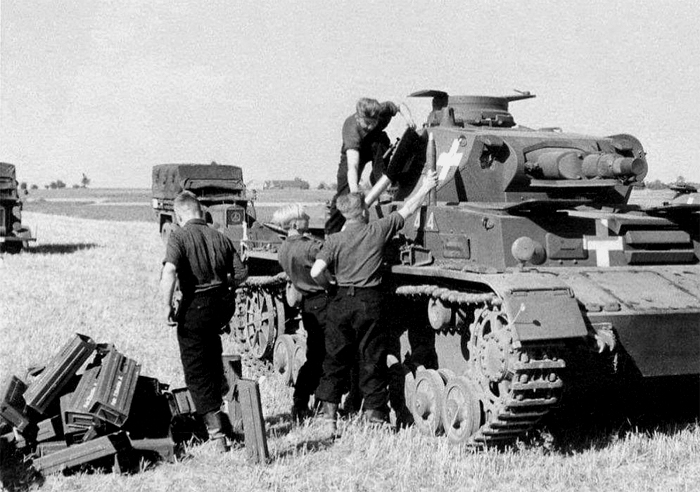
a Panzer IV replenishing its ammunition during the Polish campaign in September 1939; note the stack of metal transport containers for the rounds, source: Flickr.com, edited
Now let us introduce a slight complication and return to the point that the 50 mm Panzergranate 39 for the later versions of the Panzer III differed in construction from the standard described above. In modern international notation, the 5 cm Panzergranate Patrone 39 was not APCBC-HE-T but APC-HE-T — meaning the shell had an armour-piercing cap but no ballistic cap. As a result it had a less sharply pointed nose than the standard Panzergranate 39 in larger calibres, something that is fairly easy to spot in photographs.
Now that we have described the overall construction of the standard German Panzergranate 39, let us look at a few specific details. We will start with the bursting charge. The charge in an anti-tank shell was, of course, incomparably smaller than that in a high-explosive shell. The 75 mm Panzergranate 39 for the KwK 40 gun of the Panzer IV, for example, contained a bursting charge of just 17 grams, whereas the Sprenggranate for the same gun carried a charge of 686 grams — forty times as much. The purpose of the two types of ammunition was entirely different, and the explosion of a small charge inside the confined interior of a tank has a very different effect from the same event in the open — so the armour-piercing shell needed only a negligible quantity of explosive to fulfil its role.
To make it unmistakably distinct from high-explosive shells, the Panzergranate 39 was standardly painted black with a white tip. In red lettering, the shell also bore basic information about its origin: the date and place of filling with explosive, the manufacturer's code, the type of explosive filler, and the date, location and name of the firm responsible for final assembly (which in practice meant the installation of the fuze).
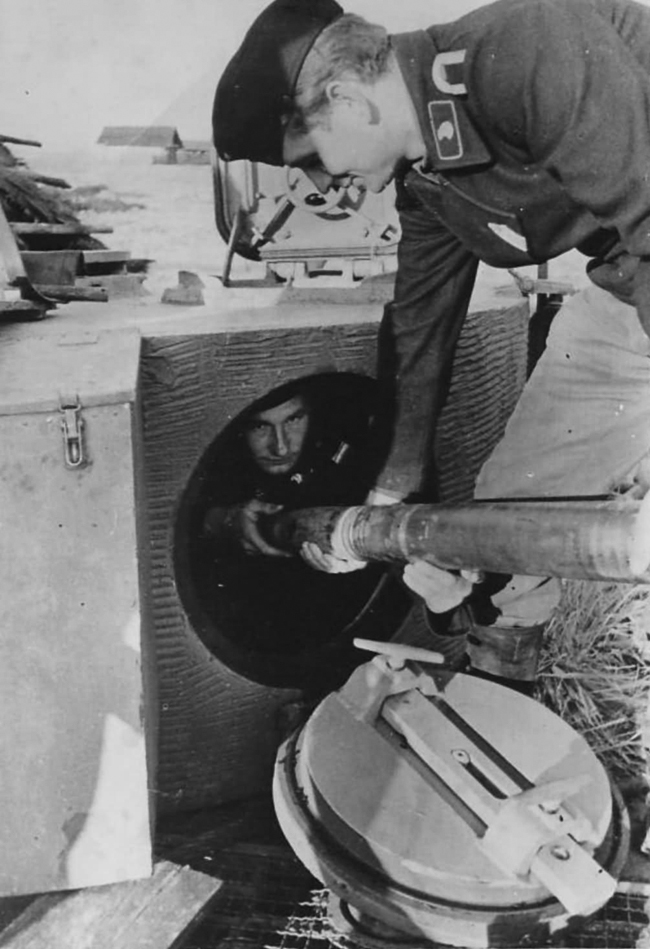
again a Tiger tank, with 88 mm ammunition being loaded aboard through the opening in the rear of the turret, source: Flickr.com, edited
At the beginning of our discussion of armour-piercing shells we noted that they defeat armour through kinetic energy. So let us take a moment to look at just how much energy was actually involved. To make it worthwhile, let us pick something suitably impressive: the Panzergranate 39/43 in 88 mm calibre, designed for the gun of the Königstiger. This projectile weighed 10.2 kg and left the muzzle at 1,000 m/s — at that moment it carried 5,100,000 joules of kinetic energy. If that figure does not mean much to you, consider that a 9 mm pistol bullet carries around 500 joules. That comparison should give you a rough idea of the scale.
The Armour-Piercing Panzergranate 40
As noted above, the kinetic energy of an armour-piercing shell grows primarily with its velocity. For this reason, weapons designers around the world — including in Germany — had been searching before World War II for ways to give a projectile the highest possible speed. This effort soon ran into a practically insurmountable barrier: it turned out that when a shell strikes armour at 800 m/s or more, it shatters regardless of the quality of steel from which it is made. For these impact velocities some entirely different and far harder material was needed. Tungsten carbide proved to be the answer — it is more than twice as hard as hardened steel.
A suitable material had been found, but it came with two serious drawbacks. The first was cost. Tungsten is a relatively rare element and its extraction is expensive — expensive enough that the Germans found it worthwhile to send ships all the way to Japan to obtain it. The second drawback was its density. If designers had simply taken a standard Panzergranate 39 and replaced the steel shell body with one made of tungsten carbide, the cost would have been ruinous, and the shell would also have been roughly twice as heavy, meaning it could not be fired at sufficient velocity for the hardness of the material to make any difference. This led to a new projectile design: the composite rigid shot, or in German, Hartkernprojektil — a shell with a hard core.
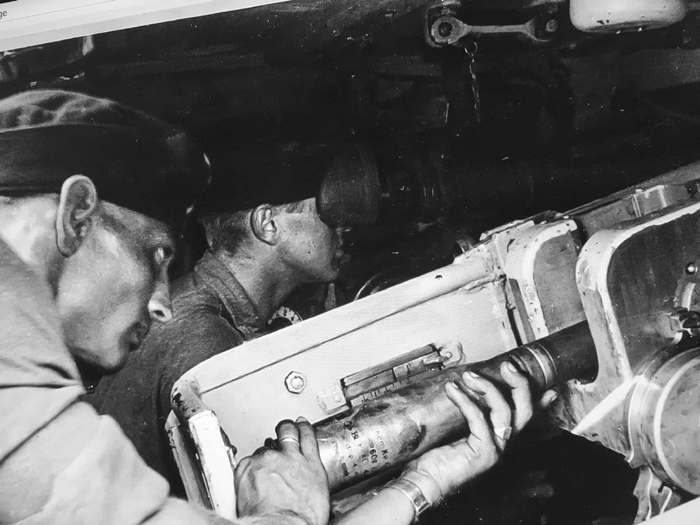
the loader of a Panzer III inserting a 50 mm round into the gun's breech, source: Flickr.com, edited
The key idea was that the super-hard, super-dense tungsten carbide was used only for a smaller-diameter core, not for the entire shell. This core was then encased in a softer material that gave the projectile its overall shape and, crucially, a diameter matching the calibre of the gun. The new type of ammunition was designated Panzergranate 40 and was produced in calibres from 20 mm up to 88 mm. How large was the penetrating core in each calibre? In the 2 cm Panzergranate Patrone 40, the core had a diameter of 12 mm — 60% of the projectile's total diameter — but accounted for 92% of its total weight. The soft casing around this core was made from an aluminium-copper-magnesium alloy (what we would today recognise as duralumin). The core inside the 5 cm Panzergranate Patrone 40 measured 21 mm in diameter — 42.3% of the overall diameter — and the soft casing was made from steel at the rear and bakelite (synthetic resin) with a metal-plated tip at the front. The 7.5 cm Panzergranate Patrone 40 concealed a core of 28 mm diameter, representing 37.3% of the total diameter, with the casing again partly steel and partly bakelite and a hollow sheet-metal nose. Finally, the 8.8 cm Panzergranate Patrone 40 had a core of 35 mm diameter (39.8% of the total) with the same steel-and-bakelite casing arrangement and a hollow nose.
The purpose of the soft outer casing was not merely to bring the projectile up to the correct calibre. It also absorbed the initial shock of impact with the enemy armour. The soft casing distributed part of the energy sideways upon impact, clearing the way for the hard core, which then punched through the plate. The casing separated from the core in the process and fell away, so that only the core itself entered the interior of the enemy tank. Unlike the Panzergranate 39, the Panzergranate 40 carried no bursting charge, so inside the enemy vehicle it caused destruction purely through brute force — whether by directly hitting crew members or stored ammunition, by spraying spall from the inner surface of the armour, or through the intense heat generated by the energy released during penetration.
Because of its composite construction, the Panzergranate 40 was significantly lighter than the all-steel Panzergranate 39. With a similar propellant charge in the cartridge case, it therefore left the gun barrel at a considerably higher velocity. To illustrate the difference, consider the two types of ammunition for the 7.5 cm KwK 40 L/48 gun used in later versions of the Panzer IV. The steel 7.5 cm Panzergranate Patrone 39 weighed 6.8 kg and achieved a muzzle velocity of 750 m/s from that gun. The tungsten 7.5 cm Panzergranate Patrone 40, by contrast, weighed only 4.1 kg and left the same barrel at 930 m/s.
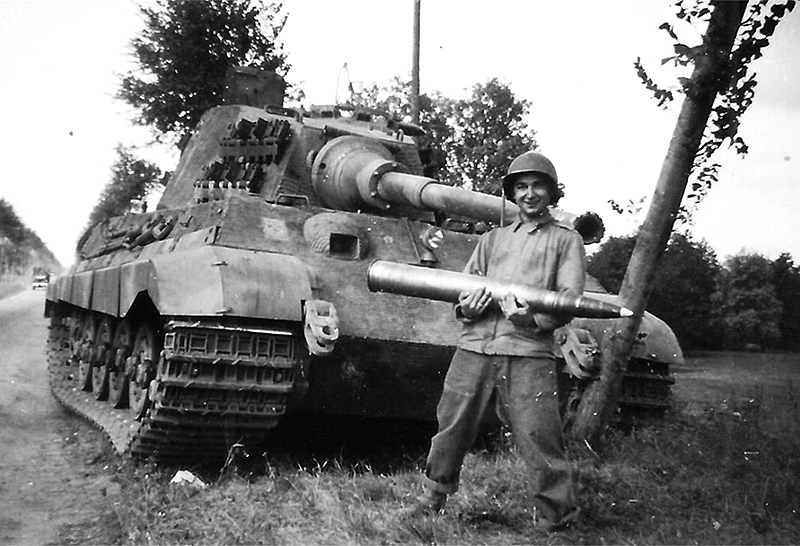
an American soldier poses in amusement with an enormous 88 mm round for a Königstiger tank gun, source: Flickr.com, Public Domain, edited
The lower weight of the Panzergranate 40 compared with the Panzergranate 39 produced one interesting paradox. If you plug the figures given above into the formula for kinetic energy, you will find that the muzzle energy of the tungsten 7.5 cm Panzergranate Patrone 40 was actually about 7.3% lower than that of the standard 7.5 cm Panzergranate Patrone 39. Yet the Panzergranate 40 could penetrate thicker armour: when fired from the KwK 40 L/48 at a range of 1,000 metres, the Panzergranate 39 defeated 85 mm of armour, while the Panzergranate 40 went through 97 mm — 14% more. How is that possible?
The answer lies in what is called the sectional density of the projectile. This parameter describes how effectively a projectile can penetrate a medium and is calculated as the mass of the shell divided by the square of its diameter. Once the Panzergranate 40 strikes its target and the soft outer casing falls away, all that remains is the hard core itself — very heavy for its size, with a relatively small diameter. The sectional density of the bare core is therefore very high, and its ability to push through a medium — in this case, armour plate — is correspondingly impressive.
On the other hand, what is an advantage for the Panzergranate 40 at the moment of impact is a curse during flight. While the complete projectile is in the air — soft casing and all — it has relatively little weight for its diameter. This means its sectional density is actually lower than that of the steel Panzergranate 39, and its ability to push through a medium — in this case, air — is correspondingly poor. In plain terms: the Panzergranate 40 bleeds off velocity far more rapidly in flight than the Panzergranate 39, because it is worse at overcoming air resistance. The result is that the Panzergranate 40 delivers excellent performance at shorter ranges, but is unsuitable for firing at 1,500 metres and beyond, as it simply runs out of speed — and with it, accuracy and effectiveness.
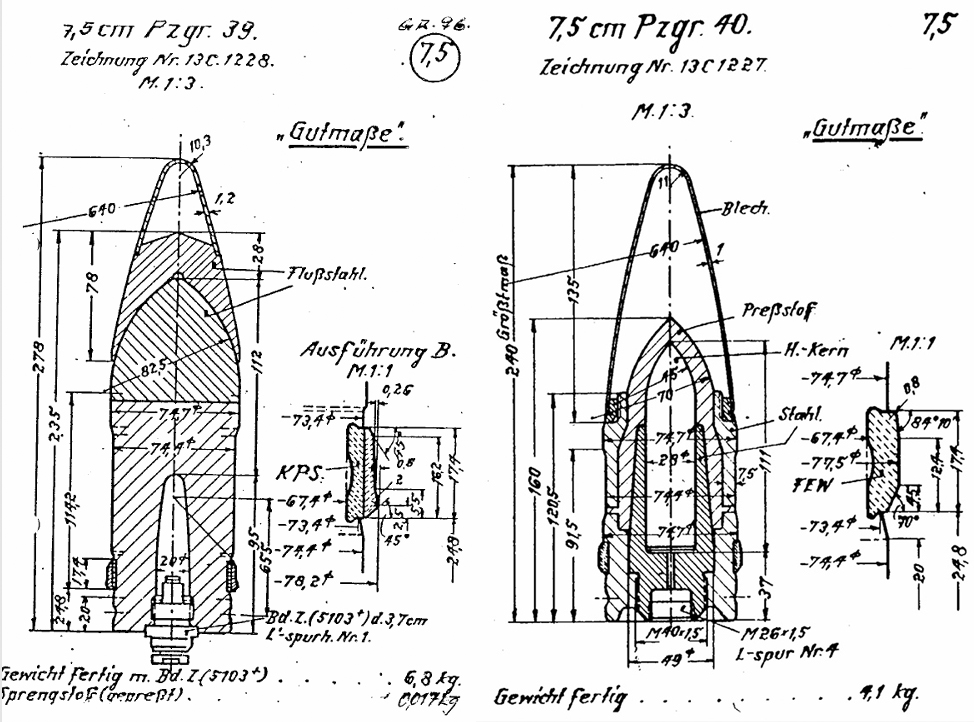
a comparison of the internal construction of the Panzergranate 39 and Panzergranate 40, source: Geschossringbuch Band I, Juli 1939, public domain, edited (click on the image for full size)
Although the tungsten carbide core itself was smaller in diameter than the gun's calibre, the Panzergranate 40 cannot be classified as a sub-calibre projectile, because the soft casing remained firmly attached to the core throughout flight and separated only upon impact with the target. In modern international terminology it was therefore an APCR (Armour-Piercing Composite Rigid) round. This type of projectile is now considered obsolete — modern tanks use APFSDS (armour-piercing fin-stabilised discarding sabot) ammunition, where the sabot separates in flight. Interestingly, Germany was also developing discarding-sabot projectiles towards the end of World War II, though these were spin-stabilised by rifling rather than fin-stabilised. A 1953 US Army report on German artillery ammunition lists eleven different experimental discarding-sabot designs that were captured at the artillery proving ground at Hillersleben at the end of the war.
As already noted, tungsten was in critically short supply for Germany, and the situation only worsened as the war continued — a state of affairs to which Czech airmen serving in the RAF also contributed, when in December 1943 they sank the freighter Alsterufer, which was carrying 300 tonnes of tungsten to Germany, representing roughly a full year's consumption for the German war industry. As in other fields, the Germans were forced to improvise. The result was a round in which the tungsten carbide core was replaced by a steel one. This type of ammunition was designated Panzergranate 40/1, or alternatively Panzergranate 40 (W), where the W stood for Weichkern (soft core). Even in this materially compromised form, at shorter ranges the projectile was still more effective than the standard Panzergranate 39, thanks to the sectional density advantage of its core. From 1942 onwards, the full tungsten Panzergranate 40 became an increasingly rare commodity, and tank crews treated these rounds with great care, saving them for encounters with the most heavily armoured Soviet vehicles.
In the literature, or in computer games, you may also come across armour-piercing ammunition designated as Panzergranate 41. We will not cover it here, because it was not intended for German tanks. It was a specialised type of projectile developed for guns with a tapered bore, which caused the round to deform — that is, reduce in diameter — as it passed through the barrel.
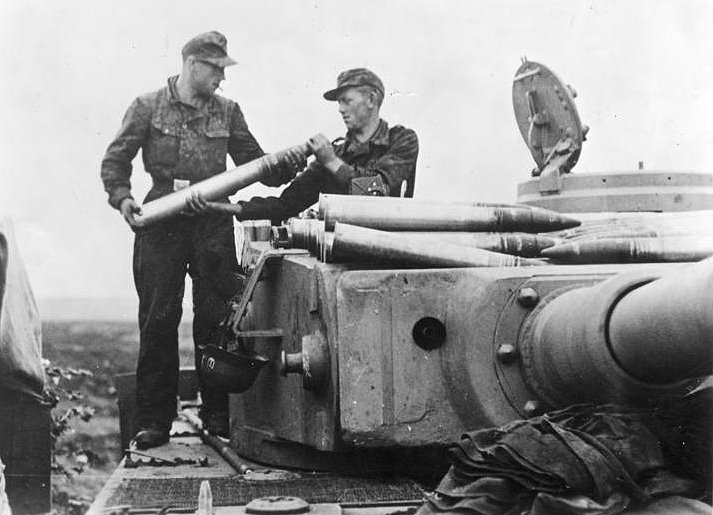
a Tiger tank loading 88 mm ammunition during the Battle of Kursk in the summer of 1943, source: Bundesarchiv Bild 183-J14931, Wikimedia, Creative Commons, edited
The Shaped-Charge Hohlladung Granate
We have described the German kinetic armour-piercing shells — those that defeat armour through momentum. But German tankers also had access to shaped-charge anti-tank shells, known in German as Hohlladung Granate, which work on an entirely different principle. This type of ammunition exploits what is known as the Munroe effect to concentrate a large proportion of the explosive energy into a narrow jet, using a specially shaped charge. The shell is filled with explosive, and in the forward part of this filling a cavity is formed in the shape of a dimple or funnel. The walls of this cavity are lined with a layer of metal — copper or steel — which forms what is called the shaped-charge liner.
The charge must be initiated from the rear end of the shell so that the detonation wave travels towards the nose. When the wave reaches the cavity at the front, it collapses and melts the shaped-charge liner, which is then formed into what is called the shaped-charge jet. This jet moves forward at enormous velocity in the direction of the detonation, and is capable of burning through armour plate — but only over a distance of a few tens of centimetres, after which it very rapidly loses its energy. Since the jet forms inside the shell itself, its effectiveness is entirely independent of the velocity at which the shell strikes the target. This is the fundamental difference compared with kinetic penetrators, for which impact velocity is critical. Indeed, an excessively high impact velocity is actually undesirable for a shaped-charge round, because the process that initiates inside the shell after it hits the target — detonating the charge and forming the jet — requires a certain amount of time to unfold. For this reason, shaped-charge rounds were loaded with a considerably smaller propellant charge and the projectile left the barrel much more slowly than kinetic rounds. Unfortunately, this lower velocity also made shaped-charge shells less accurate at longer ranges — say, beyond 1 km.
Designing a shaped-charge shell requires ensuring that the main charge is initiated from the rear — not from the nose but from the base. Yet the trigger must still come from a nose fuze at the tip of the shell, which fires on impact. This fuze does not directly initiate the main charge, however. Instead, the flash from the nose fuze travels down a hollow aluminium tube that runs through the main charge to a booster at the base of the shell. This booster then initiates the main charge from the correct end — that is, from the opposite end to the cavity with the shaped-charge liner. Because the shaped-charge jet requires a certain distance in which to form, there was also a fairly long hollow cavity ahead of the main charge at the tip of the shell.
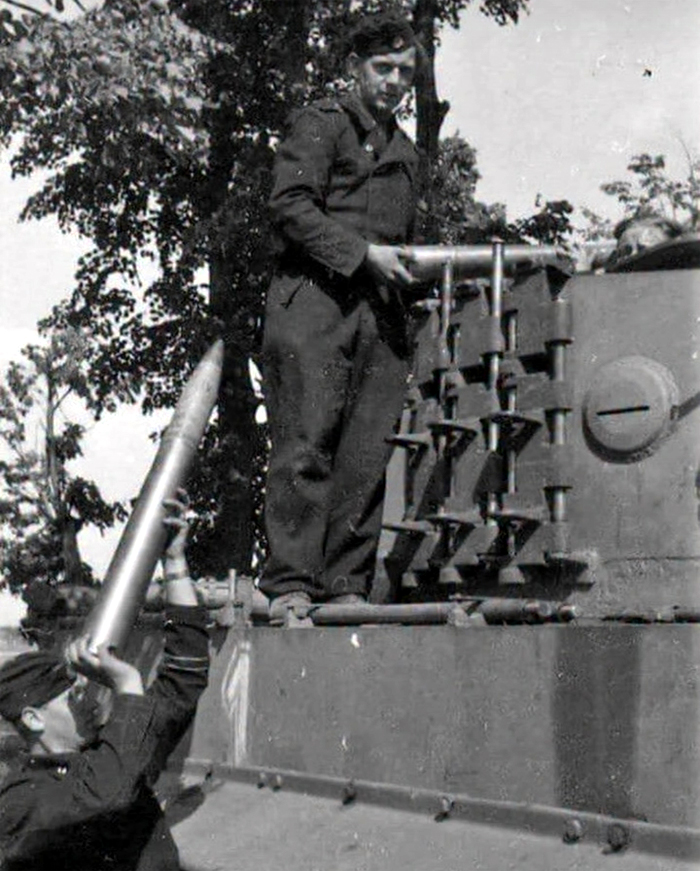
loading ammunition into a heavy Tiger tank was evidently a favourite subject for German photographers, source: Flickr.com, edited
For shaped-charge shells, there is a direct relationship between the diameter of the charge and the effectiveness of the jet — that is, the thickness of armour the jet can burn through. It therefore made little sense to produce this type of ammunition in small calibres. Shaped-charge shells were accordingly only available for the Panzer IV (75 mm), the Tiger (88 mm) and the Königstiger (88 mm) — and of course also for other vehicles such as the Stug III, Nashorn, Jagdpanther and Ferdinand.
The first shaped-charge round to enter German tank service was the 7.5 cm Gr.38 Hl, introduced in 1940 for the short-barrelled KwK 37 L/24 gun of the Panzer IV. Improved generations followed over the next few years — the 7.5 cm Gr.38 Hl/B and 7.5 cm Gr.38 Hl/C — and the original variant was retrospectively redesignated 7.5 cm Gr.38 Hl/A to distinguish it from its successors (though some sources describe the sequence differently). The velocity of the shaped-charge jet in these rounds ranged between 4,000 and 6,000 m/s, and the armour penetration was 70 mm for the Hl/A, 75 mm for the Hl/B, and 90 or 100 mm for the Hl/C (depending on which source you trust). For the crews of the early Panzer IV variants armed with the short 7.5 cm KwK 37 L/24, this type of ammunition was a genuine godsend. That gun was not designed for destroying enemy armour, and its performance with standard Panzergranate 39 kinetic rounds reflected that fact. After the invasion of the Soviet Union, however, Panzer IVs found themselves forced into tank-on-tank engagements, and shaped-charge ammunition often represented their only realistic chance of success in such encounters.
Detailed statistics from the 9th Panzer Division fighting on the Eastern Front clearly show how, from the start of Operation Barbarossa, shaped-charge ammunition progressively accounted for a growing share of total rounds fired by Panzer IVs with the KwK 37 L/24, eventually becoming the most commonly used type. Somewhat surprisingly, much the same was true of the later Panzer IV variants equipped with the KwK 40 L/48 gun. Here too, shaped-charge rounds dominated the ammunition consumption statistics. Of all the rounds fired by Panzer IVs with the KwK 40 L/48 in the 9th Panzerdivision between January 1942 and October 1943, a remarkable 42% were shaped-charge shells. A further 39% were high-explosive Sprenggranate, 18% were Panzergranate 39 kinetic rounds, and just 1% were Panzergranate 40.
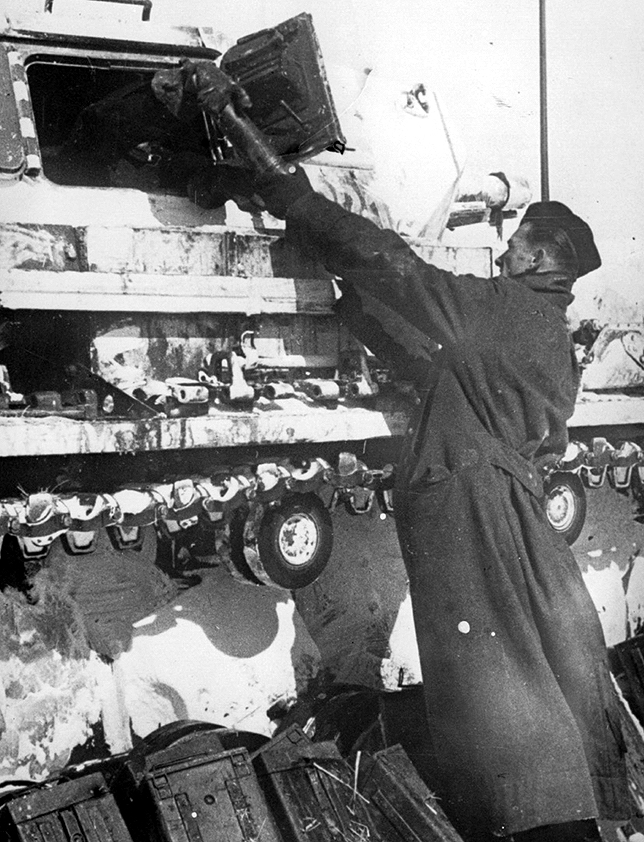
a Panzer IV replenishing ammunition for its 75 mm gun, source: Flickr.com, edited
The shaped-charge shell for the Tiger's gun was designated 8.8 cm Gr.39 Hl, while the one for the Königstiger was the 8.8 cm Gr.39/43 Hl. Both types were rated to penetrate 90 mm of armour. Among the crews of these later heavy tanks, however, shaped-charge ammunition enjoyed no particular popularity. The guns of both vehicles offered comparable (Tiger) or even superior (Königstiger) performance with standard kinetic rounds, which were at the same time easier to aim accurately at longer ranges thanks to their higher velocity and consequently flatter trajectory.
The Smoke Shell: Nebel Granate
At the start of this article we promised a brief mention of smoke shells. These were by no means available for all German tank guns — only, it appears, for the KwK 37 and KwK 40 in 75 mm calibre, as used in the Panzer IV (and also in the assault gun Stug III). The purpose of a smoke shell (Nebel Granate) is to create an opaque screen that denies the enemy observation of the battlefield, or at least makes it considerably more difficult. To achieve this effect, the gunner was supposed to land the smoke shell roughly 100 metres in front of the enemy's position. The full designation of the 75 mm tank smoke shell was 7.5 cm Nebelgranate Patrone KwK. The projectile weighed approximately 6.2 kg and contained a porous pumice stone saturated with so-called oleum (a mixture of chlorosulfuric acid and sulfur trioxide). Running through the centre of the shell was a tube containing 56 grams of explosive (in this case picric acid), whose detonation was intended to scatter the pumice and its smoke-generating substance into the surrounding area. Once the oleum came into contact with air, it produced a dense white smoke cloud that also irritated the eyes and respiratory tract.
Cartridge Cases
As noted earlier, German tank ammunition was of the fixed type, so it is worth also saying something about the cartridge cases that formed a single unit with the shells. In German tank ammunition, cartridge cases were made from either brass or steel. Each specific case type had its own four-digit identification number, and if the case was steel, the letters St. (Stahl = steel) were added to that number. For example, the cartridge cases for the short-barrelled 7.5 cm KwK 37 of the Panzer IV bore the type number 6354 for the brass version and 6354 St. for the steel version.
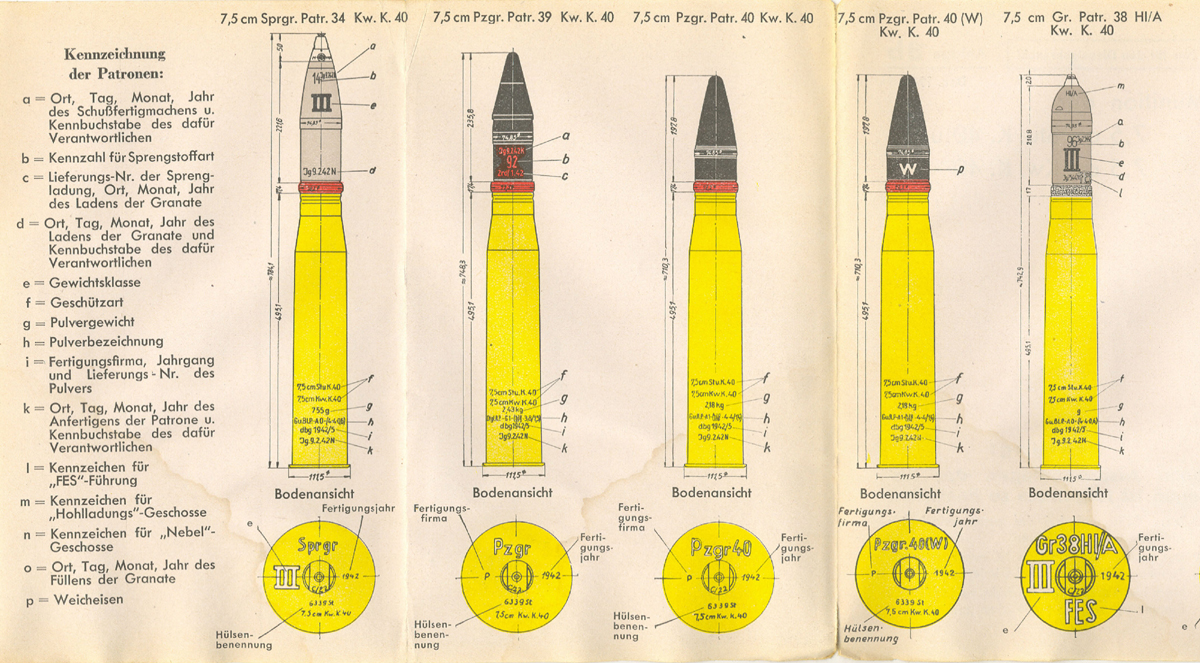
types and markings of 75 mm rounds for the KwK 40 gun of the Panzer IV, as described directly in a German technical manual, source: Flickr.com, edited (click on the image for full size)
Inside the cartridge case, the propellant charge was stored in a textile bag (Kartuschbeutel). When ignited, this charge propelled the shell out of the barrel. The Germans used various types of nitrocellulose-based smokeless powder as propellant in their artillery rounds — either pure nitrocellulose, or mixtures with nitroglycerin, nitroguanidine (known as Gudol), or diethylene glycol. Nitroglycerin-based powder was reportedly the most energetic of these mixtures, but also burned at the highest temperature, resulting in greater wear on the gun barrel. Gudol powder, on the other hand, burned at the lowest temperature and produced virtually no muzzle flash — but it generated the most smoke, which was obviously far from ideal.
The burning behaviour of a propellant is influenced not only by its chemical composition but also by the shape of its grains. German artillery rounds used both granular and tubular powder. The grains of granular powder were shaped into small flakes, perforated discs (like a washer) or strips. In later types of tank ammunition with long cartridge cases, however, tubular powder predominated — powder pressed into long hollow tubes, much like macaroni. These tubes were bundled together inside the cartridge case (and the textile bag) with string, forming a kind of sheaf. The propellant was ignited by what is called a primer, sometimes also referred to as a base fuze. German artillery rounds generally used both percussion primers (fired mechanically by the striker) and electric primers (fired by an electrical impulse). For tank guns, however, the Germans consistently used electric firing, meaning tank ammunition was typically fitted with an electric primer of the C/22 type.
Like the shells themselves, the cartridge cases carried a range of markings conveying various types of information. First among these was the type — or often multiple types — of weapon for which the round was intended. For rounds designed for one or two specific guns this was straightforward, but some cases bore quite a long list of compatible weapons. The 88 mm Sprenggranate Patrone 43 cartridge case, for example, listed five other weapon types in addition to the 8.8 cm KwK 43 tank gun.
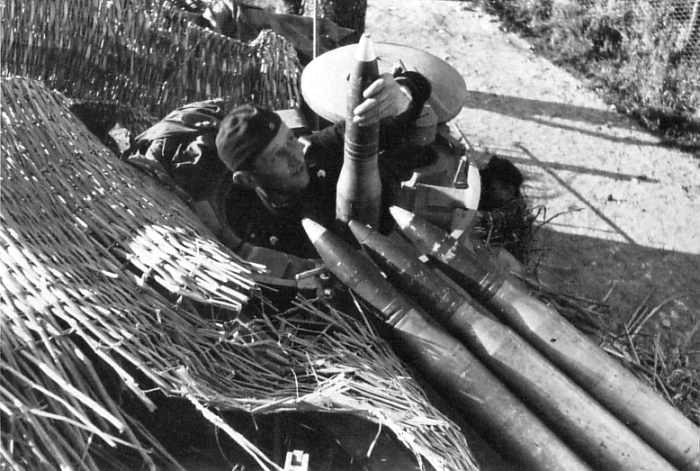
a Panther tank crew loading 75 mm ammunition through the commander's cupola hatch, source: Flickr.com, edited
Another important piece of information on the cartridge case was the weight of the propellant charge in grams or kilograms, its composition and the form (shape of the grains). The differences in propellant weight between different rounds were truly enormous. The 75 mm Panzergranate Patrone for the short-barrelled KwK 37 of the Panzer IV, for instance, used a propellant charge of just 370 g, whereas the equivalent round in the same calibre for the later Panzer IV versions with the KwK 40 gun required 2.43 kg. There was also a striking difference between high-explosive and anti-tank rounds intended for one and the same gun. An armour-piercing shell needs the highest possible velocity to have enough energy to defeat armour. As mentioned just a few lines above, the anti-tank round for the 7.5 cm KwK 40 of the late-model Panzer IV had a propellant charge weighing 2.43 kg. Yet the high-explosive round for exactly the same gun managed with only 755 g of propellant.
The composition of the propellant charge was indicated on the cartridge case by abbreviations: pure nitrocellulose = Nz., nitrocellulose + diethylene glycol = Digl., nitrocellulose + Gudol = Gu., nitrocellulose + nitroglycerin = Ngl. The grain shape was also abbreviated: flakes = Bl.P., discs = Rg.P., tubes = R.P., strips = Str.P. These shape codes were followed by the dimensions of the individual grains — so, for example, the full code Gu. Bl.P. (4, 4, 0.6) indicated a Gudol-nitrocellulose mixture in flake form with dimensions of 4 × 4 × 0.6 mm. The cartridge case also showed the place and date of manufacture of the propellant charge and the manufacturer's code, as well as the place and date of the case filling.
If the ammunition was intended for use in tropical conditions, the cartridge case carried the red letters Tp (Tropisch). For standard ammunition used in European climates, the required ballistic performance was calculated at a reference temperature of 10°C, and the weight of the propellant charge was derived accordingly. For "tropical" ammunition, intended primarily for units fighting in North Africa, the reference temperature was 25°C. Higher temperatures accelerate the rate of the chemical reaction in the propellant — it burns faster, pressure in the chamber rises more quickly, and the projectile achieves a higher muzzle velocity. Rounds for tropical conditions were therefore given a slightly smaller propellant charge to prevent the guns from being overstressed by the extra power generated in the African heat.
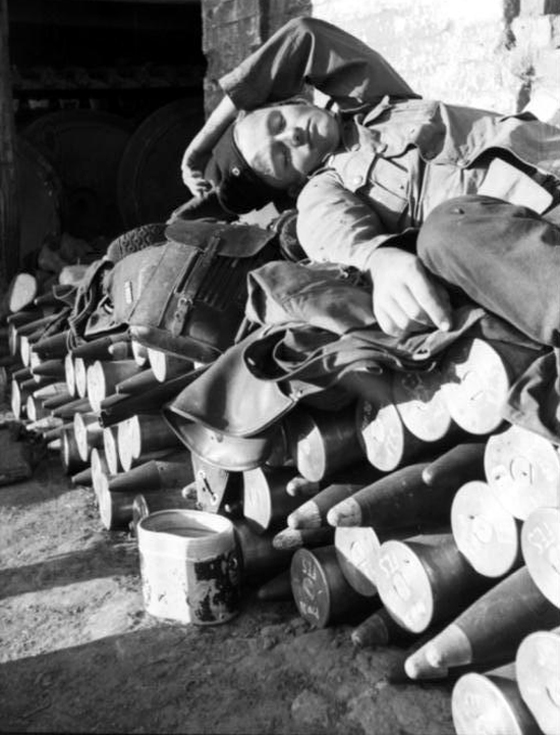
the bed may be hard, but exhaustion wins out — a young tanker rests on a pile of ammunition, source: Flickr.com, edited
Finally, let us explain the letters oBD that appeared on some cartridge cases. This was an abbreviation for ohne Bleidrath — without lead wire. When a shell was fitted with copper driving bands, firing would gradually foul the barrel with copper deposits. To counter this, a 12-gram lead wire was inserted into the cartridge case of such rounds. The lead vapourised during firing and, as it passed through the barrel, acted as a chemical agent that removed the copper residue. If the shell had steel rather than copper driving bands, this measure was unnecessary and no lead wire was fitted — and such cases were marked oBD accordingly. Some of the markings described above were repeated on the base of the cartridge case, so that soldiers could immediately identify a round as they pulled it from its storage box.
If you are curious about typical tank ammunition consumption figures, we can unfortunately offer only a handful of numbers from the German campaign in Poland in 1939. According to data on the website panzerworld.com (which we consider a reliable source), during 36 days of fighting against the Poles the Germans fired a total of 164,117 rounds of 37 mm ammunition for the Panzer III and 137,146 rounds of 75 mm ammunition for the Panzer IV. Only 87 Panzer IIIs were deployed in Poland, giving a figure of 1,886 rounds per tank — nearly enough to justify replacing the gun barrel — which works out to an average of 52 rounds fired per tank per day of the campaign. Approximately 200 Panzer IVs were deployed, yielding a consumption of 686 rounds per tank, or an average of 19 rounds per tank per day. The source does not give ammunition consumption figures for Panzer II tanks separately, only noting that a total of around 4 million rounds of 20 mm ammunition were expended (though this figure likely includes anti-aircraft guns as well). Consumption for the Panzer I is almost certainly folded into the overall rifle and machine-gun ammunition total, which came to approximately 398 million rounds for the Polish campaign.
ARTICLE
CONTENTS:
Reproducing text from the Panzernet website without the written consent of the operator is prohibited.