TANK KV-1
Germany's nightmare of '41
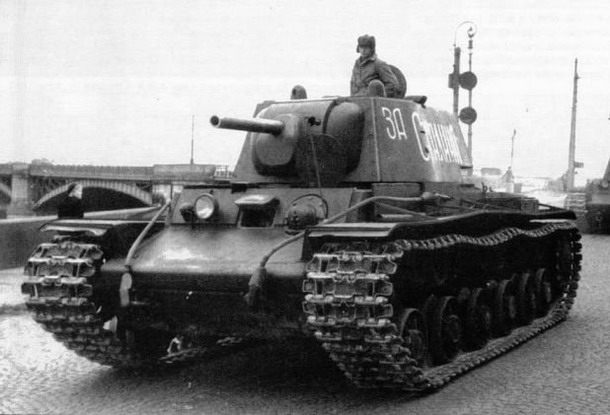
KV-1 tank, source: Topwar.ru with permission of the operator, modified
Origins of the Tank
It is something of a paradox that the famous heavy tank KV came into being as an unintended by-product of the development of two other, far less celebrated, vehicles. It all began in 1938, when Soviet designers were working on a new machine intended to replace the outdated and not particularly successful T-35 tank. The concept that emerged called for multiple armaments distributed across three turrets. When a model of the three-turreted machine was shown to Stalin, he began removing turrets and asking the designers present what each removal would mean. He was told that it would reduce the vehicle's weight but also its firepower. The new tank project was accordingly approved in a two-turreted form, and in 1939 two competing teams began work on prototypes designated SMK and T-100.
A young designer, Zh. Ya. Kotin, who was working on the SMK, seized on Stalin's idea of reducing the number of turrets and began pushing for the development of a third variant — one with a single turret. Kotin recognised that multi-turreted tanks were a dead end: their only real advantage, the multiple gun armament, was more than outweighed by drawbacks such as excessive weight, mechanical complexity and high production costs. Stalin approved the single-turreted variant, and on 27 February 1939 the decision was formalised by official Order No. 45ss. Kotin now had a clear path — in theory. However, to compete with the rival SMK and T-100, his single-turreted vehicle still had to meet the specification and carry two guns. The only solution, of course, was to mount both weapons in the single turret.
First Prototype
At the S. M. Kirov Plant in Leningrad, development of the SMK and its single-turreted rival — which received the designation KV, standing for the initials of the powerful Soviet marshal Kliment Voroshilov — proceeded in parallel. N. L. Dukhtsov was appointed chief designer of the KV. Development of the vehicle proceeded at a genuinely record pace. Design work began on 1 February 1939 (even before official approval), the technical design and a mock-up were completed by 7 April, and by 1 September the first prototype had been assembled and factory trials had begun.

KV tank prototype still armed with two guns, source: Aviarmor.net with permission of the operator, modified
Technical Description
The prototype — and the later production tanks derived from it — had a suspension consisting of six road wheels on each side. The wheels were twin, all-metal, and featured indentations and small circular lightening holes. The road wheels were evenly spaced and each was independently suspended and sprung by a swing arm connected to a torsion bar. At the front of the running gear was a spoked idler wheel, and at the rear a large toothed drive sprocket. Three evenly spaced return rollers supported the track from above. Track width was 70 cm.
The hull, whose individual sections were joined primarily by welding, sat on the running gear. The nose of the hull was formed by two plates meeting at a sharp angle (87°). The lower plate was 75 mm thick and angled at 30° from vertical. The upper plate was 40 mm thick and set at 63°. Two heavy towing eyes were fitted to the lower plate. The upper plate carried the mounting for the radio aerial rod. From the upper nose plate rose the frontal wall of the driver's compartment, angled at 30° with 75 mm of armour. In the centre of this plate was the driver's rectangular vision port, which could be closed by a shutter in dangerous conditions, leaving only a narrow slit for forward observation. A headlamp was installed to the right of the port. The prototype did not yet have a hull machine gun; this was only introduced on the production tanks. On production tanks, add-on armour up to 35 mm thick was also quite frequently welded directly onto the driver's frontal plate.
In the left section of the driver's compartment roof was a circular driver's hatch, closed by a single-piece lid. The compartment roof — ahead of the turret and for a short distance behind it — was 40 mm thick. Above the engine compartment it was "only" 30 mm. The floor armour followed a similar pattern: the front half was 40 mm thick, thinning to 30 mm under the engine compartment. It is worth noting that the most modern German tank of the time, the PzKpfw IV Ausf. D, produced from September 1939 onwards, had frontal hull armour of the same thickness as the engine compartment floor of the Soviet KV-1 — 30 mm. The exposure of these two surfaces to enemy fire is, of course, incomparable.
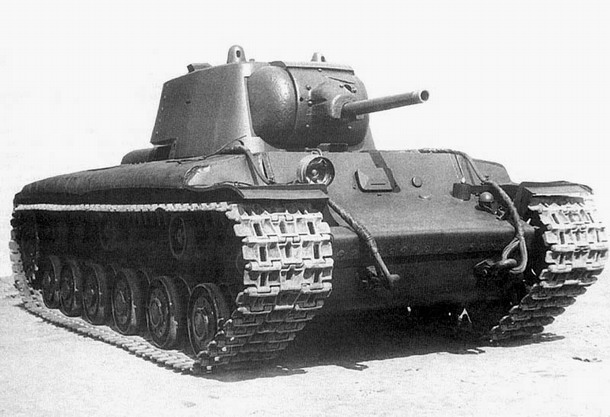
early-production KV-1 with L-11 gun — note the simple ball mount aperture instead of an integrated hull machine gun, source: Aviarmor.net with permission of the operator, modified
The turret was mounted in the front half of the hull on its centreline. It was both welded and riveted, with a hexagonal floor plan and a rounded rear. The first production turrets also had a rounded rear; later production turrets had a squared-off rear instead. From 1941, more resilient cast turrets began to be fitted.
From the frontal wall of the turret protruded a semi-circular gun mantlet — or rather a twin-gun mantlet on the prototype — 90 mm thick. The full frontal wall of the turret was 75 mm thick. The side and rear walls were the same thickness. The roof plate was 40 mm. These figures applied to both the prototype and the early production tanks. On the prototype, two guns were installed in the turret: a more powerful 76.2 mm gun on the left and a lighter 45 mm gun on the right. Production tanks were armed with a single gun of 76.2 mm calibre. The specific type changed during the production run; the first production vehicles were fitted with the L-11.
Two periscopic gun sights protruded from the turret roof like a pair of horns, with the ventilator outlet between them; further to the rear was a central circular crew hatch closed by a single-piece lid. Production tanks also had a set of four fixed observation periscopes on the turret — one facing each side and two facing rearward. The prototype was probably not yet fitted with these. The side walls of the turret had slit vision ports and, below them, small circular pistol ports for firing personal weapons. In the centre of the rear turret wall was a DT machine gun of 7.62 mm calibre, used to drive off infantry attacking the tank from behind.
At the rear of the tank was the engine compartment. Immediately behind the turret was a service access opening, flanked by two smaller longitudinal air intake grilles. Behind these grilles, two exhausts emerged through the roof plate. Further rearward were two circular access covers for servicing the transmission. The tank's powerplant was a twelve-cylinder diesel V-2, producing a maximum of 600 horsepower at 2,000 rpm. The prototype, however, was fitted with a weaker version of this engine rated at 500 hp. The gearbox provided five forward speeds and one reverse.
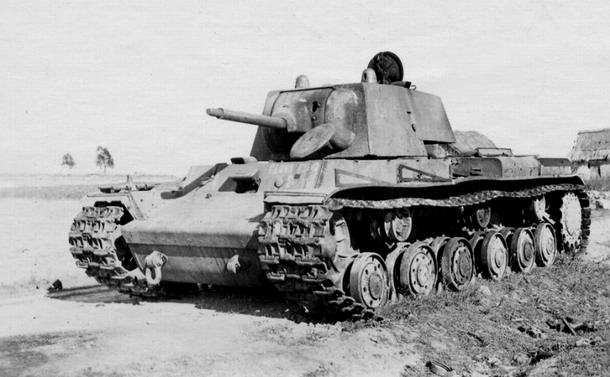
destroyed KV-1 with L-11 gun, source: Waralbum.ru with permission of the operator, modified
The rear of the tank itself was formed by two rounded sections. Behind the upper rounded section — armoured to 60 mm — was a further ventilation grille. The lower rounded section carried two towing eyes and had a full 75 mm of armour. The upper rounded section was later replaced by a flat angled plate. The crew consisted of five men. The driver and radio operator sat side by side in the front of the hull; the radio operator was also responsible for operating the hull machine gun. The remaining three men were stationed in the turret: the gunner, the junior mechanic who operated the rear turret machine gun, and the tank commander, who also served as the gun loader.
During combat, if there was no need to fire the rear machine gun, the junior mechanic had to descend from the turret into the hull to avoid being struck by the gun's recoil. This made clear that while the junior mechanic spent most of a battle uselessly tucked away inside the hull, the commander had his hands full simultaneously directing the entire crew and loading the gun. This unfortunate division of roles was not corrected until the modernised KV-1S appeared in 1942.
After the factory trials of the prototype, the identified shortcomings were addressed, and on 5 September 1939 the vehicle was loaded onto a railway wagon and dispatched to Moscow. On 23 September it was demonstrated to senior army officials alongside the rival SMK and T-100 prototypes. Although around twenty different faults were found in the KV during comparative testing, it performed better than any of the other prototypes. No final verdict was passed on any of them at this stage; instead, modifications were specified for all three and the prototypes were sent back to their parent factories for the work to be carried out. The KV returned to the Leningrad plant on 8 October 1939 and the designers and workers set to work immediately.
The Winter War
After the recommended modifications had been made, the tank underwent another round of factory trials — which were interrupted on 30 November by the outbreak of war with Finland. Shortly thereafter came the decision to send all three prototypes into actual combat. This was by no means a consequence of a shortage of other fighting vehicles, as the Soviets held an approximately 200-to-1 numerical advantage over the Finns in tanks. The Winter War battlefield was simply to serve as a uniquely realistic, live-fire testing ground.

KV-1 with F-32 or F-34 gun, captured and pressed into service by the German 8th Panzer Division, source: Waralbum.ru with permission of the operator, modified
Before being sent to the front, the weaker of the two guns was removed from the KV prototype, as testing had shown that two guns were more hindrance than help and complicated the crew's work inside the turret. On 13 December the tank was therefore dispatched to Finland armed with a single 76.2 mm gun and a coaxial DT machine gun of 7.62 mm calibre. Together with the other two test prototypes, the SMK and T-100, the KV formed a heavy tank test company under the 91st Tank Battalion, which was part of the 20th Heavy Tank Brigade normally equipped with T-28 tanks. The KV's crew consisted of three men from the Leningrad factory and two officers from the 20th Heavy Tank Brigade. A special commission was present to observe how the tank performed in combat conditions.
On 18 December 1939 the KV went into action for the first time, advancing alongside the SMK, T-100 and a single T-28 near Lake Summajärvi. The tank passed through Finnish anti-tank fire without difficulty and penetrated as far as the enemy fortifications — which its armament proved unable to destroy — before having to withdraw. The following day an inspection revealed results that impressed the members of the commission: the armour, gun and tracks bore a total of nine hits from Finnish shells, not one of which had penetrated the vehicle. The most serious damage was a hit on the gun barrel, which had to be replaced before the tank could fight on.
Impressed by the prototype's combat performance, the Chairman of the Council of People's Commissars (the equivalent of Prime Minister) Vyacheslav Molotov signed Order No. 443ss on 19 December 1939, officially accepting the KV into Red Army service. An order was placed at the same time for an initial production run of fifty vehicles. On 2 January 1940 the prototype was sent back to the factory along with a list of minor faults and imperfections identified during combat use, to be rectified before series production began.
One of the requested improvements was the addition of a hull machine gun. The first production tanks were completed before an integrated machine gun could be incorporated, so an opening was cut into the left side of the frontal hull plate for firing from inside the tank. Later production tanks did receive a proper machine gun, installed in that same position in the driver's frontal plate and operated by the radio operator.
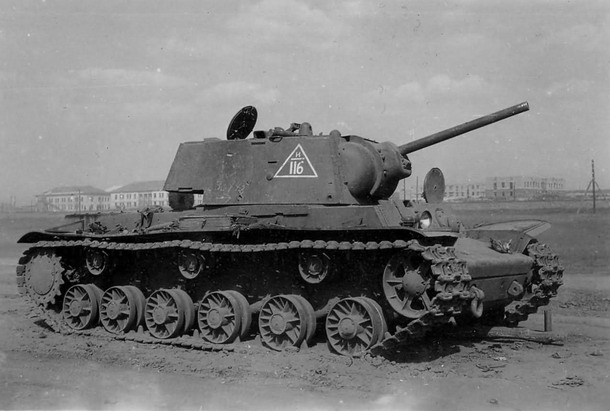
destroyed KV-1 with ZIS-5 gun, source: Worldwarphotos.info with permission of the operator, modified
Another suggested improvement came out of experience with Finnish fortifications. The 76.2 mm gun simply was not powerful enough to demolish them, so a proposal was made to build an experimental variant armed with a much heavier weapon capable of destroying reinforced concrete emplacements. This proposal resulted in the KV-2, armed with a 152 mm howitzer and described separately. During development it was not yet referred to as the KV-2 — it was simply called the KV with the large turret, or the KV with the MT-1 turret. The original KV was then logically called the KV with the small turret. The official KV-1 and KV-2 designations were not adopted until January 1941.
Development of the large-turreted KV proceeded so quickly that when production started at the Leningrad plant on 4 January 1940, both types were effectively being built in parallel. In January not a single vehicle was completed; in February, three were finished with the large turret and 152 mm howitzer (serial numbers U-0, U-1 and U-3) and one with the small turret and 76.2 mm gun. All four were immediately dispatched to the Finnish front. In March 1940 another vehicle followed — serial U-4 — again of the KV-2 type, though this one was not sent to Finland as the Winter War ended on 13 March.
After the fighting ended, all the KV tanks were sent back to the Soviet Union and on 19 March took part in a parade before the country's senior political and military leadership. The powerful tanks, some bearing the marks of deflected Finnish shells on their armour, made a strong impression, and their production was given higher priority. In May the original order was even increased from 50 to 230 vehicles to be delivered by the end of 1940 — 130 of the KV-1 type and the remaining 100 of the KV-2 type.
It was at this point that the designers realised the war with Finland had left no time for genuinely thorough testing of the new tanks — particularly driving trials. During June, intensive tests were therefore conducted in the Leningrad area and at the Kubinka proving ground, revealing a number of hidden defects and shortcomings, mainly in the suspension, engine, clutch and transmission. Production could not simply be halted during testing, so the necessary corrections had to be incorporated into the ongoing production run. As a result, the first KV production tanks were highly unreliable and the army returned many of them to the factory for repairs. By the end of 1940, 141 KV-1s and 102 KV-2s had been completed — of this combined total of 243, the army rejected 47 as defective.
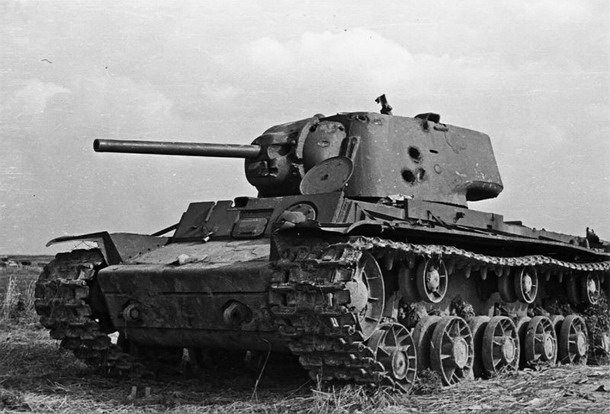
destroyed KV-1 with ZIS-5 gun and cast turret, source: Topwar.ru with permission of the operator, modified
The first production tanks were armed with the L-11 gun of 76.2 mm calibre. Their weight was 43 tonnes (sometimes quoted as 43.5 t) and their maximum speed 35 km/h. A 600-litre fuel supply allowed a range of around 250 km. Sources unfortunately disagree on whether these early tanks were designated Model 1939 or Model 1940; there is similarly conflicting information about the designations of subsequent variants and the differences between them. What is clear, however, is the sequence of changes that took place during production: principally upgrades to the armament and a gradual increase in armour thickness and weight.
In November 1940, more modern guns began to be fitted. The original L-11 was replaced by the F-32, of the same calibre. However, there were not enough F-32 guns to keep pace with tank production, so F-34 guns — otherwise used in the T-34 — were also fitted. Tanks from this production batch are referred to as the Model 1940 by some authors and the Model 1941 by others. During 1941, trials were conducted with a new cast turret; firing tests showed conclusively that the cast turret was more resistant than the welded version. The cast turret's armour was 95 mm thick and, while it improved protection, it also increased the tank's weight. For the remainder of 1941 both turret types were produced in parallel.
Sources disagree on when the even more modern ZIS-5 gun — still of 76.2 mm calibre — began to be installed. Some accounts state it was fitted from July 1941 in tanks with the cast turret; others maintain that the ZIS-5 did not enter series use until the modernised KV-1S, produced from August 1942. The most likely explanation is that the gun did indeed enter series production with the KV-1S in 1942, but was also frequently retrofitted into older KV-1s, for example during repairs.
All variants of the main gun used standard armour-piercing anti-tank rounds, high-explosive fragmentation rounds and, later, shaped-charge and sub-calibre ammunition as well. The number of main gun rounds carried on board varied between 111 and 116 depending on the model. Up to 3,000 rounds of machine gun ammunition were also stowed.
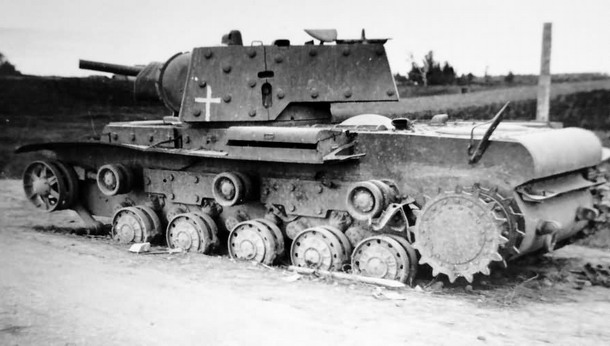
KV-1E with add-on armour on turret and hull, source: Worldwarphotos.info with permission of the operator, modified
In September 1941, sixty KV-1 tanks appeared on the Leningrad front fitted with an unusual M-17T petrol engine. The reason for this anomaly was that the Leningrad factory had exceeded its production quota. Tanks built above quota could be retained on the "home" front for the defence of the city itself. Leningrad workers, motivated by the first German attacks and air raids, produced sixty tanks above their original September 1941 plan — only to find that there were no diesel powerplants available for them. The factory therefore turned to whatever was on hand: the M-17T petrol engines.
In October 1941 the Leningrad factory received orders to evacuate production to Chelyabinsk. Ten thousand workers and twelve thousand machines were transported, and production continued at the new location at an even more intensive pace. In 1941 a total of 1,396 KV-1s were produced — 885 of them still in Leningrad, and the remaining 511 in Chelyabinsk, where by that point almost all vehicles were being built with the cast turret.
The "Fast" KV-1S
The cast turret improved protection but added weight. Combined with the add-on armour that was fitted to the driver's and radio operator's frontal plate on late-production tanks, this meant that later KV-1s weighed as much as 47.5 tonnes — with the predictable consequence of reduced speed. Soviet designers set to work finding a way out of the vicious cycle of increasing armour and decreasing mobility. The result was the modernised variant designated KV-1S.
The starting point for the modernisation was a thorough analysis of KV tanks hit in combat. The designers identified which areas were most frequently struck and which were hit least often. On that basis they proposed an optimised armour distribution — thicker where it mattered most, and reduced where it could afford to be. The lower nose plate was thinned from 75 mm to 60 mm. The upper nose plate was conversely thickened from 40 mm to 50 mm. The driver's frontal plate remained at 75 mm. The hull floor was 30 mm throughout, and the hull sides were 60 mm. The cast turret had a frontal wall 82 mm thick, side walls of 75 mm and a 40 mm roof.
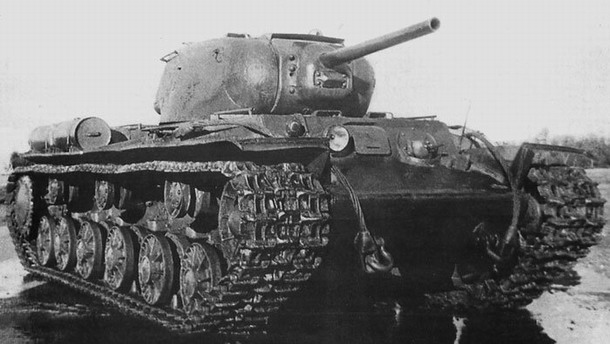
modernised KV-1S tank, source: Topwar.ru with permission of the operator, modified
This weight-saving regime brought the tank down to 42.5 tonnes. Thanks to this reduction and improvements to the transmission, speed increased to 43 km/h — which, after all, gave the tank its name: the letter S stood for "Skorostnyj", meaning "fast". The tank also received new tracks 608 mm wide (compared to 700 mm on the original KV-1). Another new feature was a commander's cupola, positioned in the right rear section of the turret. The rear turret machine gun mount moved from the centre to the right side so that the tank commander could operate it. The junior mechanic, previously assigned to that gun, could now take over the loader's role and relieve the previously overburdened commander.
The KV-1S was produced from 20 August 1942 until April 1943. Various sources give differing totals for the number of vehicles produced, ranging from 1,370 to 1,800.
The Armoured KV-1E
Another interesting but unofficial KV-1 variant emerged in the summer of 1941. As the KV-1 saw its first combat against German opponents, reports began arriving that the Wehrmacht was deploying powerful 88 mm anti-aircraft guns in an anti-tank role, and that Soviet tanks were unable to withstand them. Add-on armour plates were therefore fitted to tanks already in service. Steel strips were welded onto the original armour on the turret sides, threaded holes were drilled into them, and armour plates 20 to 35 mm thick were then bolted on.
Tanks modified in this way were unofficially designated KV-1E and were very easy to identify by the large bolt heads decorating the sides of their turrets. The add-on plates had cutouts for the side vision slits and pistol ports. Only turrets with a squared-off rear were modified in this way. In addition to the turret sides, small add-on armour plates were also fitted to the sides of the hull between the road wheels and the upper return rollers. The letter E in the designation abbreviated the word "Ekranirovanyj", meaning "screened" or "up-armoured". The KV-1E was never officially approved, however, and existed only as a field modification of tanks already in service. In fact, the opposite came to pass: the fitting of supplementary armour was eventually officially banned, as the increased weight of the KV-1E led — beyond the expected drop in speed — to a higher rate of mechanical failure in heavily stressed components.
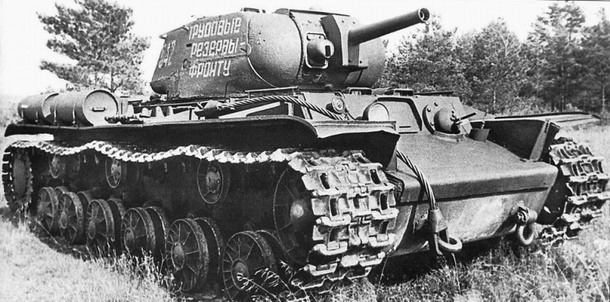
KV-8S flamethrower tank, source: Waralbum.ru with permission of the operator, modified
Flamethrower Variant
The KV-1 also existed in a flamethrower version — in fact in several different forms. The first was a prototype designated KV-6: essentially a standard KV-1 with a flamethrower added alongside the 76.2 mm gun. Only the on-board ammunition supply was reduced to make space for an incendiary fuel tank. This tank, however, was a rather small one; its fuel supply was sufficient for only 15 bursts. This limitation meant the prototype was not approved for series production.
The second flamethrower variant was designated KV-8, development of which began in November 1941. Again it used the standard hull and turret, but this time the main armament was changed: the original 76.2 mm gun was replaced by a 45 mm gun. The smaller weapon — and the reduced ammunition load it required — left enough space inside the tank for a proper incendiary fuel tank. The flamethrower, of the ATO-41 type, was mounted to the left of the gun barrel. To prevent the flamethrower tank from being immediately identified as such, the gun barrel was wrapped in a tube that made the weapon appear to have a larger calibre. This concealment was inspired by a Soviet lesson from the Winter War, where flamethrower tanks had invariably become the first targets of Finnish anti-tank fire — presumably because of the psychological terror that flames produced in soldiers.
The 45 mm gun was stowed with 92 rounds of ammunition. The on-board incendiary fuel supply of 960 litres was sufficient for 107 bursts. The flamethrower's range was around 60 metres, though with a thicker fuel mixture this could be as much as doubled. A flamethrower version of the modernised KV-1S was also produced, again with a 45 mm gun, and designated KV-8S. This variant increased the gun ammunition supply at the expense of a reduced fuel load: 114 rounds of 45 mm ammunition were carried along with 600 litres of fuel, sufficient for approximately 60 bursts. The KV-8S weighed 43 tonnes and was crewed by five men, the same as the standard KV-1S. During production, the newer ATO-42 flamethrower began to be fitted to these tanks.
As 1942 turned into 1943, Soviet officials were increasingly asking what purpose the heavy KV-1 tank actually served when it carried the same armament as the medium T-34, which was far cheaper to build and operate. The Battle of Kursk in the summer of 1943 brought matters to a head, making it abundantly clear that the KV-1's 76.2 mm guns were inadequate for effective combat against modern German tanks — the Panther and the Tiger. Designers accordingly began working intensively on re-arming their heavy tanks with more powerful guns. Beyond several rejected prototypes, these efforts also produced the production tank KV-85, described separately.
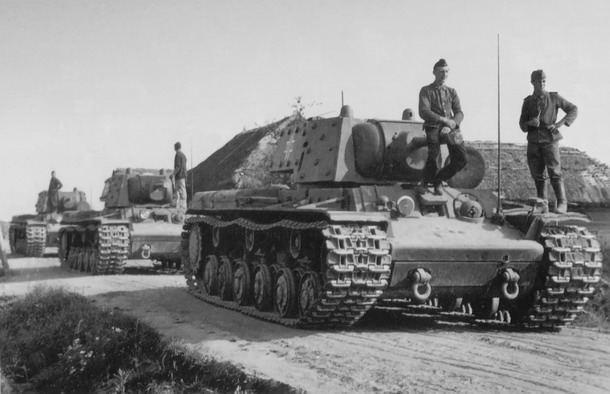
three KV-1E tanks pressed into German service, source: Waralbum.ru with permission of the operator, modified
Re-arming was not the only avenue the Soviets explored, however. The KV-1 chassis served as the basis for a whole range of experimental prototypes, which are described in a separate chapter HERE.
Combat Deployment
On the day the Great Patriotic War broke out, the Red Army had a total of 508 KV-1 tanks at its disposal. At that time — June 1941 — the Germans had no tank capable of effectively destroying these Soviet machines. It is therefore clear that the KV-1 was a very hard nut for the Germans to crack. There are documented cases of a single KV-1 halting the advance of entire German units, which had to wait for heavy weapons capable of dealing with the Russian colossus to be brought up.
Even so, the KV-1 suffered enormous losses — as did the Red Army as a whole. Most of these losses, however, were not incurred in tank-versus-tank combat. KV-1s more often fell victim to air strikes and artillery, or most commonly of all, mechanical breakdowns. With the Wehrmacht advancing at such pace during the first weeks and months of Operation Barbarossa, the Soviets could not recover or repair disabled tanks quickly enough and simply abandoned them where they stood. The same fate befell vehicles that became bogged down in soft ground.
The KV-1 proved most effective in defensive combat. This was demonstrated perfectly by Senior Lieutenant Zinoviy Kolobanov, whose unit of just four KV-1 tanks (some accounts say seven) was defending the approach road to the village of Krasnogvardeysk near Leningrad. The road was flanked by marshy ground, severely restricting the tanks' room to manoeuvre. Kolobanov surveyed the position carefully and ordered his tanks to dig in and camouflage themselves with a clear view along the road. He also ordered his individual vehicle commanders not to open fire until the enemy was close enough.

KV-1 fitted with the German KwK 40 L/43 gun of 75 mm calibre, source: Waralbum.ru with permission of the operator, modified
On 14 August 1941, the advance elements of the German 8th Panzer Division drove straight into the trap. Kolobanov's tank number 864 opened fire. His first shot knocked out the lead tank in the German column. The Germans had no idea where the shot had come from and assumed the tank had struck a mine. The entire column halted — making it a perfect target. Kolobanov kept firing. He destroyed the second tank and then immediately the tank at the very rear of the column. The Germans now knew they had been ambushed, but the road was blocked by burning wrecks at both ends. The German tanks began to leave the road, and one by one slowly waded into the soft ground on either side. The Soviets kept firing; the Germans returned fire.
After half an hour of fighting, 38 destroyed German tanks lay on the field (some sources say 43), mostly Panzer II and Panzer III types — 22 of them destroyed by Kolobanov's tank alone. The Soviets had not lost a single vehicle. After the battle, Kolobanov's tank was said to have had 152 hits from German shells counted on its hull. Not one had penetrated the armour.
The only other army to receive KV-1 tanks voluntarily from the Soviets was the Polish Army, which received five KV-1s in January 1945 — by which time they were already obsolete machines. The Soviets also involuntarily equipped both the Germans and the Finns with KV-1s in the form of captured vehicles. The Germans pressed captured tanks into their own service under designations corresponding to the variant: early models were called Panzerkampfwagen KV-1 753(r), while the KV-1S became the Panzerkampfwagen KV-1S 755(r). The Germans also modified their captured tanks, fitting their own commander's cupolas and anti-tank rifles, and in one KV-1 with a cast turret they even installed their own gun — the KwK 40 L/43 of 75 mm calibre, normally fitted to the German PzKpfw IV Ausf. G.
The KV-1 came into existence as a by-product of the development of other tanks, and with a touch of irony one might say it was haunted by a kind of "unwanted child" complex throughout its entire service life. There was always another tank that was preferred over it. First it was the T-34, which offered equal firepower at a fraction of the cost — true both for the 76.2 mm version and for the KV-85. Later it was the IS-1, which effectively ended any prospect of re-arming the KV with a more powerful gun. The KV-1 was also not particularly popular with tank crews, mainly due to its difficult handling, low speed and relatively frequent mechanical failures. It was most useful to the Soviets during the first year of the war with Germany, when it still posed a genuine threat to its opponents.
Technical Specifications
|
KV-1 |
KV-1S |
Weight |
43 – 47.5 t |
42.5 t |
Length |
6.95 m |
6.95 m |
Width |
3.32 m |
3.32 m |
Height |
2.71 m |
2.64 m |
Engine |
V-2 |
V-2 |
Maximum power |
600 hp |
600 hp |
Maximum speed |
35 km/h |
43 km/h |
Road range |
225 – 250 km |
330 km |
Turret front armour |
75 mm |
82 mm |
Hull front armour |
75 mm |
75 mm |
Armament |
L-11/F-32/F-34 gun, 76.2 mm 3 × DT machine gun, 7.62 mm |
ZIS-5 gun, 76.2 mm 3 × DT machine gun, 7.62 mm |
Crew |
5 men |
5 men |

ARTICLE
CONTENTS:
Reproducing text from the Tankist website without the written consent of the operator is prohibited.