TANK KV-2
more self-propelled howitzer than tank
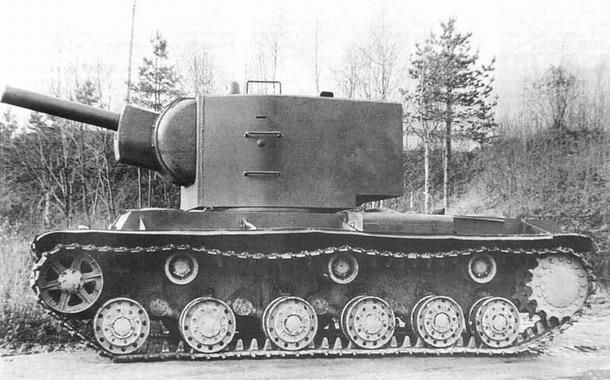
KV-2 heavy tank, source: Aviarmor.net with permission of the operator, modified
Origins of the Tank
The origins of the heavy tank KV-2 are inseparable from those of the KV-1. It all began in 1938, when the idea emerged of replacing the outdated five-turreted T-35 with a newer machine carrying three turrets. Discussion of this project eventually reduced the turret count to two, and in 1939 work began on two new vehicles, the T-100 and the SMK. In parallel, however, development of a third tank carrying only a single turret was also approved. Work on the single-turreted machine began on 1 February 1939 at the S. M. Kirov Plant in Leningrad. The new tank received the designation KV, concealing the name of the Soviet marshal Kliment Voroshilov. The first KV prototype was completed on 1 September 1939. From then on, a cycle of testing, modifications and further testing ensued — interrupted on 30 November by the outbreak of the Soviet-Finnish war.
The KV prototype was sent to the front to prove its worth in real combat, and it performed excellently in almost every respect — with one minor shortcoming. The 76.2 mm gun it carried could not deal with Finnish reinforced concrete bunkers. In December 1939 the army command therefore requested the development of another variant of the tank, armed with a weapon powerful enough to destroy fortified targets. That was the first step on the road to the KV-2. At the time, however, the designations KV-1 and KV-2 did not yet exist — the tanks were simply called the KV with the small turret (s maloj basnju) and the KV with the large turret (s balshoj basnju). The KV-1 and KV-2 designations were only introduced in January 1941.
On 4 January 1940, production of the KV tank started at the Leningrad plant, and it was immediately decided that the first four hulls produced would serve as the basis for the new, more heavily armed variant. No modifications to the running gear or hull compared to the existing KV prototype were envisaged. All work was to focus on selecting a suitable weapon, building a new turret to accommodate it, and mounting that turret on the standard hull.
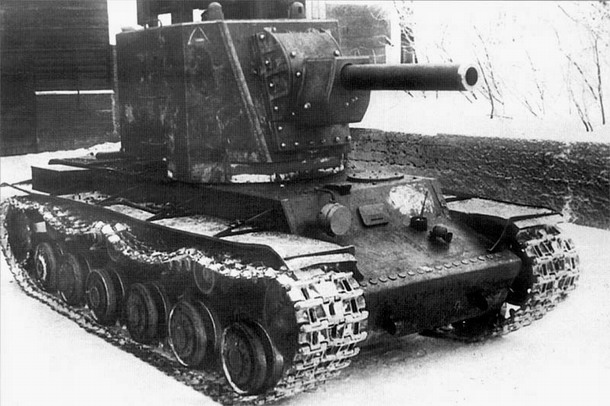
KV-2 with the earlier turret design, source: Topwar.ru with permission of the operator, modified
Technical Description
The running gear and hull of the KV-2 were identical to those of the KV-1. On each side, the suspension consisted of six road wheels that were twin, all-metal, and featured indentations and small circular lightening holes. The road wheels were evenly spaced and each was independently suspended and sprung by a swing arm connected to a torsion bar. At the front of the running gear was a spoked idler wheel and at the rear a large toothed drive sprocket. Three evenly spaced return rollers supported the track from above. Track width was 70 cm. The hull, whose individual sections were joined primarily by welding, sat on the running gear. The nose was formed by two plates meeting at a sharp angle (87°). The lower plate was 75 mm thick and angled at 30° from vertical; the upper was 40 mm thick and set at 63°. Two heavy towing eyes were fitted to the lower plate. The upper plate carried the mounting for the radio aerial rod.
From the upper nose plate rose the frontal wall of the driver's compartment, angled at 30° with 75 mm of armour. In the centre was the driver's rectangular vision port, which could be closed by a shutter in dangerous conditions, leaving only a narrow slit for forward observation. A headlamp was installed to the right of the port. Neither the prototype nor the first production tanks yet had an integrated hull machine gun; this was added later. In the left section of the driver's compartment roof was a circular driver's hatch closed by a single-piece lid. The compartment roof — ahead of the turret and for a short distance behind it — was 40 mm thick; above the engine compartment it was "only" 30 mm. The floor armour followed a similar pattern: the front half was 40 mm thick, thinning to 30 mm under the engine compartment. It is worth noting that the most modern German tank of the time, the PzKpfw IV Ausf. D, produced from September 1939, had frontal hull armour of the same thickness as the engine compartment floor of the Soviet KV — 30 mm. The exposure of these two surfaces to enemy fire is, of course, incomparable.
The engine compartment occupied the rear of the hull. Immediately behind the turret was a service access opening, flanked by two smaller longitudinal air intake grilles protected by mesh guards. Behind these grilles, two exhausts emerged through the roof plate. Further rearward were two circular access covers for servicing the transmission. The tank's powerplant was a twelve-cylinder diesel V-2, producing a maximum of 600 horsepower at 2,000 rpm. The gearbox provided five forward speeds and one reverse. The rear of the hull was formed by two rounded sections. Behind the upper rounded section — protected by 60 mm of armour — was a further ventilation grille. The lower rounded section carried two towing eyes and had a full 75 mm of armour. The upper rounded section was later replaced by a flat angled plate.

KV-2 with the earlier turret design, source: Aviarmor.net with permission of the operator, modified
Model 1940
The work on the new turret was led by engineer Dukhtsov, the weapon adaptation was handled by engineer Kurin, and the overall project was overseen by designer Kotin. The prototype of the new turret, designated MT-1, was designed and built during January 1940. It was considerably larger than the turret of the KV-1. Its frontal wall was slightly angled, with a large gun mantlet bolted to it by means of large screws. To the right of the mantlet was a ball mount for a DT machine gun of 7.62 mm calibre. The side walls of the turret angled outward for roughly the first quarter of their length — so the turret widened from the front plate rearward to that point — then angled back inward for the remainder. The rear wall consisted of two plates joined at an angle. A large bolted-on rectangular cover occupied most of the rear wall, concealing a large opening through which ammunition was loaded into the turret.
The frontal wall of the turret was 75 mm thick; the sides and rear were 60 mm and the roof 20 mm. The side walls had vision slits with small closable circular pistol ports below them. Two such ports were also in the rear wall on either side of the bolted cover. Three steps were welded to the sides of the turret, serving as a ladder for the crew to climb in. Two periscopic sights protruded from the front of the turret roof, and two more fixed periscopes were fitted in the rear section of the roof. On the left was the single circular entry and exit hatch, closed by a single-piece lid. The turret housed four men: the commander, the gunner and two loaders. The turret was relatively tall, giving the tank an overall height of 3.45 m — which was one of the reasons it was later replaced by a new, lower and easier-to-produce design.
The first weapon considered for the new machine was the 152 mm howitzer Model 1909/1930. This was ultimately rejected in favour of the more modern M-10 howitzer Model 1938/1940 of the same calibre (the weapon's exact bore was 152.4 mm). The gun mounting allowed vertical elevation from −5° to +12°. Horizontal traverse was naturally provided by the turret.
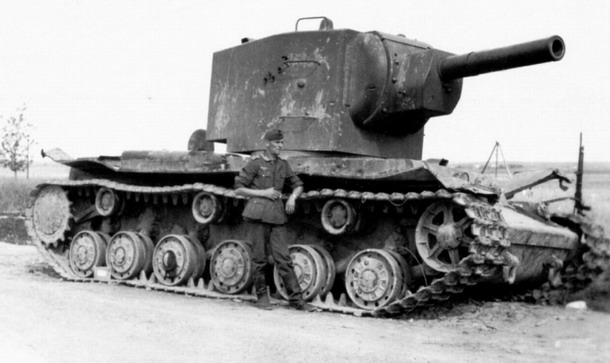
knocked-out KV-2 with the later turret design, source: Waralbum.ru with permission of the operator, modified
The turret was mounted on a standard KV-1 hull and on 10 February firing trials of the new vehicle took place. None of the designers or military officials present had any experience with a vehicle armed with such a powerful weapon. There were serious concerns that the enormous recoil force on firing could damage the running gear, or even overturn the entire tank — after all, the turret with its howitzer weighed a full 12 tonnes and, given its height, raised the tank's centre of gravity considerably. The first shot was therefore fired with the turret rotated 90 degrees to the side, the most unfavourable position for stability. The fears proved unfounded. The tank remained completely stable after the shot and was even able to start up and drive away immediately.
It is worth noting that the designers fitted the prototype with a flap at the end of the barrel. Its purpose was to protect the weapon from dust ingestion, but also from enemy fire — the bore diameter was so large that enemy infantry could theoretically shoot through the barrel into the tank's interior. The flap was operated by a pull-rod from inside the fighting compartment. On the very first shot, however, the flap was blown clean off the barrel, and it was therefore not fitted to any subsequent vehicles.
In February 1940, three KV-2 tanks were produced and all three were dispatched to Finland that same month. They did not participate in actual combat, however, being used only for test firing against already-captured Finnish fortifications. The results exceeded expectations. On 13 March the Winter War ended and all the KV tanks returned home. On 19 March they took part in a display of new equipment for the country's senior political and military leadership. The powerful tanks made a strong impression and their production was given higher priority. In May an order arrived for 230 vehicles — 130 of the KV-1 type and 100 of the KV-2 type — to be delivered by the end of 1940.
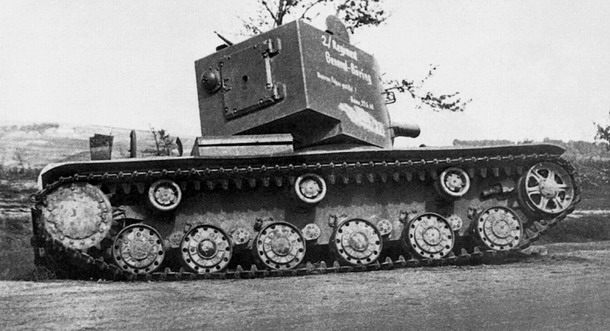
knocked-out KV-2 with the later turret design, source: Waralbum.ru with permission of the operator, modified
It was at this point that the designers realised the war with Finland had left no time for genuinely thorough testing of the new tanks — particularly driving trials. From 10 to 26 June, intensive tests were therefore conducted in the Leningrad area and at the Kubinka proving ground; the test KV-2 covered 2,565 km during this period. The trials revealed a number of hidden faults and deficiencies, mainly in the running gear, engine, clutch and transmission. Of the two KV variants, the KV-2 was the more unreliable — primarily because of its weight, which exceeded that of the KV-1 by a full 6 tonnes. Production could not simply be halted during testing, so corrections had to be incorporated into the ongoing production run. As a result, the first series-produced tanks were highly unreliable and the army returned many of them to the factory for repairs. By the end of 1940, 141 KV-1s and 102 KV-2s had been completed — of this combined total of 243, 47 were returned by the army as defective.
Model 1941
In September 1940 the new-design turret mentioned earlier was developed. All of its walls were now perpendicular to the ground, which simplified production. The slight break in the side walls was retained but made more gradual, so that no sharp edge was visible from the side. Two periscopes were again fitted in the front of the roof. The circular entry hatch moved to the left side, with a new turret ventilator outlet appearing to its right. A second ventilator outlet was located in the right rear corner of the roof. At the rear, an additional — this time rectangular — hatch was added. Instead of the original two fixed periscopes there were now three: one facing each side and one facing rearward. The rear wall of the new turret was a single flat plate with no break. In its centre was again a large rectangular ammunition loading aperture, but its cover was now hinged rather than bolted on, making it much easier to open. To the left of this aperture in the rear wall was a ball mount for a third DT machine gun. The new turret was overall 20 cm lower than the old one — which also meant the boarding ladder on the sides was reduced from three steps to two. Armour thickness was unchanged compared to the earlier turret.
The new turret was successfully tested in September and immediately replaced the old design in production. The two models of the KV-2 are generally distinguished by their turret type: the older Model 1940 and the newer Model 1941. The ammunition supply aboard the KV-2 with the new turret was 36 howitzer shells and 3,087 rounds for all three machine guns. The howitzer's rate of fire was 2 to 3 rounds per minute — relatively low, primarily because of the great weight of the shells, which made them difficult to handle, and because the two-piece (separated) ammunition extended the loading cycle. The tank weighed 52 tonnes. Its maximum road speed was 35 km/h, though the average was only around 20 km/h. Road range was approximately 250 km; cross-country range was around 150 km.
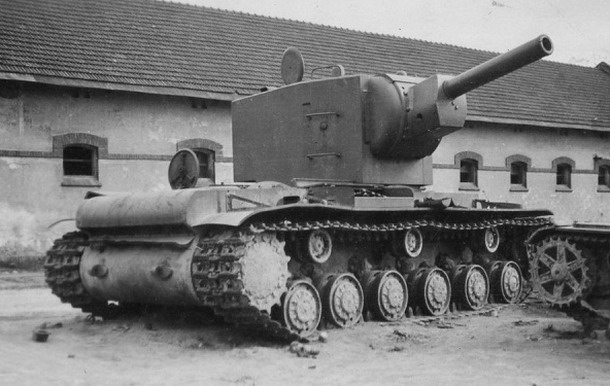
KV-2 with the later turret design, source: Waralbum.ru with permission of the operator, modified
The original towed M-10 howitzer was available with many types of ammunition; exactly how many of these were adapted for use in the KV-2 is not entirely clear. Sources agree on the use of high-explosive fragmentation rounds for use against infantry. Some also state that the tanks were equipped with concrete-piercing and even armour-piercing rounds; other sources dispute this. Without stating definitively that all of these types were available for the KV-2, a summary of the key characteristics of each is as follows. The 152 mm concrete-piercing shell weighed more than 40 kg and left the barrel at 530 m/s; the high-explosive fragmentation shell had similar characteristics. The armour-piercing shell weighed a full 51 kg with a muzzle velocity of 436 m/s; at a range of 1,500 metres this round could penetrate 70 mm of armour. The effect of this ammunition on German tanks was utterly devastating. Because of its immensely powerful armament, Soviet soldiers gave the KV-2 the nickname "Dreadnought" — a russified form of the English word Dreadnought, a type of heavily armed battleship.
One might think that the KV-2's heavy armour and unrivalled firepower made it almost indestructible. In 1941, when Operation Barbarossa was launched, even the Germans had no tank capable of destroying it. Yet losses among KV-2 tanks were just as high as among other Soviet equipment. Rather than enemy fire, however, the cause was almost entirely poor command decisions, mechanical breakdowns, and dismal Soviet logistics. Most KV-2s were lost because they became bogged down, broke down during long road marches, or simply ran out of fuel and had to be abandoned by their crews. This is illustrated by countless photographs showing German soldiers examining an immobilised KV-2 in otherwise excellent condition — apart from the evidence of numerous completely ineffective hits from German shells. Even so, the "KV-twos" were a very uncomfortable problem for the Germans, and every one they managed to destroy or disable attracted admiring attention.
As already noted, many KV-2 tanks were left on the battlefield with only minor damage. The Germans recovered a large number of them, repaired them and pressed them into their own service under the captured-equipment designation Panzerkampfwagen KV-II 754(r). As period photographs confirm, at least one of the captured vehicles was even fitted by the Germans with a commander's cupola from a PzKpfw IV. Some captured tanks were also sent back to Germany for evaluation; one eventually made its way all the way to Prague, where it was put on public display as part of an exhibition called "Soviet Paradise".
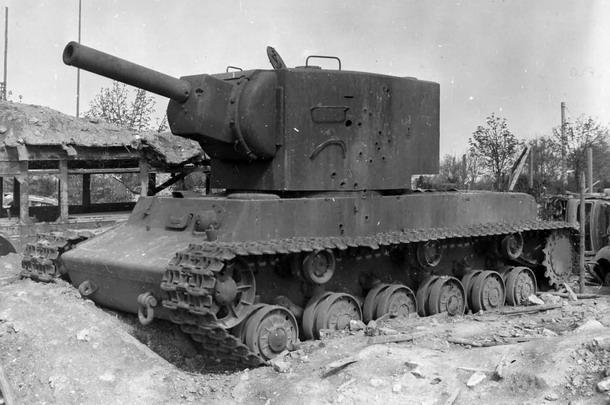
"stripped" wreck of a KV-2, source: Worldwarphotos.info with permission of the operator, modified
Production of the KV-2 continued until October 1941, by which point a total of 334 vehicles had been built. The reason for ending production was that under the prevailing circumstances, tanks designed to break through fortified lines were simply not needed. The nearest enemy fortifications were in East Prussia — a target far beyond the Soviets' reach in 1941. Nevertheless, KV-2 tanks continued to take an active part in fighting right through to the very end of the war.
Technical Specifications
|
KV-2 (1940) |
KV-2 (1941) |
Weight |
54 t |
52 t |
Length |
7.02 m |
6.95 m |
Width |
3.32 m |
3.32 m |
Height |
3.45 m |
3.25 m |
Engine |
V-2 |
V-2 |
Maximum power |
600 hp |
600 hp |
Maximum speed |
32 km/h |
35 km/h |
Road range |
250 km |
250 km |
Cross-country range |
150 km |
150 km |
Turret front armour |
75 mm |
75 mm |
Hull front armour |
75 mm |
75 mm |
Armament |
M-10 howitzer, 152 mm 3 × DT machine gun, 7.62 mm |
M-10 howitzer, 152 mm 3 × DT machine gun, 7.62 mm |
Crew |
6 men |
6 men |

ARTICLE
CONTENTS:
Reproducing text from the Tankist website without the written consent of the operator is prohibited.