TANK T-34
the Soviet triumph of simplicity
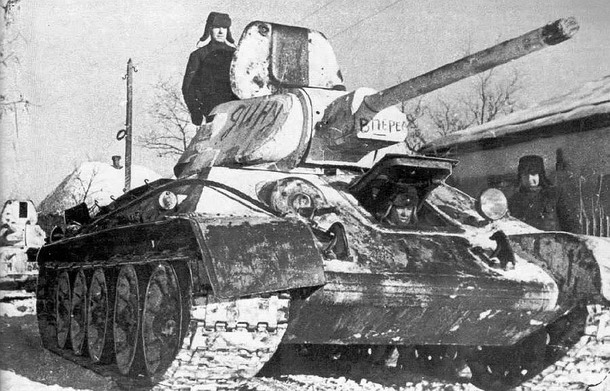
T-34 tank, source: Flickr.com with permission of the publishing user, modified
The T-34 became nothing less than a symbol of the Second World War. Alongside the Soviet rocket launcher Katyusha and the German tank Tiger, the T-34 is surely among those machines whose name is recognised even by people with no particular interest in military history. The T-34 is frequently described as the finest tank of the entire Second World War — an oversimplification, perhaps, but one that speaks to just how exceptional this vehicle was. And yet, with relatively little going differently, this legend among tanks might never have come to exist at all.
The Army Requirement
By the second half of the 1930s it was already clear that the existing versions of the BT light tanks had reached their ceiling and that further development along those lines was no longer worthwhile. A decision was therefore taken to begin work on a new tank to replace the ageing BTs. On 13 October 1937 the specification for the new vehicle — to be designated BT-20 — was finalised, and before the month was out the design bureau of the Kharkov Factory No. 183 (officially known as the Kharkovskiy parovozostroitelnyy zavod, or KhPZ) was formally tasked with the development work. Earlier that same year, the young M. I. Koshkin had taken charge of the factory's design team, replacing A. Firsov, who had been arrested and was later executed.
The army's specification called for a tank with a convertible drive — the same arrangement used on the older BTs. This type of running gear allowed the tank to travel either on its tracks or on its road wheels alone. The tracks were used when the terrain was soft or broken; on roads or other firm surfaces the tracks could be removed and the tank could run on its wheels at speeds that would have been unthinkable with the tracks fitted.
Prototypes A-20 and A-32
The Kharkov team's response to this requirement was the project designated A-20 — a tank expected to weigh around 18 tonnes, protected by 20 mm of armour and armed with a 45 mm 20K gun. Koshkin, however, personally had little faith in the future of convertible-drive tanks, and so alongside the official A-20 project he quietly prepared a second design on his own initiative — a fully tracked vehicle given the working designation A-32 (sometimes also referred to as the T-32).
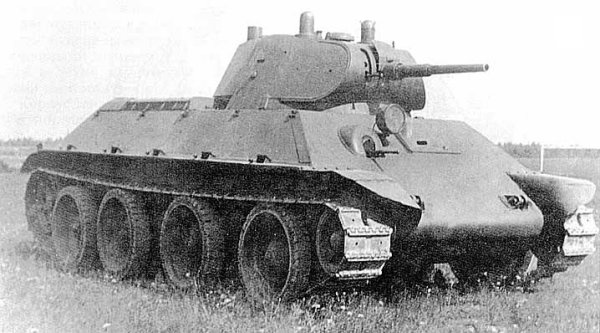
A-20 convertible-drive tank prototype during trials, source: Wikimedia, Mikhail Baryatinsky, Free Art License
Koshkin understood the drawbacks of the convertible drive very well. It was more complex and expensive to build, it added weight, and most importantly its limited load-bearing capacity placed a ceiling on the tank's total weight and therefore on the thickness of its armour and the power of its armament. The A-32 suffered from none of these constraints. Its frontal armour was increased to 32 mm (sometimes cited as only 30 mm), compared to 20 mm on the A-20, while the whole vehicle was only about one tonne heavier — precisely because the additional drivetrain hardware needed to power the road wheels had been eliminated.
But it was not simply a matter of the specific merits and drawbacks of the two running gear configurations. The convertible-drive concept was falling out of favour worldwide. In practice, tank crews only removed their tracks for longer road marches, and those were the exception rather than the rule. Was it really worth the engineering effort to add that one capability — essentially marginal in real operations — to the design? As it turned out, many Soviet military officials thought so.
To be fair to the A-20, it is worth noting one genuinely important innovation that this project introduced: a sharply sloped, unbroken frontal hull plate. That angle increased the effective thickness of the armour and therefore its ability to resist penetration. The A-32 adopted this same feature from the A-20. The A-32 was also originally designed with the same armament as the A-20, though with the proviso that its greater load capacity should allow the 45 mm gun to be exchanged for a more powerful 76.2 mm weapon.
Both the A-20 and A-32 projects were presented at a session of the USSR Defence Committee on 4 May 1938. From the outset, Koshkin and his A-32 made two powerful enemies: Marshal Kliment Voroshilov and (future Marshal) Grigory Ivanovich Kulik, who took a one-sided preference for the convertible-drive tank, arguing that speed mattered more than armour. They accused Koshkin of having ignored the official specification and wasted time and resources on an unnecessary second project. However, the session also heard directly from tank crews, who presented their experience of the Spanish Civil War. That combat experience had exposed two fundamental weaknesses of the BT and T-26 tanks supplied by the Soviets to the Spanish Republicans: the armour was not thick enough and was readily penetrated by German 37 mm anti-tank guns, and the petrol engines were highly prone to fire when hit.
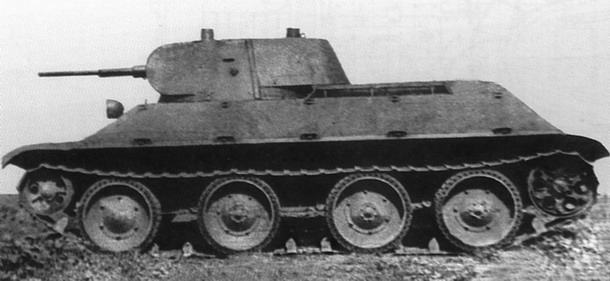
A-20 convertible-drive tank prototype during trials, source: Wikimedia, Public domain, modified
No final decision was reached at the conference. Stalin, however, approved the continuation of work on both projects, with the winning design to be determined by prototype trials. The Kharkov factory was given one year to build the prototypes. This was the first time the future T-34 came close to never existing.
The A-20 and A-32 prototypes were completed in June 1939 and testing began — initially factory trials in July, followed by army trials in August. The two vehicles were very similar in their structural design, and both hulls already closely resembled the eventual production T-34. Their turrets, welded from rolled steel plate, were also very alike. Both prototypes were originally fitted with the same 45 mm main armament, though during factory trials the A-32's gun was replaced with the more powerful L-10 of 76.2 mm calibre, with a barrel length of 23.7 calibres.
The A-20's running gear consisted of four road wheels on each side, solid-tyred with rubber rims. The rear three pairs were driven, the front pair steerable. The A-32 used the same type of road wheel but had five on each side, spaced more closely together. Both vehicles shared the same arrangement of drive sprockets at the rear and idler wheels at the front. No return rollers were needed, as the tracks rested directly on the tops of the road wheels.
The V-2 Engine
The choice of powerplant was critically important — it had to be as compact as possible while delivering adequate power. There was considerable debate over whether to use a petrol or diesel engine. The story goes that Koshkin's colleague N. A. Kucherenko settled the argument by summoning all the parties to the factory yard, where he had a bucket of petrol and a bucket of diesel brought out. He then took a lit torch and held it first to the petrol, which of course burst into flames immediately. When he plunged the same torch into the diesel, it went out. That, so the tale goes, was that. Whether this scene actually took place is another matter. In any case, reducing the tanks' tendency to catch fire when their engines were hit was a goal the designers had set themselves after the Spanish experience, and a diesel engine was clearly the way to achieve it.
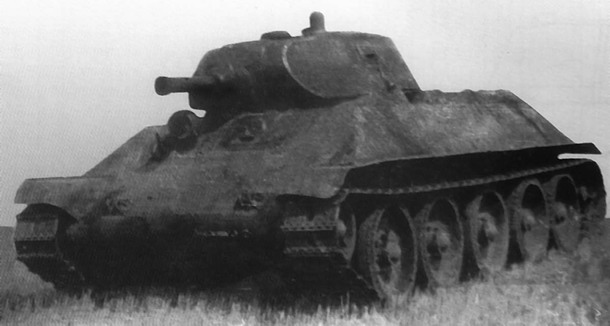
A-32 tank prototype armed with the L-10 gun, source: Wikimedia, Public domain, modified
The engine department at the Kharkov factory had by that point already been working for several years on developing exactly such a compact and powerful diesel unit. The engine design was finalised as early as 1937, but purges that struck the factory's departments meant that series production could not begin before late 1938. Nevertheless, this engine — designated V-2 — was selected as the powerplant for both the A-20 and A-32.
Army Trials
Unfortunately for Koshkin and his colleagues, Grigory Kulik was appointed to the prototype trials commission, and from the start made no secret of his hostility towards the A-32. The prototype also suffered clutch and cooling problems during testing, which played into the hands of its opponents. They deliberately exaggerated every issue and refused to accept the argument that any prototype would have its teething troubles. For the second time, Koshkin and his design were in real danger of being cancelled. The A-20 proved faster, as expected, particularly on hard surfaces, while the A-32 showed greater resistance to gunfire in ballistic tests.
Both vehicles demonstrated their strengths and weaknesses, and the commission proceeded cautiously in drawing its conclusions. As the trials went on, sympathy within the commission gradually began to shift towards the A-32, but not by enough for a clear and definitive verdict to be delivered. Instead, a diplomatic compromise was reached on how to proceed. Proponents of the A-32 argued that its armour could be increased further to 45 mm, and so in August 1939 the commission resolved that the factory should build two experimental tanks with this heavier protection and submit them for further testing.
The A-34 Prototype
The designers had already explored the idea of heavier armour during the A-32 factory trials, loading the tank with additional ballast to simulate the increased weight and observing the effect on its handling. They found that the vehicle could take roughly seven more tonnes without any loss of mobility. Work thus began on a heavier, more heavily armoured variant, which received the factory designation A-34. According to many sources, the "34" in the designation was Koshkin's own idea — a reference to 1934, the year in which he claimed to have first conceived the idea of the new tank he one day hoped to build.
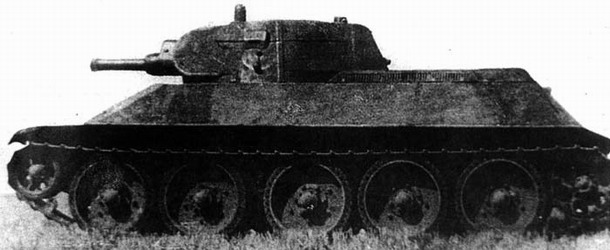
A-32 tank prototype armed with the L-10 gun during trials, source: Flickr.com, Public domain, modified
On 19 December 1939 an official recommendation was issued to accept the new tank into Red Army service, on condition that the prototypes passed driving trials and covered at least 3,000 km without serious problems (some sources give the limit as only 2,000 km). This recommendation also contained the first mention of the new official designation for the future tank — T-34, following directly from the factory designation A-34.
On a related note, it is often suggested that the designations A-20 and A-32 were derived from the thickness of their frontal armour — 20 mm for the A-20, 32 mm for the A-32. This theory has at least two holes in it. Many sources state that the A-32's frontal armour was in fact only 30 mm and not 32 mm, which would mean the designation does not correspond to the armour thickness at all. And secondly, if the first two projects truly received their names from their armour figures, why was the same logic not applied to the third? Why did Koshkin assign the designation A-34 rather than A-45, to match the 45 mm armour? Whether the designations actually reflected armour thickness or not remains unclear.
But back to the A-34 with its reinforced armour. The first prototype was completed in January 1940 and the second followed in February. The A-34 already corresponded in virtually all respects to what would become the production T-34. The frontal hull armour was increased to the specified 45 mm, the hull sides and rear to 40 mm, the turret walls to 45 mm, and the turret roof to 20 mm. The heavier armour was not the only difference from the A-32 — the extra weight margin also allowed the designers to fit a more powerful main gun, the L-11 of the same 76.2 mm calibre but with a longer barrel of 30.5 calibres and a higher muzzle velocity.
The Kharkov factory took particular care with both A-34 prototypes, since everyone understood that these two vehicles would very likely determine the fate of the entire project. All welds were treated with hot oil and carefully ground smooth, and higher-grade imported materials were used in the manufacture of certain engine and transmission components.
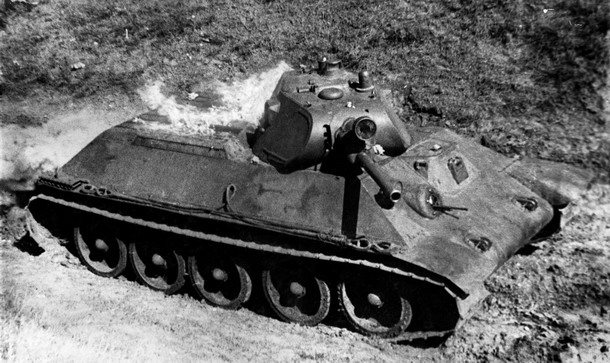
A-34 prototype at Kubinka during flammability tests — note the original design of the driver's vision port, source: Flickr.com, Public domain, modified
Intensive trials of both prototypes began immediately, with the aim of covering the required 3,000 km in time for the vehicles to be demonstrated in Moscow on 17 March at a review of new equipment for senior military officials. The driving trials, however, kept turning up problems that needed attention, and this delayed progress. By late February it became clear to the designers that reaching the 3,000 km target by the required date was out of the question. Kulik, the implacable opponent of Koshkin's tank, had of course already ruled that the A-34s could not take part in the Moscow review unless the driving trials had been completed as the commission required.
Koshkin therefore decided, in agreement with his colleagues, that both prototypes would drive to Moscow under their own power, covering the necessary test kilometres along the way. In addition to the two tanks, the convoy included two artillery tractors (probably of the Voroshilovets type): one fully loaded with spare parts for both tanks, and the other converted into a mobile billet for the crew. For reasons of secrecy, both tanks were covered with tarpaulins and the route was carefully planned to avoid all towns and main roads. In the early hours of 6 March 1940, the column set off towards Moscow. The long journey in discomfort and bitter cold took its toll on Koshkin's health.
Despite the hardships and breakdowns, both tanks arrived in Moscow on time and in working order. On 17 March they were demonstrated to the Soviet Union's most senior military and political leaders, including Molotov, Voroshilov, Beria, and Stalin himself. Most of those present were favourably impressed, and Stalin ordered that the Kharkov factory be given the support it needed to address the remaining shortcomings (which Kulik continued to raise) and prepare for series production. From the Kremlin the two tanks were dispatched to Finland. Although the Winter War with the Finns was already over by then, the tanks were taken to the Mannerheim Line — which the Soviets had acquired along with the Finnish part of Karelia — to demonstrate their ability to engage bunkers. From there they went to the Kubinka proving ground for further army trials, including firing tests. On 31 March 1940 the Defence Ministry gave conditional approval for series production to begin, subject to the prototypes passing the army trials.
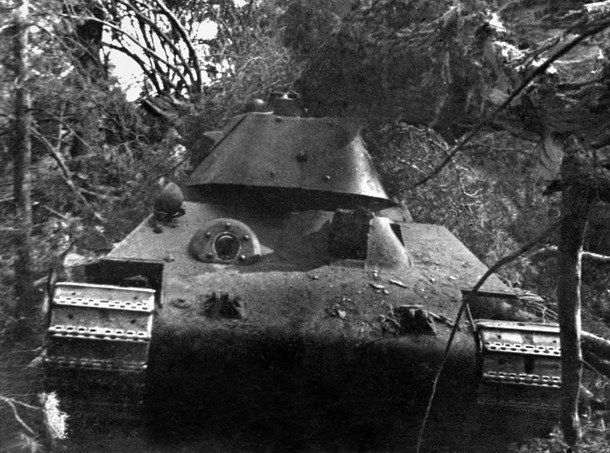
A-34 tank prototype at Kubinka during driving trials — note the original design of the driver's vision port, source: Flickr.com, Public domain, modified
Series Production
The army trials at Kubinka continued until early May and produced very favourable results for the prototypes. They did reveal a range of minor and more significant shortcomings, but all of these could be addressed before series production began. On 5 May 1940 an order was placed for 600 T-34 tanks to be delivered by the end of the year. Production was to be split between two factories: the parent factory in Kharkov, No. 183, was to supply 500 vehicles, with the remaining hundred to be built at the Stalingrad Tractor Factory. First deliveries were expected as early as June. This naturally required a sharp increase in production of the V-2 diesel engines and the involvement of a large number of additional suppliers.
In the summer of 1940, however, Kulik intervened again. He had commissioned a comparative analysis of the T-34 against the German PzKpfw III, two examples of which the Soviets had purchased from Germany and brought to Kubinka for testing. The T-34 surpassed the German vehicle in armour protection and armament — surely the two most fundamental qualities. But Kulik was more interested in the T-34's weaknesses, and on those he focused. The Panzer III had a superior torsion-bar suspension system, a more spacious three-man turret, a highly practical commander's cupola, better-quality optics, more reliable communications equipment, and a more dependable engine and transmission.
On the basis of this comparative analysis, Kulik ordered a halt to the production run that was just getting under way, and demanded the immediate redesign of the entire project. The matter was eventually resolved by the personal intervention of People's Commissar for Heavy Industry Malyshev, who had been lobbied by the Kharkov factory's officials. Malyshev ruled that the Soviet Army could not afford to halt production of a much-needed new tank while a war was raging in Europe, and that improvements to the T-34 should be pursued in parallel with its series production. These improvement efforts, incidentally, led to the T-34M project — but more on that later. The bureaucratic delays caused by Kulik meant that production fell behind schedule, and the first three series-production T-34 tanks finally left the Kharkov factory only on 15 September 1940. By the end of the year, Kharkov had produced just 115 tanks against the planned 500. The Stalingrad factory had started work on 23 vehicles but had not completed a single one by the end of 1940.
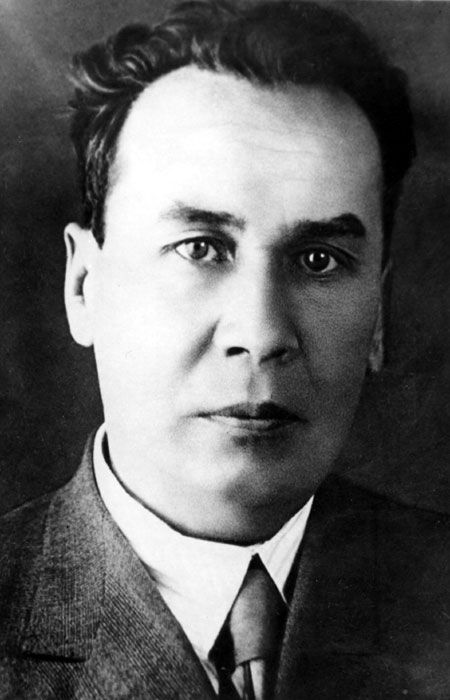
Mikhail Ilyich Koshkin (1898–1940), the father of the T-34, source: gosu-wot.com, modified
The spiritual father of the T-34, Mikhail Koshkin, survived the completion of the first three examples of "his" tank by just eleven days. On 26 September 1940 he died of pneumonia — a consequence of the winter ordeal he had endured driving both A-34 prototypes from Kharkov to Moscow. His place was taken by Alexander Alexandrovich Morozov.
T-34 Model 1940
These first series-production tanks are generally referred to as the T-34 Model 1940, or sometimes Model 1939/40. The tank rode on a running gear consisting of five large-diameter road wheels on each side. The wheels were of twin construction with rubber tyres and measured 830 mm in diameter. In later years of production, however, road wheels appeared in many different forms — pressed, cast, with rubber rims and without. Each wheel was independently suspended on a swinging arm connected to a vertically mounted coil spring. At the front was a smaller idler wheel and at the rear the drive sprocket, both lightened with cut-outs. The tracks also appeared in various forms — smooth, patterned, pressed, and cast — with a width of 550 mm (though some sources suggest this was later reduced to 500 mm).
The hull was welded from plates of rolled homogeneous armour. The lower front plate was 45 mm thick and angled at 53° from vertical. The upper front plate was also 45 mm and angled at 50° from vertical. Just above the nose of the hull, two tow-rope hooks were fitted to the upper plate. Above these, on the right side, was the embrasure for the hull machine gun — a 7.62 mm DT — and to its left the driver's hatch with its vision ports. Two large headlamps were mounted on either side of the front plate. Sheet-metal mudguards over the tracks extended beyond the nose of the hull on both sides.
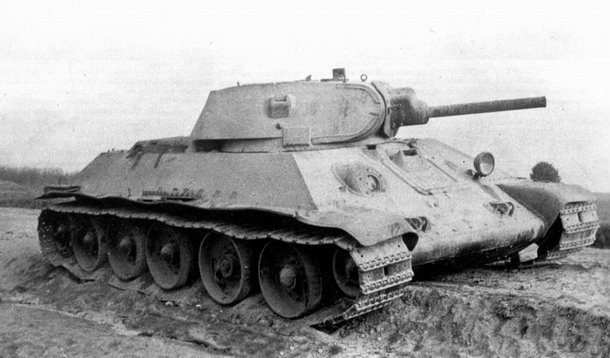
Destroyed T-34 Model 1940 with welded turret — note the distinctive gun mantlet characteristic of this variant, source: worldwarphotos.info with permission, modified
The hull side walls were 40 mm thick and angled at 40° from vertical. The hull roof was 20 mm thick, as was the floor (though other figures are sometimes cited for the floor thickness). The rear of the hull was formed by upper and lower plates of equal thickness — 45 mm each. The upper plate was angled at 42°, the lower at 45°. From the upper plate two exhaust pipes emerged, partially concealed under riveted covers, directed downward and rearward. The entire upper rear plate was removable to allow engine or transmission replacement. For minor repairs and inspections, a service hatch was provided between the exhaust pipes. The hull roof over the engine compartment behind the turret was slightly raised, with hinged covers concealing ventilation and access openings for the engine and transmission.
In the rear of the hull was installed a twelve-cylinder V-2 diesel engine developing a maximum of 500 horsepower at 1,800 rpm, behind which sat a four-speed gearbox. The first production tanks had a total of six internal fuel tanks with a combined capacity of 460 litres. The engine was liquid-cooled, with a total coolant volume of 95 litres. The Model 1940 weighed 26.5 tonnes and had a maximum road speed of around 55 km/h, falling to approximately 35 km/h cross-country.
The turret was mounted in the front part of the hull. The first T-34s had an oval-shaped turret welded from cold-pressed plates, 45 mm thick on the front and sides and 40 mm at the rear, with a 16 mm roof. In the rear wall of the turret was a large opening covered by a bolted armour plate, used for removing the gun. Observation periscopes were fitted in the turret sides, with ports for crew small-arms fire below them. One such port was also provided in the centre of the rear armour plate.
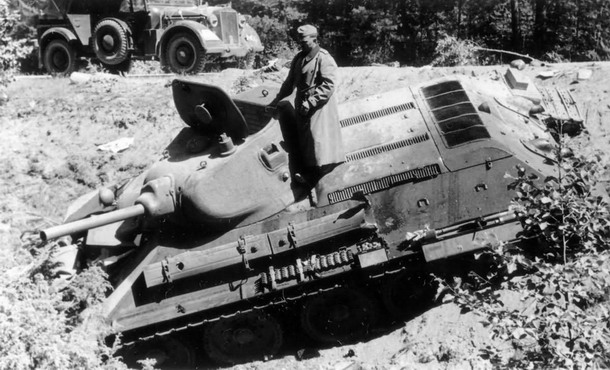
A fine view of a knocked-out T-34 Model 1940 with cast turret — note the distinctive gun mantlet typical of this variant, source: worldwarphotos.info with permission, modified
The turret roof was virtually covered with various openings. The main one was the large combined hatch for the commander and loader, which occupied almost the full width and roughly a third of the length of the roof. This arrangement was far from ideal — the hatch was very heavy and difficult to open, and once raised it stood perpendicular to the roof and blocked the forward view. To see properly ahead, the commander had to lean well out of the hatch, exposing himself to enemy fire. A commander's periscope was fitted on the left side of this hatch, and to its right a closeable port for flag signalling. This periscope was discontinued from autumn 1941 onwards — the opening was either welded shut or simply not cut in the first place. Ahead of the main hatch was an armoured ventilator cover. To its left emerged the PT-6 periscopic gunsight. Lifting rings for crane cables were also mounted on the turret roof.
Turret rotation was powered by an electric motor; manual traverse was available as a backup. With the motor, a full 360° rotation took 14 seconds. The turret had no separate floor rotating with it. The turret ring was one of the tank's weaknesses — a sufficiently powerful hit could cause the entire turret to be blown completely off. This was true of, among other things, the guns carried by the German Tiger tanks (from the later years of the war, of course). German soldiers sometimes mockingly said that T-34s doffed their hats to the Tigers.
The front face of the turret was heavily rounded, with the gun mantlet projecting from it. The T-34 Model 1940 was armed with the L-11 gun of 76.2 mm calibre, with a barrel length of 30.5 calibres — approximately 2.32 metres. Tanks fitted with this weapon are easily identified by the distinctive rounded cover of the muzzle brake. To the right of the gun a 7.62 mm DT machine gun was mounted co-axially. To the left was the TOD-6 gunsight. The gun mantlet allowed an elevation range of -3° to +30°. The gun fired several types of ammunition; the standard armour-piercing round, the BR-350A, weighing 6.3 kg, could penetrate 62 mm of armour at 500 metres, 56 mm at 1,000 metres, and 49 mm at 1,500 metres.

Destroyed T-34 Model 1940 with welded turret, source: waralbum.ru with permission, modified
The crew numbered four men. Inside the hull, the driver/mechanic and the gunner/radio operator sat side by side. In the turret, the loader and the commander had their stations, with the commander also serving as the gunner. The two-man turret was one of the T-34's most serious weaknesses. In combat, the commander had to concentrate on firing the gun and could not properly attend to the work of commanding — that is, identifying targets and coordinating the crew's actions. The turret crew used a single shared hatch in the roof for entry and exit. The driver had his own hatch in the front hull plate directly ahead of his seat, which the radio operator also used. For emergency escape, the radio operator had an additional hatch in the hull floor.
The driver controlled the tank using conventional brake levers. Since the gearbox was located in the hull rear, changing gear was no simple matter — the shift rods were very long, and drivers frequently carried a wooden mallet or hammer to help force a recalcitrant gear lever into position. An unusual feature of the driver's station was a pair of compressed-air cylinders, used to assist engine starting in extreme cold. Internal crew communication was handled by a TPU-3 intercom. External communication was more complicated. In the early period there was a shortage of radio sets, so only company-commander tanks were fitted with them; the set used was the 71-TK-3.
T-34 Model 1941
The year 1941 brought a series of improvements. One of the most significant was the installation of a new main gun. The designers had not been satisfied with the original L-11 and set about finding a replacement. Their choice fell on the new F-34 of 76.2 mm calibre, developed at the Moscow artillery design centre as the successor to the F-32 tank gun. At the end of 1940 the weapon was adapted for installation in the T-34 turret, fitted to a single test tank, and subjected to firing trials. These proved highly successful, and series production of the new gun began in January 1941. By February, F-34 guns were being delivered to the Kharkov factory and fitted to the first tanks. Vehicles armed with this gun began to be designated T-34 Model 1941.
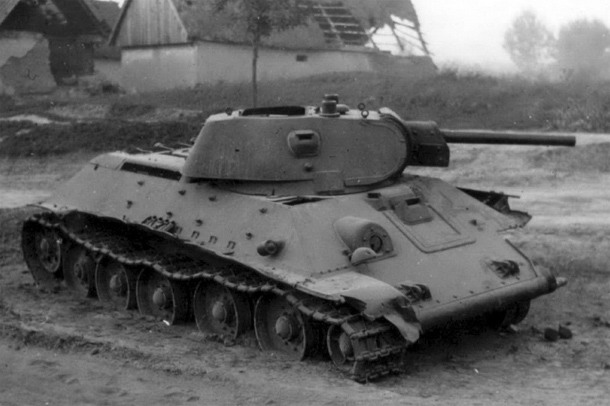
T-34 Model 1941 with F-34 gun and welded turret, source: waralbum.ru with permission, modified
This change was initially unofficial, since the F-34 had never been formally adopted into Red Army service due to an administrative oversight. All that changed when war broke out on Soviet territory. The new weapon proved far superior to the old "L-eleven" in combat, and the F-34 — and therefore the T-34 Model 1941 — was officially approved in the summer of 1941. The new gun then gradually replaced the original entirely and was fitted to all subsequent T-34s.
The F-34 shared the same 76.2 mm calibre as the L-11 but had a barrel length of 42 calibres. At 500 metres it could penetrate 69 mm of armour, at 1,000 metres 61 mm, and at 1,500 metres 54 mm. The new gun was accompanied by new optics: a PT-7 periscopic gunsight in the turret roof and a TOD-7 sight in the front wall beside the barrel. According to some publications, an unspecified number of T-34s were armed with F-32 guns instead of F-34s due to supply shortages; other sources flatly deny this.
Another significant change introduced in 1941 was the production of a cast turret. Casting was technologically simpler than rolling and welding armour plate of such thickness. The new turret appeared in spring 1941. It had the same shape as the original welded turret but its armour was 52 mm thick (compared to the original 45 mm). The relatively sharp side edges of the welded turret's front face, with their characteristic weld lines, disappeared in the cast version. Model 1941 tanks were produced with both types of turret, and photographs also show that some Model 1940 tanks were fitted with the newer cast turrets.
A new observation periscope for the loader appeared in the turret roof of some tanks. According to some sources this modification was confined to commander's tanks. Beyond these changes, a number of smaller improvements were also applied during 1941. The weight of the Model 1941 rose to 28.5 tonnes, with no corresponding reduction in speed.
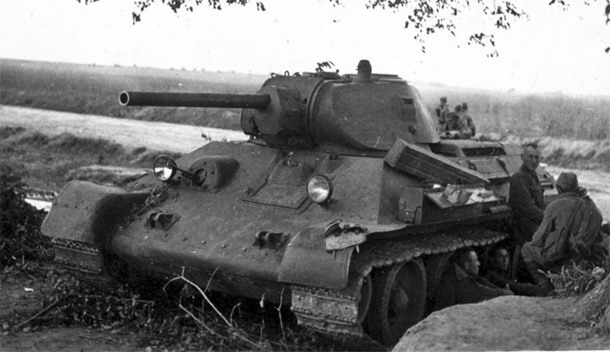
T-34 Model 1941 with F-34 gun and welded turret, source: waralbum.ru with permission, modified
The T-34M Project
Let us return to the earlier order halting T-34 production, issued in the summer of 1940 by Grigory Ivanovich Kulik (by then already a Marshal of the Soviet Union). As we have seen, series production went ahead regardless, but the new chief designer Morozov was required to begin work on eliminating the tank's shortcomings. Under Morozov's leadership, two modernisation projects were developed in 1941. The first, designated A-41, aimed to improve the tank's characteristics without altering its fundamental design. The most significant planned improvement was the installation of a larger three-man turret. This project quietly disappeared for reasons unknown — probably because it satisfied its critics too little, offering only minimal changes.
The second project carried the factory designation A-43 but became better known under the name T-34M. It is worth recalling that Kulik, in his efforts to halt T-34 production, had cited a comparative analysis against the German Panzer III, from which the German vehicle emerged ahead of its Soviet counterpart in a number of areas. The T-34M project therefore set out to close those gaps by adopting certain design features from the German tank. The new vehicle was to have six small road wheels with torsion-bar suspension — exactly as on the Panzer III — a larger three-man turret as on the German tank, a commander's cupola as carried on the German vehicle, and a multi-speed gearbox for smoother driving. From the original T-34, the steeply sloped armour and the armament were retained.
There is a certain irony in the fact that in 1940 the Soviets were trying to bring the T-34 closer to the German model, while a year later it was the Germans who were attempting to incorporate the T-34's qualities into their own new tank, the Panther. The T-34M would in all likelihood have replaced the T-34 in production had war with Nazi Germany not broken out in June 1941. Under those new circumstances there was neither time nor resources for developing new tank designs. Maximising output of the existing vehicles became the absolute priority. Even so, although the T-34M never entered production, several of its features were in later years adopted into the standard T-34.
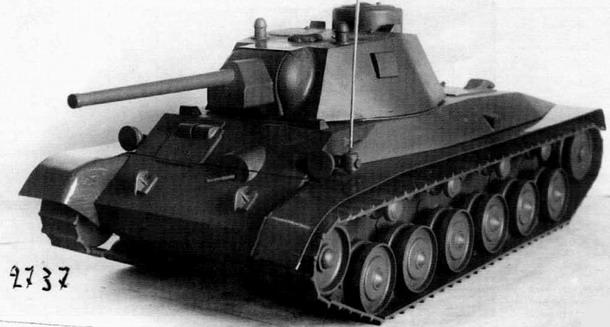
Model of the unbuilt T-34M tank, source: aces.gg, modified
From the start of production to the German invasion in June 1941, a total of 1,225 T-34 tanks had been completed. Only 967 of these, however, were actually available to combat units — the rest were still in factories, en route from factories to the army, or at military training establishments. An immediate decision was taken to intensify T-34 production. On 1 July, the State Defence Committee ordered the Krasnoe Sormovo Factory No. 112 in Gorky (today Nizhny Novgorod) to join production with immediate effect. The first tanks left this factory in November 1941, and by the end of the year 173 had been built there. The Kharkov Factory No. 75, however, was unable to produce sufficient V-2 diesel engines, and so the Krasnoe Sormovo factory was forced to fit its first production series with the petrol M-17T engine instead.
The overall production figures did not rise dramatically as a result — at least not in 1941. The reason was the loss of the T-34's main manufacturer, the Kharkov Factory No. 183. This plant was one of those that had to be evacuated eastward to avoid falling into the path of the rapidly advancing Germans. On 19 September 1941 the first trains left Kharkov carrying the machinery, workers, and materials of Factory No. 183, bound for Nizhny Tagil. There the evacuated Kharkov factory was merged with the local Uralvagon plant (the Uralsky vagonostroitelnyy zavod imeni F. E. Dzerzhinskogo). The combined enterprise became an enormous factory operating under the new name Uralsky Vagonostroitelnyy Zavod 183 imeni I. V. Stalina (Uralvagon for short). T-34 production resumed in December 1941, when the first 25 tanks rolled off the line — assembled from components evacuated from Kharkov.
During the second half of 1941, a total of 1,886 T-34 tanks were completed across all factories, the majority at the Stalingrad STZ plant, which was the only one that had operated without interruption throughout the year. Spreading production to new factories gradually introduced a variety of small differences by which the origin of a particular tank could be identified. A characteristic feature of STZ-built tanks, for instance, was a sharp-edged muzzle brake cover on the gun barrel. While the covers on tanks from other factories had a bend in them, the Stalingrad version had none.
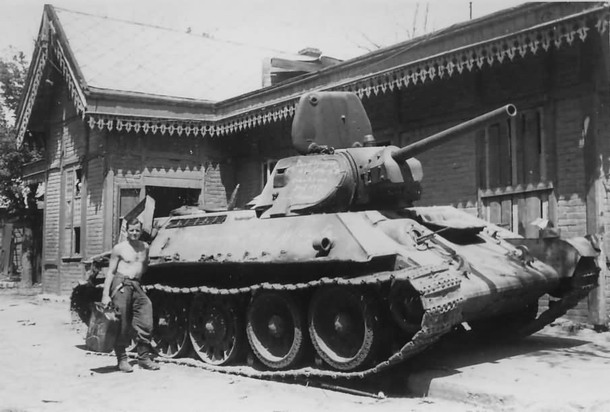
T-34 Model 1941/42 — already fitted with the new driver's hatch, but still with the unshielded machine gun and original tracks, source: Worldwarphotos.info with permission, modified
T-34 Model 1942
Although the overriding priority for 1942 was simply to push tank production to the maximum, a number of significant improvements nonetheless distinguished the T-34 Model 1942 from its predecessors. The armour of the cast turret was increased to 60 mm on the front face. The hull side walls were also thickened, from the original 40 mm to 45 mm. Some tank factories additionally welded on supplementary armour, particularly on the front hull and the turret sides. A new driver's hatch was introduced, equipped with two narrow vision ports with shutters, taken directly from the unbuilt T-34M project. This hatch type was retained unchanged in all subsequent T-34/85 tanks as well.
The hull machine gun received a new armoured collar that better protected this vulnerable area against hits. The service hatch in the rear hull wall changed from its original rectangular shape to circular. In the summer of 1942, supplementary fuel tanks appeared on the tanks, mounted on the rear hull wall above the track mudguards; these were angular in shape and held 40 litres each. New cross-pattern tracks also replaced the original smooth ones in 1942. Beyond these changes, numerous other modifications were made with the aim of simplifying and reducing the cost of production. These efforts succeeded in cutting the price of a T-34 from 269,500 roubles for the Model 1940 to 193,000 for the Model 1941, with further reductions in later years bringing the cost down to 135,000 roubles. This naturally involved some reduction in the quality of finish, but had no significant impact on reliability or overall combat value.
The improvements of the Model 1942 were not all introduced into series production simultaneously, but gradually. As a result, photographs frequently show tanks that carry only some of the 1942 features — typically the new driver's hatch — while retaining earlier components. These vehicles are sometimes referred to as T-34 Model 1941/42.

T-34 Model 1942 — note the armoured machine gun collar, new tracks, and new driver's hatch, source: Bundesarchiv_Bild_101I-240-2130-04, Wikimedia, Creative Commons, modified
In 1942, the Stalingrad STZ factory faced a rubber shortage and turned to producing a new type of all-steel road wheel. These were unpopular with crews, as the metal-on-metal contact at higher speeds produced uncomfortable noise and vibration. To mitigate this, crews fitted rubber-rimmed wheels on the first and last axles, where contact with the tracks was most intense, leaving the remaining axles with the all-steel type. This arrangement is clearly visible in photographs from this period.
When the Germans attacked Stalingrad in the summer of 1942, storm clouds began to gather over the factory there. Yet the plant continued production even as fighting raged around the city, right up until September when it was captured. To compensate for the loss of STZ output, additional factories were brought into T-34 production. From August 1942, part of the armaments complex at Chelyabinsk — which, thanks to its concentration of evacuated military factories, had earned the name Tankograd ("Tank City") — switched to building T-34s. In October, the Uralmash plant (Uralsky mashinostroitelnyy zavod) in Sverdlovsk (today Yekaterinburg) joined in. Other factories are mentioned in the literature as well, though it is not always entirely clear whether a given plant was producing complete tanks or only components.
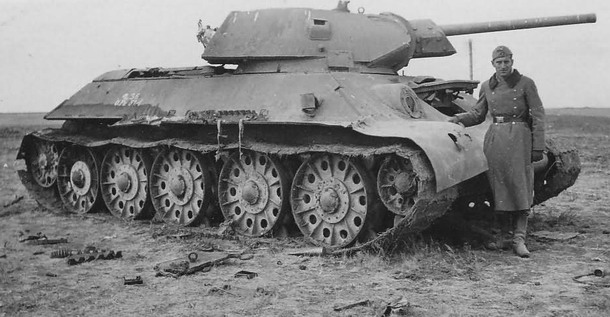
T-34 Model 1941/42 from the STZ factory — note the all-steel wheels without rubber rims and the distinctive muzzle brake arrangement below the gun barrel, source: Worldwarphotos.info with permission, modified
T-34 Model 1943
1943 brought — inevitably — the Model 1943. Its defining feature was a new hexagonal turret, designed and built by the Uralmash factory engineers at the end of 1942, drawing inspiration from the T-34M project. The new turret was more spacious than the original, which not only made life easier for the crew but also allowed more ammunition to be carried — the ammunition load for the gun increased from 77 rounds on the Model 1942 to a full 100. Despite being larger, the new turret still accommodated only two crew members, leaving one of the T-34's most persistent shortcomings unresolved.
The new turret also had thicker armour than the previous versions: 70 mm on the front face and 52 mm on the sides. Although the hexagonal turret was adopted by several factories, not all of them made the change, so some new tanks continued to be built with the older turret design. Turrets differed in minor details according to which factory had produced them. All factories except one cast their turrets; only Uralmash in Sverdlovsk produced pressed turrets, which had rounded roof edges. Their shape earned them the nickname "turtle-back," as they genuinely resembled a tortoise shell.
On the roof sat two circular hatches side by side — one each for the loader and commander — each with a single-piece lid opening towards the front of the tank. Tanks fitted with this turret earned the nickname "Mickey Mouse" from German soldiers, since with both hatches open the silhouette resembled the ears of the cartoon character. Ahead of the left hatch was an observation periscope. At the rear of the turret roof was an armoured ventilator cover. Slit-type vision ports were set into the side walls, and on some turrets small pistol ports for crew small arms were provided below them. During 1943 a commander's cupola — again inspired by the T-34M project — began to be fitted to the turret. The cupola gave the commander an all-round view and greatly improved his situational awareness on the battlefield.
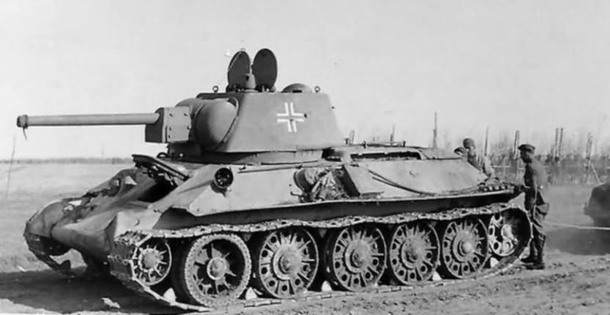
T-34 Model 1943 in German service — note the new turret with two circular hatches, source: worldwarphotos.info with permission, modified
Further changes on the Model 1943 included a new five-speed gearbox and new air filters. 1943 also saw the first appearance of cylindrical supplementary fuel tanks, mounted on the sides of the engine compartment. The weight of the T-34 Model 1943 stood at 30.9 tonnes. Despite the increase in weight, maximum speed did not fall — it remained 55 km/h on road and approximately 35 km/h cross-country. A significant new capability arrived in October 1943 with the introduction of the BR-350P sub-calibre round. This projectile, weighing 3.02 kg, could penetrate 92 mm of armour at a range of 500 metres.
The designation system for the various models was never formally standardised. It is therefore common to encounter designations shifted by a year — with the first model called Model 1939 — as well as designations for transitional versions such as Model 1940/41. The well-known and widely used designation T-34/76, reflecting the gun calibre, was not in fact Soviet in origin: it was introduced by the Germans. The Soviets simply called the tank with the 76.2 mm gun "T-34," and the later version with the 85 mm gun "T-34-85."
In September 1942, new German Tiger heavy tanks appeared, with 100 mm of frontal armour. The T-34 was no longer able to deal with these vehicles even with sub-calibre ammunition in a head-on engagement, and Soviet designers were forced to find a solution. The result was a new version of the tank armed with an 85 mm gun. The T-34/85 is covered separately in another section of this site.
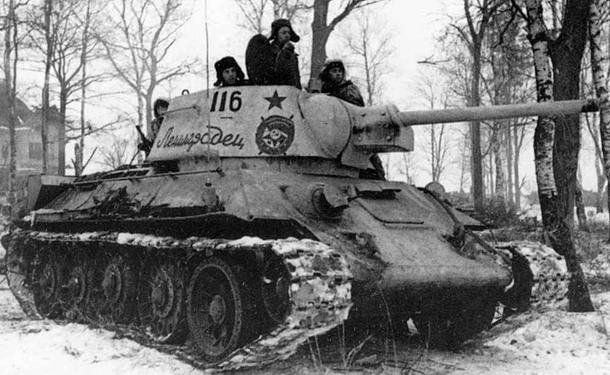
T-34 Model 1943 — to conserve rubber, only the first road wheel has a rubber rim; the rest are all-steel, source: worldwarphotos.info with permission, modified
Combat Deployment
Given their date of introduction, the T-34 tanks missed the Soviet-Finnish War, and so their combat debut came with the Great Patriotic War against the Nazis. In 1941, Soviet armoured forces were in the midst of a reorganisation begun the previous year. The Soviets were building enormous mechanised corps, each numbering more than a thousand tanks. According to the May 1941 plan, 30 such corps were to be formed. How many tanks the Red Army actually had at the moment Operation Barbarossa began is a difficult question, and many different figures appear in the sources. The total is sometimes given as high as around 23,000 — a quantity at which it seems almost impossible that the Germans with their three and a half thousand tanks could have succeeded at all.
The Soviet tank figures, however, need to be examined more closely. Over 4,000 vehicles were unfit for combat for various reasons, and by no means all tanks were positioned in the border military districts where they could actually take part in the defence. It is recorded that on 1 June 1941 the Soviet Army had 18,691 combat-ready tanks. Of these, 12,782 were deployed in the five border districts — the Leningrad, Baltic, Odessa, Western Special, and Kiev Special Military Districts — and of those, "only" 10,746 were in combat-ready condition. It should also be borne in mind that the great majority of these tanks were older types and light tanks. Of the total number in the border districts, only 967 were T-34s. The exact distribution of those among the various mechanised corps is a matter on which widely differing figures circulate — partly due to the Soviet command itself, which deliberately obscured the true numbers to conceal the scale of the losses.
Not even all the T-34s were in ideal fighting condition. They suffered from clutch and main gearbox failures, and there were insufficient spare parts and ammunition. Adequately powerful recovery vehicles were also lacking. Most of the crews of the new tanks had virtually no experience — many had received their vehicle only days before the war broke out. Drivers often had just a few hours of time behind the wheel of the new tank, and a fair number of gunners had never fired the new gun at all.
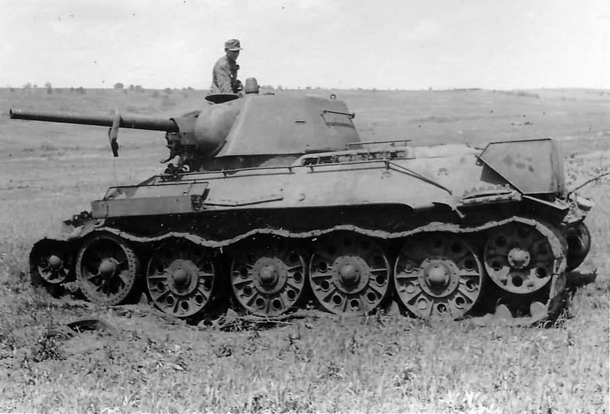
Destroyed T-34 Model 1943 — note the supplementary tank at the rear, source: worldwarphotos.info with permission, modified
Historians frequently debate whether the Germans knew of the T-34's existence before Operation Barbarossa began. The combat reports of front-line units make plain the complete shock and surprise at encountering the unknown Bolshevik armoured vehicle. On the other hand, Germany had military attachés in the Soviet Union who had the opportunity to see the new tanks at the May Day military parade in 1941, and it was their job to report this to Berlin. The German command therefore probably was aware that such a tank existed — but this information apparently never filtered down to the front-line units themselves.
At the time of the attack on the USSR, German self-confidence was also at its height after the lightning victories across Europe, and the Nazis did not perceive some new Soviet machine as anything to be particularly concerned about. After all, the Wehrmacht had encountered stronger tanks than its own in France and had prevailed — so why not in Russia too? The front-line units that actually had to face the T-34 in combat, however, certainly did not see it so simply.
The first encounters with individual T-34s occurred on the very first day of the operation — 22 June 1941. The most common towed anti-tank weapon in the German army in 1941 was still the 37 mm gun. Against the strong and sharply sloped frontal armour of the T-34, this was an extremely weak weapon: at over 200 metres, German rounds simply bounced off, and at closer range they merely buried themselves in the armour. The most effective weapon against the T-34 proved to be the towed 88 mm anti-aircraft gun. The Germans did not have as many of these as they needed, however, and had to make do with what they had. This usually meant letting the T-34 come close enough and hoping to destroy the tracks, jam the turret ring with a hit to the turret race, or penetrate the armour at a weaker point such as the hull machine gun embrasure.

T-34 Model 1943 with commander's cupola in Wehrmacht service, source: worldwarphotos.info with permission, modified
How, then, was it possible that the T-34 suffered such enormous losses in the first weeks and months of Operation Barbarossa? The Soviets had in their hands a fighting vehicle that surpassed everything their enemy could field, yet they were unable to use it properly. It was a combination of many factors. Beyond the mechanical unreliability and crew inexperience already mentioned, the most damaging was the abysmal standard of tactical command, supply, and maintenance. The entire army still bore the consequences of the political purges. Experienced officers capable of commanding larger formations were absent; many of those in post were fresh graduates of military schools with no practical experience. Behind every commander, moreover, stood a political officer with orders to shoot him if his conduct was deemed cowardly. This completely paralysed the independence and initiative of junior commanders, who preferred to wait passively for orders from above rather than act on their own judgment.
Logistical problems were compounded by the difference in fuels. The majority of Soviet tanks had petrol engines, so petrol supply took priority over diesel deliveries. Reconnaissance was a complete failure. Tank units were frequently sent on long road marches without encountering the expected enemy. Combined with the poor diesel supply, this had literally fatal consequences — the Germans regularly came across undamaged tanks that had simply run out of fuel, with no means of replenishment in time. Recovery vehicles were also in critically short supply, and the Germans often found operational tanks stuck in mud or abandoned with only minor faults.
Soviet coordination between different arms was equally poor. The German advance was a model of cooperation between tanks, infantry, artillery, and air power. On the Soviet side, nothing of the sort applied. A large part of the Soviet air force had been destroyed on the ground, leaving the German Stukas free to attack moving tank columns with impunity. Even individual tank attacks were poorly coordinated due to the absence of radios. The command tank was easily identified by the enemy by its long whip antenna, and the Germans concentrated all their fire on it — once destroyed, the entire Soviet counter-attack usually collapsed.
page under construction...

ARTICLE
CONTENTS:
Reproducing text from the Tankist website without the written consent of the operator is prohibited.