TANK T-28
the Soviet mastodon with five turrets
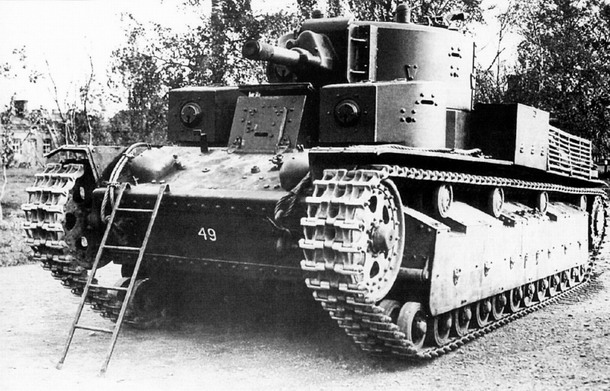
medium tank T-28, source: Waralbum.ru with permission, edited
Origins of the Tank
Development of the T-28 began in 1931 at the Bolshevik plant in Leningrad, under chief designer N. V. Tseyts. According to the army specification, the new tank was to be capable of breaking through fortified points in the enemy line, opening the way for lighter tanks and infantry. It was to have robust armour and powerful armament. At the time this project was conceived, multi-turret tanks were very much in fashion across Europe. The Western powers were also experimenting with the concept, but most quickly recognised the drawbacks and abandoned their projects. The Soviet Union did not. There, two types of multi-turret tank actually reached series production — the medium T-28 and the heavy T-35.
The First Prototype
The T-28 prototype was completed before the end of 1931. The vehicle rode on a relatively tall running gear with twelve road wheels on each side. The road wheels were rubber-tyred and only 28 cm in diameter. They were arranged in pairs, each pair mounted on a shared bogie with a coil spring. The bogies were then linked in groups of three — the three front bogies with their six wheels, and the three rear bogies with their six wheels. The suspension mechanism was covered by sheet metal fairings and was not visible from outside. The track assembly was completed by a spoked idler wheel at the front and a spoked drive sprocket at the rear, with four return rollers supporting the upper run of the track.
The hull was constructed from steel plates joined by riveting. The fighting turrets were located in the forward half of the hull. The main turret was mounted on the centreline of the hull on a raised superstructure, with two supplementary machine-gun sub-turrets positioned on either side of the hull in front of it. A 45 mm cannon was installed in the front face of the main turret, while the sub-turrets were armed with 7.62 mm DT machine guns. The main turret was fully rotating; the machine-gun sub-turrets could traverse only within a 165° arc. The main turret's traversing mechanism was driven by an electric motor — a complete novelty for its time. In the rear of the hull was the engine compartment, housing the originally aircraft-derived M-17 petrol twelve-cylinder engine producing a maximum of 450 horsepower at 1,400 rpm. Two fuel tanks held a combined total of 660 litres of petrol. The gearbox provided five forward gears and one reverse. The prototype weighed 18 tonnes.
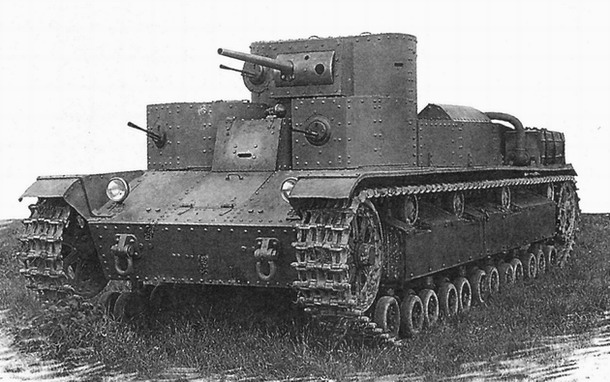
T-28 prototype, source: Wikimedia, Public domain, edited
Trials of the prototype were conducted in 1932 and revealed a number of deficiencies. Nevertheless, a decision was taken that once these were resolved the tank would enter series production, which was to take place at the Krasny Putilovets plant (later renamed the Kirov plant). At the end of 1932 the prototype and all technical documentation were transferred there, and the plant's engineers began working to address the identified shortcomings. The changes they made brought about a significant difference in appearance between the series production tanks and the prototype.
Series Production Tanks
The series tanks first received new turrets, of the same design as those used on the T-35 — standardisation intended, naturally, to reduce production costs. A new main armament was also installed in the new main turret: the KT-28 gun of 76.2 mm calibre with a barrel length of 16.2 calibres. The original 45 mm cannon had rightly been considered too weak by the military. 69 rounds of ammunition were carried for the gun.
A 7.62 mm DT machine gun was installed to the right of the cannon — the same type as in both supplementary sub-turrets — giving the tank a total of three machine guns. Further improvements included the replacement of riveted joints at some critical locations with welding. The tank's armour was also thickened, reaching 30 mm on the hull front. This brought the tank's weight up to as much as 25 tonnes (some sources give a higher figure). The engine remained unchanged from the prototype. The series T-28 was capable of an impressive maximum speed of around 40 km/h.
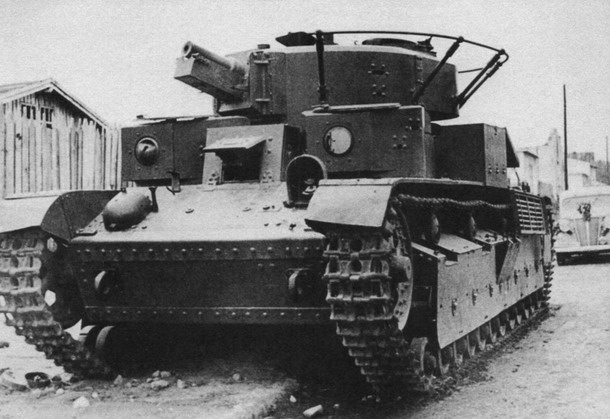
T-28 with KT-28 gun, here in the command version with the frame antenna around the turret, source: Waralbum.ru with permission, edited
The crew consisted of six men. The driver sat in the centre of the forward hull section, his head enclosed in a small armoured box projecting from the hull roof between the two machine-gun sub-turrets. In the front face of this box was a closable rectangular vision port. When the cover was shut, the driver could still look out through a vision slit. The entire front plate of the driver's box was also hinged, as was the forward portion of the hull roof above it — when both were folded open, they formed a hatch large enough for the driver to enter and exit the vehicle.
The other two crew members in the hull were the machine gunners, each stationed in one of the sub-turrets, with their own square hatch in the roof of their respective turret for entry and exit. The remaining three crew — the commander, the gunner, and the loader — were stationed in the main turret, which they accessed through a pair of hatches in the rear section of its roof.
Series production began in early 1933. The first eight hull assemblies were completed in February, and by the May Day celebrations of 1933 twelve complete tanks were ready. Ten of them appeared in the military parade in Moscow on the first of May, while the remaining two took part in the parade in Leningrad. On 11 August 1933 the tank was officially accepted into service with the Red Army under the designation T-28. Production continued for the next seven years until 1940, resulting in a total of around five hundred vehicles — figures of 503, 490, and other numbers are all cited.

T-28 with L-10 gun in Finnish service, source: Waralbum.ru with permission, edited
Tank variants
Over the long production run, many minor and more substantial design changes were introduced. Based on the most significant of these, four models of the tank can theoretically be distinguished. The first has already been described above. The change that defined the second model came in 1938: it was the installation of the new L-10 gun of the same calibre but with a longer barrel, a higher muzzle velocity, and therefore greater penetrating power. At the same time, an additional DT machine gun was fitted in the rear wall of the main turret — and a fifth machine gun of the same type could be mounted on a ring mount around one of the hatches in the main turret roof. Following combat experience in Finland, a further modification was applied to several tanks in 1939: a radical increase in armour thickness, up to 80 mm on the hull front and 40 mm on the sides. This modification brought a corresponding increase in weight to 32 tonnes and a drop in maximum speed to 23 km/h. The more heavily armoured version was designated T-28E. The final modification was the installation of a new conically-shaped turret in 1940, though this affected only a handful of tanks. The new turret with its sloped walls offered improved resistance to enemy fire.
Also worth mentioning is the command version of the tank, fitted with a 71-TK-1 and later 71-TK-3 radio set. These vehicles are immediately identifiable by the large frame antenna that encircled the main turret, supported on eight struts. The radio allowed command tanks to communicate with rear headquarters. Ordinary tanks, however, were not equipped with radios, and communication with them was only possible using signal flags. The prominent antenna made command tanks an easily identified and eagerly sought target for enemy fire.
In 1937 a prototype of a submersible variant of the T-28 was built. The T-28 PCh, as this vehicle was designated, was hermetically sealed throughout, with engine air intake and exhaust handled by a snorkel system. Tests confirmed that the vehicle was capable of travelling along the bottom at depths of up to 4 metres — yet it was never approved for series production, and its first prototype remained its last. A similar fate befell another variant designed for mine clearing. This modified tank pushed two large rollers ahead of it, joined by a frame, which detonated mines beneath them. Trials of the prototype ran from May to July 1939 and exposed a fundamental weakness: the mine-clearing mechanism could survive only two to three detonations before becoming unusable — thoroughly inadequate for the task. The entire mine-clearing tank project was terminated in 1940.
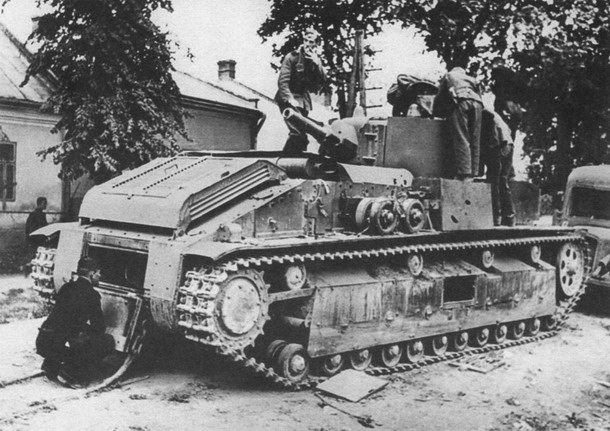
German soldiers examining a knocked-out T-28 with additional turret armour, source: Waralbum.ru with permission, edited
A purely experimental variant built in 1938 featured a redesigned running gear: instead of twelve small road wheels, six larger wheels were fitted on each side, individually suspended and sprung by torsion bars. From the outset this was more of a general test of a new suspension concept than a new version of the T-28 as such, and it is therefore unsurprising that it never entered production. For the same reason, another T-28 modification was built experimentally armed with an 85 mm F-39 gun — primarily a trial of the weapon itself rather than development of a new tank, and again production never followed.
One variant that did reach production was the bridge-layer, designated IT-28. In this conversion all turrets and part of the hull superstructure were removed. The front face of the superstructure was raised and fitted with two machine guns as the vehicle's only integral armament. A lifting beam was added to the hull roof, carrying a large two-rail bridge. The bridge measured 13.3 metres in length and 3.35 metres in width, weighed 4.2 tonnes, and had a load-bearing capacity of up to 50 tonnes. Laying the bridge reportedly took 1 to 3 minutes; reloading it onto the vehicle took 3 to 5 minutes. The total weight of the bridge-layer with the bridge fitted was 29 tonnes.
Trials of the IT-28 were conducted in July 1940 and confirmed the vehicle's viability. Series production was approved in 1941 but was never actually launched — Operation Barbarossa and the German invasion arrived, fundamentally reshuffling the priorities of armoured vehicle production.
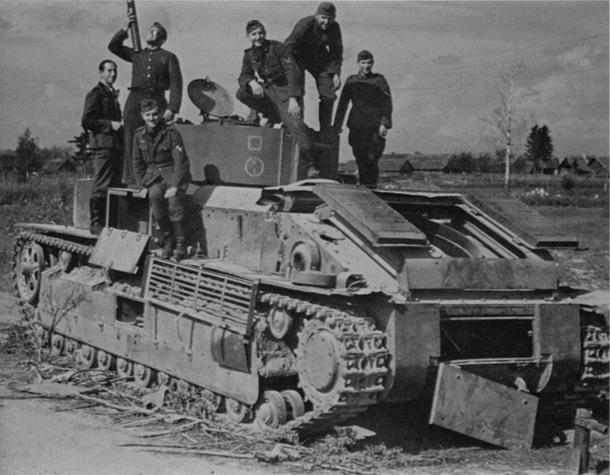
German soldiers examining a knocked-out T-28 — note the open cover of the large fan above the engine, source: Waralbum.ru with permission, edited
Combat deployment
The first unit to receive T-28 tanks was the 2nd Independent Reserve Regiment of the Leningrad Military District's Supreme Command. In 1933 this unit received the first ten tanks of the type. A year later, six tank regiments armed with T-28s already existed: in addition to the 2nd Regiment, there was the 1st in Smolensk, the 3rd in Moscow, the 4th in Kharkov, the 5th in Kyiv, and the 6th in Slutsk. In December 1935 a reorganisation took place in which the regiments were disbanded and new heavy tank brigades were formed. Two of them — the 10th and 21st — took part in the Soviet invasion of Poland in September 1939, and it was there, within those brigades, that the T-28 had its combat debut. The 10th Brigade had 98 T-28 tanks on strength when Poland was attacked; the 21st Brigade had as many as 105.
T-28s also took part in the Soviet-Finnish War at the turn of 1939 and 1940. The Finns, however, proved a far tougher opponent than the Poles, who had already been brought to their knees by the Wehrmacht's attack from the west. The Soviets suffered heavy losses in Finland in both men and equipment, and the T-28 was no exception. The experience gained in Finland was ultimately the main reason for the armour reinforcement applied to the T-28 at the end of 1939.
The tank's real ordeal, however, came with the outbreak of war against Nazi Germany in 1941. In theory, the T-28's armament and armour were comparable to its German counterparts, the Panzer III and Panzer IV — but in practice the battlefield told a different story. In the first months of fighting the Soviets suffered enormous losses, and the T-28 was no different. The superb German tactical coordination of tanks, infantry, artillery, and air power meant that the number of T-28s in the Soviet Army fell dramatically by the end of 1941. The Soviets themselves began progressively withdrawing the type from frontline service and replacing it with more modern vehicles. The last known combat action of these tanks was in the defensive fighting around besieged Leningrad in 1943.
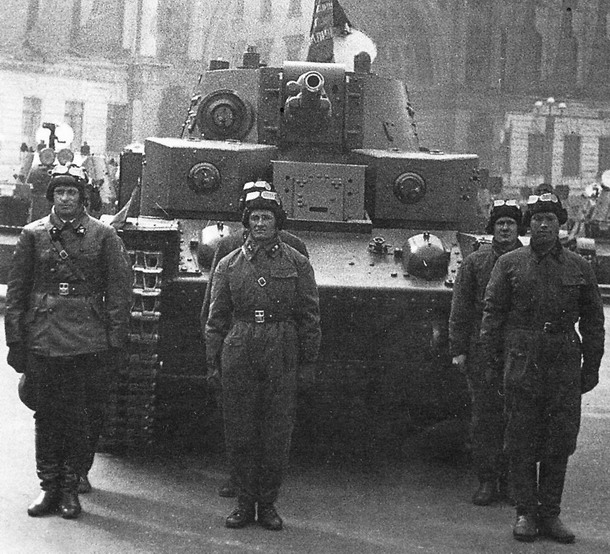
T-28 with conical turret, source: Waralbum.ru with permission, edited
In 1935 the Soviets sold two T-28 tanks to Turkey, where they remained in service even after the Second World War. Another operator was Finland, which captured two T-28s during the Winter War and five more during the Second World War. The Finns committed these captured tanks to battle against their original owners, but were required to surrender all of them after the war ended — keeping only one, which they converted into a recovery vehicle. A certain number of T-28s were also captured by the Germans, who used them primarily for testing purposes but most likely also deployed some in combat.
Technical Specifications
Weight |
25.2 t |
Length |
7.36 m |
Width |
2.87 m |
Height |
2.62 m |
Engine |
M-17 |
Maximum output |
500 hp |
Maximum speed |
38 km/h |
Range – road |
180 km |
Range – cross-country |
100 km |
Turret armour |
20 mm |
Hull armour |
20–30 mm |
Armament |
1 x 76.2 mm gun KT-28 or L-10 3 to 5 x 7.62 mm DT machine gun |
Crew |
6 men |

ARTICLE
CONTENTS:
Reproducing text from the Tankist website without the written consent of the operator is prohibited.