TANK IS-1
Stalin's Heavy Hitter

IS-1 tank, source: Aviarmor.net with permission of the operator, modified
Origins of the Tank
At the turn of 1942 and 1943, the development of heavy tanks in the Soviet Union had reached a dead end. The existing heavy tanks of the KV series were no longer meeting the demands of the modern battlefield. The KV-2 tanks, though impressive in appearance, had proven simply too slow for the fast-paced style of warfare the Germans were applying. Complaints from crews about the KV-1 were also mounting, as its vulnerability grew with the introduction of more effective anti-tank weapons on the enemy's side. Soviet designers tried to address this shortcoming by adding more armour, but that only led to a very unpleasant reduction in mobility and further complaints from the troops.
Neither the upgraded KV-1S, which was somewhat lighter and faster, nor the prototype KV-13 with its sturdy, partially cast armour, offered a way out of the vicious cycle. On top of that, both the KV-1S and the KV-13 were still armed with "only" 76.2 mm guns. Soviet military officials were beginning to ask what purpose the heavy KV tanks actually served, given that they offered practically nothing the medium T-34 could not also do, while costing far more to produce than the T-34. In December 1942, two more tank prototypes based on the KV-13 chassis were built, designated Object 233 and Object 234, but by that point the army leadership had essentially lost interest. The entire heavy tank programme was on the verge of cancellation in favour of more efficient production of medium-class tanks.
Everything changed decisively in January 1943, when the Soviets captured their first example of the new German Tiger tank. The captured vehicle was sent to Moscow for thorough examination. Firing trials produced deeply unwelcome results for the Soviet high command. The 76.2 mm guns of the T-34 and KV-1 could only penetrate the new German machine at suicidally close range. Further development of heavy tanks was immediately given the green light.

Object 237 prototype with S-31 gun, source: Wikimedia, Public domain, modified
First Prototypes
As early as February, the GKO (Gasudarstvenyj kamitet oborony – the State Defence Committee) ordered development of a new heavy tank to begin, based on the latest prototypes – the KV-13, Object 233 and Object 234. The development programme was named IS (also rendered as JS in some Western sources) in honour of Iosif Stalin. In March and April, trials of Object 233 and 234 were conducted to identify any shortcomings. However, the KV-13 and Object 233 prototypes were still armed only with 76.2 mm guns, which had proven inadequate against the new German armour. Object 234 carried the U-11 tank howitzer of 122 mm calibre, which also failed to meet current requirements. The primary task was therefore to find a new, more powerful weapon for the future IS-series tanks.
Firing trials against the captured Tiger were concluded in April 1943. The 52-K M1939 anti-aircraft gun of 85 mm calibre proved to be highly effective against the Tiger's armour during those tests. On 5 May, the GKO therefore issued Decree No. 3289ss, officially tasking two design bureaux with developing a tank version of that anti-aircraft gun. The two bureaux were the Moscow Central Artillery Design Bureau led by Vasily Gavrilovich Grabin, and the design department of Factory No. 9 led by Fyodor Fyodorovich Petrov.
In mid-June both designers presented their work. Grabin's gun was designated S-31, while Petrov's was named D-5T. In the case of Petrov's weapon, it was an adapted version of the D-5S gun developed for the SU-85 self-propelled gun. It was clear from the outset to the designers of the new tank that fitting an 85 mm weapon into the existing turret would severely restrict the interior space and make the crew's work extremely difficult. A decision was therefore made to develop a new, larger turret. Installing the new cast turret in turn required lengthening the hull and running gear by a full 42 cm. The suspension was accordingly extended, a sixth road wheel was added to the original five, and the new 85 mm gun could finally be installed. The result of all these modifications was the prototype designated Object 237. By the end of July 1943, two test vehicles had been built – one with the S-31 gun and one with the D-5T. The two machines can be told apart in photographs by the way the gun is mounted.
Object 237 prototype with D-5T gun, source: Wikimedia, Public domain, modified
Experiments were also carried out with fitting an 85 mm gun into a production KV-1S. Here too, however, the standard turret proved too small for the new weapon. The designers therefore decided to try fitting not just a more powerful gun but an entirely new turret onto the KV-1S – and they tried it with both gun variants. This led to two further test prototypes: Object 238 with the S-31 gun and Object 239 with the D-5T. All four prototypes (the two variants of Object 237, Object 238 and Object 239) were tested in July 1943. The vehicles with the S-31 gun failed the trials, and the prototypes approved for production were Object 239 and Object 237 with the D-5T gun. The former entered series production as the KV-85 (described separately), and the latter as the IS-85. The tank became better known, however, under the designation IS-1, which it officially received in March 1944 after its younger sibling with the "2" in its name had appeared.
Technical Description
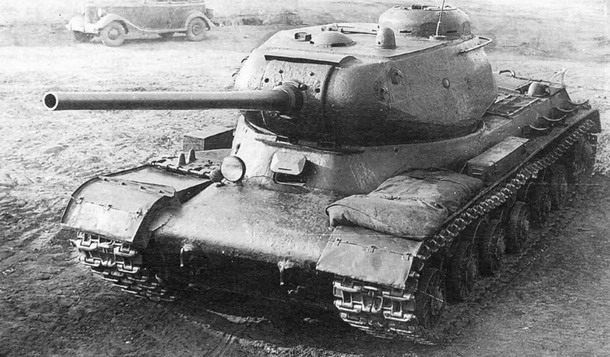
The IS-1 ran on a suspension derived from that of the KV-series tanks, to which it was therefore closely related in design. On each side it had six twin solid road wheels with star-shaped indentations, each independently suspended and sprung by torsion bars. At the front was an idler wheel identical in size to the road wheels. At the rear was the toothed drive sprocket, the largest wheel in the entire running gear assembly. Three evenly spaced return rollers supported the track from above.
The lower front hull plate was followed by a sharply angled glacis, above which the driver's frontal plate rose above the level of the mudguards. The centre of this plate was flat and housed the driver's rectangular, closable vision port. When the port was shut due to combat danger, the driver could only see through a narrow slit in the cover. A pair of periscopes passing through the roof above his station gave him a view to the sides. The glacis curved on both sides, flowing rearward into the turret ring. Behind the turret ring, the hull maintained a constant width all the way to the stern, with only the slightly wider track mudguards projecting to the sides. The lower front hull plate was 100 mm thick, the angled glacis above it 60 mm, and the driver's frontal plate a full 120 mm.

IS-1 tank, source: Flickr.com with permission of the publishing user, modified
The tank's turret was positioned closer to the front. It was largely cast, giving it rounded shapes with no hard edges. All turret walls were 100 mm thick, with a 30 mm roof. In the bulged frontal wall of the turret was mounted the aforementioned D-5T gun of 85 mm calibre, and coaxially with it a DT machine gun of 7.62 mm calibre. A second machine gun of the same type was fitted in a ball mount in the right half of the rear turret wall. A third DT machine gun was carried loose inside the hull. Three types of ammunition were used for the main gun: a high-explosive fragmentation shell 53-UO-365 weighing 9.08 kg with a muzzle velocity of 785 m/s, an armour-piercing round 53-UBR-365 weighing 9.02 kg with a muzzle velocity of 792 m/s, and finally a sub-calibre round weighing 4.99 kg that left the barrel at 1,200 m/s. A total of 59 main gun rounds were carried on board. Machine gun ammunition stowage amounted to 2,520 rounds.
Both side walls of the turret had small, closable pistol ports for the crew to fire their personal weapons. In the left rear section of the turret roof was a commander's cupola fitted all around with a ring of vision ports. The cupola had a circular hatch closed by a two-piece lid. A second circular hatch, this one with a single-piece lid, was located to the right of the commander's cupola. The turret roof also featured a ventilator outlet, a rotating periscope and various other fittings. Handrails for infantry riders were welded to the sides of the turret.
The crew consisted of four men: driver, commander, gunner and loader. The driver sat in the front of the hull, while the rest of the crew occupied the turret. The driver had no dedicated hatch of his own and had to squeeze into his station through the turret hatches, just like the rest of the crew. When required, the commander operated the machine gun in the rear turret wall. Behind the turret was the engine and transmission compartment. Inside sat a twelve-cylinder diesel engine B-2IS with a maximum output of 520 horsepower at 2,000 rpm. With it, the tank was capable of reaching an impressive top speed of 37 km/h on roads.

rear of IS-1 tank, source: Flickr.com with permission of the publishing user, modified
The engine compartment was separated from the rest of the interior by a bulkhead with only a service opening for the most essential repairs that could be carried out from inside the vehicle. The roof of the engine compartment had louvred grilles for air intake. In the rear wall were access panels for servicing. On each side of the engine compartment, two additional fuel drums were mounted, one on each side.
IS-1E Prototype
Alongside the production tank, one further interesting experimental prototype was built, designated IS-1E. It differed not only in its running gear but above all in its powertrain. The suspension on each side consisted of five large solid road wheels. The front idler and rear drive sprocket were identical to those of the production tanks. Between the last road wheel and the rear drive sprocket there was a large gap, and within it an additional idler roller mounted in a completely unconventional position on the lower run of the track. The upper return rollers had disappeared entirely, as the track rested directly on top of the large road wheels.
An even more significant change took place inside the vehicle. Soviet designers decided to test a hybrid petrol-electric drivetrain on this prototype. The principle was that the combustion engine did not drive the tank's sprockets directly but instead powered only an electric generator, which in turn supplied current to an electric motor that was connected to the drive sprockets. The advantages of this arrangement were easier handling and smoother travel without the need to change gears. However, these advantages were outweighed by several drawbacks: unnecessary complexity, significant energy losses and a higher susceptibility to mechanical failure. The Soviets eventually recognised this, and the IS-1E prototype remained the first and last of its kind.

IS-1 tank, source: Flickr.com with permission of the publishing user, modified
It is worth noting that the Germans also experimented with this type of drivetrain, with Professor Porsche being its most ardent advocate. Their attempts too ended in failure in the vast majority of cases, and the only vehicle with such a drivetrain to enter series production was the heavy tank destroyer Ferdinand.
Combat Deployment
The Red Army officially accepted the IS-1 into service on 4 September 1943. The tanks did not see their first combat action, however, until February 1944. On 15 February, the 13th Guards Tank Regiment arrived in the area of Korsun-Shevchenkivskyi in central Ukraine, with 21 IS-1 tanks on its strength at the time. The regiment joined an attack on the village of Lysyanka against the German 3rd Panzer Corps. It must be said that this combat debut did not go particularly well for the new tanks. Five IS-1s drove into the assault on the village and all five were knocked out by fire from German tanks and self-propelled guns. The village was eventually captured, but mainly because the encircled Germans had run out of fuel.
The first documented engagement between IS-1 tanks and German Tigers took place on 4 March 1944 near the Ukrainian town of Staro-Konstantinov. The 1st Guards Tank Regiment clashed there with a company from the German 503rd Heavy Tank Battalion. The day's tally was two damaged Tigers on the German side and one destroyed and two damaged IS-1s on the Soviet side.
These early combat results only confirmed the concerns of Soviet military officials that the IS-1 would not be an effective enough weapon against the most modern German armour, and that developing the more powerful IS-2 had been the right decision. Production of the IS-1 took place only in the second half of 1943, and just 107 vehicles were built in total.
Technical Specifications
Weight |
44 t |
Length |
8.56 m |
Width |
3.07 m |
Height |
2.73 m |
Engine |
B-2IS |
Maximum power |
520 hp |
Maximum speed |
37 km/h |
Hull armour |
front 100 – 120 mm sides 90 mm rear 60 mm |
Turret armour |
walls 100 mm roof 30 mm |
Armament |
1 × D-5T gun, 85 mm 3 × DT machine gun, 7.62 mm |
Crew |
4 men |

ARTICLE
CONTENTS:
Reproducing text from the Tankist website without the written consent of the operator is prohibited.