HETZER
light tank destroyer from Prague's ČKD
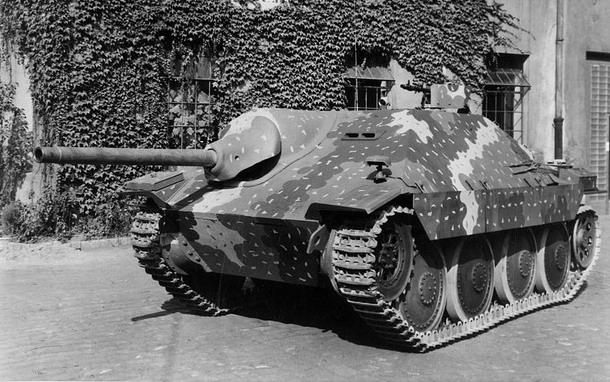
Jagdpanzer 38(t) Hetzer in the factory yard, source: Praga archive, with permission of the company representative, edited
What to do with the ČKD plant?
The proposal to build a new light tank destroyer emerged from discussions within the German Army High Command in December 1943. The OKH (Oberkommando des Heeres) was reportedly looking simply for additional production capacity for the StuG III assault gun, and their attention fell on the Prague plant of BMM (Böhmisch-Mährische Maschinenfabrik), the successor company to ČKD in the Protectorate. At the time, this factory was producing the Marder III tank destroyer, which could fairly be described as already outdated and insufficient for current needs. A survey of production capacity, however, revealed that the Prague plant lacked the equipment to manufacture the 24-tonne StuG and could only build lighter vehicles. The Germans therefore decided to use the plant at least for the construction of a new light self-propelled gun, whose design would make use of the tried-and-tested chassis of the PzKpfw 38(t) tank.
The PzKpfw 38(t) tank itself was no longer in production by this point, but thanks to its sound performance in wartime service, production of its chassis and drivetrain components continued as the basis for other combat vehicles. Alongside the already-mentioned Marder III, the same chassis was also used by the anti-aircraft tank Flakpanzer 38(t) and the self-propelled gun Grille.
Since the technological constraints of the Prague plant meant that only a light vehicle could be built there, it was decided this limitation would be compensated by a high top speed. The Ordnance Office's requirements for the new combat vehicle therefore called for a maximum speed of 55 to 60 km/h — a requirement which, I should note upfront, was never actually met. The vehicle was to weigh around 13 tonnes and have a fully enclosed fighting compartment with steeply sloped walls. Both of these requirements were entirely logical. The open fighting compartment, and the poor crew protection that came with it, had been the principal weakness of the previous generation of Marder III tank destroyers. The sloped armour, meanwhile, was intended to compensate for the thin plating dictated by the weight limit. Only the front face, at 60 to 80 mm, was to be proof against artillery fire; the remaining surfaces could be thinner, sufficient to resist small-arms fire and shell fragments. As for armament, it was decided to use the 75 mm PaK 39 gun, which also equipped the German Jagdpanzer IV in its L/48 variant.
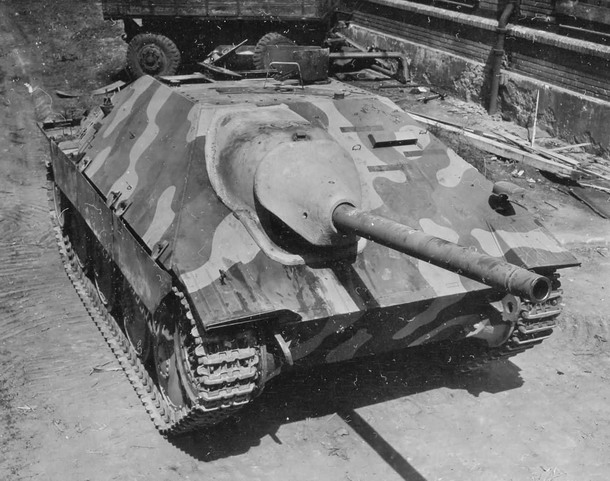
Jagdpanzer 38(t) Hetzer captured by the Allies in the factory yard in Pilsen, source: worldwarphotos.info, public domain, edited
A lightning-fast production start
On 17 December 1943, Hitler approved the project, declaring it the best possible use of the BMM plant. Work on the design got under way at a racing pace, and by 24 January 1944 a full-scale wooden mock-up of the vehicle was already complete and ready to be presented to the Ordnance Office committee. The first three prototypes were then built in March 1944. Given the enormous urgency of the programme, there was no question of thorough prototype testing. After all, the chassis, engine, gearbox, and gun of the new vehicle were all components that had been in production and thoroughly proven for years. Series production was ordered from April onwards, with output set to ramp up progressively to a target of 1,000 vehicles per month by March 1945. Škoda in Pilsen was to join production from July 1944. At full capacity, both the Prague and Pilsen plants would each produce five hundred vehicles per month.
The first mock-up had a shorter fighting compartment than the later production vehicles. The engine bonnet was longer and sloped more gradually. The gun barrel shroud was also changed from the mock-up. The prototypes in turn differed from the production vehicles in the design of the gun mount on the front hull plate: on the prototypes it intruded more deeply into the front plate, had irregular edges, and was fixed with externally visible rivets. On production tank destroyers, no rivets were visible and the edge of the mount followed more closely the shape of the spherical gun mantlet — the so-called Kugellafette.
It is almost unbelievable that the Prague plant actually succeeded in completing the first 20 required production vehicles in April — just one month after building the prototypes, and only four months after the original concept was first conceived. That is an utterly unique pace of development. On 20 April, Hitler's birthday, the new armoured vehicles were demonstrated to the Führer. As photographs show, the tank destroyers were not yet fully complete on that day — at minimum, the gun barrel shroud was still missing. In May, 50 examples were completed as planned, and in June a full hundred new tank destroyers rolled off the production lines. It should be noted, however, that army inspectors found a number of deficiencies and faults when accepting the vehicles. Production quotas for subsequent months were therefore reduced to allow the factory to complete vehicles to a standard the army considered acceptable.
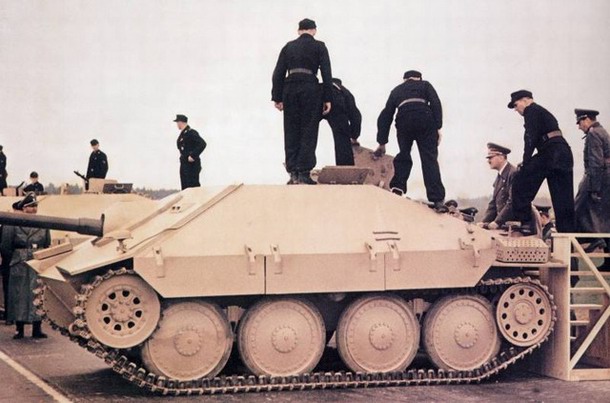
April 1944, Adolf Hitler inspects the first examples of the Jagdpanzer 38(t); note that the tank destroyer still lacks its gun barrel shroud, source: Flickr.com with permission of the publishing user, edited
As for the official name of the new combat vehicle, various accounts differ considerably. In the earliest documents discussing the future vehicle, the names "leichte Sturmgeschütz 38(t)" and "leichte Panzerjäger 38(t)" appear. The later official designation was most likely "Jagdpanzer 38(t) für 7,5 cm PaK 39 L/48". The combat name Hetzer (meaning "baiter" or "harrier") was, according to some sources, assigned in the autumn of 1944 when the official designation changed to "Jagdpanzer 38(t) Hetzer".
Other sources, however, maintain that the name Hetzer was never official and that its association with this vehicle came about through a complete misunderstanding. Hetzer was the designation for a planned light tank destroyer project called E-10, which bore a considerable resemblance to the Jagdpanzer 38(t). At one meeting with representatives of the Czech factory, German army officials apparently mentioned this project as a competitor to the vehicle under discussion — but the Czech side incorrectly understood them to be referring to their own new vehicle. The Czechs therefore used the name Hetzer in the official documentation accompanying the first deliveries to combat units. From there the name found its way into reports reaching the Inspectorate of Armoured Troops, where it was assumed the soldiers themselves had spontaneously given the vehicle this name — which was of course not the case. Whatever the truth of the matter, the name Hetzer is used in the literature entirely naturally to refer to this tank destroyer.
Vehicle Description
The Hetzer had a very progressive design. The fighting compartment was fully enclosed with steeply sloped walls. Both the upper and lower front plates were 60 mm thick. The upper plate was angled at 60° from vertical, the lower at 40°. The sides and rear were only 20 mm thick, the roof 8 mm, and the floor 10 mm. The Hetzer measured 6.27 metres in length including the gun and 4.77 metres without it. It was 2.63 metres wide and only 1.85 metres tall. The low silhouette made the Hetzer a difficult target to spot and hit, frequently giving it the advantage of a first, surprise shot. The vehicle's combat weight was 16 tonnes — three tonnes more than planned. The problem, however, was less the total weight itself than its distribution. The vehicle was front-heavy due to the thick frontal armour and the gun with its considerable barrel overhang. The gearbox was also placed in the nose of the hull, and the rear-mounted engine was not sufficient as a counterbalance to all of this.
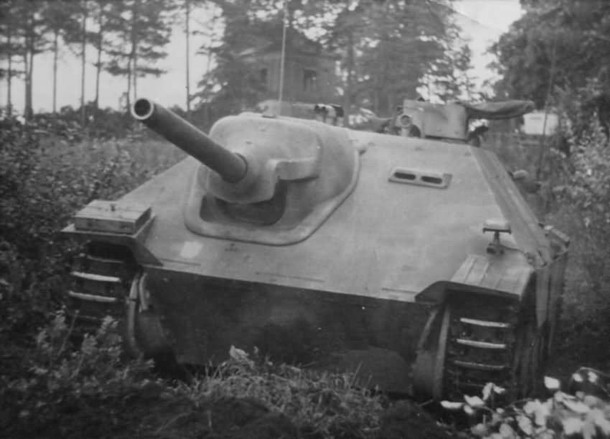
Jagdpanzer 38(t) Hetzer with the older, more robust gun barrel shroud variant, source: worldwarphotos.info with permission of the operator, edited
The tank destroyer was built on the aforementioned tank chassis, which nonetheless had to be modified for the purpose. The chassis was widened and fitted with larger road wheels taken from the prototype of the PzKpfw 38(t) neuer Art. These modifications were necessary to allow the chassis to carry the larger and heavier gun and the more heavily armoured fighting compartment. The rear idler wheels also underwent certain changes; several variants differing in the number and size of lightening holes were used over the course of production. Instead of the two return rollers found on the standard tank, the Hetzer had only one, positioned centrally. The track was 35 cm wide.
Engine and Gun
The powerplant of the new vehicle was the six-cylinder Praga AE 2800 petrol engine of 7.754 litres displacement, producing a maximum output of 160 horsepower at 2,600 rpm. On roads the Hetzer could reach a top speed of 40 km/h — considerably less than the army had originally demanded. Average cross-country speed was around 15 km/h. The on-board fuel supply of 320 litres gave a maximum road range of approximately 180 kilometres and 130 km off-road. The gearbox had five forward gears and one reverse. The engine was mounted at the rear, the gearbox at the front of the hull, connected by a driveshaft. A large access hatch in the right-hand side of the sloped rear plate provided access to the powerplant for maintenance.
The main armament was the 75 mm anti-tank gun PaK 39 L/48 with a barrel length of 48 calibres. The gun was mounted unconventionally to the right of the vehicle's centreline and was protected by a cast Saukopf mantlet (sometimes also called Saukopfblende). Its off-centre position limited the gun's traverse: instead of the originally requested 15° to each side, it could only traverse 11° to the right and 5° to the left. Armed with this weapon, the Hetzer was capable of penetrating the turret of the Russian T-34/85 with a frontal hit at a range of 700 metres, whereas for the T-34/85 to penetrate the Hetzer's frontal armour, it needed to close to within 400 metres. Against the heavy IS-2 tank, on the other hand, the Hetzer had no chance at ranges beyond 100 metres, whereas the IS-2 could deal with the Hetzer from over a kilometre away.
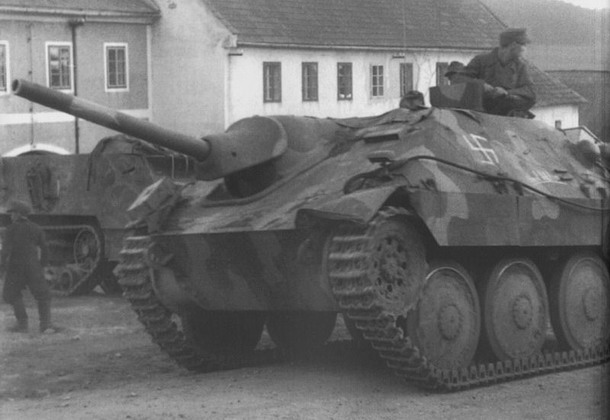
Jagdpanzer 38(t) Hetzer, late production variant with the lighter gun barrel shroud, source: Flickr.com, public domain, edited
When compared with the tanks of the Western Allies, the Hetzer's combat value is even more striking. Both the British Cromwell and Churchill and the American Sherman (A2, 75 mm) were unable to penetrate the German vehicle's frontal armour even at point-blank range. In the other direction, the Hetzer could deal with them at ranges of several hundred metres, and in the case of the Cromwell, at over a kilometre.
However, the moment an opponent managed to approach the Hetzer from the side or rear, the balance of power was completely reversed. The vehicle's thin side armour could be penetrated even by small-calibre guns or indeed by infantry anti-tank rifles. The Germans therefore endeavoured to deploy Hetzers in larger formations so that the vehicles could cover one another, and ideally in close cooperation with infantry.
The Hetzer was also equipped with an MG 34 or MG 42 machine gun, mounted on the roof towards the right-hand side, operated by the loader from inside the vehicle without the need to leave the armoured compartment. However, once the 50 rounds in the drum magazine were expended, the loader had to replace it regardless and was exposed to enemy fire while doing so. For this reason the machine gun was at least protected by a low shield in the shape of a pointed chevron.
As already noted, the main gun was mounted to the right of the centre of the fighting compartment, which caused considerable difficulty for the loader. The gun was designed to be loaded from the right, but there was simply insufficient room to the right of the breech, so the loader sat to the left of the weapon and had to load it from the wrong side, reaching across the breech cover. This slowed the loading process and resulted in a relatively low rate of fire. The on-board ammunition stowage for the main gun was limited to just 40 to 41 rounds due to the confined interior — though in later production versions this was increased to 45. Four types of ammunition were used with the gun: the armour-piercing Pzgr 39, the high-explosive fragmentation Sprgr, the shaped-charge Gr 38 HL, and, where available, the subcalibre Pzgr 40, deployed against the most heavily armoured opponents.
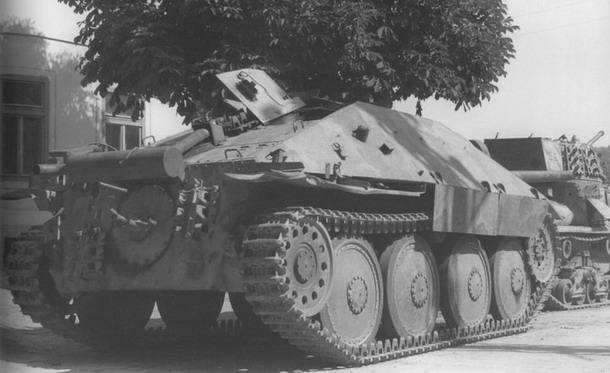
Jagdpanzer 38(t) Hetzer, source: Flickr.com, public domain, edited
The crew consisted of four men: the commander, gunner, loader, and driver, who communicated with one another via the vehicle's internal intercom. The driver, gunner, and loader all sat in a single row along the left wall of the fighting compartment. The driver's station was at the front; his forward view was provided by a binocular vision port in the front plate. Vision for the gunner and the loader — who also operated the machine gun — was provided by optical sights extended through the vehicle's roof.
The commander's station was at the right rear, behind the gun. The commander effectively sat in a recess of the fighting compartment that extended into the engine compartment space. The gun in front of him separated him from the rest of the crew, and he therefore had his own hatch above his station, with a two-piece lid that passed through both the horizontal and sloped portions of the roof. For observation, the commander used a binocular periscope that extended above the roofline. Given the arrangement of the crew and their observation devices, the Hetzer was practically blind on the right-hand side — a fact that could easily be exploited by enemy attackers.
Running Production Changes
During the production period the Hetzer went through several rounds of refinement. Their general aim was, if not to reduce the vehicle's weight, then at least to distribute it more evenly between the front and rear. Various versions of the rear idler wheel were fitted in succession. Both the gun mount and the gun barrel shroud were reduced in size and weight. Road wheels with a larger metal hub and a narrower rubber tyre were introduced. The leaf springs of the front pair of road wheels were strengthened from the original 7 mm to 9 mm to better withstand the increased load on the front of the chassis.
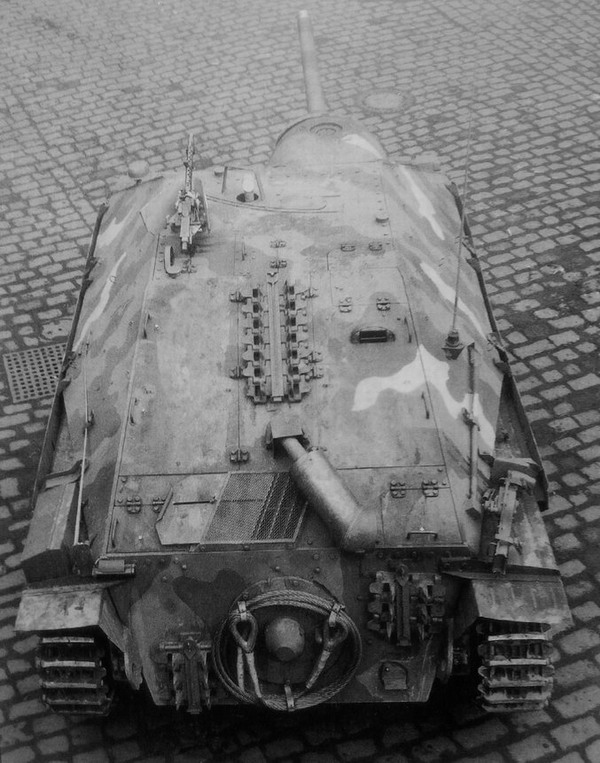
Jagdpanzer 38(t) Hetzer, source: Praga archive, with permission of the company representative, edited
The exhaust cover was also redesigned. The long, transversely mounted, perforated shroud was replaced by a short, curved cover of large diameter — the so-called Flamm-Vernichter. This shortened exhaust cover was not an ideal solution, however: it muffled noise less effectively and frequently emitted flames that were easily visible at night. Commanders sometimes complained that it was impossible to warm up the engine before moving out, as the vehicle's position was quickly betrayed by the noise.
Organisation
Although the first series of Hetzers was completed in April 1944, the first vehicles did not reach combat units until July. In the intervening period, crews were trained, operating manuals produced, and the vehicles were put through trials under various conditions at the armoured warfare schools. The first unit to receive the new vehicle was Panzerjäger Abteilung 731, which took delivery of 45 Hetzers in the first half of July. It was followed by Panzerjäger Abteilung 743, which received the same number of Hetzers in the second half of the month. Both battalions were deployed on the Eastern Front. Vehicles were subsequently allocated to three further tank destroyer battalions: the 741st, 561st, and 744th.
The remaining vehicles were assigned to tank destroyer companies (Panzerjäger Kompanie) belonging to infantry, cavalry, or Panzergrenadier divisions. Each such company had an establishment of 14 tank destroyers. From February 1945, due to shortages of equipment, this was reduced to just ten. From April 1944 to May 1945, more than 2,800 Hetzers were built in total, including command and recovery variants.
In combat conditions the vehicle proved highly effective. It was mobile, well-armed, and in a frontal engagement sufficiently resistant to enemy fire. As unit reports confirm, the Hetzer was a reliable vehicle with a relatively low rate of mechanical failure. It also performed particularly well in street fighting, where the advantage of the remotely operated machine gun came fully into its own.
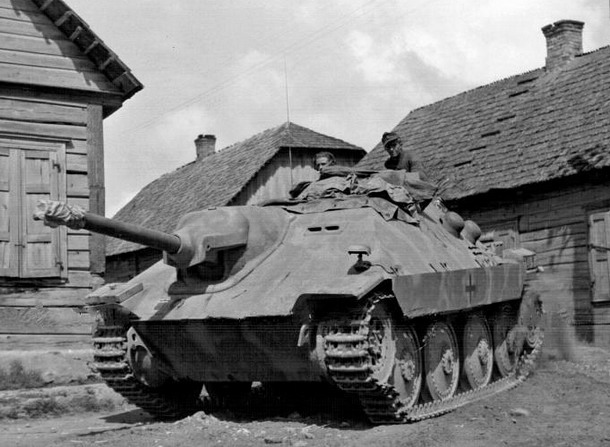
Hetzer with the older gun barrel shroud, source: Flickr.com with permission of the publishing user, edited
Derived Combat Vehicles
By the end of the war a large number of projects to modify the Hetzer tank destroyer had been conceived. Some resulted in the construction of a prototype, some even reached small-series production, but many remained only on the drawing board.
Among these conversions was a flame-throwing tank designated the Flammpanzer 38(t) Hetzer. Twenty of these vehicles were built towards the end of 1944. The gun was replaced by a flame projector. The crew remained four men, comprising the driver, the commander, the flame-thrower operator, and a radio operator. The Flammpanzer Hetzers were used primarily to destroy enemy bunkers and concealed infantry. The vehicles produced were formed into two companies: Panzer-Flamm-Kompanie 352 and 353.
Another interesting variant of the Hetzer to reach small-series production was a self-propelled 150 mm howitzer designated the sIG 33 auf Jagdpanzer 38(t). As the name suggests, the vehicle's main weapon was the heavy infantry howitzer sIG 33 (schwere Infanterie Geschütz), which the Germans had already fitted to a number of previous self-propelled platforms. Installing such a large weapon required, among other things, a substantial increase in the height of the superstructure. Thirty of these vehicles were produced in December 1944.
The Hetzer chassis also gave rise to an anti-aircraft tank armed with the 20 mm FlaK 38 cannon. The roof plate was removed and the rapid-fire weapon was installed in the open fighting compartment. This Flakpanzer did not enter series production, however, and only a single prototype was ever built — and it is quite possible that this was not even an official project but merely a field conversion.
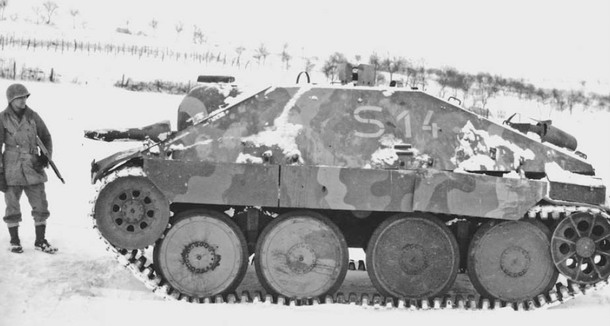
the flame-throwing Flammpanzer 38(t) Hetzer captured by the Americans, source: Flickr.com, public domain, edited
A similar fate befell a reconnaissance tank based on the Hetzer, the so-called Aufklärungspanzer. Like the anti-aircraft tank, it had the roof plate removed, with the edges of the open fighting compartment raised with armour panels. A short-barrelled 75 mm KwK 37 L/24 gun was installed in the front plate. This vehicle too was built only as a single prototype.
The self-propelled 105 mm howitzer StuH 42/2 mounted on the Hetzer chassis likewise remained at the project stage. This vehicle would have borne the rather unwieldy designation Sturmhaubitzwagen 638/14 mit 10,5 cm StuH 42/2.
The same was true of the armoured personnel carrier nicknamed Kätzchen. This vehicle was intended to supplement the existing range of half-tracked armoured personnel carriers late in the war, but was to be fully tracked. It never reached series production and was most likely built only in a single example — one that may never have been fully completed. The Kätzchen project is described separately in the Special Vehicles section.
The Hetzer also had its own command variant, designated the Panzerbefehlswagen Hetzer. It differed from the standard tank destroyer in its expanded radio equipment and an additional antenna with a star-shaped branching end. The Fu 8 radio set had a range of up to 50 km for voice communication and up to 120 km using Morse code.
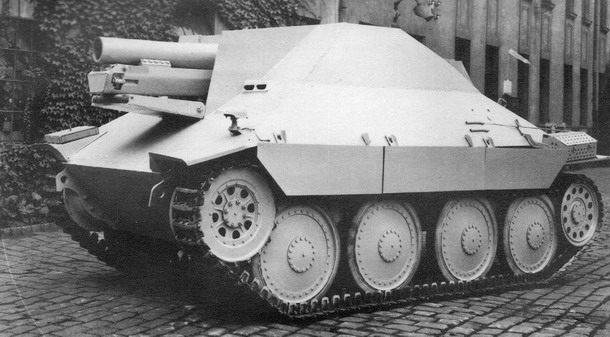
the 150 mm howitzer sIG 33 auf Jagdpanzer 38(t), source: Praga archive, with permission of the company representative, edited
The Hetzer chassis also served as the basis for the Bergepanzer Hetzer recovery and service vehicle. The original tank destroyer was stripped of its armament and roof but equipped in return with a winch and a dozer blade, and carried a large quantity of additional equipment on board. The so-called "dozer blade" was in fact less a blade than an anchoring spade (its actual name was Panzerberganker). While it could be used to clear rubble or debris blocking the path of other vehicles, its primary function was to stabilise the recovery vehicle itself. The lower edge of the spade was fitted with a spike: when the Bergehetzer was pulling another vehicle with its winch, the dug-in spade provided a firm anchor and kept the recovery vehicle from being dragged forward (in the photograph below the spade is shown in the raised position). A total of 181 of these vehicles were built by the end of the war. According to some sources, the frontal armour of the Bergepanzer Hetzer was reduced from 60 to 30 mm in order to relieve the strain on the chassis. Test results showed that the recovery vehicle could only tow a damaged Hetzer over short distances and in gentle terrain — not on slopes, in sand, or in deep mud — otherwise the gearbox, which was not designed for such loads, would fail.
In early 1945 the Germans also attempted to increase the Hetzer's firepower by fitting the more powerful KwK 42 L/70 gun, as used on the Panther tank. This modification led to a significant reduction in the vehicle's mobility, however, as the heavy gun placed an excessive load on the front of the chassis. Further trials in this direction were therefore abandoned.
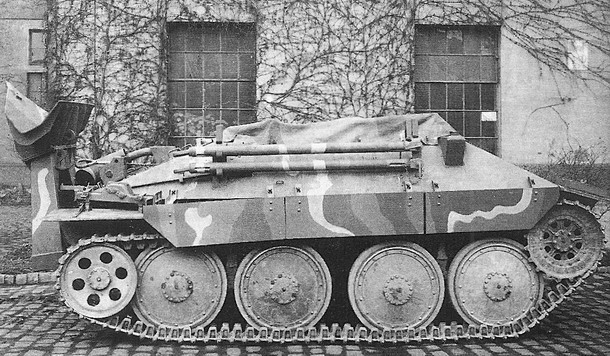
the Bergepanzer Hetzer recovery and service vehicle, source: Praga archive, with permission of the company representative, edited
The Hetzer proved so effective a solution that the Germans began working intensively on ways to maximise its production output. The vehicle intended to achieve this was a new generation designated the Hetzer Starr (Starr meaning "rigid" or "fixed"). This variant of the tank destroyer was designed to be simpler and cheaper to manufacture than the original Hetzer, primarily through substituting the powerplant and removing the gun's recoil mechanism. The new powerplant was to be the twelve-cylinder diesel Tatra 103. Between May 1944 and February 1945, a total of 14 Hetzer Starr prototypes were built, but only one of them was fitted with the diesel engine; the rest were powered by the older petrol Praga AE.
The rigid gun installation (hence the name Starr) considerably simplified both manufacture and maintenance, while removing the recoil mechanism freed up internal space that was used to increase the ammunition stowage to 79 rounds. The drawback was that the recoil forces of each shot were transmitted directly into the vehicle's structure, which naturally suffered accordingly. During the first firing trials in August and September 1944, the sighting equipment repeatedly failed, simply unable to withstand the unabsorbed shock of each shot. Eight of the 14 prototypes survived the war, and all were converted back to their original configuration — with a recoil-equipped gun — for use by the Czechoslovak army.
The End of the War and After
Towards the end of the war, as the situation of the Third Reich deteriorated, Hetzers were frequently called upon to substitute for lost tanks. They were deployed literally until the final hours of the Second World War, serving by that point only in mixed units composed of military personnel of every kind. During the May 1945 uprising, the insurgents seized a number of vehicles from the factory floor and turned them against the occupiers. Some of these had not yet been completed and therefore had no gun installed; the opening left by the missing weapon was covered with a steel plate, and the only armament was the machine gun. One such incomplete Hetzer took part in the fighting around the radio building.
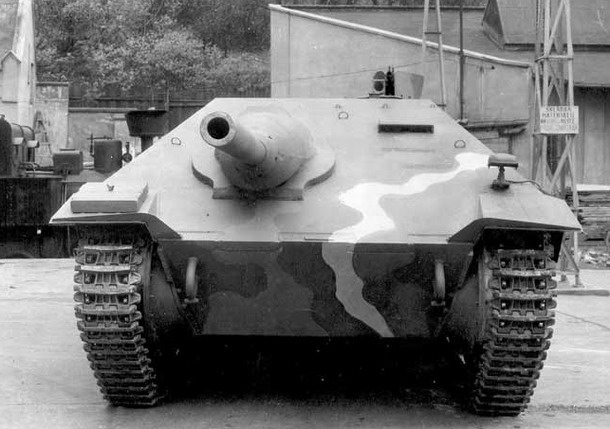
one of the Hetzer Starr prototypes with its rigidly mounted gun, source: Praga archive, with permission of the company representative, edited
After the war, production of Hetzers continued in Czechoslovakia until the 1960s under the designation ST-I (Stíhač Tanků I, or Tank Destroyer I). The post-war Czechoslovak army operated a total of 300 of these vehicles, of which approximately half were built after the war.
Fifteen Hetzers were promised to the Romanian army but were never delivered. The Hungarians, however, did receive their 75 vehicles and apparently deployed them in combat against the Soviets. The Swiss army ordered 158 vehicles from the Czech manufacturers after the war. The tank destroyers designated G-13 by the Swiss differed from the original Hetzer in having guns fitted with a muzzle brake, different headlights, and various other details. It is the Swiss G-13 that is most frequently seen representing the German Hetzer at military history events today.
Technical Specifications
|
weight: |
16 t |
|
length: |
6.27 m |
|
width: |
2.63 m |
|
height: |
1.85 m |
|
engine: |
Praga AE 2800 |
|
engine output: |
160 hp |
|
max. speed: |
40 km/h |
|
fuel capacity: |
320 l |
|
fuel consumption – road: |
180 l / 100 km |
|
fuel consumption – off-road: |
250 l / 100 km |
|
hull armour: |
|
|
- front: |
60 mm |
|
- sides: |
20 mm |
|
- rear: |
20 mm |
|
crew: |
4 men |
|
armament: |
PaK 39 L/48 gun, 75 mm calibre 1 x MG 34 machine gun, 7.92 mm calibre |

ARTICLE
CONTENTS:
Reproducing text from the Panzernet website without the written consent of the operator is prohibited.