KÄTZCHEN
a project for an armoured infantry carrier
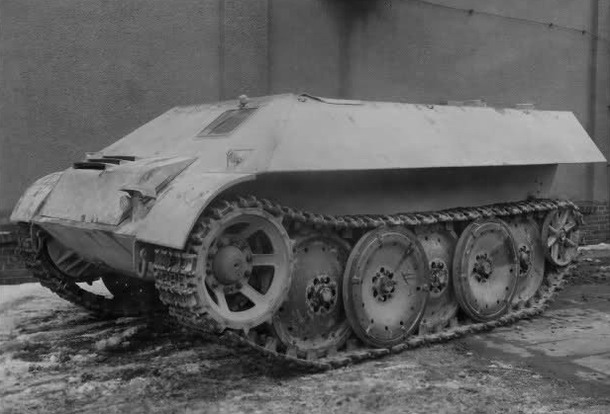
prototype of the Kätzchen K1 armoured personnel carrier by Auto-Union, source: Flickr.com with the permission of the publishing user, edited
Origins of the project
In 1939 the German army introduced the half-tracked armoured personnel carrier Sd.Kfz. 251 — a vehicle designed for the transport and direct combat support of infantry soldiers, though not ordinary infantry. It was intended to serve the Panzergrenadiere, the mechanised infantry who accompanied tanks, protected them and assisted them in combat situations that were less suited to tanks alone. By November 1941, after more than two years of war, the Germans could say with confidence that the method of fighting the armoured carrier had made possible had proved itself without reservation. Not only did the armoured carriers lend attacks an unprecedented punch, they also substantially reduced casualties among their own troops — Heinz Guderian reportedly went so far as to call the vehicle a "blood-saver". Two years of wartime service had, however, also exposed many weaknesses of the Sd.Kfz. 251, and so — in that same November of 1941 — the Weapons Office decided to initiate the development of a new armoured personnel carrier that would replace the "251" in future. A major modernisation programme for the Sd.Kfz. 251, designated HKp 6.03, was already under way at the time, but what was now envisaged was not a modernisation but the development of an entirely new design.
The starting point for thinking about the new vehicle was an analysis of the shortcomings of the existing one. The half-tracked chassis could handle much more difficult terrain than a wheeled one, but it still lagged well behind tanks in this respect. The next-generation armoured carrier was therefore to be fully tracked without question. The payload-to-weight ratio of the Sd.Kfz. 251 was considered insufficient. The new carrier was therefore to carry a payload of 2.5 to 3 tonnes while keeping its own unladen weight below 10 tonnes. The Sd.Kfz. 251's low speed was also seen as a weakness, so its successor was to be capable of 70 to 80 km/h on road and 40 to 50 km/h cross-country. A further requirement was for 30 mm of frontal armour, a range of 400 to 500 km, and an overall vehicle height of between 1,700 and 1,800 mm with a ground clearance of at least 400 mm. The tracked carrier was to transport a driver with co-driver and a ten-man infantry section.
And those were only the principal requirements. Beyond these, the vehicle's design was to allow easy access to the powerplant and controls, including straightforward removal and replacement, as well as simple installation of additional equipment including weapons, ammunition boxes or radio apparatus. It was to be capable of operating in ambient temperatures ranging from +60 to –50 degrees Celsius, and was to place zero or minimal demands on scarce raw materials such as rubber. The armoured vehicle was to be capable of serving not only as an infantry carrier but also as an ambulance, ammunition carrier, command vehicle, communications vehicle, or weapons platform for a wide range of armaments including a 20 mm cannon, mortar, light gun, flamethrower or rocket launcher.
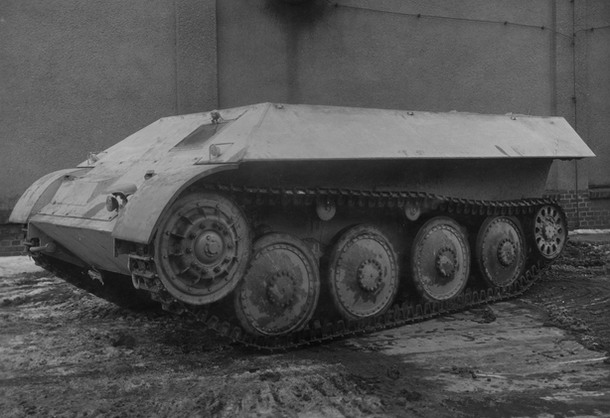
prototype Kätzchen K2 was given the running gear from the Marder III tank destroyer, source: Flickr.com with the permission of the publishing user, edited
Development
The development of the new vehicle was, for reasons that are unclear, entrusted to Auto-Union, a firm that otherwise produced only wheeled armoured and off-road vehicles. The Weapons Office's representative on the project was Ing. Heinrich Ernst Kniepkamp, who was deeply involved in the development of fast armoured vehicles. Work on the new carrier proceeded at anything but a racing pace. A full year after the first requirements were formulated — in November 1942 — the vehicle still existed only as drawings and calculations, while theoretical discussions between the Weapons Office and Auto-Union continued merrily. The required cabin dimensions, track width, armour thickness and maximum weight were all subject to change, and no decisions had been reached regarding the type of engine or gearbox either. One thing that was settled was that the running gear would consist of large road wheels sprung by torsion bars and arranged in multiple overlapping rows — hardly surprising, given that Ing. Kniepkamp was a great advocate of this type of running gear and, according to some sources, even its inventor.
Given the quantity of uncertainties and changes in the specification, it comes as no surprise that in January 1943 Auto-Union formally expressed doubts about how seriously the army actually intended to pursue the new vehicle. The gentlemen at the Weapons Office presumably decided that a promise costs nothing, and so they reassured the manufacturer with smooth words to the effect that the new carrier would fully replace both the Sd.Kfz. 251 and the smaller Sd.Kfz. 250 in production no later than during 1944. And so development work continued. In February 1943, in connection with the new vehicle, the name Kätzchen — meaning "kitten" — appeared for the first time. In April 1943, Auto-Union was commissioned to build a full-size wooden mock-up of the vehicle, to be followed by the production of five pre-production prototypes.
BMM enters the picture
In April 1943, the slow progress of development work on the new carrier attracted the attention of the Ministry of Armaments, whose representatives decided to intervene. The Ministry considered that too much time had already been lost and that a rapid solution was now needed. Rather than developing an entirely new vehicle, an existing armoured vehicle was to be adapted instead. The Marder III tank destroyer, produced by Prague-based BMM (the former ČKD), appeared to be a suitable candidate for such adaptation. BMM's management sensed a good business opportunity and quickly came forward with a concrete modification proposal. The gun was removed from the Marder III Ausf. M and the front wall of the fighting compartment was sealed with a solid armour plate. The side walls were raised and the rear section extended. Double-leaf entry doors were fitted in the rear wall. Simple seats were installed around the interior, accommodating 11 soldiers, with the driver as the twelfth man on board. The vehicle could also serve for transporting ammunition, and it accordingly received the designation Munition und Mannschaftsträger auf Fahrgestell 38 M (a photograph of this vehicle can be seen HERE).
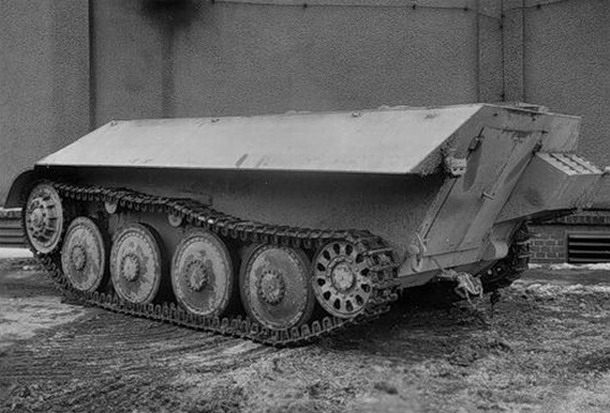
this photograph of the Kätzchen K2 prototype shows the air exhaust vent on the rear wall particularly clearly, source: Flickr.com with the permission of the publishing user, edited
The Weapons Office, including Ing. Kniepkamp, was naturally opposed and argued that the improvised vehicle from BMM's workshops would not come close to matching the specifications of the Auto-Union design. Ministry representatives eventually conceded that the hastily assembled Prague proposal was indeed not the ideal solution. They were nonetheless convinced that a degree of healthy competition could only benefit the project. BMM was therefore tasked with preparing its own Kätzchen design that would meet the specification and be directly comparable with the Auto-Union vehicle. The order was placed in September 1943 and covered the construction of two prototypes, one with a Praga petrol engine and one with a Tatra 103 diesel.
At the turn of 1943 and 1944, the number of prototypes ordered from Auto-Union was reduced from the original five to three. One of these was to use — remarkably — the running gear from the forthcoming Hetzer tank destroyer, a design from rival firm BMM. How had this come about? The literature offers no clear explanation, but two basic possibilities suggest themselves. Either Auto-Union had been instructed to do so because the Ministry or the Weapons Office simply wanted another comparison point, or it may have been Auto-Union's own initiative. After all, if Prague-based BMM was developing its Kätzchen to the same specification as Auto-Union, the result would presumably be a very similar vehicle differing primarily in its running gear. So if Auto-Union prepared its own version of the vehicle using BMM's running gear, the competition would effectively have nothing unique left to offer.
In any case, Prague-based BMM was tasked with supplying the necessary components to Auto-Union — primarily the road wheels, their swing arms with leaf springs, drive and idler wheels, return rollers and tracks. In Prague, however, they may have suspected that this was an attempt to edge them out of the project, and they decided to make life at least a little difficult for their competitor by sending to Germany, instead of Hetzer components, parts from the Marder III tank destroyer, whose road wheels were 50 mm smaller in diameter. Auto-Union complained about the delivery of incorrect components in a report from August 1944. It could not wait for the matter to be rectified, however, and simply used what it had received. We should naturally acknowledge that the incorrect delivery could also have been the result of an honest mistake, a misunderstanding or someone's carelessness — but we will probably never know.
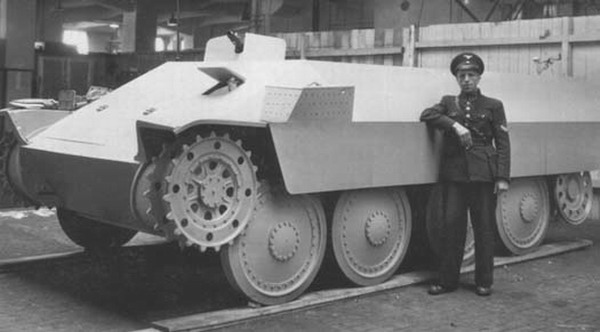
BMM's Kätzchen carrier design, at this stage still with only a wooden mock-up hull fitted, source: Flickr.com with the permission of the publishing user, edited
Prototypes K1 and K2
The Auto-Union prototypes were designated Kätzchen K1 and K2. A report dated 14 February 1944 states that both prototypes were already complete and undergoing driving trials, while the third prototype was still under construction according to the same report. Prototype K1 had a running gear consisting of five road wheels on each side, each wheel made up of two discs. The discs of the even-numbered wheels were mounted further apart on the axle, with the discs of the odd-numbered wheels fitting into the gap between them — an arrangement similar to that used on late-production German tanks and some half-track vehicles. The road wheel axles were connected to swing arms and sprung by torsion bars. The wheels had a steel rim around their circumference with a thin rubber tyre beneath it. At the front was a toothed drive sprocket and at the rear an idler wheel. The tracks were 400 mm wide — quite generous for such a light vehicle — and Auto-Union itself was reportedly considering replacing them with narrower and lighter tracks, though why this was never done is not clear from the literature.
Prototype K1 weighed 10,650 kg, stood 1,865 mm tall and had 30 mm of frontal armour. It is most commonly stated to have been powered by a Horch 724 engine, though the literature also suggests it may have been the more common Maybach HL66 P developing 180 horsepower. The gearbox is generally cited as a Zahnradfabrik SMG-51. The vehicle's overall appearance unmistakably reflected strong inspiration from the Panther tank. The literature states that the interior volume of the Kätzchen was 50% greater than that of the older Sd.Kfz. 251 — and we are talking about volume here, not floor area. This figure is almost hard to believe. In photographs, the Kätzchen gives the impression of a very small and above all very short vehicle — but that impression is quite misleading. Yes, the Kätzchen was shorter than the half-tracked Sd.Kfz. 251, but by only 60 cm (the Sd.Kfz. 251 measured 5.8 metres in length and the Kätzchen 5.2 metres). The new carrier was, however, laid out far more efficiently overall.
The engine compartment was located at the right rear of the hull. The engine was completely enclosed in a steel box with vents in its top panel and in the rear wall of the hull. On the left side opposite the engine were two fuel tanks. The main entry hatch was in the left part of the rear wall. At the entrance end the interior was therefore narrower due to the engine and fuel tanks, but further forward it opened out to the full width of the vehicle. Inside the cabin were two large wooden benches — the longer one running along the entire left side, and the shorter one on the right, positioned ahead of the engine compartment. Beneath this bench ran the driveshaft connecting the engine to the gearbox, located at the right front of the vehicle. The driver's seat was on the left beside the gearbox, and he looked out through a vision port in the front wall. The cabin roof was open, allowing soldiers to fire over the sides and, if necessary, to abandon the vehicle through the opening.
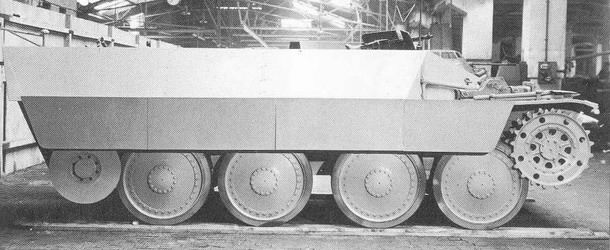
BMM's Kätzchen carrier design, again shown with only a wooden mock-up hull fitted, source: Flickr.com with the permission of the publishing user, edited
The second prototype, designated Kätzchen K2, received the already-mentioned running gear from the Marder III tank destroyer — meaning four rubber-tyred road wheels on each side, sprung in pairs by leaf springs, plus a rear idler wheel and two small return rollers. The only component not taken from the Marder III was the front drive sprocket, which was presumably designed and manufactured specifically for the new carrier. The differences between the two prototypes did not end with the running gear, however. While K1 had 30 mm of frontal armour, K2 had only 15 mm. With a total weight of 8.75 tonnes, K2 was some 1,900 kg lighter than K1, which weighed 10.65 tonnes. Prototype K2 was powered by the Maybach HL66 P engine developing 180 horsepower. It was originally fitted with a Zahnradfabrik SMG-51 gearbox, which was later reportedly replaced by a GGS-48 type. There were also a number of other, less significant differences, such as the design of the front and rear towing shackles and the shape of the raised ventilated cover over the gearbox in the right section of the front wall. The third planned Auto-Union prototype was apparently never completed.
BMM's demonstrator
BMM, having joined the Kätzchen project later, was unable to make up the ground it had lost to its competitor. And so, while Auto-Union had two completed prototypes in February 1944, BMM could in March 1944 show only a chassis fitted with a wooden mock-up hull. The basic internal layout of the BMM prototype was essentially identical to that of the Auto-Union vehicle, with perhaps the sole exception of the fuel tanks, which on the BMM design were positioned ahead of the engine.
BMM had therefore not delivered a fully functional prototype, and a direct practical comparison with the competition could not take place. Only the two Auto-Union prototypes were therefore subjected to comparative trials. The Kätzchen K2 — using components from the Marder III — handled heavy terrain less well and also experienced problems at higher speeds, with the rubber tyres of the road wheels suffering severe damage at speeds above 35 km/h. Prototype K1 emerged as the winner of the comparison, but this proved of little use. Series production never followed, and the entire project was probably cancelled sometime in the final quarter of 1944.
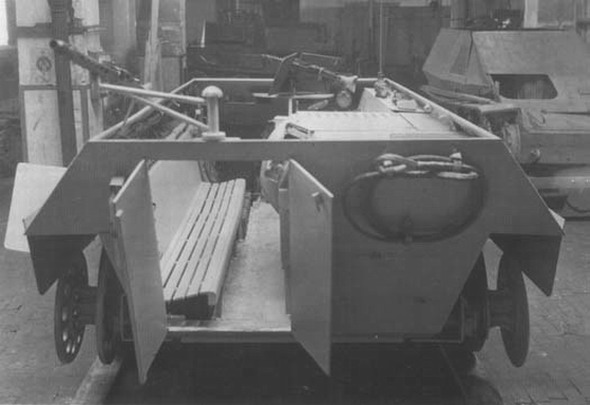
rear view of BMM's Kätzchen demonstrator, source: Flickr.com with the permission of the publishing user, edited
One interesting footnote in connection with the BMM chassis-based design is worth mentioning. Although the German Kätzchen never entered production, a remarkably similar vehicle was introduced into service in Sweden some fifteen years later. The vehicle, designated Pansarbandvagn 301, was of course a more modern design, including a fully enclosed cabin and a roof-mounted 20 mm cannon. Its overall concept was, however, very similar to that of the Kätzchen, and crucially it used a chassis derived from the Swedish licensed production of the TNH tank — essentially the PzKpfw 38(t) — thereby sharing the same fundamental elements as the wartime BMM Kätzchen project. You can judge the resemblance for yourself in the photograph HERE.
And one final brief observation to close. None of the available sources explains why German planners, in their search for a new armoured personnel carrier, did not make use of the concurrently developed ammunition carrier VK 5.01 — or indeed whether this possibility was ever considered at all. The VK 5.01 was almost uncannily similar in its overall concept to the Kätzchen — the two vehicles are frequently confused with one another on the internet, and at one point this even happened on our own website. The VK 5.01 was admittedly designed primarily as an ammunition vehicle, but adapting it for use as an infantry carrier would undoubtedly have been straightforward. Sponsoring two such similar parallel projects was an unambiguous waste of money, time and materials.
ARTICLE
CONTENTS:
Reproducing text from the Panzernet website without the written consent of the operator is prohibited.