VK 5.01
an armoured ammunition vehicle for the infantry
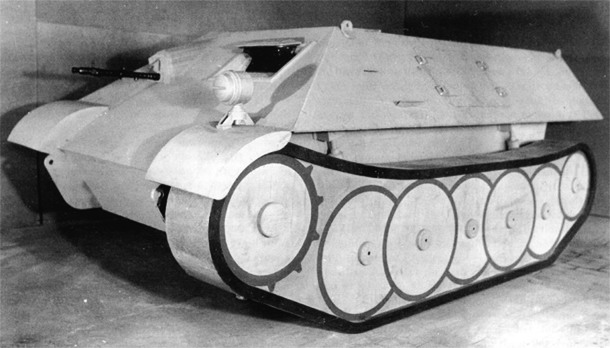
wooden mock-up of the VK 5.01 ammunition carrier, built in June 1943; the hull's strong resemblance to the Panther tank is unmistakable, source: aviarmor.net, edited
A new ammunition vehicle
In October 1941, series production of the armoured ammunition carrier VK 3.02 was launched. Its first practical use with combat units, however, proved a great disappointment, and production was terminated again very quickly. The infantry nonetheless needed an ammunition vehicle, and so in December 1941 a new project was initiated, with the aim of producing a more advanced and capable gepanzerter Munitionsschlepper. The project was designated VK 5.01 — the letters VK standing for Vollketten Kraftfahrzeug (fully tracked vehicle), the number before the decimal point indicating the expected weight of the vehicle in tonnes, and the digits after the decimal point the prototype sequence number.
The parameters defined by the Weapons Office called for a fully tracked vehicle with a maximum speed of 65 km/h, a two-man crew, and the ability to carry at least 1,000 kg of cargo directly on board. The vehicle was to be capable of turning on the spot through 180 degrees and of withstanding frontal fire from armour-piercing rifle rounds of 7.92 mm calibre. The ammunition carrier was to be armed with a machine gun installed in a "hull mount" — i.e. fixed in the hull without a rotating turret — and, in the interest of streamlining development and production, was to share as many components as possible with an armoured vehicle already in production.
The design and its revisions
The task of producing a detailed design for the new vehicle was entrusted to Weserhütte of Bad Oeynhausen. The first drawings were, for some reason, not ready until mid-February 1943. Representatives of the Weapons Office studied the proposal and on 17 February returned with additional requirements, all sharing the common theme of saving scarce materials and money. The road wheels were to be all-steel, without rubber-tyred rims. The armour plates were to be made from steel produced in Siemens-Martin open-hearth furnaces rather than the higher-quality but more expensive steel from electric arc furnaces. The powerplant was to be one of the "standard" engines used in lorries, and finally, instead of the proposed torsion bar suspension, the ammunition carrier was to receive leaf or coil springs. At the time it was still anticipated that as many as 8,000 of the new ammunition vehicles would be ordered, and that quantity of rubber and quality steel would then be sorely missed in the production of far more important tanks.
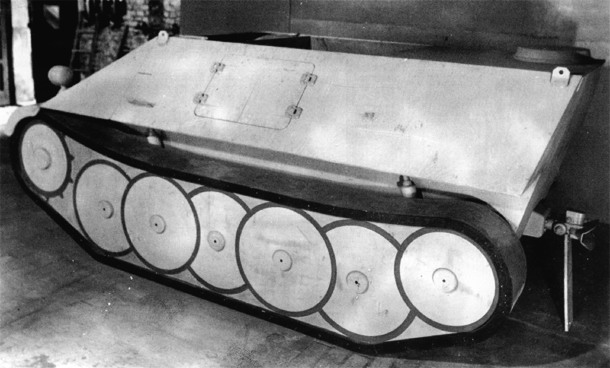
wooden mock-up of the VK 5.01 ammunition carrier; the originally proposed side doors were later replaced by large doors in the rear wall, source: aviarmor.net, edited
The designers at Weserhütte accordingly revised their proposal and resubmitted it to the army for review in May 1943. The hull of the proposed vehicle showed clear and strong inspiration from the most modern German tank of the time, the Panther. All walls were angled as steeply as possible to maximise protection. The running gear consisted of five large road wheels on each side, arranged in two partially overlapping rows. At the rear was a smaller idler wheel and at the front a toothed drive sprocket. Suspension was provided by coil springs, with the first and last road wheels also fitted with shock absorbers. The tracks were 330 mm wide. The ratio of the track contact length to the track gauge was 1:1 (1,840 mm : 1,840 mm), which allowed the vehicle to turn on the spot without difficulty. The chosen powerplant was a Maybach HL42 six-cylinder petrol engine with a maximum output of 100 horsepower.
The heaviest armour was naturally on the front wall, at 20 mm. At the front of the vehicle was the crew compartment for two men. The driver sat on the left, the machine-gunner on the right — which of them also served as vehicle commander is not clear from the available sources. Notably, the vehicle was not steered by conventional brake levers or a steering wheel, but by handlebars similar to those of a motorcycle. Behind the seats of both crew members was the cargo area, with the engine section at the very rear of the hull. According to the designers' calculations, the vehicle could carry 2,000 kg of cargo directly on board and a further 2,000 kg on a towed trailer. The cargo area volume was calculated at 1.2 m³ — sufficient space to load 15,000 rifle and machine-gun rounds in crates plus a further 96 rounds of 80 mm mortar ammunition, or alternatively 22 rounds of 150 mm artillery ammunition plus 45 rounds of 75 mm.
The roof above the crew seats and above the cargo area remained open. Both men also boarded and dismounted through this opening. To facilitate loading and unloading of ammunition, double-leaf doors were provided in both side walls of the cargo section. The engine compartment naturally had a roof. In its centre was a fan for drawing air to the radiator, with two vents on either side through which the heated air was expelled. On the rear wall of the hull, a cylindrical exhaust silencer was mounted, with a towing attachment for the trailer below it.
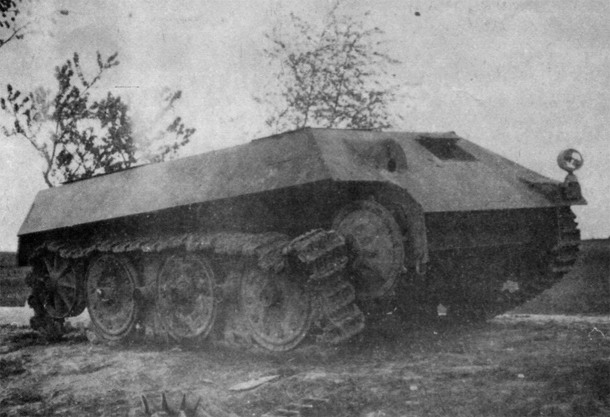
the wreck of the VK 5.01 ammunition carrier as found by soldiers of the US First Army in the Ruhr, source: internet, Public Domain, edited
Mock-up and prototypes
As the next step towards a prototype, a full-size wooden mock-up of the vehicle was ordered from Weserhütte. After studying it in June 1943, the Waffenamt came back with several change requests. The overall height of the vehicle was to be reduced from 1,690 to 1,550 mm and the engine was to be moved to the left side. Large entry doors were then to be provided on the right side of the rear wall. The soldiers considered this a better solution than the double-leaf doors in the side walls — large doors at the rear could serve not only for crew entry and exit and ammunition loading and unloading, but also for loading a wounded man on a stretcher. The armoured vehicle could therefore bring ammunition to the battlefield and return with at least one casualty on board.
According to some sources, the production of three prototypes was ordered — one with torsion bar suspension and two with coil springs — apparently so the army could compare both systems. The literature unfortunately provides no details about the subsequent development and production of the VK 5.01. Some information is available from another source, however. A single example of the vehicle was found by soldiers of the US First Army in the Ruhr in the very final stages of the war. The intelligence officer summoned to examine it, Captain G. D. Drury, inspected the damaged vehicle and recorded his findings in a report dated 19 May 1945.
The report states, among other things, that the vehicle examined had its road wheels sprung by torsion bars — consistent with the information above regarding three prototypes with different suspension systems. A particularly interesting point is that the engine compartment was not positioned on the left side as the Weapons Office had requested in June 1943, but on the right. The entry doors were consequently located on the left side of the rear wall. The report further notes that the vehicle had a four-speed forward and one reverse gearbox, and four interconnected fuel tanks with a combined capacity of approximately 230 litres. How many examples were ultimately built remains an unanswered question.
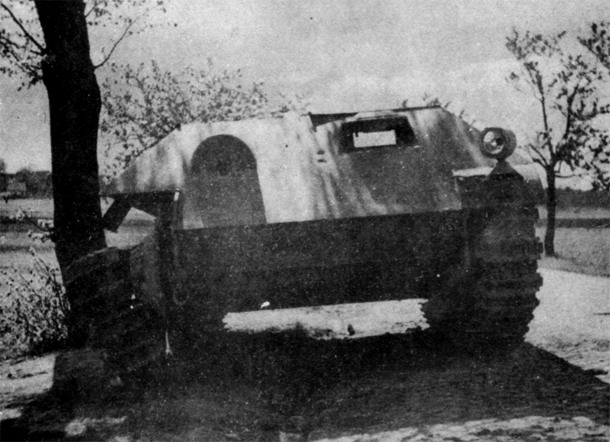
the wreck of the VK 5.01 ammunition carrier found by American soldiers; the right-hand track drive sprocket appears to have disintegrated, source: internet, Public Domain, edited
One final brief observation to close. None of the available sources explains why German planners, in their search for a new ammunition vehicle, did not make use of the concurrently developed armoured personnel carrier Kätzchen — or indeed whether this possibility was ever considered at all. The Kätzchen was almost uncannily similar in its overall concept to the VK 5.01 — the two vehicles are frequently confused with one another on the internet, and at one point this even happened on our own website. The Kätzchen was admittedly designed primarily as a troop carrier, but adapting it for use as an ammunition vehicle would undoubtedly have been straightforward. Sponsoring two such similar parallel projects was an unambiguous waste of money, time and materials.
ARTICLE
CONTENTS:
Reproducing text from the Panzernet website without the written consent of the operator is prohibited.