OTTO CARIUS
Oberleutnant, 27. 5. 1922 – 24. 1. 2015
"Fear is the prerequisite of courage. True courage means precisely the overcoming of fear."
"Fear is the prerequisite of courage. True courage means precisely the overcoming of fear."
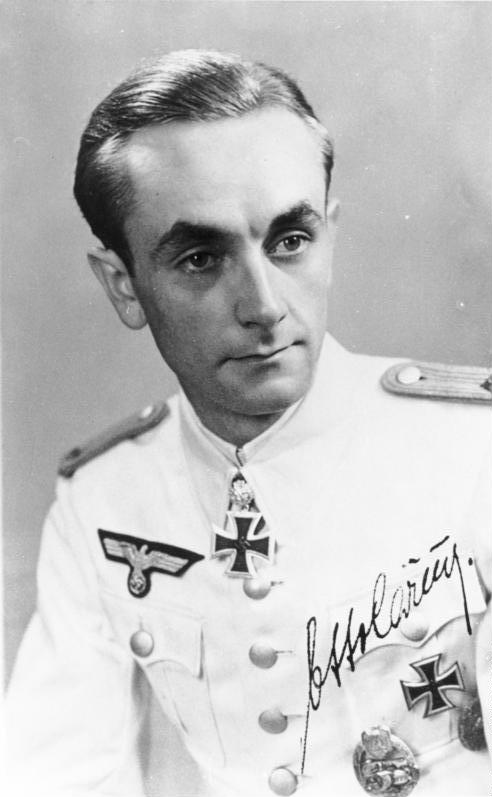
Otto Carius in dress white uniform adorned with the Tank Badge, the Wound Badge, the Iron Cross and the Knight's Cross with Oak Leaves, source: Bundesarchiv_Bild_146-1979-064-06, Wikimedia, Creative Commons, edited
Introduction
In early 2015, a slight 92-year-old retired man named Otto Carius died in the small town of Herschweiler-Pettersheim in south-western Germany. Just four years earlier he had not yet been a retired man but a pharmacist, running the "Tiger Pharmacy" at 77 Hauptstrasse. Seventy years before that, however, he was neither a retiree nor a pharmacist, but Oberleutnant Carius, freshly appointed commander of the 2nd Company of the 512th Heavy Tank Destroyer Battalion and one of the most successful tank commanders in the entire history of armoured warfare.
Otto Carius was born on 27 May 1922 in the town of Zweibrücken, near the French border, to Otto and Lise Carius. His father was a major in the engineer corps and became involved in the Second World War from its very first day, during the invasion of Poland. When his son Otto also enlisted, his father urged him on one point alone: "Don't join the tankers!" By a twist of fate, however, both his sons – elder Otto and younger Wolfgang – ended up serving in the armoured forces.
Into the Army on the Third Attempt
When war broke out in September 1939, Otto Carius was just 17 years old, having recently finished his schooling. Despite this – or perhaps because of it – he immediately applied to join the Wehrmacht. With his slight, thin build and innocent face he looked more like a boy than a man, so it is hardly surprising that he was rejected for physical insufficiency. He tried again and was rejected again. The young Otto, however, was deadly serious about serving his country, and so refused to be discouraged and tried his luck a third time. By now it was spring 1940, and Carius stated on his application that he would like to serve in an anti-tank unit. The third attempt succeeded – though not entirely. Otto was accepted, but was assigned to the infantry, specifically to the 104th Infantry Replacement and Training Battalion (Infanterie Ersatz Bataillon 104) in Poznań, Poland. He thus celebrated his eighteenth birthday in barracks.
Young Carius's time with the infantry lasted barely a few months. When his company commander announced he was looking for 12 volunteers for the armoured forces, Otto stepped forward without hesitation – and was among those selected. He moved from Poznań to the town of Vaihingen near Stuttgart, home of the 7th Armoured Replacement and Training Battalion (Panzer Ersatz Abteilung 7). During training he was assigned as loader to a crew commanded by NCO August Wehler. The tank on which they served was the light Panzer 38(t) of Czechoslovak design. The crew – like many others – underwent gunnery trials at the Putlos military range on the Baltic coast.
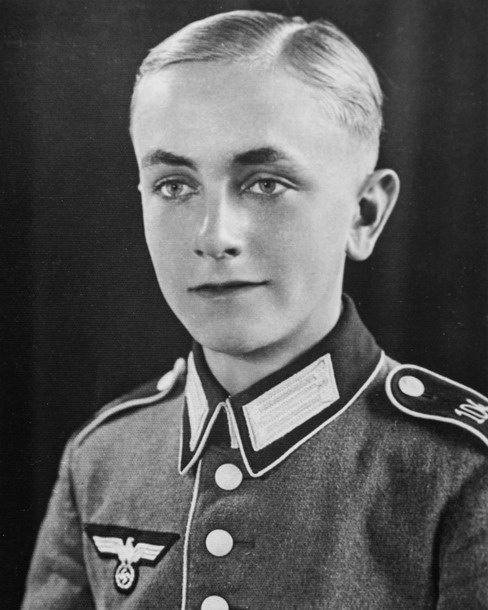
a freshly turned eighteen-year-old Otto Carius as a member of Infanterie Ersatz Bataillon 104; it is hard to believe that four years later this slight young man would be a feared tank ace, source: Flickr.com, public domain, edited
Operation Barbarossa
From the soldiers who had completed their training, a new tank regiment – Panzer Regiment 21 – was formed at Vaihingen on 1 October 1940. Otto Carius's tank was assigned to this unit, which meant he was no longer part of a training formation but a fighting one. Panzer Regiment 21 subsequently became the core of the newly created 20th Panzer Division (20. Panzer Division). In the weeks and months that followed, Carius spent most of his time in the divisional training area at Ohrdruf. In June 1941 the division moved to East Prussia and on 21 June took up its starting positions on the border with the Soviet Union – more precisely on the border of Lithuania, north-east of the town of Suwałki (in present-day Poland). The following day Operation Barbarossa began, the first combat action not only for 19-year-old Otto Carius but for most of the men in his unit.
Carius's 20th Panzer Division was part of the XXXIX Panzer Korps, which fell under Panzer Gruppe 3 within Heeresgruppe Mitte (Army Group Centre). On the day the attack on the Soviet Union began, the 20. Panzer Division had a total of 227 tanks, of which 121 were Panzer 38(t), 31 Panzer IV, 31 Panzer II and 44 obsolete Panzer I. The first day of Barbarossa passed without major incident for the 20. Panzer Division, which advanced more than 60 kilometres and captured the airfield near the town of Alytus.
And what were Carius's impressions of his first day of actual combat? Remarkably mundane, as it turned out. In his memoirs he essentially mentions only two things. The first was the omnipresent dust – kilograms, quintals, and tonnes of it. At the end of the day soldiers had to literally dig their tanks out of the stuff. The second discomfort was his position inside the tank. As loader he had the least situational awareness of anyone in the crew, and the fewest opportunities to stick his head out for fresh air. Carius's first real fight came on the night of 22–23 June, still in the area around Alytus. The following day the unit pressed on towards the Lithuanian capital Vilnius. Given their area of operations, the soldiers of the 20th Panzer Division experienced not only combat but also a very warm reception from the Lithuanian population, who perceived the German army as liberators from Soviet oppression.
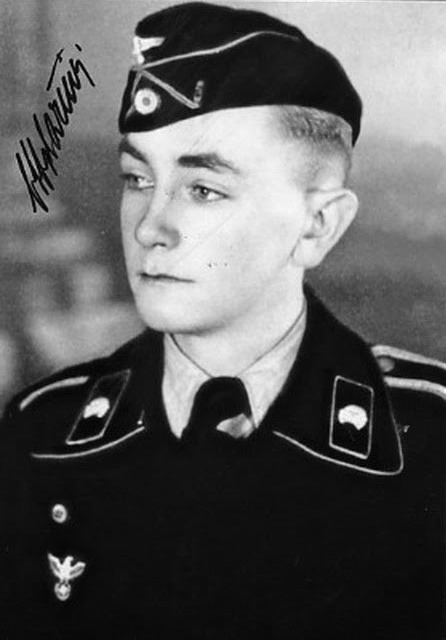
Otto Carius here already in the black tanker's uniform, source: Flickr.com, public domain, edited
After capturing Vilnius, the 20th Panzer Division headed south-east towards Minsk. The tanks devoured the kilometres while their crews swallowed the dust. The German advance seemed unstoppable. The tanks were practically always on the move, and so the other crew members – including Carius – had to learn to drive them too and simply take turns at the controls. After successful fighting north of Minsk, the division continued north-east towards Vitebsk. On 8 July 1941, more than 400 km inside Soviet territory near the Belarusian village of Ulla, Otto Carius experienced his first hit from an enemy round. His Panzer 38(t) had crossed a pontoon bridge over the Western Dvina and was continuing forward when suddenly a loud metallic crash rang out and the whole tank shuddered. The terrifying silence that followed was broken a second later by the radio operator's scream. A Russian 45 mm anti-tank round had punched through the frontal hull armour right next to the machine gun aperture and torn off the radio operator/gunner's arm. Further damage was done by spalling armour fragments and sheared rivet heads; one such piece of the tank's own armour drove into loader Carius's face and also knocked out several of his teeth. The crew immediately abandoned the stricken tank and took cover from further enemy fire.
The wounded Carius sought medical attention and quickly returned to his unit, which had by then reached Vitebsk. In the days and weeks that followed, Carius's division continued pushing east through the towns of Demidov, Dukhovshchina and Yartsevo, then south towards Yelnya, where at the beginning of August 1941 it took part in hard fighting against Russian units encircled near Smolensk. On 4 August Carius received orders to return to Germany, having been nominated for an officer training course at Wünsdorf near Berlin. The course ended on 2 February 1942, but Otto Carius did not pass and therefore remained an NCO. He was sent straight back to his unit on the Eastern Front.
Carius thus rejoined Panzer Regiment 21 of the 20th Panzer Division, which was now holding winter defensive positions near the town of Gzhatsk (today Gagarin), some 150 km west of Moscow. The regiment was in a sorry state: most of its tanks had been lost, and so few remained that they were enough to equip only a single company. It was during this demanding period that Carius was appointed commander of one of the tank platoons, giving him responsibility for four tanks. From March to June 1942 the unit fought defensive actions in the area east of Vyazma and gradually fell back towards the town of Sychyovka, some 65 km north of Vyazma. Carius spent part of 1942 as an engineer platoon commander. His memoirs make it unclear whether this was a punishment or simply the result of his platoon having lost all its tanks. The first explanation would also make sense, since shortly before this Carius had made a serious mistake: during an unexpected Russian attack he had lost his nerve, begun to retreat with his tank and dragged the others along with him. He immediately realised his error and returned to the fight, but still had to face his superiors.
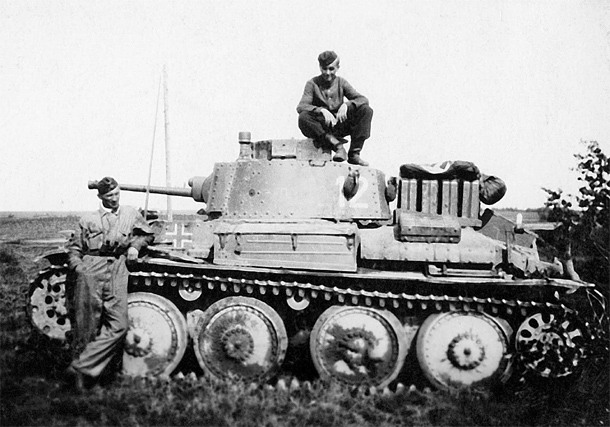
Otto Carius on the turret of his PzKpfw 38(t) on the Eastern Front, source: Flickr.com with the permission of the publishing user, edited
The Tiger Tank
Whatever the reason for Carius's brief stint with the engineers, he soon returned to his tank platoon. In January 1943 the now 20-year-old lieutenant received a telegram informing him of a transfer to the 500th Training Tank Battalion – major changes lay ahead. On arrival at the training centre he learned he had been selected for training on Germany's newest tank, the Tiger. The soldiers travelled first to Putlos, then to Paderborn, and finally to France. When the new heavy tank was first presented to them, their impressions were decidedly mixed. The Tiger was angular and ugly – no graceful curves, no sloped armour. But the moment you sat inside, everything became clear: robust and powerful, yet so responsive and easy to handle.
Nevel – Vitebsk 1943
On completing his training, Carius became commander of the 1st Platoon of the 2nd Company of the 502nd Heavy Tank Battalion (schwere Panzerabteilung 502). Note: it is possible that at the start of his time with schwere Panzerabteilung 502, Carius was "merely" a tank commander and did not become platoon commander until later (perhaps at the turn of 1943/44?); the literature is unfortunately not entirely clear on this point. In any case, in July 1943 he headed with his new tank back to the Eastern Front to take part in the defensive fighting around Leningrad. Attack, retreat, counter-attack: the fighting south-east of Leningrad continued until September 1943 without a decisive outcome for either side, though all Red Army attempts to break through the German line were (for now) repelled. The Tigers were now needed elsewhere, and so Carius's company received orders to move to Nevel, some 90 km north of Vitebsk, where the Russians were pressing hard against the German front line. The tankmen of the 502nd Battalion were tasked with holding the road between Velikiye Luki, Nevel and Vitebsk at all costs.
On 4 November 1943, Carius found himself alone with his tank in an advanced position somewhere between Nevel and Vitebsk. The crew was performing maintenance on their Tiger when a column of twelve T-34s with infantry suddenly appeared. This time Carius kept his nerve and let the enemy come right up close. The Russians apparently took the lone German tank parked at the roadside for an abandoned wreck and paid it no attention – a fatal mistake. When Carius finally gave his gunner the order to fire, the first Russian tank was barely 60 metres away. The 88 mm shell punched through the Russian armour like a knife through butter; the stricken T-34 slid into a ditch and burst into flames. Panic broke out among the other Russian tanks. The infantry jumped off and began running; the tanks turned and tried to disappear as fast as possible. Not one of them managed to return fire against the German vehicle. After a brief engagement, 10 destroyed T-34s were left on the spot; only two had managed to escape.
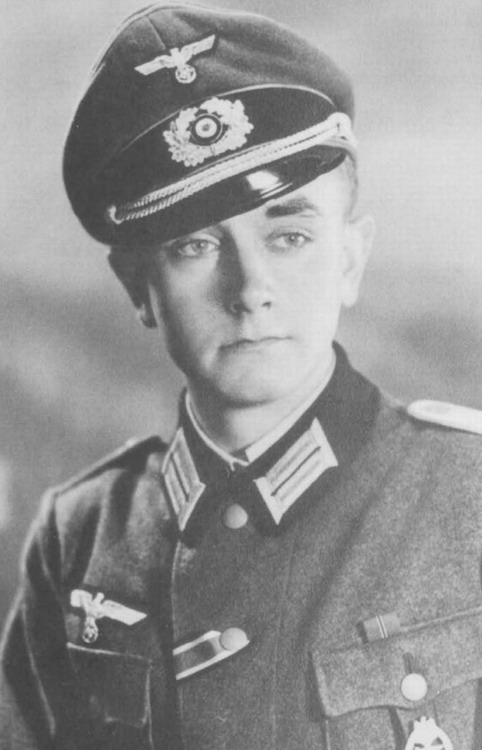
in autumn 1942 Carius was promoted to the rank of Leutnant, source: Flickr.com with the permission of the publishing user, edited
That evening Carius was withdrawn from his position and an 88 mm Flak gun was set up in the area, its crew taking over the watch on this stretch of road. Since the Russians were moving up more forces into the vicinity, Carius was sent back to the same spot two days later, this time with one additional Tiger. At noon five Russian tanks appeared on the road. As they threaded their way between the wrecks of the T-34s destroyed two days earlier, the Germans engaged them: the Tigers knocked out 3 Bolshevik tanks while the remaining two fell to the Flak gun. It could now reasonably be assumed that the Ivans would not try the same spot a third time, and so both Tigers were withdrawn from this sector.
That evening Carius received orders to drive the Soviets out of a nearby village (the name of which is unfortunately not known). Four Tiger tanks and 3 half-tracks mounting four-barrel 20 mm Flak guns were sent into the village. Without any losses of their own, the Germans destroyed 3 Russian anti-tank guns and forced the enemy to evacuate the village. On 2 December 1943, Carius and the Tiger of Oberfeldwebel Zwetti were sent into action near the village of Goruschka (there are four places of this name within a 40 km radius of Velikiye Luki). During the advance against entrenched Russian positions, Carius's Tiger became bogged down and could not free itself unaided. Zwetti's tank came to help. The men jumped out and, under enemy fire, worked frantically to attach the tow cables. Carius was hit by a shell splinter in the temple during this work. Fortunately the splinter had not penetrated the skull, so his gunner simply pulled it out and stopped the ugly bleeding with a pressure bandage.
The following day Carius and Zwetti continued fighting and managed to destroy two Russian anti-tank guns. Before long, however, they found themselves inside an area that was completely controlled by Russian infantry – in trenches and from positions up in the trees – with no friendly infantry of their own to support them. Mortar and anti-tank rifle fire rained down on both Tigers from all sides. It made no sense to push further against concealed infantry; the Tigers had to wait for their own infantry to come and help clear the area. They simply stood their ground and watched each other's backs. During the afternoon, Oberfeldwebel Zwetti contacted Carius by radio to report that his tank appeared to be leaking something. Carius's driver tried starting the engine and the temperature instantly shot into the red. One of the Russian rounds had evidently struck the radiator or a coolant hose. Once again Zwetti had to take Carius in tow and haul him to safety.
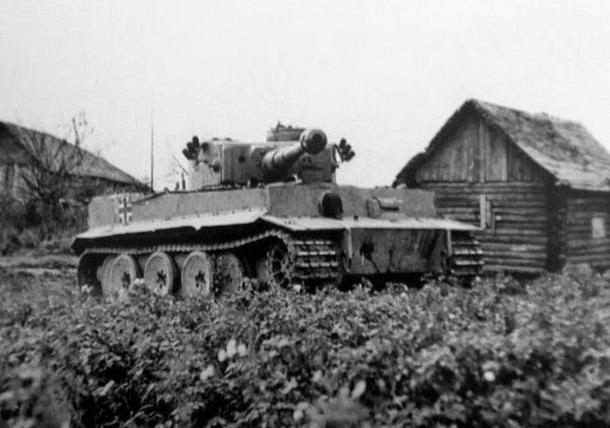
Carius's first Tiger with turret number 213 in a Russian village; the vehicle is missing the first road wheel in the outer row, source: Flickr.com with the permission of the publishing user, edited
Leningrad 1944
Although much of the area east of the Nevel–Vitebsk line was criss-crossed with marshes and difficult to traverse, the Russians still managed to bring ever more troops and equipment into the area. Despite piecemeal German successes, this section of the front could no longer be held. At the end of 1943 a general withdrawal began, in the course of which Carius's unit was moved north to the Leningrad area. As the men of the 502nd Battalion left Nevel by train, they could watch German engineers blowing up the tracks and bridges behind them.
Otto Carius's new area of operations was around the village of Gatchina, about 25 kilometres south of Leningrad itself. It was January 1944, and although a bitter frost prevailed everywhere, the ground around Leningrad was politically very hot indeed. The Red Army was preparing its final push to lift the two-and-a-half-year siege of the city. On 14 January 1944 the Soviets launched the Leningrad–Novgorod Offensive, committing more than 800,000 troops and some 550 tanks. By this time the Germans no longer held Leningrad in a complete encirclement, but they still controlled the main railway lines into and out of the city. The Russians had managed to ship a considerable force across the Gulf of Finland to Oranienbaum (today Lomonosov), and this meant the assault on the German positions south of Leningrad could come simultaneously from the north-east and from the north-west.
It was clear to the Germans that this time they would not repel the Soviet attack and they began preparing the evacuation of the entire area. Gatchina was an important road and rail junction, linking Leningrad to Volosovo and on westward to the Estonian city of Narva, which was the goal of the German withdrawal. The Tigers of the 2nd Company of the 502nd Heavy Battalion were tasked with protecting the units withdrawing along the main Gatchina–Volosovo–Narva road from Russian attacks. However, the Russians more or less controlled the area to the north of this route, meaning the retreating Germans were being pressed not only from the rear but also from the right flank.
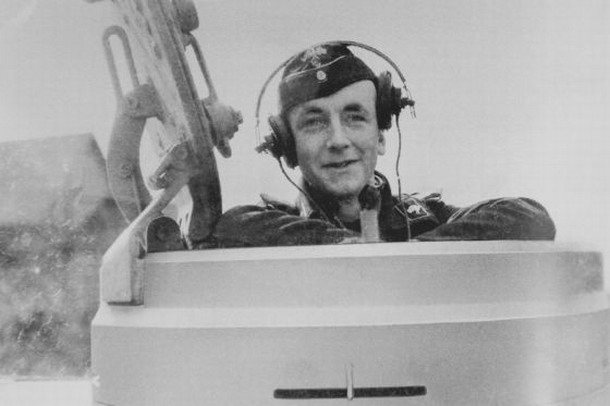
Otto Carius in the commander's cupola of his Tiger; he later wrote that this early cupola design was not particularly satisfactory and that he preferred the later version, source: Flickr.com with the permission of the publishing user, edited
The tankmen scarcely knew which fire to put out first. One evening, after reconnoitring the area north of the main withdrawal road, the entire platoon stopped for the night in an abandoned village. During the night the Russians approached the village, gave it a precautionary shelling, and then a column of T-34s drove straight in. By the time the Germans realised what was happening, Russian tanks were right beside them – literally. One Soviet tank came so close to one of the Tigers that when the German gunner traversed the turret, the barrel struck the Russian's armour. The Tiger commander, a certain von Schiller, had to first order his driver to back up a short distance before the gunner could shoot the brazen T-34 to pieces from point-blank range.
When the main body of the withdrawing Army Group North had reached the relative safety beyond Volosovo, Carius's company received orders to hold the road junction east of the town and delay the Russian pursuit as long as possible. Enemy infantry soon swarmed around them on all sides. Twice the Russians tried to bring up an anti-tank gun and twice the Tigers destroyed it before it could fire. A third attempt was not made, but the Soviets did begin laying down regular mortar fire on the position. It was only a matter of time before Soviet tanks arrived – or worse, bypassed the position and encircled them. Carius repeatedly requested by radio to be allowed to withdraw, but permission was refused. In the end, four Tigers spent the entire night at the junction under mortar fire.
In the morning the long-awaited order to withdraw west finally came. It then emerged, however, that two of the four German tanks had suffered damage to their radiators from the mortar fire and were unable to move. Tow cables were quickly attached, the two serviceable Tigers took their damaged comrades in tow and set off westward towards Volosovo. The towed Tigers had their turrets traversed to the rear to cover the small column if necessary. At Volosovo, Carius's platoon was reunited with the rest of the 2nd Company. The two damaged Tigers were repaired and, together with troops of the 3rd SS Panzer Corps, stayed in the town to further delay the Red Army's advance. To everyone's relief, the order to withdraw soon followed. The tankmen loaded their vehicles onto waiting freight wagons and left Volosovo by rail for Narva in Estonia.
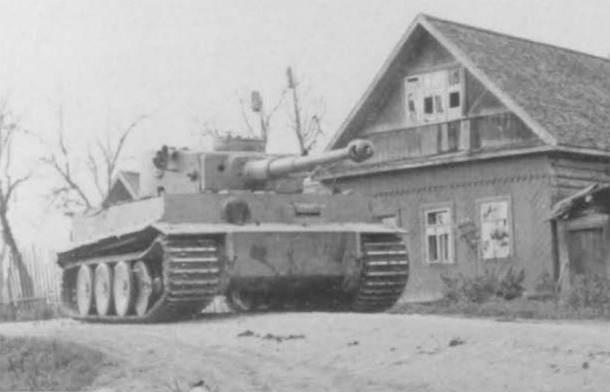
Carius's Tiger number 213, again without the first outer road wheel, source: Flickr.com with the permission of the publishing user, edited
Narva 1944
At Narva the now complete 1st Platoon was assigned to the SS Panzer Grenadier Division Nordland, commanded by SS Brigadeführer Fritz von Scholz. The front line in this sector ran along the Narva River itself: the Germans held the western bank, the Russians the eastern. Only near the city of Narva (yes, the river and the city share the same name :-)) did the Germans also hold a small defensive bridgehead on the eastern bank. Carius's platoon was tasked with reinforcing the bridgehead. Two bridges connected the German bridgehead with the city on the opposite bank, one road bridge and one rail bridge. The rail bridge was soon destroyed, leaving only a single link. Should that be lost, Carius's platoon would be completely cut off on the eastern bank and doomed. Carius therefore asked von Scholz for permission to withdraw to the western bank and cross back over the river to engage only when necessary. Von Scholz agreed, and Carius set his four Tigers moving across the bridge.
A short while later, however, a field car appeared on the scene and out stepped Field Marshal Walter Model himself. Without asking a single question, he gave Carius an exemplary dressing-down and ordered his immediate return to the eastern bank. He capped the whole episode by making Carius personally responsible for holding the bridgehead without losing a single Tiger. Carius simply saluted, jumped back into his tank, and within moments the whole platoon was back on the other side of the river. The Nordland Division grenadiers soon succeeded in fortifying the bridgehead, and the Tigers were able to be pulled back for other duties.
They were first needed north of the city of Narva near the village of Riigiküla, where the Russians were attempting to cross the river and establish themselves on the western bank. Once the situation there had calmed down, Carius's platoon was transferred further west to where another very dangerous situation was developing. The dangerous spot was an area in the bend of the Narva River south-west of the city of the same name. The river flowed into this area from the south-west out of Lake Peipus, before curving first east and then, after about ten kilometres, north towards the city and then on to the Baltic. That roughly ten-kilometre stretch where the river ran almost due west to east can no longer be found on maps today, as an artificial reservoir – the Narva Reservoir – was built there in the 1950s. In any case, the terrain to the north of this river section was considered by the Germans to be impassable, being full of forests and marshes. The Russians, however, had managed to cross the river on this stretch and advance northward to the railway line running from Narva west to the Estonian capital Tallinn. About a kilometre further north, the same direction was followed by the only main road.
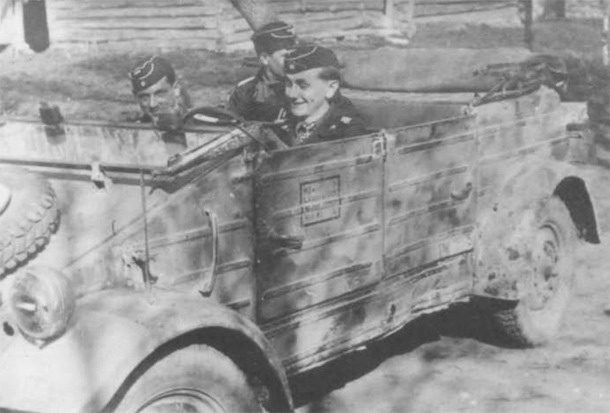
Carius at the wheel of a Volkswagen Kübelwagen; for a platoon (and later company) commander, this vehicle was perhaps as important as the tank itself, source: Flickr.com with the permission of the publishing user, edited
The Russians were thus threatening the last withdrawal route the Germans still had available. Carius's Tigers were therefore sent to the spot to hold back the Russian attempts to push further north and effectively encircle Narva. Lieutenant Carius and Sergeant-Major Kerscher took up positions with their tanks near the village of Sinimäe (about 15 km west of the city of Narva) at the foot of a hill called in German the Kinderheimhöhe (in Estonian, Lastekodumägi). Carius himself refers in his memoirs to a village called Limbitu, which may have been a local name. The German infantry fortified themselves in abandoned houses, and together with the tanks they watched the activity on the other side of the railway embankment. Using tanks – and especially Tigers – for this kind of sentry duty was a "mortal sin" for experienced tankmen, but the Germans simply had nothing more suitable available.
The Soviets continued moving more troops, equipment and supplies into their sector, and the frequency and intensity of the shelling of German positions grew accordingly. It was clear the Russians were preparing for an attack; only the timing remained uncertain. The German infantry lay concealed in the basements of houses that were gradually being reduced to rubble, while the tankmen crouched in their vehicles day after day, unable to be out of them for long since an enemy attack could come at any moment. It was the end of February 1944; inside the tanks it was so cold that the moisture from the crew's breath froze on the inner walls, and if a soldier fell asleep leaning his head against the wall he would literally freeze to it. Every engine start immediately attracted Russian mortar fire. The crews of both Tigers in this position ultimately spent nearly three weeks there – without being able to wash, or to sleep in warmth and peace.
Carius's crew got a brief rest on 15–16 March 1944, when their Tiger had to be towed away for repairs after an unfortunate hit from a Russian mortar. The very next day the Ivans launched their attack. As soon as the half-hour artillery barrage lifted, Carius and Kerscher set out with their Tigers to find the enemy. They soon ran into six Russian T-34s, but their advance from the railway was covered by an anti-tank gun that the Germans had to deal with first. Only then did they take on all six enemy tanks. The rest of the Russian armour preferred to withdraw back behind the railway embankment. That afternoon more artillery came down and another breakthrough attempt was made. Before the Russians pulled back again, Carius and Kerscher had destroyed a further five T-34s and one KV-1.
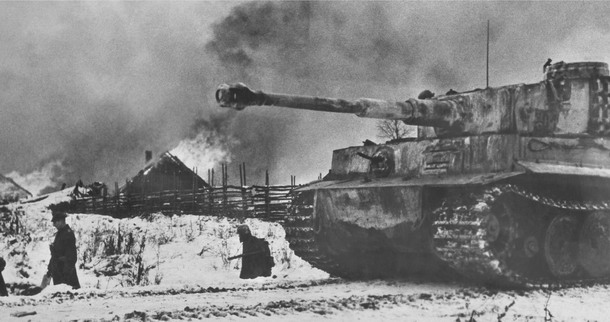
a Tiger from the 502nd Heavy Tank Battalion somewhere in northern Russia, giving some idea of the scenes from the defensive fighting around Narva, source: Flickr.com with the permission of the publishing user, edited
Barely an hour and a half later came a third assault wave. Carius was shouting into the radio for reinforcements, as he no longer had enough ammunition to repel this attack. The situation was saved by a third Tiger belonging to Sergeant-Major Gruber, which arrived on the scene, and above all by German artillery that finally began plastering the Russian assembly positions. Before the end of the day came a fourth Russian breakthrough attempt. That too was stopped. The night was quiet, giving supply lorries time to reach the Tigers and top them up with fuel and ammunition. The following day saw fighting for the fortified ruins of houses. The three Tigers that day deprived the Red Army of eight guns and four tanks. On 19 March 1944, the Reds' attempts to break through the German line continued; Carius's group destroyed at least nine Soviet tanks and one anti-tank gun during the day.
In the days that followed, the tankmen repelled attack after attack in quick succession. Without losing a single vehicle of their own, Carius's platoon destroyed a total of 38 Russian tanks, 4 self-propelled guns and 17 artillery pieces between 17 and 22 March 1944!
Kampfgruppe Strachwitz
Only at the end of the month could the Tigers be withdrawn from this sector and sent to the town of Sillamäe for maintenance, repairs and – naturally – rest. The respite was to last only a few days, however. Now that the Germans had managed to exhaust the Russians' offensive potential, they intended to seize the initiative and destroy the entire enemy bridgehead.
Command of this operation was given to Colonel Count Hyacinth Strachwitz. Strachwitz divided the action into three phases. In the first phase he planned to cut off and destroy the smaller portion of the Russian bridgehead reaching up to the Narva–Tallinn railway, attacking from the west. The entire 2nd Company of the 502nd Heavy Tank Battalion – including Carius and his platoon – was assigned to Kampfgruppe "Strachwitz". Due to the marshy terrain, however, the Tigers could not play a full part in this phase and took on more of a supporting role. The attack on the western tip of the bridgehead began on 26 March 1944. The Germans caught the Russians completely off guard. During the first day of the attack, the designated portion of the bridgehead was cut off and encircled; the following day the pocket was cleared.
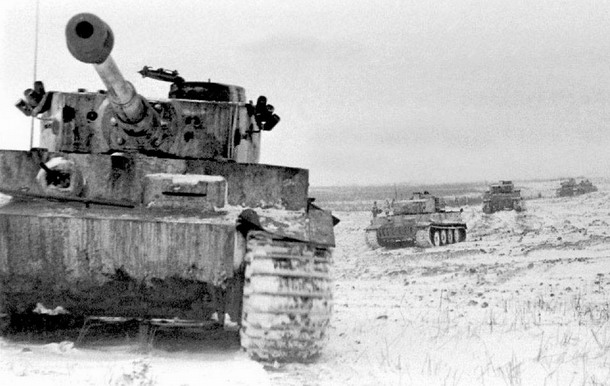
tanks from the 502nd Battalion assigned to Kampfgruppe Strachwitz advancing through snowy terrain near Narva, source: Flickr.com with the permission of the publishing user, edited
Count Strachwitz's next step was the elimination of the eastern portion of the bridgehead, which extended to the railway line. Correctly reasoning that the enemy would expect an attack from the west (as in the first phase), he decided to attack from the north. This was a considerable risk, as it required crossing the railway embankment, which was only possible at one point where a road crossed the tracks. Carius's 1st Platoon was to lead the attack. Strachwitz, however, explicitly ordered that the platoon commander – Carius – must not ride first, as he did not want the command tank to be taken out by mines. The platoon was therefore to advance in the order (tank commanders) Kerscher, Carius, Zwetti and Gruber. Behind them would follow four more Tigers commanded by the company commander, von Schiller. The Tigers were to "merely" punch through and then stand guard while the main assault force – consisting chiefly of Panzer IV tanks and armoured personnel carriers – pushed into the marshy terrain beyond.
The attack began on 6 April 1944. Carius's platoon reached the railway and crossed it with astonishing speed. The Russian anti-tank gun guarding the crossing stood unmanned with a muzzle cover in place. The Germans knocked it out with a single shot and pressed on. In quick succession Carius's platoon destroyed seven more anti-tank guns that had been trained across the tracks and thus now faced away from the approaching Tigers. During the subsequent advance one tank in the platoon was knocked out and another damaged. The main assault force of Kampfgruppe Strachwitz succeeded nonetheless, and the eastern portion of the bridgehead at the railway line was also eliminated. Captured Russians stated that they had indeed expected the attack from the west and had prepared for it there. Nobody had even considered that the Germans would risk making the main thrust through such a narrow point from the north.
Strachwitz now began planning the third and final phase of his operation: nothing less than the complete destruction of the remaining Russian bridgehead on the north-western bank of the Narva River. Conditions were difficult, however. The terrain was very marshy and the only routes passable by tanks were narrow paved roads; any blockage on these would create a very serious problem. The German forces were divided into three assault formations, with the Tiger group led by company commander von Schiller. The attack began on 19 April 1944. At first everything went smoothly; the Russians remained suspiciously quiet. After a while the Tiger column moving along a narrow road suddenly halted. The first tank in the column, commanded by a certain Alfredo Carpaneto, had struck a mine, stopped, and blocked the entire road. After several hours of inaction, Strachwitz summoned company commander von Schiller and Carius on foot. The Count was beside himself with rage and roared at von Schiller for allowing the column to sit idle so long without ensuring the advance continued as planned. He immediately relieved von Schiller of command and gave it to Carius.
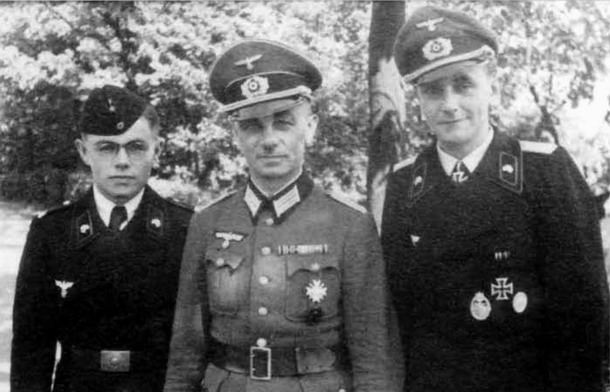
Carius during a brief visit home with his father and brother, source: Flickr.com with the permission of the publishing user, edited
When Carius returned to his tanks, he ordered Carpaneto to try to edge his crippled tank closer to the side of the road with its one remaining track, while another Tiger pushed from behind. After a while enough space was created to drive past the damaged tank. The column was moving again, but the lost time could not be made up. At dusk the tanks reached an anti-tank ditch that had to be bridged. Strachwitz ordered the tanks to spend the night where they were and continue in the morning. A night in the middle of enemy territory – nobody slept a wink. The soldiers sat on their turrets with submachine guns, peering into the darkness.
In the morning the tanks crossed the ditch and pushed on. After a few kilometres, however, the whole situation repeated itself. The leading tank struck another mine and again halted the entire column. Carius was about to climb out to sort the situation. Before doing so he pulled out his cigarettes, put one in his mouth and leaned down to the flame of the lighter his gunner was offering him. A lucky chance that saved Carius's life. At precisely that moment his Tiger took a direct hit to the commander's cupola. The Russian shell tore it completely off and flung it away. Had Carius not bent down to the lighter, his head would have gone with it. He was incredibly fortunate even so, catching two shell splinters in the head; he was nonetheless capable of continuing the advance. The enemy fire intensified, however, and moments later Carius's Tiger took a heavy hit to the turret ring and could no longer fight. The crew quickly abandoned the tank and "transferred" to other Tigers. Carius ordered a withdrawal and the whole group began slowly pulling back.
Of the three damaged Tigers, the Germans managed to recover only one; two vehicles – including Carius's – had to be blown up by engineers during the night. The other two German assault formations fared no better, and so Strachwitz called off the entire operation. The Russian bridgehead on the Narva had not been eliminated. Carius's unit was then withdrawn to Sillamäe for repairs to the damaged tanks, and at the end of April 1944 was sent some 170 km further south, to the area around the city of Pskov.
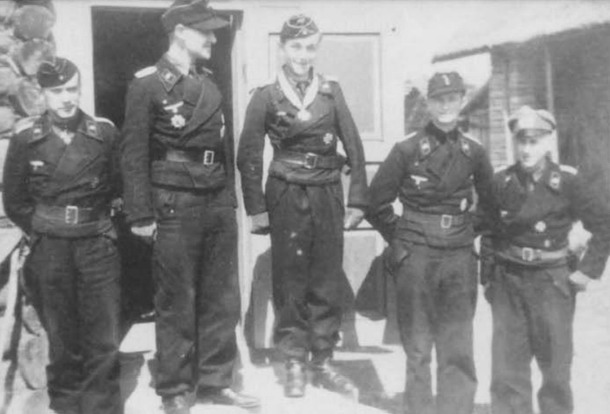
Carius received the Knight's Cross while in the sick bay; that did not stop his comrades from celebrating, source: Flickr.com with the permission of the publishing user, edited
Pskov 1944
Shortly after arriving at Pskov, Carius's health deteriorated rapidly. He suffered asthma attacks and could not walk more than a few steps without a stick. The military doctor, Dr. Schönbeck, diagnosed the effects of prolonged physical and mental strain and ordered Carius a week's rest. In recognition of his actions around Narva, Lieutenant Carius was awarded the Knight's Cross on 4 May 1944. He had to receive it in the sick bay. As a further reward, Otto was granted four weeks' leave and headed home to Germany to visit his family – but had barely spent five days at home when a telegram arrived ordering his immediate return to his unit.
A Russian breakthrough had occurred near Pskov and the Tigers were to stop it. In May 1944 the 502nd Battalion received a new commander, Major Schwaner. He planned a full-battalion attack for 08:00. The objective was to retake an important fortified high ground from which the Germans had been driven by a Russian assault. Platoon commander Carius ventured to express the opinion that by 08:00 the tank commanders would not have had time to familiarise themselves with the terrain and coordinate their advance with the infantry. His objection was overruled and the attack went ahead. The accompanying infantry was soon paralysed by heavy enemy artillery fire, and so the Tigers eventually reached the objective alone. The fortifications still contained plenty of Russian soldiers, however, who knew that without infantry support the German tankmen could not dislodge them. The battalion therefore stayed put and waited for the infantry to arrive.
The Red Army soldiers inside the fortifications meanwhile energetically directed their comrades' artillery fire. More and more Russian shells fell among the parked Tigers, knocking them out one by one. Only when seven Tigers had been immobilised did Major Schwaner stir himself to action. He ordered Carius's platoon to hold the area while the other tanks returned to bring up the infantry. Carius waited with his three still-serviceable Tigers until nightfall. He was not prepared to wait any longer, knowing that isolated tanks in the dark would be all too easy targets for Russian engineers. Before the sun had fully set, all three Tigers returned to their starting positions. Without any territorial gain, the battalion had lost seven precious tanks.
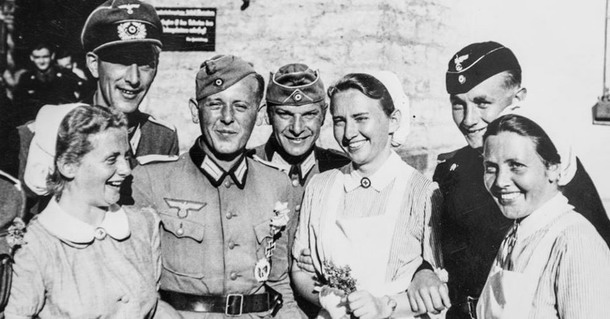
in summer 1944 Carius spent some time convalescing in Tallinn; this snapshot apparently dates from those days – Carius is naturally the only soldier in the black tanker's uniform, source: Flickr.com with the permission of the publishing user, edited
The following day the attack was made again, this time with better infantry coordination. The high ground was finally retaken. Russian artillery (and driver carelessness) knocked out a further three Tigers during the action. During the night, however, the Germans managed to tow all the tanks away for repairs – all except one, which the Russians had already occupied and converted into a bunker. The Germans therefore shot it to pieces themselves.
Daugavpils 1944
The next area of operations for Carius's unit was south of the city of Daugavpils (German: Dünaburg) in Latvia. The unit's task was to hold the northern flank of a Russian offensive aimed at the Lithuanian capital Vilnius. The German forces in the area were not strong enough to mount any strategic counter-thrust into the flank of the Russian advance on Vilnius. The Russians for their part had no interest in major action on their northern flank and concentrated on advancing in the main direction of attack. There was therefore relative quiet in Carius's sector and no large-scale fighting. It was not until the night of 19–20 July 1944 that Carius received orders to move north-east of Daugavpils, where a Russian attack of 90 to 100 tanks had developed. The German 190th Infantry Division deployed in the area was unable to stop such an onslaught on its own.
Carius was given temporary command of the entire company and set off northward with a total of eight Tigers. All three companies of the 502nd Battalion gradually assembled at a concentration point about 5 km north-east of Daugavpils. Carius's tanks had the furthest to come from the south and arrived last, completing their refuelling and ammunition replenishment last of all. They then set off in a north-easterly direction to meet the Russian offensive. The heat was intense, and so after about 45 minutes of travel the men had to stop and let the engines rest. From the distance came the sound of heavy noise. Carius and Kerscher climbed into a Kübelwagen and drove towards the sound to find out what was happening. It did not take long before they ran into an enormous column of retreating German troops. Cars, lorries, motorcycles, tractors – dozens, or rather hundreds of vehicles loaded to the roof with men and materiel, literally fleeing south-west. Carius knew his Tigers were heading in the right direction.
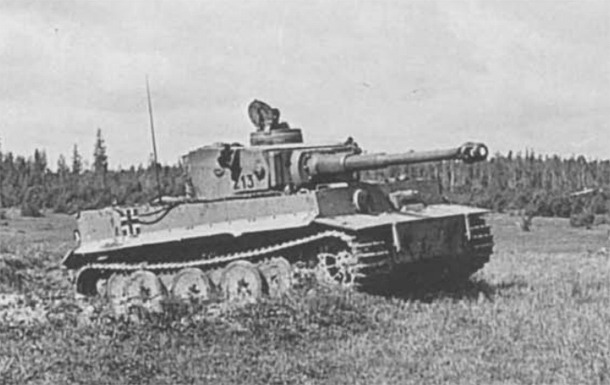
another photograph of Carius's original Tiger number 213, again from the "missing wheel series", source: Flickr.com with the permission of the publishing user, edited
The Village of Malinova
The number of retreating vehicles gradually thinned out and the Kübelwagen pressed on with its reconnaissance. A few kilometres further on, a lone German NCO stopped them, eyes wide with horror, and told both men that Russian tanks were already in the village over the hill. The name of that village was Malinova, some 15 km north-east of Daugavpils. Carius drove up to the foot of the hill, where both men got out and went to look for themselves. Through binoculars they could clearly see two Soviet tanks on patrol at the edge of the village and more moving inside it. That was enough; they raced back to their Volkswagen and headed straight back to their tanks.
Carius brought all eight of his Tigers to the hill before the village of Malinova. The tankmen had no accompanying infantry, no artillery – they were essentially on their own (not counting the signals half-track and the reconnaissance car). Without knowing the surrounding terrain or the exact enemy strength, Carius was unwilling to send all his tanks into action at once. He therefore decided that only he and his battle-hardened number two, Sergeant-Major Kerscher, would make the initial attack. The remaining six Tigers were to stay put and come to their comrades' aid only on a radio signal. Success depended on the element of surprise. Speed was everything.
The drivers of both Tigers started their engines and moved off along the road directly towards the village – Carius first, Kerscher about 150 metres behind him. The German tanks drove at full speed. Carius passed without firing between two T-34s parked at the edge of the village. Only at that point did their crews come to life and begin traversing their turrets to aim. Before they could complete the movement, Kerscher knocked both Russians out with accurate fire at point-blank range. He then drove into the village behind his commander and together they began clearing it. The whole action lasted less than a quarter of an hour. Most of the Russian crews had not even managed to get back into their tanks; those who had got inside had no time to drive even a metre. Only two Soviet tanks managed to leave the village and attempt to escape, but Carius radioed his remaining Tigers and they stopped both fugitives.
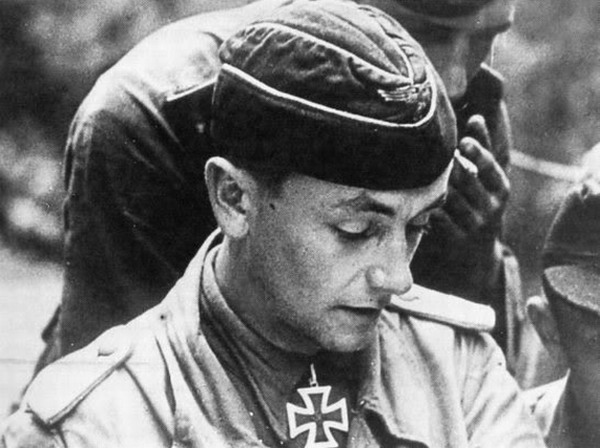
platoon commander Otto Carius during a briefing with the individual tank commanders, source: Flickr.com with the permission of the publishing user, edited
During the fighting in the village, the German tankmen encountered a type of Russian tank previously unknown to them. A massive machine with a very long gun fitted with a muzzle brake? For a moment Carius hesitated, wondering if he was looking at a German Königstiger that the Russians had captured. But he quickly noticed the tank's running gear, which was thoroughly Russian in appearance, and ordered fire. The unknown type proved to be the heavy tank IS-2, nicknamed by the Germans simply Stalin. The German tankmen were fortunate to have encountered this type at close quarters and unprepared for battle, as it was an extremely dangerous opponent. The village of Malinova contained no fewer than 17 of them – and not one survived. In and around the village lay a total of 22 smouldering Bolshevik armoured vehicles: 17 of the IS-2 type and 5 T-34s.
After the action Carius contacted his regimental headquarters, reported his position and the situation, and announced that he planned to continue looking for the enemy. He correctly surmised that the Russian tanks in Malinova had been only a vanguard and that further Soviet units would not be far away. All eight Tigers left the village along a field track heading east. After about four kilometres they joined a road on which the track marks of Russian tanks were clearly visible. This was evidently the route the now-destroyed 22 Russian vehicles had taken to arrive. If none of the Russians had managed to send a warning during the fighting in the village, it was to be expected that more Soviet tanks would soon come the same way to meet up with their vanguard.
The Tigers left the road and pressed on eastward towards the Russians. Before long they were stopped by a small stream. The soldiers found a suitable crossing point and began the ford. The first six vehicles crossed without difficulty, but the seventh became stuck in the churned-up bed. After some effort it managed to reverse back to the bank. Carius was not prepared to risk it and ordered the last two Tigers to stay on that side of the stream and keep watch. Only six Tigers continued east. The tankmen soon found the perfect ambush position. They camouflaged their vehicles on elevated ground from which they could observe two to three kilometres of the road, and waited.

a snapshot from a minesweeper trip during his stay at the sanatorium in Tallinn, source: Flickr.com with the permission of the publishing user, edited
Carius was expecting a Russian column and had assigned each tank its own fire sector so they would not "steal" each other's targets. The important thing was to hold their nerve until the column was in exactly the right position and then open fire simultaneously. They did not have to wait long. First they heard the familiar rumble of tracks from the east, then a whole Russian column appeared in clouds of kicked-up dust. As if on parade, the tanks came laden with infantry, lorries full of ammunition and fuel moving between them. After what felt like an eternity of waiting, the Germans had the enemy exactly where they wanted them, and Carius gave the long-awaited order: "Feuer!" Six barrels fired simultaneously and hit their targets with perfect accuracy.
Terrible panic broke out on the road. Nobody knew where the surprise fire had come from. The infantry leaped from the tanks and most fled in all directions. Vehicles trying to leave the column collided with each other and blocked the way. Another German salvo, and another. "A terrible and magnificent sight at the same time," Carius wrote later in his memoirs. Without a single loss of their own, the six Tigers destroyed a total of 28 Russian tanks!
After the battle the German tankmen returned to the village of Malinova and began preparing for the night. Carius set out in his Kübelwagen to headquarters to arrange supplies for his unit and bring infantry into the village to guard the tankmen from a Russian night attack. He also brought back Battalion Commander Major Schwaner to see the scene of destruction for himself. On that day, 20 July 1944, Carius's company destroyed a total of 50 Russian tanks – without a single loss of their own!
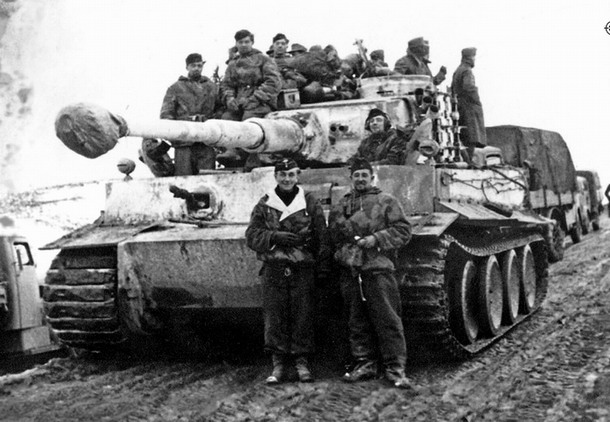
Otto Carius (with the turned-down white collar) in front of his comrade Rudolf Zwetti's tank, source: Flickr.com with the permission of the publishing user, edited
The following day the accompanying infantry dug defensive positions about three kilometres from the village of Malinova, into which the Tigers withdrew. Carius and his men spent three relatively quiet days there before an order arrived to move to new defensive positions north of the road running east from Daugavpils towards Polotsk. Carius protested, arguing that the defence needed to be held much further north or the enemy would bypass it on this road and encircle the defenders. He ultimately persuaded the battalion commander to allow him to take four Tigers and move to the Daugavpils–Riga road running north-west. There the tanks were to keep watch and, in the event of a Russian attempt to encircle the city from the north, delay the enemy and give the others time to move or withdraw.
Face to Face with Death
For this action Carius took with him the tanks of Kerscher, Göring and Eichhorn. As usual he wanted to go ahead first in the field car to reconnoitre the area. No serviceable Kübelwagen was available, however, and so Carius had to make do with a motorcycle. He did not ride it himself but sat in the sidecar with a map on his knee, moving ahead of his tanks. It was 24 July 1944, shortly before eight o'clock in the evening. Carius planned to position his tanks in a small village a few kilometres north of Daugavpils and spend the night there. He rode into the village first on the motorcycle; all was perfectly still. Carius ordered the driver to pass through the village and pull up on the high ground beyond. They stopped, and Carius unfolded his map. "Russians!" shouted the motorcycle driver suddenly, pointing at a lone building standing on the high ground beyond the village. "Back quickly!" shouted Carius, but the driver was flustered and stalled the engine. At that moment Russian fire was already raining down on them. Both immediately jumped off the dead motorcycle and tried to run, but Carius was hit in the thigh.
The driver tried to help his commander, partly hoisting him onto his back and dragging him away as fast as he could. In doing so he fully exposed him to enemy bullets. Within moments the unfortunate Carius took another hit to his left arm and four more hits in his back. The driver was also lightly wounded. That was the end – they could not run any further. Carius lay where he was, bleeding heavily. Three Russian soldiers stopped firing and were cautiously approaching. Then Carius heard the sound he knew so well – his Tigers. The German tankmen had heard the shooting and set out to help their commander. As two Tigers burst out of the village, two of the three Russians ran. The third, who wore an officer's uniform, quickly drew his pistol from its holster and, before he too fled, fired three shots at Carius. Two bullets thankfully missed. The third struck Carius in the neck.
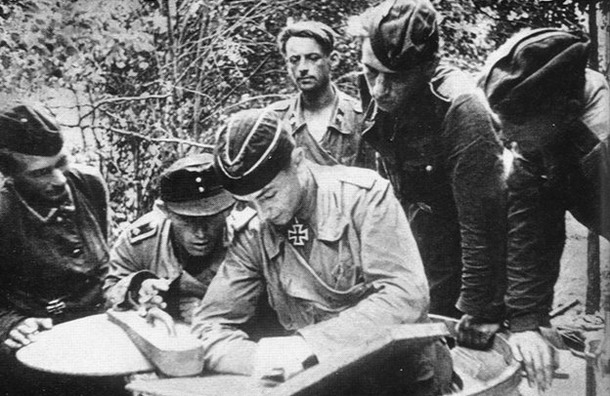
a pre-combat briefing; this Tiger is the newer version with the redesigned commander's cupola, source: Flickr.com with the permission of the publishing user, edited
The two Tigers stopped right beside their barely breathing commander. The tankmen did not know which wound to bandage first. Carius had seven gunshot wounds on his body. They applied a tourniquet to the thigh wound, dressed the others with pressure bandages and then lifted the wounded man onto the rear of one of the tanks. Meanwhile concealed Red Army soldiers began emerging from the other buildings in the village and shooting. There were not many of them and they were quickly driven off. The "ambulance" Tiger immediately set off back to the main road. It was an enormous stroke of luck that during the previous advance an Oberleutnant Wolff, commander of a reconnaissance platoon also conducting a recce in the area, had attached himself to the group of tanks. Wolff had a Kübelwagen. They transferred the fading Carius into it and Wolff set off with him for the nearest dressing station.
Carius lost consciousness on the way. He came round only briefly as they were transferring him from the Volkswagen to an ambulance. He reached the field hospital around one o'clock in the morning. He received anaesthesia immediately and went straight to the operating table. He came round in a hospital bed practically swathed in bandages. He had lost an enormous amount of blood and needed several transfusions among other things. The following day he was visited by the 502nd Battalion commander, Major Schwaner, and later by other comrades. Although nobody said it out loud, it was clear to everyone that Lieutenant Carius would not be returning to his company any time soon. This realisation was all the more sobering for the fact that on the very day of his wounding, Carius had been officially appointed commander of the 2nd Company of the 502nd Battalion (until then he had been performing this role only in an acting capacity). He learned of this appointment retrospectively in the field hospital.
Carius's wounds were healing well, but given the overall severity of his injuries a decision was made to send him to Germany for full treatment and convalescence. He travelled first by ship to the port of Swinemünde (today the Polish town of Świnoujście) and from there by train to hospital in Lingen. The journey took a total of two weeks, during which the broken bone in his thigh knitted in such an unfortunate way that one leg remained shorter than the other. Nothing could be done about this at the hospital. And that was not the only health problem: Carius's body, already worn down by the hard life at the front, was at the very limit of its reserves. It had given its last strength to heal the wounds, so that when the young soldier arrived at the hospital he weighed only 40 kg.
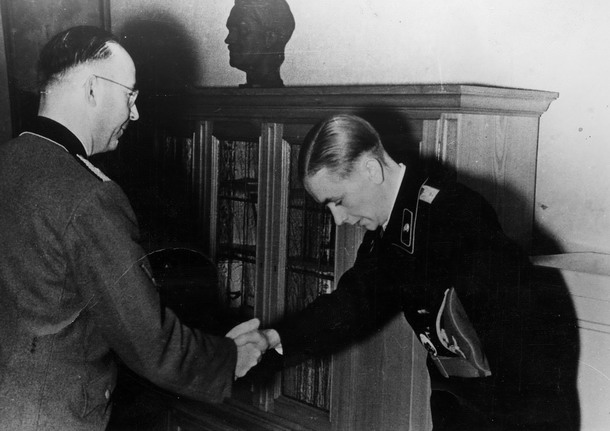
Otto Carius receiving the Oak Leaves to his Knight's Cross from the hands of Reichsführer-SS Himmler, source: Flickr.com with the permission of the publishing user, edited
Oak Leaves
Carius spent several weeks entirely bedridden, only beginning to slowly relearn how to walk in late September 1944. And it was also during his time in hospital that he learned, backdated to 27 July 1944, he had been awarded the Oak Leaves to his Knight's Cross. He was simultaneously promoted to the rank of Oberleutnant. At 22 years old, Otto Carius had become not only the 535th member of the Wehrmacht to receive this high decoration, but also its youngest recipient to date. Carius was to receive the decoration in person from the Führer as soon as he was physically able. That moment came at the end of October. The new Oberleutnant travelled by train to Salzburg, only to be told there that the Oak Leaves would not be presented by the Führer but by SS chief Heinrich Himmler.
Himmler first apologised for the Führer's absence, then set about pinning the precious piece of metal onto Carius. When he removed the Knight's Cross to attach the Oak Leaves, he was amused to discover that the soldier did not have the cross hanging around his neck on the official ribbon but on a plain elastic band from a pair of motorcycle goggles. "Very practical," commented Carius on the matter. There followed dinner in the company of other senior officers, after which the two men spent 30 minutes in private conversation. Carius could not help noticing that he had been left alone with one of the most senior figures in the Third Reich, with a loaded pistol at his hip.
Himmler made a good impression on him, but when he offered Carius the chance to transfer from the Wehrmacht to the Waffen-SS, Carius politely declined. When asked at the end of their meeting whether he had any special personal wish, Carius said he wanted to return to the front to his unit as soon as possible. Himmler replied, however, that he would have to remain in Germany until at least the end of the year to recover properly.
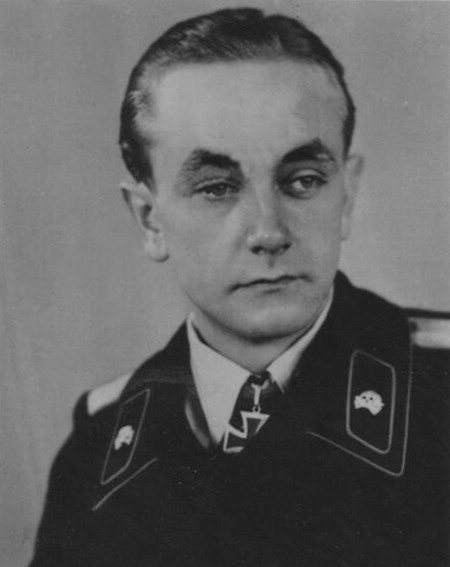
Otto Carius in tanker's uniform, source: Flickr.com with the permission of the publishing user, edited
Switching to the Jagdtiger
Carius spent Christmas 1944 still in hospital. In the first days of January 1945 he went to Berlin to apply through the appropriate channels to be returned to his 502nd Heavy Tank Battalion. The application was refused and he was instead assigned to the Training and Replacement Tank Battalion in Paderborn. He was originally to serve as an instructor for recruits, but managed to persuade his superiors to assign him to a combat unit after all. He was therefore assigned to the 512th Heavy Tank Destroyer Battalion at Sennelager as commander of the 2nd Company. This unit was equipped with the heaviest German tank destroyer, the Jagdtiger. Numbers were insufficient, however, and so each company received only 10 vehicles.
Carius was disappointed with both the men and the equipment in this unit, but it was at least a chance to get back to the front. Most of the soldiers in his company had no combat experience whatsoever, and their morale and will to win were nowhere near what he had been accustomed to in the past. The Jagdtiger had no rotating turret, which caused something close to claustrophobia in the old tanker. Its long gun vibrated so much on the move that after literally just a few kilometres the sighting was knocked off, making a first-round hit unreliable.
On the Western Front
On 8 March 1945 the unit was sent to the Western Front. It first travelled by train to Siegburg and was then to continue to Remagen to help contain the Americans, who had managed to seize the strategically vital Ludendorff Bridge over the Rhine. Due to the enemy's absolute air superiority, the transport could move only at night, and in addition there was considerable chaos on the railways. By the time the unit reached its destination, there was no one left to contain at the Rhine. The Americans had already pushed further north-east and were beginning to close the so-called Ruhr Pocket. All encircled units were trying to fight their way out. Carius's company advanced east along the Sieg River in the direction of the towns of Eitorf, Betzdorf and Siegen.
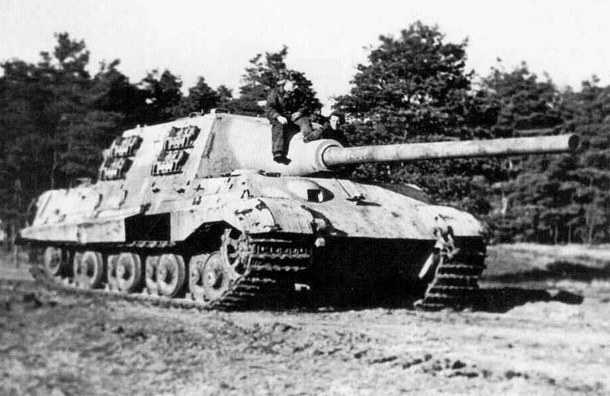
in early 1945 Carius was assigned to the 512th Heavy Tank Destroyer Battalion, equipped with Jagdtigers; the old tanker needed a little time to get used to a vehicle without a rotating fighting turret, source: Flickr.com with the permission of the publishing user, edited
During the fighting in the Ruhr Pocket, Carius's fears about his men's low fighting spirit were confirmed. Two Jagdtigers from his company were in a camouflaged advantageous firing position when an American tank column appeared on the road about 1.5 km in front of them. The Germans could not have asked for better conditions. Yet the NCO in command refused to give the order to fire, fearing retaliation from American aircraft. Not only that, he panicked and wanted to leave the position as quickly as possible. In his frantic manoeuvring he managed to damage both vehicles so badly that they were unable to move. One of them could not be repaired and had to be blown up.
When the soldiers reached Siegen they camouflaged their vehicles with grass and branches, but even so a passing American aircraft spotted them and destroyed or damaged two Jagdtigers so badly that the Germans blew them up themselves. Carius's company had achieved no combat success whatsoever, and of its original ten tank destroyers only seven remained. The next morning the unit moved a little further north to the village of Weidenau, where American tanks were found on the high ground behind the village. Carius decided to attack with four Jagdtigers. The Americans spotted the Germans and literally fled in headlong panic. One tank instead of fleeing tried to hide behind a building. Carius fired two shots. Two 128 mm shells passed through the entire house with enormous force and destroyed the tank sheltering behind its walls.
The following day the company received orders to move about 75 km north to the town of Unna. Seven Jagdtigers drove under their own power to Gummersbach and from there continued by rail to Unna. Around the town the unit became involved in several long-range exchanges of fire with the Americans, which mostly produced no losses on either side. One exception was an action in which a lone Jagdtiger ambushed five American tanks it found taking a break at the side of the road. The inexperienced Jagdtiger commander, however, gave himself away before he intended to. Two of the American vehicles withdrew while the remaining three opened fire. The hapless commander panicked and ordered his driver to turn the vehicle for a retreat. The moment the hull turned its rear to the enemy, he and his entire crew were condemned. Carius noted at the time that even the finest weapons in the hands of brave and eager soldiers count for nothing if proper training is lacking.
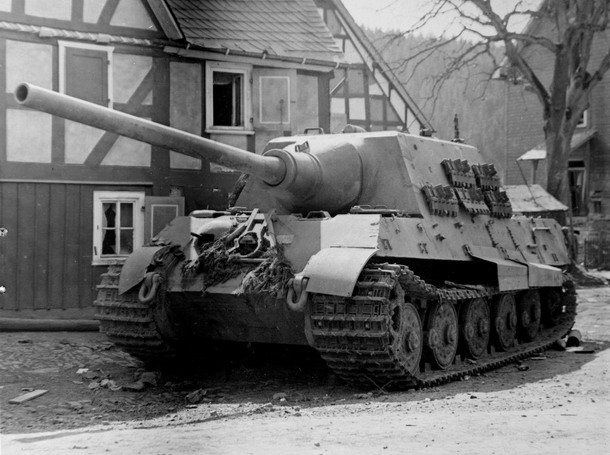
the 512th Heavy Tank Destroyer Battalion fought on the Western Front against the Americans in 1945, source: Flickr.com, public domain, edited
From his positions around Unna, Carius could watch through binoculars as an American column entered Dortmund. He could also see that white flags were flying from buildings in the city and that the civilian population – mainly women and girls – were welcoming the Americans as liberators. But no one had called off the war yet, and so Carius, despite what he saw, felt bound by his military oath. The Jagdtigers continued withdrawing east. On one of the following days they took up a favourable firing position at the edge of a larger village and waited. When Allied tanks appeared, the Germans opened fire and destroyed several. Shortly afterwards, however, a doctor came rushing up, desperately urging them to leave, not to fight here. The village was full of wounded men from earlier fighting and was serving effectively as a field hospital. The doctor rightly feared the Americans would respond with artillery or an air strike on the village.
The End in the Ruhr Pocket
Carius therefore decided to negotiate with the enemy. He drove out to the Americans in a field car and brought back a flag of truce. The outcome of the negotiations was an agreement that the German Jagdtigers would leave the village without a fight and the Americans would take it over peacefully, avoiding casualties. Two more days passed as late April 1945 approached. Carius and his company were in the forests near an unnamed German village when the guard post reported that Americans had arrived in the village. Carius had his entire unit fall in and looked into the faces of his soldiers. The expression on most of them made it plain they had no wish to fight anymore. The fear of captivity had slowly but surely evaporated – after all, this was not the Eastern Front. Carius understood that this was his unit's last parade. He spoke to his men, said his farewells, and dismissed the unit. According to some sources he then ordered all the Jagdtigers to be blown up before the company surrendered to the Americans.
Some accounts state that Carius and his men did not surrender until 7 May, but this is probably inaccurate. In his own memoirs Carius recalls hearing the news of Hitler's death (30 April 1945) already as an American prisoner, on the radio. Together with others he kept his fingers crossed – among others – for his comrades from the 502nd Heavy Tank Battalion, who were still fighting hard against the Red Army for several more days. Carius did not think much of the Americans; in his view they were a considerably weaker opponent than the tenacious Russians. He spent just over two weeks in an American prisoner of war camp. They found him of little interest and of no importance, and besides, he appeared to be in poor health. He was therefore released before long and able to return home.
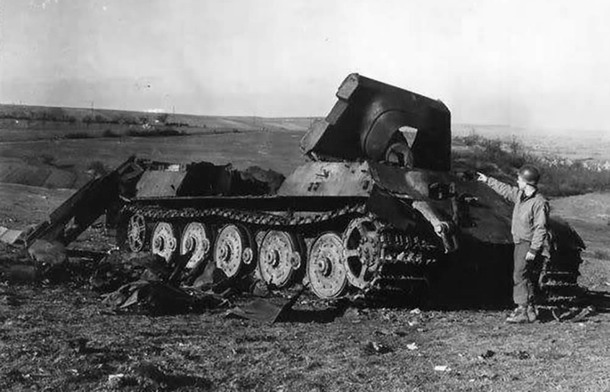
a significant proportion of Jagdtiger losses were due to breakdowns and accidents; by this stage immobilised vehicles could no longer be towed away, so their crews usually blew them up, source: Flickr.com, public domain, edited
Oberleutnant Otto Carius thus survived the war. He had spent nearly four years at the front. In that time he had credited to his account at least 150 destroyed enemy tanks – making him the second most successful tank commander in history (after Kurt Knispel). After the war he studied pharmacy at the University of Heidelberg and opened a pharmacy in the small town of Herschweiler-Pettersheim in south-western Germany. Until 2011 you could find him serving behind the counter in person, and as photographs online confirm, a good number of his admirers made the trip specially to see him. Otto Carius died on 24 January 2015 at the age of 92. The "Tiger Pharmacy" is of course still operating – as you can see for yourself: www.tiger-apotheke.de.

ARTICLE
CONTENTS:
Reproducing text from the Panzernet website without the written consent of the operator is prohibited.