ÜBERSICHTSTAFEL
a recognition guide for German soldiers
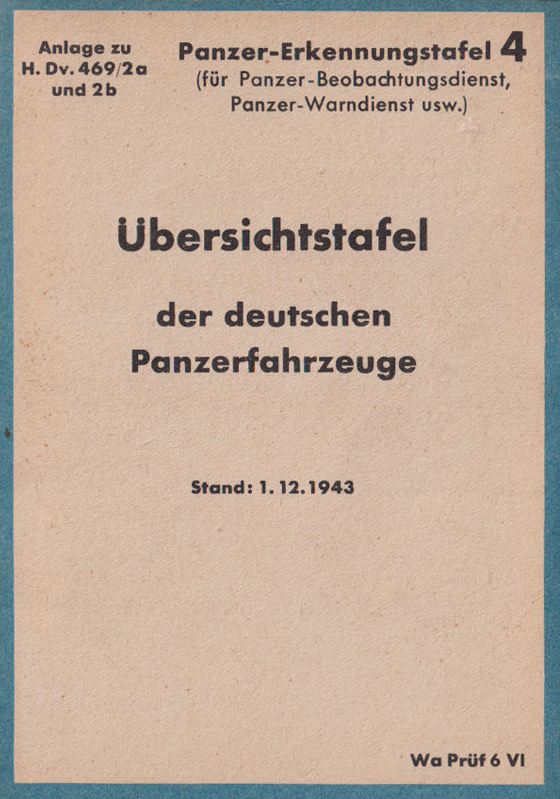
This slim booklet was one of a whole series of similar documents intended to help soldiers identify various types of armoured vehicle — not only enemy ones, but their own as well. Its purpose is in fact inscribed on the title page itself: "Panzer-Erkennungstafel für Panzer-Beobachtungsdients, Panzer-Warndients esw." — roughly a tank recognition chart for the use of the observation and warning service. It was therefore intended for forward patrols and observers whose task was to warn their unit in good time of approaching enemy tanks.
This particular booklet illustrates and summarises the key specifications of the most common types of German tanks, assault guns, tank destroyers, half-track vehicles, and armoured cars — in this case, friendly vehicles. The purpose of the document was to reduce the risk of so-called friendly fire, i.e. mistakenly engaging one's own armoured vehicles. In addition, further booklets were of course published covering the main combat vehicles of the enemy. The cover of the booklet devoted to British and American equipment can be viewed HERE, and the cover of the brochure on Soviet equipment HERE. These documents were not intended to be permanent. As new types of fighting vehicle appeared on the front, new editions of the booklets were issued (for example, the cover of the Soviet equipment brochure mentioned above bears the validity date of 1 February 1943, with a note that the older edition of 1 July 1942 was to be destroyed).
The booklet whose contents can be viewed below dates from December 1943. The document was not formatted as a bound book with individual pages, but as a single long folded sheet that the reader could unfold and fold back up again. It was of course not a comprehensive survey of all existing armoured vehicle types, but rather a selection. What the selection criteria were is not clear. Simple prevalence within the army was probably not the deciding factor, since otherwise the tank destroyer Elefant could hardly have featured here — in December 1943, fewer than fifty of them were in service across the entire German army.
It is also worth noting that this and similar booklets were not issued as standalone documents, but as appendices to manual number H.Dv.469 — a general manual for anti-tank defence across all arms of service (Panzerabwehr aller Waffen). The abbreviation H.Dv. stands for Heeres-Dienstvorschrift, which can be translated as army service regulation. Regulations of this type formally governed a wide range of areas of German army functioning, from organisational matters, training, and care of the wounded, through to communications security, logistics, and even the conduct of combat operations. Such regulations were issued not only within the army (Heeres-Dienstvorschrift) but also in the air force (Luftwaffen-Dienstvorschrift, abbreviated L.Dv.) and the navy (Marine-Dienstvorschrift, abbreviated M.Dv.).
GUIDE CONTENTS:
Tanks
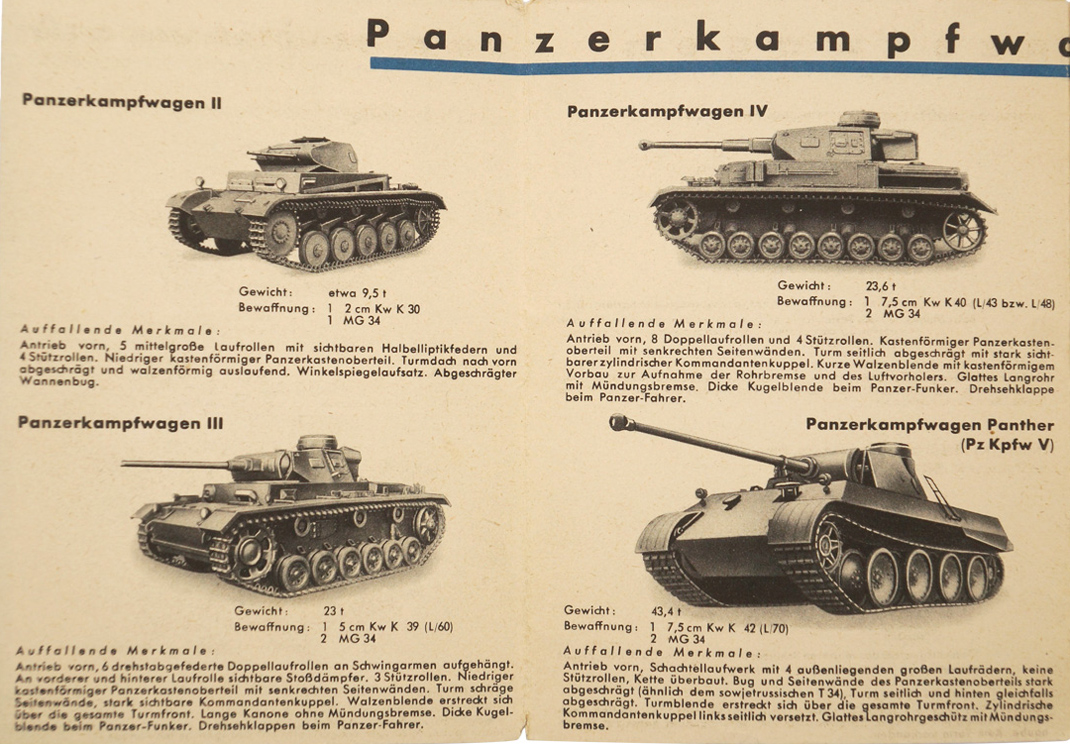
Panzerkampfwagen II, III, IV, and V, their weight, armament, and key recognition features such as barrel length, gun muzzle brake, large or small road wheels, position of the commander's cupola, etc.
Tanks and Half-Tracks
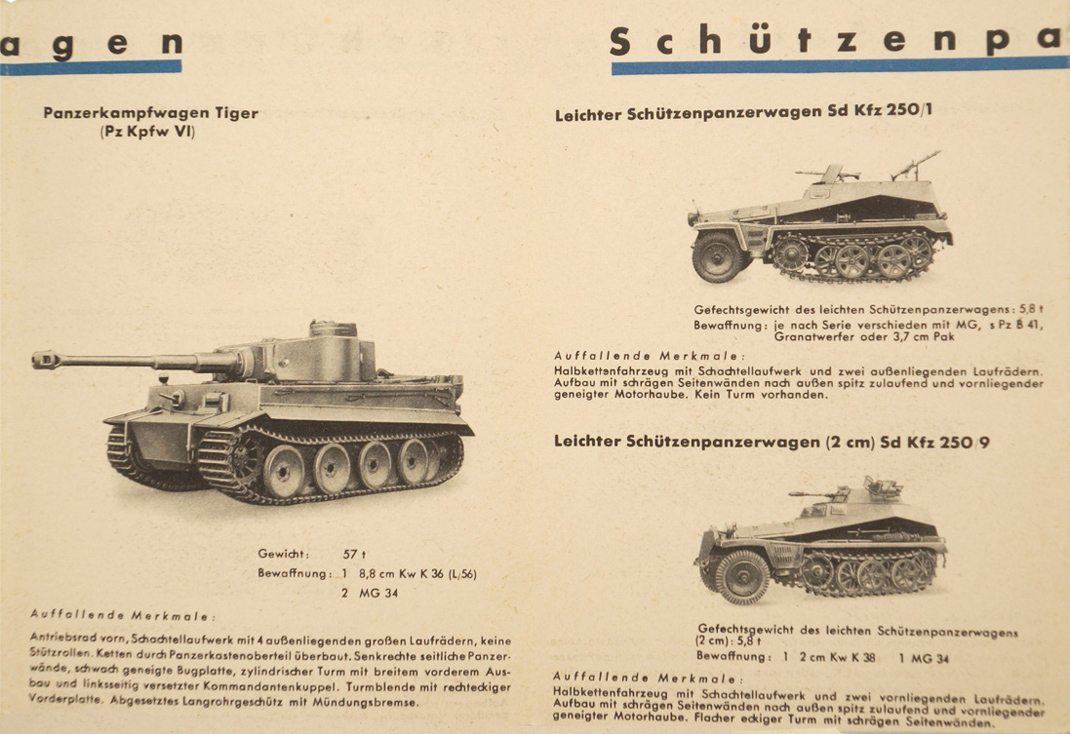
The last tank covered is the heavy Tiger, after which the half-track armoured personnel carriers begin — specifically the light Sd.Kfz. 250. In addition to the basic Sd.Kfz. 250/1 variant, the Sd.Kfz. 250/9 with its fighting turret and 20 mm gun also earned a place in the booklet.
Half-Tracks and Reconnaissance Vehicles
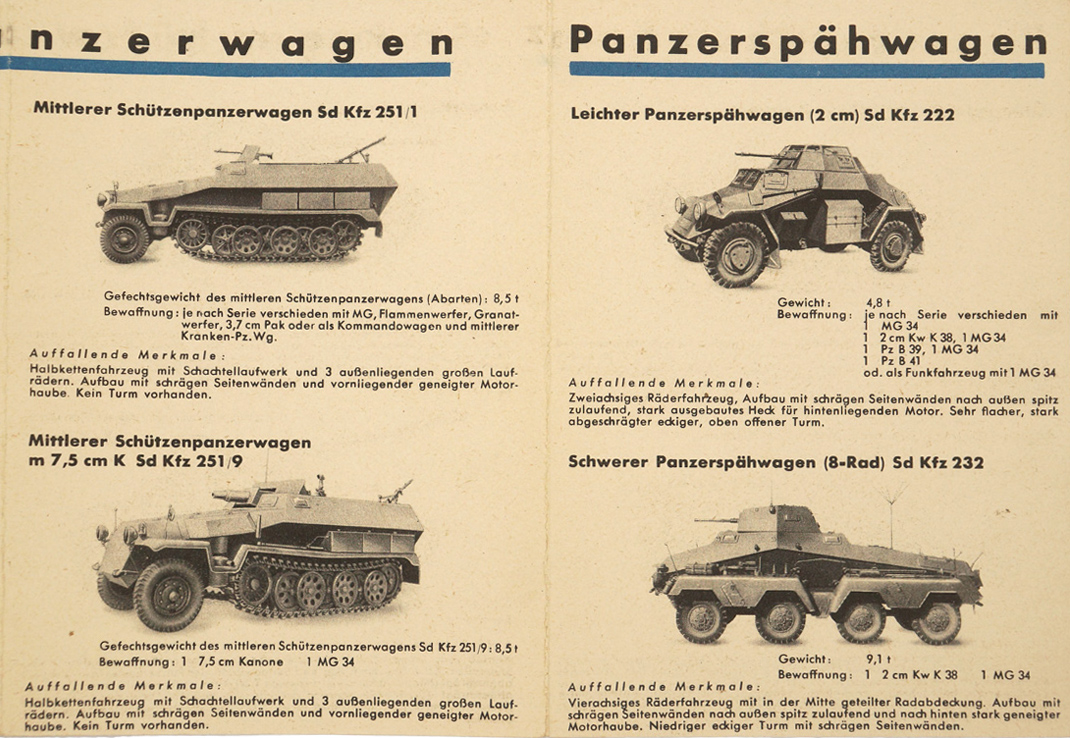
The half-track section continues with the armoured personnel carrier Sd.Kfz. 251 and its artillery support variant the Sd.Kfz. 251/9. This is followed by the light armoured reconnaissance car Sd.Kfz. 222 and the heavy eight-wheeled Sd.Kfz. 232.
Reconnaissance and Assault Guns
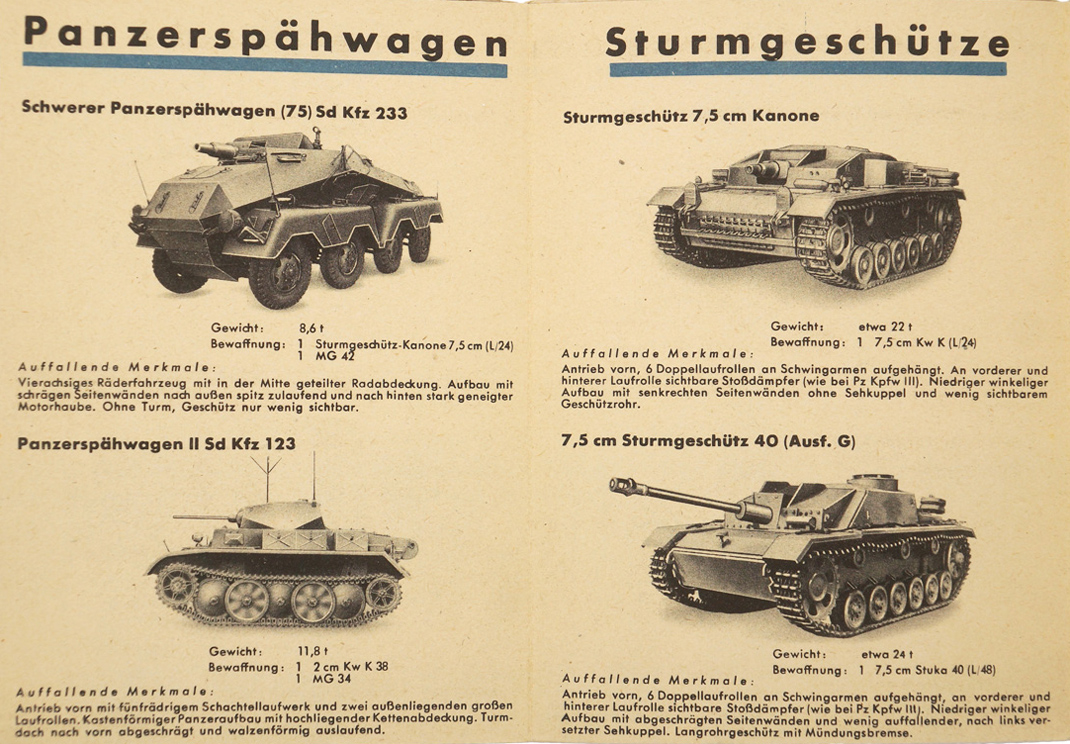
The reconnaissance vehicle family closes with the Sd.Kfz. 233 armed with a 75 mm gun and the reconnaissance tank Luchs. These are followed by the assault guns StuG III, in both the older short-barrelled L/24 version (24 calibres) and the newer L/48 version (48 calibres).
Tank Destroyers
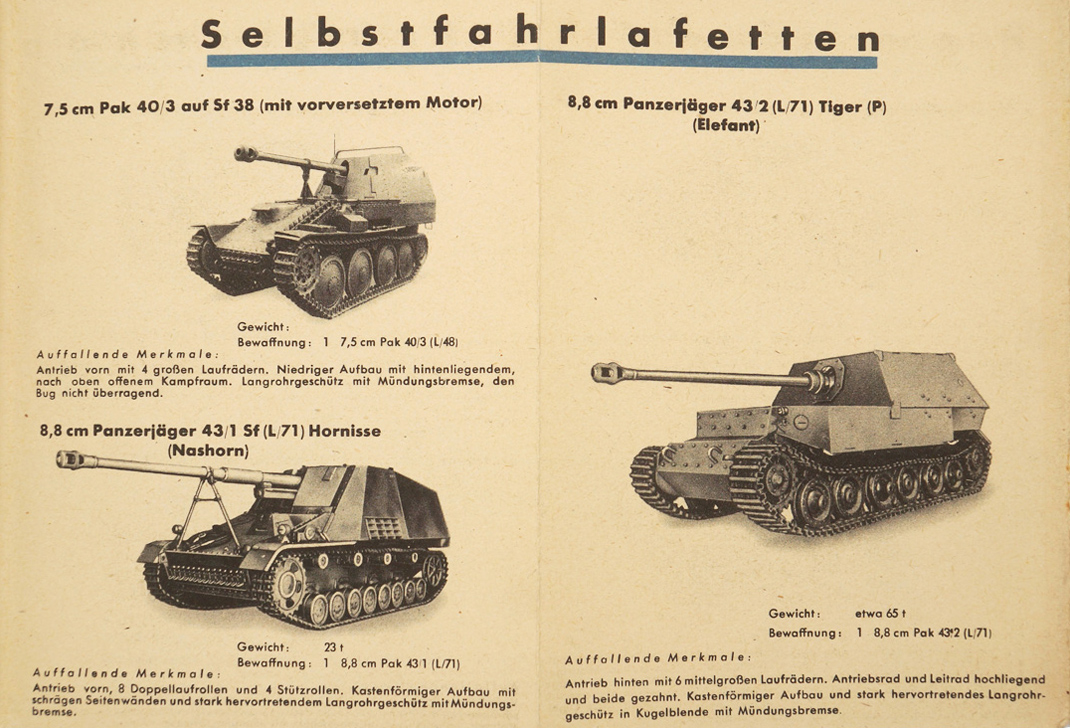
Although this page bears the somewhat misleading heading Selbstfahrlafetten (a term also used for self-propelled guns), it shows exclusively tank destroyers — specifically the Marder III, Nashorn, and Elefant (though the illustration shows the original Ferdinand without the hull machine gun).

Reproducing text from the Panzernet website without the written consent of the operator is prohibited.