Sd.Kfz. 233
fire support for armoured cars
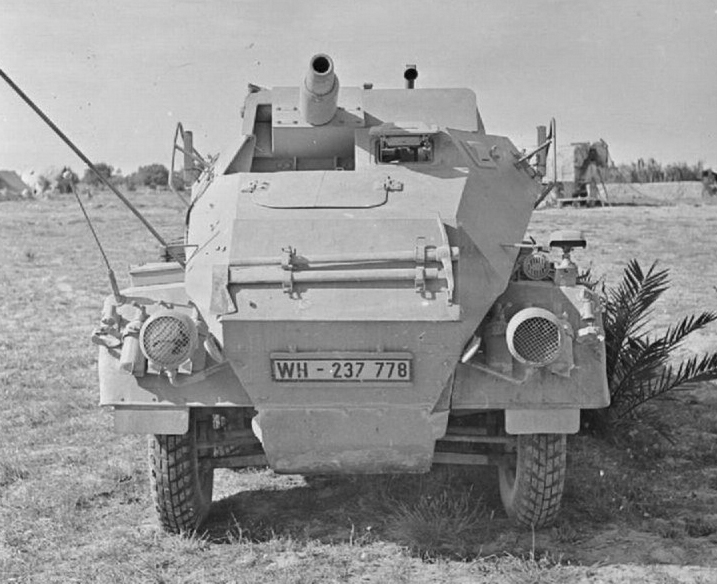
heavy armoured car Sd.Kfz. 233 captured by the Allies in Africa, source: Flickr.com, Public domain, edited
Origins of the Vehicle
Combat deployment of armoured cars brought with it one specific problem: how to provide this type of vehicle with effective artillery support. The armoured cars Germany used in the early years of the Second World War were armed at most with light 20 mm cannon. While these offered some effect against lightly armoured enemy vehicles, they were powerless against fortified strongpoints or hardened artillery positions. A supporting weapon of larger calibre was needed — one capable of dealing with such obstacles to an advance.
Conventional artillery firing from fixed positions behind the front line was not really a practical option. Armoured cars were very fast, capable of covering dozens of kilometres in a single hour and engaging the enemy at any moment along the way. Nor were conventional tracked self-propelled guns the right answer. The main asset of tracked SPGs was not so much their speed as their ability to tackle difficult terrain. Wheeled armoured cars, by contrast, were more or less tied to roads, tracks, or at least reasonably level ground. It was therefore far more efficient to deploy expensive tracked self-propelled artillery in support of tanks in broken country than to have it winding along roads trying to keep pace with much faster wheeled armoured cars.
The logical solution was therefore to mount an artillery weapon directly on one of the wheeled armoured vehicles themselves. And where better to install a heavy weapon than on the heaviest available platform — the eight-wheeled Sd.Kfz. 231. Thus was born the gun-armed car that received the official name schwerer Panzerspähwagen (7,5 cm) and the code designation Sd.Kfz. 233.
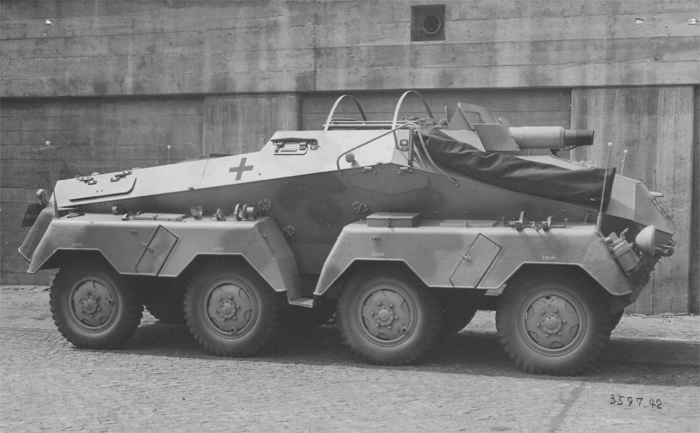
heavy armoured car Sd.Kfz. 233, source: Flickr.com with the permission of the publishing user, edited
Design Description
As already noted, the new vehicle was derived from the armoured car Sd.Kfz. 231 and shared most of its characteristics. It was built on the Büssing-NAG GS chassis with eight individually suspended wheels, all of which were both driven and steerable. The gearbox offered six forward and six reverse ratios. The fuel capacity was 150 litres. Power was provided by the Büssing-NAG L8V eight-cylinder engine. Some vehicles were fitted with the older version of this engine, displacing 7.913 litres and producing 150 horsepower, while others had the newer version with 8.363 litres and 180 horsepower. The reasons why both engine variants were used must be understood in the context of the Sd.Kfz. 233's production history — but more on that later.
The armoured hull was identical to that of the Sd.Kfz. 231 except for the fighting compartment. It consisted of upper and lower halves with walls angled in opposite directions, so the vehicle widened from the chassis upwards and then narrowed again towards the roof. This angling of the walls increased their resistance to enemy fire. The steel plate from which the hull was welded was 30 mm thick at the front, 10 mm on the sides, 8 mm at the rear, and 5.5 mm on the floor and roof. The armour could therefore offer meaningful protection only against small arms fire and shell fragments.
The front of the hull was formed by upper and lower plates. The upper plate carried brackets for mounting an axe and a pickaxe, while the towing rope was attached to the lower plate. The upper front plate transitioned into a steeply raked forward glacis, beneath which was the front driver's station. A crew entry hatch was cut into the right-hand side of this glacis, closed by a two-piece lid, and served primarily as the driver's access point.
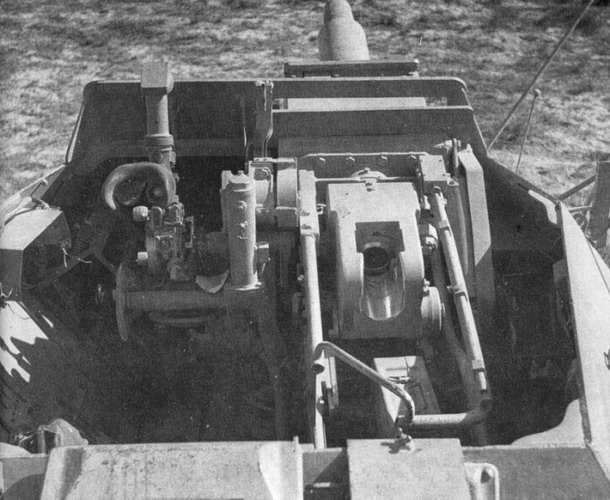
view into the fighting compartment of the Sd.Kfz. 233, source: Flickr.com, Public domain, edited
Moving rearward, the glacis stepped up into the front wall of the crew compartment — and here the differences from the Sd.Kfz. 231 began. Compared to the parent vehicle, the Sd.Kfz. 233 had neither a fighting turret nor a cabin roof. The crew space was therefore completely open at the top. The men on board were protected from the rear and sides only by the relatively low walls that remained after the removal of the cabin roof and turret. An additional section of armour plate was fitted above the front wall to raise it, providing at least some improved protection for the fighting compartment from the front.
In the left portion of the front wall was a vision port with a cover that hinged upwards, the cover incorporating an observation slit for use when closed. A further vision port of the same design was located in the left side wall of the compartment. Both ports served the front driver, whose station was in this part of the cabin. In the right-hand portion of the front wall was the short-barrelled 75 mm cannon; to accommodate this fairly large weapon, more than half of the front wall had to be cut away.
As for the exact version of cannon fitted, two conflicting accounts can be found. Some authors state that the tank gun KwK 37 L/24 — normally mounted in early versions of the Panzer IV — was used. Others give the variant of this weapon designated StuK 37 L/24, which was otherwise fitted to the StuG III assault gun. Since the two were variants of the same weapon, this dispute is probably not of great significance. A third designation also appears in the literature — simply Kanone 37 — which was reportedly assigned to the weapon after modification for installation in an armoured car. This was therefore just a different name, not a different type of gun.
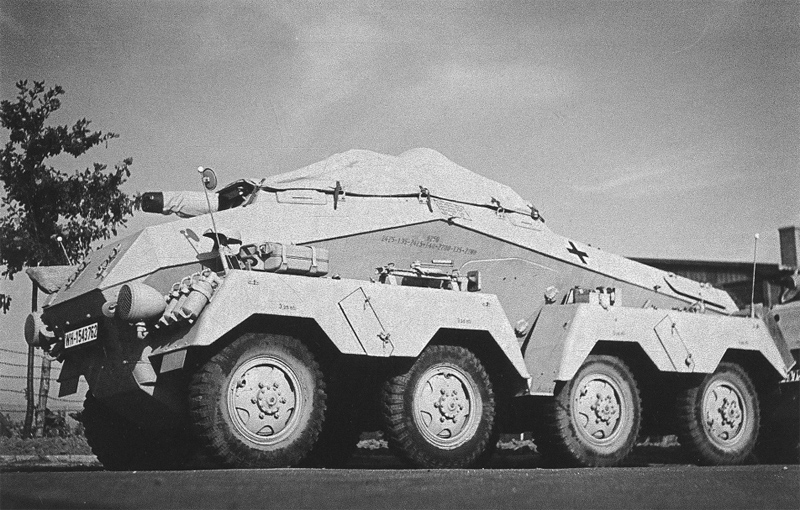
Sd.Kfz. 233, note the canvas cover protecting the interior of the fighting compartment, source: Flickr.com with the permission of the publishing user, edited
The gun mounting allowed vertical elevation to be adjusted over a range of −4° to +20°. Maximum lateral traverse was 12° to the right and 9° to the left; beyond that, the entire vehicle had to be turned. The on-board ammunition supply comprised 32 rounds. The cannon was served by a monocular periscopic sight, the SflZF1, with five-times magnification. This sight protruded quite noticeably above the open top of the fighting compartment and is often clearly visible in photographs. The secondary weapon was the MG 42 machine gun in 7.92 mm. This was not permanently installed in the hull; instead, the crew carried it in the fighting compartment and mounted it on a bracket on the right side of the cabin only when needed, firing it over the cabin walls. 1,500 rounds of machine-gun ammunition were carried.
The rear wall of the cabin stepped down to the roof of the engine compartment. This wall also had vision ports cut into it — two facing directly rearward and one on each side — belonging to the rear driver's station, which was located in this part of the cabin, slightly to the left of the vehicle's longitudinal axis (though from the rear driver's own perspective, facing backwards, this was effectively to the right of the axis).
At the very rear of the hull was the engine compartment housing the already-mentioned Büssing-NAG L8V unit. In the front portion of the engine compartment roof was a grilled air intake opening for the powerplant. Further back, a large service access hatch in the bonnet roof allowed access to the engine; it was closed by a two-piece lid whose halves opened outwards to the sides. Additional smaller service hatches were located in the side walls of the bonnet. A final service opening occupied virtually the entire rear hull wall — or rather its upper portion — protected by a single louvred cover that opened downward. Over this louvred cover a solid armour plate was fitted, with a spare wheel mounted on it.
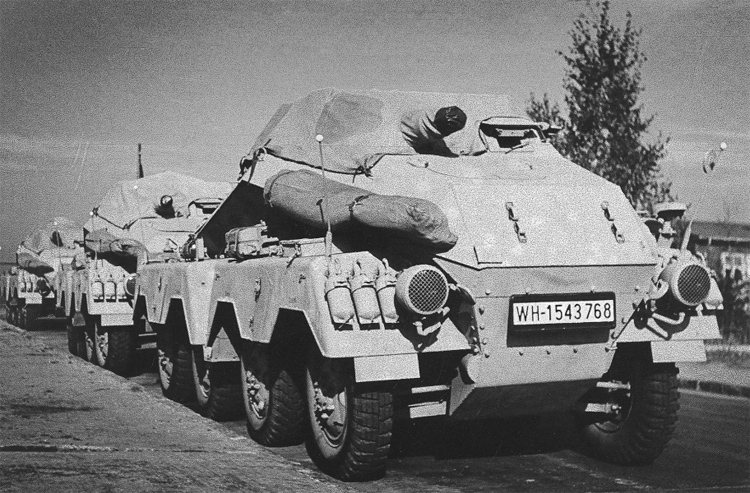
Sd.Kfz. 233, note the canvas cover protecting the interior of the fighting compartment, source: Flickr.com with the permission of the publishing user, edited
Running along almost the entire length of the vehicle on each side were two large double mudguards, each covering two adjacent wheels. The space between the two double mudguards was used for a crew escape hatch cut into the lower portion of the hull side wall. The mudguard surfaces provided storage space for various equipment, and also carried the front driver's rear-view mirrors, the horn, and at the very rear, the two exhaust pipes.
The Sd.Kfz. 233's weight is usually given as between 8.58 and 8.7 tonnes. Its top road speed was a very impressive 85 km/h in both directions of travel. The vehicle measured 5.85 metres in length, 2.2 metres in width and 2.25 metres in height. It was equipped with the Fu Spr.Ger. "a" radio set. The crew comprised three men: the gunner and commander — who also served as the cannon loader — had their stations in the open fighting compartment, while a single driver sat in the hull and had to move between the front and rear driving positions as required.
Modified Version
Towards the end of the production run, a slightly modified variant appeared. To improve protection for the crew in the open fighting compartment, this late-production version had armoured side panels welded onto the sides of the fighting space. Given the scarcity of photographs showing this feature, it can be assumed that only a limited number of vehicles were built with this additional armour.
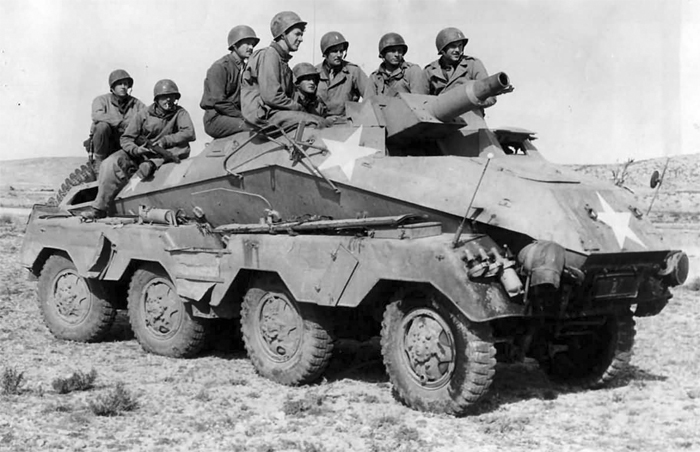
Sd.Kfz. 233 captured by the Americans, source: Flickr.com, Public domain, edited
Series Production
The start and end of the production period is a highly contentious question. According to most sources, production of the Sd.Kfz. 233 began in 1942 and ended the following year. Other credible sources — Pejčoch, for example — date the start of production as early as 1940 and its conclusion to 1942. When the broader context is considered, however, more arguments support the validity of the first theory.
Essentially the only argument in favour of production beginning as early as 1940 is that the need for artillery support for armoured cars must surely have become apparent in the very first campaigns of the war, rather than only in its third year. Proponents of a 1940 start also argue that production must have ended in 1942 because that is when production of the Sd.Kfz. 231 itself ceased. This date is, however, itself disputed — the end of production of the "parent" type is often given as late as 1943 (see the article on the Sd.Kfz. 231) — so this particular argument does not hold up.
Far more of the available evidence points to production beginning only in 1942. Among the most significant indicators is the choice of armament itself. It was precisely at the beginning of 1942 that production of the Panzer IV tank and the StuG III assault gun switched to variants fitted with the more powerful long-barrelled KwK 40 L/43 and StuK 40 L/43 cannon respectively. As a result, the ordnance office suddenly had a considerable stock of surplus older KwK 37 L/24 and StuK 37 L/24 guns on its hands, making their use in other vehicles a natural proposition.
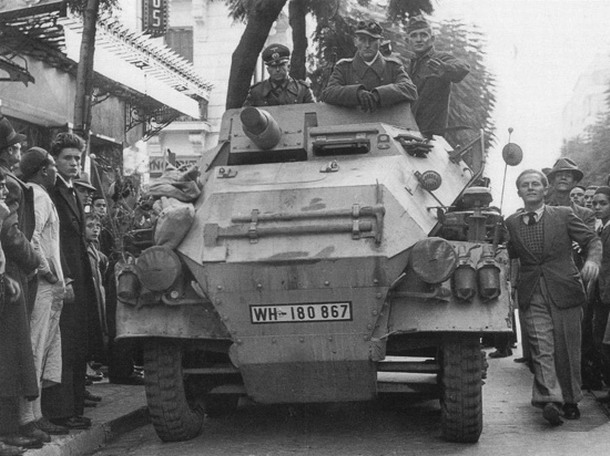
Sd.Kfz. 233 with old-pattern vision ports — apparently one of the vehicles produced by retrospective conversion, source: Flickr.com with the permission of the publishing user, edited
A further significant piece of evidence is the absence of additional frontal armour on the Sd.Kfz. 233. On the standard Sd.Kfz. 231, this appliqué armour (known as Zusatzpanzer or Zusatzfrontplatte) was fitted until 1942, when it was discontinued in connection with the strengthening of the main hull frontal armour itself from 14.5 mm to 30 mm. The Sd.Kfz. 233, with rare exceptions, did not have this additional armour (more on those exceptions shortly), which suggests that these vehicles were built from 1942 onwards. The relatively small number of Sd.Kfz. 233s produced also supports the shorter production period of 1942–1943. The total number of vehicles built is most commonly given as 129, including retrospective conversions, which are discussed below.
An attentive reader might at this point raise a hand and ask: "if the Sd.Kfz. 233 was only produced from 1942 onwards, how can it be that some of these vehicles were powered by the older Büssing-NAG L8V engine variant displacing 7.913 litres and producing 150 horsepower?" This is an entirely valid question, since this weaker engine version had ceased to be fitted to the parent type Sd.Kfz. 231 as early as 1941. And further questions follow. Photographs demonstrate that some Sd.Kfz. 233s had the older-pattern vision ports in the cabin walls — ports that had been replaced on the parent Sd.Kfz. 231 even before 1940. And then there are the already-mentioned exceptions regarding the additional frontal armour: photographs confirm that vehicles with the Zusatzpanzer did exist.
The answer to all three questions is straightforward. Although the majority of Sd.Kfz. 233s were built as new vehicles, during 1943 ten older, previously used Sd.Kfz. 231 or Sd.Kfz. 232 vehicles were converted to the Sd.Kfz. 233 standard. It was presumably through these conversions that the hybrids described above came about — inheriting various older components such as the engines, vision ports and Zusatzpanzer from their donor vehicles.
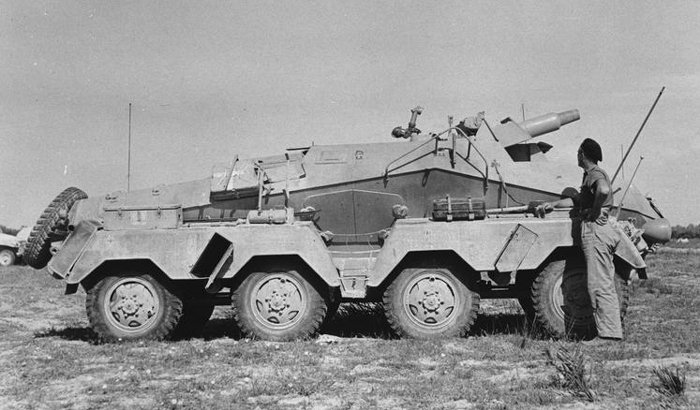
Sd.Kfz. 233 captured by the Allies in Africa, source: Flickr.com, Public domain, edited
Combat Deployment
The Sd.Kfz. 233 saw its first combat deployment in North Africa. The majority of vehicles, however, were deployed on the Eastern Front. In 1943 the heavy armoured car Sd.Kfz. 234 was introduced to replace its predecessor, yet the Sd.Kfz. 233 continued to serve until the very end of the Second World War.
In closing, it is worth mentioning the rather unflattering nickname the vehicle earned among the troops: "Stummel" — a German word meaning cigarette stub or stump. The name was directed less at the vehicle as a whole than at its armament specifically. Given its calibre, the KwK 37 cannon (and its variants) had a genuinely very short barrel — 24 calibres, equating to just 180 cm. The same nickname was applied to other vehicles armed with this weapon or its derivatives.
Technical Specifications
|
weight: |
8.58 t |
|
length: |
5.85 m |
|
width: |
2.20 m |
|
height: |
2.25 m |
|
engine: |
Büssing-NAG L8V |
|
engine output: |
150 hp (later 180 hp) |
|
max. speed: |
85 km/h |
|
range - road: |
300 km |
|
range - off-road: |
150 km |
|
armour - front: |
30 mm |
|
armour - sides: |
10 mm |
|
armour - rear: |
8 mm |
|
crew: |
3 men |
|
armament: |
StuK 37 L/24 cannon, 75 mm MG 42 machine gun, 7.92 mm |

ARTICLE
CONTENTS:
Reproducing text from the Panzernet website without the written consent of the operator is prohibited.