WERBEPANZER
Goebbels' marketing war
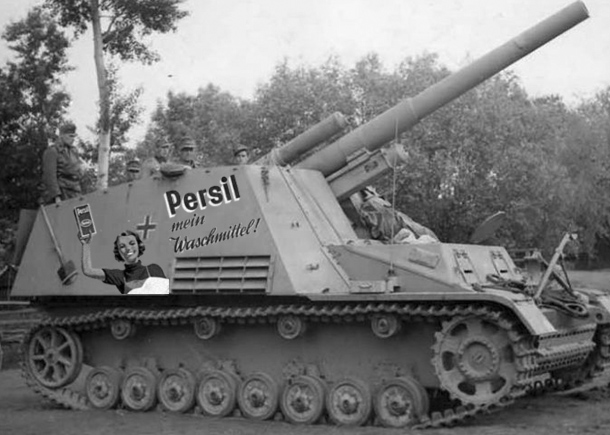
war attracts media attention, and Hitler and Goebbels decided to monetise that fact — the Werbehummel, i.e. the self-propelled gun Hummel serving as an advertising platform, source: Flickr.com with permission of the publishing user, edited
Perhaps you've noticed this yourself — you want to watch a video clip of fighting in Ukraine (or anywhere else in the world) on a news website, but before the operator lets you anywhere near that horror, they force you to sit through one or two adverts. And perhaps it crossed your mind that it is a rather vulture-like thing to try to profit from such misery, and to place an advert for a new kitchen or a beach holiday in front of footage of a shelled village. Know, however, that there is nothing new under the sun.
Much can be said about war and warfare, and among its undeniable truths is the fact that war is an enormously expensive enterprise that simultaneously attracts enormous public attention. The First World War demonstrated what industrialised warfare actually means. Its conduct cost far more money than any previous conflict. Precisely costing a conflict of such scale is virtually impossible, but it is estimated that the war cost around 200 billion dollars of the day — equivalent to approximately 3.8 trillion ($3,800,000,000,000) in today's money. The Second World War pushed that scale considerably further still. The United States alone spent the equivalent of an estimated 4.1 trillion dollars in today's money on the Second World War — and the Americans participated for a shorter time and less intensively than, say, Germany or the USSR.
The cost of wars grows hand in hand with technological progress, which brings ever more sophisticated and expensive weapons and military equipment. Similarly growing is the public attention that wars attract — also driven by technological progress, specifically in the field of communications. Whereas people learned about events on the fronts of the First World War primarily from printed newspapers, by the Second World War Germans could in effect listen to live radio broadcasts from the front, and in cinemas watch sound — and often colour — footage of the fighting. Almost every German family had a relative at the front, which only further heightened the universal interest in events on the battlefields.
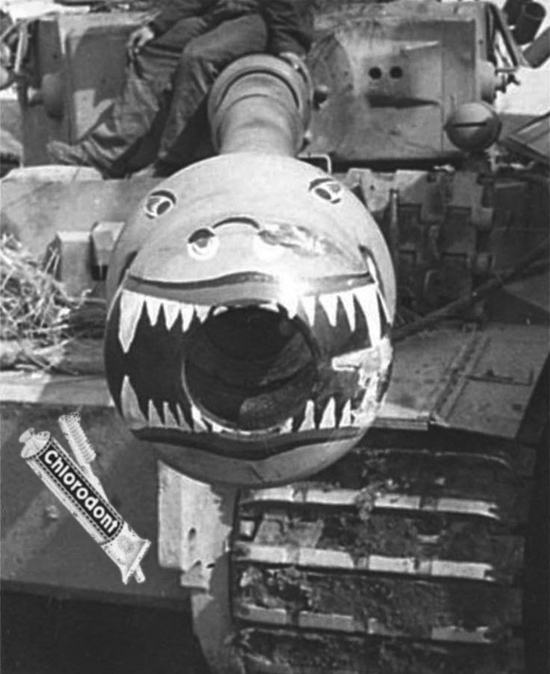
this is what a toothpaste advertisement could look like, here placed on a Werbepanzer of the Tiger type, source: Flickr.com with permission of the publishing user, edited
As far as Germany was concerned, these two "new" dimensions of modern warfare collided during a meeting between Hitler and Joseph Goebbels in November 1939. When Hitler complained to his faithful Minister of Propaganda that the recently started war was proving an unexpectedly large money pit, Goebbels came up with an interesting idea. His ministry was, in effect, the Nazi marketing department — tasked not only with spreading the correct ideology among the German people but also with stoking their interest in and enthusiasm for the war. In today's media terminology one might say that the ministry was, among other things, trying to boost the war's "ratings." And when something has high ratings, it can be very effectively used to reach potential customers. And companies are very happy to pay for the privilege of reaching potential customers. Goebbels was essentially proposing to Hitler that they turn the entire war into one giant advertising space.
Hitler was sceptical at first. He reportedly even said that marketing was a Jewish invention designed to foist things on people they don't need — but when Goebbels presented him a few days later with a quick financial study showing the potential revenues, he changed his mind. The study from the Propaganda Ministry was admittedly still a simplified overview of the whole question, but it was nevertheless very impressive. It focused on three basic types of media — radio, film, and print — and analysed them from several angles, assessing their audience reach, the possibilities for advertising messages, and the potential revenues.
Based on the penetration of radio receivers in German households, it was estimated that the audience for war broadcasts could easily reach five million adult listeners every day. The content of broadcasts was moreover entirely under the Propaganda Ministry's control, so inserting virtually any advertising spot presented no difficulty whatsoever. Calculating the potential revenues from radio advertising was not so straightforward, however. Being a born marketer, Goebbels was clear that advertising airtime could not be sold like bread rolls, because not every second was equal. During the launch of a major offensive, the audience for news from the front would likely be many times higher than in periods of general quiet. Even so, the estimated monthly revenue was climbing towards one million Reichsmarks.
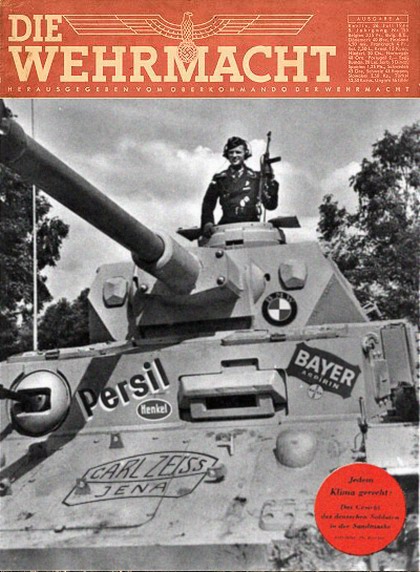
and this is how advertising reached readers — front-line photographs were simply full of it; here the cover of the magazine Die Wehrmacht, featuring a Werbepanzer IV, source: Flickr.com with permission of the publishing user, edited
With film as the next medium, the whole matter was actually very straightforward. The main programme carrying front-line footage was the official newsreel, shown in every cinema before every film. Its audience was estimated at only around one million viewings per month, but thanks to the combination of audio and visual content it had a very powerful impact on viewers. The content of the newsreels was also completely under the Propaganda Ministry's control, which meant advertising footage could be inserted at will. Goebbels was worried, however, that if he simply inserted an advertising break that momentarily interrupted the main content, audiences would stop watching the screen — they'd light a cigarette, nip to the toilet, start chatting, and in short would not pay attention to the adverts, reducing their effectiveness. Goebbels wanted to serve the advertising in a way that not only did not irritate cinema audiences but that they would actually enjoy watching. A quick survey among cinema-goers showed that what audiences liked most in the newsreels was footage of modern combat vehicles in action. The challenge, then, was how to place advertising within such footage in a natural, unobtrusive way.
And then of course there were the traditional print media — newspapers and magazines. Here too, the Propaganda Ministry had at its disposal a whole range of official military publications whose content it could fully control. To pick just a few at random: magazines such as Die Wehrmacht, Der Adler, Die Kriegsmarine, Illustrierter Beobachter, Berliner Illustrierte Zeitung, or Signal — all full of attractive, often colourful photographs of soldiers and military equipment. With an estimated readership of less than a million per month, however, the potential of these magazines was relatively modest. Germany also had hundreds and hundreds of other magazines and local and national newspapers, all of which carried front-line news and photographs at least occasionally. Getting advertising into every article about events at the front in every newspaper — now that would be a real jackpot. These commercial periodicals naturally already ran paid advertising in the normal way, but advertisers paid the newspaper publisher for it. What Goebbels was after was a way to get advertising into private newspapers for which the money would go to the German army!
Another quick survey showed that newspaper and magazine editors most frequently illustrated their articles with photographs featuring some kind of military vehicle. Just as with the newsreels, this was simply the type of image that drew readers in. It was precisely into these images that advertising needed to be placed — advertising that the client would commission not from the newspaper publisher but directly from the army! The advert would then become a direct part of the front-line photograph, and any newspaper publisher wishing to use the photograph would simply have to live with it. But how to get an advertising message directly onto a photograph of a tank? You could hardly have an advertising hoarding on a stand standing next to the vehicle in the photograph — that would be absurd. Goebbels quickly arrived at the obvious answer: the best solution was simply to paint the advertising slogans and logos directly onto the armour of the fighting vehicles! Then they would automatically appear in every photograph!
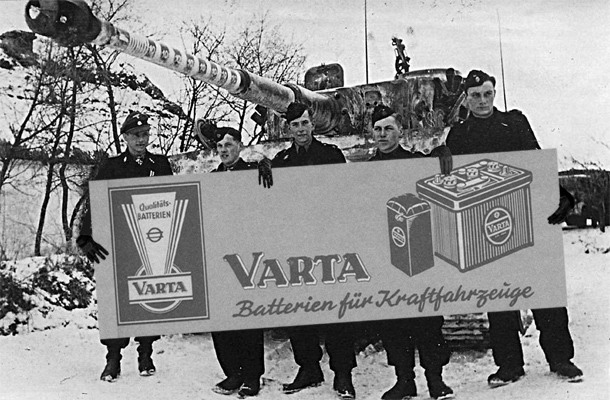
if a client had sufficient funds, they could also become the sponsor of a specific tank crew; the better that crew performed on the battlefield, the more media coverage they received, and the more often the sponsor appeared in newspapers and cinemas — here Michael Wittmann's crew poses with their sponsor's logo, source: Flickr.com with permission of the publishing user, edited
Hitler, dazzled by the prospect of millions of marks for the war effort, gave Goebbels permission to proceed with his proposal — and Goebbels threw himself into it with gusto. An entirely new section was created within the Propaganda Ministry to handle everything needed. Catalogues of available advertising space had to be produced, along with a rate card. The price for placing a logo on the front armour of a tank was naturally different from placing one on the side of its turret. Potential advertising clients had to be approached, the advantages of this type of advertising explained to them, the best placement for their adverts agreed upon, and orders secured. Artists and sign-painters then had to travel directly to the combat units to physically paint the selected logos and slogans onto the fighting vehicles.
In aircraft hangars, advertisements were painted onto the wings and tail fins of fighters and bombers; in dry docks, enormous advertising hoardings were painted onto the sides of warships of every type; and in infantry barracks, adverts were stitched onto the tarpaulins of lorries. We shall, however — in keeping with the focus of the Panzernet website — concentrate on ground-based armoured fighting vehicles. The truth is that a tank does not offer an abundance of large, unbroken surfaces for advertising. On the other hand, unlike a ship in the middle of the ocean or an aircraft in the air, a tank presents no difficulty when it comes to photographing it from very close range, meaning the advertisement would be perfectly legible.
Goebbels' people worked with a will, so that by May 1940 a substantial proportion of German tanks were already rolling into the attack on France with advertising painted on their armour. Tank crews whose vehicles carried advertising — for whom the designation Werbepanzer was introduced — received special instructions that among other things required them to clean their vehicles regularly to remove dust and mud, so that the logos and slogans on the armour remained clearly visible at all times. The commercial success of Goebbels' idea was not long in coming. For the following six weeks, German newspapers and newsreels covered nothing but the fighting in France. The Propaganda Ministry expertly supplied all publishers with quality photographs of the right vehicles, from the right angle, advertisers were pleased with the growing interest in their products, and the Führer watched with satisfaction as the money rolled in — which he immediately reinvested in his beloved army.
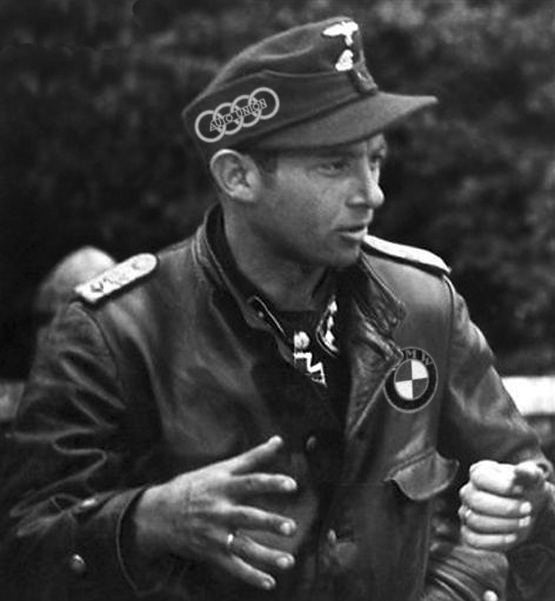
Michael Wittmann again — Goebbels' propaganda had turned him into a hero and a celebrity, and immediately began monetising that through advertising placed directly on his uniform, source: Flickr.com with permission of the publishing user, edited
Once the Western campaign ended, however, advertiser interest in placing ads dropped sharply. The period of occupation without active fighting was far less interesting to the public, and the number of war articles and reports in the newspapers fell dramatically. It was clear to Hitler and Goebbels that if they were to revive advertiser demand, the Wehrmacht would have to go and attack someone again before long. An attack on England would certainly have been very attractive from a media perspective, but there was that blasted English Channel to contend with, and Hitler's indecision about whether he actually wanted to attack the British at all. The Führer had, however, another ace up his sleeve — a true advertising killer blow: an attack on the very heartland of Bolshevism, on the USSR itself!
Such a campaign promised truly gigantic audience figures. Its preparation, however, required a great deal of time, so Hitler and Goebbels agreed to try to earn a little money in the meantime on a couple of smaller, faster offensives. In February 1941 the Wehrmacht therefore launched its campaign in North Africa, and in April of the same year conquered Yugoslavia and Greece. By that point, Goebbels' people were feverishly negotiating with the biggest German companies, offering them — under pledges of secrecy — advertising space in a forthcoming offensive "the like of which the world had never seen." An absolutely unprecedented level of media coverage was anticipated, and the advertising rates set were commensurate. Orders flooded in, and artists painted one famous logo after another on German tanks and self-propelled guns.
Operation Barbarossa was launched on 22 June 1941. The marketing experts from the Propaganda Ministry had not been exaggerating. Media coverage of the attack on the USSR was enormous; footage of German tanks with their advertising slogans found its way not only into German newspapers and newsreels but into news reports literally all around the world. Everything was going to plan and advertising revenues were climbing to dizzying heights.
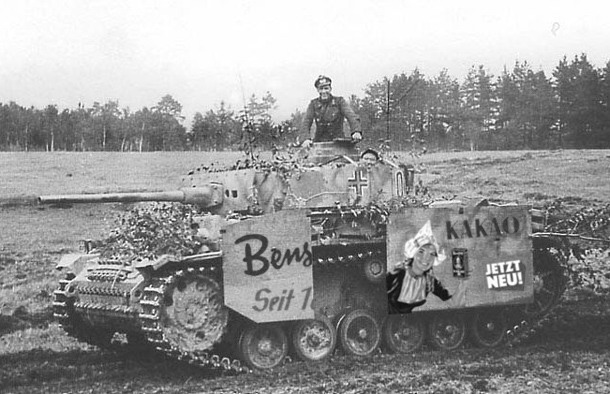
the true purpose of introducing side skirt armour (Schürzen) was not so much crew protection as the creation of additional advertising space; occasionally in combat some of the plates were lost, leaving the advertisement incomplete, and advertisers quite rightly complained — source: Flickr.com with permission of the publishing user, edited
On 17 July 1941, Goebbels requested a confidential meeting with Hitler at which he raised a rather heretical but all the more intriguing idea. German forces in the East were advancing at an almost unbelievable pace, and it seemed that within two months at most Moscow would be captured and the entire Soviet Union would collapse and fall — which, from Goebbels' point of view, would be a pity. Given the enormous advertising revenues the Eastern campaign was generating, wouldn't it be wonderful if the Russians could hold out a little longer and the fighting — and the publicity — could continue? If the German offensive were to ease off "just a touch" and be deliberately prolonged, say, until the end of the year, it could earn far more money!
Hitler at first couldn't believe his ears, but after a moment began to think the idea over. What country would he actually be able to attack after conquering the USSR? He still hadn't made up his mind about England, and no other worthy adversary remained on the European continent. Conquering impoverished Africa — that was nothing prestigious. The Führer was actually rather alarmed at the thought of conquering the Soviet Union and having the war end as a result. What would he do then? He too, in the end, found himself warming to the idea of easing the German advance slightly, letting the Russians recover a little, and allowing the fighting to continue for perhaps another six to eight months — life would remain interesting and advertising revenues would be maintained. As early as 19 July 1941, the Führer issued Directive No. 33, ordering the diversion of armoured units from Army Group Centre southward toward Kiev and northward toward Leningrad — effectively halting the advance on Moscow. The German generals protested, but had no choice but to obey.
As for Germany's subsequently mounting failures on the Eastern Front, we shall probably never know with certainty how much was the result of an objective struggle against a powerful enemy and how much was Hitler's deliberate effort to hold his forces back and prolong the fighting. What is certain is that sooner or later the situation escaped German control. Throughout the war, however, Hitler remained acutely aware that it was an offensive that generated the highest audience figures and revenues — which is why he was so obsessed with attacking at all times and in all places regardless of the chances of success. Consider the famous Battle of Kursk, before which every general advised the Führer to go on the defensive — but he insisted on the attack. Or consider the utterly hopeless offensives of the war's final months, such as Operation Wacht am Rhein in December 1944 or Operation Frühlingserwachen in March 1945... do you really think they served any purpose other than a marketing one?
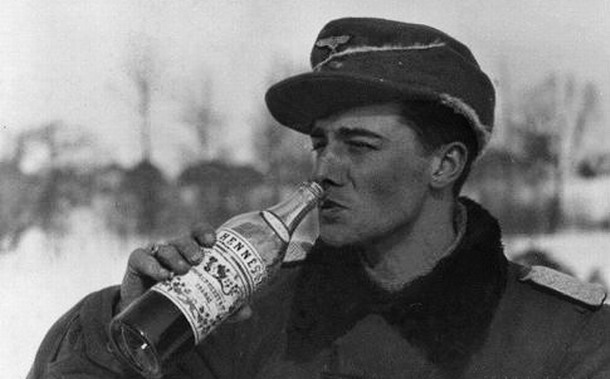
another celebrated war hero, Jochen Peiper — do you really think he's holding that bottle of Hennessy with the label facing the camera purely by chance? Not a chance; the cognac manufacturer had to pay a tidy sum for that particular product placement, source: Flickr.com with permission of the publishing user, edited
In any case, the long war in the East and the subsequent opening of the second front placed enormous financial strain on Germany, and the pressure to generate advertising revenue kept growing. Advertising was consequently exerting an ever-greater influence on the very development of new fighting vehicles. One need only consider how the area of unbroken flat surfaces on armoured vehicles kept increasing. First came vehicles such as the Hummel, Nashorn, Ferdinand, and Jagdtiger, which still represented a more or less reasonable compromise between combat effectiveness and the size of the advertising surface on their armour — but later came new and frankly absurd projects such as the Maus or the Grille 17/21, in which virtually everything else had been sacrificed to the size of the available advertising space. Yes — this was the true origin of Hitler's well-known obsession with mega-sized fighting vehicles!
The Propaganda Ministry was also looking for ways to increase the advertising potential of existing fighting vehicles. The uninformed reader may be surprised to learn this, but the true reason for the introduction of the so-called Schürzen was not the protection of vehicles against enemy projectiles — it was the creation of a large, unbroken surface for advertising! Take the assault gun StuG III, for example. Its sides offered virtually no usable advertising space to speak of. But add side skirt armour to those sides and — lo and behold — you have a literal mobile billboard! And the same applied to the Panzer III, Panzer IV, StuG IV, StuH 42, and others. This did, however, bring certain problems. The side skirt armour consisted of several separate plates, and in combat the occasional plate was lost. The ministry then had to deal with complaints from advertisers who had seen a photograph in the newspaper of their tank with their advert — but with a piece missing. The careless tank crew that had so neglected the care of the advertising on their vehicle could naturally expect a stiff punishment.
Fighting against overwhelming odds on the Eastern Front and the arrival of the heavy Tiger tank gave rise to a new type of hero: tank aces. Tanks in general were perceived by the German public as a symbol of the military successes of the Reich, and successful tank crews, aided by propaganda, easily became genuine celebrities. In this Goebbels immediately smelled an opportunity for an entirely new type of advertising. Private companies were given the chance to become something like a sponsor of a specific tank crew. The more successful that crew was, the more it was written about, and the more frequently footage featuring the sponsor's logo appeared in newspapers and cinemas. Goebbels went so far as to have sponsors' logos placed directly on the uniforms of the most famous heroes, such as Michael Wittmann. Every photograph of him in the newspapers thus automatically became an advertisement — much like today's sportsmen.
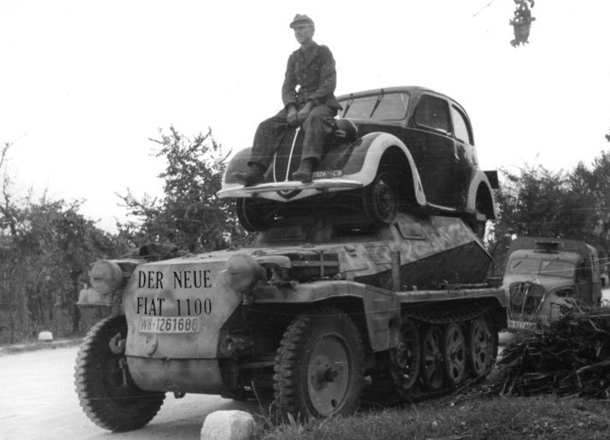
this Fiat 1100 automobile advertisement became one of the largest 3D installations ever mounted on armoured equipment; the advertising vehicle used was a half-track Sd.Kfz. 250 (in this photograph the installation is not yet quite complete — the wheels still need to be fitted), source: Flickr.com with permission of the publishing user, edited
Beyond simple advertising slogans and images painted on armour, other forms of advertising were gradually introduced — most notably the placement of the actual products being promoted, or scale models of them, directly on the fighting vehicles. By 1944 you might spot on the battlefield, for example, a tank carrying an enormous model of an Electrolux vacuum cleaner on its turret roof, a giant pack of Eckstein cigarettes, or an oversized replica of a bottle of Beck's beer. One of the largest such 3D installations was undoubtedly the advertisement for the Fiat 1100 automobile, in which the actual car being promoted was mounted on a half-track Sd.Kfz. 250! That was an advertisement you simply could not miss.
In the quest to increase revenue, the Propaganda Ministry began looking for advertisers outside Germany as well. After all, newspapers and magazines in the occupied countries also covered front-line news, and the German magazine Signal was aimed primarily at occupied territories. And indeed, advertisers were successfully recruited in countries such as France and the Netherlands, keen to promote their products through photographs and film footage from the front.
Goebbels, who regarded the whole military advertising business as his personal creation, gradually became absolutely consumed by the drive to expand advertising revenues further, to the point where he completely lost all sense of proportion. According to his colleagues, he repeatedly spoke of the delight he took in America's entry into the war, because footage of German tanks with their advertising-covered armour would now find its way far more frequently into newspapers and cinemas all across America. He considered it excellent news and immediately ordered an increase in the rates for advertising placed on tanks fighting on the Western Front. By the end of the war, however, German businesses had entirely different things on their minds than advertising.
1st April 2024, HAPPY APRIL FOOLS' DAY!
Reproducing text from the Panzernet website without the written consent of the operator is prohibited.